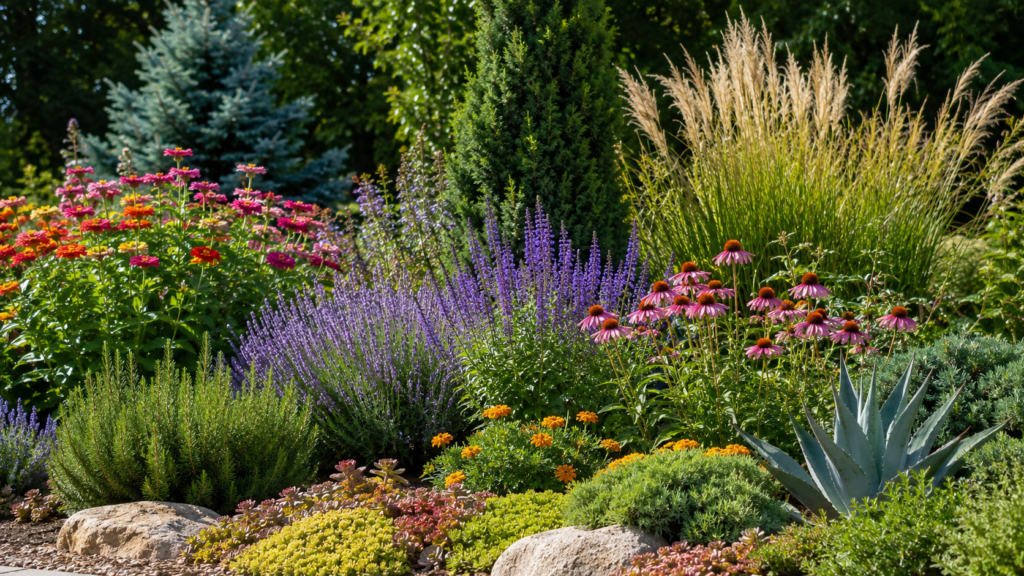
Outdoor plants for full sun usually need at least six hours of direct light, but success also depends on climate, heat, humidity, drainage, water, and mature size. Strong choices include zinnias, coneflowers, salvias, lavender, rosemary, stonecrop, grasses, and selected succulents.
Quick Picks
Start with the site’s main challenge.
| Garden need | Starting point | Main check |
|---|---|---|
| Easy seasonal color | Marigold | Avoid excess fertilizer |
| Long summer flowering | Zinnia | Provide airflow |
| Sunny container | Petunia | Water regularly |
| Hot, dry pot | Portulaca | Use sharp drainage |
| Pollinator perennial | Coneflower | Avoid saturated soil |
| Dry-ground perennial | Yarrow | Allow for spread |
| Fragrant border | Lavender | Keep the crown dry |
| Evergreen structure | Dwarf juniper | Check mature width |
| Architectural focal plant | Agave | Consider spines and frost |
| Warm-climate climber | Bougainvillea | Consider thorns and frost |
| Low ground cover | Stonecrop | Avoid rich, wet soil |
Full Sun, Heat, and Drought Are Different
| Attribute | Describes | Does not guarantee |
|---|---|---|
| Full-sun tolerance | Direct-light performance | Drought survival |
| Heat tolerance | High-temperature performance | Low water use |
| Drought tolerance | Limited-moisture survival | Wet-soil tolerance |
| Humidity tolerance | Moist-air performance | Waterlogged-root tolerance |
| Container tolerance | Restricted-root performance | Infrequent watering |
What Does Full Sun Mean?
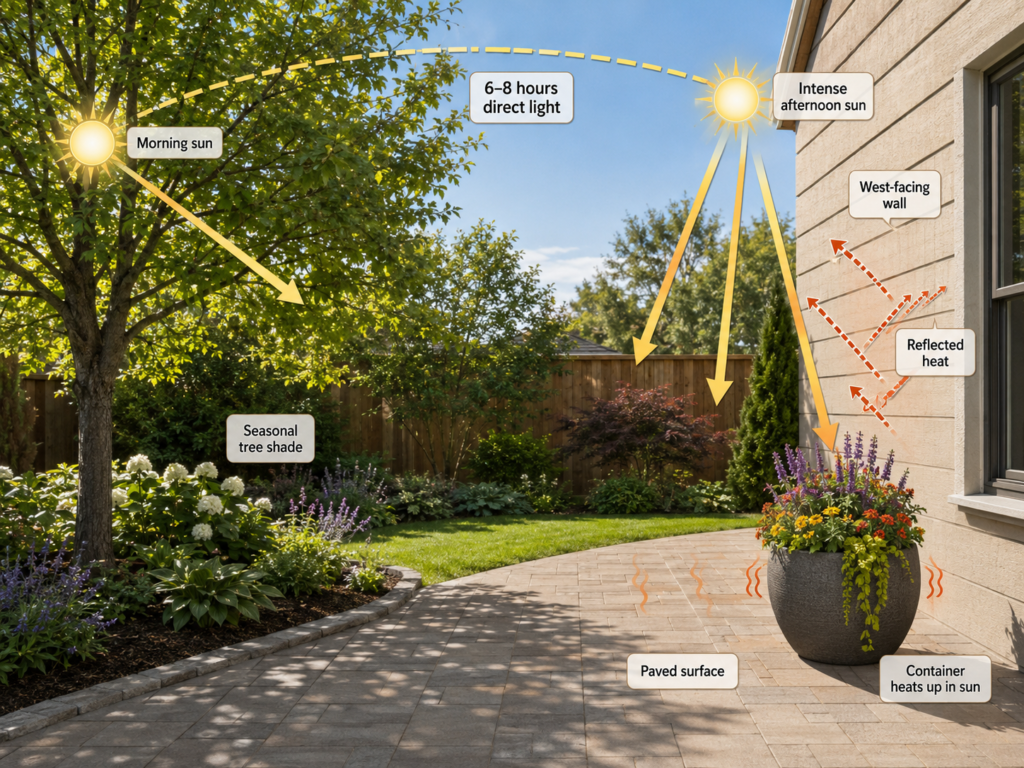
Full sun generally means at least six hours of unobstructed direct light during the growing season. Some flowering annuals perform best with eight hours or all-day sun.
Timing matters. Morning sun is cooler than late-afternoon exposure beside walls, paving, glass, or dark pots that store heat.
Check:
- Duration: Total direct-light hours
- Intensity: Morning versus afternoon sun
- Heat load: Extra heat from nearby surfaces
Observe the site morning, midday, and late afternoon because seasonal shade can change exposure.
Sun, Heat, Drought, and Humidity
Light, temperature, moisture, and humidity create separate stresses. Petunias enjoy sun but dry quickly in pots; agaves handle intense light but dislike saturated soil.
Identify the main pressure:
- West-facing paving: reflected heat
- Rooftop or balcony: wind and rapid drying
- Humid border: fungal pressure
- Wet-winter bed: seasonal waterlogging
- Cold inland garden: freezing temperatures
Choose plants for the complete conditions, not sunlight alone.
How to Choose Full-Sun Plants
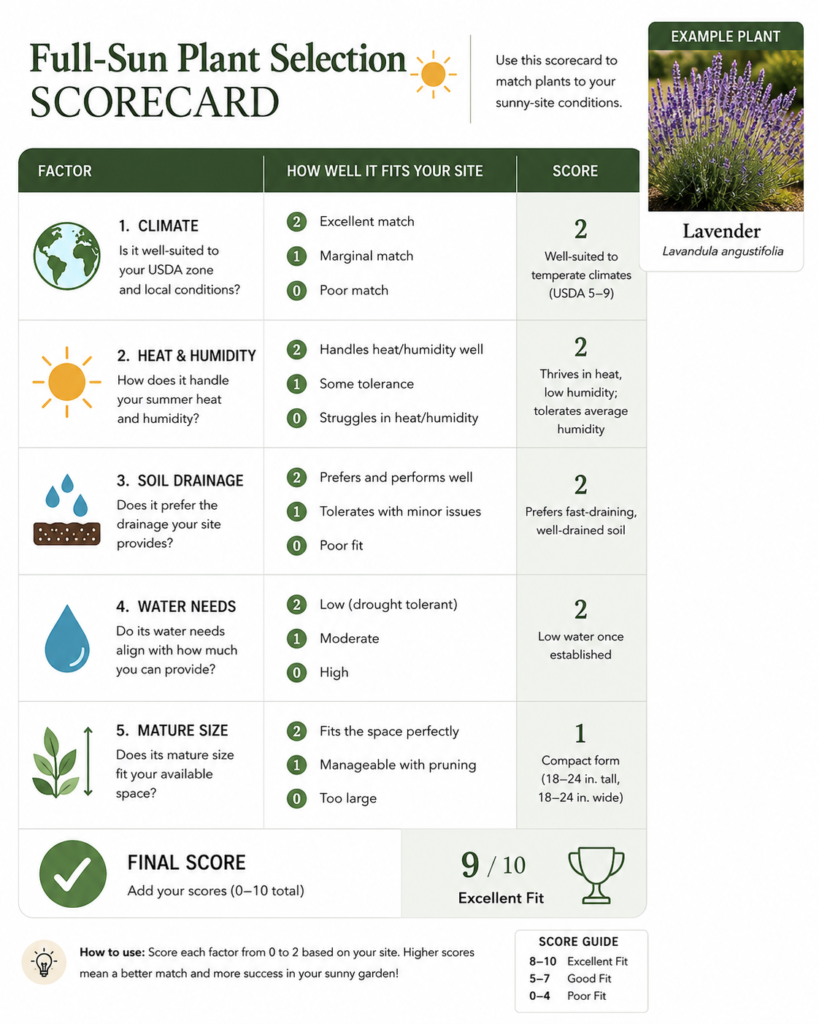
A well-matched plant needs less maintenance. Evaluate climate, drainage, water, and space before appearance.
Check Climate
Record winter lows, summer highs, rainfall, humidity, frost, and wind. Lavender, rosemary, and rock rose prefer sunny, freely drained sites. Bougainvillea and many aloes suit frost-free regions or movable containers. Coneflower, yarrow, stonecrop, and little bluestem suit many temperate gardens.
Test Drainage
Dig a hole about 30 centimetres deep, fill it with water, and watch how quickly it drains. Water remaining close to a day suggests slow drainage.
Possible solutions include:
- A raised bed
- Wider soil improvement
- Higher ground
- A container
- A plant suited to heavier soil
Assess Water and Space
Petunias, sunflowers, and flowering pots may need frequent summer watering. Yarrow, stonecrop, agave, and juniper usually need less after establishment.
Check mature height, width, airflow, access, and clearance from paths, doors, thorns, and spines.
Choose Pots or Beds
Pots offer soil and drainage control but dry faster. Beds provide more root space. Movable containers suit tender plants needing winter protection.
Use the Full-Sun Plant Fit Score
| Factor | 0 | 1 | 2 |
|---|---|---|---|
| Climate | Unsuitable | Needs protection | Naturally suitable |
| Heat and humidity | Poor match | Manageable | Strong match |
| Soil and drainage | Major conflict | Can improve | Already suitable |
| Water needs | Unrealistic | Manageable | Easy to provide |
| Mature size | Does not fit | Needs control | Fits naturally |
How the Fit Score Works
The Full-Sun Plant Fit Score is location-specific. Bougainvillea may score highly in a frost-free garden and poorly where winters freeze.
| Score | Meaning | Decision |
|---|---|---|
| 9–10 | Excellent match | Plant normally |
| 7–8 | Good match | Correct one limitation |
| 5–6 | Conditional | Expect extra care |
| 3–4 | Weak match | Choose an alternative |
| 0–2 | Unsuitable | Avoid major intervention |
For example, rosemary may receive two points each for a mild climate, dry summer heat, free-draining soil, manageable watering, and adequate space. That creates a score of 10.
The same rosemary in wet clay and a freezing winter climate may score only four or five unless it is grown in a movable container.
Use the score before buying long-lived shrubs, climbers, grasses, and succulents. Replacing an annual is easy; relocating a mature agave, juniper, or bougainvillea is not.
How We Chose These Plants
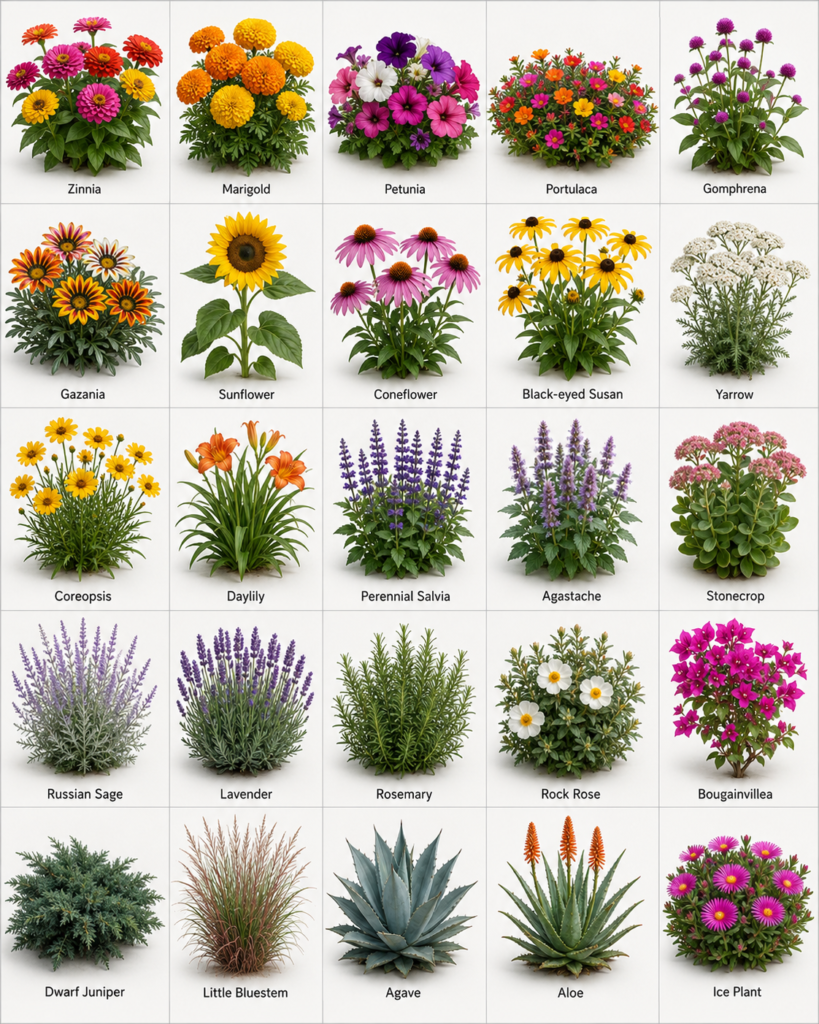
The 25 plants represent several growth forms, climates, and garden functions. “Best” means best within suitable conditions rather than best universally.
Each plant was reviewed for:
- Direct-light requirements
- Climate suitability
- Heat and humidity response
- Drainage
- Water needs
- Mature dimensions
- Container suitability
- Maintenance
- Safety
- Availability
- Garden function
The list includes annuals for quick seasonal color, perennials for recurring displays, shrubs for structure, climbers for screening, grasses for texture, and succulents for dry sites.
Plants with safety or environmental concerns remain in the guide only when those limitations can be clearly explained.
Why Botanical Names Matter
Common names can cover several plants with different sizes, hardiness, and safety profiles. “Salvia,” “aloe,” “agave,” “juniper,” and “ice plant” are broad groups.
Cultivar names matter too. A compact zinnia may remain below 30 centimetres, while a tall cutting variety may exceed 1 metre. A low juniper may eventually spread several metres, and agave species differ greatly in size and cold tolerance.
Record:
- Botanical name
- Cultivar
- Mature height and width
- Cold tolerance
- Soil preference
- Water needs
- Toxicity
- Invasive status
Keep or photograph the full nursery label. Accurate identification makes later pruning, care, replacement, and safety research easier.
Compare 25 Full-Sun Plants
| Plant | Type | Main value | Water | Pots |
|---|---|---|---|---|
| Zinnia | Annual | Long summer color | Moderate | Yes |
| Marigold | Annual | Dependable flowers | Moderate | Yes |
| Petunia | Annual | Trailing color | Moderate | Excellent |
| Portulaca | Annual succulent | Hot, dry sites | Low | Excellent |
| Gomphrena | Annual | Heat and dried flowers | Low–moderate | Yes |
| Gazania | Tender perennial | Dry-site flowers | Low | Excellent |
| Sunflower | Annual | Height and pollinators | Moderate | Dwarf forms |
| Coneflower | Perennial | Pollinators | Low–moderate | Compact forms |
| Black-eyed Susan | Annual/perennial | Late yellow flowers | Moderate | Compact forms |
| Yarrow | Perennial | Dry-soil performance | Low | Yes |
| Coreopsis | Annual/perennial | Long flowering | Low–moderate | Yes |
| Daylily | Perennial | Seasonal color | Moderate | Large pots |
| Perennial salvia | Perennial | Flower spikes | Low–moderate | Yes |
| Agastache | Perennial | Fragrance and pollinators | Low | Yes |
| Stonecrop | Succulent perennial | Late flowers | Low | Excellent |
| Russian sage | Perennial | Airy blue flowers | Low | Large pots |
| Lavender | Shrub | Fragrance | Low | Excellent |
| Rosemary | Herb/shrub | Edible evergreen foliage | Low | Excellent |
| Rock rose | Evergreen shrub | Poor-soil performance | Low | Compact forms |
| Bougainvillea | Climber/shrub | Screening and color | Low–moderate | Yes |
| Dwarf juniper | Evergreen shrub | Year-round structure | Low | Yes |
| Little bluestem | Ornamental grass | Texture | Low | Large pots |
| Agave | Succulent | Architectural form | Very low | Excellent |
| Aloe | Succulent | Sculptural foliage | Low | Excellent |
| Ice plant | Ground cover | Dry ground coverage | Very low | Excellent |
25 Full-Sun Plant Profiles
Flowering Annuals
1. Zinnia
Zinnias provide long summer color in many flower forms. Plant them in open sun with good drainage and airflow, and water at soil level to reduce mildew.
Best for: Cut flowers and pollinators
Avoid when: The site is shaded, crowded, or constantly wet
2. Marigold
Marigolds produce dependable yellow, orange, and gold flowers. French types are compact, while African types are taller. Heavy feeding may produce leaves instead of flowers.
Best for: Beginners, edging, and containers
Avoid when: Light is limited or soil stays wet
3. Petunia
Petunias suit baskets, window boxes, and sunny pots. They flower best with abundant light, consistent moisture, and regular container feeding.
Best for: Dense seasonal displays
Avoid when: Watering will be irregular
4. Portulaca
Portulaca is a low succulent annual for hot, exposed sites. Its flowers open strongly in bright light, and its fleshy leaves tolerate brief dry periods.
Best for: Hot pots and dry edging
Avoid when: Soil is heavy or moisture-retentive
5. Gomphrena
Gomphrena produces rounded flowers that hold their color when dried. It performs well in heat, with dwarf forms for pots and taller forms for cutting.
Best for: Heat, dried flowers, and pollinators
Avoid when: Conditions remain cool and wet
6. Gazania
Gazania carries vivid daisy-like flowers and suits dry edges and containers. It prefers strong sun, moderate fertility, and fast drainage.
Best for: Gravel beds and exposed pots
Avoid when: Winter or rainy-season soil remains wet
7. Sunflower
Sunflowers range from dwarf container plants to giants above 2 metres. Tall forms need space, moisture, and protection from strong wind.
Best for: Pollinators and temporary height
Avoid when: The site is narrow, windy, or difficult to water
Flowering Perennials
8. Coneflower
Coneflowers suit temperate borders and pollinator gardens. Plant them in sun and well-drained soil, and water consistently until established.
Best for: Pollinators and naturalistic planting
Avoid when: Soil remains saturated
9. Black-Eyed Susan
Black-eyed Susan includes annual, short-lived, and perennial Rudbeckia forms. They adapt to ordinary sunny soils, although some reseed freely.
Best for: Late-season color
Avoid when: Self-seeding is unacceptable
10. Yarrow
Yarrow combines finely divided foliage with flat flower clusters. Lean, sunny soil keeps the stems stronger than rich, wet ground.
Best for: Dry borders and cut flowers
Avoid when: Soil is heavily fertilized or constantly moist
11. Coreopsis
Coreopsis produces yellow, gold, red, or bicolored flowers. Most forms prefer direct sun, moderate fertility, and free drainage.
Best for: Mixed perennial beds
Avoid when: Cultivar hardiness is unknown
12. Daylily
Daylilies produce many buds and prefer at least six hours of sun with moderate moisture.
Best for: Reliable recurring color
Avoid when: Cats can reach the plant; Hemerocallis is highly toxic to cats
13. Perennial Salvia
Perennial salvia, including Salvia nemorosa hybrids, produces upright flower spikes and may rebloom after faded stems are removed.
Best for: Pollinators and vertical structure
Avoid when: The species is not locally hardy
14. Agastache
Agastache offers aromatic foliage and flowers for bees and butterflies. It needs an open site and excellent winter drainage.
Best for: Fragrance and pollinators
Avoid when: Winter soil stays wet
15. Stonecrop
Stonecrop includes low Sedum ground covers and taller Hylotelephium forms. Tall forms may flop in rich soil.
Best for: Dry borders and late flowers
Avoid when: Soil is rich or waterlogged
16. Russian Sage
Russian sage, Salvia yangii, forms airy blue-purple flowers above silvery stems. It stays strongest in lean, sunny soil.
Best for: Hot borders and silver foliage
Avoid when: The site is shaded or heavily fed
Shrubs and Climbers
17. Lavender
Lavender provides fragrance, flowers, and pollinator value. Drainage is critical, and different groups vary in cold and humidity tolerance.
Best for: Gravel gardens, paths, and pots
Avoid when: The site has wet clay or stagnant humidity
18. Rosemary
Rosemary is an evergreen culinary shrub with upright and trailing forms. It needs strong light and sharp drainage; pots help where winter protection is required.
Best for: Edible landscapes and evergreen form
Avoid when: Winters are cold and wet
19. Rock Rose
Rock rose, Cistus, is an evergreen shrub for warm, stony, low-fertility sites. Established plants dislike hard pruning and root disturbance.
Best for: Mediterranean-style gardens
Avoid when: Ground stays saturated
20. Bougainvillea
Bougainvillea provides vivid bracts and screening in frost-free climates. Strong supports and careful placement are essential because many varieties are thorny.
Best for: Warm walls and pergolas
Avoid when: Frost, weak supports, or narrow paths are concerns
21. Dwarf Juniper
Dwarf junipers offer evergreen structure in spreading or upright forms. Check mature width because low plants may still spread widely.
Best for: Year-round structure
Avoid when: Soil stays wet or dimensions are unknown
Grasses, Succulents, and Ground Covers
22. Little Bluestem
Little bluestem, Schizachyrium scoparium, provides fine texture and seasonal color. Lean soil and full sun help it remain upright.
Best for: Naturalistic borders
Avoid when: The bed is shaded or heavily fertilized
23. Agave
Agaves create bold rosettes and need intense light with excellent drainage. Mature size and terminal spines make placement important.
Best for: Dry-climate focal points
Avoid when: Frost, waterlogging, or pedestrian contact is likely
24. Aloe
Aloes suit warm patios and frost-free gardens. Use sharp drainage and introduce protected plants gradually to intense sun.
Best for: Containers and succulent displays
Avoid when: Pets can reach Aloe vera, which is toxic to dogs and cats
25. Ice Plant
Hardy Delosperma ice plants form low mats of bright flowers. They need sharp drainage, especially in winter.
Best for: Rock gardens and slopes
Avoid when: Identity, drainage, or invasive status is uncertain
Best Plants by Garden Goal
- Low maintenance: Yarrow, stonecrop, little bluestem, dwarf juniper, rock rose, and climate-appropriate agave
- Containers: Petunia, compact zinnia, marigold, portulaca, lavender, rosemary, stonecrop, dwarf agave, and small aloes
- Long color: Zinnia, marigold, petunia, gomphrena, coreopsis, salvia, and black-eyed Susan
- Pollinators: Coneflower, salvia, agastache, lavender, yarrow, stonecrop, and sunflower
- Privacy or structure: Bougainvillea, upright rosemary, juniper, grasses, Russian sage, and tall sunflowers
- Dry soil: Portulaca, yarrow, stonecrop, Russian sage, lavender, rosemary, rock rose, little bluestem, agave, and ice plant
Best Plants by Climate
Cool and Cold Winters
Use zinnias and marigolds as annuals. Consider coneflower, black-eyed Susan, yarrow, coreopsis, stonecrop, and little bluestem where locally hardy. Protect rosemary, aloe, and bougainvillea.
Temperate Climates
Good starting points include perennial salvia, agastache, coneflower, lavender, Russian sage, stonecrop, dwarf juniper, and grasses. Check winter drainage.
Hot and Dry Climates
Choose portulaca, gazania, gomphrena, yarrow, rosemary, rock rose, agave, aloe, and ice plant. Separate thirsty annuals from succulents.
Hot and Humid Climates
Use marigold, gomphrena, disease-resistant zinnia, black-eyed Susan, selected salvia, sunflower, and portulaca in free-draining soil. Increase airflow.
Frost-Free Tropical and Subtropical Climates
Bougainvillea, aloe, agave, portulaca, gomphrena, tropical salvias, and rosemary may work. Check monsoon drainage and invasive potential.
Climate Decision Matrix
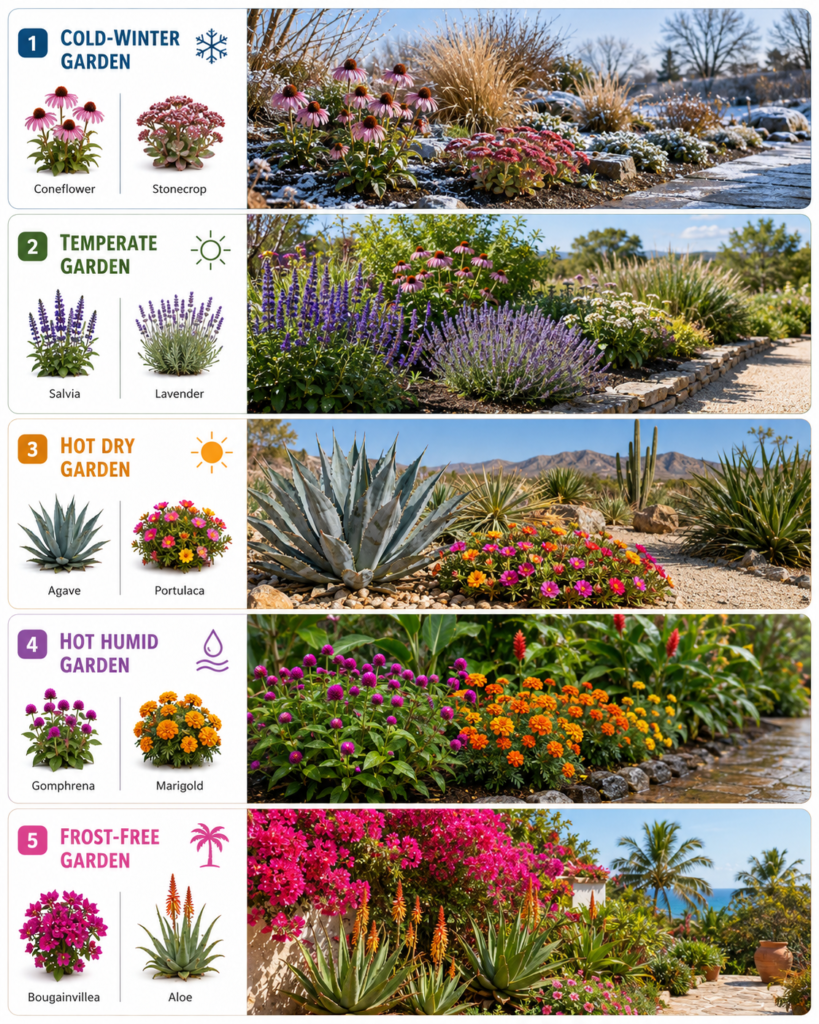
| Climate | Strong choices | Main risk | Adjustment |
|---|---|---|---|
| Cold winter | Coneflower, yarrow, stonecrop | Tender plants freezing | Use movable pots |
| Cool, wet winter | Hardy perennials | Root rot | Use raised beds |
| Temperate | Salvia, coreopsis, Russian sage | Winter drainage | Match species to rainfall |
| Hot and dry | Portulaca, agave, aloe | Overwatering | Separate irrigation |
| Hot and humid | Gomphrena, marigold, salvia | Fungal disease | Increase airflow |
| Frost-free subtropical | Bougainvillea, aloe, agave | Heavy rain | Use raised positions |
| Tropical monsoon | Heat-tolerant annuals | Waterlogging and spread | Prefer regional alternatives |
| Windy coastal | Low succulents and grasses | Salt and wind | Avoid unsupported tall plants |
Full-Sun Plants for Pots
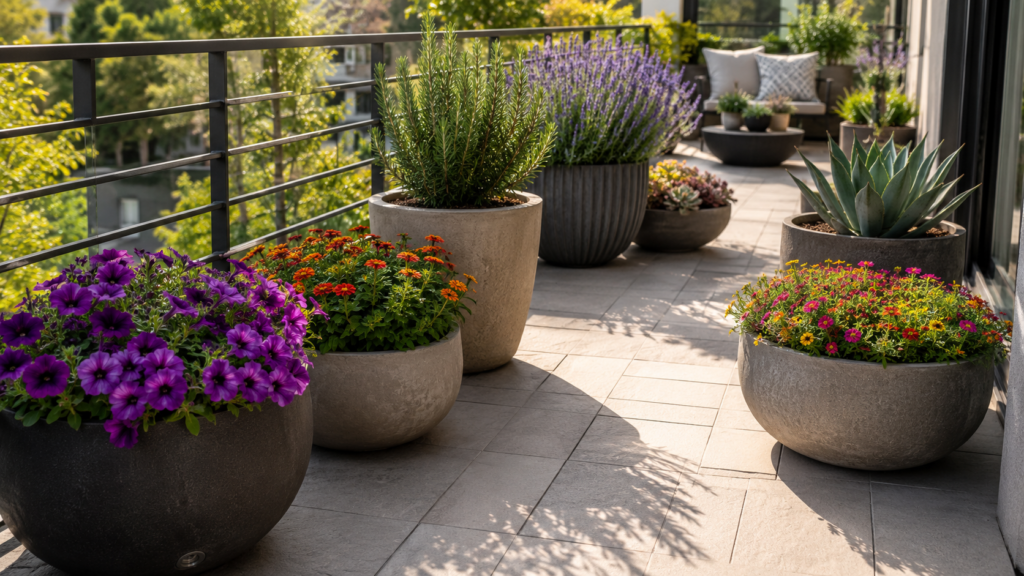
Pots heat and dry faster than open ground. Use drainage holes, fresh container mix, enough root volume, and wind-stable containers.
Petunias, zinnias, and marigolds need more water and nutrients than portulaca, stonecrop, agave, and aloe. Keep plants with different needs in separate pots.
Soil and Planting
- Remove turf, weeds, and competing roots.
- Check drainage; use a raised bed where water lingers.
- Loosen soil beyond the root ball.
- Plant at the nursery depth.
- Open circling roots.
- Water thoroughly.
- Keep mulch away from stems and crowns.
Prepare the wider root zone rather than creating one heavily amended pocket surrounded by compacted soil.
Long-Term Care
Water when the root zone begins to dry. Feed container annuals as needed, but avoid overfeeding drought-adapted plants.
Deadhead for longer flowering. During heatwaves, check pots often, delay fertilizer, avoid hard pruning, and protect newly planted specimens from peak heat.
Watering New Plants
Drought tolerance develops after roots spread beyond the nursery root ball. Water thoroughly after planting, check both the root ball and surrounding soil, adjust after rainfall, and reduce frequency gradually.
Keep mulch away from crowns and avoid heavy fertilizer during stress.
Common Plant Problems
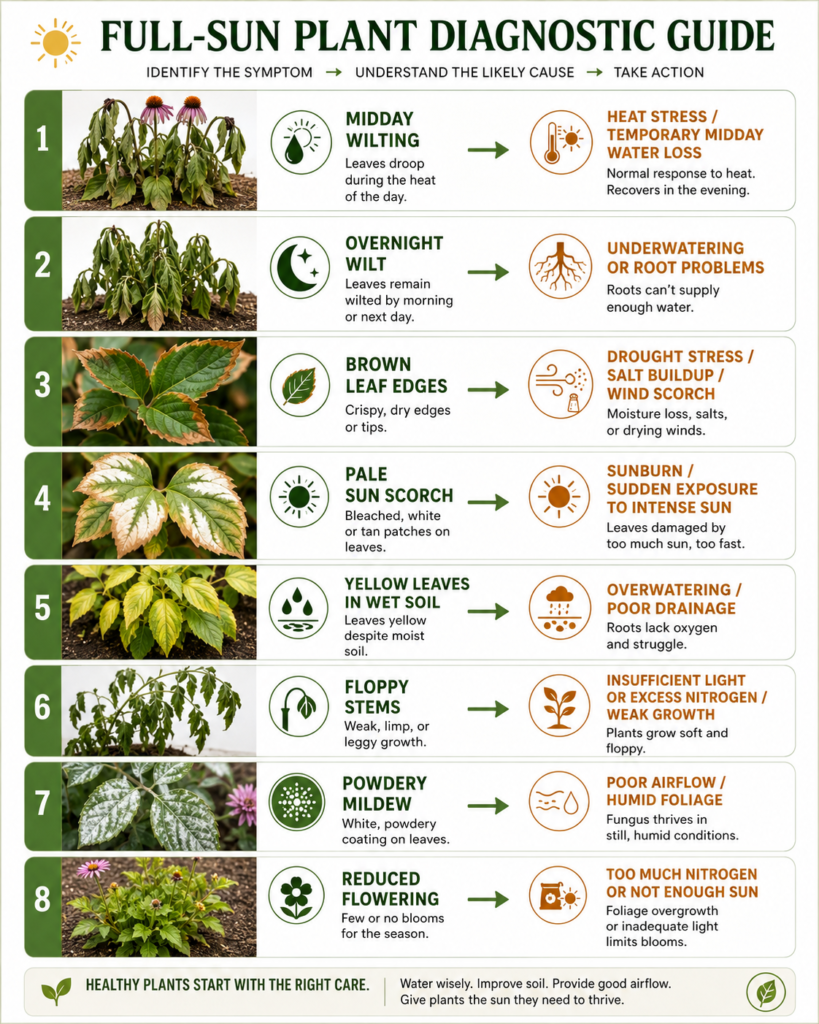
| Symptom | Likely cause | Response |
|---|---|---|
| Midday wilt, evening recovery | Temporary heat stress | Check soil first |
| Wilt continues overnight | Root or moisture problem | Inspect roots and drainage |
| Brown edges | Drought, wind, or salts | Water deeply if dry |
| Pale scorch | Sudden exposure | Acclimate gradually |
| Few flowers | Shade or excess nitrogen | Review light and feeding |
| Yellow leaves in wet soil | Poor drainage | Reduce water |
| Floppy stems | Shade, rich soil, crowding | Increase light and spacing |
| White coating | Powdery mildew | Improve airflow |
Plants moved from greenhouses or indoor areas should be introduced to direct outdoor sunlight gradually. Even a full-sun plant can scorch after an abrupt change.
Safety and Local Rules
Daylilies are highly toxic to cats, and Aloe vera is toxic to dogs and cats. Bougainvillea may have thorns, while agaves may have sharp terminal spines.
Keep hazardous plants away from:
- Paths
- Play areas
- Pet zones
- Doorways
- Seating
- Maintenance routes
Check local invasive-species databases before planting vigorous climbers, self-seeding ornamentals, or spreading ground covers. A plant that remains controlled in a cold climate may spread aggressively in a frost-free region.
In fire-prone areas, follow local defensible-space rules and remove dry or dead plant material near structures.
Measured Planting Plans
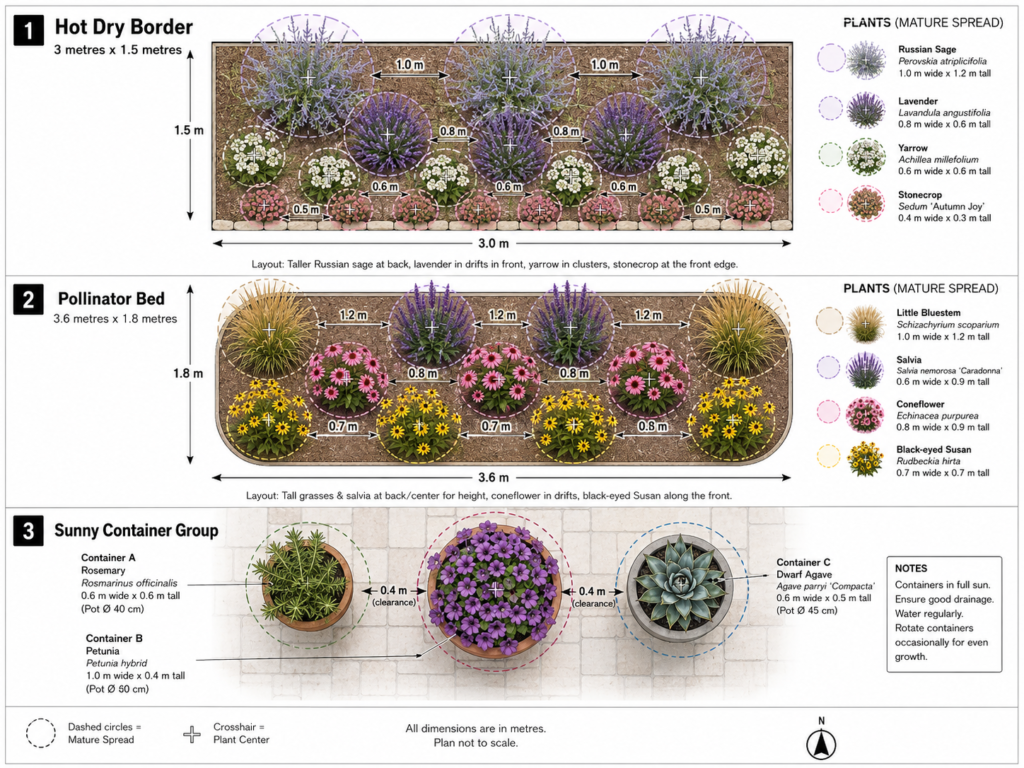
Hot, Dry Border — 3 m × 1.5 m
Use two compact Russian sage plants at the back, three lavenders and three yarrows through the middle, and five stonecrops or ice plants along the front.
Keep the soil sharply drained and leave enough space for mature airflow.
Temperate Pollinator Bed — 3.6 m × 1.8 m
Place little bluestem or agastache at the back, three coneflowers and three black-eyed Susans in the middle, and three compact salvias at the front.
Repeat plants in groups instead of scattering single specimens.
Sunny Container Group
Use:
- A 45–60 cm focal pot for rosemary or compact bougainvillea
- A 30–40 cm flowering pot for petunia or zinnia
- A shallow pot for portulaca, stonecrop, or dwarf agave
Separate pots allow each plant to receive the correct watering schedule.
Related Full-Sun Guides
Useful supporting topics include sunlight measurement, drainage, potting mix, watering, pollinator plants, pet-safe choices, hardiness, drought-tolerant borders, and container gardens.
Keep each guide focused on a separate search intent.
Final Plant Checklist
Before buying, confirm:
- Sunlight and afternoon heat
- Winter hardiness and humidity tolerance
- Soil drainage and water needs
- Mature height and width
- Pot or bed suitability
- Local invasive restrictions
- Toxicity and thorn risks
- Compatible neighboring plants
- Establishment watering
- Botanical identity
Choose plants for climate, soil, water, space, and purpose—not popularity.
FAQs
How many hours of sun do full-sun plants need?
Most need at least six hours of direct light. Many flowering annuals bloom more heavily with eight hours.
What are the best outdoor plants for full sun?
Zinnia, marigold, coneflower, salvia, yarrow, lavender, rosemary, and stonecrop are strong choices in suitable conditions.
Which full-sun plants need the least water?
Agave, stonecrop, yarrow, Russian sage, lavender, and ice plant usually need less water after establishment.
Which full-sun plants grow well in pots?
Petunia, compact zinnia, marigold, portulaca, rosemary, lavender, stonecrop, dwarf agave, and small aloes are useful choices.
Can full-sun plants receive too much sun?
Yes. Sudden exposure, reflected heat, wind, and dry roots can scorch sun-loving plants.
Why are my full-sun plants not flowering?
Common causes include insufficient light, excess nitrogen, dry soil, extreme heat, or the wrong season.
Is full sun the same as drought tolerance?
No. Full sun describes light exposure; drought tolerance describes survival with limited soil moisture.
Which full-sun plants suit cold winters?
Coneflower, yarrow, stonecrop, little bluestem, and locally hardy salvias suit many cold regions. Zinnias and marigolds work as annuals.
Myra is the founder and lead writer of Plantsaholic. She shares practical, research-backed advice on indoor plants, outdoor gardening, flowers, herbs, succulents, and everyday plant care. Her goal is to help gardeners of all experience levels grow healthier plants through simple, easy-to-follow gardening guides.