To fix root rot in houseplants, stop watering, remove the plant from its pot, brush or rinse away old soil, cut off brown or mushy roots, and repot the healthy roots in fresh, well-draining mix. Use a clean pot with drainage holes, then water only when the mix has partly dried.
Root rot is confusing because the plant often looks thirsty while the soil is already wet. Leaves droop, stems soften, growth slows, and many plant owners water again. That usually makes the problem worse because damaged roots cannot absorb the water already around them.
The real fix is simple: confirm the root problem, remove dead tissue, reset the potting environment, and change the watering routine so the plant can rebuild healthy roots.
Root Rot Quick Fix
If your houseplant is wilting while the soil is wet, do not water again. Root rot rescue starts with inspection, not guesswork. More water can increase saturation, reduce oxygen, and speed up decline.
Use this quick process:
- Stop watering a wet, wilted plant.
- Slide the plant out and inspect the roots.
- Cut black, mushy, hollow, slimy, or smelly roots.
- Discard old wet or sour-smelling soil.
- Repot in fresh, airy potting mix.
- Use a clean pot with drainage holes.
- Keep the plant in bright indirect light.
- Avoid fertilizer until the plant stabilizes.
- Propagate healthy stems or nodes if most roots are gone.
If roots are mostly firm, rescue the plant. If roots are mostly gone but stems or nodes are healthy, propagate. If roots, crown, and stems are all mushy, discard the plant.
What Is Root Rot?
Root rot is root decay caused by wet, poorly aerated potting conditions and, in many cases, soil-borne pathogens. It damages the root system until the plant can no longer absorb water, oxygen, and nutrients properly.
Root rot is not one single disease. It is a general term for root deterioration caused by organisms that attack roots in wet, poorly draining soil. Common root rot organisms include Pythium, Phytophthora, Rhizoctonia, and Fusarium.
Root rot becomes more likely when potting mix stays saturated, when the pot has no drainage, when the plant sits in low light, or when the container is too large for the root system.
It is not simply “too much water.” It is root damage caused by wet, stale, low-oxygen conditions. Roots need moisture, but they also need air.
Root Rot vs Overwatering
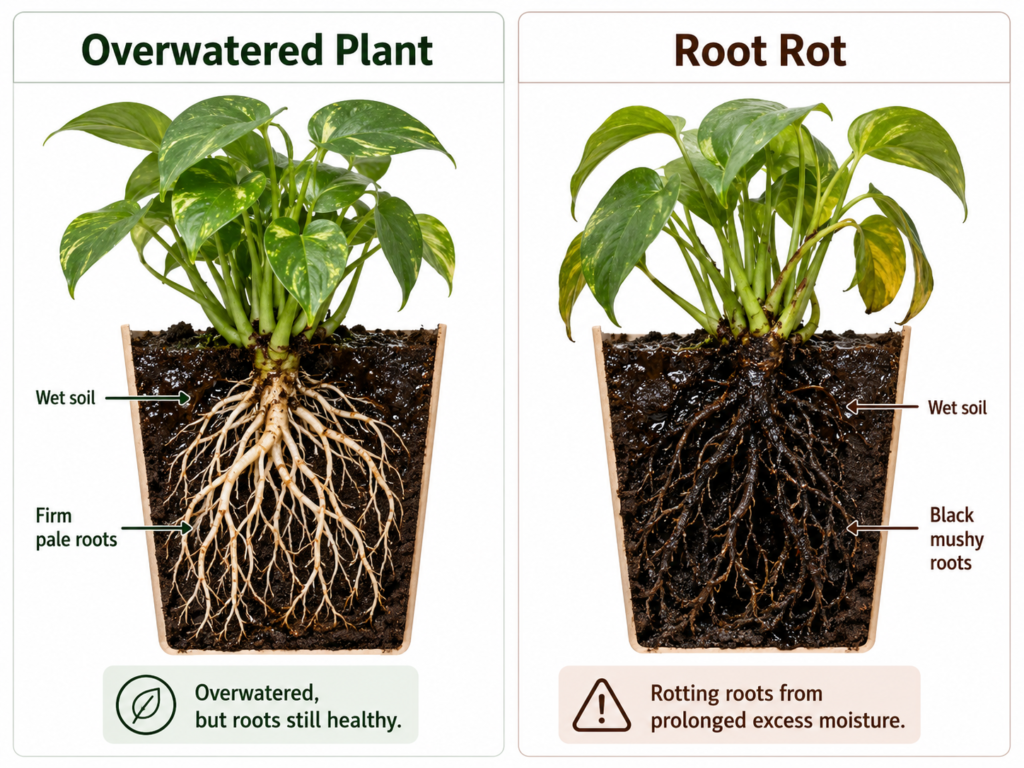
Overwatering and root rot are connected, but they are not the same thing. Overwatering means the plant receives more water than it can use or drain away. Root rot means the roots have already started decaying.
A plant can be overwatered without rotten roots. If roots are firm, pause watering, improve light, increase airflow, and empty the saucer. If roots are mushy, black, hollow, or smelly, the plant needs root rot treatment.
| Situation | Likely issue | Best action |
| Wet soil but firm roots | Overwatering risk | Pause watering, improve light |
| Wet soil plus yellow leaves | Early root stress | Inspect roots soon |
| Wet soil plus mushy roots | Root rot | Trim roots, discard soil, repot |
| Wet soil plus mushy crown | Severe rot | Propagate or discard |
| Dry soil plus crispy leaves | Underwatering likely | Rehydrate carefully |
A plant watered too heavily once may recover after drying out. A plant kept in a no-drainage pot for two weeks may already need root pruning and repotting.
Root Rot Lookalikes
Several houseplant problems can look like root rot from above the soil. Yellow leaves, wilting, brown tips, leaf drop, and slow growth can also come from underwatering, low light, pests, fertilizer salts, cold damage, transplant shock, or natural leaf aging.
Common lookalikes include:
- Underwatering: dry soil, light pot, crispy leaf edges, firm roots.
- Low light: slow drying soil, pale growth, stretched stems.
- Fertilizer burn: brown tips, crusty soil surface, possible salt buildup.
- Cold damage: blackened or translucent leaves after cold exposure.
- Pest damage: webbing, sticky residue, stippling, or visible insects.
- Natural aging: one or two older lower leaves yellow while new growth stays healthy.
- Fungus gnats: often signal wet soil, but they do not prove root rot alone.
If the soil is dry and roots are firm, do not treat it as root rot. If the soil is wet and roots are mushy, act immediately.
Signs of Root Rot
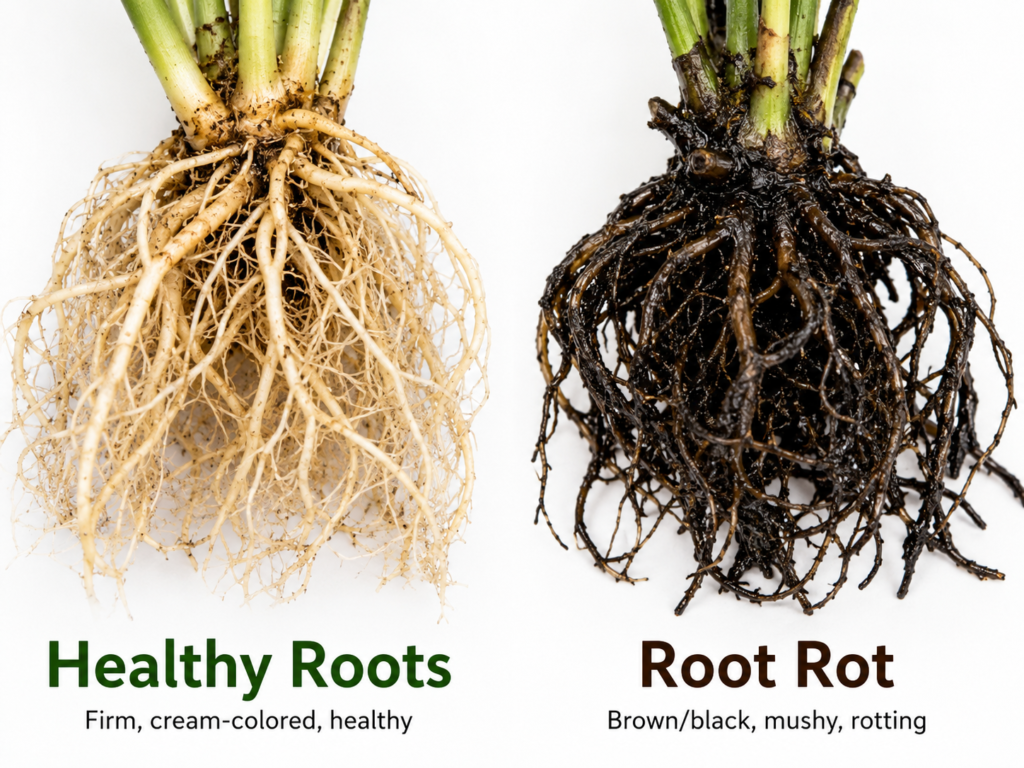
The most reliable sign of root rot is root texture. Healthy roots are usually firm and white, cream, tan, or light brown. Rotted roots are brown or black, soft, mushy, slimy, hollow, stringy, or foul-smelling.
Leaf symptoms can warn you, but they cannot confirm root rot alone. Yellow leaves, wilting, brown patches, leaf drop, slow growth, and soft stems can come from many causes. The strongest warning sign is a plant that wilts while the soil still feels wet.
Check for these signs:
- Soil stays wet much longer than normal.
- Leaves wilt even though the mix is damp.
- Lower leaves turn yellow and soft.
- Stems near the soil line feel weak or mushy.
- Roots look black, brown, slimy, or hollow.
- The pot smells sour, swampy, or rotten.
- Fine roots fall apart when touched.
If a peace lily droops while the soil is still damp and lower leaves yellow, inspect the roots before adding water.
Can You Fix It Without Repotting?
Mild overwatering can sometimes be corrected without repotting, but true root rot usually needs root inspection, pruning, and fresh potting mix. If roots are brown, mushy, blackened, or smelly, remove the plant from the pot.
Try drying the plant first only if roots are firm, the pot has drainage holes, there is no rotten smell, and the plant is not collapsing. Move it into brighter indirect light, improve airflow, empty saucer water, and let the mix dry.
Repot immediately if:
- The pot smells sour or swampy.
- The soil stays wet for a week or longer.
- Leaves keep yellowing after watering changes.
- The stem base is soft.
- Roots are black, mushy, or falling apart.
- The plant is in a no-drainage container.
Firm roots mean adjust care first. Mushy roots mean repot and prune.
How to Fix Root Rot
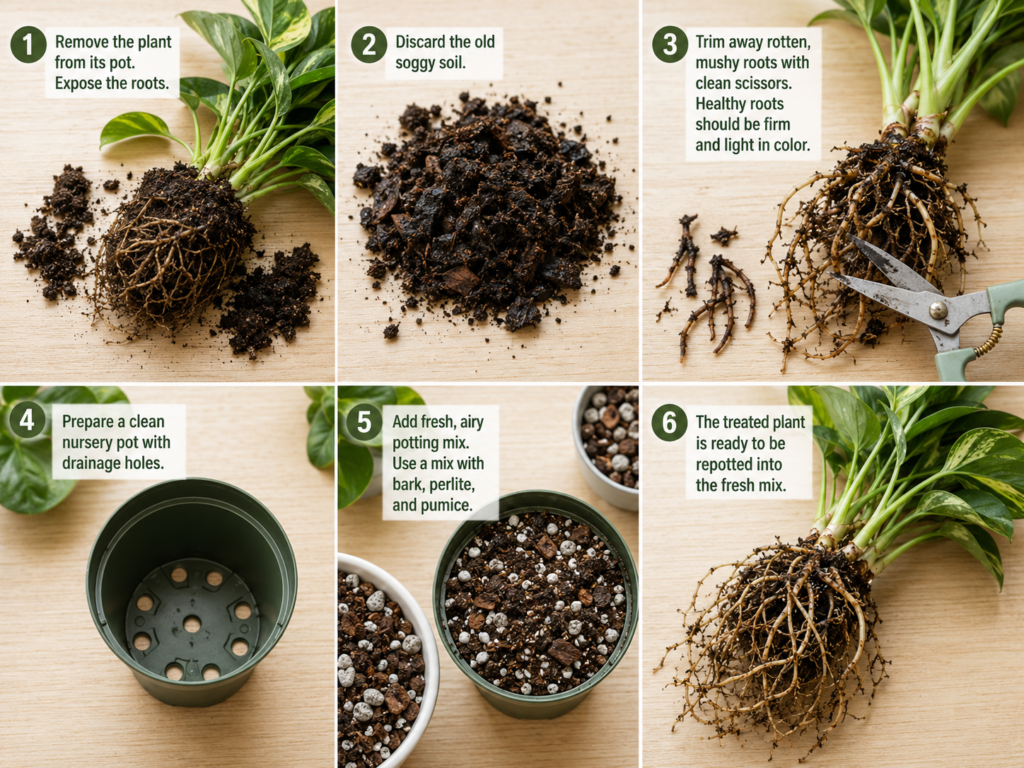
Fix root rot by stopping water, removing the plant, discarding old soil, trimming rotten roots, cleaning the pot, repotting in fresh airy mix, and changing aftercare.
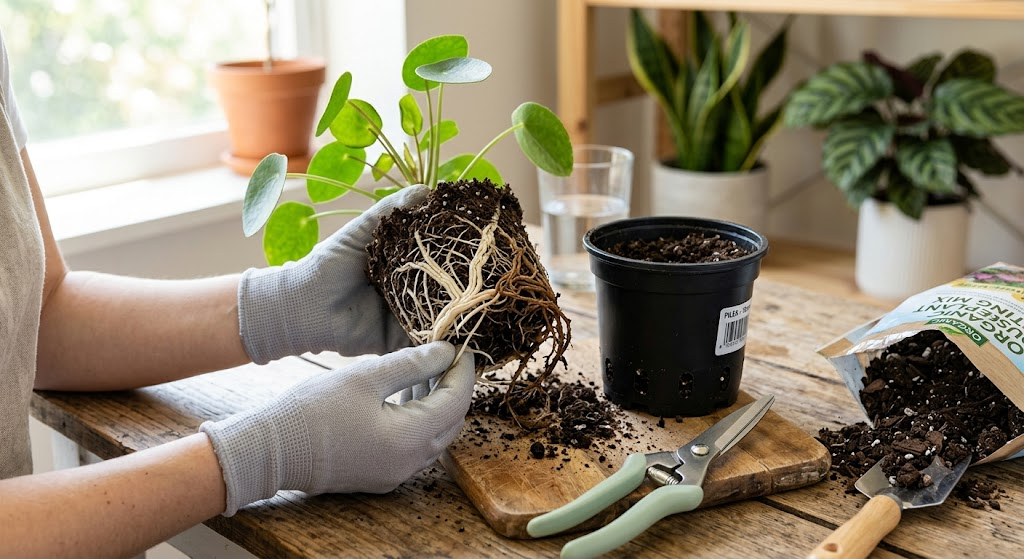
Prepare clean scissors or pruning shears, fresh potting mix, a clean pot with drainage holes, paper towels, and a small stick for loosening soil. Remove the plant gently and avoid pulling hard on weak stems. Brush or rinse away old soil so you can see the roots.
Keep firm white, cream, tan, or light brown roots. Cut away every black, mushy, hollow, slimy, or foul-smelling root. If the outer layer slips off and leaves a thin string, remove that root too.
Step-by-step process:
- Stop watering immediately.
- Remove the plant from the pot.
- Brush or rinse old soil from the roots.
- Cut away mushy, black, hollow, or smelly roots.
- Trim damaged leaves if many roots were removed.
- Clean the pot or choose a new one.
- Repot in fresh, well-draining mix.
- Use a pot with drainage holes.
- Water lightly only if the new mix is dry.
- Keep the plant in bright indirect light.
If you are unsure whether to cut a root, gently pinch it. Firm roots stay intact. Rotten roots collapse, slip, or smell bad.
Hydrogen Peroxide for Root Rot
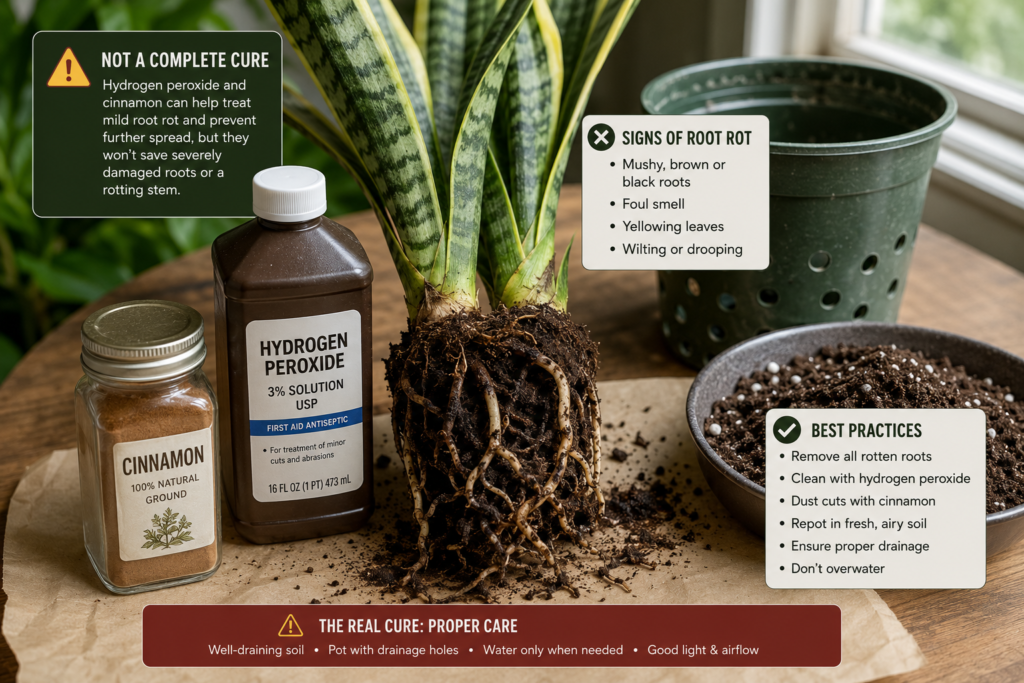
Hydrogen peroxide is popular online, but it should not be treated as the main root rot cure. It cannot rebuild dead roots, fix compacted soil, repair a mushy crown, or solve a pot with no drainage.
The reliable treatment is still physical cleanup: inspect the roots, cut away rotten tissue, discard old soil, use clean materials, and correct watering conditions.
Use caution with peroxide:
- Do not use it instead of repotting.
- Do not soak weak roots for long periods.
- Do not use strong concentrations on damaged roots.
- Do not expect it to reverse dead root tissue.
- Do not keep the plant in the same dense, wet mix.
Peroxide is optional at best. Trimming rotten roots and repotting correctly are essential.
Cinnamon for Root Rot
Cinnamon is often mentioned as a natural plant-care remedy, but it is not a complete root rot treatment. It cannot restore dead roots, dry saturated soil, remove pathogens from contaminated mix, or fix a no-drainage container.
Root rot is not fixed by sprinkling powder on wet soil. If roots are mushy, the plant must be removed and inspected. If old soil smells rotten, it should be discarded.
Cinnamon may be a minor optional add-on, but it is not a cure. Clean cuts, fresh mix, drainage, and correct watering matter far more.
Is It Too Late to Save?
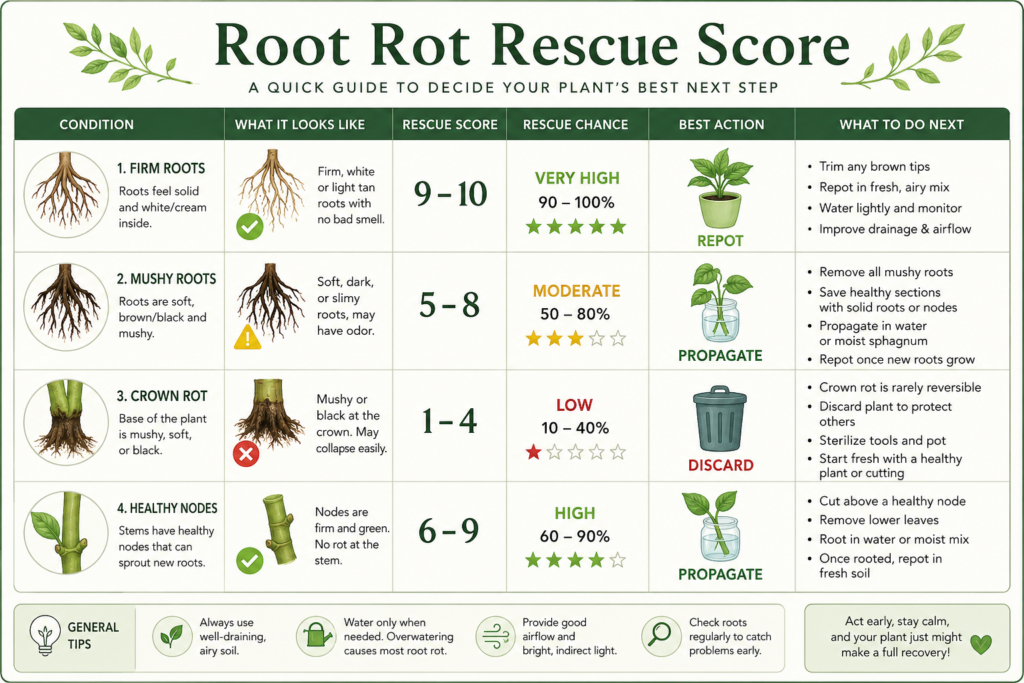
A plant has a good chance of recovery if it still has firm roots and a firm crown or stem base. If nearly all roots are mushy or the crown is black and soft, propagation or disposal is safer.
The crown, stem base, rhizome, or node often matters as much as the roots. Some plants can regrow roots from healthy stems or nodes, but they cannot recover from fully rotten central tissue.
| What you find | Rescue chance | Best action |
| 70%+ roots firm | High | Trim rot, repot, adjust watering |
| 40–70% roots firm | Moderate | Trim rot, reduce foliage, repot smaller |
| Less than 40% roots firm | Low | Repot only if crown is firm; take cuttings |
| Crown or stem base mushy | Very low | Propagate healthy parts or discard |
| No healthy roots but healthy nodes | Propagation possible | Take cuttings |
Rescue the original plant when roots and crown are firm. Propagate when roots are mostly gone but stems or nodes are healthy. Discard when all living tissue is soft, black, or rotten.
Best Soil and Pot After Root Rot
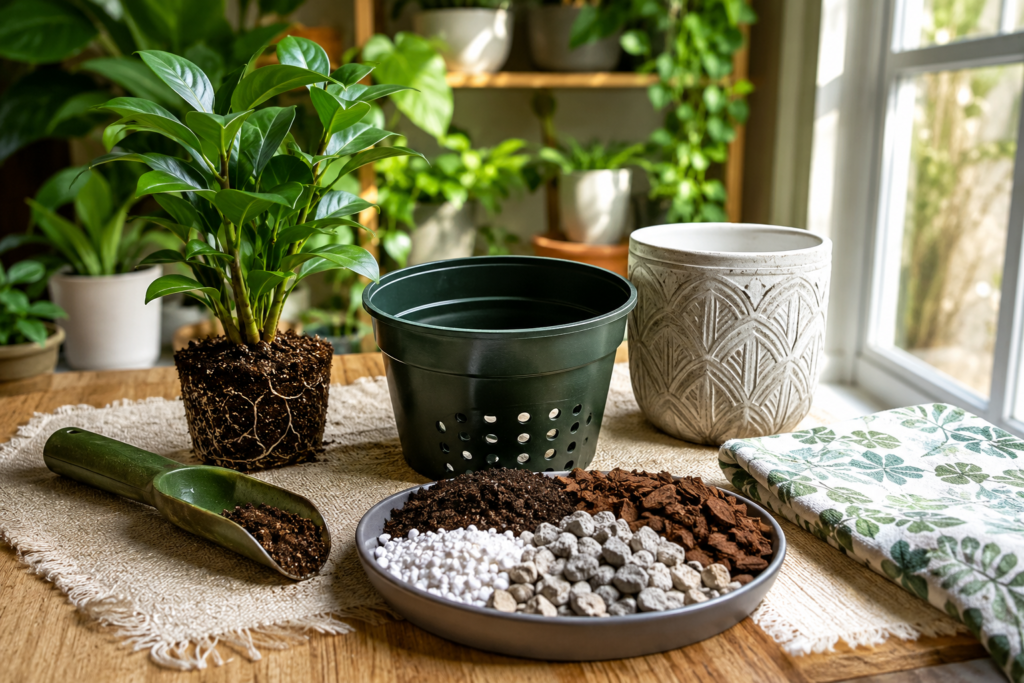
Use a clean pot with drainage holes and fresh, well-draining potting mix after root rot. Do not reuse old soil, use regular garden soil, or add gravel inside the pot.
The best recovery pot is close to the size of the remaining root system. An oversized pot holds extra wet mix that damaged roots cannot use quickly. After root rot, a large pot often makes the moisture problem worse.
Best pot features:
- Drainage holes.
- Size close to the remaining root ball.
- Removable saucer or cachepot.
- Easy access for checking moisture.
- Clean surface with no old infected soil.
Best mix by plant type:
- Pothos, monstera, philodendron: indoor mix plus bark, perlite, or pumice.
- Peace lily: airy but moisture-retentive mix.
- Calathea and maranta: fine but breathable mix.
- Snake plant and ZZ plant: cactus mix plus pumice or perlite.
- Aloe and succulents: fast-draining mineral-heavy mix.
- Orchids: orchid bark mix suited to the orchid type.
- Ferns: airy mix that stays lightly moist, not saturated.
Choose a pot and mix that dry at the right speed for the plant. If the pot has no drainage, do not use it as the main growing pot.
Do Rocks Prevent Root Rot?
No. Rocks, gravel, or pebbles inside the bottom of a plant pot do not reliably prevent root rot. Water can remain in the potting mix above the gravel until that upper layer becomes saturated.
Better drainage solutions include drainage holes, airy potting mix, perlite, pumice, bark, correct pot size, and empty saucers.
Root Rot in No-Drainage Pots
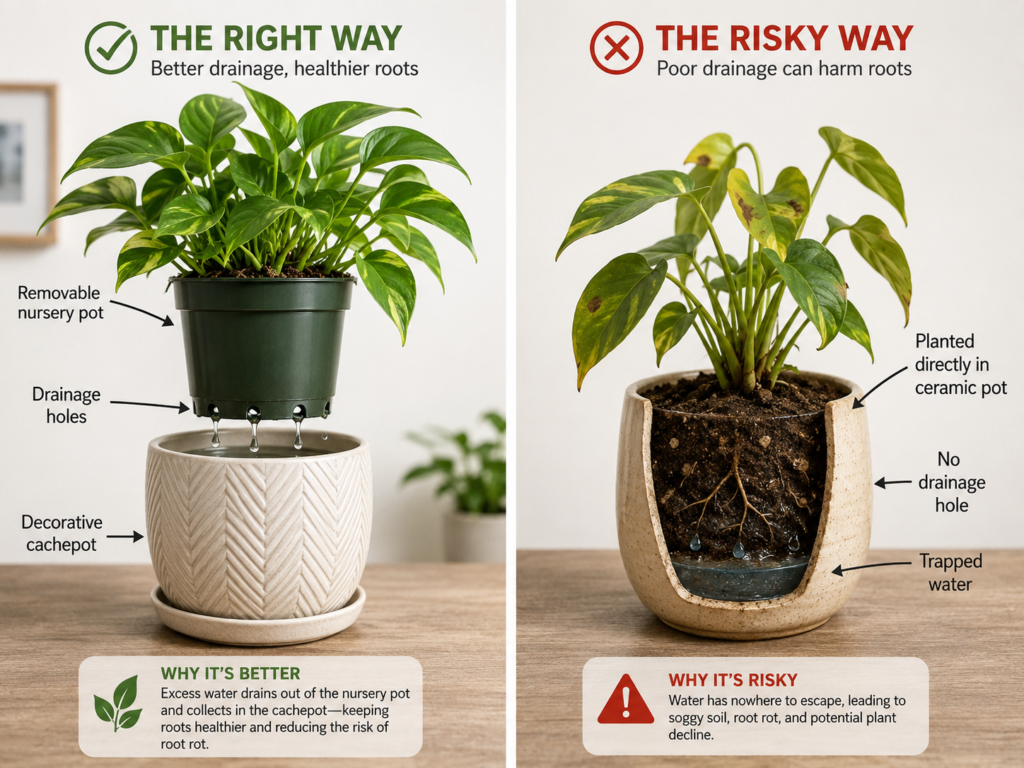
You can sometimes save a plant with root rot from a pot without drainage, but move it into a nursery pot with drainage holes during recovery. A no-drainage container traps water at the bottom and keeps the lower root zone wet.
Decorative pots can work as outer cachepots, not sealed growing containers. Grow the plant in a removable nursery pot, water it outside the decorative pot, let it drain fully, and place it back after runoff is gone.
No-drainage rescue process:
- Remove the plant from the no-drainage container.
- Inspect roots for mushy, black, hollow, or smelly tissue.
- Cut away rotten roots.
- Discard old wet potting mix.
- Repot into a clean nursery pot with drainage holes.
- Let water drain fully after each watering.
- Use the decorative pot only as an outer cachepot.
- Pour out hidden water after watering.
Use no-drainage pots for display only, not as the main recovery pot.
Aftercare After Repotting
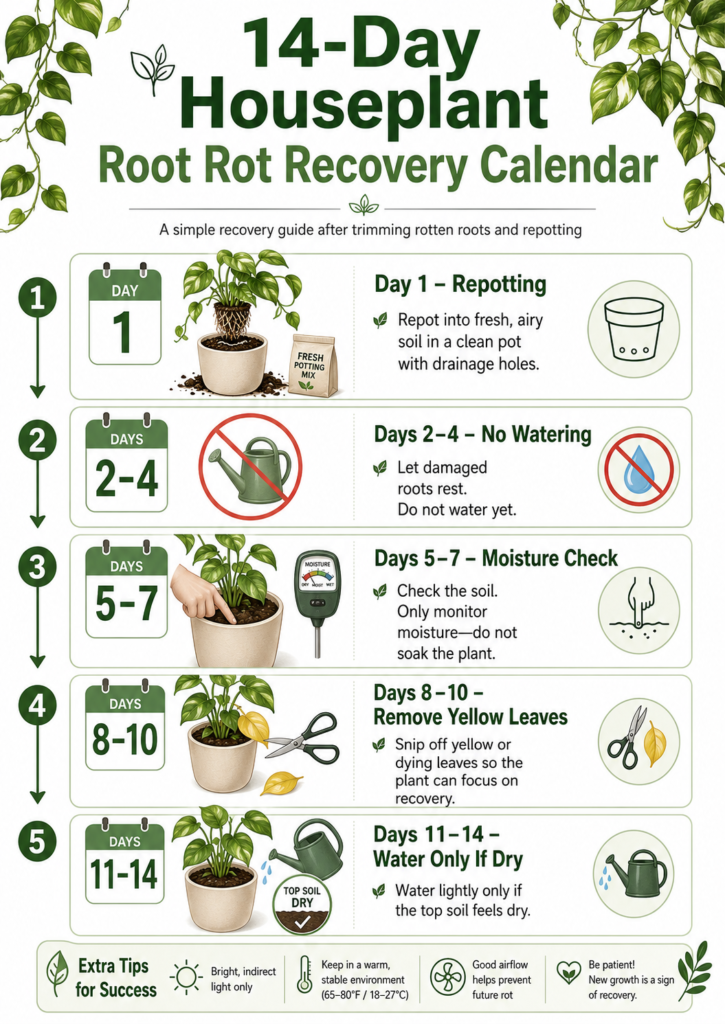
After repotting a plant with root rot, keep it stable, warm, and in bright indirect light. Do not fertilize immediately. Water only when the correct amount of potting mix has dried.
A rescued plant may look worse before it looks better. Some older leaves may yellow or drop. The first sign of success may simply be that the decline slows or stops.
14-day recovery plan:
- Day 1: Repot, water lightly only if needed, and drain fully.
- Days 2–4: Do not water unless the mix dries fast.
- Days 5–7: Check moisture with a finger, stick, or meter.
- Days 8–10: Remove fully yellow or collapsing leaves.
- Days 11–14: Water only if the mix is ready.
- Week 3 onward: Watch for stable leaves or new growth.
- Month 2 onward: Resume diluted feeding only if active growth returns.
Judge recovery by stability first, not instant new leaves.
When to Recheck Roots
Do not keep pulling the plant out after treatment. A rescued plant needs stability to rebuild roots.
Check roots again only if the plant keeps worsening. Reinspect if the plant wilts while the mix is wet, the crown softens, a sour smell returns, the soil stays wet too long, or the plant becomes loose.
How to Prevent Root Rot
Prevent root rot by matching watering to the plant, using drainage holes, improving light, avoiding compacted soil, emptying saucers, and never letting roots sit in standing water.
The most common reason root rot returns is that the plant goes back into the same conditions: a dark corner, oversized pot, dense soil, no-drainage container, or fixed weekly watering habit.
Prevention checklist:
- Check soil moisture before watering.
- Use a pot with drainage holes.
- Empty saucers and cachepots.
- Increase light if soil stays wet too long.
- Refresh compacted old potting mix.
- Avoid oversized pots.
- Do not reuse soil from a rotted plant.
- Clean tools after trimming diseased roots.
- Quarantine new plants for one to two weeks.
- Keep plants out of shared drainage water.
If soil takes too long to dry, fix the reason: low light, dense mix, pot size, or missing drainage.
Winter Root Rot
Root rot often happens more in winter because indoor plants grow more slowly in lower light and use less water. If you keep the same summer watering schedule, the potting mix may stay wet much longer.
Winter prevention tips:
- Check moisture deeper in the pot.
- Reduce watering in low-light months.
- Move plants closer to bright indirect light if safe.
- Avoid cold windowsills when soil is wet.
- Empty saucers after watering.
- Avoid heavy fertilizing when growth is slow.
- Use airy mix for plants that stay wet too long.
When light drops, water use drops. Adjust watering before the soil starts staying wet.
When to Propagate
Propagate instead of repotting when the root system is mostly gone but stems, nodes, rhizomes, or leaf cuttings are still healthy. Propagation saves healthy tissue before the base collapses.
For vining houseplants, a healthy node is valuable. Pothos, philodendron, monstera, syngonium, tradescantia, and hoya can often regrow from node cuttings.
Good propagation candidates include pothos, philodendron, monstera, syngonium, tradescantia, hoya, peperomia, string of hearts, ZZ plant divisions, and snake plant leaf cuttings.
Repot when enough firm roots remain. Propagate when roots are mostly gone but healthy stems, nodes, rhizomes, or leaves remain.
Root Rot Mistakes
The biggest root rot mistakes are watering again because the plant looks wilted, reusing old soil, choosing an oversized pot, adding rocks for drainage, fertilizing too soon, and failing to fix the original conditions.
Avoid these mistakes:
- Watering a wet, wilted plant.
- Reusing contaminated potting mix.
- Repotting into a much larger container.
- Keeping the plant in a pot without drainage.
- Adding rocks inside the pot.
- Fertilizing immediately after root pruning.
- Leaving runoff in the saucer.
- Returning the plant to the same low-light spot.
- Checking the roots every day after repotting.
- Ignoring mushy crown or stem tissue.
If an action keeps the root zone wetter, delays drying, or stresses damaged roots, avoid it during recovery.
Root Rot Recovery Supplies
The most useful root rot recovery supplies are clean cutting tools, fresh potting mix, a pot with drainage holes, and a reliable way to check moisture. Products help only when they support the correct rescue process.
A simple plantsaholic root rot rescue kit should include:
- Sterile pruning scissors or shears.
- Fresh chunky houseplant mix.
- Perlite, pumice, or orchid bark.
- Clean nursery pot with drainage holes.
- Removable saucer.
- Wooden moisture-check stick.
- Optional moisture meter.
- Plant labels for repot and watering dates.
- Gloves and paper towels for cleanup.
Do not rely on hydrogen peroxide, cinnamon, or a “root rot cure” if the plant stays in dense wet soil with no drainage. Fresh mix, clean tools, oxygen, and drainage matter most.
Root Rot by Plant Type
The rescue process is similar for most houseplants, but potting mix, watering interval, and propagation choice should match the plant type.
Plant-specific guidance:
- Pothos: trim rotten roots, repot in airy mix, and take node cuttings as backup.
- Monstera: use chunky aroid mix with bark, perlite, and support if roots were reduced.
- Snake plant: remove mushy roots and rhizome sections; use a small pot with fast-draining mix.
- Peace lily: use airy but moisture-retentive mix and keep evenly moist, not soggy.
- Succulents: remove mushy tissue, use mineral-heavy mix, and delay watering when appropriate.
- ZZ plant: remove rotten tubers or roots, repot small, and water sparingly.
- Calathea: avoid soggy soil but do not swing into severe dryness.
The rescue method is universal, but recovery watering must match the species.
FAQs
What is the fastest way to fix root rot?
Stop watering, remove the plant from its pot, cut off mushy or black roots, discard old soil, and repot in fresh well-draining mix. If roots are already rotten, drying the plant in the same pot is usually not enough.
Can a houseplant recover from root rot?
Yes, if enough firm roots, healthy crown tissue, or viable stem nodes remain. Dead roots cannot heal, but healthy tissue can grow new roots in better conditions.
What does root rot look like?
Root rot usually looks like brown or black roots that feel mushy, slimy, hollow, stringy, or rotten-smelling. Healthy roots are firm and usually white, cream, tan, or light brown.
Can root rot be fixed without repotting?
Mild overwatering may improve without repotting if roots are still firm. Confirmed root rot usually needs repotting because rotten roots and contaminated wet soil must be removed.
Should I cut off all mushy roots?
Yes. Cut off all mushy, black, hollow, slimy, or foul-smelling roots. These roots are dead or badly damaged.
Should I water after repotting root rot?
Water lightly only if the fresh mix is dry. If the mix is already moist, wait, and always let excess water drain completely.
How long does root rot recovery take?
Mild cases may stabilize in two to three weeks. Moderate cases can take one to three months, while severe cases may not recover.
Can hydrogen peroxide cure root rot?
Hydrogen peroxide should not be treated as a root rot cure. It cannot rebuild dead roots or fix bad drainage.
Do rocks at the bottom of a pot prevent root rot?
No. Rocks or gravel do not reliably prevent root rot. Use drainage holes, airy potting mix, correct pot size, and proper watering instead.
What is the best soil after root rot?
Fresh, airy, well-draining potting mix matched to the plant type is best. It should hold some moisture but still allow oxygen around the roots.
Root Rot Rescue Checklist
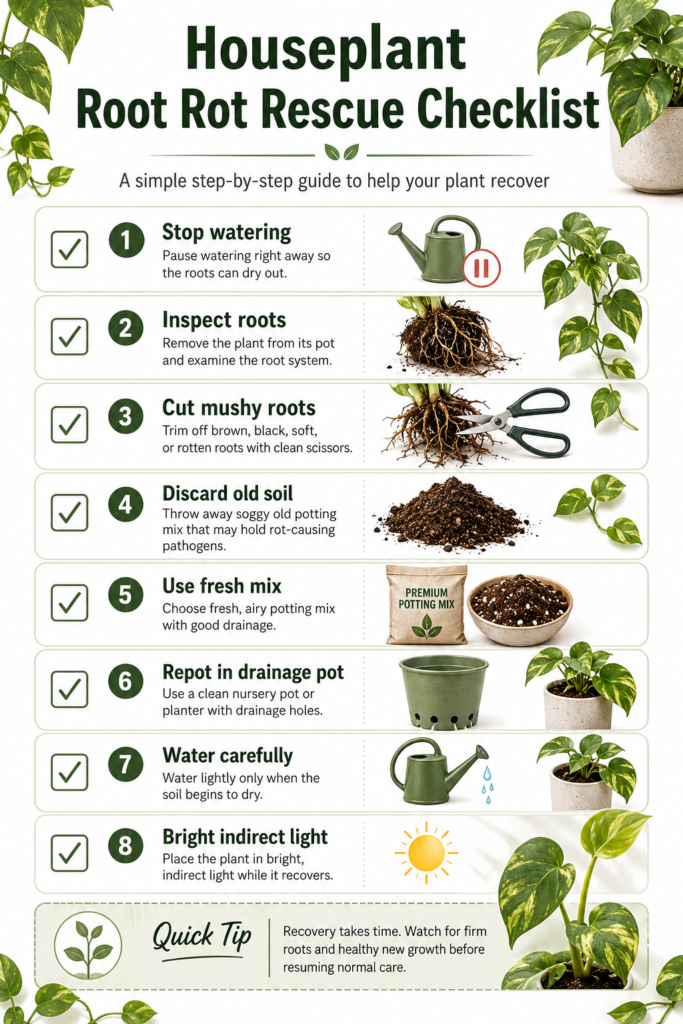
Use this checklist before, during, and after treatment:
- Check whether the soil is wet or dry.
- Remove the plant from the pot.
- Confirm root texture, not just leaf symptoms.
- Cut away black, brown, mushy, hollow, or smelly roots.
- Discard old potting mix.
- Clean or replace the pot.
- Choose a pot with drainage holes.
- Use fresh, well-draining mix.
- Repot into a pot that matches the remaining roots.
- Water lightly only if needed.
- Empty all runoff.
- Keep the plant in bright indirect light.
- Avoid fertilizer until growth stabilizes.
- Take cuttings if root loss is severe.
- Change the watering habit that caused the problem.
Firm roots plus a firm crown means rescue. Some root loss plus healthy stems means rescue with patience. Mostly rotten roots plus healthy nodes means propagate. Mushy crown plus rotten smell means discard. Wet soil plus wilting leaves means inspect before watering.
Root rot is fixable when you catch it early. Stop guessing from the leaves, inspect the roots, remove rotten tissue, and rebuild the potting environment.

Myra is the founder and lead writer of Plantsaholic. She shares practical, research-backed advice on indoor plants, outdoor gardening, flowers, herbs, succulents, and everyday plant care. Her goal is to help gardeners of all experience levels grow healthier plants through simple, easy-to-follow gardening guides.