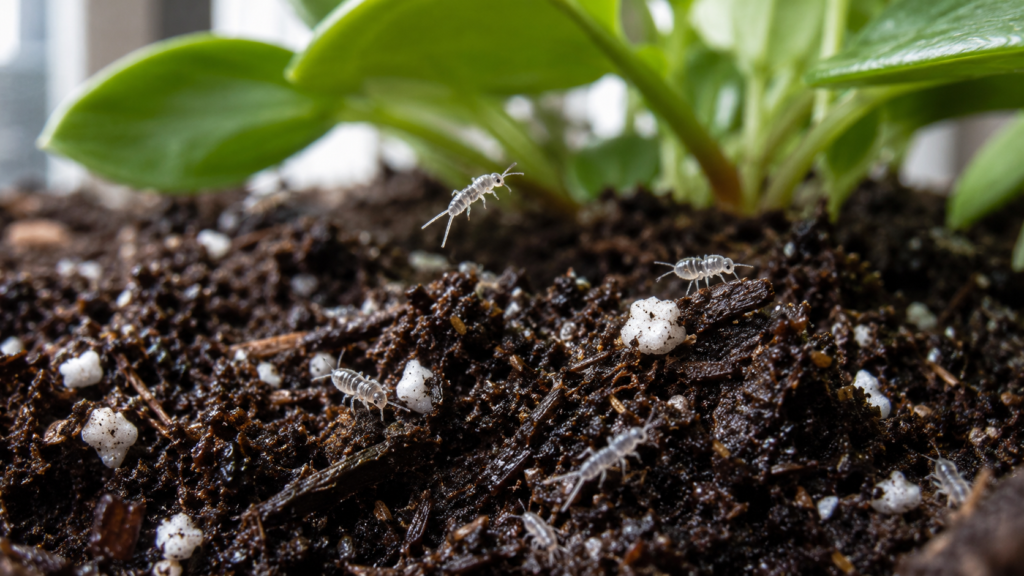
Noticed tiny bugs jumping across your houseplant soil after watering? They are probably springtails.
Springtails are tiny, wingless organisms that live in damp soil and feed mainly on fungi, algae, bacteria, and decaying organic matter. A few springtails are normally harmless to established houseplants. However, a large population may indicate that the potting mix is staying wetter than the plant requires.
There is usually no need to reach for pesticides or immediately repot the plant. First, confirm that the organisms are springtails, empty any standing water, check the soil moisture and drainage, and assess the plant’s health.
If the plant is yellowing, wilting despite wet soil, growing poorly, or producing a sour smell, inspect the roots. The springtails may not be harming the plant, but the wet conditions supporting them may also encourage root rot.
Springtails at a Glance
| Question | Direct answer |
|---|---|
| Are springtails harmful? | Usually not to established houseplants |
| Why are they in the soil? | Moisture, fungi, and decomposing material |
| Do springtails fly? | No, but they can jump |
| Do they indicate overwatering? | Large populations often indicate persistent moisture |
| Should the plant be isolated? | Usually not |
| Are pesticides required? | Rarely |
| When should you repot? | When the roots, soil, or drainage have failed |
| Are they harmful to people or pets? | No |
What Are Springtails?
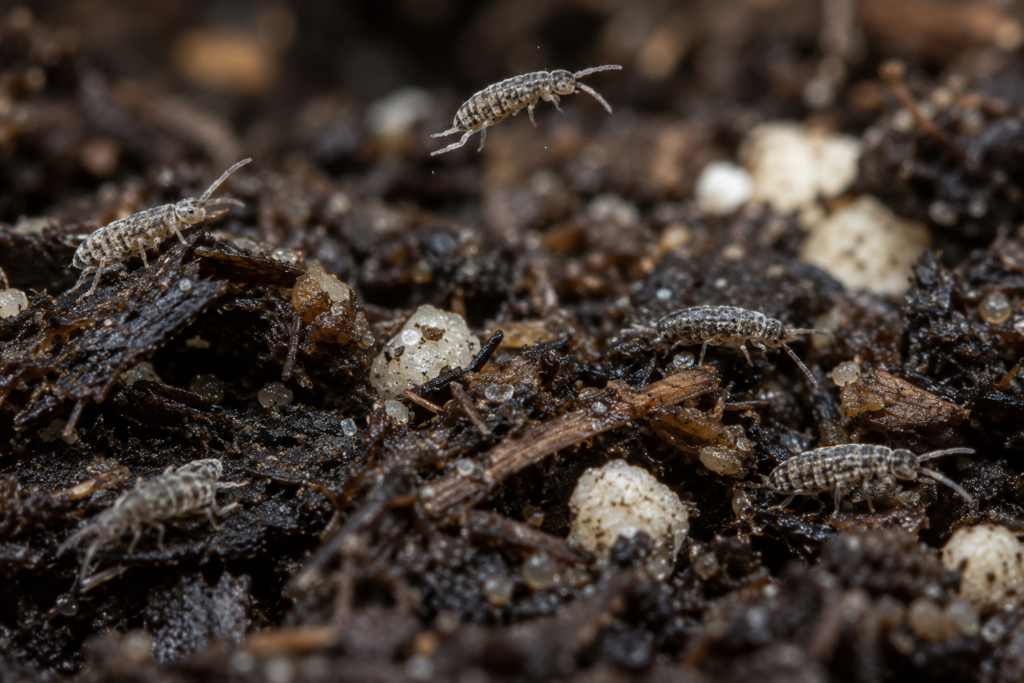
Springtails are minute, wingless arthropods belonging to a group called Collembola. Most springtails found in houseplant soil are around 1–3 millimetres long.
Depending on the species, they may appear:
- White
- Cream
- Grey
- Blue-grey
- Brown
- Almost black
Their bodies may be elongated or rounded.
Springtails get their name from a forked structure beneath the abdomen called a furcula. When disturbed, the furcula snaps against the surface and launches the springtail into the air.
This jumping action is a defence mechanism. Springtails do not jump onto plants to attack them, and they cannot fly around the home like fungus gnats.
Springtails commonly feed on:
- Fungi and fungal spores
- Algae and biofilm
- Bacteria and microorganisms
- Decaying leaves and stems
- Dead or damaged roots
- Organic material in bark, peat, moss, or compost
- Pollen and microscopic debris
In natural soil, springtails help break down dead organic material and contribute to nutrient cycling. A small population can therefore exist in healthy potting soil without causing damage.
Are Springtails Harmful?
Springtails are usually harmless to mature houseplants.
Most species are decomposers rather than plant-feeding pests. They consume fungi, microorganisms, algae, and decaying material instead of healthy leaves, stems, or roots.
You may notice springtails gathering around damaged roots. However, this does not necessarily mean they caused the damage. They may simply be feeding on the decomposing tissue.
Some springtail species can damage:
- Germinating seeds
- Very fine roots
- Young seedlings
- Tender new growth
This risk is mainly associated with unusually large populations and vulnerable plants. Established houseplants are rarely seriously damaged.
When a mature plant is declining, investigate more common causes before blaming springtails, including:
- Excessive watering
- Root rot
- Poor drainage
- Compacted soil
- Insufficient light
- Fertilizer buildup
- Temperature stress
- Fungus gnats
- Root mealybugs
- Root aphids
A healthy plant with a few springtails normally needs monitoring rather than treatment.
How to Identify Springtails
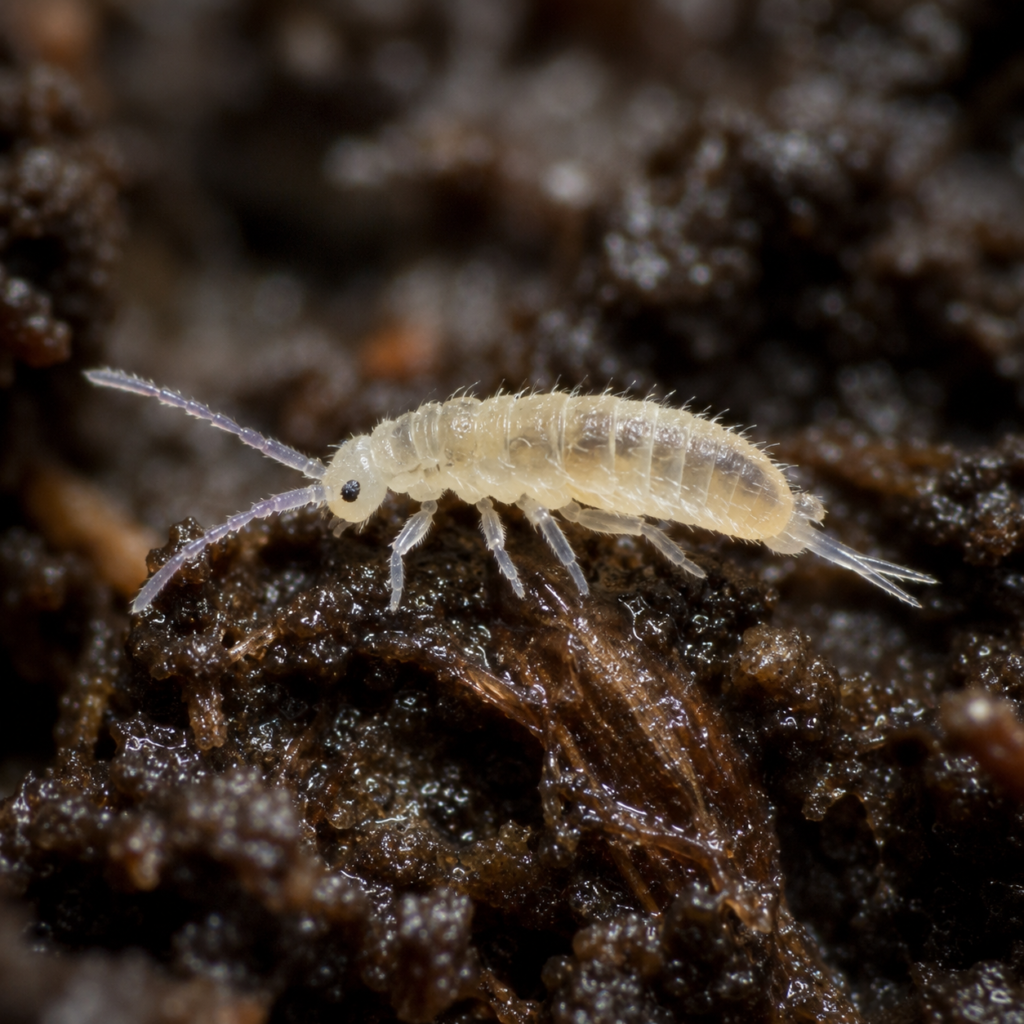
Movement is the easiest way to identify springtails.
They crawl over moist soil but jump suddenly when disturbed. They do not fly, hover around leaves, or gather around windows like adult fungus gnats.
To examine the organisms:
- Inspect the soil shortly after watering.
- Shine a bright light across the soil surface.
- Tap the side of the pot gently.
- Disturb a small area of soil with a wooden stick.
- Watch whether the organisms jump, crawl, or fly.
- Check the pot rim and drainage saucer.
- Inspect the inside of any decorative outer pot.
- Use a phone macro lens or magnifier if available.
Springtails may become especially visible after watering because water pushes them toward the soil surface. Some may also be washed through drainage holes into the saucer.
Their lightweight bodies can float on water, which is why they are sometimes seen moving across the surface of water collected beneath a pot.
Do not identify soil organisms by colour alone. Springtails, mites, fungus gnat larvae, and young root pests may all appear white or pale without magnification.
Movement, body shape, exact location, and plant symptoms provide more reliable clues.
Springtails vs Other Soil Bugs
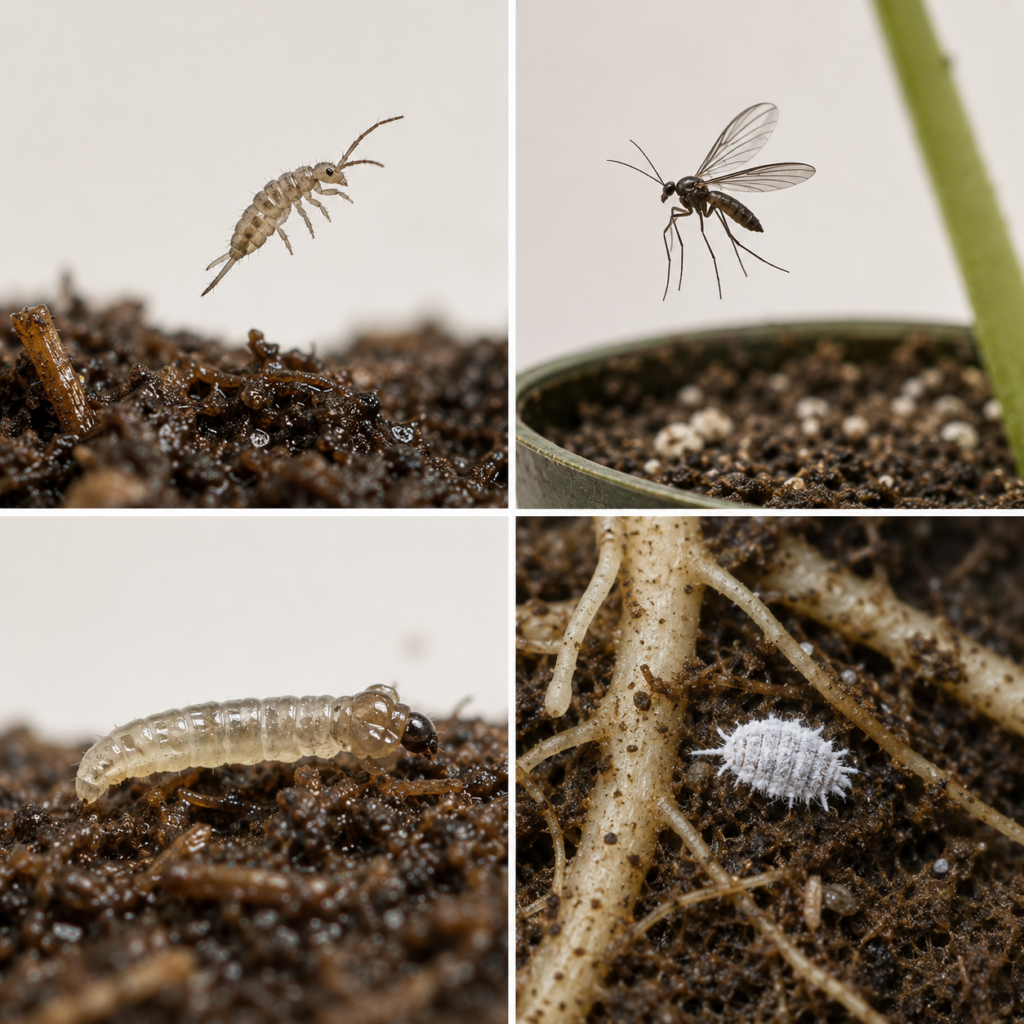
Springtails are often confused with fungus gnats because both are associated with moist, organic potting soil.
| Organism | Movement | Main clue | Plant risk |
|---|---|---|---|
| Springtail | Jumps and crawls | Wingless and active on wet soil | Usually harmless |
| Adult fungus gnat | Flies weakly | Small dark fly around plants and windows | Mostly a nuisance |
| Fungus gnat larva | Crawls | Clear, wormlike body with a dark head | May damage fine roots |
| Soil mite | Crawls steadily | Rounded body and does not jump | Usually harmless |
| Root mealybug | Moves slowly | White cottony wax around roots | Harmful |
| Root aphid | Crawls | Waxy colonies attached to roots | Harmful |
| Flea | Jumps | Usually linked to an animal host | Not a soil decomposer |
Springtails and fungus gnats can live in the same pot. Seeing jumping organisms does not automatically rule out a fungus gnat problem.
Yellow sticky cards may help detect flying fungus gnat adults, but they will not control springtails living inside the soil.
Seek expert identification when:
- The organisms do not consistently jump.
- White cottony material appears around the roots.
- Several plants begin declining together.
- The insects are attached to roots or stems.
- You are considering pesticide treatment.
Why Do Springtails Appear
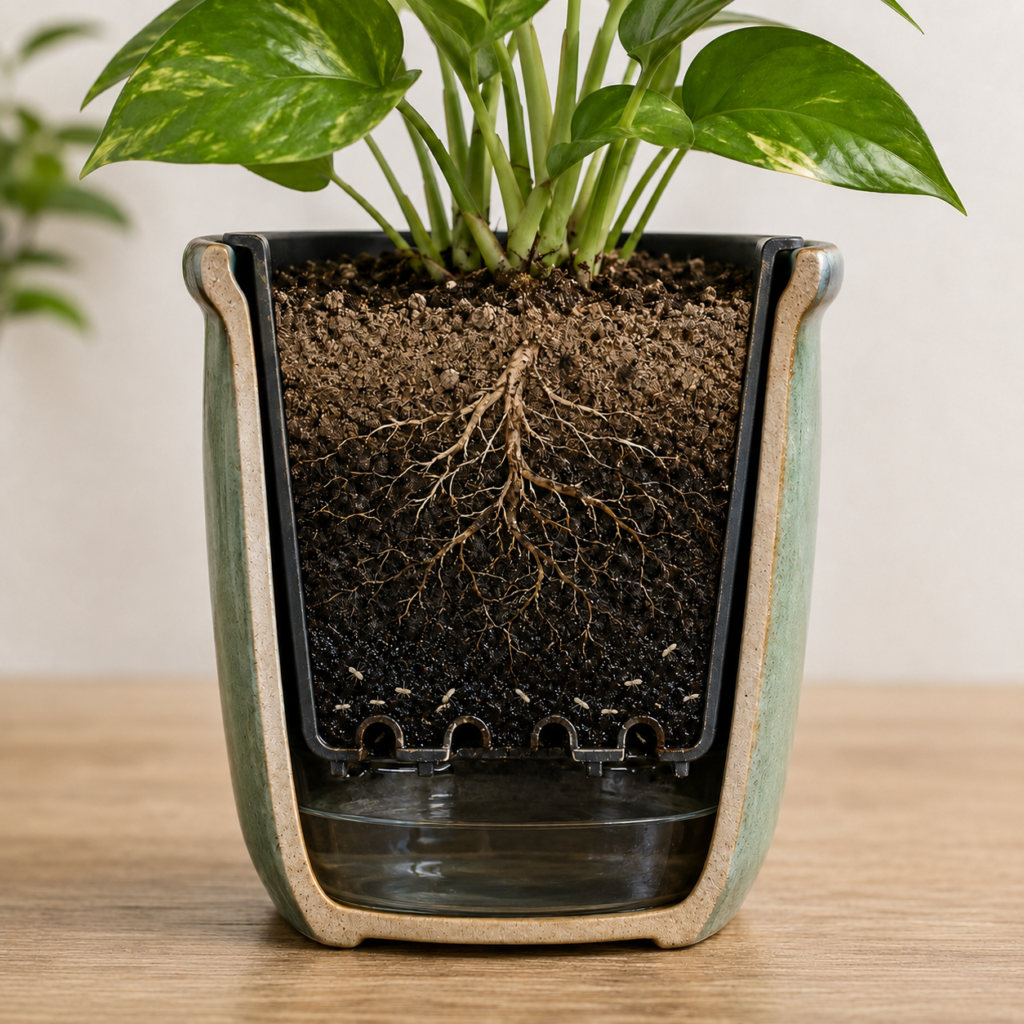
Springtails multiply when a pot provides three things:
- Moisture
- Shelter
- Organic food
The main trigger is usually not one heavy watering. It is a watering routine that prevents the deeper root zone from drying appropriately.
Common causes include:
- Watering according to a fixed schedule
- Watering again before deeper soil has dried
- Standing water inside a saucer or cachepot
- Blocked drainage holes
- Pots without drainage holes
- Dense or compacted soil
- Deteriorated potting mix
- A container that is too large for the root system
- Low light that slows plant water use
- Cooler temperatures
- High humidity
- Poor air circulation
- Decaying leaves or moss
- Algae and fungal growth
- Springtails already present in nursery soil
The soil surface may look dry while the centre or bottom of the pot remains saturated.
This often happens when a small plant is placed in a large amount of soil. It can also occur when a plastic nursery pot sits inside a decorative container containing hidden water.
A few springtails do not automatically prove that the plant is overwatered.
The more concerning signs are:
- Large numbers of springtails
- Soil that remains wet for many days
- Standing water
- Green algae
- A sour smell
- Yellowing leaves
- Poor growth
- Wilting while the soil is wet
What Should You Do?
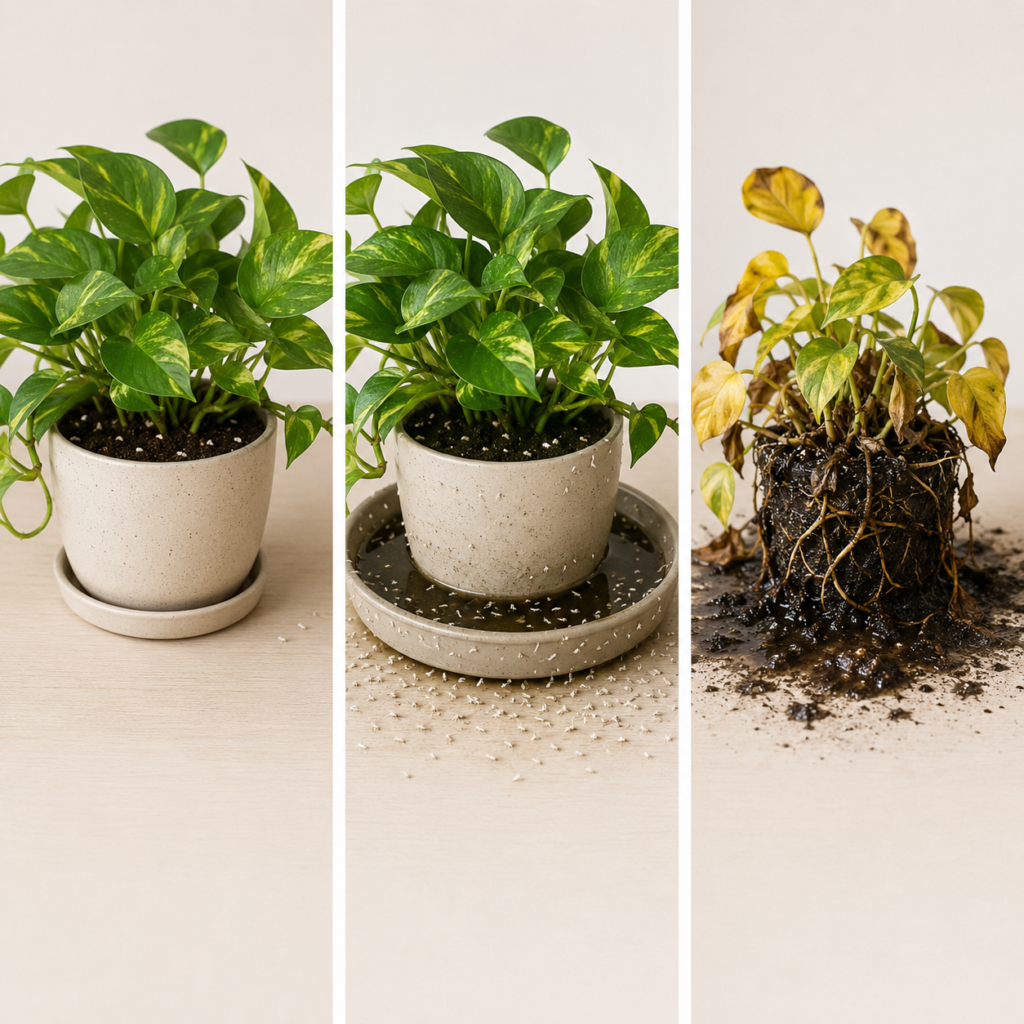
Your response should depend on the condition of the plant, not only on the number of organisms you can see.
A Few Springtails and a Healthy Plant
Leave them alone and monitor the plant. Direct treatment is usually unnecessary.
Many Springtails but Healthy Foliage
Check the watering routine, drainage holes, saucer, and decorative outer pot.
Yellow Leaves and Wet Soil
Review watering frequency, available light, soil condition, and root health.
Wilting While the Soil Is Damp
Inspect the roots. Wilting in wet soil may indicate that damaged roots can no longer absorb water properly.
Tiny Flying Insects
Investigate fungus gnats rather than springtails.
White Cottony Material Around Roots
Investigate root mealybugs.
Sour or Compacted Soil
The potting mix may have deteriorated and require replacement.
Springtails Appearing Around the Room
Look for another source of moisture, such as leaking trays, condensation, wet shelves, or plumbing problems.
Environmental correction should normally come before pesticides or emergency repotting.
How to Get Rid of Springtails
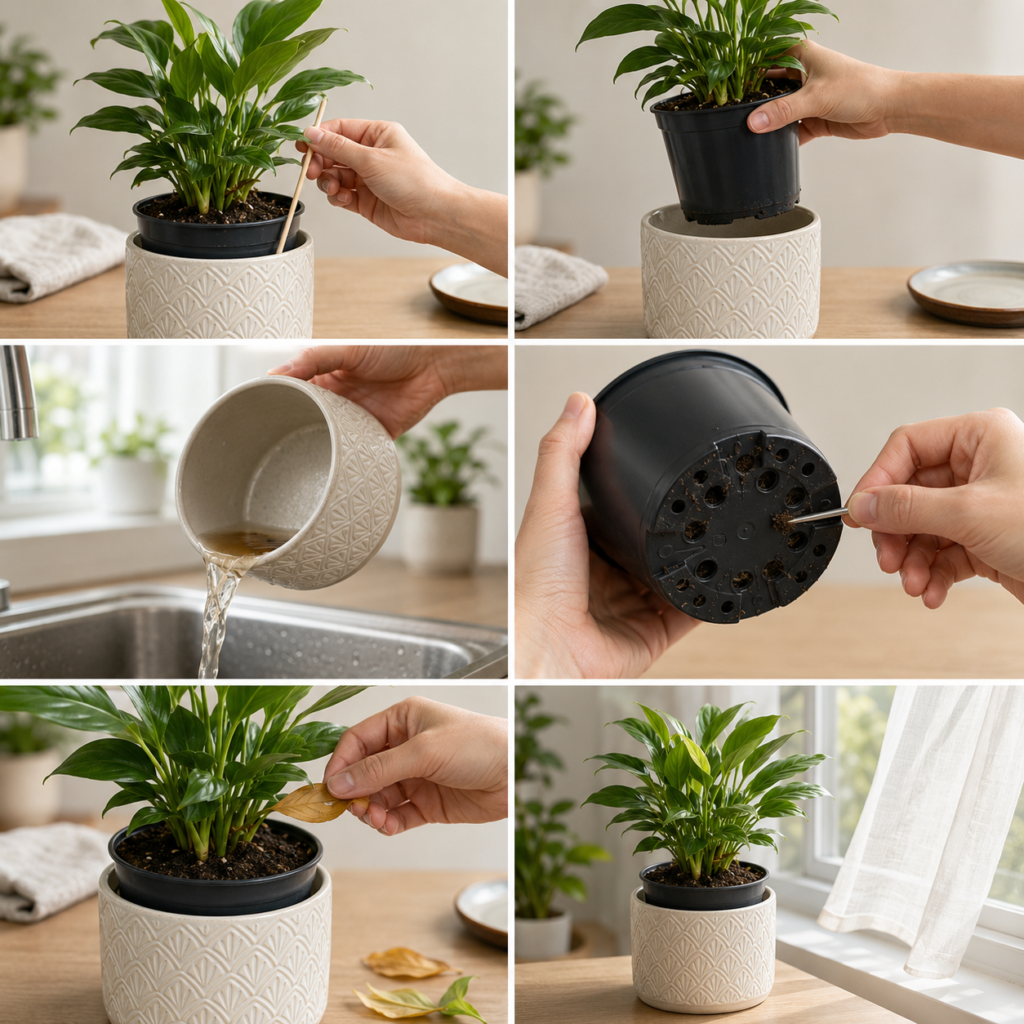
To reduce springtails, make the soil less continuously wet while still meeting the plant’s moisture requirements.
1. Confirm the Identification
Make sure the organisms jump and do not fly.
If they move slowly, have dark heads, or leave waxy or cottony material, they may be another soil pest.
2. Empty Standing Water
Check both the drainage saucer and decorative outer pot.
A nursery pot may appear to be draining correctly while sitting in water inside a cachepot. This keeps the lower root zone saturated and creates ideal conditions for springtails.
Empty standing water after each watering.
3. Check Moisture Below the Surface
Surface dryness can be misleading.
Useful ways to assess deeper moisture include:
- Lifting the pot to compare its weight
- Inserting a wooden skewer
- Checking below the surface with a finger
- Observing how long the pot takes to become lighter
A moisture meter may provide extra information, but it should not be the only method used.
4. Adjust the Watering Routine
Do not water automatically because a certain number of days has passed.
Water when the plant reaches its appropriate moisture threshold. This threshold will vary depending on the plant species, pot size, soil type, light, temperature, and season.
5. Improve Drainage
Make sure drainage holes are open and excess water can escape freely.
If the soil is dense or compacted, improving the watering schedule may not be enough. Severely deteriorated soil may need to be replaced.
6. Remove Decomposing Material
Remove:
- Fallen leaves
- Dead flowers
- Rotting moss
- Dead stems
- Organic debris
These materials provide additional food for fungi and decomposers.
7. Improve Light and Airflow
Suitable light helps the plant grow and use water more efficiently.
Gentle airflow can also prevent the surface from remaining continuously damp. Avoid placing the plant in harsh direct sun unless the species can tolerate it.
8. Monitor the Next Few Watering Cycles
Springtails may not disappear immediately.
Monitor the population over two or three appropriate watering cycles. Numbers should gradually decline as the habitat becomes less favourable.
9. Inspect the Roots if Symptoms Continue
If the plant remains unhealthy, remove it carefully from the pot and examine the roots.
Healthy roots are commonly:
- Firm
- Pale
- Cream-coloured
- Light brown, depending on the species
Rotten roots may be:
- Black
- Dark brown
- Soft
- Mushy
- Foul-smelling
- Easy to pull apart
Killing springtails will not restore a plant with root rot. The damaged root system and failed growing conditions must be addressed.
How Dry Should the Soil Get?
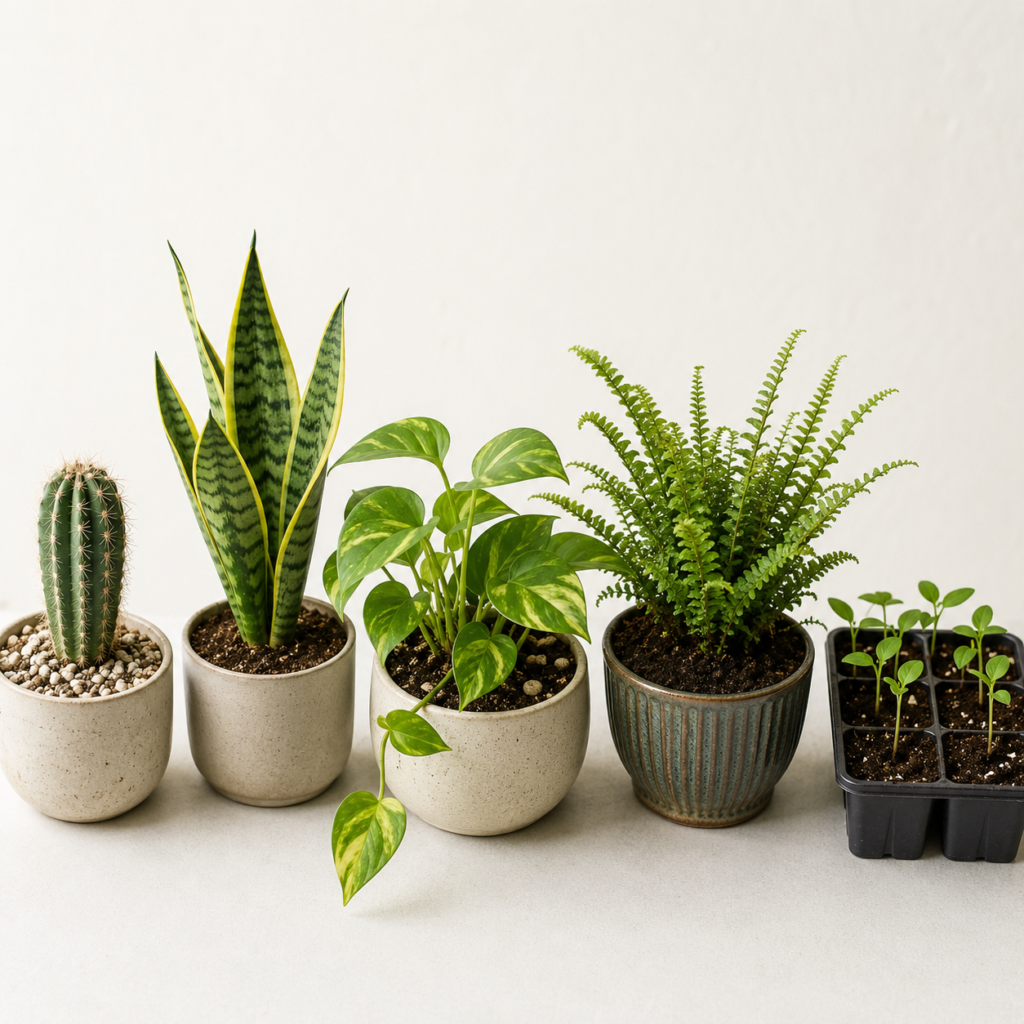
There is no universal drying rule for every houseplant.
| Plant group | Suggested moisture checkpoint |
|---|---|
| Cacti and succulents | Allow most or all of the mix to dry |
| Snake plants and ZZ plants | Let most of the root zone dry |
| Pothos and philodendrons | Rewater when the upper layer is dry and the pot feels lighter |
| Monsteras and many aroids | Allow the upper section to dry |
| Peace lilies | Reduce saturation without prolonged severe drought |
| Ferns | Let the surface begin drying while deeper soil remains lightly moist |
| Calatheas and marantas | Maintain moderate moisture without waterlogging |
| Seedlings | Keep evenly moist but aerated |
| Fresh cuttings | Avoid saturation and complete dryness |
| Orchids in bark | Allow water to drain and bark to approach dryness |
| Bog plants | Do not apply standard houseplant drying advice |
Advice to “let the soil dry completely” may work for succulents but could seriously damage ferns, seedlings, prayer plants, or fresh cuttings.
Bottom watering also does not guarantee springtail control. Leaving a pot soaking for too long may keep the lower root zone saturated.
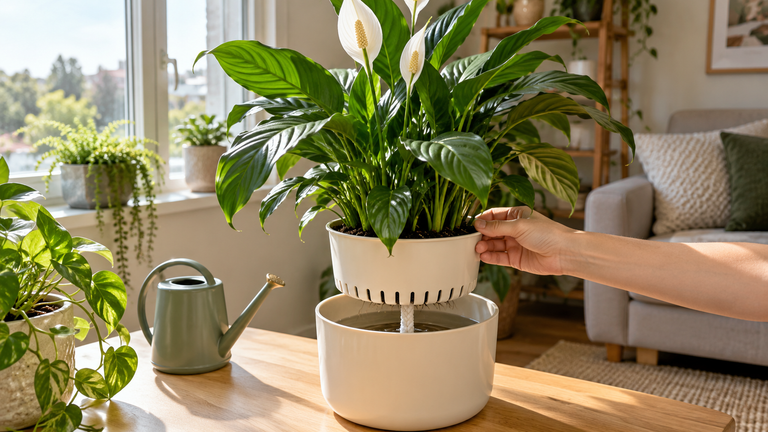
Similarly, self-watering reservoirs should be managed according to the needs of the plant rather than kept permanently full.
When Springtails Signal Problems
Springtails often act as indicators of a damp, fungus-rich environment.
They may not be causing the plant’s decline, but the same conditions supporting them can reduce oxygen around the roots and encourage decay.
| What you notice | Possible explanation | Best action |
|---|---|---|
| Springtails with healthy growth | Suitable habitat | Monitor |
| Yellow lower leaves and wet soil | Excessive moisture | Adjust watering |
| Wilting in wet soil | Root dysfunction | Inspect roots |
| Sour smell | Anaerobic soil or decay | Unpot and examine |
| Green algae | Persistent surface moisture | Improve growing conditions |
| Black, mushy roots | Root rot | Remove damaged roots and repot |
| Firm, pale roots | Healthy roots | Avoid unnecessary disturbance |
| Water beneath the inner pot | Hidden saturation | Empty and clean cachepot |
A wet plant may wilt because damaged roots cannot absorb and transport water effectively. Adding more water usually makes the problem worse.
When Should You Repot?
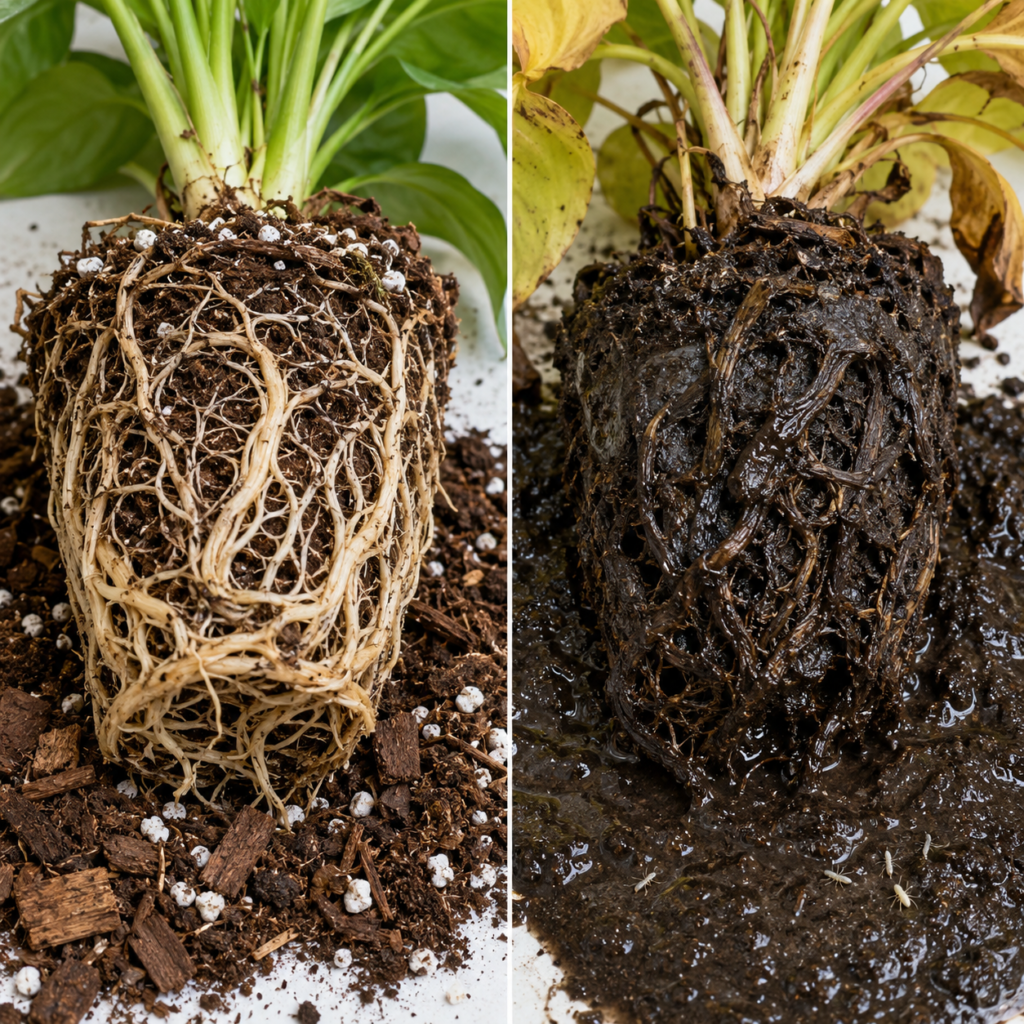
Do not repot a healthy plant solely because a few springtails are present.
Repotting disturbs the roots and changes how moisture moves through the container. It should be reserved for situations where the roots, soil, or drainage system have failed.
Repot When:
- The soil remains wet for an unusually long time.
- Water drains very slowly.
- The mix has collapsed or compacted.
- The soil smells sour or rotten.
- Roots are black, soft, or mushy.
- The pot has no functional drainage.
- Heavy garden soil was used indoors.
- The container is much larger than the root system.
- Another harmful root pest is present.
- Moisture correction fails to resolve an extreme problem.
Use a clean container with drainage holes and a potting mix suited to the plant.
Do not automatically move the plant into a much larger pot. Excess soil surrounding a small root system can stay wet for too long.
Trim only roots that are clearly dead or rotten. Use clean tools and preserve firm, healthy roots whenever possible.
Do Home Remedies Work?
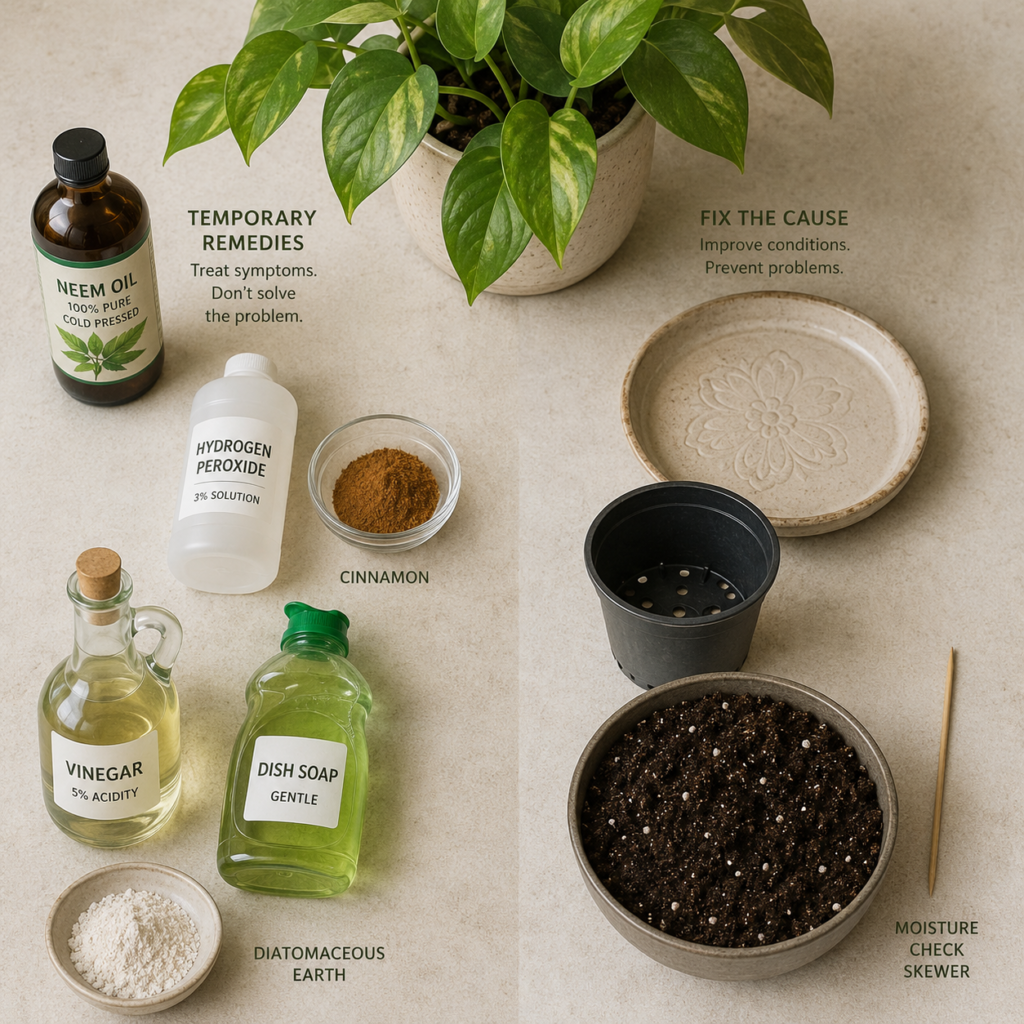
Many online remedies focus on killing visible springtails rather than correcting the damp conditions that support them.
| Remedy | Recommendation | Main limitation |
|---|---|---|
| Correcting moisture | Recommended | Must be appropriate for the plant |
| Emptying standing water | Recommended | Hidden cachepots are often overlooked |
| Improving drainage | Recommended | Severe problems may require repotting |
| Removing debris | Recommended | Does not correct deep saturation alone |
| Neem oil drench | Usually unnecessary | May not be labelled for this use |
| Hydrogen peroxide | Not a first choice | Incorrect use may damage roots |
| Cinnamon | Weak option | Does not correct moisture |
| Vinegar | Avoid | Can injure roots and change soil pH |
| Dish soap drench | Avoid | Not formulated for root systems |
| Diatomaceous earth | Limited value | Becomes ineffective when wet |
| Sticky traps | Not useful for springtails | Designed for flying insects |
| General insecticide | Usually unnecessary | Does not solve the habitat problem |
A direct pesticide treatment may be justified only when:
- The organisms have been correctly identified.
- The population remains extreme after environmental correction.
- Springtails repeatedly leave the pot.
- Tender seedlings are being damaged.
Use only products legally labelled for the plant, target organism, indoor location, and application method in your country.
How to Prevent Springtails
Springtails are likely to return if the soil remains continuously damp.
To prevent excessive populations:
- Check the soil before watering.
- Use watering reminders as inspection prompts, not automatic watering dates.
- Match the potting mix to the plant.
- Use containers with drainage holes.
- Empty saucers and cachepots.
- Remove fallen leaves and decaying moss.
- Replace compacted or deteriorated soil.
- Provide suitable light.
- Improve gentle airflow.
- Avoid oversized pots.
- Inspect new nursery plants.
- Adjust watering during cooler or darker months.
- Clean wet shelves and trays.
- Monitor self-watering reservoirs.
The objective is not to create sterile soil. Healthy potting soil contains microorganisms and may support a few harmless arthropods.
The goal is to keep moisture, drainage, oxygen, and decomposition in balance.
Can Springtails Spread?
Springtails can crawl or jump into nearby damp pots, especially when plants share wet trays or touch each other.
However, they do not infect plants like a disease. They also cannot maintain a lasting population on clean, dry household surfaces.
If springtails repeatedly appear away from the plant, inspect for:
- Leaking saucers
- Damp shelves
- Humidifier spills
- Wet moss poles
- Condensation
- Plumbing leaks
- Damp wood
- Stored wet potting soil
- Water beneath trays or furniture
Vacuuming or wiping them away provides temporary cosmetic control. They may return until the source of moisture is corrected.
Springtails do not bite, sting, infest pets, contaminate food, or damage furniture.
Springtails in Special Growing Systems
Terrariums
Springtails are sometimes deliberately added to bioactive terrariums because they consume fungi and decomposing organic material.
Their presence can be beneficial when the system is balanced. Excessive numbers combined with foul odour, rotting plants, heavy algae, or constant condensation suggest that moisture and ventilation need adjustment.
Propagation Boxes
Propagation containers require high humidity, but the rooting material must still contain oxygen.
Do not completely dry unrooted cuttings to eliminate springtails. Instead:
- Increase brief air exchange.
- Remove rotting material.
- Reduce standing water.
- Use an airy propagation mix.
Self-Watering Pots
A reservoir can benefit moisture-loving plants, but it may keep unsuitable species constantly saturated.
Allow the reservoir to empty when the plant and system permit it. Check whether the wick is supplying water faster than the plant can use it.
Moss Poles and Orchid Bark
Constantly wet moss poles may support springtails and drip water into the pot.
Orchid bark may also become more moisture-retentive as it decomposes. Replace degraded bark when drainage and aeration begin to decline.
FAQ’S
Are springtails harmful to houseplants?
Springtails are usually harmless to established plants. They mainly feed on fungi, microorganisms, and decomposing organic matter.
Do springtails eat healthy roots?
Most springtails do not significantly damage healthy mature roots. Some species may affect germinating seeds, fine roots, or tender seedlings in unusually high numbers.
Do springtails mean my plant is overwatered?
A few springtails do not prove overwatering. However, a large population often indicates that the potting mix remains persistently damp.
Why do springtails appear after watering?
Water pushes hidden springtails toward the soil surface and creates the moist conditions they prefer.
How do I get rid of springtails?
Empty standing water, adjust the watering routine, remove decomposing debris, improve drainage, and allow the soil to reach the plant’s appropriate drying point.
Should I let the soil dry completely?
Only if complete drying is suitable for the plant. Moisture-sensitive plants may require reduced saturation rather than complete dryness.
Are springtails the same as fungus gnats?
No. Springtails are wingless and jump. Adult fungus gnats are small dark flies.
Should I isolate the plant?
Confirmed springtails normally do not require isolation. Temporary isolation may be useful when the identification is uncertain or another pest is suspected.
Will repotting remove springtails?
Repotting may remove many springtails, but they can return if the new growing medium remains continuously wet.
Does bottom watering prevent springtails?
Not necessarily. Leaving the pot soaking for too long may keep the lower soil saturated.
Are springtails harmful to people or pets?
No. Springtails do not bite, sting, infest animals, or damage household property.
How long does it take to reduce springtails?
The population may begin declining after one or more appropriate drying cycles. The timing depends on the plant, pot size, soil, temperature, and original population.
Final Verdict
Springtails in houseplant soil are normally harmless decomposers rather than destructive plant pests.
A small population can usually be tolerated when the plant is healthy and the potting mix drains and dries appropriately.
Large populations deserve attention because they often indicate:
- Persistent moisture
- Hidden standing water
- Decomposing organic material
- Poor drainage
- Deteriorated potting soil
Correct these conditions before attempting direct treatment.
Empty the cachepot, check moisture below the surface, remove dead material, and adjust watering according to the plant’s needs.
Inspect the roots if the plant wilts in wet soil, develops yellow leaves, produces a sour smell, or grows poorly. Repot only when the roots, soil, or container have failed.
Avoid improvised vinegar, dish soap, peroxide, or pesticide drenches that may damage the plant without correcting the underlying problem.
The practical rule is simple:
- Leave a few springtails in a healthy pot alone.
- Correct excess moisture when numbers become high.
- Inspect roots when the plant begins declining.
- Repot when the growing environment has failed.
- Investigate another pest when the organisms do not jump.
Healthy roots need both water and oxygen. Restoring that balance protects the plant and naturally limits excessive springtail populations.
Myra is the founder and lead writer of Plantsaholic. She shares practical, research-backed advice on indoor plants, outdoor gardening, flowers, herbs, succulents, and everyday plant care. Her goal is to help gardeners of all experience levels grow healthier plants through simple, easy-to-follow gardening guides.