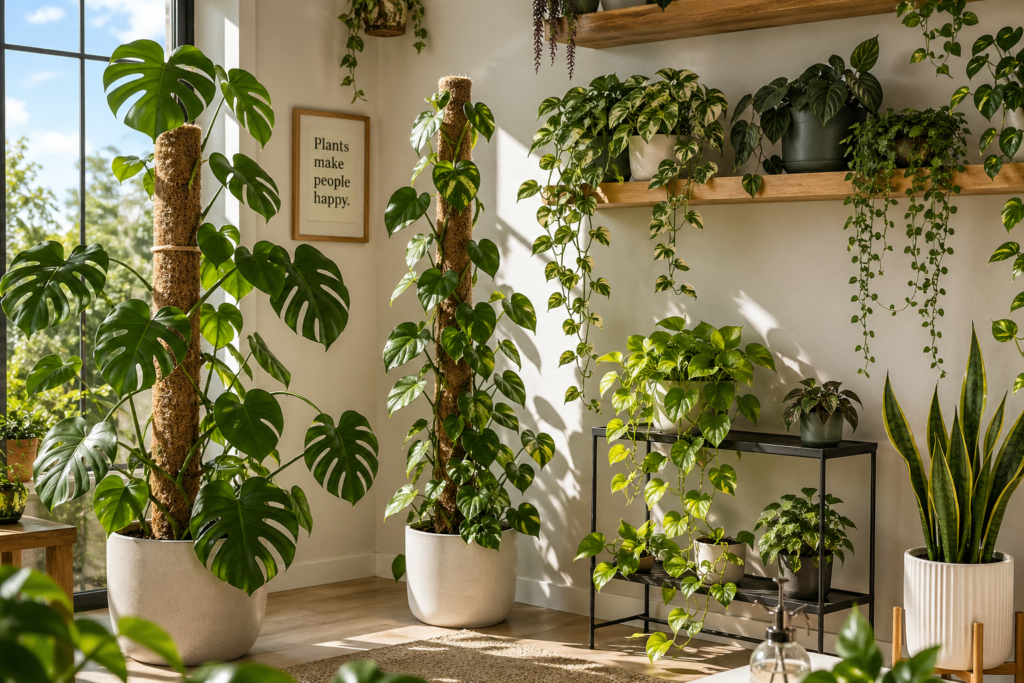
Vine plants are among the most flexible houseplants because they can trail, climb, spread, hang, or wrap around supports. They work well on shelves, moss poles, trellises, walls, hanging baskets, balconies, offices, and indoor plant corners.
Growing vine plants like an expert is not about watering on a fixed schedule. It is about understanding how vines naturally grow. Most vine plants climb toward light, grow from nodes, and respond strongly to support, pruning, light, and root health.
Expert vine care depends on:
- Bright indirect light
- Airy soil
- Correct watering
- Structural support
- Regular pruning
- Seasonal adjustment
Whether you grow Pothos, Philodendron, Monstera, Hoya, English ivy, or String of Hearts, the same rule applies: build the right growing system, and the plant responds with stronger roots, fuller vines, larger leaves, and healthier growth.
What Makes Vine Plants Different From Other Houseplants?
Vine plants are built for movement. Unlike upright plants that grow with thick stems or trunks, vines produce flexible stems that search for light and support. This allows them to climb poles, trail from shelves, wrap around trellises, or spill from hanging baskets.
The biggest difference is node-based growth. Each node can produce leaves, roots, branches, or aerial roots. This makes vine plants easier to prune, propagate, and reshape than many upright plants.
Key differences include:
- Flexible stems
- Growth from nodes
- Strong propagation ability
- Fast recovery after pruning
- Climbing or trailing growth habits
Main vine growth styles:
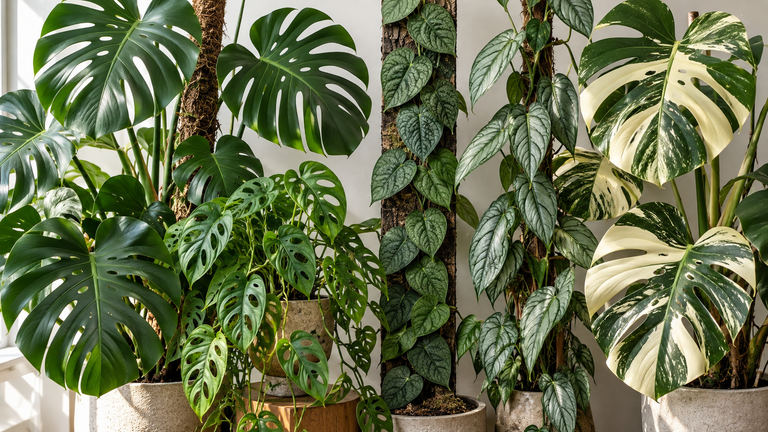
Climbing vines
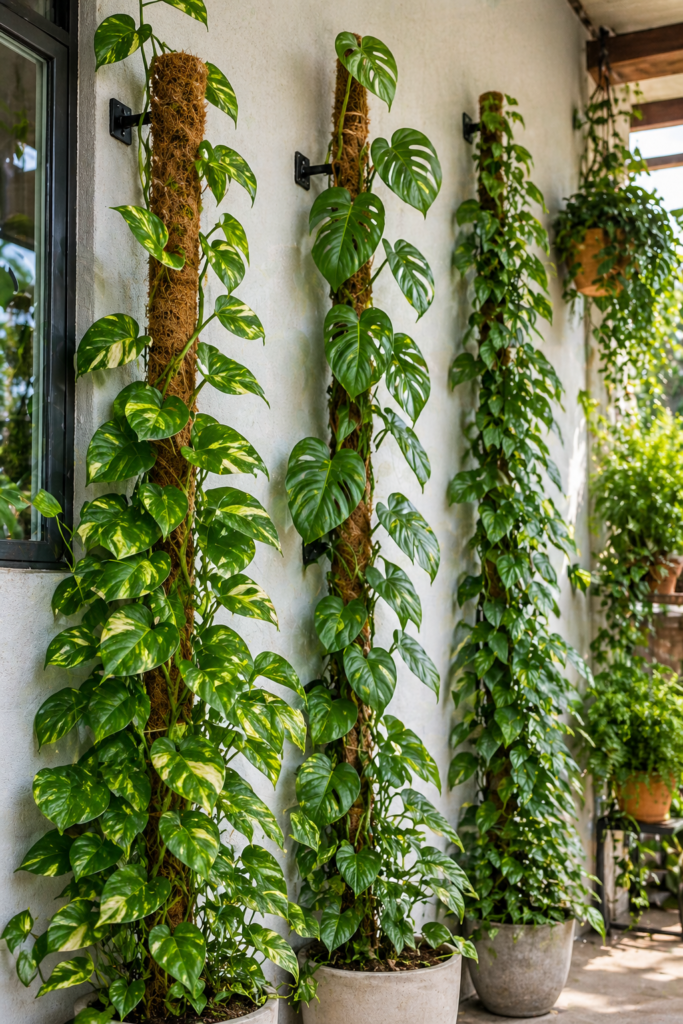
Climbing vines search for support and often grow stronger when trained upward.
Examples:
- Monstera deliciosa
- Epipremnum aureum
- Philodendron hederaceum
Trailing vines
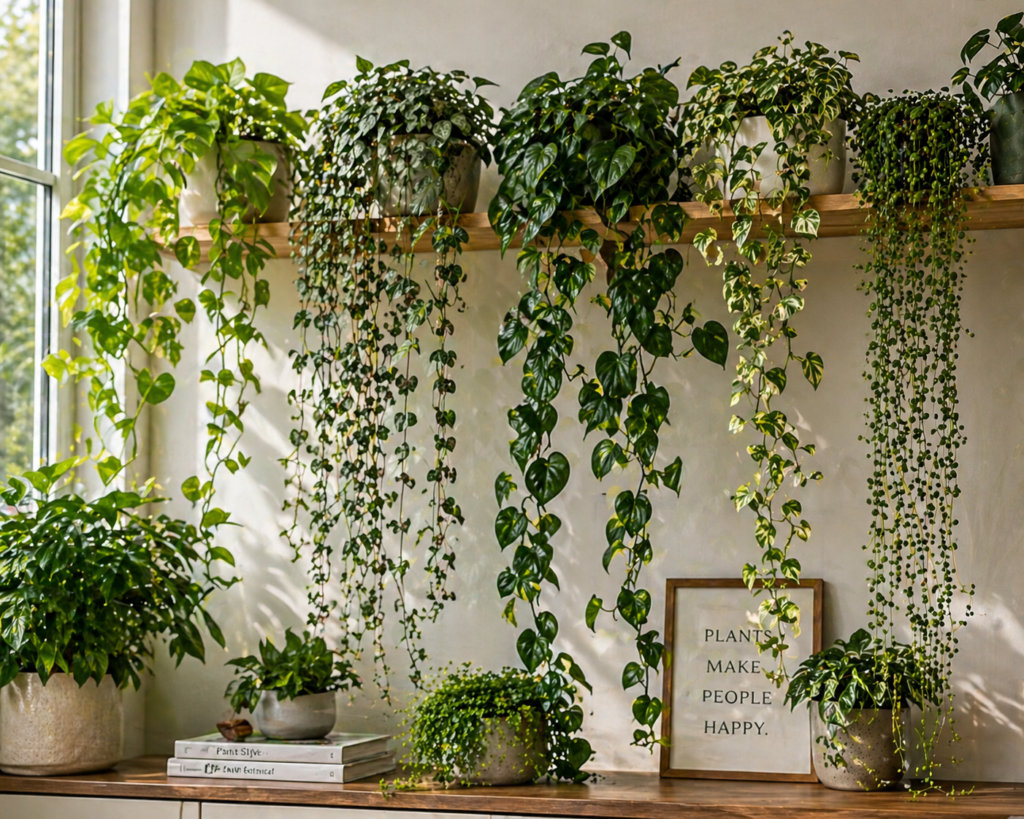
Trailing vines naturally hang downward and look attractive on shelves, baskets, and plant stands.
Examples:
- Ceropegia woodii
- Hedera helix
- Tradescantia zebrina
Decision rule:
Grow vines upward for bigger leaves and stronger stems. Let them trail for soft decorative movement.
How Do You Choose the Best Vine Plant for Your Home?
Choosing the right vine plant starts with your space, not the plant’s appearance. Many beginners buy a beautiful vine first and later realize their room does not provide enough light, humidity, or space.
Expert growers check the growing conditions first. Then they choose a vine that matches the room.
Important selection factors:
- Light intensity
- Window direction
- Room humidity
- Vertical space
- Hanging or climbing preference
- Growth speed
- Pet safety
Best Vines for Lower Light
- Epipremnum aureum
- Philodendron hederaceum
- Scindapsus pictus
Best Vines for Bright Indirect Light
- Monstera deliciosa
- Hoya carnosa
- Ceropegia woodii
Best Beginner Vines
- Pothos
- Heartleaf Philodendron
- Syngonium podophyllum
Real-world example:
A Hoya in a dim hallway may barely grow, while the same plant near a bright east-facing window can produce new vines and flowers.
Decision rule:
Start with Pothos if you are new to vine plants. It is forgiving, fast-growing, and easy to propagate.
What Light Conditions Help Vine Plants Grow Faster?
Light is the main driver of vine growth. Without enough usable light, fertilizer, watering, and pruning cannot fully fix slow growth. Light affects stem length, leaf size, root strength, color, and branching density.
Most indoor vine plants prefer bright indirect light. Many evolved under tropical forest canopies, where they receive filtered sunlight rather than harsh direct sun all day.
Best light conditions:
- Bright indirect light
- Filtered morning sun
- East-facing window light
- South-facing window with a sheer curtain
- Stable daily brightness
Signs of insufficient light:
- Long gaps between leaves
- Small new leaves
- Slow growth
- Pale foliage
- Vines leaning toward the window
Signs of too much direct sun:
- Burn marks
- Crispy edges
- Faded color
- Dry leaf patches
Real-world example:
A Pothos far from a window may survive but grow slowly. Move it closer to bright indirect light, and growth often improves within weeks.
Decision rule:
If internode spacing is increasing, your vine usually needs more light.
What Is the Best Soil Mix for Vine Plants?
Soil is the root environment. Vine roots need moisture, oxygen, and space. Most beginner problems happen when soil holds too much water and not enough air.
The best soil for vine plants is loose, airy, and well-draining. It should hold some moisture but dry fast enough to prevent root suffocation.
Ideal vine plant soil mix:
- 40% quality potting mix
- 30% perlite
- 20% orchid bark
- 10% compost
Why this works:
- Potting mix provides base nutrition
- Perlite improves oxygen flow
- Bark adds structure and drainage
- Compost supports healthy root activity
Plant-specific adjustments:
Monstera deliciosa
Add more bark for chunkier structure.
Hoya carnosa
Add more perlite for faster drying.
Hedera helix
Keep slightly more moisture retention.
Signs soil is too dense:
- Soil stays wet too long
- Sour smell from the pot
- Fungus gnats appear
- Growth slows
- Leaves yellow despite watering
Decision rule:
Many watering problems are actually soil problems. If the roots cannot breathe, the vine cannot grow well.
What Type of Pot Is Best for Vine Plants?
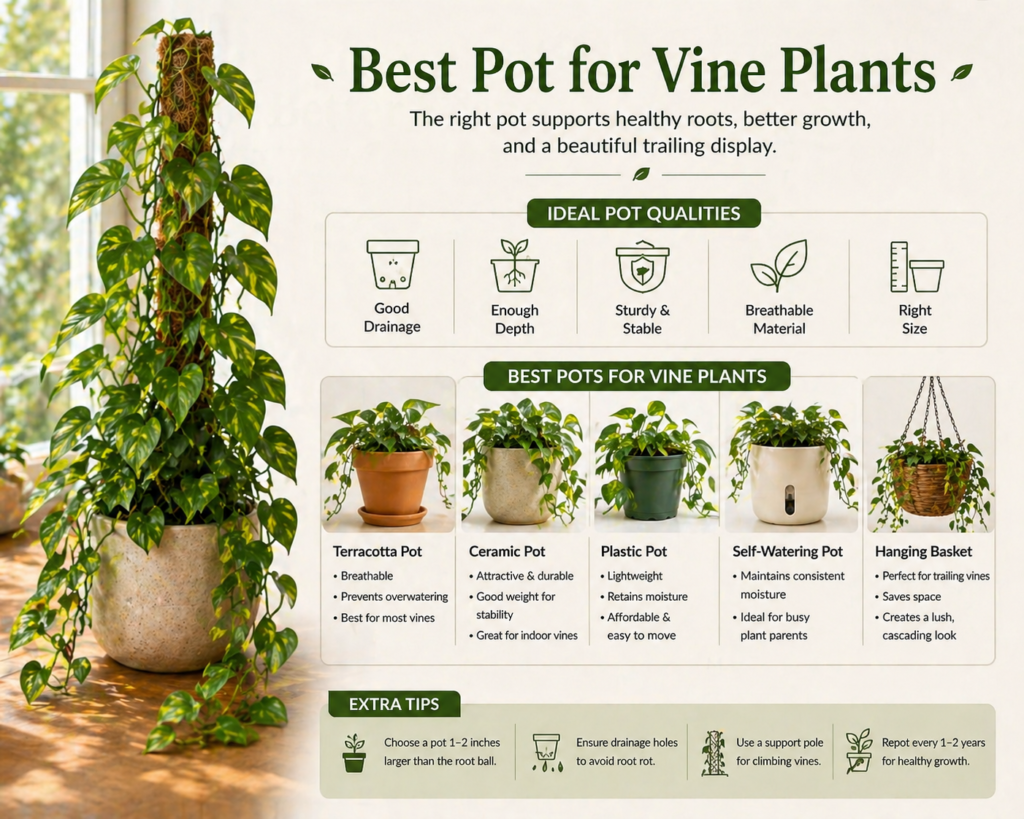
The pot affects root health, drainage, watering frequency, and plant stability. A healthy vine needs a container that allows excess water to escape while supporting root expansion.
Terracotta and plastic pots behave differently. Terracotta dries faster because it is porous. Plastic holds moisture longer, which helps in dry rooms or for moisture-loving vines.
Terracotta Pots
Best for:
- Hoya carnosa
- Ceropegia woodii
- String-type vines
Benefits:
- Faster drying
- Better airflow
- Lower overwatering risk
Plastic Pots
Best for:
- Epipremnum aureum
- Philodendron hederaceum
- Moisture-tolerant vines
Benefits:
- Holds moisture longer
- Lightweight
- Good for hanging baskets
Pot rules:
- Always use drainage holes
- Avoid oversized pots
- Size up only 1–2 inches
- Use stable pots for climbing vines
Decision rule:
The best pot matches your watering habits and the plant’s growth style.
How Often Should You Water Vine Plants?
Watering should be based on soil condition, not a strict calendar. Expert growers check the root zone before watering.
Most vine plants prefer partial drying between watering. This creates a healthy moisture-oxygen cycle. Constant wet soil lowers oxygen and increases root rot risk.
General watering rule: Water when the top 1–2 inches of soil feel dry.
Watering frequency depends on:
- Pot size
- Soil structure
- Room temperature
- Light level
- Humidity
- Season
Seasonal guide:
Spring and Summer
- More active growth
- Usually every 5–7 days
Fall and Winter
- Slower growth
- Usually every 10–14 days
Signs of overwatering:
- Yellow leaves
- Soft stems
- Wet, heavy soil
- Fungus gnats
- Root smell
Signs of underwatering:
- Drooping leaves
- Curling leaves
- Dry edges
- Crispy foliage
Best watering method:
- Water deeply
- Let excess water drain
- Empty saucers
- Never let roots sit in water
Decision rule:
When unsure, check the soil first, not the calendar.
Do Vine Plants Need a Moss Pole, Trellis, or Support System?
Support systems are one of the biggest upgrades for vine plants. Support is not only decorative. It can change how the plant grows.
In nature, many vines climb trees, rocks, and surfaces to reach stronger light. Indoor support recreates that behavior. When a climbing vine attaches to support, it may produce stronger stems and larger leaves.
Moss Poles
Best for aerial-root climbers.
Ideal for:
- Monstera deliciosa
- Epipremnum aureum
- Philodendron hederaceum
Benefits:
- Better root attachment
- Moisture support
- Larger foliage potential
Trellis
Best for decorative shaping.
Good for:
- Hoya carnosa
- Hedera helix
Wall Clips
Best for:
- Green wall styling
- Space-saving design
- Controlled direction
Support mistakes to avoid:
- Installing support too late
- Tying stems too tightly
- Using unstable poles
- Forcing mature stems to bend
Decision rule:
Use vertical support for bigger leaves. Use shelves or hanging baskets for decorative trailing.
How Do You Prune Vine Plants for Fuller Growth?
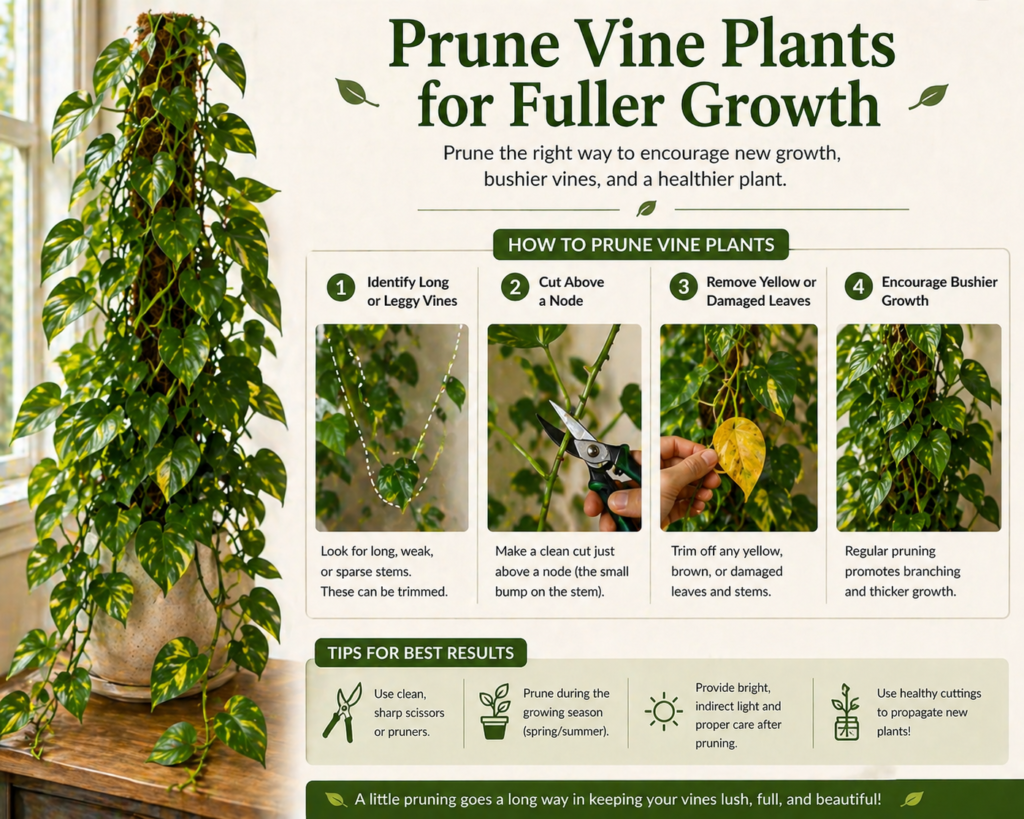
Pruning is growth control. Vine plants naturally grow longer, not always fuller. Without pruning, many vines become sparse, leggy, and uneven.
Every cut above a node gives the plant a chance to branch. This creates denser foliage and a fuller plant.
Where to prune:
Cut above a node because nodes activate new growth.
Benefits of pruning:
- Fuller growth
- Denser foliage
- Stronger branching
- Better airflow
- Improved shape
- More propagation cuttings
Best pruning seasons:
- Spring
- Early summer
Avoid:
- Heavy winter pruning
- Cutting too much at once
- Using dirty scissors
Remove:
- Yellow leaves
- Weak stems
- Leggy vines
- Damaged sections
- Dead foliage
Real-world example:
A single Pothos vine cut at several nodes can create multiple new growth points and slowly turn a sparse pot into a fuller basket.
Decision rule:
If your vine looks long but empty, pruning is usually the fastest correction.
How Do You Propagate Vine Plants Successfully?
Propagation is one of the strongest advantages of vine plants. Because vines grow from nodes, they are easier to multiply than many upright plants.
The most important rule is simple: every cutting needs a node. A leaf without a node will not create a full new plant.
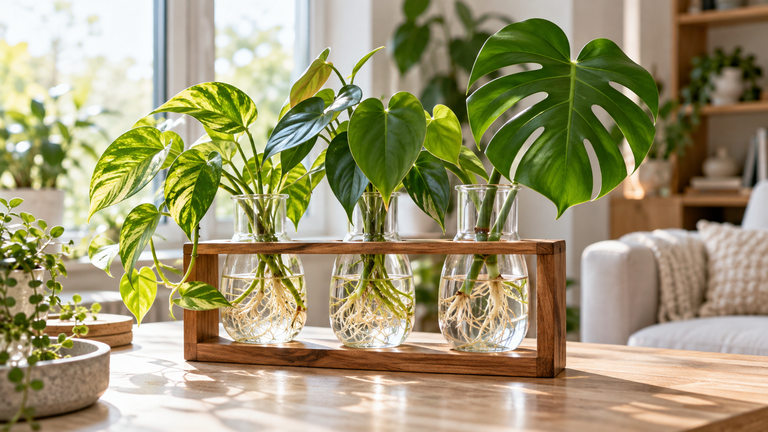
Water Propagation
Best for beginners.
Benefits:
- Easy to monitor roots
- Simple setup
- Works well for Pothos and Philodendron
Steps:
- Cut below a node
- Remove the lower leaf
- Place the node in water
- Keep in bright indirect light
- Change water weekly
- Transfer to soil once roots develop
Soil Propagation
Best for stronger soil adaptation.
Needs:
- Moist soil
- Warm conditions
- Stable light
Moss Propagation
Best for aerial-root species.
Good for:
- Monstera deliciosa
- Philodendron hederaceum
Common mistakes:
- Cutting without a node
- Keeping cuttings in low light
- Using dirty water
- Leaving roots too long before planting
Decision rule:
Water propagation is easiest. Soil propagation builds stronger transplant adaptation.
What Fertilizer Helps Vine Plants Grow Faster?
Vine plants are active growers, and active growth requires nutrients. Potting soil contains nutrients at first, but those nutrients reduce over time.
A balanced fertilizer works best for most vine plants. Nitrogen supports foliage, phosphorus supports roots, and potassium supports overall plant strength.
Best fertilizer types:
Balanced Liquid Fertilizer
Good ratios:
- 10-10-10
- 20-20-20
Benefits:
- Fast absorption
- Easy dilution
- Quick response
Organic options:
- Worm castings
- Compost tea
- Fish emulsion
Feeding schedule:
Spring and Summer
Feed every 2–4 weeks.
Fall and Winter
Reduce or pause feeding.
Signs of deficiency:
- Pale leaves
- Small new growth
- Weak stems
- Slow growth
Signs of overfeeding:
- Burnt leaf tips
- White salt buildup
- Root damage
- Brown edges
Decision rule:
Fertilizer helps growth, but it cannot replace proper light.
How Do You Make Vine Plants Grow Faster?
Fast vine growth comes from consistent conditions. Vine plants grow faster when light, root oxygen, watering, nutrients, and support work together.
The biggest growth accelerator is better usable light. Once a vine receives stronger indirect light, it can produce more energy for stems, leaves, and roots.
Ways to speed up vine growth:
- Increase bright indirect light
- Improve soil aeration
- Use balanced fertilizer
- Add moss pole support
- Prune regularly for branching
- Maintain stable humidity
- Repot when root-bound
- Rotate the plant weekly
Fast-growth formula:
Light + airy soil + deep watering + feeding + climbing support = faster growth.
Real-world example: A climbing Monstera under bright indirect light often grows faster and stronger than the same plant left trailing without support.
Decision rule:
Fix light and roots before adding more fertilizer.
How Can You Increase Humidity for Better Vine Growth?
Many vine plants come from tropical environments where humidity is higher than most indoor spaces. Heating, air conditioning, and dry rooms can stress leaves.
Humidity matters because leaves lose moisture through transpiration. In dry air, vines may develop brown edges, crispy tips, curled leaves, or weak new growth.
Ideal humidity range:
- 50–70%
Best humidity methods:
Humidifier
Most effective and stable.
Plant Grouping
Creates a small humidity zone.
Pebble Trays
Helpful but limited.
Bathroom Placement
Useful only if the room has enough light.
Humidity-sensitive vines:
- Monstera deliciosa
- Philodendron hederaceum
- Hedera helix
More tolerant vines:
- Epipremnum aureum
- Hoya carnosa
Signs humidity is too low:
- Brown edges
- Crispy tips
- Curling leaves
- Dry new growth
Decision rule:
If leaves brown despite correct watering, humidity may be the hidden issue.
How Does Seasonal Care Affect Vine Plants?
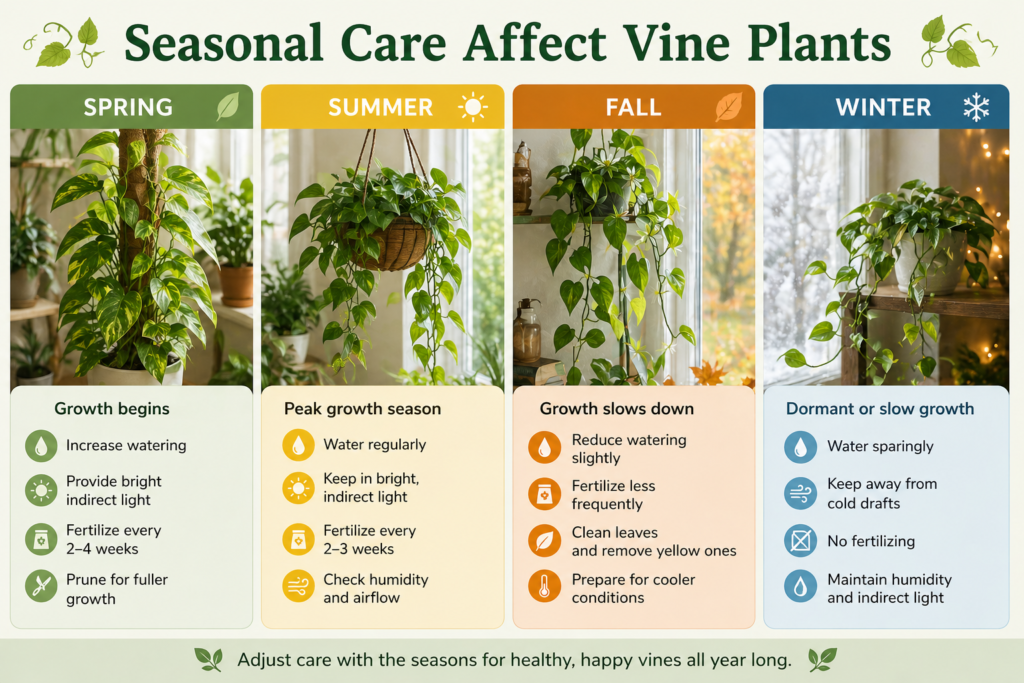
Vine plants do not grow at the same speed all year. Seasonal changes affect light, temperature, humidity, and watering needs.
Spring and summer are active growth seasons. Fall and winter usually bring slower growth because light levels drop and indoor air becomes drier.
Spring
Best time for:
- Repotting
- Fertilizing
- Pruning
- Propagation
Summer
Focus on:
- Humidity support
- More watering checks
- Active feeding
Fall
Reduce:
- Fertilizer frequency
- Heavy pruning
Winter
Watch for:
- Overwatering
- Dry air
- Low-light stress
Seasonal mistakes:
- Overwatering in winter
- Fertilizing inactive roots
- Ignoring humidity drops
- Keeping plants too far from light
Decision rule:
Adjust care with the season, not habit.
Why Are Vine Plant Leaves Turning Yellow?
Yellow leaves are a symptom, not a final diagnosis. One old yellow leaf is often normal aging. Multiple yellow leaves appearing quickly usually mean stress.
The most common cause is overwatering. When roots stay wet too long, oxygen drops and roots cannot absorb nutrients properly. Low light, poor drainage, nutrient deficiency, root crowding, and temperature shock can also cause yellowing.
Common causes:
- Overwatering
- Poor drainage
- Low light
- Root-bound stress
- Nutrient deficiency
- Temperature shock
Quick diagnosis:
- Yellow + wet soil = overwatering
- Yellow + dry soil = underwatering
- Yellow + pale new growth = nutrient issue
- Yellow + stretched stems = low light
- Yellow + crowded roots = repot needed
Decision rule:
If yellowing spreads quickly, inspect the roots first.
Why Is Your Vine Plant Growing Leggy?
Leggy growth happens when a plant stretches for light instead of building dense foliage. Vine plants naturally grow toward brighter conditions, so low light causes long bare stems and wide gaps between leaves.
Leggy growth is not permanent damage. Once light improves and pruning begins, most vines can become fuller again.
Main causes:
- Low light
- No pruning
- Uneven light exposure
- No climbing support
How to fix it:
- Move closer to bright indirect light
- Prune above nodes
- Rotate weekly
- Add climbing support
- Feed during active growth
Decision rule:
Legginess usually means light correction matters more than fertilizer.
What Are the Best Beginner Vine Plants?
The best beginner vine plants are forgiving, adaptable, fast to recover, and easy to propagate. Beginners should prioritize resilience over rarity.
Best beginner choices:
Pothos
Best overall beginner vine.
Why:
- Low maintenance
- Fast growth
- Easy propagation
Heartleaf Philodendron
Great climber or trailer.
Why:
- Forgiving
- Attractive foliage
- Easy to prune
Syngonium Podophyllum
Good compact option.
Why:
- Adaptable
- Fast-growing
- Easy indoors
Hoya Carnosa
Good for bright spaces.
Why:
- Durable
- Attractive vines
- Flowering potential
Avoid as first vines:
- Delicate ivy types
- String of Pearls
- Rare humidity-sensitive vines
Decision rule:
Your first vine plant should teach success, not test your patience.
What Are the Most Common Vine Plant Pests?
Pests are easier to prevent than remove. Most vine pests appear when plants are stressed, airflow is poor, humidity is too low, or soil stays too wet.
Common pests:
- Spider mites
- Mealybugs
- Aphids
- Fungus gnats
- Scale insects
How to identify them:
- Spider mites: fine webbing
- Mealybugs: white cotton clusters
- Aphids: soft green or black insects
- Fungus gnats: small flies near soil
- Scale: hard brown bumps
Prevention system:
- Inspect weekly
- Isolate new plants
- Improve airflow
- Avoid soggy soil
- Clean leaves regularly
Treatment options:
- Neem oil
- Insecticidal soap
- Alcohol swabs
- Soil drying for fungus gnats
Decision rule:
Weekly inspection is easier than emergency pest treatment.
Indoor Vine Plants vs Outdoor Vine Plants
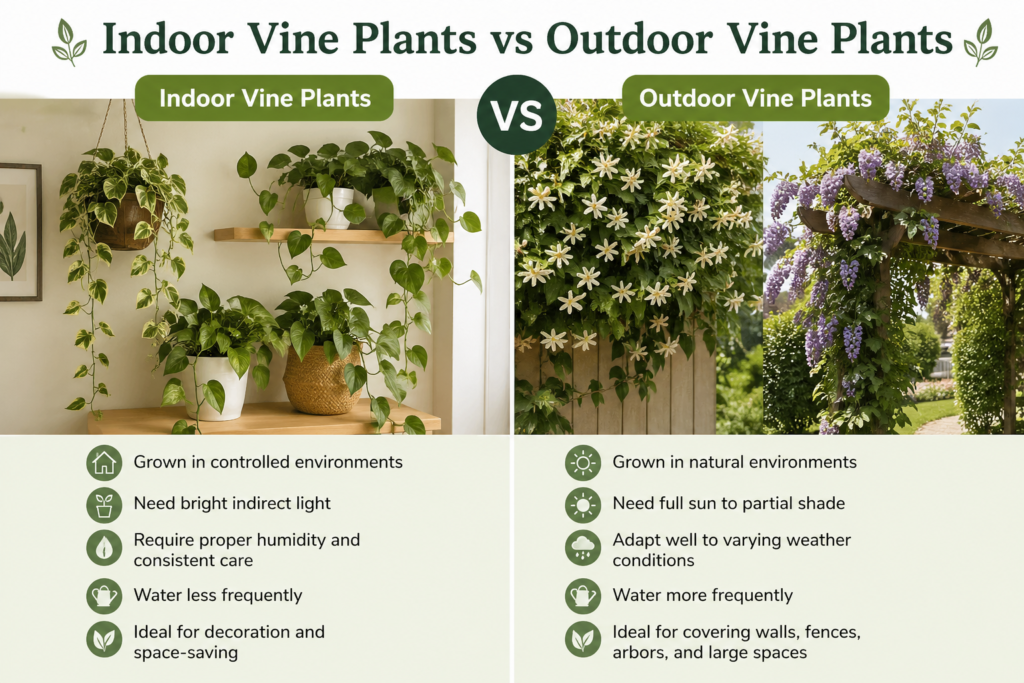
Indoor and outdoor vine plants grow under different conditions. Indoor vines experience controlled temperature, filtered light, and limited airflow. Outdoor vines experience stronger sunlight, rainfall, weather shifts, and higher pest pressure.
Indoor vines usually grow slower but more predictably. Outdoor vines may grow faster because of stronger light and natural humidity, but they need more protection from heat, cold, wind, and pests.
Indoor vines need:
- Careful watering
- Light positioning
- Humidity support
- Pest checks
Outdoor vines need:
- Weather monitoring
- Stronger support
- Pest inspection
- Sun protection when needed
Real-world example:
Hedera helix can grow aggressively outdoors but struggle indoors because of dry air and weaker airflow.
Decision rule:
Indoor vine care is about control. Outdoor vine care is about adaptation.
When Should You Repot Vine Plants?
Repotting is root management, not just a size upgrade. Repotting too early can create excess wet soil. Repotting too late can cause root crowding and slow growth.
Signs your vine needs repotting:
- Roots circle the pot
- Roots come through drainage holes
- Water drains too quickly
- Growth slows
- Soil breaks down
- Plant dries out too fast
Best time:
Spring, because active growth helps recovery.
Repotting rules:
- Size up only 1–2 inches
- Refresh the soil
- Inspect roots
- Trim damaged roots
- Avoid oversized pots
Decision rule:
Repot based on root condition, not plant height.
How Do You Train Vine Plants for Better Shape?
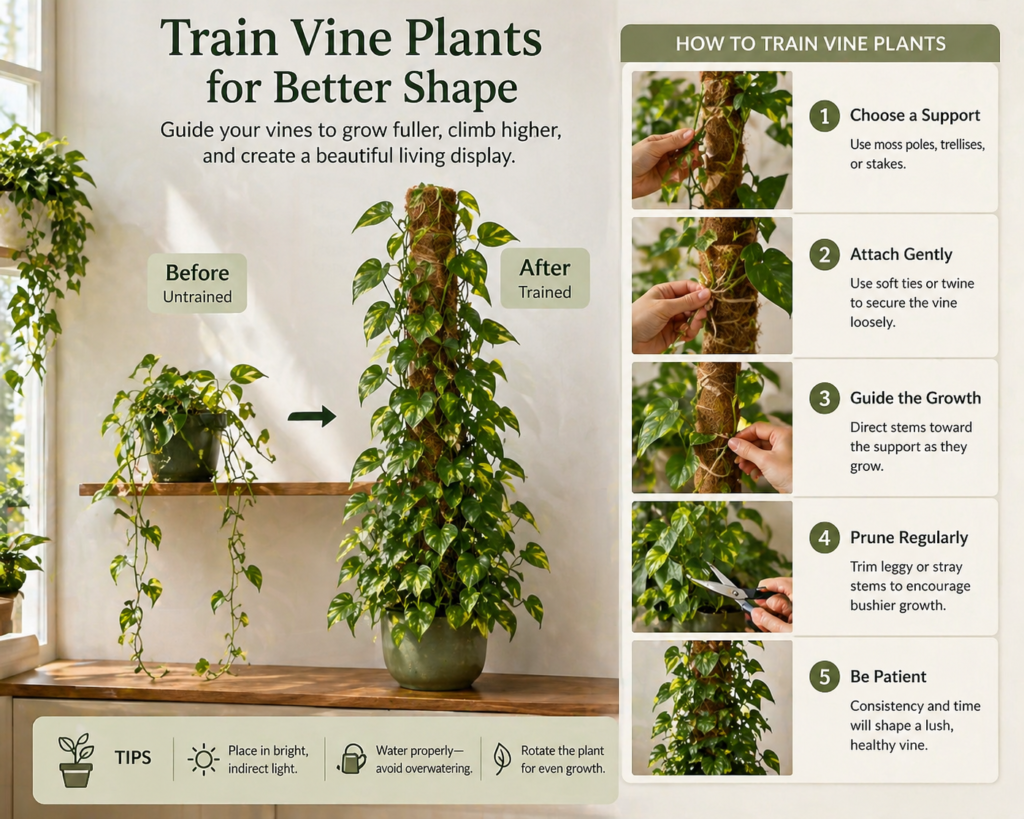
Training gives you control over direction, density, and structure. Without training, vines can become tangled, uneven, or hard to manage.
Training improves appearance and can also improve light exposure and airflow.
Main training styles:
Vertical Climbing
Best for:
- Larger leaves
- Mature growth
- Moss pole systems
Good for:
- Monstera deliciosa
- Philodendron hederaceum
Trailing Systems
Best for:
- Shelves
- Hanging baskets
- Soft decorative growth
Wall Training
Best for:
- Green wall design
- Compact spaces
- Controlled direction
Training tools:
- Clips
- Soft ties
- Moss poles
- Trellises
- Wall hooks
Mistakes to avoid:
- Forcing hard bends
- Tying stems tightly
- Using unstable support
- Waiting too long to train
Decision rule:
Train young stems early because they are easier to guide.
Final Expert Vine Plant Growth System
Expert growers do not guess. They build repeatable systems. The healthiest vine plants usually come from consistent care rather than occasional intense effort.
Core vine growth system:
- Strong indirect light
- Airy root-zone soil
- Moisture-based watering
- Proper support
- Strategic pruning
- Consistent feeding
- Seasonal adjustment
Priority order:
- Light
- Soil
- Water
- Support
- Pruning
- Fertilizer
- Humidity
Weekly checklist:
- Inspect leaves
- Check soil moisture
- Look for pests
- Rotate the plant
- Adjust support
- Remove damaged leaves
Real-world truth:
Most vine plant problems are not random. They are system failures.
Decision clarity:
Fix the system, and vine growing becomes predictable.
FAQs
How fast do vine plants grow?
Fast-growing vines like Pothos can produce several feet of growth per year indoors with proper light, watering, and nutrients.
Can vine plants live in water permanently?
Some can survive long-term in water, but soil usually provides stronger nutrition and better root support.
Why are my vine leaves getting smaller?
Small leaves are usually caused by low light, no climbing support, or nutrient deficiency.
Should I mist my vine plants?
Misting helps briefly, but a humidifier provides more stable humidity.
How often should I prune vine plants?
Prune every 4–6 weeks during active growth to maintain fullness.
What is the easiest vine plant to propagate?
Epipremnum aureum is one of the easiest because its nodes root quickly in water or soil.
Do vine plants grow better hanging or climbing?
Climbing usually produces stronger growth and larger leaves. Hanging creates decorative trailing growth.
Are vine plants good for beginners?
Yes. Pothos, Heartleaf Philodendron, and Syngonium are excellent beginner vine plants.

Myra is the founder and lead writer of Plantsaholic. She shares practical, research-backed advice on indoor plants, outdoor gardening, flowers, herbs, succulents, and everyday plant care. Her goal is to help gardeners of all experience levels grow healthier plants through simple, easy-to-follow gardening guides.