Outdoor purple leaf plants have become one of the strongest trends in landscape design because they solve a major gardening problem: maintaining color after flowers fade. Traditional flowering gardens often look spectacular for a few weeks, but once bloom cycles end, the landscape can look flat and visually empty. Purple foliage changes that by providing long-term color through leaves instead of flowers.
Purple foliage works because it creates contrast. Deep plum, burgundy, lavender, and bronze-purple leaves create visual depth and make nearby plants look brighter. This makes them highly valuable in structured landscapes where consistency matters.
Purple leaf plants are widely used for:
- Borders
- Foundation planting
- Privacy screens
- Containers
- Shade gardens
- Full-sun beds
- Ground covers
- Focal-point trees
The strongest benefit is simple:
Flowers create seasonal peaks.
Purple foliage creates seasonal consistency.
That creates stronger year-round garden value.
What Are Outdoor Purple Leaf Plants?
Outdoor purple leaf plants are ornamental plants grown primarily for their foliage color rather than flowers. Their decorative value comes from leaf pigmentation, shape, texture, and structural contribution to landscape design.
Unlike flower-driven plants, foliage plants often hold visual value for much longer. This makes them useful as permanent landscape elements rather than temporary seasonal highlights.
Purple foliage appears across several plant categories:
Shrubs
Used for:
- Structure
- Privacy
- Borders
Perennials
Used for:
- Flexible color
- Seasonal layering
Ground Covers
Used for:
- Soil coverage
- Edge planting
Trees
Used for:
- Height
- Focal points
Each category serves a different landscape function.
Decision clarity:
Use shrubs for framework, perennials for color layers, ground covers for filling, and trees for vertical balance.
Why Are Leaves Purple Instead of Green?
Purple leaves get their color from anthocyanins, natural pigments that partially mask chlorophyll and create purple, plum, burgundy, and violet tones. Chlorophyll still exists, but anthocyanins change how the leaf appears.
These pigments are functional.
Not decorative.
Anthocyanins help protect plants from:
- Strong sunlight
- Heat stress
- Temperature shifts
- Oxidative damage
This is one reason some purple plants perform well in exposed landscapes.
Purple intensity changes based on growing conditions. Strong sunlight often deepens purple tones, while excess nitrogen may encourage greener growth.
This is why some purple plants fade under shade or poor feeding balance.
Decision clarity:
If color fades, check light before adjusting fertilizer.
Which Outdoor Purple Leaf Plants Are Best for Landscaping?
The best outdoor purple leaf plants combine ornamental appeal with practical landscape reliability. A strong plant must handle weather, root competition, pruning, and seasonal stress while maintaining good color.
The strongest purple landscape plants offer:
- Stable growth
- Strong root systems
- Predictable mature size
- Good pruning response
- Reliable color retention
Good landscaping starts with plant function.
Not just appearance.
That means choosing plants based on their role:
- Structure
- Coverage
- Privacy
- Focal point
- Layering
This makes plant matching more effective and reduces replacement costs later.
Decision clarity:
The best purple plant is the one that matches your climate, space, and maintenance level.
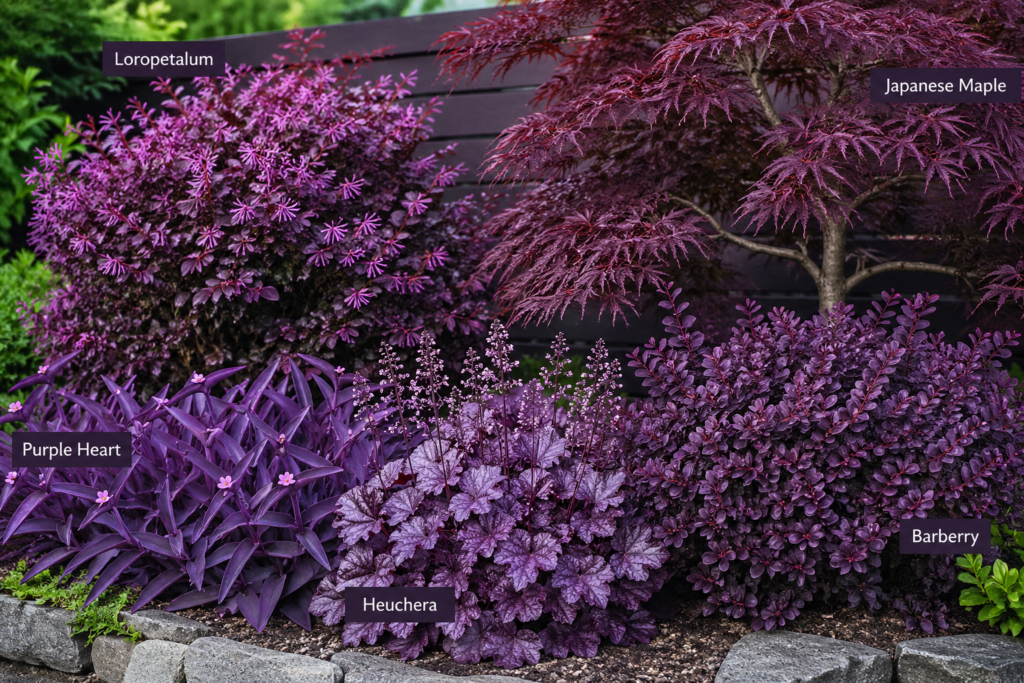
Heuchera: Best Purple Perennial for Shade
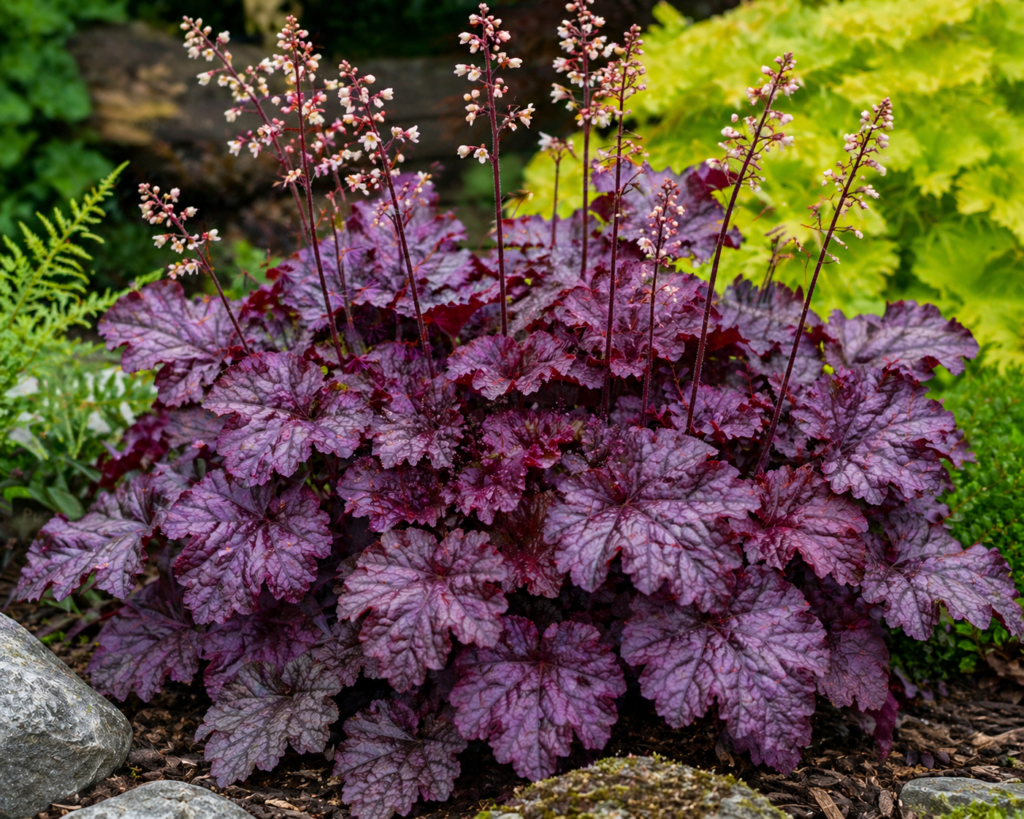
Heuchera is one of the most reliable purple foliage perennials because it combines compact growth, shade tolerance, and strong ornamental consistency.
Its rounded leaves create strong texture and mass in shaded borders, woodland gardens, and containers.
Many cultivars offer rich plum and near-black foliage.
Popular purple varieties:
- Plum Pudding
- Obsidian
- Palace Purple
Best uses:
- Shade borders
- Path edging
- Containers
- Under trees
Heuchera performs best in partial shade where leaf texture stays cleaner and moisture balance remains stable.
Planting in groups creates stronger visual impact than single plants.
Spacing:
12–18 inches apart.
Decision clarity:
Choose Heuchera if you want reliable purple color in shade with low maintenance.
Loropetalum Chinense: Best Purple Shrub for Privacy
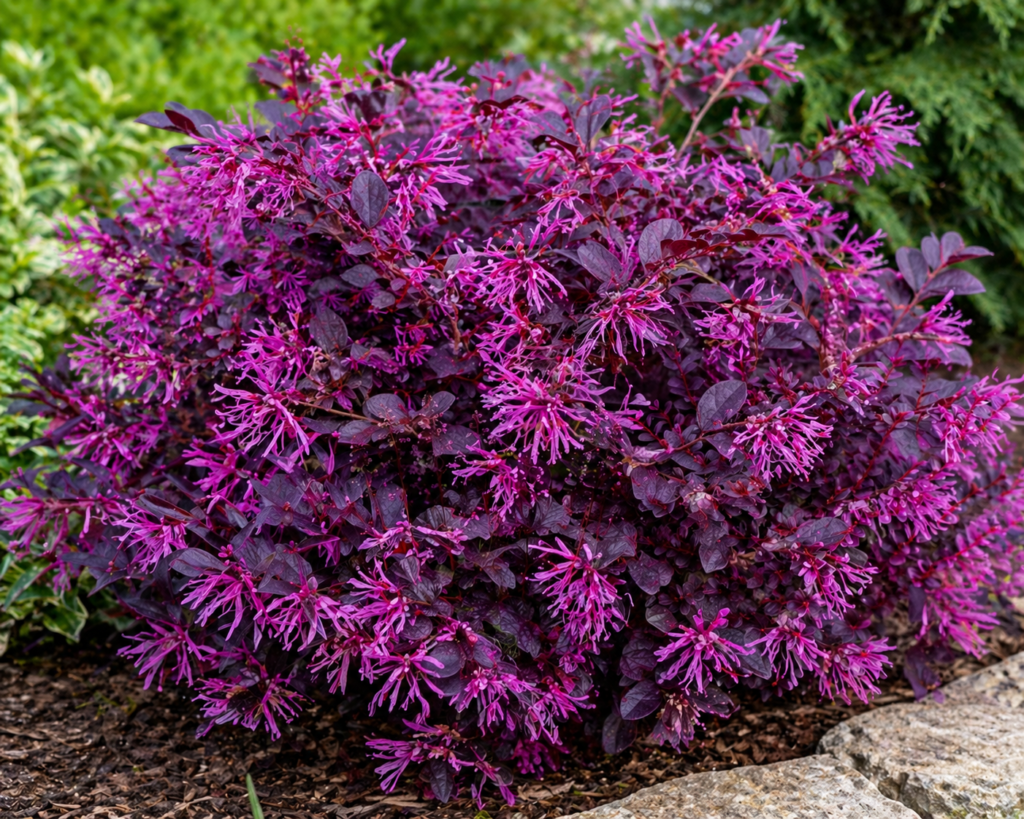
Loropetalum chinense is one of the strongest purple shrubs because it combines privacy, color, flowers, and structure in one plant.
Its burgundy to plum foliage creates strong contrast and often stays evergreen in warm climates.
This creates year-round structural value.
In spring, pink fringe-like flowers add extra ornamental layering.
Best uses:
- Privacy screens
- Hedges
- Foundation planting
- Border structure
Strong advantages:
- Fast growth
- Evergreen structure
- Flowering value
- Strong pruning response
Spacing:
3–5 feet for hedges.
6 feet minimum for standalone plants.
Common mistake:
Planting too close to walls.
This reduces airflow.
Decision clarity:
Choose Loropetalum for privacy and permanent purple structure.
Tradescantia Pallida: Best Fast-Growing Purple Ground Cover
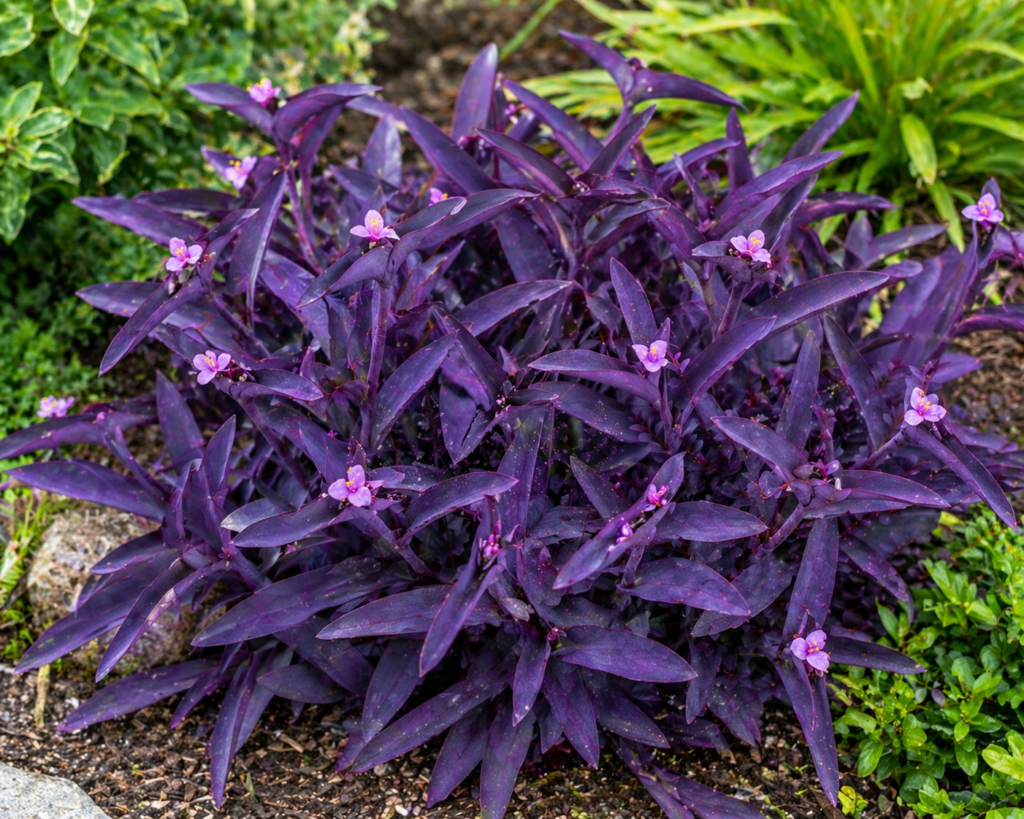
Tradescantia pallida, commonly called Purple Heart, is one of the fastest-growing purple foliage plants in landscaping.
Its deep violet-purple foliage and trailing stems make it ideal for fast color coverage.
Purple Heart works well in:
- Borders
- Pathways
- Containers
- Retaining walls
Its biggest advantage is speed.
It can spread quickly within one growing season under warm conditions.
Strong benefits:
- Fast growth
- Easy propagation
- Strong heat tolerance
- Low cost
Spacing:
12–15 inches apart.
Common mistake:
Planting in soggy soil.
This increases root rot risk.
Decision clarity:
Choose Purple Heart for fast coverage and low-cost color expansion.
Berberis Thunbergii: Best Purple Shrub for Tough Borders
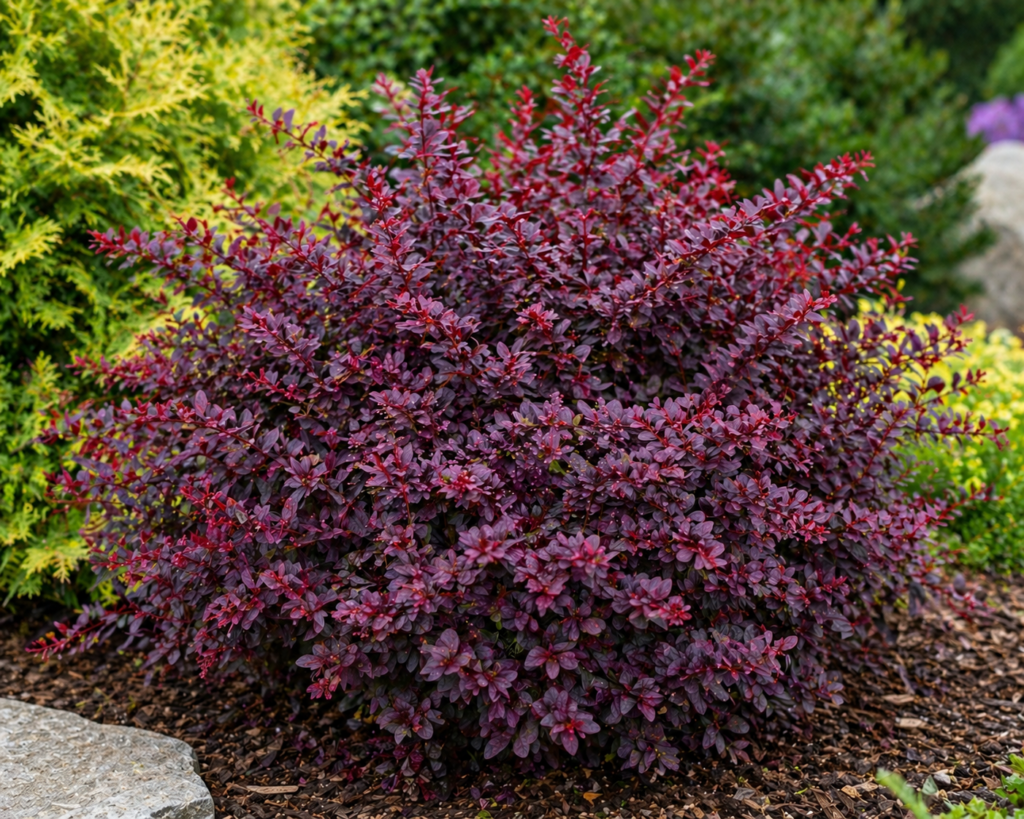
Berberis thunbergii is one of the toughest purple shrubs because it combines color with durability.
Its thorny stems create natural protection, making it useful for security hedges and boundary planting.
Its foliage deepens under strong sunlight.
This makes it highly effective in exposed dry landscapes.
Best uses:
- Property lines
- Security hedges
- Dry landscapes
- Decorative borders
Benefits:
- Drought tolerance
- Compact growth
- Low maintenance
- Thorn protection
Spacing:
2–3 feet for hedges.
Important note:
Check local regulations.
Barberry is invasive in some areas.
Decision clarity:
Choose Barberry if durability matters more than softness.
Acer Palmatum: Best Purple Tree for a Focal Point
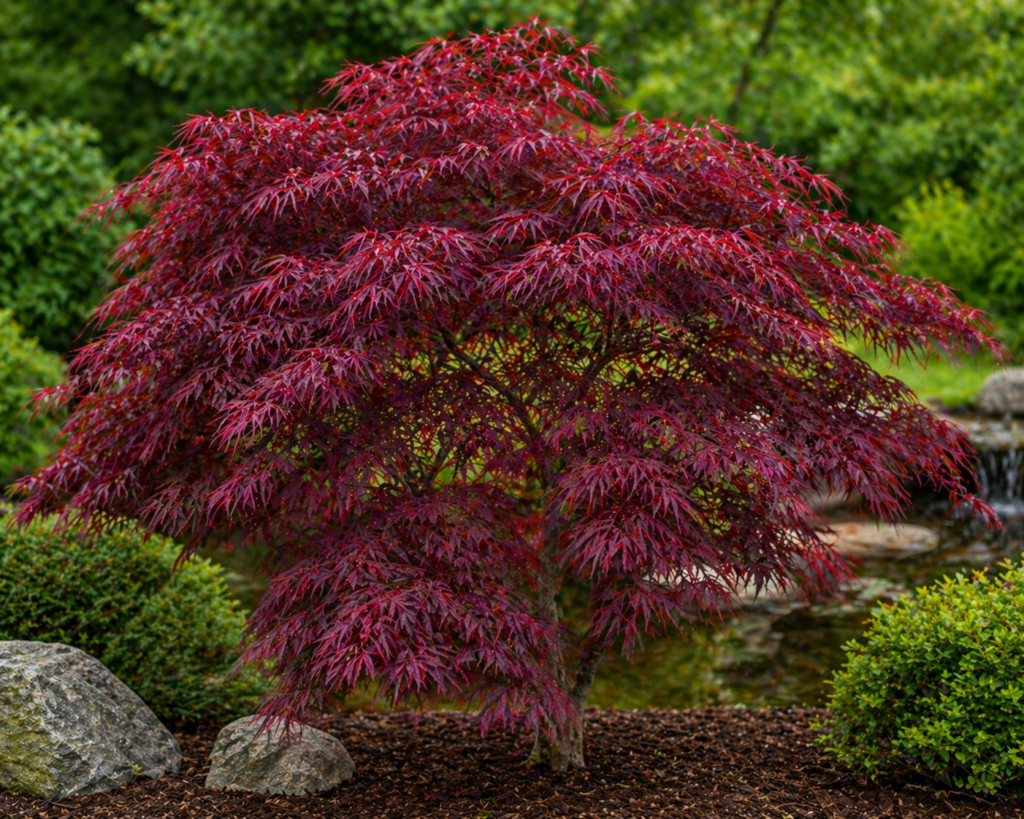
Acer palmatum, or Japanese Maple, is one of the most elegant purple-leaf trees in landscaping.
Its main value is visual architecture.
Not just color.
Japanese Maple creates height, movement, and layered seasonal interest.
Spring growth often starts red-purple, deepens into burgundy, and transitions to crimson in fall.
Strong cultivars:
- Bloodgood
- Emperor I
- Garnet
Best uses:
- Entry gardens
- Courtyards
- Water features
- Luxury focal points
Japanese Maple needs space.
Its branching shape is part of its beauty.
Minimum visual space:
6–8 feet.
Common mistake:
Planting in intense afternoon heat.
Decision clarity:
Choose Japanese Maple for premium focal-point design.
More Outdoor Purple Leaf Plants Worth Considering
Secondary purple foliage plants help expand design flexibility.
Two strong options include:
Cotinus coggygria (Smoke Bush)
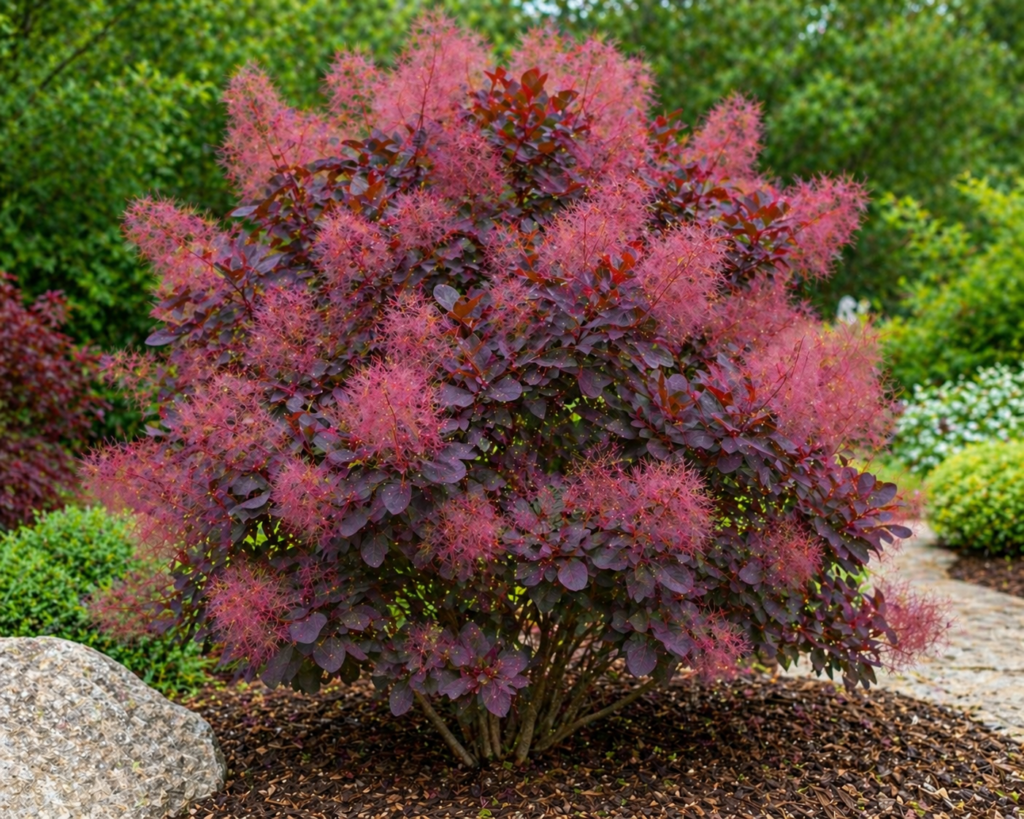
Strong for:
- Large borders
- Privacy layering
- Drought tolerance
Its smoky flower plumes create soft texture.
Physocarpus opulifolius (Ninebark)
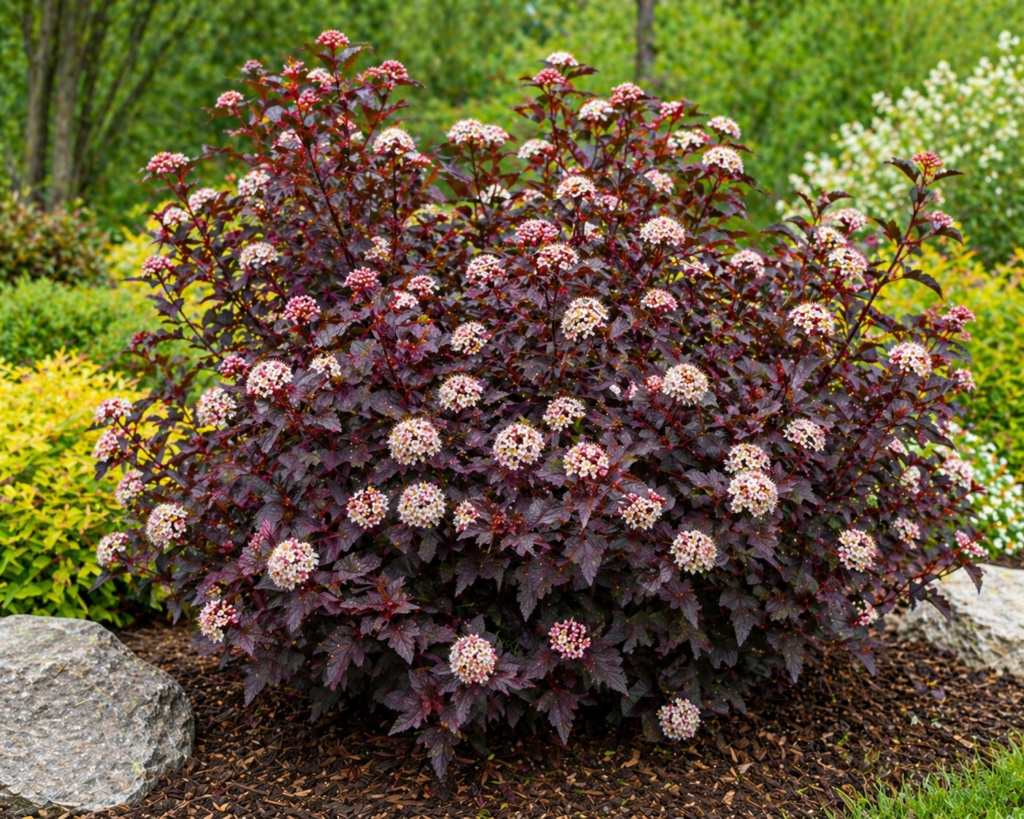
Strong for:
- Cold climates
- Structural planting
- Winter interest
Its peeling bark adds texture beyond foliage.
Decision clarity:
Use secondary plants for texture diversity, not just more purple.
Purple Plant Comparison Table
| Plant | Mature Height | Sun Needs | Growth Speed | Type |
|---|---|---|---|---|
| Heuchera | 8–18 inches | Partial shade | Moderate | Perennial |
| Loropetalum | 4–10 feet | Full sun | Fast | Shrub |
| Purple Heart | 6–12 inches | Full sun | Very fast | Ground cover |
| Barberry | 2–5 feet | Full sun | Moderate | Shrub |
| Japanese Maple | 8–20 feet | Partial sun | Slow | Tree |
Decision clarity:
Choose based on role, not appearance.
Which Purple Leaf Plants Grow Best in Full Sun?
Full sun often deepens purple foliage color because anthocyanins respond strongly to light.
Best full-sun purple plants:
- Loropetalum chinense
- Tradescantia pallida
- Berberis thunbergii
- Alternanthera dentata
Sun intensifies color but increases heat stress.
Watch for:
- Leaf burn
- Heat stress
- Root dryness
Root protection matters.
Use mulch.
Decision clarity:
Use sun-adapted purple plants in exposed beds.
Which Purple Leaf Plants Grow Best in Shade?
Not all purple plants need strong sun.
Some perform better in partial shade.
Best shade-friendly options:
- Heuchera
- Ajuga reptans
- Oxalis triangularis
Shade reduces scorching and improves leaf quality.
But deep shade can weaken color.
Best condition:
Bright indirect light.
Decision clarity:
Use shade-adapted purple plants under trees and beside walls.
Do Purple Leaf Plants Stay Purple All Year?
Not always.
Purple foliage changes based on species and season.
Evergreen purple plants like Loropetalum chinense often hold color longer.
Deciduous plants like Acer palmatum lose leaves and shift color.
Color retention depends on:
- Light
- Climate
- Water
- Fertilizer
- Seasonal temperature
Seasonal variation is normal.
Not a problem.
Decision clarity:
Expect changes.
Do not expect permanent identical color.
How Do You Design a Purple-Themed Outdoor Garden?
Purple-themed gardens work best when dark foliage is balanced with lighter contrast plants.
Too much dark foliage creates heaviness.
Professional layouts use three layers:
Background Layer
Use:
- Loropetalum
- Japanese Maple
Purpose:
Structure.
Middle Layer
Use:
- Heuchera
- Barberry
- Ninebark
Purpose:
Mass and texture.
Front Layer
Use:
- Purple Heart
- Ajuga
Purpose:
Coverage.
Best companion colors:
- White
- Lime green
- Silver
- Yellow
Decision clarity:
Purple works best with contrast.
Common Purple Garden Design Mistakes
Purple foliage is powerful but easy to misuse.
Common mistakes:
- Too much dark foliage
- Poor contrast pairing
- Ignoring mature size
- Wrong background colors
- Overcrowding
Purple against dark green often loses impact.
Purple against black fencing often disappears.
Spacing mistakes reduce airflow.
Decision clarity:
Contrast and spacing create better purple gardens.
How to Choose the Best Purple Leaf Plant for Your Yard
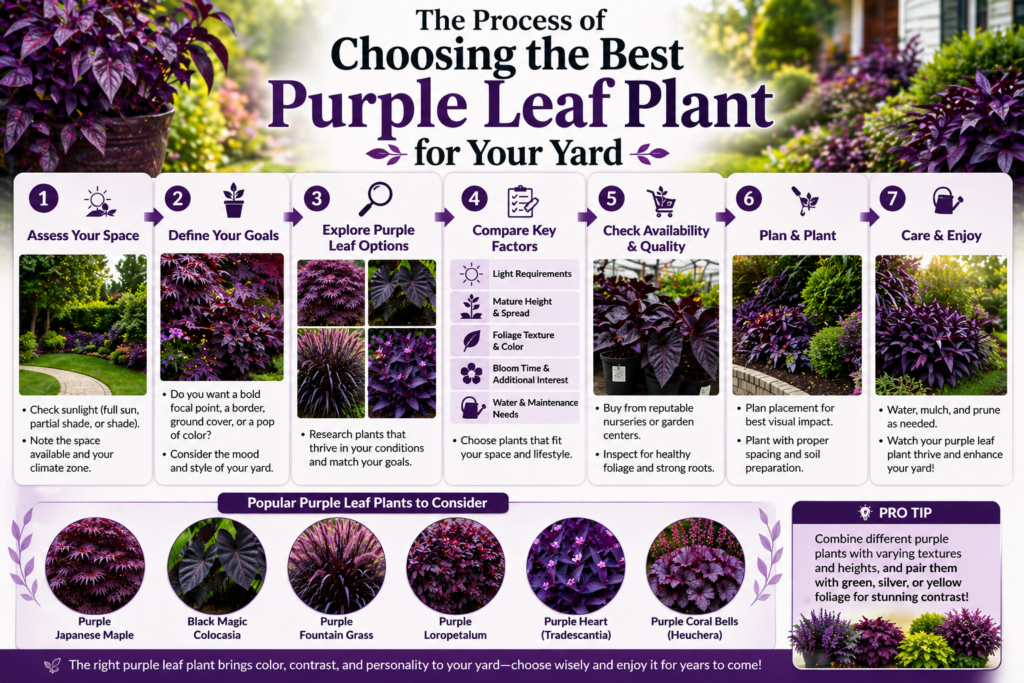
Plant selection should solve a problem.
Not just fill space.
Need privacy?
Choose Loropetalum.
Need shade?
Choose Heuchera.
Need fast ground cover?
Choose Purple Heart.
Need focal structure?
Choose Japanese Maple.
Need a durable hedge?
Choose Barberry.
Good buying decisions start with:
- Light
- Climate
- Space
- Maintenance
Function before color.
Always.
Decision clarity:
Choose based on need first.
What Problems Commonly Affect Outdoor Purple Leaf Plants?
Purple foliage plants show stress faster because leaves are the main ornamental feature.
Common problems:
- Green fading
- Brown edges
- Root rot
- Leggy growth
- Weak color
- Leaf burn
- Pest damage
Main causes:
- Wrong light
- Overwatering
- Poor drainage
- Heat stress
- Excess nitrogen
Most purple plant problems are environmental.
Not genetic.
Decision clarity:
Fix the cause.
Not the symptom.
Why Are Purple Leaves Burning?
Purple leaf burn appears as:
- Brown edges
- Dry tips
- Crispy patches
- Curling leaves
Dark leaves absorb more heat.
That increases burn risk.
Main causes:
- Heat overload
- Reflected heat
- Water inconsistency
- Salt buildup
- Wind dehydration
Hot walls increase leaf stress.
Especially white reflective walls.
Decision clarity:
Reduce heat exposure first.
Then adjust watering.
Seasonal Care Guide for Outdoor Purple Leaf Plants
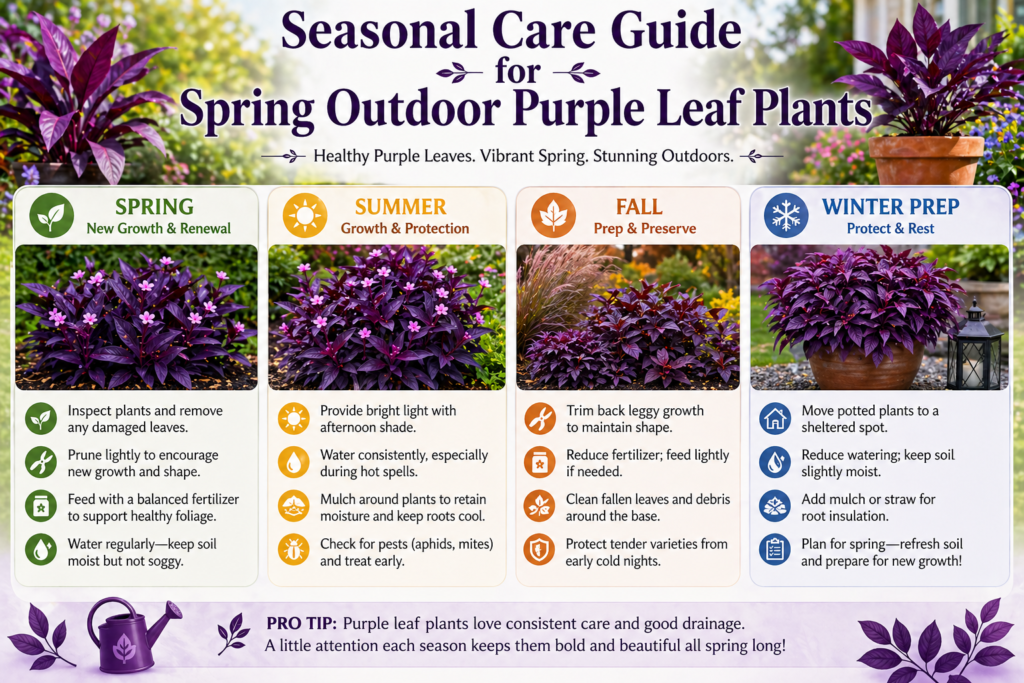
Seasonal care improves foliage quality.
Spring
Prune damage and fertilize lightly.
Summer
Deep water and protect roots.
Fall
Add compost and shape lightly.
Winter
Mulch roots and reduce watering.
Seasonal timing matters.
Late fertilizing before winter often weakens plants.
Decision clarity:
Preventive seasonal care creates stronger plants.
Real Landscape Case Study: Building a Purple Border System
A residential garden replaced annual flowers with purple foliage plants to reduce maintenance and improve year-round color.
The redesign used:
- Loropetalum for structure
- Heuchera for mid-layer color
- Ajuga for ground coverage
- Japanese Maple for focal structure
Results after eight months:
- Lower maintenance
- Better year-round color
- Less bare soil
- Stronger curb appeal
Key lesson:
Foliage systems create stability.
Flowers create peaks.
Decision clarity:
Use foliage first.
Flowers second.
How to Choose Purple Leaf Plants Based on Climate
Climate matching prevents plant failure.
Best cold-climate purple plants:
- Heuchera
- Barberry
- Japanese Maple
- Ninebark
Best warm-climate purple plants:
- Loropetalum
- Purple Heart
- Alternanthera
Best dry-climate purple plants:
- Barberry
- Smoke Bush
Climate determines survival.
Not beauty.
Decision clarity:
Choose climate fit first.
Are Purple Leaf Plants Pet-Safe?
Pet safety matters.
Some purple plants are safer than others.
Generally safer:
- Heuchera
Use caution:
- Tradescantia pallida
- Berberis thunbergii
Low-growing plants are easier for pets to chew.
Placement matters.
Decision clarity:
Prioritize safer plants if pets chew foliage.
Nursery Buying Checklist for Healthy Purple Leaf Plants
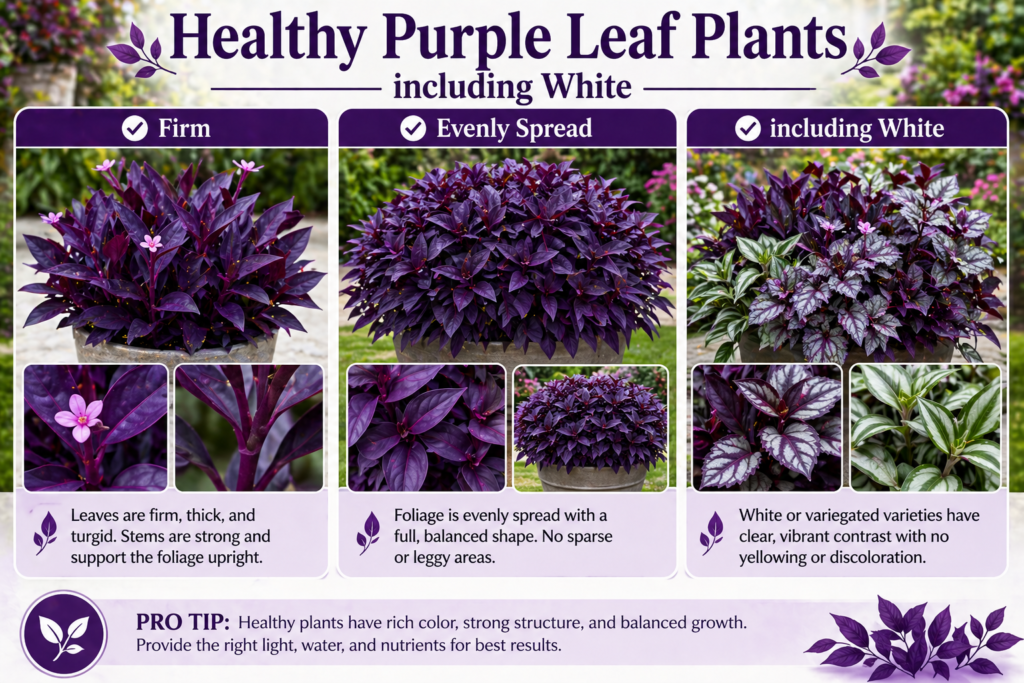
Plant quality starts at purchase.
Check roots first.
Healthy roots should be:
- White
- Firm
- Evenly spread
Avoid:
- Mushy roots
- Sour smell
- Black roots
Check leaves:
- Strong color
- Good density
- No major spotting
Smaller healthy plants often establish faster than oversized stressed plants.
Decision clarity:
Buy healthy roots.
Not bigger plants.
How Much Do Purple Leaf Plants Cost?
Typical price ranges:
- Ground covers:$5–15
- Perennials:$8–20
- Shrubs:$20–80
- Trees:$50–250+
Heuchera is affordable.
Acer palmatum is usually premium-priced.
Size, rarity, and maturity affect cost.
Decision clarity:
Pay for plant health.
Not plant size.
Final Thoughts
Outdoor purple leaf plants provide stronger long-term landscape color than flower-only systems.
Purple Foliage Works Long-Term
- Better contrast
- Better structure
- Better seasonal consistency
Use:
- Use shrubs for structure.
- Use perennials for flexible color.
- Use ground covers for coverage.
- Use trees for focal points.
Purple works best when balanced with lighter companion plants.
That creates stronger visual contrast.
Decision clarity:
Purple foliage is one of the smartest long-term landscape investments.
FAQ Section
What is the best outdoor purple leaf plant for beginners?
Heuchera is beginner-friendly because it is easy to grow, low-maintenance, and shade-tolerant.
Which outdoor purple leaf plant grows the fastest?
Tradescantia pallida grows very fast and spreads quickly in warm climates.
Do purple leaf plants need full sun?
Not all. Some like Barberry and Purple Heart prefer full sun, while Heuchera performs better in partial shade.
Why are my purple leaves turning green?
Usually because of low light or excess nitrogen fertilizer.
Which purple leaf plant is best for privacy?
Loropetalum chinense is one of the best purple privacy shrubs.
Which purple leaf plant is best for shade?
Heuchera is one of the strongest shade-friendly purple foliage plants.
Myra is the founder and lead writer of Plantsaholic. She shares practical, research-backed advice on indoor plants, outdoor gardening, flowers, herbs, succulents, and everyday plant care. Her goal is to help gardeners of all experience levels grow healthier plants through simple, easy-to-follow gardening guides.