Perennial purple leaf plants bring long-lasting color to gardens without depending only on flowers. Their foliage creates contrast, structure, and depth through the growing season, making them useful for borders, containers, shade gardens, ground covers, and modern landscape designs.
Unlike annual plants that need replacing every season, perennial purple foliage plants return year after year when matched with the right climate, soil, and light conditions. They help homeowners create a stable, low-maintenance, and visually rich garden system.
What Are Perennial Purple Leaf Plants?
Perennial purple leaf plants are ornamental plants that return every year and produce purple, burgundy, plum, bronze-purple, violet, or nearly black foliage. Their main value comes from their leaves rather than short-lived flowers, which makes them useful where consistent color matters.
These plants may grow as compact clumps, spreading ground covers, upright border plants, trailing plants, tall background plants, or ornamental grasses. Their purple color is often linked to natural pigments called anthocyanins, which can also help protect leaves from stress.
Common types include:
- Purple ground covers like Ajuga
- Purple border plants like Heuchera
- Purple succulent perennials like Sedum
- Purple trailing plants like Purple Heart
- Tall purple foliage plants like Bugbane
- Purple ornamental grasses for movement
Popular cultivars include Heuchera ‘Obsidian’, Ajuga ‘Black Scallop’, Sedum ‘Dragon’s Blood’, and Bugbane ‘Black Negligee’. Choose cultivars based on climate performance, growth habit, and site fit, not just color depth.
Decision clarity:
Choose perennial purple leaf plants when you want long-term color, repeated yearly growth, and stronger garden structure without relying only on flowers.
Why Purple Foliage Creates Better Landscape Structure
Purple foliage creates structure because dark leaf color adds visual weight. It helps anchor lighter plants and creates stronger contrast, focal points, and visual depth in garden beds.
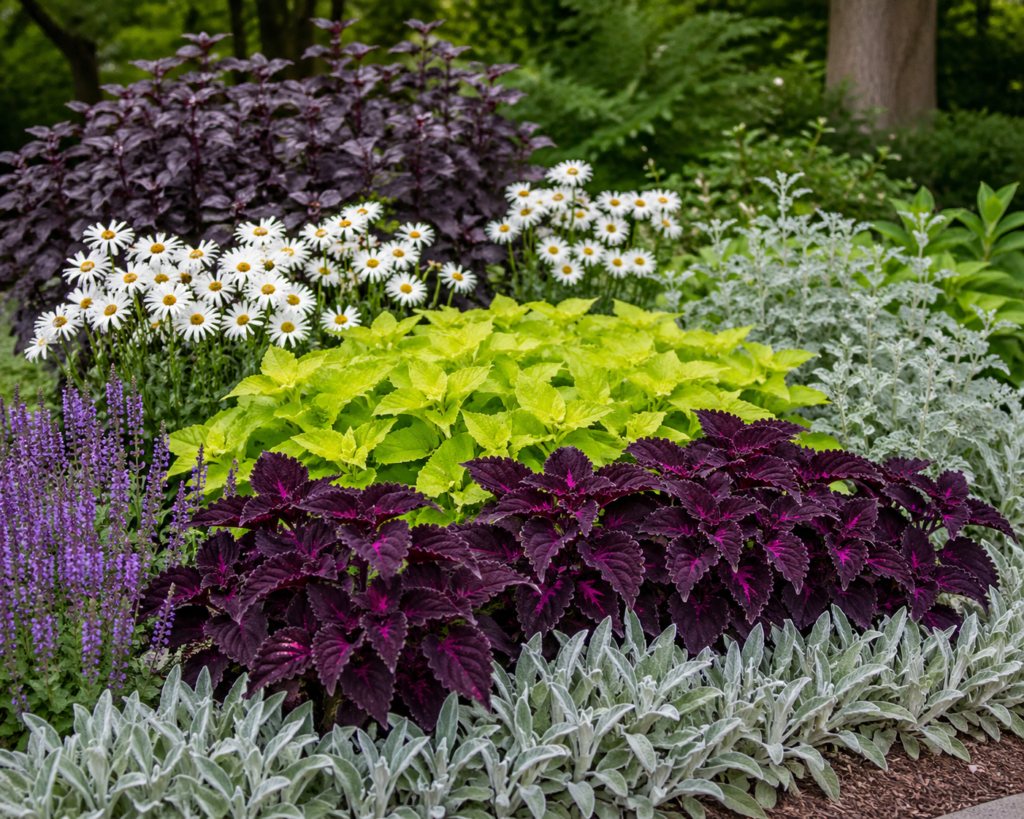
Purple leaves work especially well beside lime green, silver, white, yellow, and soft pink plants. These combinations help each plant stand out instead of blending into a flat green mass.
Purple foliage helps with:
- Better contrast
- More visual depth
- Stronger focal points
- Longer seasonal color
- Better garden layering
Real-world use:
A border with hostas, white astilbe, and purple heuchera looks more balanced than a border filled with only green foliage.
Decision clarity:
Use purple foliage as a contrast tool, not as the only color. Too much purple can feel heavy, but controlled placement creates elegance and structure.
Best Types of Perennial Purple Leaf Plants
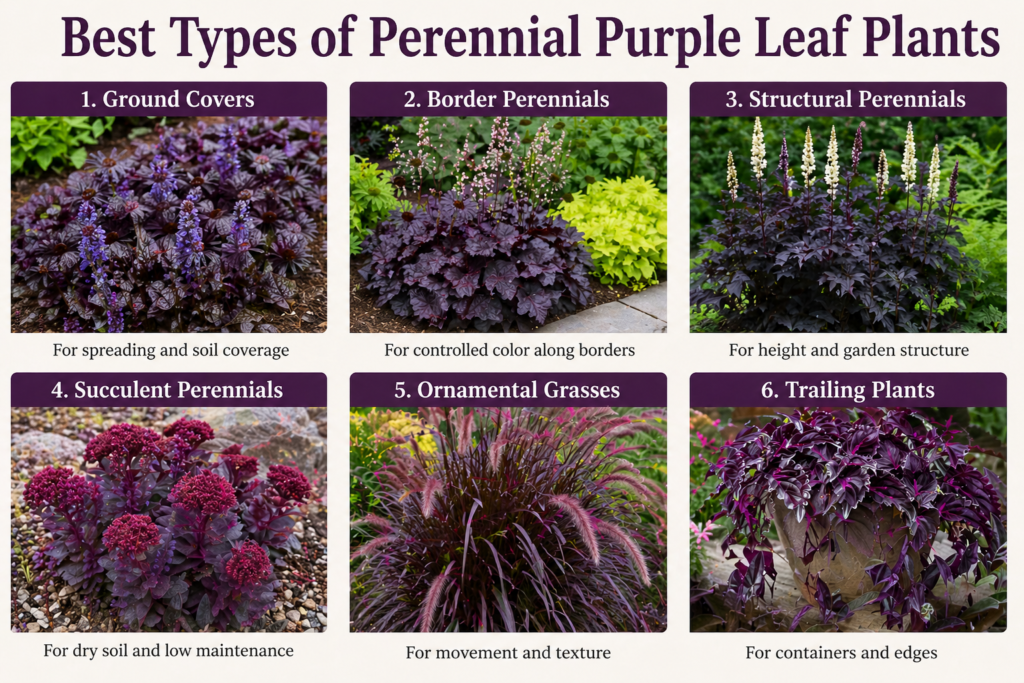
The best perennial purple leaf plants depend on garden function. Some are better for coverage, some for borders, some for containers, and others for height.
Ground covers like Ajuga fill empty spaces and suppress weeds. Border plants like Heuchera work along pathways and beds. Sedum is ideal for sunny, dry areas. Purple Heart works well in warm climates and containers. Bugbane adds height and drama in shade gardens.
Best categories include:
- Ground covers for spreading and soil coverage
- Border perennials for controlled color
- Structural perennials for height
- Succulent perennials for dry soil
- Ornamental grasses for movement
- Trailing plants for containers and edges
Decision clarity: Do not choose plants only because they are purple. Choose them by role: coverage, height, drought tolerance, shade color, or container impact.
Best Purple Perennials for Ground Cover and Borders
Ground cover purple perennials are low-growing plants that spread across the soil surface. They are useful where bare soil, weeds, erosion, or empty garden gaps are problems. Purple ground covers add both function and color.
Ajuga reptans, also called Bugleweed, is one of the most popular purple ground covers. It forms a dense mat, handles partial shade, and produces attractive spring flowers. Sedum spurium ‘Dragon’s Blood’ is another strong option for dry, sunny locations.
Border purple perennials provide controlled foliage color without taking over the space. Heuchera is one of the best border purple perennials because it stays compact and comes in many purple shades. Penstemon ‘Dark Towers’ combines purple leaves with pollinator-friendly flowers, while Persicaria ‘Red Dragon’ adds bolder patterned foliage.
Best uses include:
- Under trees
- Along pathways
- Between stepping stones
- At the front of borders
- Mixed perennial beds
- Container edges
- Shade garden outlines
Important insight:
Ajuga spreads fast and may need edging. That is useful for coverage but risky in small beds with delicate plants.
Decision clarity:
Use Ajuga for coverage, Heuchera for controlled borders, and Penstemon when you want both foliage and flowers.
Structural Purple Perennials
Structural purple perennials are larger plants that give height, shape, and background support to a garden. They form the framework of the planting design.
Bugbane, also known as Cimicifuga or Actaea, is one of the best tall purple foliage perennials for shade. It produces deep-toned foliage and tall flower spikes later in the season. Chocolate snakeroot is another dark foliage option that adds height and supports pollinators.
Structural purple plants help create:
- Background height
- Vertical interest
- Garden depth
- Seasonal drama
- Strong contrast behind lighter plants
- Better balance in large beds
Real-world example:
A shade border with only short plants may look empty from a distance. Adding Bugbane in the back gives the bed height and makes the design feel complete.
Decision clarity:
Use structural purple perennials in the back of borders, near fences, or behind lower foliage plants.
Purple Ornamental Grasses
Purple ornamental grasses add movement, texture, and softness to landscape designs in ways broadleaf perennials cannot. Their narrow blades create fine texture, while their arching habit adds natural movement with wind.
Purple fountain grass is one of the most popular ornamental purple grasses because of its deep burgundy foliage, soft plumes, and graceful shape. It works well as a container centerpiece or repeating accent in sunny borders.
Purple fountain grass creates confusion because many gardeners assume it is a true perennial in all climates. It is not. It behaves as a perennial mainly in warm USDA Zones 9–11. In colder climates, winter frost often kills the root system, so it is usually grown as an annual.
Decision clarity: Choose purple fountain grass for seasonal texture and movement, but always check your climate zone before treating it as a permanent perennial.
Best Purple Leaf Perennials by Light Condition
Light is one of the most important factors for purple foliage quality. Some purple plants become richer in full sun, while others burn or fade in strong afternoon heat.
Best Purple Leaf Perennials for Sun
Sun-loving purple leaf perennials usually develop stronger color when they receive enough direct light.
Best sun options:
- Sedum telephium
- Sedum spurium ‘Dragon’s Blood’
- Purple Heart
- Purple fountain grass
- Dark-leaved Penstemon
- Purple-leaved Euphorbia varieties
Best Purple Leaf Perennials for Shade
Shade gardens often lack strong color because many flowering plants need sun to bloom well. Purple foliage perennials solve this problem by providing color through leaves.
Best shade options:
- Heuchera
- Ajuga
- Bugbane
- Purple-leaved Persicaria
- Dark-leaved foamflower hybrids
Real-world insight:
A shade bed with Heuchera, lime hosta, and white astilbe can look colorful even before flowering begins.
Decision clarity:
Choose Sedum for dry sun, Heuchera for shade color, Ajuga for shade coverage, and Bugbane for tall shade structure.
How to Choose the Right Purple Leaf Perennial
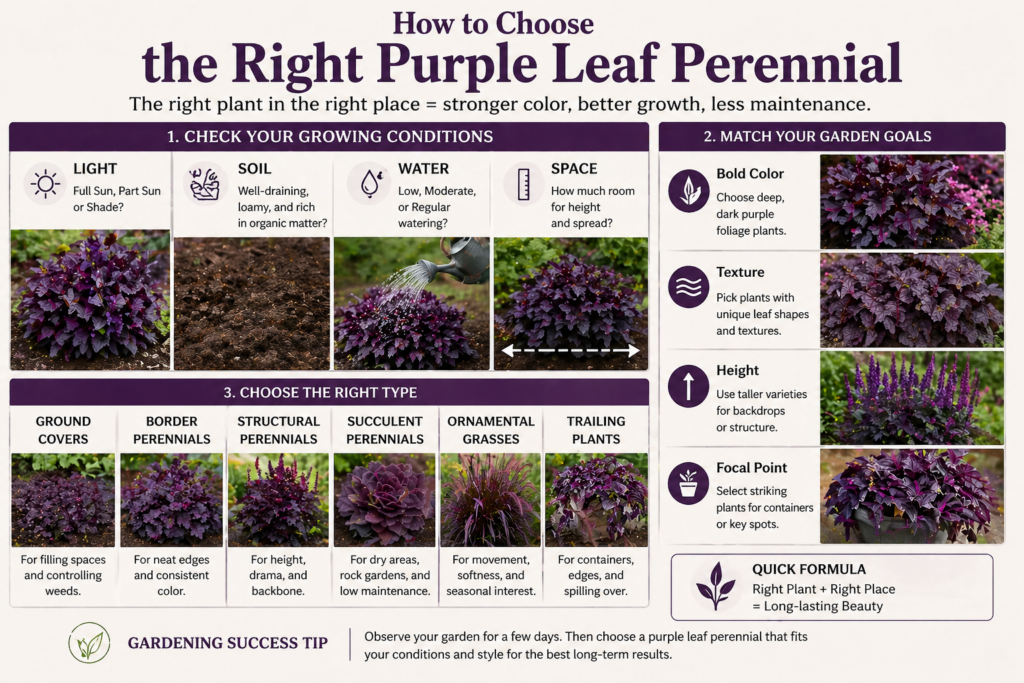
Choosing the right purple leaf perennial requires more than liking the color. The plant must match your garden’s climate, light exposure, soil type, moisture level, and available space.
Start with climate first. A plant that cannot survive winter or summer heat will not perform long term. Then check sunlight. Some purple plants need full sun to stay dark, while others burn in harsh afternoon heat. After that, consider size, spread, maintenance, and design role.
Before buying, ask:
- Is my garden sunny or shady?
- Is the soil dry or moist?
- Does the plant spread or clump?
- Is it hardy in my region?
- Will it stay purple in my light conditions?
- Does it fit my design purpose?
Quick hardiness guide:
| Plant | USDA Zones | Best Use |
|---|---|---|
| Heuchera | 4–9 | Shade borders |
| Ajuga | 3–10 | Ground cover |
| Sedum | 3–9 | Xeriscape |
| Bugbane | 4–8 | Structural height |
| Purple Heart | 8–11 | Warm climate trailing |
| Purple Fountain Grass | 9–11 | Warm climate ornamental grass |
Always inspect root health before buying. Healthy roots matter more than plant size.
Decision clarity:
Match survival needs first, design role second, and color preference third.
How to Plant Purple Leaf Perennials Correctly
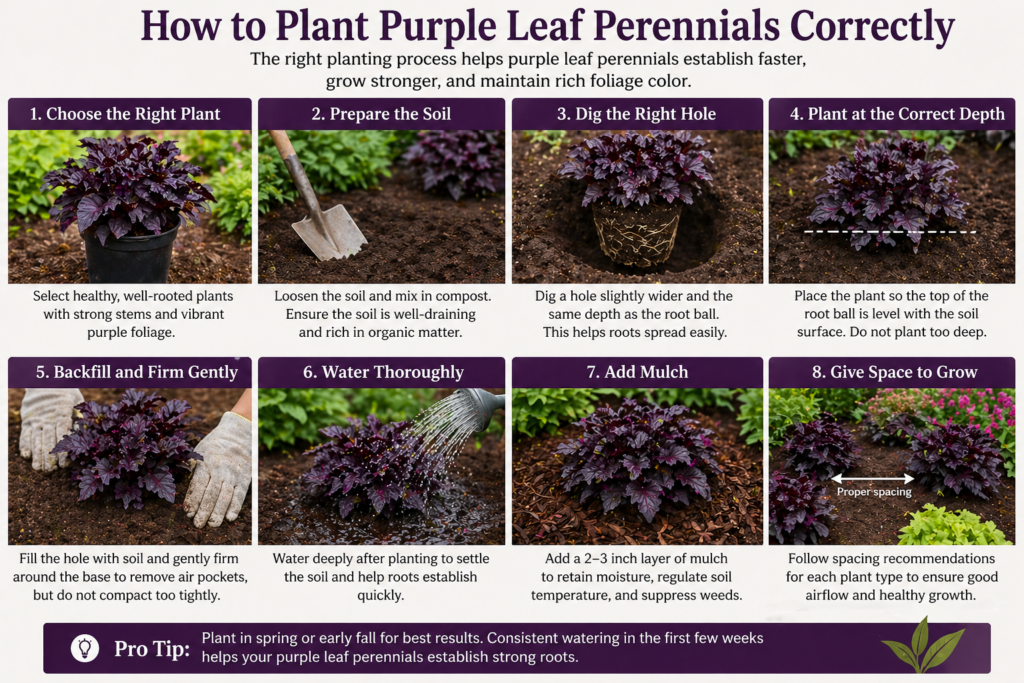
Correct planting is one of the most important steps in growing perennial purple leaf plants. Even healthy nursery plants can fail if they are planted too deep, watered incorrectly, or placed in compacted soil.
Start by clearing weeds and loosening the soil. Dig a hole twice as wide as the root ball but no deeper than the container depth. The crown should sit level with the soil surface. Planting too deep can cause crown rot, especially in Heuchera and other clumping perennials.
Planting checklist:
- Loosen soil 8–10 inches deep
- Inspect roots before planting
- Keep the crown level with soil
- Water deeply after planting
- Apply 2–3 inches of mulch
- Keep mulch 1–2 inches away from crowns
New plants usually need water 2–3 times weekly during establishment. Established plants usually need deep watering once weekly if the soil is dry.
Decision clarity:
Plant for root health first. Correct planting depth, drainage, and mulch placement prevent most early failures.
Best Soil for Purple Foliage Performance
Soil quality directly affects purple foliage color, root growth, disease resistance, and long-term plant strength. Most perennial purple leaf plants prefer soil that drains well but still holds enough moisture for steady root activity.
Loamy soil is ideal because it balances drainage and moisture retention. Too much rich fertilizer can push soft green growth and reduce purple intensity. Soil pH between slightly acidic and neutral is suitable for many ornamental perennials.
Good soil should be:
- Loose
- Well-draining
- Moist but not soggy
- Rich in organic matter
- Easy for roots to penetrate
- Free from standing water
Real-world example:
Sedum planted in rich, wet soil may flop or rot, while the same plant in lean, well-drained soil performs beautifully.
Decision clarity:
Improve drainage before feeding. Fertilizer cannot fix bad soil structure.
Watering Requirements by Plant Type
Watering needs vary between purple foliage perennials. A thick-leaved Sedum does not need the same watering schedule as Heuchera or Bugbane.
New plants need more frequent watering until roots establish. Established plants need deeper, less frequent watering. Overwatering is especially dangerous for Sedum, Purple Heart in containers, and plants in heavy soil. Moisture-loving plants like Bugbane need steadier moisture.
General watering guide:
- Sedum: low water
- Purple Heart: moderate water
- Heuchera: moderate moisture
- Ajuga: moderate moisture
- Bugbane: steady moisture
- Containers: check often
Real-world insight:
Always check soil before watering. If the top inch is still wet, wait.
Decision clarity:
Water by plant behavior, not habit. Succulent purple plants need less water, while shade foliage perennials need steadier moisture.
Fertilizer Strategy for Color Retention
Fertilizer can improve growth, but too much fertilizer can reduce purple foliage intensity. High nitrogen feeding often creates fast, soft, greener growth. Growth increases, but color weakens.
Use compost, slow-release organic fertilizer, or a balanced granular fertilizer in spring. Avoid heavy feeding late in the season because it can produce tender growth that is vulnerable to cold damage.
Best fertilizer practices:
- Feed lightly in spring
- Use compost around established plants
- Avoid high-nitrogen lawn fertilizer
- Do not fertilize stressed plants heavily
- Stop heavy feeding before winter
- Use slow-release products for containers
Signs of overfeeding:
- Greener leaves
- Weak stems
- Soft growth
- Reduced purple color
Decision clarity:
Feed for balance, not speed. The goal is strong, colorful foliage, not oversized weak growth.
Seasonal Care Guide for Purple Leaf Perennials
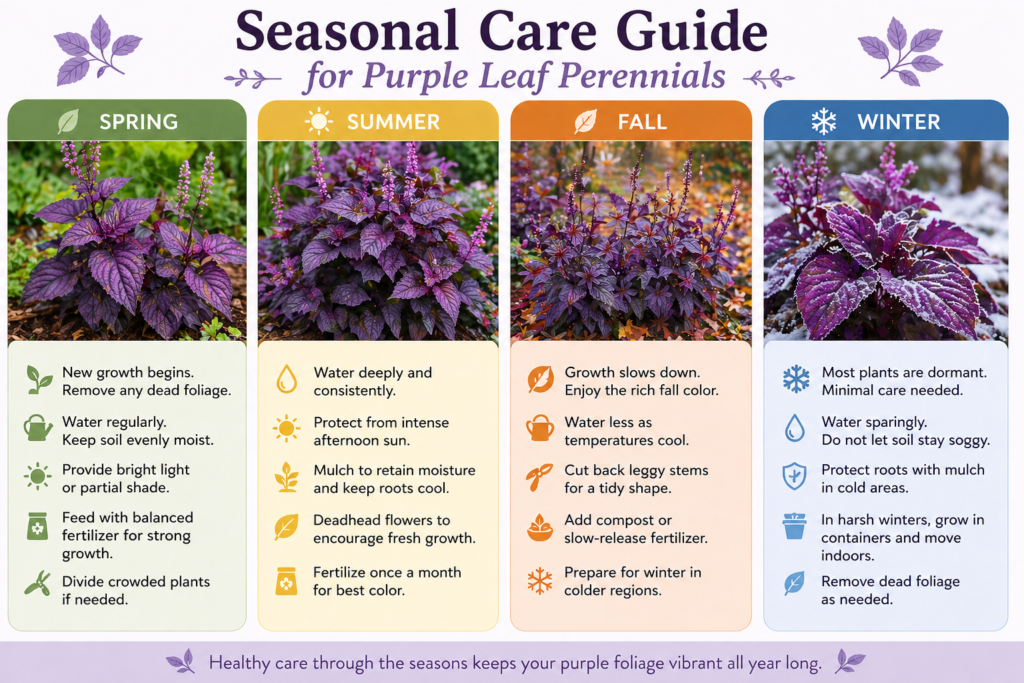
Seasonal care keeps perennial purple leaf plants healthy year after year. Each season has a different purpose.
Seasonal focus:
- Spring: clean, feed, divide, plant
- Summer: water, inspect pests, reduce stress
- Fall: remove disease, strengthen roots, mulch
- Winter: protect crowns and avoid waterlogging
In spring, remove dead foliage, check crowns, add compost, and divide crowded plants. In summer, monitor water stress, pests, and leaf scorch. In fall, reduce fertilizer, clean diseased leaves, and water before frost. In winter, protect roots and avoid soggy soil.
Real-world insight:
Many perennial failures begin with neglect in one season. Wet winter soil may damage crowns, while summer drought can weaken foliage color.
Decision clarity:
Care should follow the plant’s yearly cycle. Do not treat perennials the same in every season.
Propagation Methods for Purple Perennials
Propagation allows gardeners to create more purple foliage plants without buying new ones every season. Many perennial purple leaf plants are easy to multiply through division, cuttings, or natural spreading.
Division works well for clumping plants like Heuchera. Stem cuttings work well for Purple Heart. Ground layering works naturally with Ajuga. Seeds can be used for some species, but cultivars may not stay true from seed.
Common propagation methods:
- Division for clumping perennials
- Stem cuttings for soft-stemmed plants
- Ground layering for spreading plants
- Rooted runners for Ajuga
- Seeds for species plants
Best times:
- Spring for active growth
- Fall for cooler establishment
- Avoid extreme heat
Decision clarity: Use division and cuttings for reliable results. Use seeds only when exact cultivar color is not important.
Best Companion Plants and Pollinator Value
Companion plants make purple foliage more powerful. Purple leaves need contrast to show their full beauty. If placed beside plants that are too dark or too similar, they can disappear.
Lime green, white, silver, and yellow plants are especially effective. Hosta adds broad lime-green leaves for shade. Astilbe adds white or pink flowers and soft texture. Artemisia adds silver foliage for dry sunny sites. Japanese forest grass adds movement and brightness in shade.
Best companion groups:
- Lime green foliage
- White flowering plants
- Silver foliage plants
- Yellow flowers
- Fine-textured grasses
- Soft flowering perennials
Many purple foliage plants also provide pollinator value through flowers. Heuchera produces delicate flower spikes, Sedum supports bees and butterflies, and Penstemon is useful for hummingbirds and pollinating insects.
Decision clarity:
Pair purple with contrast and choose flowering purple foliage plants when you want both beauty and ecological value.
Landscape Design Ideas Using Purple Leaf Plants
Purple leaf plants work in many garden styles, from cottage gardens to minimalist landscapes. Their strength comes from placement. A single purple plant can become a focal point, while repeated purple foliage creates rhythm.
The most effective designs use purple as part of a layered system. Place low growers in front, medium clumps in the middle, and taller plants in the back. Add companion plants for contrast.
Design ideas include:
- Shade border with Heuchera and Hosta
- Sunny xeriscape with Sedum and Artemisia
- Container with purple grass and lime trailer
- Woodland garden with Bugbane and Astilbe
- Front-yard border with repeated purple foliage
- Patio planter with Purple Heart
Real-world insight:
Repetition matters. One purple plant may look accidental, but three repeated groups look intentional.
Decision clarity:
Decide whether purple foliage will be a focal point, border rhythm, ground cover, or background structure before planting.
Best Purple Leaf Perennials by Garden Situation
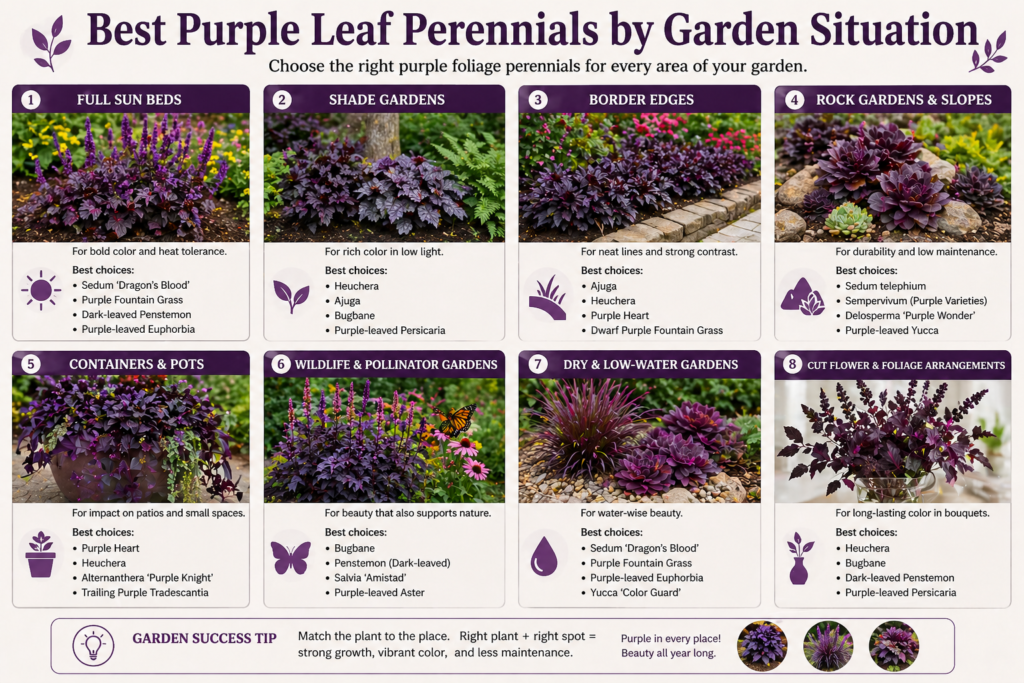
Plant selection becomes easier when matched to a specific garden problem. Instead of choosing based only on color, choose based on landscape need.
Best by use-case:
- Best for shade: Heuchera
- Best for ground cover: Ajuga
- Best for drought: Sedum
- Best for height: Bugbane
- Best for containers: Purple Heart
- Best for movement: Purple fountain grass
- Best for pollinators: Penstemon
Real-world example:
If your main problem is dry soil, Sedum is a better choice than Bugbane. If your problem is dark shade, Heuchera is better than Purple Heart.
Decision clarity:
Solve the landscape problem first. Then choose the plant.
Common Problems, Mistakes, and Fixes
Perennial purple leaf plants are durable, but problems appear when conditions are wrong. Most issues come from poor light, bad drainage, overwatering, crowding, or excessive fertilizer.
Common problems include:
- Fading purple color
- Root rot
- Powdery mildew
- Aphids
- Slugs
- Weak growth
Fading purple color usually comes from low light, excess nitrogen, wrong cultivar placement, heat stress, or seasonal change. Root rot usually comes from overwatering, heavy clay, poor container drainage, planting too deep, or mulch touching the crown. Powdery mildew often appears in crowded, humid beds.
Common mistakes:
- Choosing by color only
- Ignoring mature size
- Planting in wrong light
- Overwatering
- Overfertilizing
- Crowding plants
- Mixing incompatible water needs
Real-world insight:
A purple plant turning green is not always diseased. It is often responding to poor light or fertilizer imbalance.
Decision clarity:
Diagnose the growing condition before treating the plant. Most purple foliage problems are environmental.
Are Purple Leaf Perennials Safe for Pets?
Pet safety depends on the specific plant. Some purple leaf perennials are considered low-risk, while others may cause irritation or digestive upset if chewed.
Heuchera is commonly considered a safer ornamental option, but plants like Purple Heart may cause skin or mouth irritation in some pets. Even non-toxic plants can cause stomach upset if eaten in large amounts.
Pet safety checklist:
- Research the exact plant species
- Check toxicity before planting
- Avoid irritating plants near pet paths
- Do not use harmful pesticides
- Keep fertilizers stored safely
- Watch pets around new plants
Decision clarity:
If pets use the garden daily, prioritize safer plants and avoid placing questionable species near walkways, play areas, or resting spots.
Final Plant Selection Framework
The best perennial purple leaf plant depends on your garden problem. Instead of asking, “Which purple plant is best?” ask, “What job does this plant need to do?”
| Garden Need | Best Plant | Why |
|---|---|---|
| Shade color | Heuchera | Reliable foliage color |
| Ground coverage | Ajuga | Fast spread |
| Dry soil | Sedum | Drought-tolerant |
| Height and drama | Bugbane | Vertical structure |
| Container spill | Purple Heart | Easy trailing |
| Texture movement | Purple Fountain Grass | Soft motion |
| Pollinator support | Penstemon | Flower value |
Selection guide:
- Need ground cover? Choose Ajuga.
- Need shade border color? Choose Heuchera.
- Need dry garden color? Choose Sedum.
- Need tall shade structure? Choose Bugbane.
- Need container drama? Choose purple fountain grass.
- Need trailing warmth? Choose Purple Heart.
- Need pollinator value? Choose Penstemon.
Decision clarity:
Every plant should have a job. Match the plant to function first, then light, soil, and climate.
Faq SECTION
What is the best perennial purple leaf plant for beginners?
Ajuga and Heuchera are beginner-friendly because they are adaptable and low-maintenance.
Which perennial purple leaf plant stays purple the longest?
Heuchera ‘Obsidian’ and Ajuga ‘Black Scallop’ tend to hold color well. Light and climate still affect color.
Which purple perennial is best for shade?
Heuchera is one of the best shade choices. Ajuga is better for shade ground cover.
Which purple perennial is best for ground cover?
Ajuga is one of the best purple ground covers because it spreads fast and suppresses weeds.
Which perennial purple leaf plant is best for drought?
Sedum is one of the best drought-tolerant purple foliage plants.
Are purple leaf perennials safe for pets?
It depends on the plant. Heuchera is lower-risk, while Purple Heart may irritate pets if chewed.

Myra is the founder and lead writer of Plantsaholic. She shares practical, research-backed advice on indoor plants, outdoor gardening, flowers, herbs, succulents, and everyday plant care. Her goal is to help gardeners of all experience levels grow healthier plants through simple, easy-to-follow gardening guides.