Purple foliage plants are one of the strongest long-term tools in landscape design because they provide color beyond flower cycles. Flowers fade, but foliage remains visible for much longer, creating stronger visual structure and more consistent beauty.
Purple leaf plants work in groundcovers, perennials, shrubs, trees, containers, borders, and focal beds. Their deep color creates contrast against green, silver, white, yellow, and lime companion plants. The purple color usually comes from anthocyanins, natural pigments that protect plants from sun, cold, and environmental stress.
This guide explains how purple foliage performs through every season, which types work best, how to design with them, and how to maintain them successfully.
Quick Answer: Are Purple Leaf Plants Good for Landscaping?
Yes. Purple leaf plants are excellent for landscaping because they provide longer-lasting color than many flowering plants. They create stronger contrast, improve structure, and keep outdoor spaces visually interesting when flowers are not blooming.
Purple foliage works well in:
- foundation planting
- walkway borders
- focal islands
- privacy hedges
- containers
- mixed borders
- groundcover systems
The biggest advantage is consistency. Flowers provide temporary color, but purple foliage supports the landscape much longer.
Decision clarity:
If your goal is year-round beauty, stronger contrast, and lower seasonal replacement, purple foliage is a smart landscape investment.
Why Are Purple Leaf Plants Valuable in Landscape Design?
Purple foliage solves one of the most common landscape problems: visual flatness.
When every layer is green, landscapes often look repetitive. Purple breaks that pattern by creating contrast and visual direction.
A purple shrub near an entryway creates stronger framing than a green shrub. A purple ornamental tree can become a natural focal point. Purple groundcovers help define edges and soften exposed soil.
Purple foliage improves:
- focal point strength
- border clarity
- visual depth
- plant layering
- seasonal interest
- curb appeal
Dark purple foliage often feels elegant, structured, and intentional.
Best uses:
- foundation beds
- pathways
- patio containers
- privacy screens
- mixed borders
- entry gardens
Decision clarity:
Purple foliage improves structure faster than many flower-based designs.
How Do Purple Leaf Plants Stay Colorful Across Seasons?
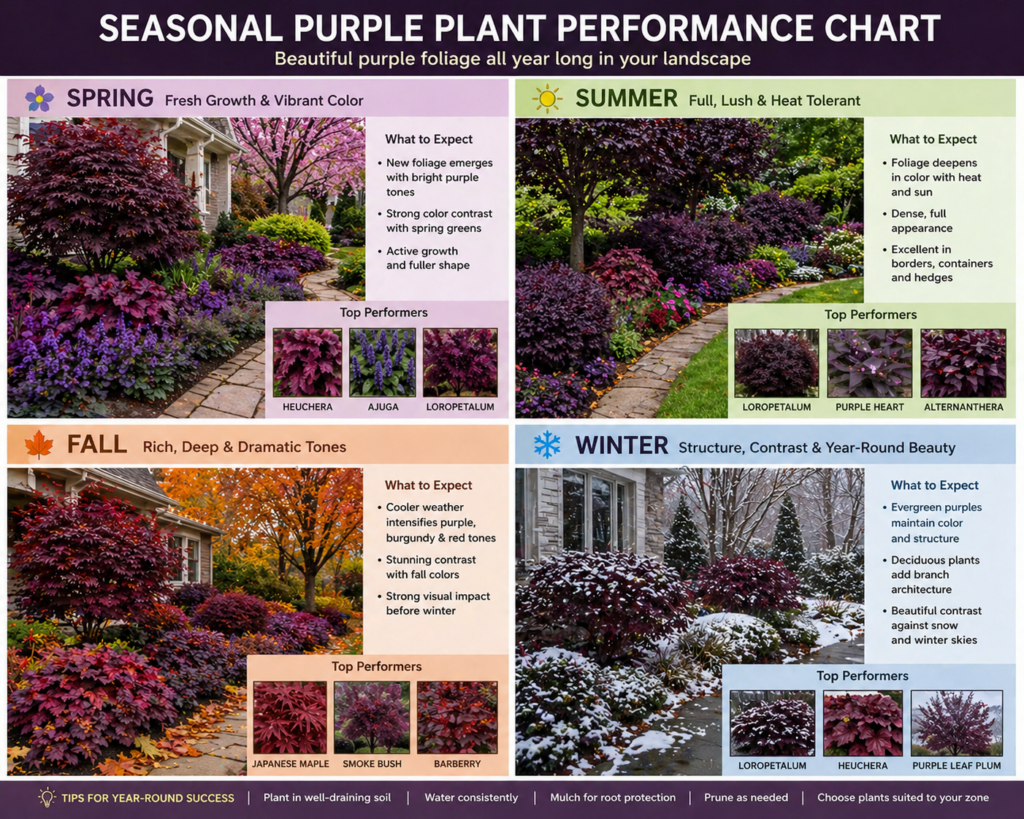
Purple foliage stays colorful because the pigment serves a protective function.
Anthocyanins help protect leaf tissue from:
- sunlight
- temperature stress
- cold damage
- environmental pressure
This is why some purple plants become deeper in color during cool weather or strong light.
Seasonal performance depends on the plant.
Some are evergreen.
Some are deciduous.
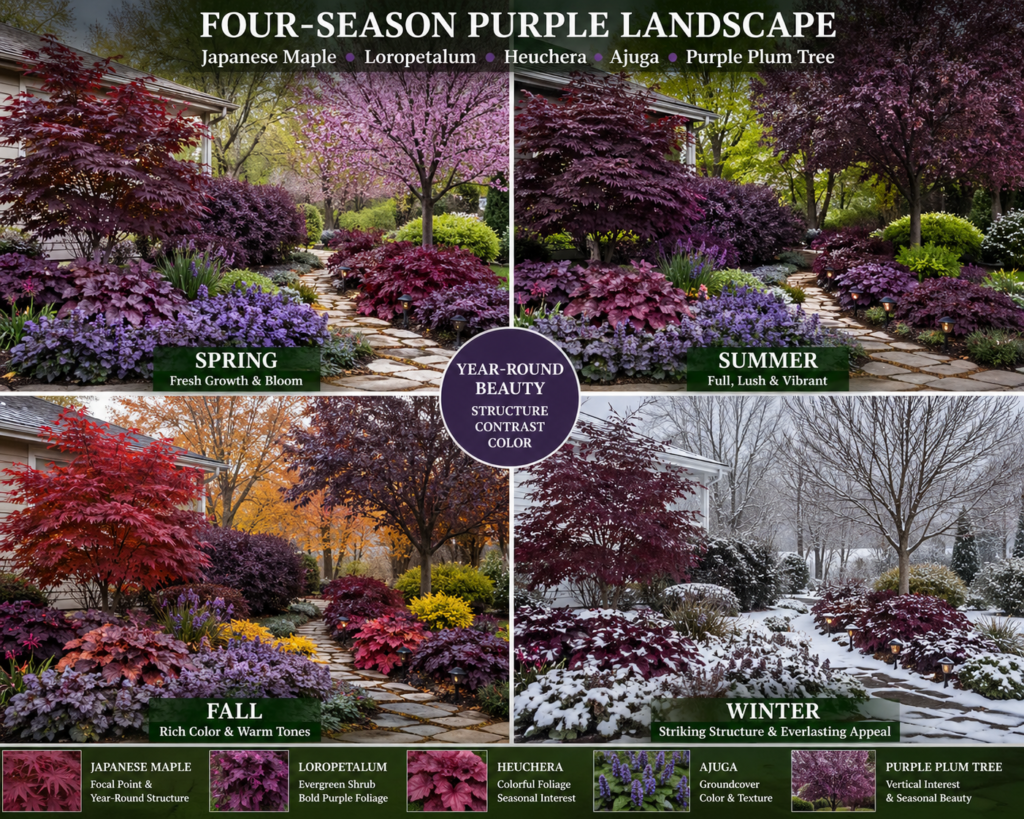
Spring
Spring brings fresh purple growth.
New leaves often appear brighter because active growth increases pigment production.
Best spring performers:
- Coleus
- Heuchera
- Ajuga reptans
Summer
Summer deepens color in sun-tolerant plants, but heat stress can weaken foliage.
Best summer performers:
- Alternanthera
- Purple Heart
- Loropetalum
Fall
Cool weather intensifies burgundy and plum tones.
Best fall performers:
- Smoke Bush
- Japanese Maple
- Barberry
Winter
Evergreen purple plants maintain structure while deciduous plants provide branch architecture.
Best winter options:
- Loropetalum
- Heuchera
- Ajuga
Decision clarity: Combine evergreen shrubs with seasonal perennials and trees for four-season performance.
Which Purple Leaf Plants Work Best for Year-Round Landscaping?
Strong purple landscapes use multiple layers.
Groundcovers cover soil.
Perennials add flexibility.
Shrubs create structure.
Trees add height.
Best Purple Groundcovers
Groundcovers help reduce weeds and cover exposed soil.
Best options:
- Ajuga reptans
- Purple Heart
- Purple Shamrock
Best uses:
- edging
- slope coverage
- underplanting
- gap filling
Best Purple Perennials
Perennials provide flexible seasonal color.
Best options:
- Heuchera
- Penstemon
- Sedum
- Coleus
Heuchera is especially useful for shade and color diversity.
Best Purple Shrubs
Shrubs create long-term framework.
Best options:
- Barberry
- Loropetalum
- Smoke Bush
- Ninebark
- Black Lace Elderberry
Best Purple Trees
Trees create focal hierarchy.
Best options:
- Japanese Maple
- Purple Leaf Plum
Decision clarity:
Layer all four plant types for stronger design.
Which Purple Plants Work Best in Different Climate Zones?
Climate compatibility determines success.
A beautiful plant that cannot survive your environment is a poor investment.
Key climate factors:
- heat
- frost
- humidity
- rainfall
- sun exposure
- drainage
Best Purple Plants for Hot Climates
Good choices:
- Loropetalum
- Purple Heart
- Alternanthera
- Barberry
These tolerate strong heat better.
Best Purple Plants for Cold Climates
Good choices:
- Heuchera
- Ajuga
- Barberry
- Japanese Maple
These recover well after winter.
Best Purple Plants for Dry Climates
Good choices:
- Barberry
- Smoke Bush
- Purple Heart
These handle drought better.
Decision clarity:
Climate fit matters more than appearance.
USDA Hardiness Zones for Purple Plants
Hardiness zones affect winter survival.
Zone 3–5
Best:
- Heuchera
- Ajuga
- Barberry
Zone 6–8
Best:
- Japanese Maple
- Ninebark
- Smoke Bush
- Barberry
Zone 8–10
Best:
- Loropetalum
- Purple Heart
- Alternanthera
- Oxalis triangularis
Decision clarity:
Always check zone compatibility before buying.
How to Choose the Right Purple Plant
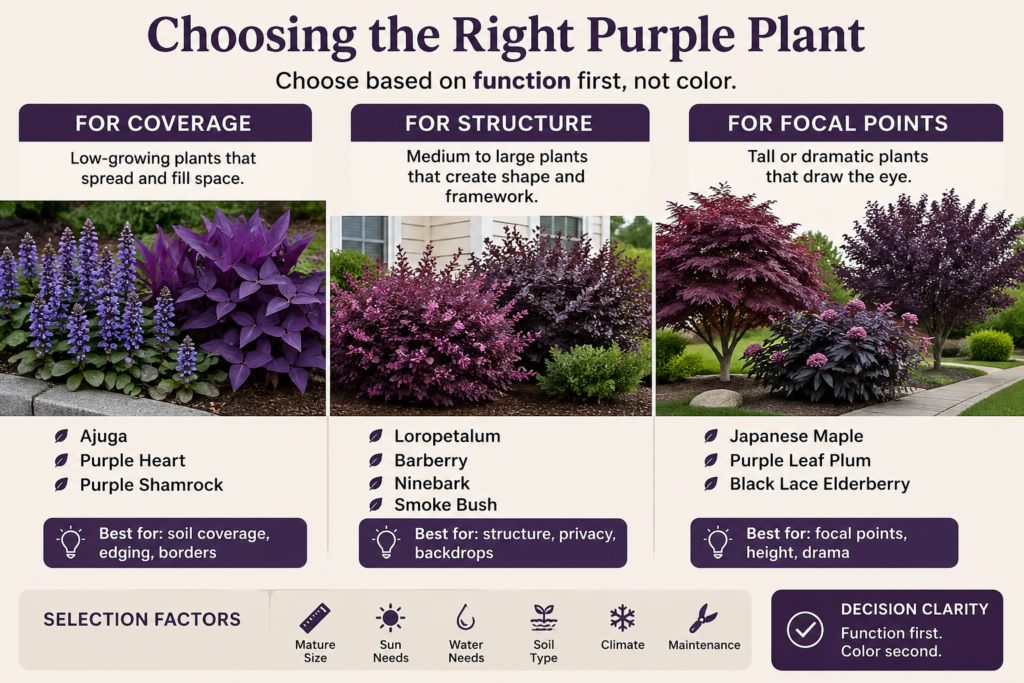
Choose based on function first.
Not color.
Common plant roles:
- soil coverage
- privacy
- structure
- focal point
- walkway framing
- container planting
For Coverage
Choose:
- Ajuga
- Purple Heart
- Purple Shamrock
For Structure
Choose:
- Loropetalum
- Barberry
- Ninebark
- Smoke Bush
For Focal Points
Choose:
- Japanese Maple
- Purple Leaf Plum
- Black Lace Elderberry
Selection factors:
- mature size
- sun needs
- water needs
- soil type
- climate
- maintenance
Decision clarity:
Function first. Color second.
Purple Plant Type Comparison Table
| Plant Type | Lifespan | Maintenance | Cost | Best Use |
|---|---|---|---|---|
| Groundcovers | 5–10 years | Low | Low | Coverage |
| Perennials | 4–8 years | Moderate | Low–Mid | Layering |
| Shrubs | 20+ years | Moderate | Mid | Structure |
| Trees | 30–50+ years | Moderate | High | Focal points |
Quick guide:
- groundcovers for fast spread
- perennials for flexible color
- shrubs for framework
- trees for focal hierarchy
Decision clarity:
Strong landscapes combine multiple plant types.
How Should You Design a Landscape Using Purple Leaf Plants?
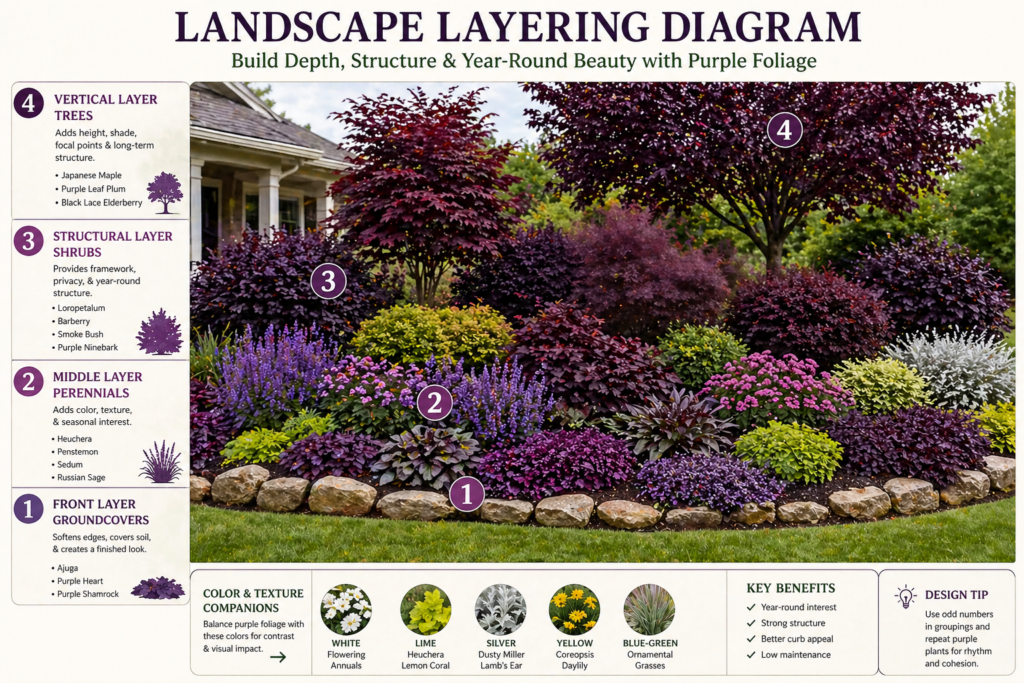
Purple foliage is powerful.
Too much makes a garden feel heavy.
Too little looks accidental.
Use purple strategically.
Front Layer
Low-growing plants.
Best:
- Ajuga
- Purple Heart
- Oxalis triangularis
Purpose:
- edging
- coverage
- border definition
Mid Layer
Perennials.
Best:
- Heuchera
- Coleus
- Penstemon
Purpose:
- transition
- color rhythm
Structural Layer
Shrubs.
Best:
- Loropetalum
- Barberry
- Smoke Bush
- Ninebark
Purpose:
- framework
- privacy
Vertical Layer
Trees.
Best:
- Japanese Maple
- Purple Leaf Plum
Purpose:
- focal points
- height
Decision clarity:
Purple should create structure, not overload.
Can Purple Leaf Plants Grow in Containers?
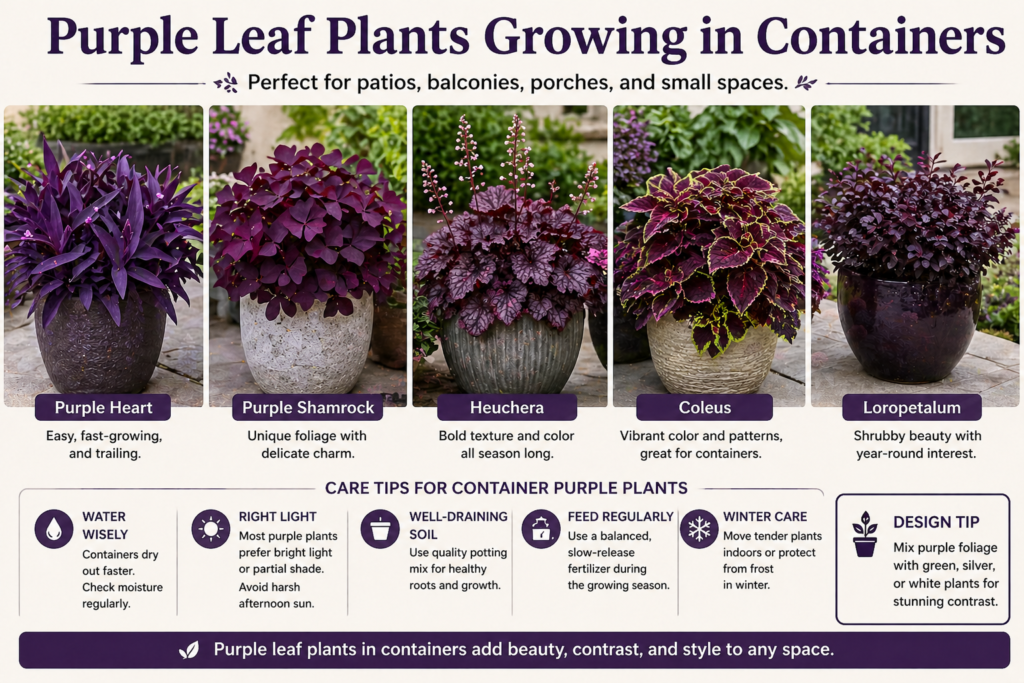
Yes.
Many purple plants perform very well in containers.
Containers offer better control over:
- drainage
- placement
- soil quality
Best container plants:
- Heuchera
- Coleus
- Oxalis triangularis
- Purple Shamrock
- Purple Heart
Benefits:
- mobility
- flexible design
- patio color
- entryway impact
Best practices:
- use drainage holes
- quality potting mix
- avoid overcrowding
- water consistently
Decision clarity:
Containers make purple foliage easy for small spaces.
Expert Design Tips for Purple Foliage
Purple works best as a contrast tool.
Use Purple as an Anchor
Best placement:
- doorways
- corners
- pathways
- focal beds
Balance with Light Colors
Best companion colors:
- white
- silver
- lime
- pale yellow
Good companion plants:
- Hosta
- Dusty Miller
- Lamb’s Ear
Avoid Too Much Dark Color
Too much dark foliage makes gardens feel heavy.
Repeat Purple Strategically
Use purple in 2–3 repeated areas for rhythm.
Decision clarity:
Purple needs balance.
Which Light Conditions Keep Purple Leaves Strongest?
Light affects pigmentation.
Too little light causes green dominance.
Correct light improves:
- color depth
- stem strength
- compact growth
- foliage density
Full Sun Purple Plants
Best:
- Loropetalum
- Barberry
- Smoke Bush
- Purple Heart
These deepen in color with sunlight.
Partial Shade Purple Plants
Best:
- Heuchera
- Coleus
- Ajuga
- Oxalis triangularis
These tolerate filtered light.
Decision clarity:
Light placement directly affects color quality.
What Soil Conditions Help Purple Plants Thrive?
Healthy roots create healthy foliage.
Best soil traits:
- drainage
- moisture balance
- organic matter
- loose texture
- balanced pH
Most purple plants prefer slightly acidic to neutral soil.
Clay Soil
Best:
- Heuchera
- Ajuga
Improve with compost.
Sandy Soil
Best:
- Barberry
- Smoke Bush
- Purple Heart
Mulch helps retain moisture.
Loamy Soil
Best:
- Loropetalum
- Japanese Maple
- Heuchera
Decision clarity:
Root health protects foliage color.
How Much Maintenance Do Purple Plants Need?
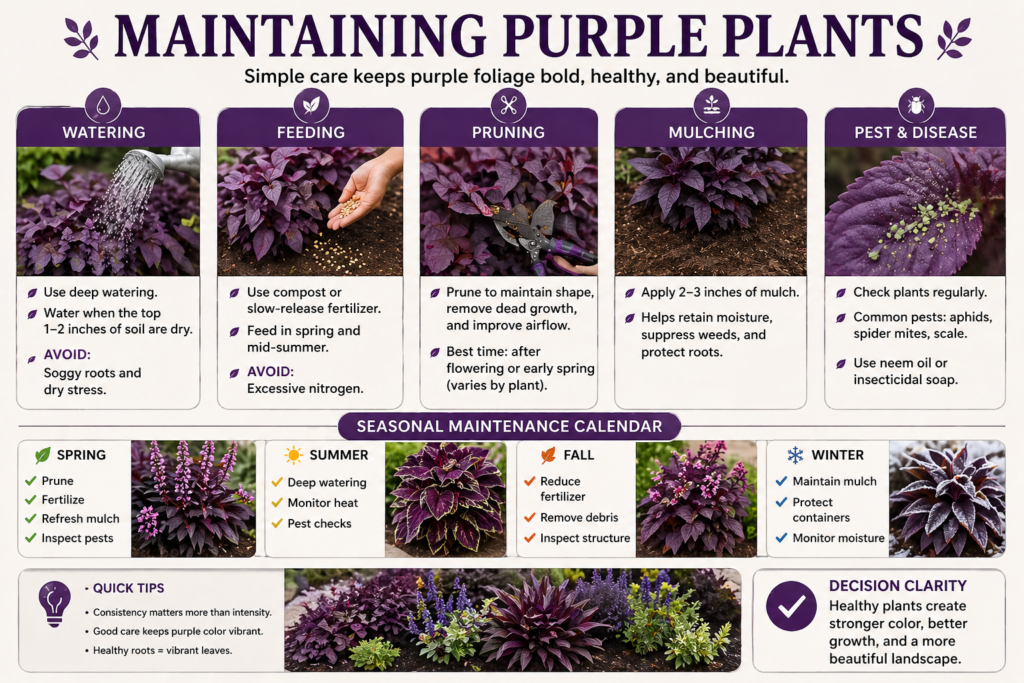
Purple leaf plants are moderate-maintenance.
Watering
Best practice:
deep watering
Avoid:
- soggy roots
- dry stress
Feeding
Use:
- compost
- slow-release fertilizer
Avoid excessive nitrogen.
Pruning
Improves:
- shape
- airflow
- density
Mulching
Benefits:
- moisture retention
- weed suppression
- root protection
Best depth:
2–3 inches
Decision clarity:
Consistency matters more than intensity.
When Should You Prune Purple Plants?
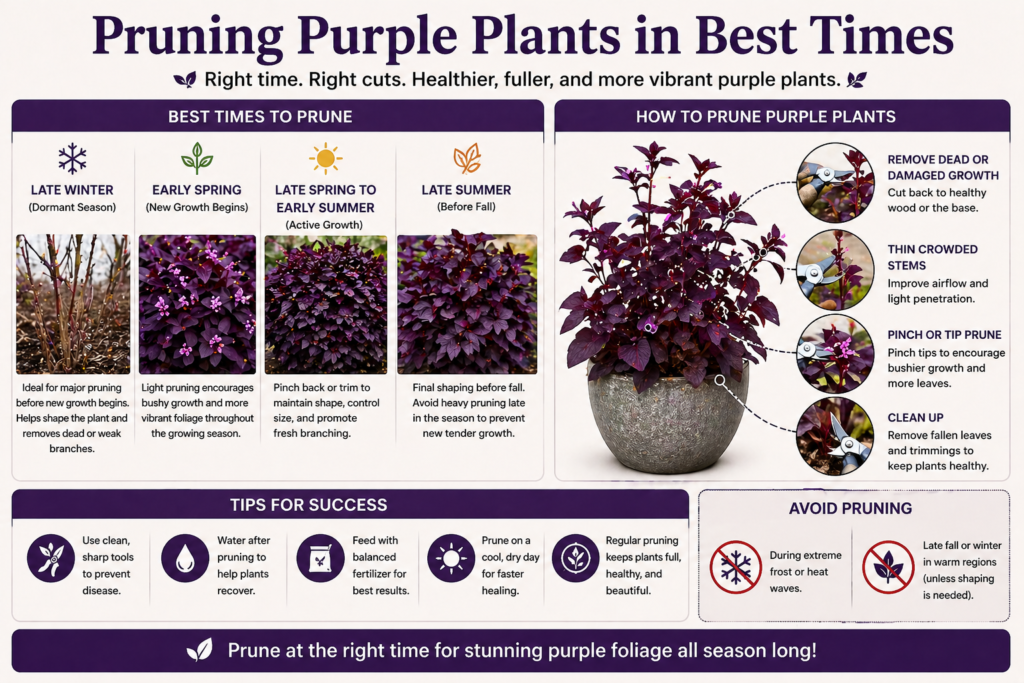
Pruning affects growth and shape.
Shrubs
Examples:
- Loropetalum
- Barberry
- Smoke Bush
Best time:
- after flowering
- early spring
Perennials
Examples:
- Heuchera
- Penstemon
Best time:
- spring cleanup
Trees
Examples:
- Japanese Maple
- Purple Leaf Plum
Best time:
- late winter
Decision clarity:
Prune for health first.
Seasonal Maintenance Calendar
Spring
Tasks:
- prune
- fertilize
- refresh mulch
- inspect pests
Summer
Tasks:
- deep watering
- monitor heat
- pest checks
Fall
Tasks:
- reduce fertilizer
- remove debris
- inspect structure
Winter
Tasks:
- maintain mulch
- protect containers
- monitor moisture
Decision clarity:
Seasonal timing improves performance.
Common Problems with Purple Leaf Plants
Purple foliage plants are resilient but not problem-free.
Root Rot
Cause:
- overwatering
- poor drainage
Signs:
- yellowing
- wilting
Fix:
improve drainage
Pest Damage
Common pests:
- aphids
- spider mites
- scale
Fix:
- neem oil
- insecticidal soap
Fungal Issues
Examples:
- mildew
- leaf spot
Fix:
- spacing
- airflow
- pruning
Heat Stress
Signs:
- burnt edges
- faded leaves
Fix:
- mulch
- deep watering
Decision clarity:
Most problems are preventable.
Why Do Purple Plants Lose Color?
Main reason:
low light.
Other causes:
- excess nitrogen
- root stress
- compacted soil
- overcrowding
Low Light
Causes:
- greener leaves
- weaker stems
Fix:
increase light exposure
Excess Nitrogen
Causes:
- greener growth
- weaker purple pigment
Fix:
reduce nitrogen
Decision clarity:
Check light first.
Purple Foliage vs Flowering Plants
Purple foliage and flowers serve different purposes.
| Factor | Purple Foliage | Flowering Plants |
|---|---|---|
| Seasonal consistency | High | Low |
| Structure | Strong | Moderate |
| Replacement frequency | Low | High |
| Maintenance | Moderate | Higher |
Purple foliage strengths:
- structure
- long-term color
- lower replacement
Flower strengths:
- fragrance
- pollinator support
- bloom variety
Best strategy:
Use purple foliage as foundation.
Use flowers as accents.
Decision clarity:
Foliage builds the system.
Are Purple Plants Native or Introduced?
Some are native.
Some are ornamental introductions.
Native advantages:
- better adaptation
- lower maintenance
- pollinator support
Introduced advantages:
- stronger color
- more variety
- unique foliage forms
Native-friendly options:
- Heuchera
- Ninebark
- Penstemon
Introduced options:
- Loropetalum
- Japanese Maple
- Purple Leaf Plum
Decision clarity:
Use native for ecology and ornamentals for stronger visual specialization.
How Long Do Purple Plants Last?
Lifespan matters for long-term value.
Groundcovers
5–10 years
Example:
Ajuga
Perennials
4–8 years
Example:
Heuchera
Shrubs
20+ years
Examples:
- Loropetalum
- Barberry
- Ninebark
Trees
30–50+ years
Examples:
- Japanese Maple
- Purple Leaf Plum
Increase lifespan with:
- proper climate matching
- pruning
- mulch
- drainage
Decision clarity:
Shrubs and trees offer strongest long-term return.
How Fast Do Purple Plants Grow?
Growth speed affects landscape maturity.
Fast Growers
Best:
- Ajuga
- Purple Heart
- Loropetalum
- Alternanthera
Best for:
- quick coverage
- fast visual impact
Moderate Growers
Best:
- Heuchera
- Barberry
- Ninebark
Slow Growers
Best:
- Japanese Maple
Best for:
- premium focal points
Decision clarity:
Growth speed affects planning.
How Much Do Purple Plants Cost?
Costs vary by plant type and size.
Groundcovers
$5–15
Examples:
- Ajuga
- Purple Heart
Perennials
$8–25
Examples:
- Heuchera
- Penstemon
Shrubs
$20–90
Examples:
- Loropetalum
- Barberry
Trees
$40–250+
Examples:
- Japanese Maple
- Purple Leaf Plum
Decision clarity:
Smaller healthy plants usually offer better value.
How to Build a Purple Landscape on a Budget
Strong landscapes do not require huge budgets.
Build in phases.
Low Budget
Best:
- Ajuga
- Purple Heart
- Heuchera
Mid Budget
Best:
- Loropetalum
- Barberry
- Ninebark
Premium Budget
Best:
- Japanese Maple
- Black Lace Elderberry
- Purple Leaf Plum
Money-saving tips:
- buy smaller plants
- divide perennials
- propagate cuttings
- phase planting
Decision clarity:
Build structure first.
How Do Purple Plants Affect Property Value?
Purple foliage improves curb appeal by creating structure and contrast.
Benefits:
- stronger first impressions
- cleaner design
- better framing
- improved visual balance
Front-yard examples:
- Japanese Maple focal point
- Loropetalum hedge
- Barberry borders
Decision clarity:
Strong landscaping improves perceived value.
Where Should You Buy Purple Plants?
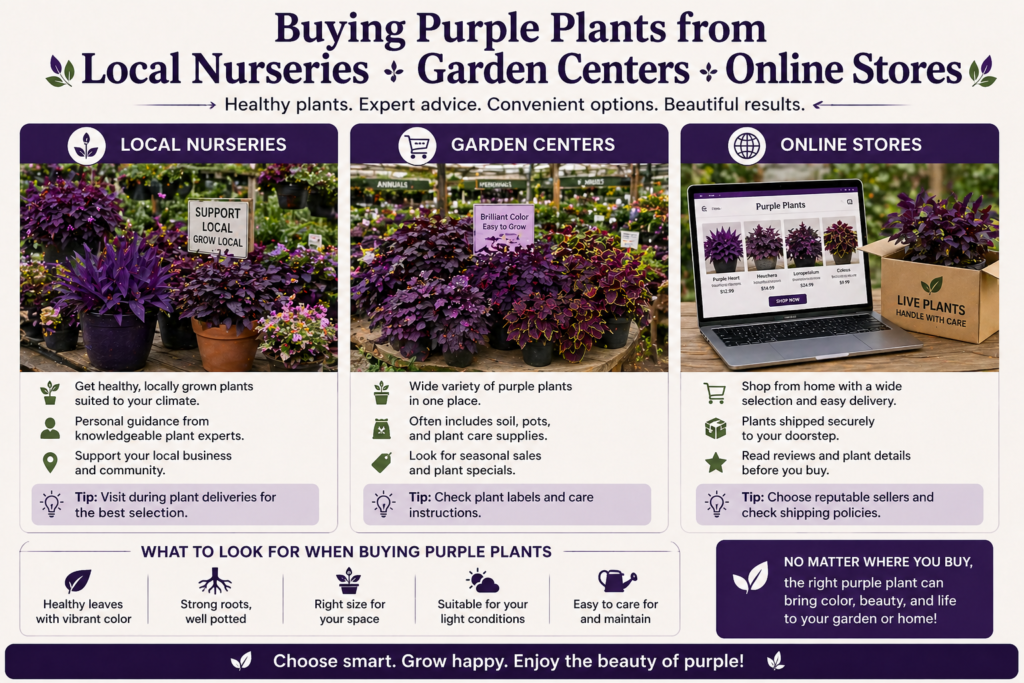
Where you buy affects plant quality.
Local Nurseries
Best for:
- root quality
- local adaptation
- advice
Garden Centers
Best for:
- convenience
- seasonal stock
Online Stores
Best for:
- rare cultivars
- wider selection
Risk:
shipping stress
Decision clarity:
Buy local for health. Online for rarity.
Nursery Buying Checklist
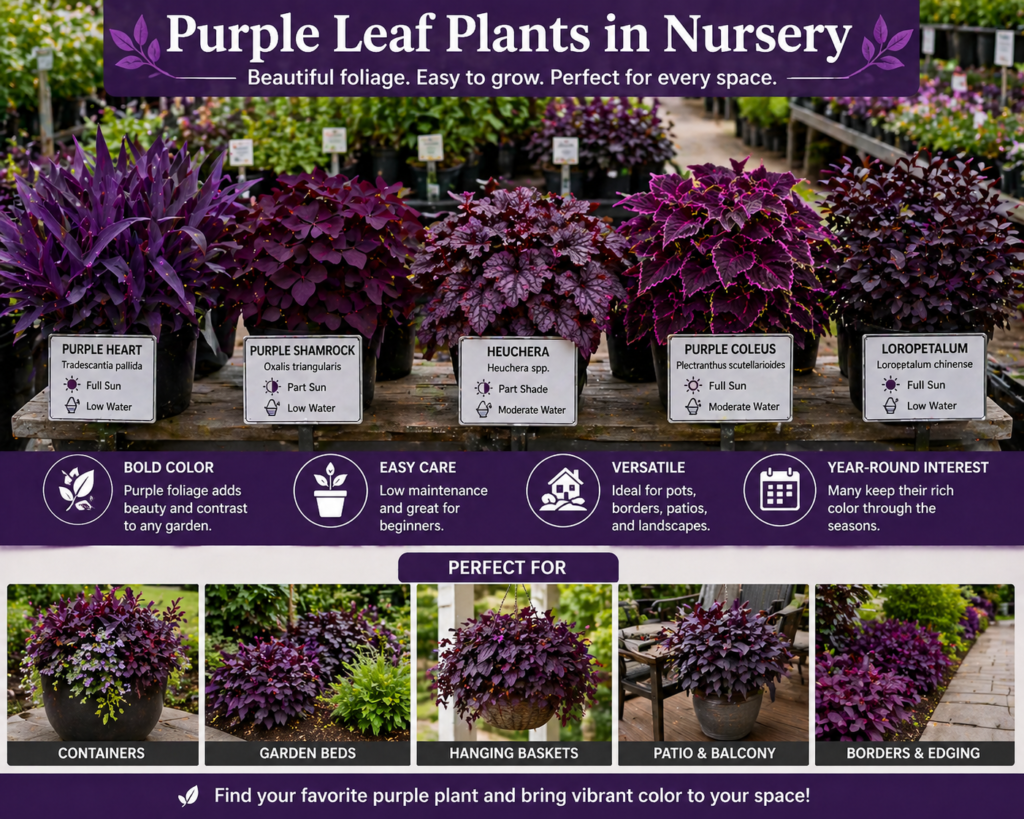
Plant quality determines success.
Root Inspection
Healthy roots:
- white
- tan
- firm
Avoid:
- black roots
- mushy roots
Leaf Inspection
Healthy leaves:
- rich color
- no severe damage
Stem Inspection
Healthy stems:
- upright
- firm
Pot Inspection
Avoid:
- root-bound plants
- circling roots
Decision clarity:
Root health matters more than plant size.
Are Purple Leaf Plants Worth the Investment?
Yes.
Purple foliage creates:
- long-term structure
- lower replacement costs
- stronger curb appeal
- easier color planning
Best investments:
- groundcovers for coverage
- shrubs for structure
- trees for focal points
Decision clarity:
Purple foliage is one of the smartest long-term landscape investments.
Final Thoughts: Building a Four-Season Purple Landscape
Purple foliage creates stronger structure, deeper contrast, and longer-lasting color than many flower-based systems.
The strongest landscapes use:
- groundcovers for spread
- perennials for layering
- shrubs for framework
- trees for focal hierarchy
Balance purple with:
- green
- white
- silver
- yellow
- lime
Avoid:
- overcrowding dark foliage
- ignoring mature size
- planting without climate matching
Purple should guide the design, not overwhelm it.
Decision clarity:
Build around purple foliage first, then use flowers as seasonal accents.
Faq section
Do purple plants stay purple all year?
Some evergreen plants like Loropetalum do. Deciduous plants lose leaves in winter.
Which purple plant is easiest for beginners?
Heuchera.
Why do purple leaves turn green?
Usually low light.
Which purple plants grow fastest?
Ajuga, Purple Heart, Loropetalum.
Which survive winter best?
Heuchera, Ajuga, Barberry.
Are purple plants better than flowering plants?
For long-term structure, yes.
Which are best in full sun?
Loropetalum, Barberry, Smoke Bush.
Which are best in shade?
Heuchera, Coleus, Ajuga.
Can purple plants grow in containers?
Yes, many compact varieties perform very well.
Can purple foliage improve property value?
Yes. Better curb appeal often improves perceived property quality.
Myra is the founder and lead writer of Plantsaholic. She shares practical, research-backed advice on indoor plants, outdoor gardening, flowers, herbs, succulents, and everyday plant care. Her goal is to help gardeners of all experience levels grow healthier plants through simple, easy-to-follow gardening guides.