Shade gardens are often treated as secondary landscape spaces. Many homeowners focus their attention on sunny borders because flowers bloom stronger there, while shaded areas are left with plain green foliage and little visual planning. This creates one of the most common landscape weaknesses: low contrast. A garden without contrast lacks dimension, and shaded spaces can quickly become visually flat. This is where shade purple leaf plants become powerful.
Purple foliage gets its color from anthocyanins, natural plant pigments that create burgundy, violet, plum, bronze-purple, and near-black leaves. In design, these dark tones work beautifully against green, silver, white, lime, and chartreuse plants.
Decision clarity: If your shade garden feels dull or flat, purple foliage is one of the fastest ways to add depth, contrast, and long-term beauty.
What Are Shade Purple Leaf Plants?
Shade purple leaf plants are ornamental plants grown mainly for their purple-colored foliage and their ability to perform in low-light conditions. Their value comes from leaves rather than flowers, which makes them useful for gardens where blooms are limited or short-lived.
These plants may appear in several shades:
- Deep burgundy
- Plum
- Wine-red
- Violet
- Bronze-purple
- Black-purple
They usually fall into these groups:
- Perennials: Long-term plants like Heuchera
- Ground covers: Low-growing spreaders like Ajuga reptans
- Tropical foliage plants: Dramatic plants like Persian Shield
- Decorative houseplants: Indoor-friendly plants like Oxalis triangularis and Rex Begonia
Shade purple plants are important because they create structure. In a shaded corner, green foliage often blends together. Purple foliage separates plant masses and gives the eye a clear focal point.
Decision clarity: Shade purple plants are not just colorful plants. They are structural landscape tools for low-light areas.
Why Do Purple Leaf Plants Work So Well in Shade Gardens?
Shade naturally reduces brightness, so many plants can appear visually similar. This creates a compressed look where leaves, borders, and planting layers blend together. Purple foliage solves this by adding dark contrast and visual depth.
Dark foliage behaves differently from light foliage. Purple, burgundy, and near-black leaves visually recede, making planting beds appear deeper. This helps small shade gardens feel more layered and better designed.
Best color combinations include:
- Purple + lime green
- Purple + white flowers
- Purple + silver foliage
- Purple + chartreuse grasses
- Purple + variegated hostas
Purple foliage also improves flower visibility. White flowers against green foliage look soft, but white flowers against purple foliage look brighter and more intentional.
Purple leaf plants also provide seasonal consistency. Flowers fade, but foliage remains active for months.
They help create:
- Longer ornamental value
- Better structure
- Stronger contrast
- Less dependence on flowers
- Better garden rhythm
Real-world example: A border with only green hostas and ferns may look blended. Adding purple Heuchera immediately separates the layers.
Decision clarity: Purple foliage is one of the easiest ways to improve a flat shade garden without redesigning the whole space.
Which Shade Purple Leaf Plants Perform Best?
Not every purple plant performs well in shade. Some need brighter filtered light to keep their color, while others tolerate deeper shade better. The best choices combine strong pigmentation, shade adaptability, structure, and easy care.
Top-performing shade purple plants include:
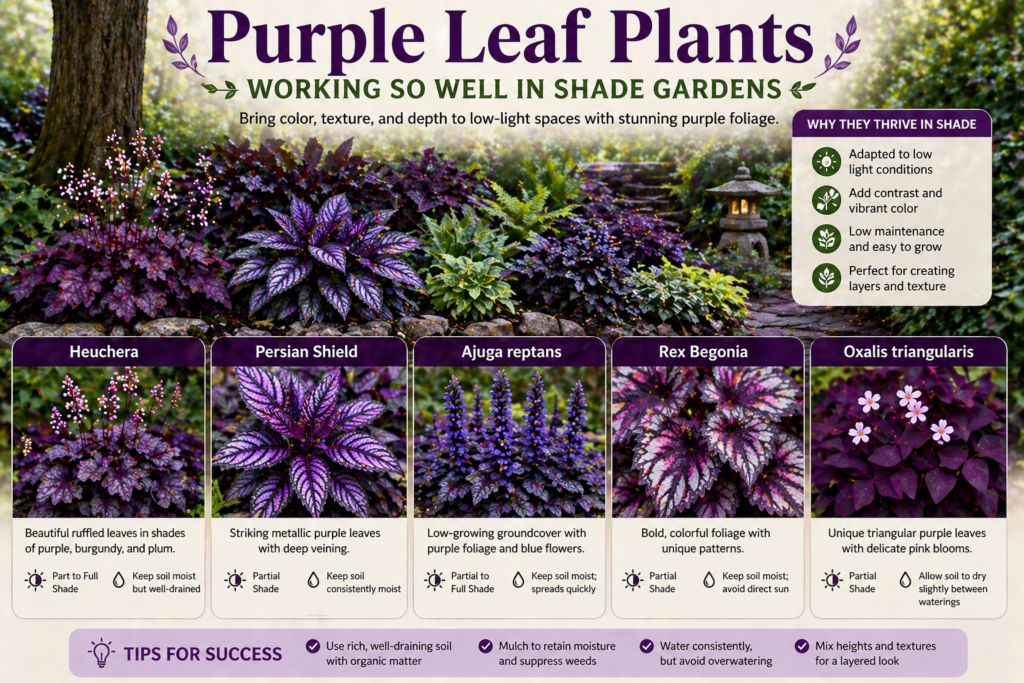
Heuchera
Heuchera is one of the best purple foliage perennials for shade. It works well in borders, containers, under trees, and woodland gardens. Popular purple varieties include dark plum, burgundy, and near-black cultivars.
Best for:
- Beginners
- Borders
- Containers
- Long-term planting
Persian Shield
Persian Shield has metallic purple foliage and creates bold visual drama. It prefers bright shade rather than deep shade.
Best for:
- Tropical-style gardens
- Containers
- Accent planting
Ajuga reptans
Ajuga is a fast-spreading purple ground cover. It helps cover soil, reduce weeds, and add low-level color.
Best for:
- Ground coverage
- Path edges
- Underplanting
Rex Begonia
Rex Begonia offers detailed leaf patterns with purple, silver, green, and black tones. It works well in containers and protected shade.
Best for:
- Decorative pots
- Covered patios
- Indoor displays
Oxalis triangularis
Oxalis has triangular purple leaves that open and close with light. It is excellent for indoor growing and small containers.
Best for:
- Indoor shade
- Small pots
- Decorative displays
Decision clarity: Choose Heuchera for reliability, Ajuga for ground cover, Persian Shield for drama, Rex Begonia for texture, and Oxalis for indoor beauty
What Are the Best Shade Purple Leaf Plants for Beginners?
Beginners should start with plants that tolerate small care mistakes and still look good. Some purple plants need exact humidity, light, or watering conditions, but others are much more forgiving.
Best beginner choices:
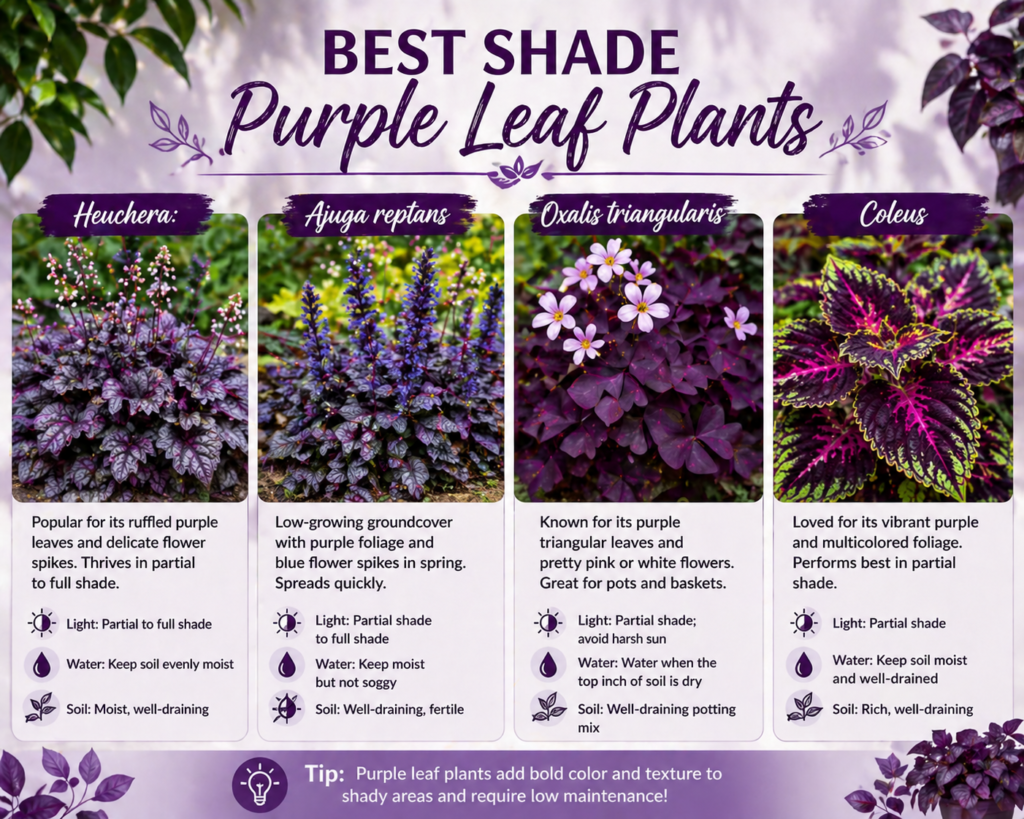
- Heuchera: Best overall beginner purple shade plant
- Ajuga reptans: Best beginner ground cover
- Oxalis triangularis: Best beginner container or indoor plant
- Coleus: Best fast-growing colorful foliage option
Heuchera is the safest starting point because it handles partial shade well, returns in many climates, and recovers from minor watering mistakes. Ajuga is also easy because it spreads quickly and fills bare spaces with little effort.
Beginner mistakes to avoid:
- Planting in dry tree-root zones
- Using compacted soil
- Overwatering containers
- Choosing deep shade for plants that need bright filtered light
Real-world advice: If this is your first purple foliage garden, start with three to five Heuchera plants in partial or dappled shade.
Decision clarity: Start with reliable plants first. Add more dramatic but sensitive plants later.
How Much Shade Can Purple Leaf Plants Tolerate?
Shade is not the same everywhere. Some areas receive bright filtered light, while others receive almost no direct sun. Purple foliage color depends heavily on light quality.
Partial Shade
Partial shade means around 3–6 hours of filtered or indirect light. This is ideal for many purple foliage plants because it supports pigment while reducing scorch.
Best partial-shade plants:
- Heuchera
- Persian Shield
- Coleus
Full Shade
Full shade means less than 3 hours of direct light. Some purple plants tolerate it, but color may become weaker.
Best full-shade plants:
- Rex Begonia
- Oxalis triangularis
- Ajuga reptans
Dappled Shade
Dappled shade is filtered light through trees. It is often the best condition for purple shade plants because it offers balanced light, stable moisture, and lower heat stress.
Warning signs of too little light:
- Purple leaves turning green
- Leggy stems
- Weak growth
- Thin foliage
Warning signs of too much sun:
- Leaf burn
- Dry edges
- Pigment bleaching
Decision clarity: Most purple shade plants perform best in bright filtered or dappled shade.
What USDA Hardiness Zones Do Shade Purple Leaf Plants Grow Best In?
Climate matters as much as shade. A plant may tolerate low light but still fail if your winters are too cold or summers are too hot.
Common hardiness zones:
- Heuchera: Zones 4–9
- Ajuga reptans: Zones 3–10
- Persian Shield: Zones 9–11
- Rex Begonia: Zones 10–12
- Oxalis triangularis: Zones 8–11
Cold-climate tips:
- Mulch perennial crowns
- Avoid wet winter soil
- Protect roots from freeze-thaw stress
Warm-climate tips:
- Improve airflow
- Maintain soil moisture
- Protect from harsh afternoon heat
A Heuchera planted in zone 5 may return every year, while Persian Shield may need to be treated as a seasonal plant or overwintered indoors.
Decision clarity: Choose plants based on your climate first, then your design goal.
Choose plants based on your climate first, then your design goal.
How Do You Design a Shade Garden With Purple Foliage?
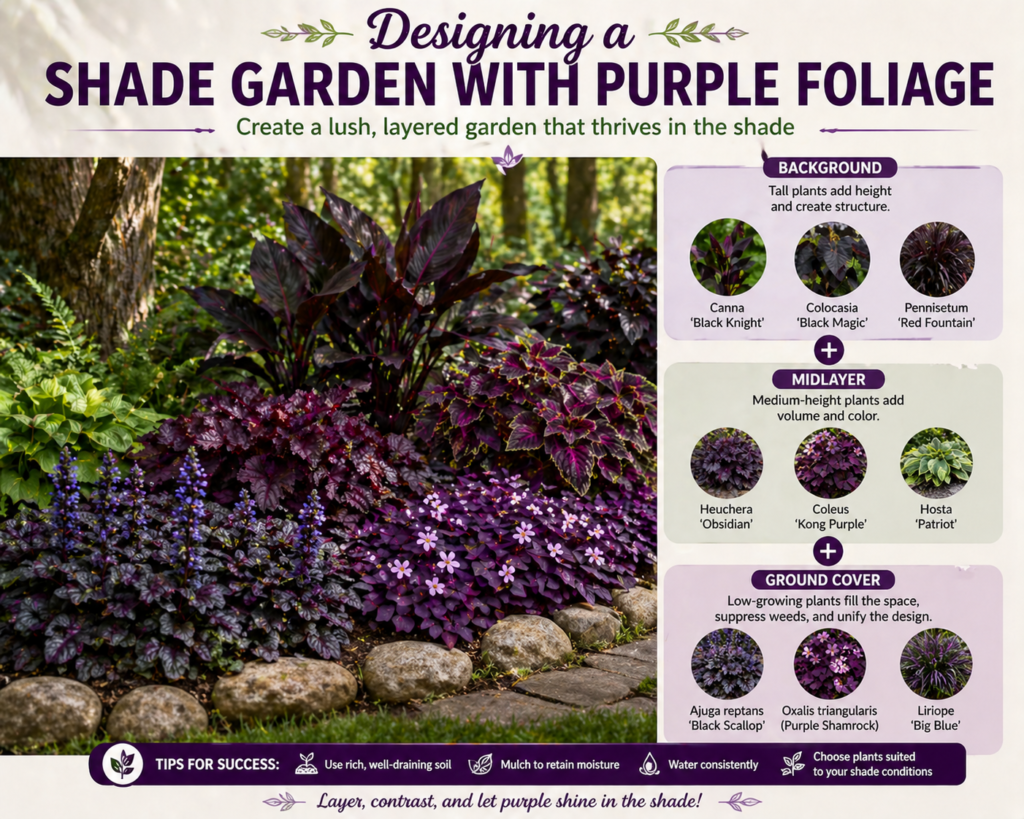
Purple foliage works best when used intentionally. Random planting weakens its effect. The strongest shade garden design uses layering, contrast, repetition, and texture.
Use this formula:
Background + midlayer + ground cover
Example:
- Background: Ferns, hydrangeas
- Midlayer: Heuchera, Persian Shield
- Ground cover: Ajuga reptans
Purple should not be placed in one isolated cluster. Repeat it every 6–8 feet to create rhythm and visual connection.
Texture is also important. Combine:
- Broad leaves
- Fine leaves
- Feathered leaves
- Cascading leaves
Good combinations:
- Heuchera + hosta + fern
- Persian Shield + ferns + white impatiens
- Ajuga + Japanese forest grass
Use purple near:
- Pathways
- Entry points
- Seating areas
- Patio containers
- Shaded borders
Avoid:
- Too many dark plants together
- Too much green without contrast
- Flat-height planting
Decision clarity: Use purple foliage as structure first and color second.
Which Plants Pair Best With Shade Purple Leaf Plants?
Purple foliage needs good companions. Without contrast, dark plants can look heavy. The best companions bring brightness, softness, or movement.
Hosta
Hostas pair beautifully with purple foliage because their bright green, blue-green, or variegated leaves create strong contrast.
Ferns
Ferns add soft texture and movement. They help balance the heavier look of broad purple leaves.
Astilbe
Astilbe adds vertical flower plumes and soft seasonal color.
Japanese Forest Grass
Hakonechloa macra creates one of the strongest gold-purple combinations.
White Impatiens
White flowers look brighter when planted near purple foliage.
Best combinations:
- Heuchera + hosta
- Persian Shield + ferns
- Ajuga + Japanese forest grass
- Rex Begonia + white impatiens
Real-world example: Purple Heuchera beside chartreuse hosta creates much stronger definition than pairing it with dark green foliage only.
Decision clarity: Companion planting is contrast engineering, not decoration.
How Do You Care for Shade Purple Leaf Plants?
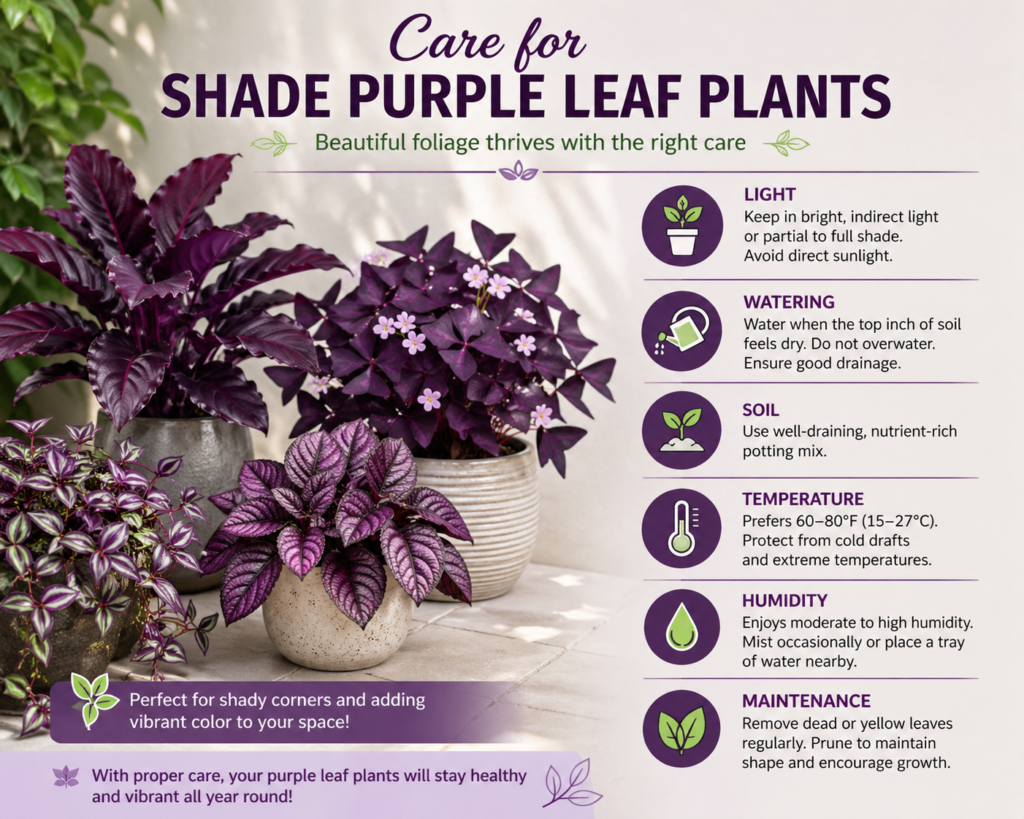
Purple foliage plants are usually low-maintenance, but care affects color, structure, and long-term health.
Watering is important. Most shade plants prefer evenly moist soil, not soggy soil.
General watering guide:
- Water deeply 1–2 times weekly
- Adjust for heat and rainfall
- Keep the root zone consistent
- Water containers more often
Signs of underwatering:
- Crispy edges
- Curling leaves
- Limp foliage
Signs of overwatering:
- Yellow leaves
- Soft stems
- Root decline
Best soil traits:
- Organic-rich
- Loose texture
- Good drainage
- Moisture retention
Useful amendments:
- Compost
- Leaf mold
- Pine bark fines
Fertilizing should be moderate. Use a slow-release balanced fertilizer and avoid too much nitrogen because nitrogen can increase green growth and reduce purple pigmentation.
Prune regularly by removing:
- Dead leaves
- Diseased foliage
- Crowded stems
- Damaged growth
Decision clarity: Good care is about balance. Healthy roots create stronger foliage color.
How Do Shade Purple Leaf Plants Perform Across the Seasons?
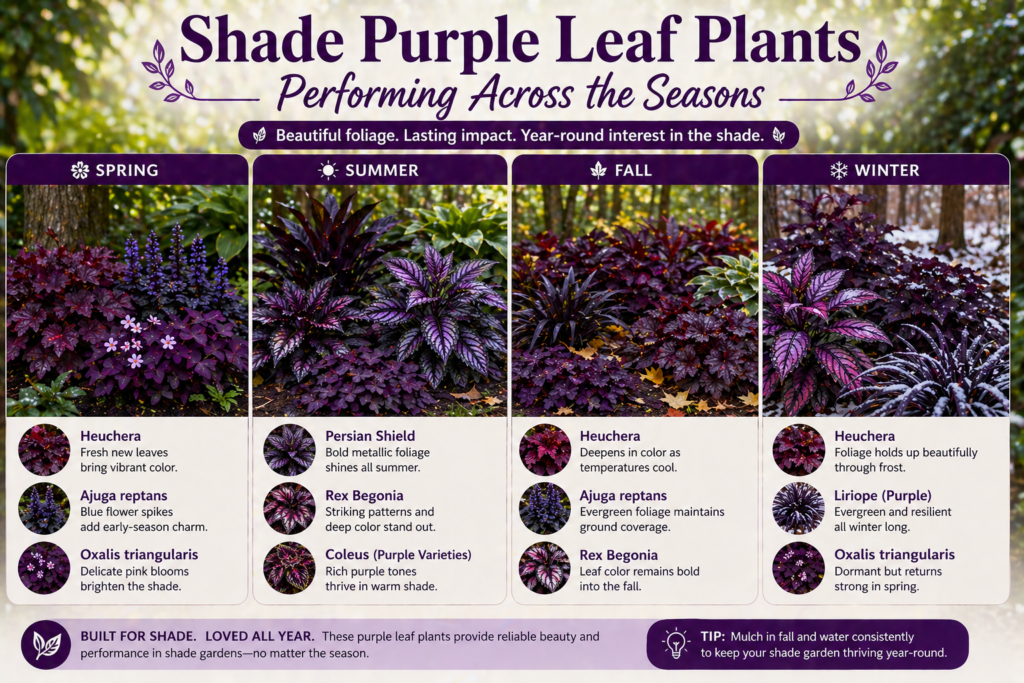
Shade purple plants change through the year. Understanding seasonal behavior prevents unnecessary replacement.
Spring
Spring is often the strongest growth season. New foliage appears fresh, dense, and colorful. It is also a good time to plant, divide, and lightly feed perennials.
Summer
Summer brings faster growth but also heat stress. Some plants may soften in color during high heat, especially if moisture is inconsistent.
Fall
Cooler weather can deepen purple pigmentation in many plants. Fall is also useful for cleanup, mulching, and preparing perennials for winter.
Winter
Perennials may go dormant in cold climates. Tropicals may slow down or need indoor protection.
Seasonal care priorities:
- Spring: Plant, divide, lightly fertilize
- Summer: Water consistently, watch heat stress
- Fall: Clean old foliage, mulch roots
- Winter: Protect crowns and avoid wet soil
Decision clarity: Color changes are often seasonal, not always a sign of plant failure.
Why Do Purple Leaves Turn Green?
Purple leaves usually turn green because of environmental conditions, not disease. The most common reason is too little light. When light levels are too low, plants increase chlorophyll production, and green becomes stronger than purple.
Other causes include:
- Excess nitrogen fertilizer
- Overcrowding
- Seasonal heat stress
- Weak airflow
- Dense shade from nearby plants
How to fix it:
- Move the plant to brighter filtered shade
- Reduce nitrogen-heavy fertilizer
- Improve spacing
- Prune surrounding plants
- Improve soil and root health
For example, Persian Shield often loses metallic purple intensity in deep shade. Moving it into brighter filtered light can restore stronger color.
Decision clarity: Color loss is usually a placement or care issue, not a reason to replace the plant immediately
What Are the Most Common Growing Mistakes With Purple Shade Plants?
Most purple foliage problems are preventable. The plant is often not the problem. The environment is.
Planting in dry tree-root zones
Tree roots compete heavily for water and nutrients, causing weak foliage and poor color.
Overwatering containers
Too much water causes root rot, yellow leaves, and soft stems.
Using heavy clay soil
Dense soil holds too much water and reduces oxygen around roots.
Overcrowding plants
Poor airflow increases disease risk and weakens growth.
Ignoring seasonal light changes
A spot that is bright in spring may become deep shade in summer when trees leaf out.
Overfeeding nitrogen
Too much nitrogen pushes green growth and reduces purple color.
Correction checklist:
- Improve drainage
- Increase filtered light
- Reduce fertilizer
- Improve spacing
- Mulch correctly
Decision clarity: Fix the growing conditions before replacing the plant.
Are Shade Purple Leaf Plants Good for Containers?
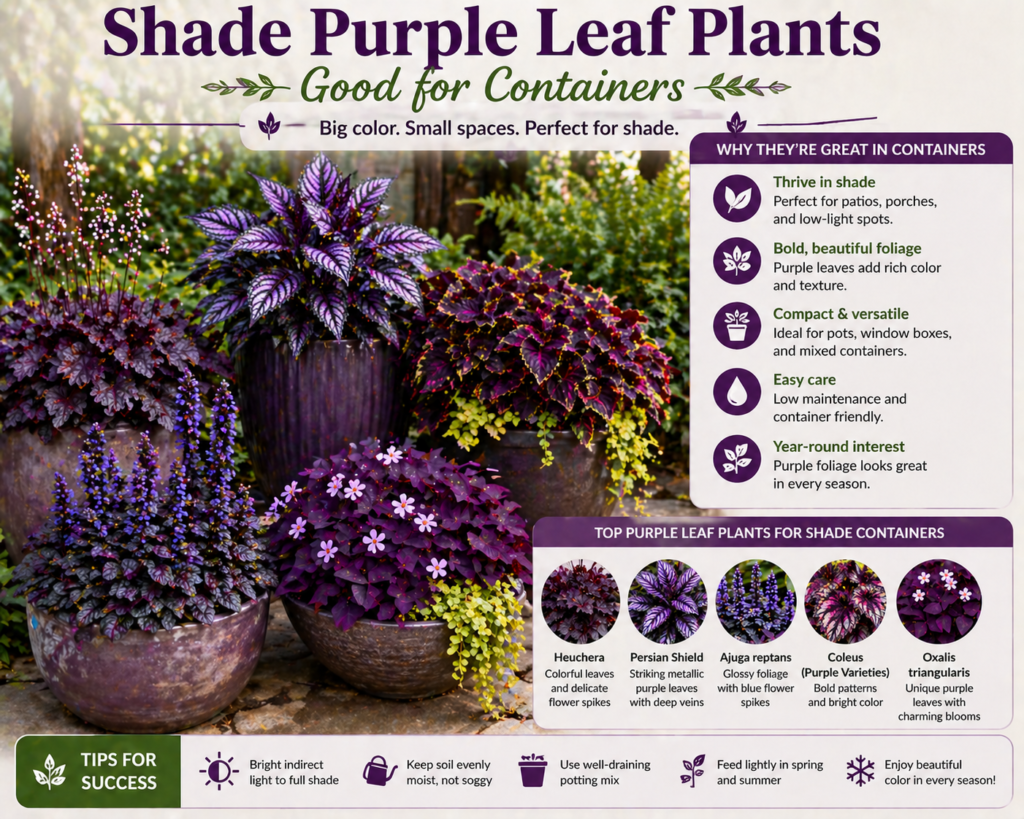
Yes, many purple shade plants grow very well in containers. Containers give gardeners better control over soil, drainage, moisture, and placement.
Best container plants:
- Heuchera
- Rex Begonia
- Oxalis triangularis
- Persian Shield
Container advantages:
- Better soil control
- Easy movement
- Decorative flexibility
- Better root monitoring
Container setup checklist:
- Use drainage holes
- Choose quality potting mix
- Add organic matter
- Avoid dense garden soil
- Use a pot at least 10–14 inches wide
A good mixed container formula:
- Focal plant: Persian Shield
- Filler plant: Heuchera
- Trailing plant: Ajuga
Containers are especially useful where shade changes seasonally. You can move the plant to better light when needed.
Decision clarity: Containers are ideal when you want more control and flexible placement.
Are Shade Purple Leaf Plants Safe for Pets?
Pet safety matters if cats or dogs chew leaves. Some purple foliage plants are lower-risk, while others can cause irritation or digestive upset if eaten.
Lower-risk options:
- Heuchera
- Ajuga reptans
Use caution with:
- Rex Begonia
- Oxalis triangularis
- Coleus
Pet-safe strategies:
- Use elevated containers
- Place plants out of reach
- Use hanging displays
- Fence delicate beds
- Avoid risky plants indoors
Possible symptoms after chewing unsafe plants:
- Drooling
- Vomiting
- Pawing at the mouth
- Digestive upset
Decision clarity: If pets live in your home, check plant toxicity before buying and place higher-risk plants where pets cannot reach them.
How Do You Buy Healthy Shade Purple Leaf Plants?
Buying healthy plants is one of the biggest factors in long-term success. Weak nursery plants often fail even when care is good.
Check roots first.
Healthy roots should be:
- White or light tan
- Firm
- Fresh-smelling
Avoid roots that are:
- Black
- Mushy
- Rotten-smelling
- Tightly circling the pot
Check foliage.
Healthy leaves should have:
- Strong color
- No spots
- No pest damage
- No yellowing
Check stems.
Healthy stems should be:
- Firm
- Upright
- Flexible
Avoid buying only the biggest plant. Smaller healthy plants often establish better than oversized stressed plants.
Decision clarity: Buy roots first, leaves second, flowers last.
Where Can You Buy Shade Purple Leaf Plants?
You can buy shade purple leaf plants from local nurseries, garden centers, online plant stores, and plant expos. The best source depends on your goal.
Local nurseries are often best for beginners because you can inspect root health, leaf condition, and pest issues before buying. They also usually carry plants suited to your climate.
Local Nurseries
Best for:
- Healthy stock
- Regional adaptation
- Root inspection
Garden Centers
Best for:
- Seasonal availability
- Common varieties
- Easy access
Online Plant Stores
Best for:
- Rare cultivars
- Specialty plants
- Collector varieties
Plant Expos
Best for:
- Unique plants
- Better variety
- Expert grower advice
Online buying risks include shipping stress, broken foliage, dry roots, and delayed planting.
Decision clarity: Buy common plants locally and rare cultivars online.
How Much Do Shade Purple Leaf Plants Cost?
Prices depend on plant type, size, rarity, and source. Common ground covers usually cost less, while rare cultivars and collector plants cost more.
Average price ranges:
- Small starter plants: $5–12
- Mid-size nursery pots: $12–25
- Large mature containers: $25–60
- Rare cultivars: $40–100+
Cost by category:
- Ground covers: Lower cost, faster coverage
- Perennials: Moderate cost, long-term return
- Tropicals: Higher replacement cost in cold climates
- Collector plants: Higher cost, stronger visual uniqueness
Buying ten small healthy plants is often smarter than buying three large stressed plants. Smaller plants adapt faster and usually establish better.
Buying tips:
- Buy in spring for best availability
- Compare root quality before price
- Avoid oversized stressed plants
- Choose climate-suitable varieties
Decision clarity: Health gives better value than instant size.
What Problems Affect Shade Purple Leaf Plants?
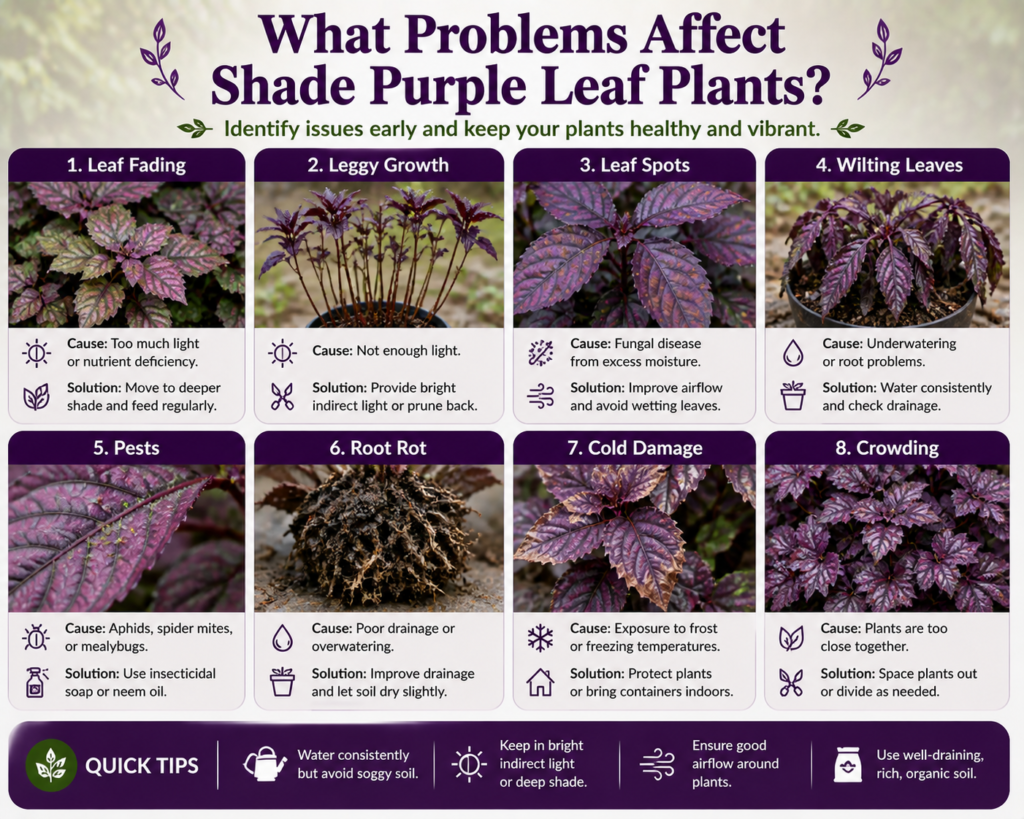
Even strong shade purple plants can face problems when conditions are poor.
Common problems include:
Powdery Mildew
Common in humid shade.
Signs:
- White coating
- Distorted leaves
Prevention:
- Improve airflow
- Space plants correctly
- Avoid overhead watering
Root Rot
Usually caused by wet soil.
Symptoms:
- Yellowing
- Soft stems
- Sudden collapse
Prevention:
- Improve drainage
- Avoid overwatering
Slugs
Common on broadleaf plants like Heuchera and hosta.
Control:
- Slug traps
- Copper barriers
- Cleaner garden beds
Leaf Scorch
Happens when shade plants receive sudden strong sun.
Fix:
- Move gradually
- Protect from afternoon sun
Decision clarity: Most problems start from environmental imbalance. Prevention is easier than treatment.
Shade Purple Plant Comparison Table
Use this table to match plant choice with real growing conditions.
| Plant | Shade Level | Growth Speed | Difficulty | Container Friendly |
|---|---|---|---|---|
| Heuchera | Partial shade | Medium | Easy | Excellent |
| Ajuga reptans | Partial to full shade | Fast | Easy | Good |
| Persian Shield | Bright shade | Fast | Moderate | Excellent |
| Rex Begonia | Full to partial shade | Medium | Moderate | Excellent |
| Oxalis triangularis | Partial shade | Medium | Easy | Excellent |
| Coleus | Partial shade | Fast | Easy | Very good |
Best by category:
- Best beginner: Heuchera
- Best ground cover: Ajuga
- Best dramatic foliage: Persian Shield
- Best indoor plant: Oxalis
- Best decorative container: Rex Begonia
Decision clarity: Performance fit matters more than appearance.
Are Shade Purple Leaf Plants Worth It?
Yes. Shade purple leaf plants are worth it because they provide long-lasting color, structure, and contrast in areas where flowers often struggle.
Long-term benefits:
- Better shade contrast
- Longer ornamental season
- Lower maintenance
- Better garden depth
- Stronger layering
- More container flexibility
For homeowners, they improve curb appeal. For landscapers, they provide better design control. For container gardeners, they create strong visual displays in patios, balconies, and covered spaces.
A flat green shade border can often be improved with only three to five strategically placed purple foliage plants. That makes them a high-impact choice without needing a full garden redesign.
Final decision clarity:
If your shade garden lacks structure, contrast, and long-term color, purple foliage plants are one of the best upgrades you can make.
FAQ SECTION
What is the best purple leaf plant for full shade?
Rex Begonia, Oxalis triangularis, and Ajuga reptans are among the best full-shade purple foliage plants because they tolerate low light better than many bright-shade plants.
Which purple shade plant is easiest for beginners?
Heuchera is one of the easiest beginner-friendly purple shade plants because it is low-maintenance, reliable, and adaptable.
Why do purple leaf plants turn green in shade?
Purple leaves often turn green when light levels are too low. Excess nitrogen fertilizer can also reduce purple pigmentation.
Can purple foliage plants survive full shade?
Yes, some can. Ajuga reptans, Rex Begonia, and Oxalis triangularis perform well in deeper shade, while others prefer filtered light.
What is the fastest-growing purple shade plant?
Ajuga reptans is one of the fastest-growing purple shade plants because it spreads quickly and forms dense ground coverage.
Are shade purple leaf plants safe for cats and dogs?
Some are safer than others. Heuchera and Ajuga are lower-risk, while Rex Begonia, Oxalis, and Coleus should be kept out of reach.
Which purple shade plants grow best in containers?
Heuchera, Rex Begonia, Persian Shield, and Oxalis triangularis grow well in containers because they adapt to controlled soil and moisture.
What plants pair best with purple foliage in shade gardens?
Hosta, ferns, Astilbe, and Japanese forest grass pair well with purple foliage because they add contrast, texture, and brightness.
How often should you water purple shade plants?
Most need evenly moist soil and usually perform well with one to two deep waterings per week, depending on heat, rainfall, and drainage.
Are purple shade plants perennial or annual?
It depends on the plant. Heuchera and Ajuga are perennial in many climates, while Persian Shield and Rex Begonia are often seasonal in colder regions.

Myra is the founder and lead writer of Plantsaholic. She shares practical, research-backed advice on indoor plants, outdoor gardening, flowers, herbs, succulents, and everyday plant care. Her goal is to help gardeners of all experience levels grow healthier plants through simple, easy-to-follow gardening guides.