Root aphids in houseplants are tiny sap-feeding insects that live on or around plant roots. They can contribute to yellowing leaves, wilting, weak growth, and reduced plant vigor, but these symptoms alone do not confirm an infestation. The strongest evidence is finding small aphid-like insects repeatedly associated with living roots.
If root aphids are confirmed, isolate the affected plant, remove contaminated growing media when appropriate, inspect root health, clean the root system, repot in fresh mix, sanitize tools and containers, and monitor the plant for renewed activity.
Root Aphids in Houseplants: Quick Facts
Root aphids are easy to misdiagnose because most of their activity occurs below the soil surface. White particles in potting mix, yellow leaves, or declining roots can have several unrelated causes.
| Question | Quick answer |
|---|---|
| Where are root aphids found? | On and around plant roots |
| Typical size | Often about 2–3 mm |
| Appearance | Pale, yellow, green, gray, brown, sometimes waxy |
| Do they jump? | No |
| Can some forms fly? | Yes |
| Do yellow leaves confirm them? | No |
| Main close lookalike | Root mealybugs |
| Best confirmation | Aphid-like insects repeatedly found around roots |
| First action | Isolate the plant |
| Reuse infested soil? | No |
| Is pesticide always needed? | No |
| Can the plant recover? | Yes, if enough healthy tissue remains |
Before taking action, answer three questions:
- Have I actually found the insect?
- Are the roots still firm and functional?
- Is the infestation localized or widespread?
What Are Root Aphids?
Root aphids are aphids that spend part or all of their feeding period below the soil surface. They use piercing-sucking mouthparts to feed from plant roots rather than gathering mainly on new leaves and soft stems.
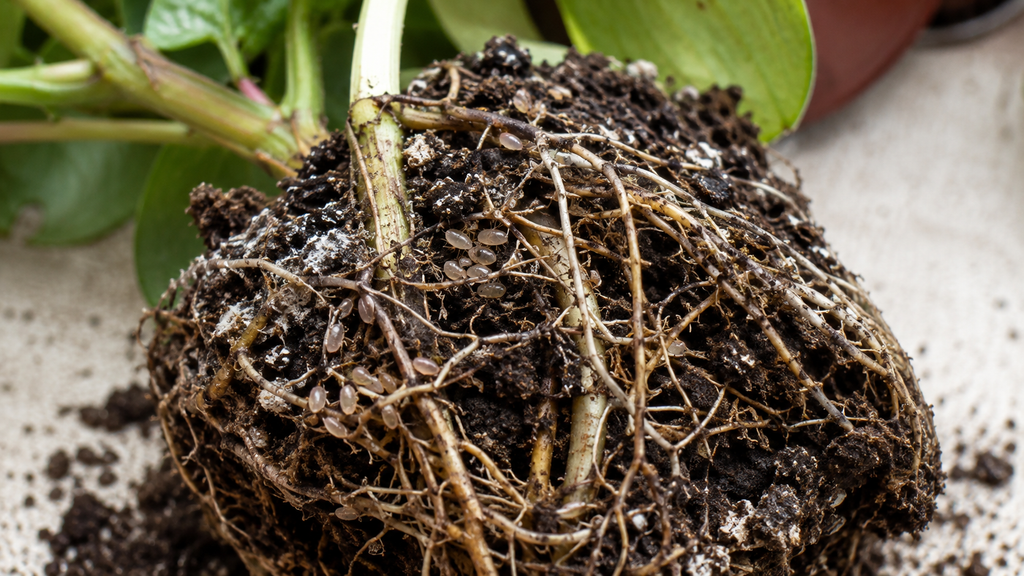
The Royal Horticultural Society describes root aphids as generally around 2–3 mm long. Their appearance varies by species and may include pale yellow, green, gray, brown, or whitish forms. Many develop a white waxy coating that can make them resemble root mealybugs or material in the potting mix.
The effect of an infestation depends on aphid population, plant age, root-system size, existing stress, plant species, and growing conditions.
Young plants and small cuttings with limited root systems may be more vulnerable than mature plants with healthy established roots.
Are Root Aphids the Same as Regular Aphids?
Root aphids belong to the broader aphid group, but their feeding location changes how they are detected and treated. Common aphids are usually visible on leaves, buds, stems, and new growth. Root aphids are protected by potting mix and roots, making surface sprays less reliable.
Do All Root Aphids Behave the Same Way?
No. Several aphid species can feed around roots, and their host plants, life cycles, colors, and winged stages vary. For houseplant care, confirming that aphid-like insects are actually feeding in the root zone matters more than identifying the exact species.
What Do Root Aphids Look Like?
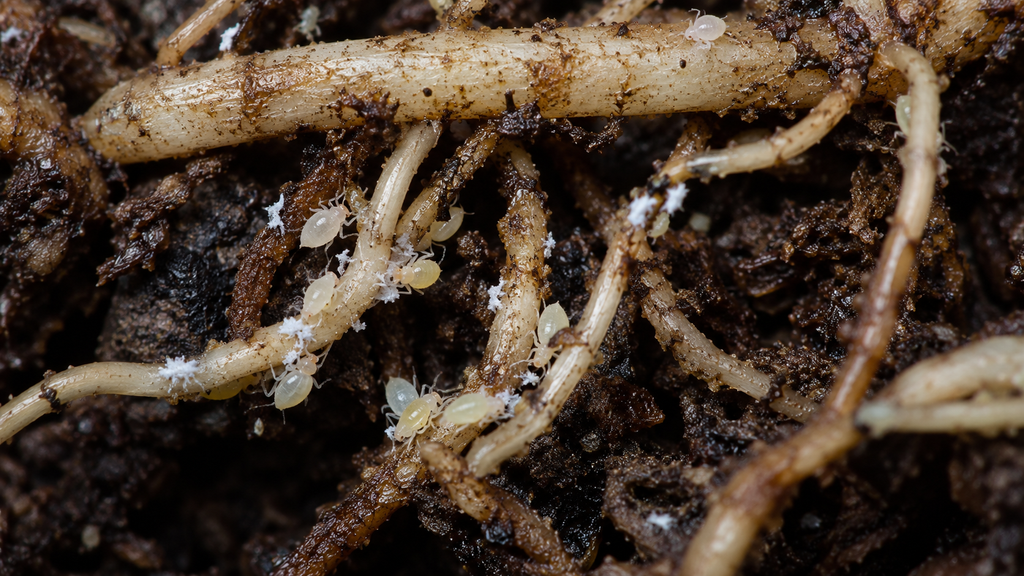
Root aphids are small, soft-bodied insects found on roots or moving through the growing medium around them. Depending on the species, they may appear cream, pale yellow, green, gray, brown, or almost white.
Many produce wax that appears as white powder, fine cotton-like material, or pale deposits around feeder roots. This is one reason root aphids are commonly confused with root mealybugs.
How Big Are Root Aphids?
Many root aphids are only a few millimeters long. At roughly 2–3 mm, they can be seen without a microscope, but identification is easier with a hand lens or phone macro camera.
Magnification can reveal legs, defined body shape, movement, root association, and aphid-like features.
What Does Root Aphid Wax Look Like?
Root aphid wax may resemble white powder, fine dust, cotton-like residue, pale deposits between soil particles, or waxy patches around roots.
White material alone does not confirm root aphids. Perlite, mineral residue, root hairs, fungal material, and root mealybugs can look similar.
Signs of Root Aphids in Houseplants
Root aphid symptoms are often indirect because feeding takes place below the surface.
Possible signs include:
- Yellowing foliage
- Slower growth
- Smaller new leaves
- Stunting
- Repeated wilting
- Premature leaf drop
- Waxy material around exposed roots
- Insects near drainage holes
- Poor response to otherwise suitable care
Can Root Aphids Cause Yellow Leaves?
Yes, but yellow leaves also occur with overwatering, underwatering, root rot, low light, fertilizer buildup, nutrient problems, and natural aging.
Use yellowing as a reason to investigate rather than as a diagnosis.
Can Root Aphids Make a Plant Wilt?
Yes. Root stress can contribute to wilting even when moisture is available. If the potting mix remains moist but the plant repeatedly wilts, inspect root condition instead of automatically adding more water.
Can Root Aphids Stop New Growth?
Heavy infestations can contribute to reduced vigor and stunting. A plant that normally grows actively but suddenly stops producing healthy new leaves deserves closer investigation when root-zone clues are also present.
When It’s Not Root Aphids
Root aphids become less likely when:
- Tiny organisms jump rapidly when disturbed.
- Small dark flies are the main insect around the pot.
- Roots are mushy or collapsing but no insects are present.
- White particles remain completely immobile.
- Tiny mites move rapidly through soil without clustering on roots.
- Inspection finds healthy roots and no aphid-like insects.
- The plant improves after correcting watering, light, or drainage.
Jumping white organisms are far more consistent with springtails than root aphids. Small black flies hovering above damp soil suggest fungus gnats.
Use this sequence:
symptom → organism → behavior → root association → decision
How to Check for Root Aphids
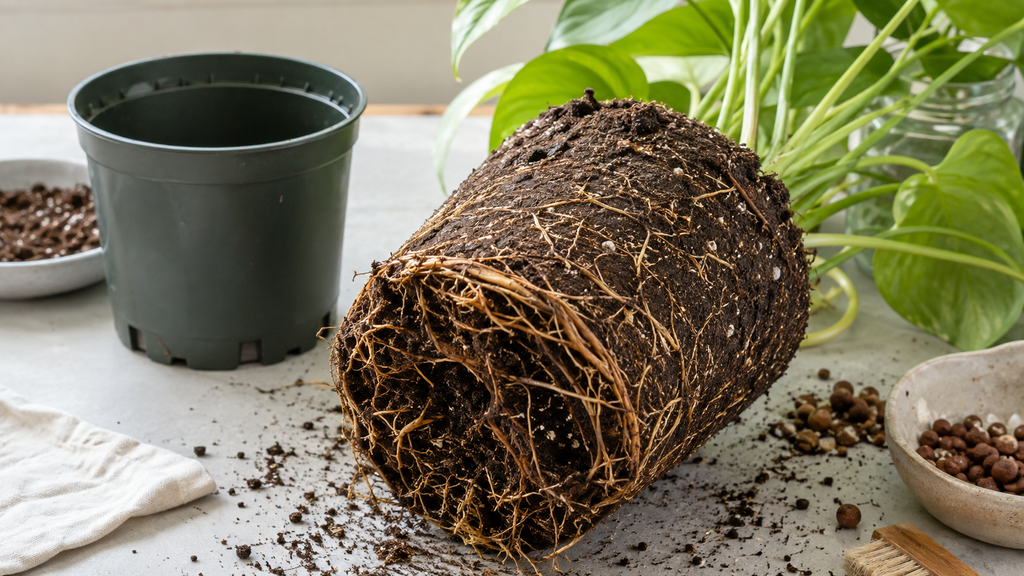
Root inspection should become more invasive only when the evidence justifies it. Completely bare-rooting a healthy plant because of one yellow leaf can create unnecessary stress.
Check External Root-Zone Evidence
Inspect drainage holes, exposed roots, the pot underside, saucer, and cachepot.
Look for insects or wax around living roots.
Inspect the Intact Root Ball
If suspicion remains, gently slide the plant from its pot while keeping the root ball intact.
Check roots pressed against the pot wall, lower root-ball edges, fine-root areas, and cracks in the growing medium.
Inspect Feeder Roots When Needed
Loosen potting mix around feeder roots only when stronger evidence is present, such as repeated insects, waxy colonies, or persistent unexplained decline.
Photograph suspicious material before cleaning the root system.
Use this threshold:
- Low evidence: monitor.
- Moderate evidence: inspect intact root ball.
- Strong evidence: inspect feeder roots.
- Confirmed insects: isolate and treat.
Root Aphids vs Similar Pests
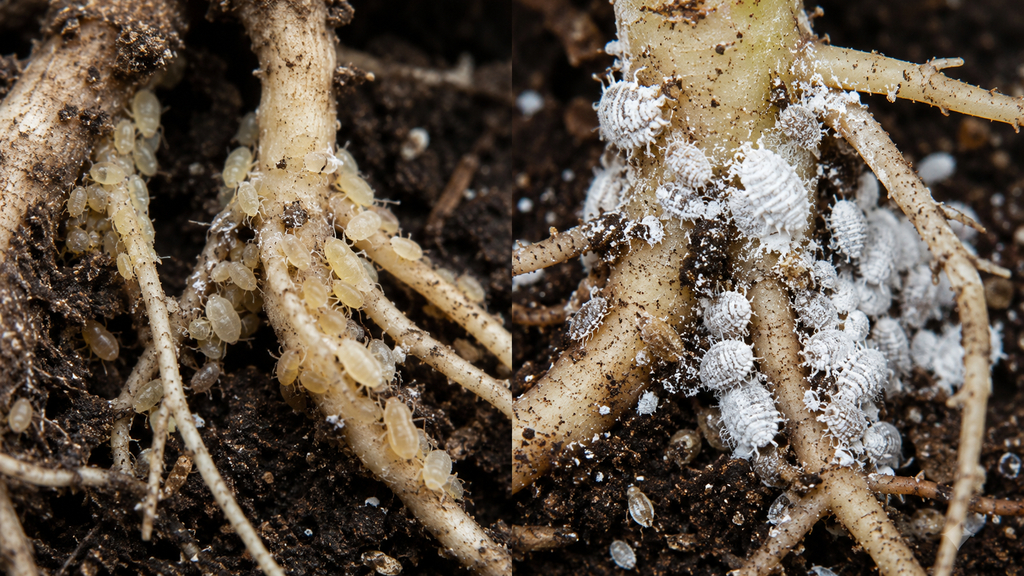
Correct identification matters because several root-zone problems can look similar.
Root Aphids vs Root Mealybugs
Both can live around roots and produce white waxy material. Root mealybugs often have a heavier, more granular or mealy coating, while root aphids tend to show a more recognizable aphid-like body under magnification.
If uncertain, photograph the insects before applying treatment.
Root Aphids vs Fungus Gnats
Fungus gnat adults are tiny dark flies commonly seen around moist potting mix. Root aphids are mainly identified by insects associated directly with roots.
If small black flies are the main clue, investigate fungus gnats first.
Root Aphids vs Root Rot
Root aphids are living insects. Root rot is deterioration of root tissue.
Rotten roots may become soft, hollow, slimy, weak, darkened, or foul-smelling.
Damaged roots without visible insects do not prove root aphids.
What About Springtails or Soil Mites?
Springtails usually jump when disturbed. Soil mites may move rapidly through potting mix without feeding on the plant.
Neither should automatically trigger root aphid treatment.
How Root Aphids Enter Houseplants
Root aphids can enter with infested plant material, growing media, roots, or contaminated materials.
Common pathways include newly purchased plants, divisions or rooted cuttings, reused potting mix, contaminated pots, shared repotting trays, soil carried on tools, plants moved indoors from outside, and winged aphid stages.
Can Root Aphids Spread Through Potting Mix?
Yes. Infested growing media can transfer insects or contaminated root material between containers.
Do not reuse potting mix from a confirmed infestation.
Can Root Aphids Spread Through Tools?
Tools can carry contaminated soil or root debris between plants. Clean trowels, scoops, trays, root hooks, and work surfaces after handling an infested plant.
How Root Aphids Spread Indoors
Some root aphid species produce winged stages, while others remain wingless in the root zone. Their biology varies, so no single lifecycle applies to every infestation.
Treat a confirmed case as potentially mobile without assuming every nearby plant is infected.
Can Root Aphids Fly?
Some life stages can develop wings and disperse to suitable hosts.
Can Sticky Traps Detect Root Aphids?
Sticky traps may catch winged aphids, but they cannot confirm whether a root system contains a hidden colony. Direct root inspection is more useful.
Which Houseplants Are at Risk?
Instead of treating the whole collection, classify plants by exposure.
Tier 1: Confirmed Plant
The plant where root aphids have been identified.
Action:
- Isolate it.
- Contain removed soil.
- Clean tools and surfaces.
Tier 2: Shared-Contact Plants
These may have shared potting mix, tools, trays, runoff, or propagation material.
Inspect them more closely.
Tier 3: Nearby Plants
Plants that were nearby but did not share materials usually need increased observation rather than automatic treatment.
Tier 4: Rest of the Collection
Plants with no known exposure and no symptoms can remain under normal monitoring.
Exposure determines inspection priority. Evidence determines treatment.
Can Root Aphids Damage Houseplants?
Root aphids can damage plants, but infestation severity and root condition matter.
A mature plant with a large root system may tolerate a small colony better than a new cutting with only a few roots.
Think in practical levels:
- Light: localized insects, healthy growth, firm roots.
- Moderate: several colonies, some yellowing, reduced vigor.
- Heavy: widespread insects, stalled growth, repeated wilting.
- Severe: large infestation plus major root or crown decline.
The condition of the plant should guide how aggressively you respond.
When Should You Treat Root Aphids?
Use both pest evidence and root condition to choose the next step.
| Evidence | Root condition | Best decision |
|---|---|---|
| Symptoms only | Healthy | Investigate first |
| Suspicious wax/insects | Healthy | Confirm with closer inspection |
| Confirmed aphids | Mostly healthy | Isolate, clean, repot, monitor |
| Confirmed aphids | Some root damage | Remove pest and stabilize roots |
| No aphids | Mushy roots | Investigate root rot |
| Confirmed aphids | Major root loss | Decide whether rescue is practical |
| Diagnosis uncertain | Any | Pause treatment |
When Is Disposal More Practical?
Consider disposal when very little healthy root tissue remains, the crown is failing, the infestation is widespread, or the plant poses a risk to a more valuable collection.
Should You Take Healthy Cuttings?
For plants that propagate easily, pest-free cuttings can provide insurance before intensive treatment.
How to Get Rid of Root Aphids in Houseplants
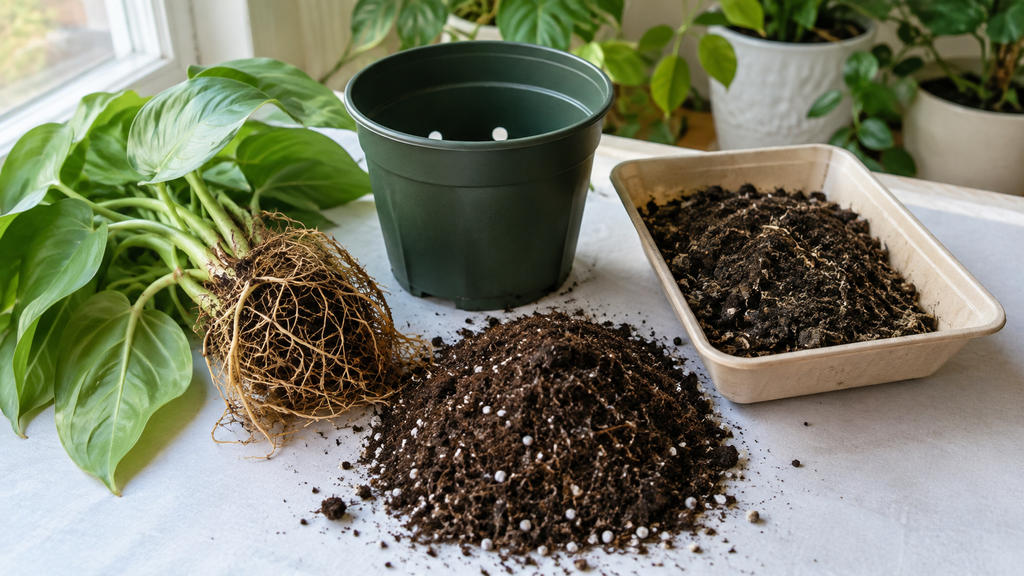
Root aphid control works best as a sequence.
1. Isolate the Plant
Move the plant away from the collection and prevent shared drainage or spilled soil.
2. Prepare the Work Area
Gather a clean pot, fresh growing mix, clean tools, a waste bag, and a contained work surface.
3. Remove the Plant
Slide the root ball from its container gently and inspect it before disturbing the growing medium.
4. Remove Contaminated Mix
Remove as much old potting material as the plant can safely tolerate. Do not reuse it.
5. Rinse and Inspect Roots
Use a gentle stream of lukewarm water to expose the roots and remove loose insects.
6. Check Root Health
Healthy roots should remain firm and structurally intact. Soft, hollow, slimy, or collapsing roots require separate root-health attention.
7. Repot in Fresh Mix
Use fresh growing media appropriate for the species and a container suitable for the remaining root system.
8. Clean Pot and Tools
Remove contaminated debris from pots, trays, tools, and work surfaces.
9. Quarantine and Monitor
Keep the plant separated while checking for renewed aphids, fresh wax, and healthy new growth.
Best Root Aphid Treatments
Treatment should be judged by what it can reach and whether the exact product is appropriate for root-zone use.
Contact Controls
Contact treatments must physically reach the insects. Because root aphids can hide deep inside potting mix, surface spraying may provide incomplete control.
Neem and Azadirachtin
Neem-based products vary significantly. A foliar neem spray and an azadirachtin root-zone product are not automatically interchangeable.
Use only according to the product label.
Biological Controls
Certain biological controls may help under suitable conditions, including:
- Beauveria bassiana
- Steinernema feltiae
- Heterorhabditis bacteriophora
Performance depends on moisture, temperature, product viability, pest density, and application conditions.
What About Hydrogen Peroxide?
Hydrogen peroxide should not be treated as the primary root aphid solution. Bubbling in soil does not prove a hidden colony has been eliminated, and strong concentrations can stress roots.
Prioritize identification, physical removal, fresh growing media, sanitation, and monitoring.
Global Product Rule
Pesticide registrations and legal applications vary by country.
Always check indoor-use directions, target pest, plant compatibility, root-zone use, dilution, and local registration.
Never convert a foliar product into a root drench unless the label allows it.
When Not to Treat Root Aphids
Do not aggressively treat when:
- Only leaf symptoms are present.
- One unidentified white particle is visible.
- Organisms jump.
- Dark flies are the main insect.
- Roots are damaged but no aphids are found.
- The plant was recently repotted.
- A stronger alternative diagnosis fits the evidence.
Also avoid repeatedly bare-rooting the plant, mixing multiple treatments, using stronger-than-labeled concentrations, overwatering, or heavily fertilizing recently disturbed roots.
Why Root Aphid Treatment Fails
A plant may continue declining even after aphids have been removed.
| What happens | Possible cause | Next step |
|---|---|---|
| Live aphids return | Infestation survived | Continue targeted control |
| Fresh wax with insects | Active colony | Reinspect roots |
| Wilting without insects | Root disturbance | Stabilize plant |
| Soft roots | Root deterioration | Investigate root rot |
| Jumping organisms | Different pest | Check springtails |
| Dark flies | Fungus gnats | Change diagnostic path |
| Healthy new growth | Treatment likely worked | Stop escalating |
Ask:
What new evidence appeared after treatment?
Treat returning insects as a pest issue and deteriorating roots as a root-health issue.
Root Aphid Recovery Time
There is no fixed recovery period. Recovery depends on healthy root mass, plant species, environmental conditions, infestation severity, and root disturbance.
Signs of recovery include no returning aphids, firm roots, stable stems, new root tips, healthy new foliage, normalizing water use, and a gradual return of growth.
Avoid heavy fertilizer immediately after major root cleaning. Resume normal feeding when active growth returns.
When to Stop Root Aphid Treatment
Stop active treatment once evidence indicates that the infestation has ended.
Look for no living aphids, no fresh waxy colonies, stable roots, healthy new growth, and no matching infestation in directly exposed plants.
Pest clearance and full cosmetic recovery are separate stages.
No new aphids + stable roots + improving growth = move from active treatment to routine monitoring.
How to Prevent Root Aphids in Houseplants
Prevention focuses on reducing introduction and transfer.
Useful habits include:
- Inspect new plants.
- Check drainage holes.
- Quarantine suspicious additions.
- Use clean growing media.
- Avoid reusing infested soil.
- Clean reusable pots.
- Clean tools after pest cases.
- Avoid shared drainage water.
- Learn each plant’s normal growth pattern.
Routine pesticide treatment of healthy plants is unnecessary.
How to Monitor Root Aphids
Monitoring should detect changes without repeatedly disturbing the roots.
During normal care, watch for new yellowing, unexplained wilting, waxy residue, crawling insects, changes in soil drying speed, and new flying insects.
During normal repotting, inspect exposed roots for firmness, pests, wax, and damage.
For uncertain cases, photograph suspicious organisms and record their movement, root association, treatment, and follow-up result.
Root Aphid Response Plan
Use this sequence:
- Suspect: Notice unusual decline or suspicious root-zone material.
- Observe: Check movement, shape, exposed roots, and drainage holes.
- Inspect: Escalate root inspection only when evidence justifies it.
- Confirm or redirect: Continue only if insects fit root aphids.
- Assess: Consider infestation severity and root condition.
- Treat: Use the least disruptive effective intervention.
- Contain: Trace shared soil, tools, runoff, and propagation material.
- Reassess: Separate surviving aphids from root stress or another problem.
- Clear: Stop active treatment when aphid evidence disappears and recovery begins.
Evidence first → intervention second → recovery proof last.
Root Aphids in Houseplants FAQs
How can I confirm root aphids before treating a houseplant?
Look for small aphid-like insects repeatedly associated with living roots. Yellow leaves, wilting, or white particles alone are not enough to confirm them.
What do root aphids look like?
Root aphids are tiny soft-bodied insects, often around 2–3 mm long. They may be pale, yellow, green, gray, or brown and can have a white waxy coating.
Are root aphids and root mealybugs the same?
No. They are different pests, although both can appear white and waxy around roots. Magnification can help distinguish their body shapes.
Are white bugs in houseplant soil always root aphids?
No. They may be springtails, soil mites, root mealybugs, fungus gnat larvae, or harmless soil organisms.
Can root aphids spread between houseplants?
Yes. They can spread through infested plants, growing media, root debris, tools, or winged stages.
Can root aphids cause yellow leaves?
Yes, but yellowing can also result from root rot, watering problems, low light, or other stresses.
Will repotting get rid of root aphids?
Repotting can remove many root aphids when infested soil is discarded and the roots are cleaned. Monitoring is still important afterward.
Can I reuse soil from a plant with root aphids?
No. Avoid reusing confirmed infested potting mix because it may transfer insects or contaminated root material.
Does neem oil kill root aphids?
Some neem or azadirachtin products may help when specifically labeled for root-zone use. Never assume a foliar product is suitable as a soil drench.
Can beneficial nematodes control root aphids?
Certain beneficial nematodes may help under suitable conditions. Effectiveness depends on species, moisture, temperature, product viability, and application.
Why is my plant still declining after treatment?
The cause may be surviving aphids, root damage, repotting stress, root rot, or another pest. Check for new evidence before treating again.
How do I know root aphid treatment worked?
Treatment is likely working when no new aphids or wax appear, roots remain firm, and healthy new growth begins.
When can I end quarantine?
End isolation when repeated checks show no new root aphid activity, the root system remains stable, and recovery is progressing.

Myra is the founder and lead writer of Plantsaholic. She shares practical, research-backed advice on indoor plants, outdoor gardening, flowers, herbs, succulents, and everyday plant care. Her goal is to help gardeners of all experience levels grow healthier plants through simple, easy-to-follow gardening guides.