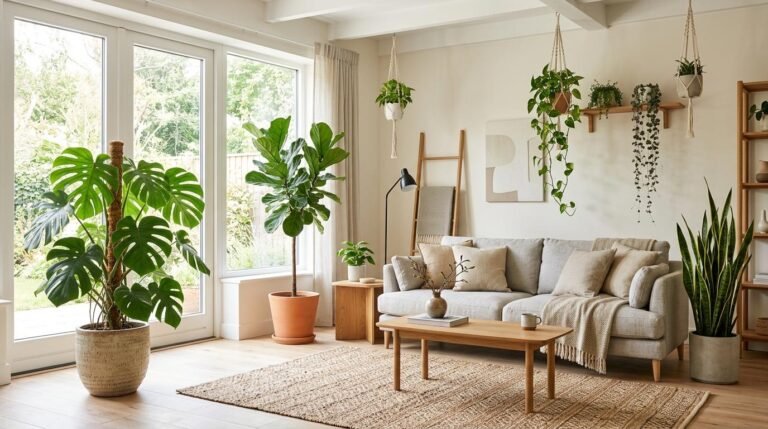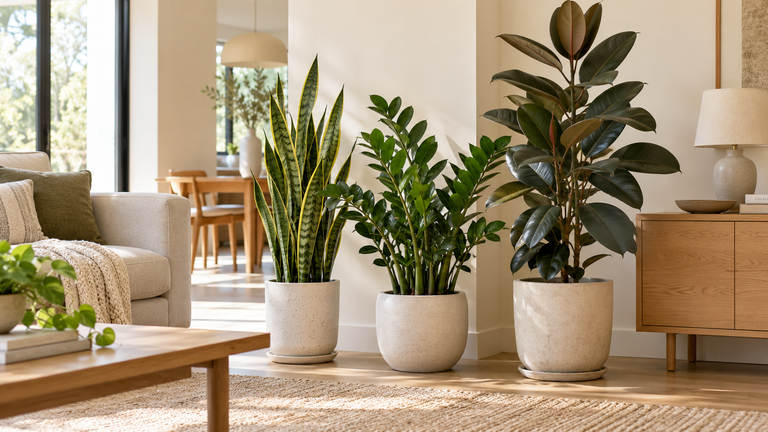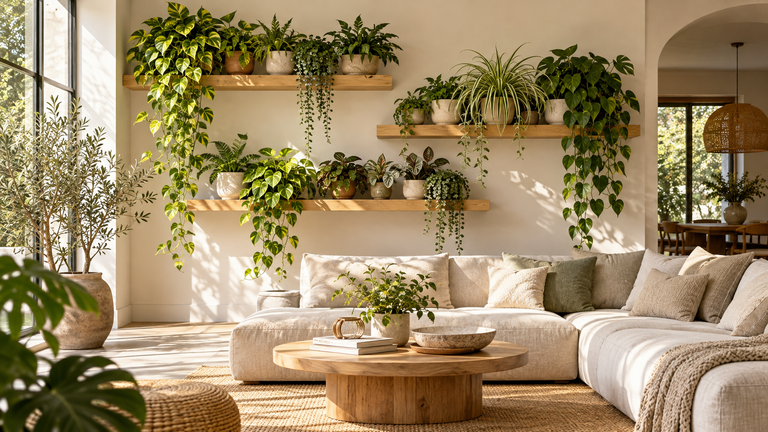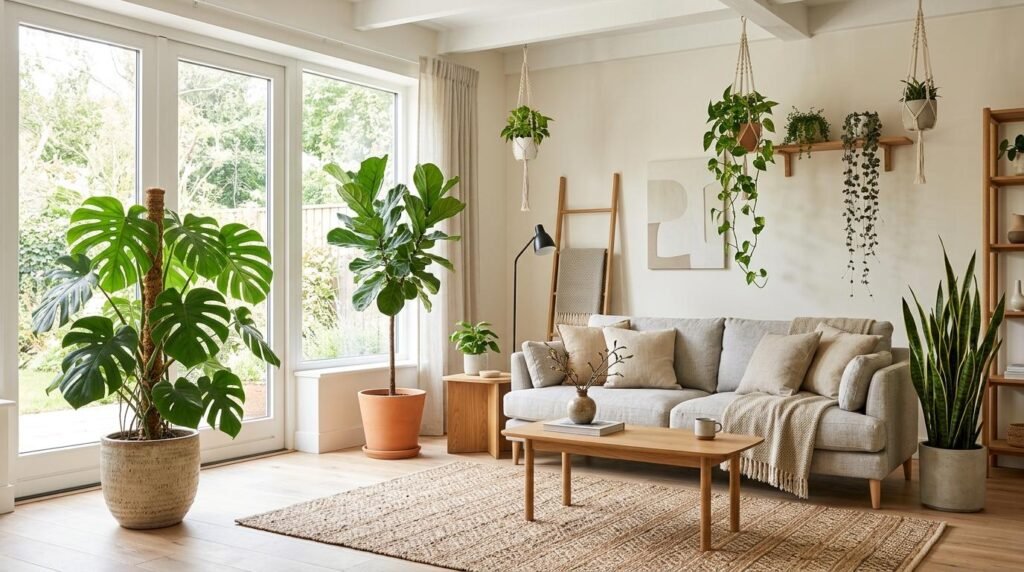
To arrange indoor plants, match each plant to the available light, choose a focal point, and group compatible species at different heights. Vary foliage shapes, coordinate pots, and preserve space for growth and care.
Thoughtful indoor plant arrangement ideas can transform empty corners and compact living rooms. However, attractive displays fail when plants receive inadequate light, poor drainage, or too little space.
This Plantsaholic guide covers placement, grouping, room layouts, troubleshooting, and traditional Feng Shui and Vastu preferences.
How Do You Plan Indoor Plant Arrangements?
Map natural light, usable display areas, and mature plant sizes before buying pots. Choose positions that preserve walking routes and watering access.
Assess Light Before Choosing Plants
Check potential positions morning and afternoon, noting direct sun, curtains, and outside shade. A light meter can clarify conditions when plants struggle despite an apparently bright room. Low-light-tolerant plants still need light. Measure or judge light at the intended foliage position: a recessed shelf or shaded corner can be much darker than the room beside it.
| Light condition | Suitable examples | Display location |
|---|---|---|
| Bright indirect | Monstera, pothos, Chinese money plant | Near a bright, filtered window |
| Moderate indirect | Parlor palm, spider plant, peperomia | Well-lit stands or tables |
| Lower natural light | Cast iron plant, ZZ plant, snake plant | Shaded spots receiving usable daylight |
| Direct sunlight | Jade, selected cacti, Echeveria | Suitable sunny windowsills |
Match the Arrangement to Your Room
With one bright window, concentrate compatible plants nearby. Larger rooms may support separate groupings beside different windows. Do not fill a dark corner simply because it is empty.
Check mature leaf spread, door clearance, pot weight, pet access, and whether you can water each plant without moving furniture. Set out your existing pots temporarily and walk through the room before buying more stands.
For plant-chewing pets, prioritize non-toxic species. Use grow lights or artificial greenery in genuinely dark areas.
What Are the Rules for Arranging Indoor Plants?
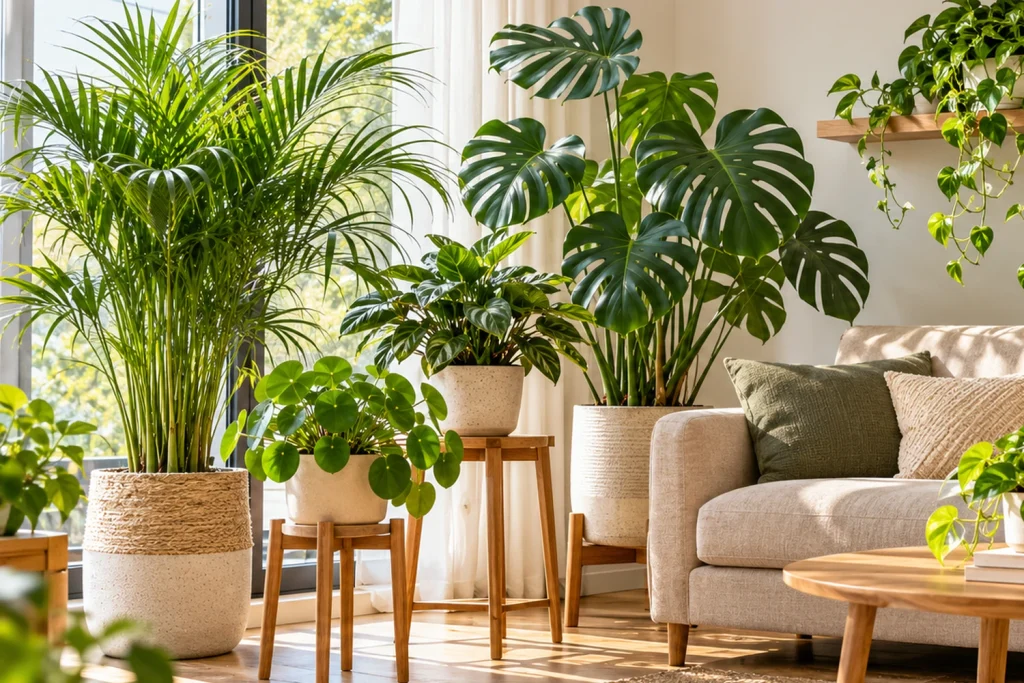
Five principles guide attractive displays: a focal point, varied heights, contrasting leaves, coordinated pots, and negative space. Plant health takes priority.
Create Height and Visual Balance
Try the rule of three: tall parlor palm, medium calathea, and small spider plant in suitable indirect light. Put the tallest behind smaller plants, or centrally on an all-around display.
Balance one large floor plant with two smaller accents elsewhere. Keep heavy pots low and trailing plants on sturdy, accessible stands.
Coordinate Pots and Protect Furniture
Repeat two or three finishes, such as cream ceramic, terracotta, and wood. Drainage-equipped nursery pots may sit inside decorative pots; empty collected water.
Use waterproof trays on furniture. If removing a pot improves visibility and access, the arrangement is overcrowded.
Broad leaves and dark pots have greater visual weight than fine foliage, so perfect symmetry is unnecessary. When an arrangement feels unbalanced, move the largest container first rather than rearranging every smaller plant.
How Do You Group Indoor Plants?
Group plants with similar light and temperature requirements. Keep separate pots because their watering needs may differ.
Arrange by Growth Habit and Spacing
Use upright foliage for structure, bushy leaves for fullness, and trailing vines for movement. Support climbers when needed.
Leave space to remove pots, inspect leaves, and accommodate growth; prevent larger plants from permanently shading smaller ones.
Grouping may slightly raise local humidity. Check each pot’s moisture separately.
On shared trays, remove standing water to protect roots. If moisture-loving foliage must sit beside a drought-tolerant plant, similar light alone does not justify planting them together in one pot. Different soil mixes and watering needs are easier to manage separately.
Inspect New Plants Before Grouping
Keep new plants separate for roughly one to two weeks when practical. Inspect stems, leaf undersides, and growing media before grouping.
Watch for webbing, cottony clusters, sticky residue, or pale stippling. Continue isolating affected plants until the pest is identified and managed. Inspect new leaves and stem junctions closely, where small insects may hide.
Which Indoor Plants Look Good Together?
Choose compatible plants with contrasting foliage. These combinations use separate pots, not necessarily shared soil.
Check care labels for light needs and eventual width; a compact companion may fit better than a fast-growing statement plant.
| Combination | Visual effect | Suitable conditions |
|---|---|---|
| Monstera, pothos, heartleaf philodendron | Broad and trailing tropical foliage | Bright indirect light |
| Parlor palm, spider plant, calathea | Soft, layered leaves | Suitable indirect light |
| Jade, Echeveria, suitable Haworthia | Sculptural succulent shapes | Bright, species-specific exposure |
| Chinese money plant, peperomia | Rounded compact foliage | Bright indirect light |
| Cast iron plant, snake plant | Upright architectural greenery | Moderate to lower natural light |
Choose Pet-Safer Substitutions
For pet-accessible displays, consider parlor palm (Chamaedorea elegans), spider plant (Chlorophytum comosum), baby rubber plant (Peperomia obtusifolia), or money tree (Pachira aquatica).
The ASPCA lists these as non-toxic to cats and dogs, although chewing any plant may upset digestion.
Monstera, pothos, philodendron, jade, snake plant, and ZZ plant are toxic to pets. Confirm scientific names. Even hanging plants can become reachable when trailing stems grow longer, so recheck access during routine pruning and cleaning.
How to Arrange Plants in a Living Room?
Anchor seating with a suitable rubber plant or Monstera beside a bright window; add a compact peperomia on a nearby table.
Style Shelves, Windows, and Tables
Place tall plants beside, not across, windows. Use compact plants on bright sills and secure trailing foliage on shelves.
Protect books and electronics from water; leave television vents clear.
Around a single window, concentrate compatible plants rather than scattering them into shade.
Try a parlor palm beside the window, spider plant on a stand, and baby rubber plant on a bright shelf, without mutual shading.
Choose a Layout for Your Furniture
- Small living room: One window-side focal plant, one tabletop accent, and one trailing shelf plant.
- Medium living room: A statement plant beside the sofa and a smaller group near another bright area.
- Open-plan room: Two taller plants can visually separate seating and dining without creating a barrier.
Check sightlines from the entrance and sofa; move foliage obstructing the window to one side.
Preserve daylight, pathways, and watering access. Avoid placing a tall, spreading plant where family members repeatedly brush against its leaves when walking past the sofa.
How to Arrange Plants in a Small Living Room?
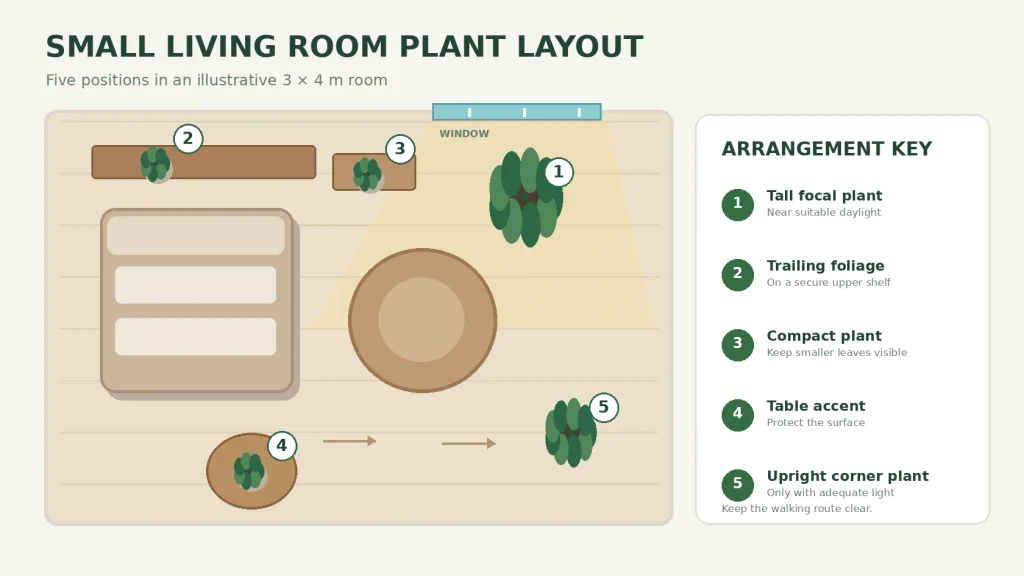
In small rooms, combine one narrow focal plant with shelves or tabletop accents. Check mature dimensions: young Monstera can quickly outgrow tight spaces.
Try a Five-Plant Layout
For an illustrative 3 × 4 meter room:
| Position | Plant role |
|---|---|
| Beside a bright window | Tall focal plant |
| Upper secure shelf | Trailing foliage |
| Lower shelf | Compact plant |
| Side table | Small accent |
| Adequately lit corner | Narrow upright plant |
Five plants are optional. If the corner is too dark, omit it or install suitable grow lighting. Keep heavy pots low and paths clear.
A ladder stand can save space, but check its stability when watered and keep vines clear of seating. If shelves cast shade on each other, put less light-demanding plants below only when those lower levels still receive sufficient daylight.
Which Plants Suit Living Room Corners?
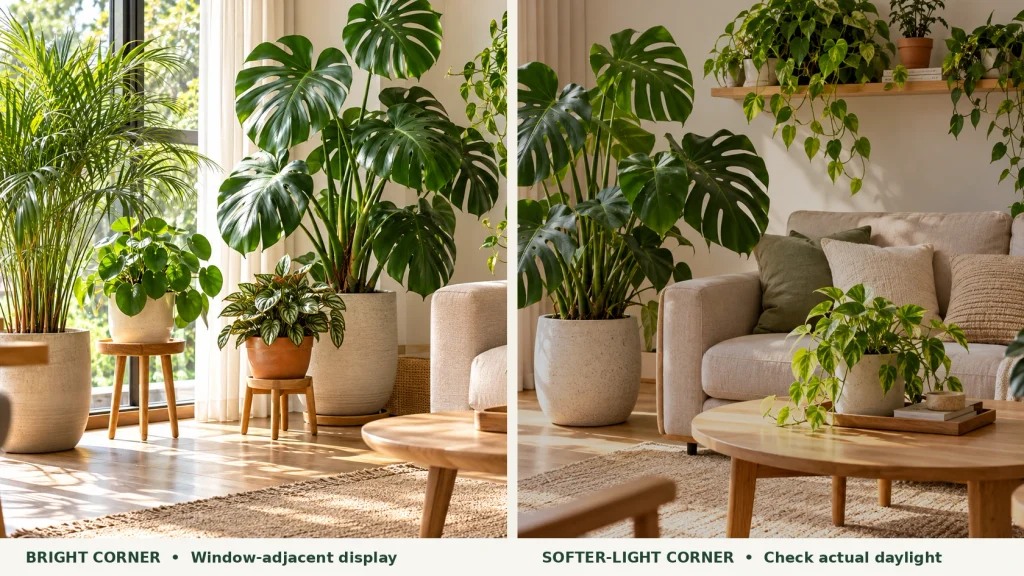
Select corner plants according to light at foliage level and mature spread; corners often receive less daylight than they appear to.
| Corner condition | Suggested choice |
|---|---|
| Bright and spacious | Monstera or rubber plant |
| Moderate indirect light | Parlor palm or cast iron plant |
| Narrow with adequate light | Snake plant |
| Lower natural light | Cast iron plant or ZZ plant if light is sufficient |
| Nearly dark | Grow light or artificial greenery |
One stable floor pot often suffices. Avoid leaves pressing against walls or sitting in hot or cold airflow.
Snake plants and ZZ plants are toxic to chewing pets.
Check for radiators, AC vents, and persistent dampness before choosing a corner. Monitor the plant after installation instead of assuming its tolerance guarantees success.
What Are Creative Indoor Plant Display Ideas?
Choose creative displays that save floor space, protect furniture, and remain easy to water.
- Plant wall: Mount suitable shelves and keep the heaviest containers lower down.
- Hanging basket: Use a fixture rated for the pot’s weight after watering.
- Tiered stand: Vary heights while preventing upper foliage from shading lower plants.
- Bookshelf: Alternate compact plants with books, using waterproof trays.
- Succulent collection: Keep compatible species in draining pots, not a sealed humid terrarium.
- Mobile cart: Lock wheels and avoid sudden moves into much stronger sunlight.
How Can Renters Display Plants Without Drilling?
Renters can use freestanding stands, side tables, or rolling carts. Tall bookcases may still need manufacturer-recommended anti-tip anchoring.
Use waterproof liners and check shelf load limits.
Minimalist rooms suit sculptural greenery; bohemian interiors suit terracotta and trailing vines. If you use a bookshelf, place a waterproof tray beneath each pot rather than relying on the shelf finish to tolerate repeated spills.
How to Arrange Plants on a Budget?
Reuse sturdy furniture: elevate a spider plant on a stool and display peperomia on a bright table. Coordinate existing pots.
Propagate spider plantlets, exchange healthy cuttings, and reuse clean outer pots. Retain draining nursery pots when practical.
Avoid unstable stands and species needing equipment you cannot supply.
Buy one healthy focal plant first, then add companions after checking how the location performs. Spend on drainage and secure supports before decorative accessories. Propagation is economical but takes time, so allow young cuttings to develop roots before using them in permanent displays.
Which Direction Is Best for Indoor Plants?
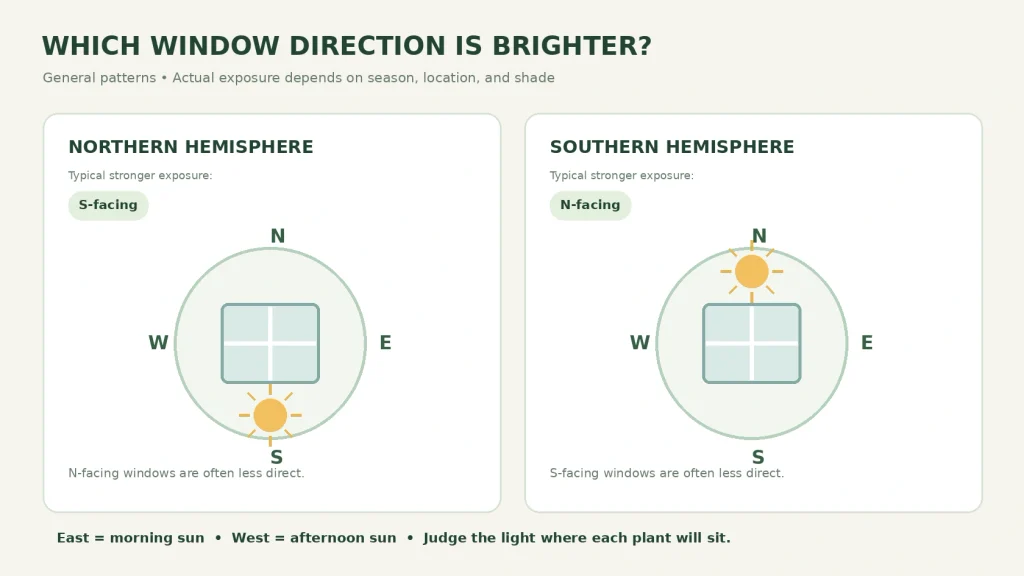
Window light varies by hemisphere, latitude, season, and shading. East commonly receives morning sun; west receives stronger afternoon exposure.
| Window orientation | General tendency |
|---|---|
| East | Morning sun |
| West | Stronger afternoon exposure |
| South, Northern Hemisphere | Often more direct light |
| North, Northern Hemisphere | Often less direct light |
| North, Southern Hemisphere | Often more direct light |
| South, Southern Hemisphere | Often less direct light |
Near the equator, seasonal angles complicate these patterns. Light weakens farther from a window; elongated new growth can suggest insufficient light.
Acclimate plants gradually to stronger sun. Rotate suitable free-standing pots, but avoid turning climbers attached to fixed supports. In a south-facing room in the Northern Hemisphere, a sheer curtain can soften strong direct sun for foliage plants that prefer filtered light.
How to Arrange Plants Using Feng Shui?
In Feng Shui, plants symbolize growth and the wood element. Compass-based traditions associate east with family and southeast with wealth; other Bagua methods differ.
Money tree, jade, and lucky bamboo are popular symbols. Money trees suit bright indirect light; jade needs brighter exposure and drainage. Keep entrances clear.
These beliefs do not scientifically establish financial outcomes. Prioritize adequate light. A healthy, uncluttered display expresses the intended symbolism more consistently than a struggling plant placed in a traditionally favored but dark sector.
Where to Place Indoor Plants According to Vastu?
Vastu traditions often favor north, east, or northeast for Tulsi and southeast for money plants. Interpretations vary and do not replace horticultural needs.
| Plant | Traditional association | Growing consideration |
|---|---|---|
| Tulsi (Ocimum tenuiflorum) | North, east, northeast | Strong sunlight and ventilation |
| Golden pothos (Epipremnum aureum) | Often southeast | Suitable indirect light |
| Lucky bamboo (Dracaena sanderiana) | East or southeast | Protection from harsh direct sun |
| Jade (Crassula ovata) | Prosperity areas | Bright light and drainage |
In South Asia, “money plant” usually means golden pothos, not Pachira aquatica or Pilea peperomioides.
Identify the species and prioritize suitable growing conditions. For example, sun-loving Tulsi is better placed at a bright, ventilated window or balcony than in a shaded interior simply because a compass direction is preferred.
What Are the 7 Lucky Indoor Plants?
Seven commonly named lucky plants are money tree, jade, lucky bamboo, pothos, peace lily, Chinese money plant, and parlor palm. None is proven to create wealth.
| Plant | Symbolic association | Cats and dogs |
|---|---|---|
| Money tree | Prosperity | Non-toxic |
| Jade | Wealth | Toxic |
| Lucky bamboo | Fortune | Toxic |
| Golden pothos | Abundance | Toxic |
| Peace lily | Harmony | Toxic |
| Chinese money plant | Generosity | Non-toxic |
| Parlor palm | Vitality | Non-toxic |
Choose by light and safety: money trees for brighter rooms, Chinese money plants for tables, jade for appropriate sun.
Verify scientific names before buying; symbolic labels do not establish care or toxicity. For a household with curious cats, a non-toxic money tree or parlor palm is a more practical lucky-plant display than a jade plant or golden pothos.
Where Should You Not Put Indoor Plants?
Avoid dark spots, heating or cooling vents, unstable furniture, temperature extremes, blocked routes, and water near electronics.
Windowless bathrooms need suitable grow lighting.
Harsh sun can scorch shade-adapted leaves. Secure hanging fixtures, drain trays, and protect children and pets from toxic plants. Also avoid putting large pots where opening windows, doors, or drawers repeatedly strikes the foliage.
How Do You Fix Plant Arrangement Problems?
Distinguish plant-health problems from visual clutter. Check growing conditions for declining foliage; adjust spacing for healthy but crowded displays.
| Symptom | Possible explanation | First action |
|---|---|---|
| Leaning toward window | Uneven or insufficient light | Review exposure |
| Long, weak stems | Inadequate light | Increase suitable light gradually |
| Scorched patches | Excess sun or another stress | Examine exposure and care |
| Yellow leaves | Water, roots, light, or aging | Check soil and roots |
| Soil stays wet | Poor drainage or low water use | Adjust watering and pot setup |
| Hidden smaller plants | Larger foliage blocks them | Reposition pots |
| Crowded display | Too many containers | Remove one or two |
These are clues, not definitive diagnoses; inspect pests, roots, and temperature too.
For clutter, remove two pots and reassess. For drooping, check root moisture before increasing watering. Yellow leaves with persistently wet soil suggest a different investigation from crisp leaf edges and rapidly drying soil; consider light, roots, and temperature before diagnosing.
How to Decorate Other Rooms With Plants?
Adapt displays to each room’s light, humidity, and daily use.
Bathrooms may be humid but dim; kitchen sills may be bright but hot. For herbs, ensure the window supplies their stronger light requirements. In home offices, allow room to move a keyboard, adjust a monitor, and water without splashing devices.
- Bedroom: Position a compact peperomia on a suitably lit dresser or a parlor palm near a window. Avoid heavy pots suspended above the bed.
- Bathroom: Some ferns and calatheas appreciate humidity, but still require light and adequate ventilation.
- Kitchen: Use bright windowsills for appropriate plants or culinary herbs; keep pots away from stove heat and food preparation.
- Home office: Choose a compact desk plant or one floor specimen, with water kept away from computers and cords.
Keep pots stable and accessible. When styling bedrooms, resist using scented flowers or large stands in cramped routes if they make the room harder to navigate at night.
How to Maintain Indoor Plant Arrangements?
Check changing foliage and seasonal light, but move plants only when needed.
| Frequency | What to check |
|---|---|
| During routine care | Soil moisture and drainage |
| Weekly | Leaves, pests, and accessibility |
| Monthly | Growth direction and stand stability |
| Seasonally | Window exposure and temperature |
| As needed | Pruning, repotting, and spacing |
Water pots individually. Clean suitable leaves, inspect for pests, prune with clean tools, and prevent vines or broad foliage from obstructing furniture or nearby plants. If a pot dries unusually fast, inspect its roots before changing the watering routine.
How to Arrange Indoor Plants Step by Step?
Start with plants you already own rather than constantly rearranging healthy specimens.
- Observe daylight at each potential location.
- Sort plants by light needs, mature size, and condition.
- Choose one healthy focal specimen.
- Add compatible plants with contrasting forms.
- Adjust heights so foliage stays visible.
- Coordinate pots and protect furniture.
- Check drainage, stability, and pet safety.
- Preserve walking routes and watering access.
- Photograph the arrangement for future comparison.
- Review after several weeks and adjust only as needed.
Rearrange an Existing Collection
For example, place an existing parlor palm near suitable light, elevate a spider plant, and display peperomia and Chinese money plant on bright furniture.
Trail pothos securely away from pets. This is an illustrative arrangement. Take a photograph of the first layout and compare it after a few weeks. Changes in leaf direction, spacing, and growth provide a practical reason to adjust the display rather than redecorate at random.
Indoor Plant Arrangement FAQs
How Many Plants Should Go in a Living Room?
Three to five may work; light, mature size, and room dimensions determine the total.
Is Grouping Better Than Spreading Plants Out?
Grouping makes a focal point; spreading plants balances spacious rooms. Both require adequate light.
Can Plants With Different Watering Needs Share a Display?
Yes. Use separate draining pots and check moisture individually.
Can Plants Go Behind a Sofa or Near a Television?
Yes, with sufficient light, stable pots, and protection for electronics and vents.
Which Direction Is Best for Indoor Plants?
It depends on hemisphere, season, and species. Evaluate actual window light.
Can Plants Survive in a Windowless Room?
They generally require suitable grow lights; household bulbs may be inadequate.
Which Houseplants Are Safer for Pets?
Parlor palms, spider plants, baby rubber plants, and money trees are non-toxic to cats and dogs.
Where Should Feng Shui Plants Go?
Often east or southeast in compass-based traditions, but light comes first.
Where Should a Money Plant Go According to Vastu?
Traditionally southeast; golden pothos still needs appropriate indirect light.
Do Houseplants Purify Indoor Air?
Not significantly under normal household conditions. Prioritize ventilation and pollution control.
How Do You Keep Plant Arrangements Beautiful?
Good arrangements combine compatible species, adequate light, and room to grow. Use a focal plant, contrasting companions, and maintain watering access.
Use vertical displays in small rooms and linked groupings in larger ones.
Feng Shui and Vastu may inspire placement, but prioritize healthy conditions. Start with three manageable plants and expand when space permits.
An arrangement succeeds when every plant thrives and improves the room.
Myra is the founder and lead writer of Plantsaholic. She shares practical, research-backed advice on indoor plants, outdoor gardening, flowers, herbs, succulents, and everyday plant care. Her goal is to help gardeners of all experience levels grow healthier plants through simple, easy-to-follow gardening guides.