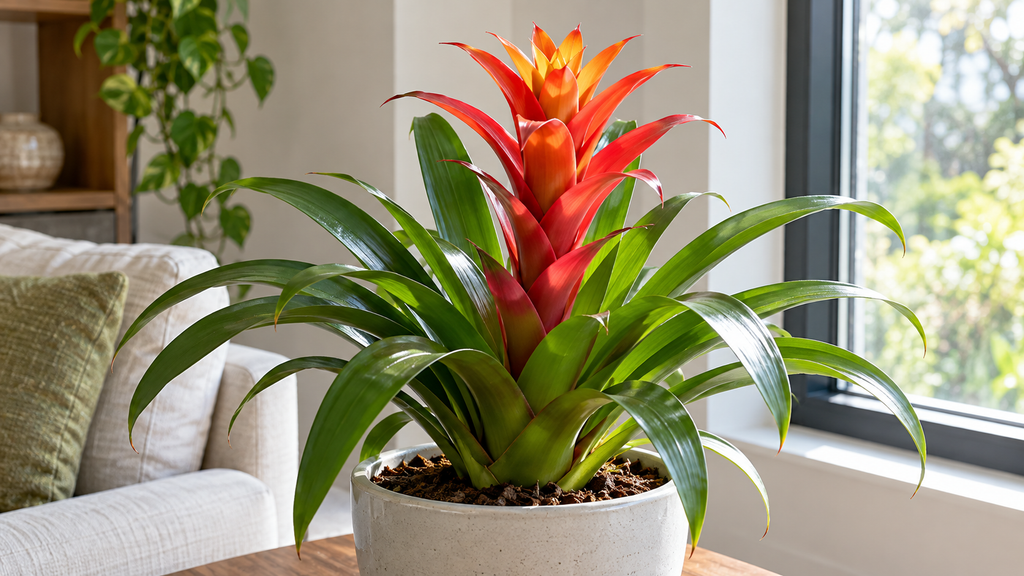
Bromeliads are easy to care for when you give them bright indirect light, warm conditions, good drainage, moderate humidity, and the right watering method for their type. Tank-forming bromeliads can hold fresh water in their central rosette, but their roots should remain airy rather than constantly wet.
Bromeliads belong to the Bromeliaceae family, which includes Guzmania, Aechmea, Vriesea, Neoregelia, Cryptanthus, Tillandsia, and Ananas. Pineapples and air plants are bromeliads too, which shows how different plants within this family can be.
The most important rule is simple: identify how your bromeliad grows before deciding how to water it. Some species store water in a central cup, some rely mainly on their roots, and many Tillandsia absorb much of their moisture through their leaves.
Bromeliad Care Basics
Most indoor bromeliads need five things: bright filtered light, warmth, moderate humidity, excellent drainage, and species-appropriate watering.
Many bromeliads are epiphytes, meaning they naturally grow attached to trees or other surfaces instead of rooting deeply into soil. They are not parasites. Their roots often provide support while the plant gathers moisture from rainfall, humid air, and organic debris.
This explains why many bromeliads have relatively small root systems and dislike dense, constantly wet potting media.
For healthy growth:
- Give the plant bright indirect light.
- Keep tropical types warm.
- Use a loose, fast-draining potting mix.
- Avoid leaving the root zone permanently wet.
- Water tank-forming bromeliads differently from terrestrial types.
- Feed lightly rather than heavily.
- Expect most mature rosettes to flower once.
- Keep the pups that form around the mother plant.
A healthy bromeliad should usually have firm leaves, stable color, and a crown that does not feel soft or rotten.
Types of Bromeliads
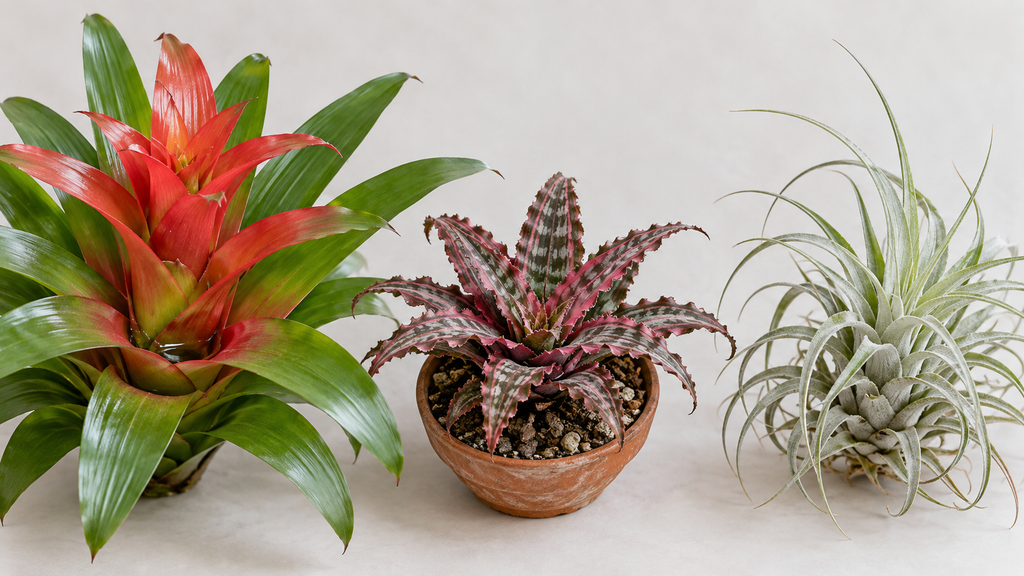
Knowing which bromeliad you own makes watering and long-term care much easier.
Tank-forming bromeliads have overlapping leaves that create a central cup capable of holding water. Many Guzmania, Aechmea, Vriesea, and Neoregelia fit this general pattern.
Terrestrial bromeliads grow more conventionally in a root-based substrate. Cryptanthus and pineapple plants are good examples.
Many Tillandsia are air plants and are commonly grown without conventional potting soil. Their leaves play a major role in absorbing moisture.
Use these clues:
- A deep central cup usually indicates a tank-forming bromeliad.
- A plant rooted firmly into soil without a water-holding center may be terrestrial.
- A plant sold mounted or without soil may be a Tillandsia-type air plant.
- If a nursery label is available, use the genus name to refine care.
The best decision sequence is: identify the plant, classify its growth type, then choose the watering method.
How to Care for a Bromeliad Plant Indoors
Indoor bromeliads grow best in bright filtered light, stable warmth, moderate humidity, and an airy root environment.
An east-facing window is often suitable because it provides useful morning light without the strongest afternoon heat. South- or west-facing windows can also work if harsh sunlight is filtered or the plant sits farther from the glass.
Signs of too much light include:
- pale foliage
- bleached patches
- brown scorch marks
- faded color
Signs of too little light include:
- very dark foliage
- soft leaves
- stretched growth
- weak overall development
Most tropical bromeliads are comfortable in normal household warmth but should be protected from frost, cold windows, strong air-conditioning vents, and direct heater airflow.
A bright bathroom or kitchen may provide useful humidity, but adequate light is still essential.
If indoor air is dry, you can:
- use a humidifier
- group plants together
- place the pot above damp pebbles
- move the plant away from heating vents
Do not solve low humidity by repeatedly watering already-wet roots. Humid air and wet soil are not the same thing.
How Often to Water Bromeliads
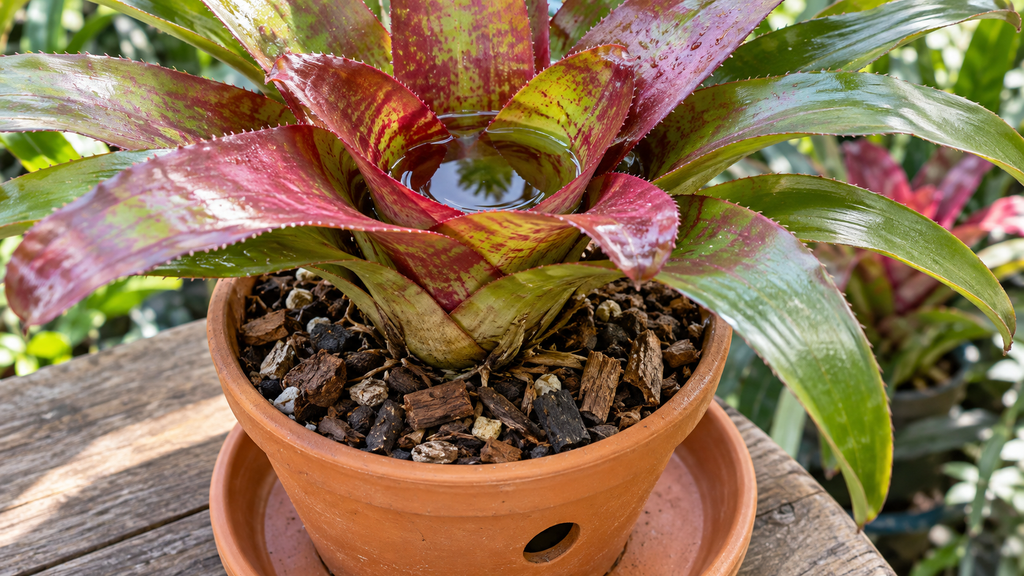
Many indoor bromeliads may need watering attention about once every one to two weeks, but a fixed schedule is less reliable than checking the plant and its growing conditions.
Water use changes with:
- temperature
- light
- humidity
- season
- pot size
- potting mix
- bromeliad type
A plant beside a bright window in summer may dry much faster than the same bromeliad during a cool, dark winter period.
Watering Tank Bromeliads
Tank-forming bromeliads collect water inside the central rosette formed by overlapping leaves.
For these plants:
- keep the central cup reasonably fresh
- replace or flush old water periodically
- remove decomposing debris
- keep the root zone well drained
Do not assume that water in the cup means the roots also need watering.
Watering the Potting Mix
Feel the substrate before watering again.
If it remains wet for many days, investigate drainage rather than increasing watering frequency.
Never allow a bromeliad pot to sit indefinitely in standing water.
What Water Is Best?
Rainwater or relatively soft water can be useful where tap water is very hard because mineral deposits may accumulate on leaves or inside the cup.
Water quality matters, but correct drainage and fresh water matter more.
Before You Water, Check These 4 Things
- What type of bromeliad is it?
- Is the root zone actually drying?
- Is the central cup fresh or stagnant?
- Are conditions warm and bright or cool and dark?
Use those answers to decide what to do.
- Dry substrate during active growth: water and drain.
- Damp substrate but dry tank: refresh the tank without soaking the roots again.
- Wet substrate for several days: investigate drainage.
- Stagnant cup: flush and replace the water.
- Mushy base or unpleasant smell: investigate rot instead of watering more.
Growing Bromeliads in Water
Most bromeliads should not have their roots permanently submerged in water.
The phrase “bromeliad in water” often causes confusion because tank bromeliads naturally hold water in their leaves while maintaining relatively airy roots.
These are separate moisture zones.
A tank bromeliad can have water in its central cup while the root zone remains lightly moist or partly dry.
Permanent root submersion can reduce oxygen around the roots and increase the risk of rot.
Use:
- a container with drainage holes
- a porous growing medium
- an emptied saucer
- an outer decorative pot that does not trap water
Tillandsia air plants are different. Many are grown without conventional soil and need a separate hydration routine based largely on wetting and drying their leaves.
Avoid treating every bromeliad as either a water plant or an air plant.
Best Light for Bromeliads
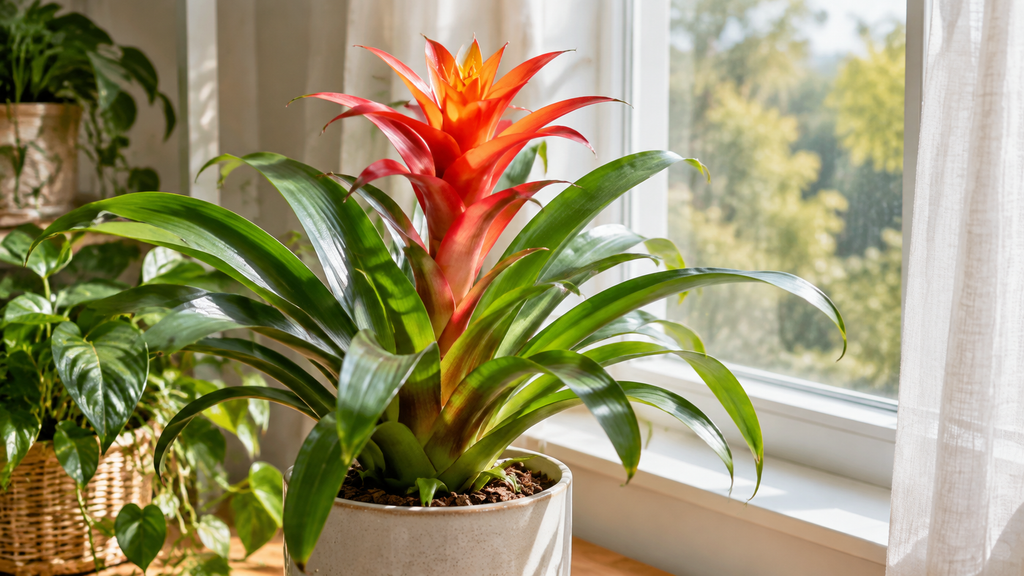
Bright indirect or filtered light is a good starting point for most commonly grown bromeliads.
The goal is enough light for strong growth and good color without prolonged scorching sun.
Too much light can cause:
- bleaching
- pale foliage
- brown patches
- dry scorched areas
Too little light can cause:
- weak growth
- very dark foliage
- soft leaves
- stretching
- poor flowering performance
A bromeliad can survive in low light without growing well.
Artificial grow lights can help in dark rooms or during winter. Follow the manufacturer’s recommended distance and adjust according to the plant’s response.
Do not use extra fertilizer as a substitute for inadequate light.
Best Soil for Bromeliads
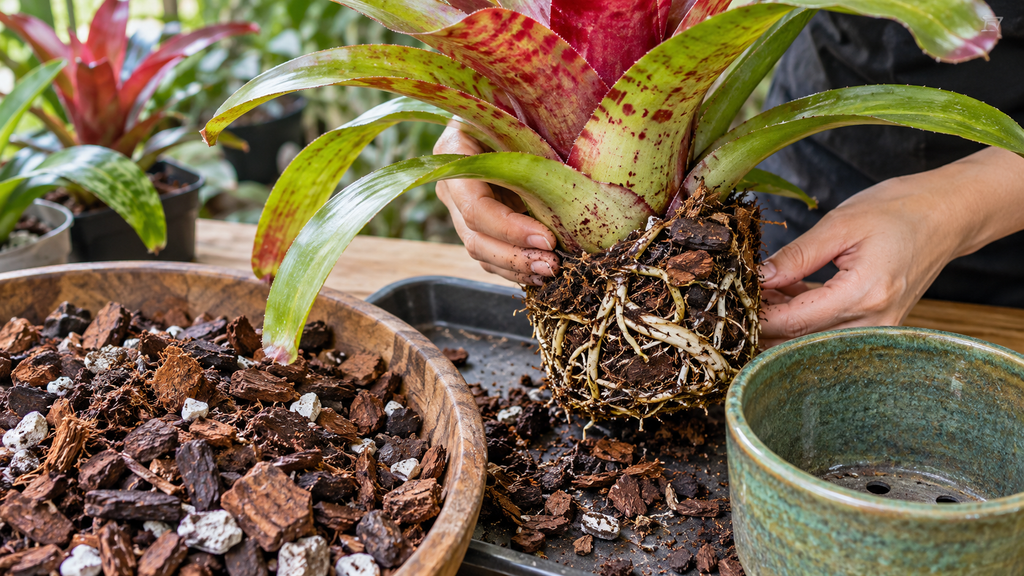
Bromeliads generally need a loose, porous, fast-draining growing medium.
The mix should retain enough moisture to support the plant but allow oxygen to return to the roots quickly after watering.
Useful ingredients may include:
- fine orchid bark
- composted bark
- coir
- coarse mineral material
- quality peat-free potting mix
- commercial bromeliad mix
Dense garden soil is usually unsuitable because it can remain wet and compacted for too long.
Does a Bromeliad Need a Large Pot?
Usually not.
Many bromeliads have small root systems compared with the size of their leaves.
An oversized pot contains more damp substrate and may take too long to dry.
When Should You Repot a Bromeliad?
Repot when:
- roots clearly outgrow the container
- mature pups create serious crowding
- the mix has broken down
- drainage has become poor
- the plant has become unstable
- root problems require inspection
Do not repot simply because the leaves extend beyond the pot or because flowering has finished.
If a healthy plant is only top-heavy, placing its pot inside a heavier decorative container may be better than dramatically increasing pot size.
Bromeliad Humidity Needs
Many tropical bromeliads appreciate moderate humidity, although there is no single percentage suitable for every species.
Humidity problems are most common in heated or air-conditioned homes.
You can increase local humidity by:
- using a humidifier
- grouping plants
- growing the bromeliad in a bright bathroom
- placing the pot above damp gravel
Misting can temporarily wet foliage, but it does not create the stable humidity that a humidifier can provide.
Brown leaf tips may indicate dry air, but they can also result from mineral buildup, irregular watering, excess fertilizer, or root problems.
Always check the whole growing environment before deciding that humidity is the cause.
Fertilizing Bromeliads
Bromeliads are generally light feeders.
A healthy indoor plant does not need frequent strong fertilizer applications.
During active growth, a weakly diluted balanced fertilizer may be used occasionally if:
- the plant receives adequate light
- roots are healthy
- new growth is developing
- temperatures are warm
Reduce feeding when:
- winter growth slows
- light is poor
- roots are stressed
- salts are accumulating
Too much fertilizer can contribute to:
- burned leaf edges
- mineral buildup
- root stress
- overly soft growth
Do not heavily fertilize a flowering bromeliad in an attempt to keep its colorful display indefinitely. The bloom is part of the plant’s mature life cycle.
Do Bromeliads Flower Once?
Most rosette-forming bromeliads flower once from each mature mother rosette.
After flowering, the mother gradually declines but normally produces pups around its base.
This means the individual rosette flowers once, but the plant lineage continues.
The mother usually does not die immediately. The decline can take many months while new offsets grow.
A slow decline combined with healthy pups is usually normal.
A rapid collapse with mushy tissue, foul odor, or severely wet roots suggests a different problem such as rot.
How Long Does the Bloom Last?
The colorful display can remain attractive for weeks or months depending on the genus, growing conditions, and whether you are looking at actual flowers or colorful bracts.
Getting a Bromeliad to Bloom Again
The original mother rosette normally does not bloom again.
Instead, its pups mature into new rosettes that eventually produce their own flowers.
Before expecting flowering from a young bromeliad, make sure it is mature and receives:
- appropriate light
- healthy root conditions
- stable warmth
- correct watering
- enough time to develop
Some mature bromeliads can be encouraged to flower through exposure to ethylene released by ripening fruit such as apples.
This technique should only be considered for a healthy, mature plant that has never flowered.
Do not try to force flowering when:
- the plant is still a small pup
- roots are unhealthy
- the plant is badly stressed
- light is inadequate
- pests or rot are present
- the mother rosette has already flowered
Bromeliad Flowers and Bracts
The colorful structure often called a bromeliad flower is frequently made largely from bracts, which are modified leaves.
The true flowers may be much smaller and shorter-lived.
Bracts can remain attractive for weeks or months, which is why many bromeliads appear to flower for such a long time.
Fading color does not automatically indicate disease.
If the plant still has:
- firm leaves
- healthy roots
- normal growth
- developing pups
the display may simply be aging naturally.
Bromeliad Care After Flowering
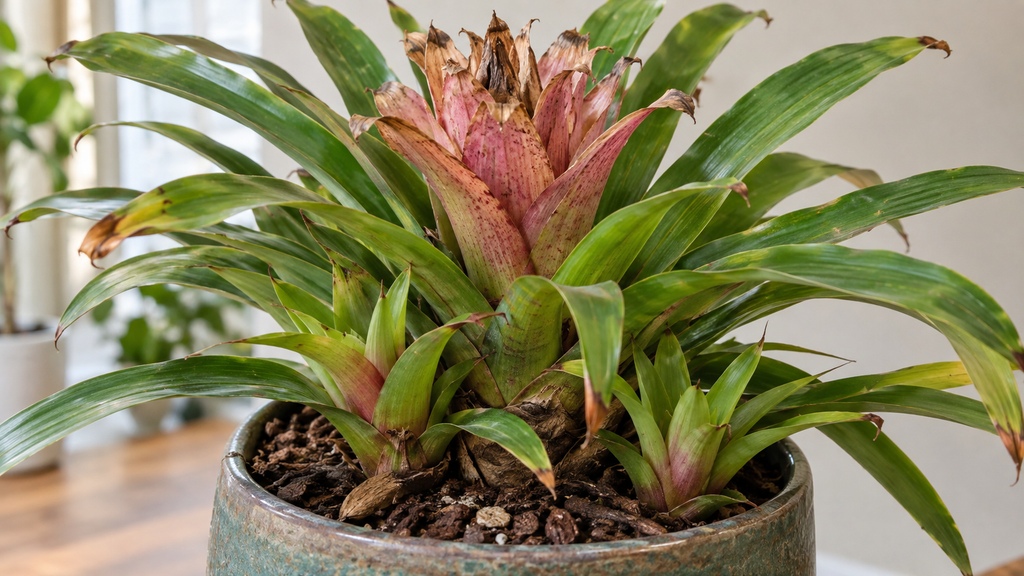
Continue normal care after the flower fades.
Do not discard the mother plant immediately because it may continue supporting pups for many months.
Once the flower spike or bracts become completely dry and unattractive, remove the spent structure with clean pruning shears.
Continue:
- bright filtered light
- appropriate watering
- good drainage
- warm temperatures
- moderate humidity
Do not increase fertilizer or watering dramatically to prevent the mother from aging.
Watch around the base for new pups.
The key distinction is:
- gradual decline plus healthy pups usually means normal aging
- rapid collapse, soft tissue, or foul smell suggests disease or rot
Bromeliad Pups
Bromeliad pups are young offsets that develop around the base of the mother plant.
They replace the mature rosette after flowering.
A young pup begins as a small group of leaves and gradually develops:
- more foliage
- a stronger base
- roots
- a recognizable rosette
Do not remove very small pups immediately.
Leaving them attached allows them to benefit from the mother plant while they gain size.
Pups can either stay attached and form a cluster or be separated into individual plants.
Separating Bromeliad Pups
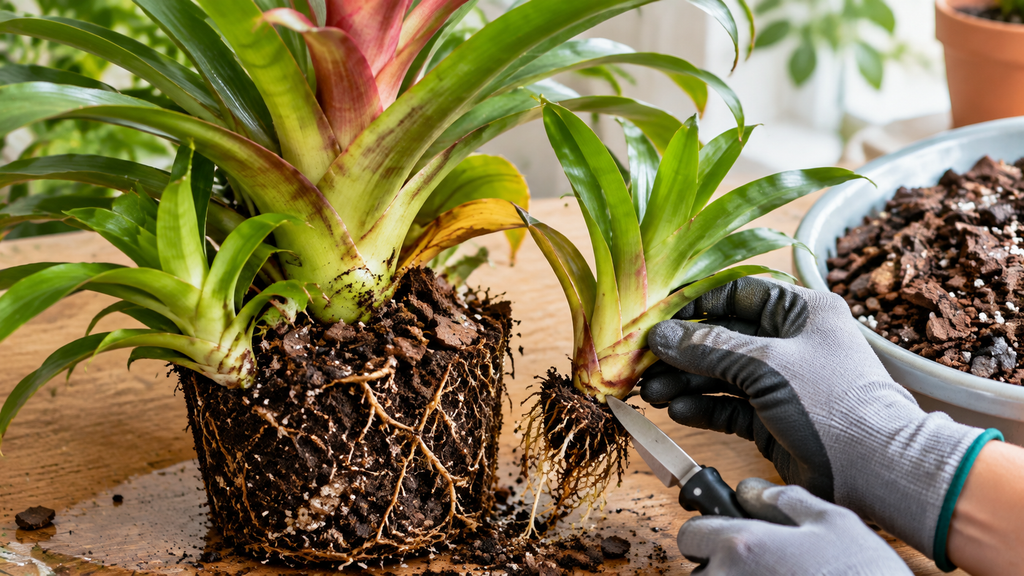
A useful general guideline is to wait until a pup reaches roughly one-third to one-half the size of the mother plant.
Larger offsets are generally easier for beginners to establish.
To separate a pup:
- Wait until it is well developed.
- Locate the connection with the mother.
- Use a clean, sharp tool.
- Preserve as much basal tissue as possible.
- Keep existing roots where possible.
- Pot it into a small container with airy mix.
- Keep it warm in bright indirect light.
Do not bury the young rosette deeply.
You can also leave pups attached if you prefer a fuller cluster or do not need separate plants.
Bromeliad Outdoor Care
Many bromeliads can grow outdoors when temperatures and light are appropriate.
In tropical and subtropical climates, suitable species may remain outdoors year-round.
In cooler climates, indoor bromeliads can often spend summer outside and return indoors before temperatures become too low.
Move indoor plants outdoors gradually.
Start with:
- bright shade
- filtered light
- shelter from strong wind
- warm nighttime temperatures
A plant accustomed to indoor light can scorch if moved directly into full afternoon sun.
Outdoor watering also changes because of:
- rainfall
- stronger wind
- higher light
- faster evaporation
- cooler nights
Tank bromeliads outdoors may collect leaves, pollen, insects, and other debris. Flush the cup periodically.
In mosquito-prone climates, regularly refreshing water in outdoor bromeliad cups can also reduce mosquito larvae.
Common Bromeliad Problems
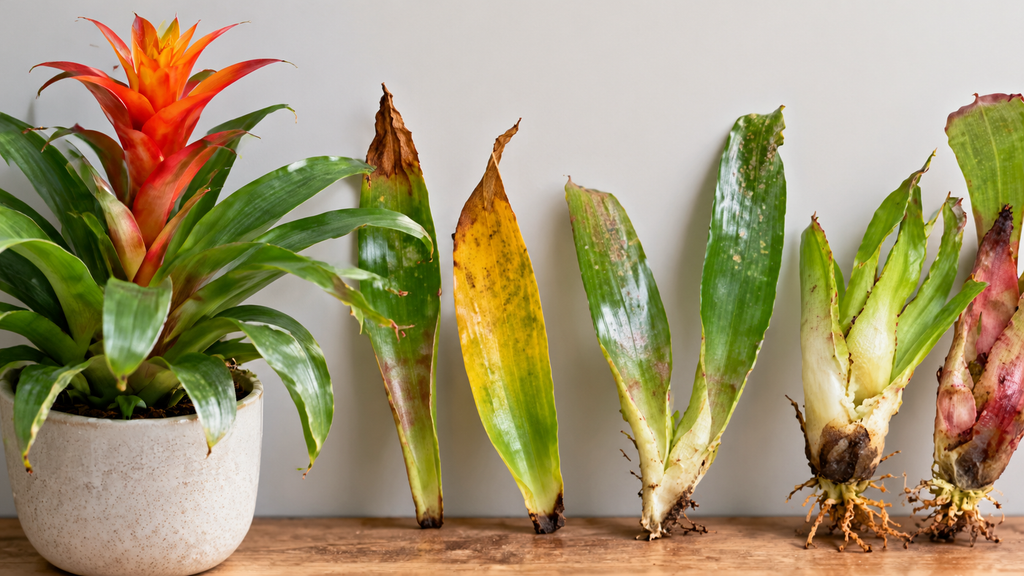
Most bromeliad problems are connected to water, drainage, light, temperature, pests, or normal post-flowering aging.
Brown Leaf Tips
Possible causes include:
- dry air
- mineral buildup
- irregular watering
- fertilizer salts
- root stress
Yellow Leaves
Possible causes include:
- too much light
- overwatering
- aging foliage
- root problems
- post-flowering decline
If yellowing appears with wet media and a soft base, investigate root health.
Mushy Base or Rot
A soft base can result from:
- prolonged wetness
- poor drainage
- cool wet conditions
- damaged crown tissue
Reduce excess moisture and inspect the roots.
Pests
Mealybugs and scale insects can affect bromeliads.
Inspect:
- leaf bases
- tight rosette crevices
- undersides of leaves
- nearby houseplants
Isolate an infested plant while you determine treatment.
A useful diagnosis rule is:
- gradual decline plus healthy pups = usually normal
- rapid collapse plus odor or mushiness = investigate rot
- visible insects = treat as a pest problem
Bromeliad Plant Benefits
Bromeliads are popular because they combine long-lasting color, architectural foliage, compact growth, and easy propagation.
Common benefits include:
- colorful bracts that remain attractive for long periods
- unusual leaf shapes and patterns
- compact root systems
- suitability for small spaces
- natural production of pups
- wide variety of forms
Avoid relying on exaggerated claims that a few houseplants can dramatically purify the air in an entire room.
Grow bromeliads primarily for their ornamental value, botanical interest, and manageable care requirements.
Bromeliads for Beginners
Many common bromeliads are suitable for beginners.
They generally do not require:
- constant repotting
- heavy feeding
- complicated pruning
- large containers
The biggest beginner challenge is understanding how the plant obtains water.
Remember:
- identify the bromeliad type
- use bright filtered light
- keep roots well drained
- maintain fresh cup water only where appropriate
- avoid overfertilizing
- expect the mother to decline after flowering
- allow pups to grow before separating them
When choosing a bromeliad in a store, look for firm leaves, a healthy base, no obvious pests, and no foul smell from the pot or central cup.
Long-Term Bromeliad Care
Long-term bromeliad care is mainly about providing stable conditions and understanding the plant’s life cycle.
Avoid repeatedly moving, repotting, fertilizing, or changing the watering routine unless there is a clear reason.
During warmer, brighter periods:
- water use may increase
- outdoor placement may be possible
- light feeding may be appropriate
During cooler, darker periods:
- the substrate dries more slowly
- feeding should decrease
- overwatering becomes easier
- cold windows can cause stress
The long-term bromeliad cycle is:
mature plant → flower → mother declines → pups develop → pups mature → new flowering rosettes
Once the original mother begins declining naturally, shift your attention toward the pups.
A successful bromeliad collection does not depend on keeping one mother plant alive forever. It depends on guiding each generation into the next.
Bromeliad Care FAQs
How Do You Care for an Indoor Bromeliad Plant?
Give it bright indirect light, warmth, moderate humidity, and fast-draining media. Water according to whether it is tank-forming, terrestrial, or an air plant.
How Often Should You Water a Bromeliad?
Many indoor bromeliads need watering attention about every one to two weeks, but conditions matter more than the calendar. Check the substrate, season, light, and plant type.
Should Bromeliads Have Water in the Center?
Tank-forming bromeliads such as many Guzmania, Aechmea, and Neoregelia can hold fresh water in their central cup. Not every bromeliad should be watered this way.
Can Bromeliads Grow With Their Roots in Water?
Most bromeliads should not have permanently submerged roots. Even tank-forming species generally need an airy, well-drained root environment.
What Light Does a Bromeliad Need?
Most bromeliads prefer bright indirect or filtered light. Too much direct sun can scorch foliage, while low light can produce weak growth.
Why Are My Bromeliad Leaf Tips Brown?
Brown tips can result from dry air, irregular watering, mineral buildup, excess fertilizer, or root stress. Check the whole growing environment before changing care.
Do Bromeliads Only Flower Once?
Most mature rosettes flower once. After flowering, the mother gradually declines while producing pups that continue the plant’s life cycle.
What Should You Do After a Bromeliad Blooms?
Continue normal care, remove the spent bloom when necessary, and allow pups to develop. Do not discard the mother plant immediately.
When Should You Remove Bromeliad Pups?
Wait until pups are well developed, usually around one-third to one-half the size of the mother plant. Larger pups generally establish more easily.
Can Bromeliad Pups Stay Attached?
Yes. They can remain attached and create a fuller cluster or be separated when you want individual plants.
How Do You Get a Bromeliad to Bloom Again?
The already-flowered mother usually will not bloom again. Instead, its pups mature into new flowering rosettes.
Can Bromeliads Live Outside?
Yes, many can grow outdoors in suitable warm conditions. Acclimate indoor plants gradually and protect tender species from frost.
Are Bromeliads Toxic to Cats and Dogs?
Several common bromeliads are considered non-toxic to cats and dogs, but it is best to verify the exact species. Even non-toxic plant material can still cause digestive upset if eaten.
Are Bromeliads Easy to Care For?
Yes, many common bromeliads are beginner-friendly. The key is identifying the growth type and avoiding permanently waterlogged roots.
Myra is the founder and lead writer of Plantsaholic. She shares practical, research-backed advice on indoor plants, outdoor gardening, flowers, herbs, succulents, and everyday plant care. Her goal is to help gardeners of all experience levels grow healthier plants through simple, easy-to-follow gardening guides.