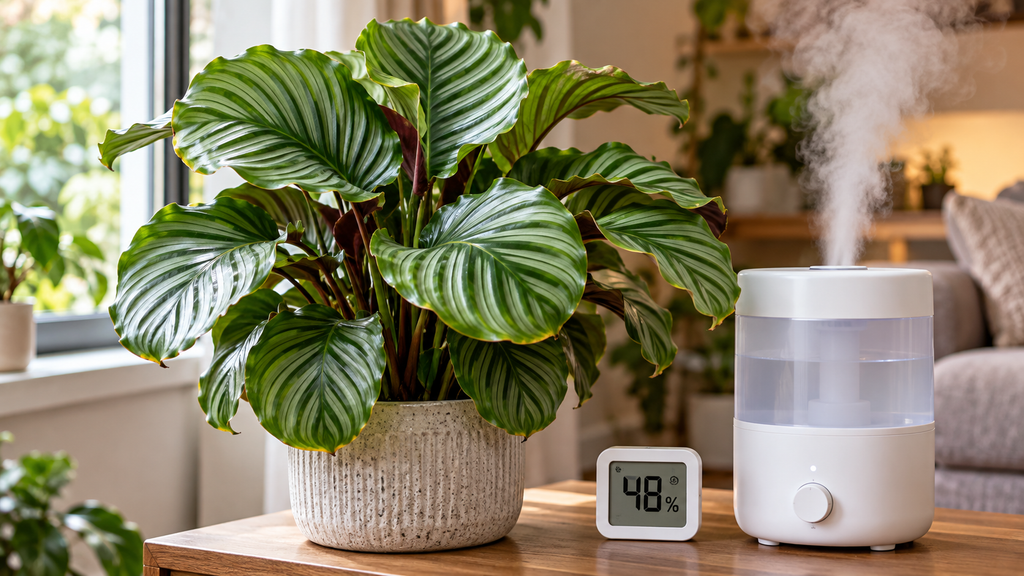
A humidifier for Calathea can help when indoor air is consistently dry, especially when relative humidity falls into the 30% range. However, not every Calathea needs one. If your home already maintains moderate humidity and the plant produces healthy new foliage, adding more moisture may provide little benefit.
Calatheas generally prefer moderate to high humidity. University of Florida guidance places suitable indoor humidity at roughly 40–60% RH, while North Carolina State Extension lists around 50–60% RH for some Goeppertia species formerly classified as Calatheas.
For ordinary homes, plant preference must also be balanced against indoor moisture control. Excessive humidity can cause condensation, damp surfaces and mold-friendly conditions. A practical approach is to keep humidity stable, measure it with a hygrometer and use a humidifier only when the room is genuinely too dry.
If your Calathea is growing well at around 40–50% RH, you may not need a humidifier. If indoor humidity repeatedly falls below 40%, especially during winter heating, a humidifier can be useful.
Do Calatheas Need a Humidifier?
Calatheas need suitable humidity, but they do not automatically need a humidifier. The humidifier is simply a tool for correcting dry indoor air when natural room humidity is insufficient.
A humidifier becomes useful when a hygrometer shows consistently low RH and the plant develops symptoms that match dry-air stress. Winter heating, air conditioning and naturally dry climates can all lower indoor humidity enough to affect sensitive tropical foliage.
Consider using a humidifier when:
- indoor humidity frequently falls below 40%;
- heating or air conditioning dries the room;
- new leaves repeatedly develop crispy edges;
- several humidity-loving tropical plants share the same area;
- the plant sits near a vent or dry interior location.
A humidifier may be unnecessary when:
- humidity already stays around 45–50%;
- healthy new foliage is developing;
- natural seasonal humidity is sufficient;
- windows or walls begin collecting condensation;
- the real problem is watering, light, roots or pests.
The key is diagnosis.
A Calathea at 29% RH with dry new leaf edges is a strong candidate for additional humidity. A Calathea at 50% RH with the same symptoms may instead be reacting to water quality, root stress, fertilizer buildup or direct sun.
Before buying a humidifier, ask:
Is the air around my Calathea actually too dry?
A digital hygrometer can answer that more reliably than leaf appearance alone.
Can You Use a Humidifier for Plants?
Yes. One humidifier can serve several plants when they share similar humidity requirements and occupy the same growing area.
Calatheas often grow well alongside Marantas, Stromanthes, many ferns and other tropical foliage plants that appreciate moderate humidity. Grouping compatible plants can also help create a slightly more humid local microclimate.
The important factor is compatibility.
A humidifier makes sense for a group of tropical plants when:
- the surrounding RH is low;
- the plants have similar humidity needs;
- the humidifier can influence the whole growing area;
- foliage is not being constantly wetted by direct mist.
Do not assume every houseplant should share the same environment. Many drought-adapted cacti and succulents have very different moisture preferences.
A useful strategy is:
Group compatible plants → measure humidity → humidify only when needed → recheck the environment.
The humidifier should improve the surrounding air, not spray one plant continuously.
What Humidity Do Calatheas Need?
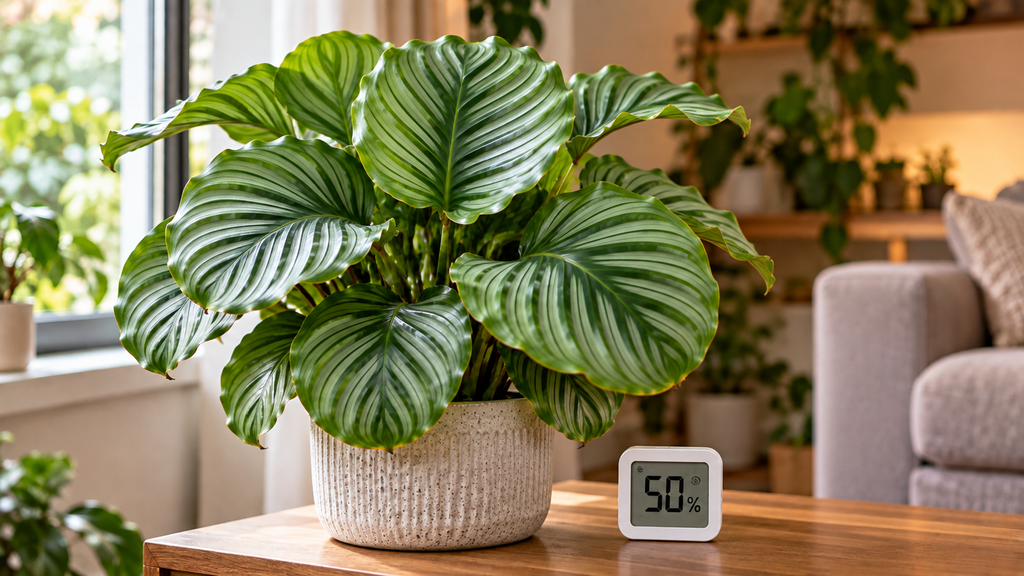
A useful indoor humidity range for Calatheas is approximately 40–60% RH. Many plants perform well around 45–50%, while more humidity-sensitive species may prefer conditions closer to 50–60%.
For most homes, start conservatively.
| Relative Humidity | Practical Meaning |
| Below 30% | Very dry |
| 30–40% | Dry for many Calatheas |
| 40–45% | Potentially workable |
| 45–50% | Good household starting range |
| 50–60% | Favorable for many Calatheas |
| Above 60% | Usually unnecessary indoors |
The important distinction is that ideal plant humidity and ideal household humidity are not always identical.
A greenhouse or plant cabinet can maintain much higher RH because ventilation, materials and moisture are carefully controlled. A bedroom or living room may develop condensation long before reaching greenhouse-like conditions.
For that reason, around 45–50% RH is a sensible household target for many growers.
If your Calathea remains healthy there, increasing humidity simply to reach 60% is unnecessary.
Stability also matters. A plant kept around 48% throughout the day may experience less stress than one cycling repeatedly between 30% and 70%.
Aim for consistent conditions rather than the highest possible reading.
Do All Calatheas Need the Same Humidity?
No. Plants sold as Calatheas do not all have identical humidity preferences.
Many species previously classified within Calathea are now placed in the genus Goeppertia. Published horticultural recommendations vary somewhat between species, which means one universal humidity number is unrealistic.
Actual performance can also depend on:
- species or cultivar;
- acclimation;
- temperature;
- airflow;
- watering consistency;
- root condition;
- light exposure;
- proximity to heating or AC vents.
A plant producing healthy leaves at 47–50% RH does not need to be pushed toward a higher number simply because another Calathea variety is commonly described as preferring 60%.
Likewise, a sensitive plant repeatedly developing dry margins at 35% RH may benefit from a moderate increase.
Use species recommendations as a starting point, then judge your own plant according to measured humidity and the condition of its new growth.
How Do You Know a Calathea Needs More Humidity?
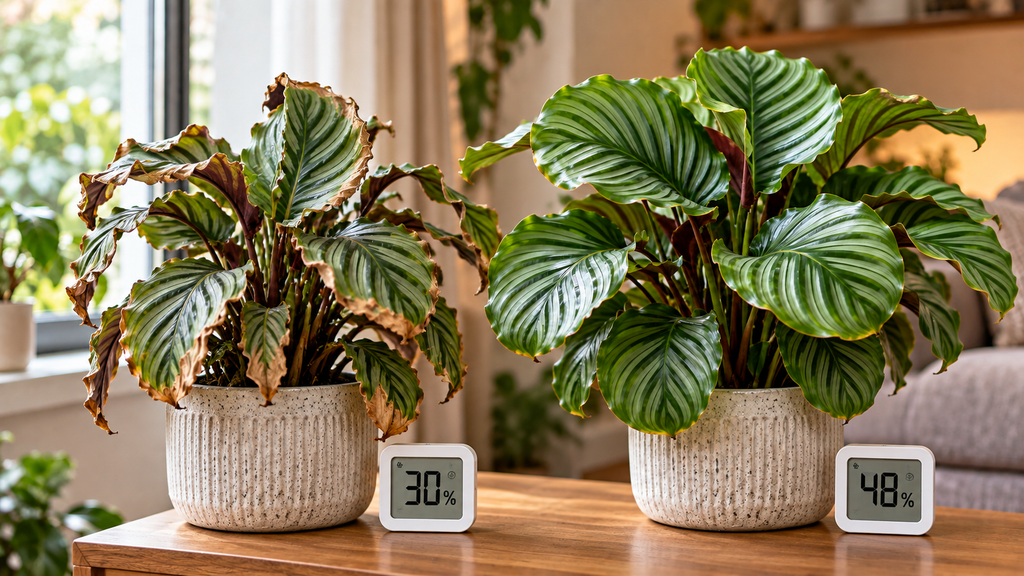
The most reliable approach is to combine humidity readings with plant symptoms.
Brown or crispy leaf edges can be associated with dry air, but they are not proof of low humidity. Similar symptoms can result from inconsistent watering, mineral buildup, fertilizer salts, direct sunlight, root problems or pests.
Possible dry-air signs include:
- crispy new leaf margins;
- brown tips;
- papery edges;
- increased curling;
- symptoms becoming worse during heating season;
- damage becoming worse near vents or radiators.
A stronger diagnosis looks like this:
30% RH + crispy new foliage + winter heating = dry air is likely contributing.
By contrast:
50% RH + brown tips = investigate other causes before raising humidity.
Run a 24-Hour Humidity Test
Before buying a humidifier, place a digital hygrometer near the plant and record RH over a normal day.
| Time | RH | Conditions |
| Morning | ___% | Heating or AC? |
| Midday | ___% | Normal daytime conditions |
| Evening | ___% | Doors/windows open? |
| Before bed | ___% | Heating status |
| Next morning | ___% | Overnight low |
Interpret the pattern:
- mostly 45–50%+ with healthy foliage: probably no humidifier needed;
- occasional brief dip below 40%: monitor;
- repeated periods in the 30s: humidification may help;
- normal RH with damaged foliage: investigate other care factors.
A full-day test is more useful than one random reading because indoor humidity can change significantly between daytime and overnight.
What Is the Best Humidifier for Calathea?
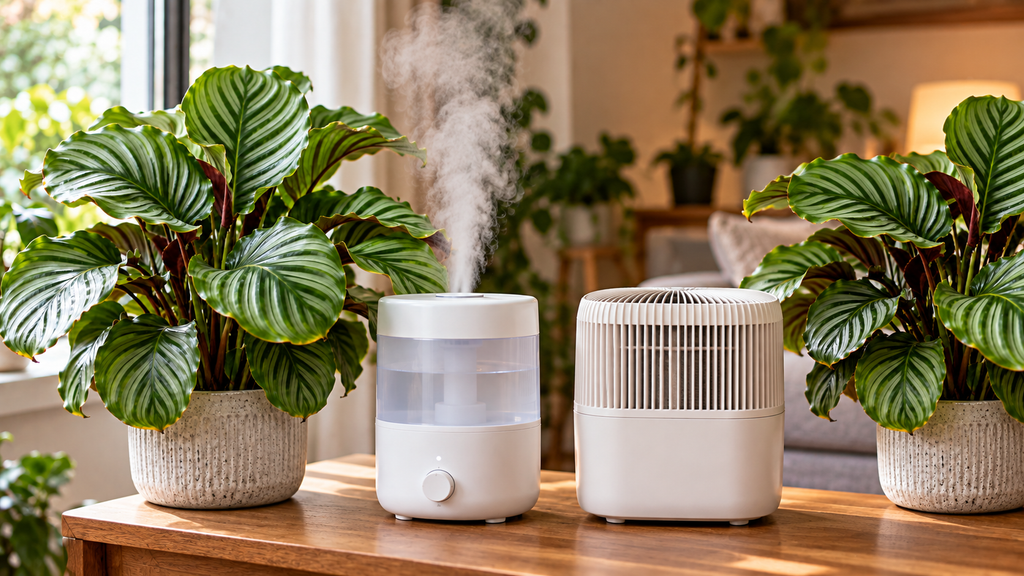
The best humidifier for Calathea is one that can maintain suitable RH in your actual room without leaving leaves, furniture or walls wet.
Choose according to room size, output control, cleaning requirements and water quality rather than visible mist.
Useful features include:
- adjustable output;
- built-in humidistat;
- automatic shutoff;
- appropriate room coverage;
- easy-to-clean reservoir;
- quiet operation;
- accessible replacement filters or parts.
For one Calathea in a small room, a compact controllable unit may be enough.
For several tropical plants in a larger room, prioritize a bigger reservoir, better room coverage and a humidistat.
Ultrasonic Humidifiers
Ultrasonic models are popular because they are quiet, compact and produce cool mist.
Their main drawback is mineral dispersion. When mineral-rich tap water is used, some units can leave white mineral dust on furniture, leaves and nearby surfaces.
Using distilled or low-mineral water may reduce this problem.
Evaporative Humidifiers
Evaporative units use a fan and wet wick or filter.
They usually disperse less mineral material but may involve:
- fan noise;
- filter replacement;
- larger physical size.
Neither type is automatically superior. Choose the one that fits your room and maintenance preferences.
Cool Mist or Warm Mist?
Calatheas do not require warm vapor.
The plant responds to relative humidity in the air, not the temperature of the visible mist. Cool-mist and evaporative units are therefore practical choices for most indoor plant areas.
Warm-mist models can also increase humidity, but the plant receives no special advantage simply because the vapor is warm.
A humidistat is usually more useful than a timer because it responds to the actual humidity level rather than operating for a fixed number of hours.
How to Use a Humidifier for Calathea Indoors
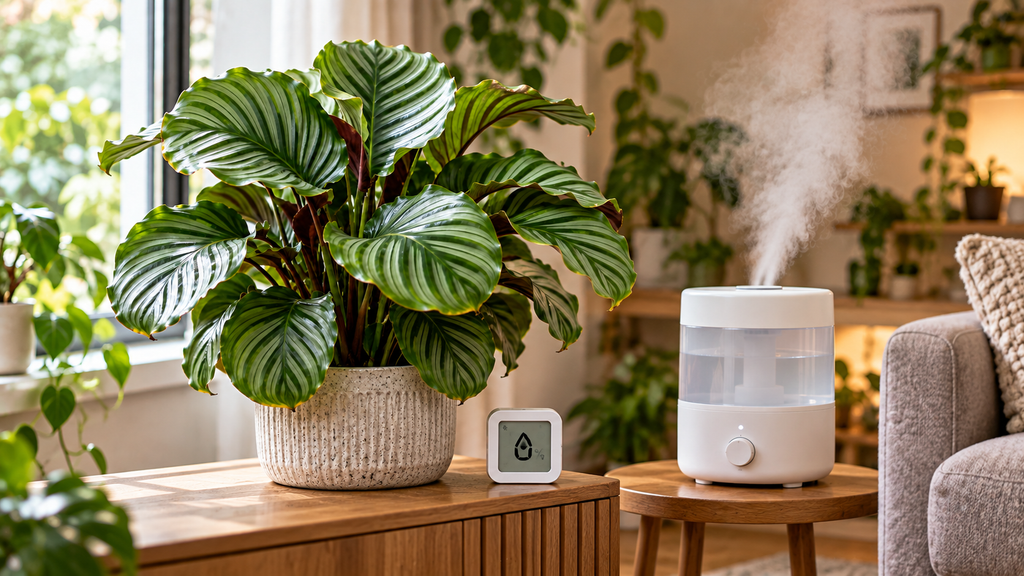
Use a humidifier for Calathea indoors to increase atmospheric moisture rather than directly wet the foliage.
Start by measuring the room’s baseline RH. Then place the hygrometer near foliage height and position the humidifier where its output can disperse through the surrounding air.
Follow this process:
- Measure starting RH.
- Position the hygrometer near the plant.
- Start the humidifier at low or moderate output.
- Avoid pointing mist directly at the leaves.
- Allow humidity to stabilize.
- Recheck the reading.
- Reduce output if surfaces become damp.
- Adjust the setting seasonally.
The healthiest setup usually looks uneventful:
- leaves remain dry;
- RH stays fairly stable;
- furniture stays dry;
- windows do not develop heavy condensation;
- the humidifier remains clean.
Do not expect previously brown tissue to become green again.
The better measure of success is whether the next few leaves develop with fewer dry margins.
How Close Should a Humidifier Be to Calathea?
There is no universal correct distance.
Humidifier output, room airflow, temperature and unit size vary too much for a fixed rule such as “two feet away” to work everywhere.
Use three checks.
Hygrometer: Does RH around the plant actually increase?
Leaves: Are droplets collecting on the foliage? If yes, move the humidifier farther away or redirect it.
Room: Are nearby walls, windows, furniture or curtains becoming damp? If yes, reduce output.
Imagine a humidifier positioned four feet away while the plant remains at 31% RH. Moving the unit closer raises RH to 46% without wetting the leaves.
That is useful placement.
If moving it extremely close pushes humidity much higher and leaves begin collecting water, the placement is too aggressive.
The correct distance is the one that improves measured humidity without creating wet surfaces.
How Long Should a Calathea Humidifier Run?
There is no fixed number of hours.
Runtime depends on:
- starting humidity;
- room volume;
- season;
- heating;
- air conditioning;
- ventilation;
- humidifier capacity.
A humidifier may be unnecessary during humid summer weather and useful for several hours or intermittently during winter.
This is why statements such as “run your humidifier four hours every day” are unreliable.
A small closed room may reach its target quickly. A large open space may barely respond to the same unit.
A humidistat-controlled humidifier simplifies the process because it can cycle according to actual RH.
Overnight use is acceptable when humidity falls during the night and the unit operates safely without producing excessive moisture.
Do not continue humidifying simply because the machine is available. Once the room reaches an appropriate RH, adding more moisture provides little benefit.
Should You Mist Calathea Instead?
Misting can be part of Calathea care, but it is not a reliable replacement for controlled humidity.
Misting places water directly onto the foliage and creates only a brief local moisture increase. A humidifier can change atmospheric RH across a larger area and for a longer period.
| Factor | Humidifier | Misting |
| Raises room RH | Yes | Very little |
| Measurable | Yes | Limited |
| Sustained effect | Possible | Usually short |
| Wets foliage | Not when positioned properly | Yes |
| Useful for several plants | Yes | Less practical |
If your room stays at 28% RH, misting once in the morning does not solve the underlying dry-air problem.
Misting may still be acceptable when:
- humidity is already reasonable;
- foliage dries quickly;
- airflow is good;
- clean water is used.
The important goal is not wet leaves.
It is stable growing conditions.
Can a Pebble Tray Replace a Humidifier?
A pebble tray may create a small local humid microclimate, but it is unlikely to correct seriously dry room air.
Pebble trays are most useful when:
- RH is already close to acceptable;
- only a small improvement is needed;
- one or two plants occupy the space.
They are less likely to solve:
- 25–30% winter humidity;
- heavy heating-related dryness;
- large open rooms;
- strong HVAC airflow.
Instead of assuming the tray works, measure it.
Place a hygrometer near the foliage, record the baseline, add the pebble tray and compare readings under similar conditions.
If RH barely changes, the tray is not solving the problem.
Grouping several tropical plants can also help create a modestly more humid microclimate through transpiration, but severe dry air generally requires a more controllable solution.
Can Humidity Be Too High for Calathea?
Calatheas tolerate humid conditions, but excessive humidity can still create problems indoors.
The biggest risk is often the surrounding home rather than the plant itself.
Warning signs include:
- heavy window condensation;
- damp walls;
- wet furniture;
- musty odors;
- potting mix that stays wet for unusually long periods;
- poor airflow.
High humidity also slows evaporation.
A Calathea growing in waterlogged soil, high humidity and stagnant air may remain wet much longer than intended.
This is why greenhouse conditions should not automatically be copied into a bedroom or living room.
A Calathea may tolerate 70% or higher under controlled growing conditions, but such levels are generally unnecessary for normal indoor care.
A better target is:
healthy foliage + stable RH + dry surrounding surfaces + good airflow.
Humidity describes water vapor in the air. It does not mean keeping the soil saturated or the leaves permanently wet.
Why Does Calathea Have Brown Tips With a Humidifier?
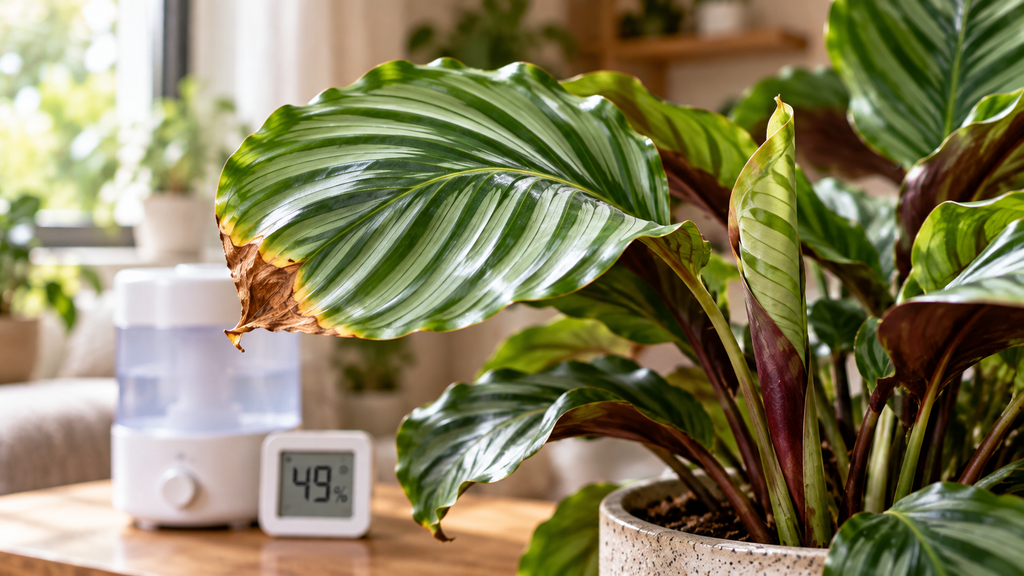
Brown tips can continue even when humidity is adequate because dry air is only one possible cause.
If the hygrometer already shows reasonable RH, investigate:
Water Quality
Mineral-heavy water can contribute to buildup in the growing medium and damaged leaf margins. Rainwater, distilled water or appropriate filtered water may help where local water quality is problematic.
Inconsistent Watering
Calatheas prefer relatively even moisture during active growth. Repeatedly allowing the root ball to become extremely dry can stress foliage.
Direct Sun
Strong direct sunlight can scorch sensitive leaves and create brown or faded patches.
Fertilizer Buildup
Excess fertilizer can increase salt concentrations around roots and contribute to leaf damage.
Heating and Air Conditioning
A room can read 50% RH while a heater or AC vent blows directly across the foliage. Move the plant before increasing humidity further.
Root Problems
Check whether the soil stays wet for too long, drainage holes are blocked or roots appear dark, soft or unhealthy.
Spider Mites
Fine webbing, stippling or pale specks can indicate spider mites, especially when plants are stressed.
Use this troubleshooting sequence:
Humidity → watering → drainage → roots → light → pests → fertilizer → water quality → airflow
Do not automatically increase humidity every time a leaf tip turns brown.
Can Calathea Purify Indoor Air?
A Calathea should not be treated as a substitute for an air purifier or proper ventilation.
Like other plants, Calatheas participate in normal biological processes including photosynthesis, respiration and transpiration. However, that does not mean one or several plants can function as dedicated whole-room air-cleaning equipment.
If indoor air quality is the concern, more direct strategies include:
- pollutant source control;
- ventilation;
- HVAC maintenance;
- appropriate filtration or air-cleaning equipment.
The exact solution depends on the pollutant involved.
Calatheas are best valued for their ornamental foliage and horticultural appeal rather than exaggerated air-purifying claims.
There is also an important connection to humidity: keeping soil or surrounding materials excessively wet can create its own indoor moisture problems.
Once again, balance matters more than maximum moisture.
How to Clean a Humidifier for Calathea
Humidifier maintenance is important because standing water can accumulate mineral deposits and microorganisms.
A basic routine includes:
- empty stale water regularly;
- wipe the reservoir;
- remove scale;
- follow manufacturer cleaning instructions;
- rinse cleaning residues thoroughly;
- replace filters when necessary;
- dry the unit before long-term storage.
Should You Use Tap Water?
That depends on the humidifier and local water quality.
Ultrasonic units can disperse minerals from tap water, sometimes creating white dust on:
- furniture;
- leaves;
- shelves;
- electronics.
Distilled or low-mineral water can help when mineral buildup is a problem.
Never add fertilizer, pesticides or plant tonics to an ordinary humidifier tank.
Only use essential oils if the manufacturer specifically states that the unit is designed for them.
A simple, easy-to-clean humidifier that you maintain regularly is usually more useful than a complicated unit that is neglected.
What Is the Best Humidity Setup for Calathea?
The best Calathea environment combines moderate humidity with appropriate light, temperature, watering, drainage and airflow.
A practical setup includes:
- bright indirect light;
- warm, stable temperatures;
- a hygrometer near plant level;
- roughly 45–50% RH as a practical home starting point;
- humidifier use only when necessary;
- evenly moist but well-drained growing medium;
- no direct mist blasting the foliage;
- gentle air movement;
- seasonal adjustment.
Three examples make the decision clearer.
Humid summer apartment: RH stays at 53%, and new leaves are healthy. No humidifier is needed.
Heated winter bedroom: RH falls to 29%, and new leaves develop crispy margins. Controlled humidification is reasonable.
Room at 50% RH with continued browning: Investigate watering, roots, light, fertilizer, pests and water quality before increasing humidity.
The simplest Plantsaholic system is:
Measure → Diagnose → Correct → Remeasure → Observe New Growth
That is more reliable than reacting to every damaged leaf by turning the humidifier higher.
Calathea Humidifier FAQs
Do Calatheas need a humidifier?
Not always. If indoor humidity stays around 40–50% or higher and the plant produces healthy new growth, a humidifier may be unnecessary.
Is 40% humidity enough for Calathea?
It can be. Some Calatheas tolerate around 40% well, while more sensitive plants may benefit from slightly higher humidity.
Is 50% humidity good for Calathea?
Yes. Around 50% RH is a practical target for many indoor Calatheas and provides a useful balance between plant needs and household moisture control.
Does Calathea need 60% humidity?
Not necessarily. Some species prefer conditions closer to 50–60%, but healthy plants growing at slightly lower RH do not need to be pushed higher.
What humidifier is best for Calathea?
Choose an easy-to-clean humidifier with adjustable output, adequate room coverage and preferably a built-in humidistat.
Is cool mist or warm mist better?
Cool mist is usually more practical. Calatheas need suitable relative humidity, not warm vapor.
How close should a humidifier be?
There is no fixed distance. Position it where RH improves around the plant without wetting leaves, walls or furniture.
How long should a humidifier run?
There is no universal runtime. Let the hygrometer or humidistat determine how long the room actually needs additional moisture.
Should you mist Calathea every day?
Daily misting is not necessary. It provides temporary moisture but does not regulate room humidity as effectively as a humidifier.
Can a pebble tray replace a humidifier?
Usually not in very dry rooms. Pebble trays may slightly improve the immediate microclimate but offer much less control.
Why are my Calathea leaves crispy with a humidifier?
Humidity may not be the cause. Check water quality, watering, roots, light, fertilizer, HVAC airflow and pests.
Can high humidity cause mold?
Excessive humidity can contribute to mold-friendly conditions when condensation or persistent dampness develops. Reduce humidifier output if surrounding surfaces become wet.
Does Your Calathea Need a Humidifier?
A humidifier for Calathea is useful when measured indoor humidity is genuinely too low, especially when RH repeatedly falls into the 30s and new foliage develops compatible dry-air symptoms.
It is not essential for every Calathea.
For many indoor plants, approximately 40–60% RH is a useful horticultural range, while around 45–50% is a practical household starting point.
Before increasing humidity, check:
- actual RH;
- new leaf condition;
- watering;
- drainage;
- root health;
- light;
- temperature;
- HVAC airflow;
- water quality;
- fertilizer;
- pests.
If humidity is low and the symptoms match, a humidifier is a logical tool.
If RH is already adequate, adding more moisture is unlikely to fix a different care problem.
The best long-term strategy is simple:
Measure first. Diagnose before treating. Maintain stable conditions. Keep surrounding surfaces dry. Judge improvement by healthy new growth.
A Calathea does not need the most humid room possible. It needs a balanced environment where humidity, watering, light, temperature and airflow work together.

Myra is the founder and lead writer of Plantsaholic. She shares practical, research-backed advice on indoor plants, outdoor gardening, flowers, herbs, succulents, and everyday plant care. Her goal is to help gardeners of all experience levels grow healthier plants through simple, easy-to-follow gardening guides.