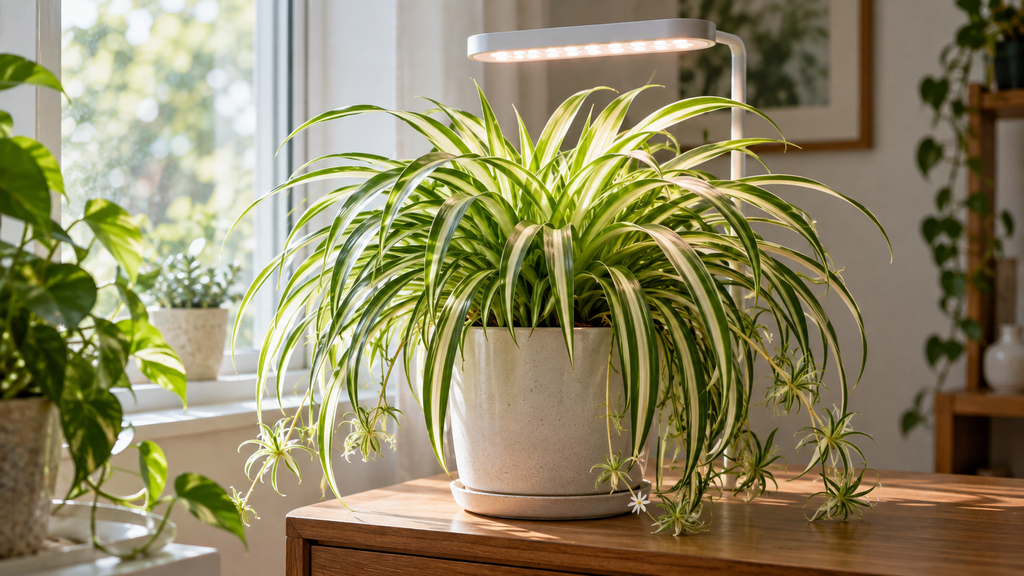
Spider plants (Chlorophytum comosum) do not automatically need a grow light. If they already receive enough natural daylight, supplemental lighting may add little benefit. A grow light becomes useful when the plant is kept in a dark room, far from a window, in a windowless space, or during seasons when daylight drops significantly.
Spider plants are often described as low-light houseplants because they tolerate conditions that would stress more light-demanding species. But low-light tolerance does not mean they prefer darkness. A spider plant may survive in a dim location while growing slowly, losing variegation, producing weaker foliage, or failing to develop runners and plantlets.
The better question is not simply, “Does a spider plant need a grow light?”
It is: Does the plant receive enough usable light where it currently grows?
If the answer is yes, natural daylight may be sufficient. If not, a properly positioned LED grow light can supplement or replace the missing light.
Most spider plants do not need a grow light if they receive medium to bright indirect light from a suitable window.
A plant close to a bright east-facing window may grow well without extra lighting, while the same plant several feet inside the room may receive much less usable light even if the room looks bright to you.
A grow light is most useful when the plant is:
- Far from a window
- In a windowless bathroom or office
- On a high shelf where daylight barely reaches the leaves
- Showing weak growth after being moved somewhere darker
- Receiving significantly less daylight during winter
- In a home heavily shaded by trees, buildings, balconies, or curtains
You probably do not need a grow light if the plant produces healthy new leaves, maintains good variegation, grows steadily during its active season, and receives strong indirect window light.
The important distinction is survival versus strong growth. A spider plant that stays green but barely produces new foliage may be tolerating its location rather than thriving in it.
How Much Light Do Spider Plants Need?
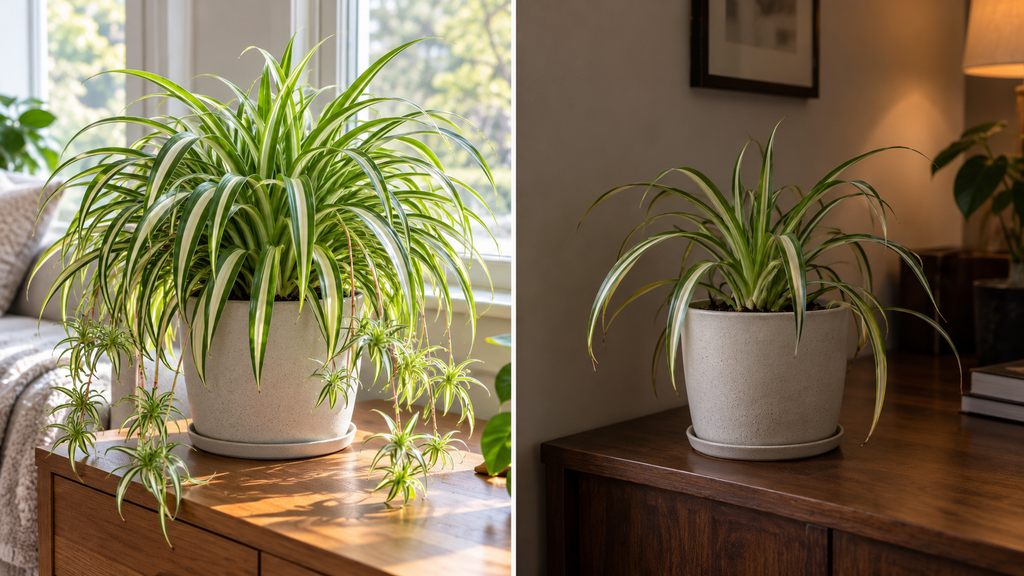
Spider plants generally perform best in medium to bright indirect light. They can tolerate lower illumination, but prolonged deep shade often leads to slower growth and less attractive foliage.
RHS recommends bright indirect light and notes that lower light can slow growth and reduce variegation. Illinois Extension also classifies spider plants as medium-light houseplants.
The amount of light reaching the plant depends on more than window direction. Important factors include:
- Window size
- Distance from the glass
- Trees or buildings outside
- Curtains and blinds
- Season
- Latitude
- Room depth
- The height of a hanging basket
That is why rules such as “keep a spider plant five feet from a window” are unreliable. Five feet from a large unobstructed window may provide more usable light than one foot from a small shaded window.
An east-facing window often gives gentle morning light. West- and south-facing windows can also work when harsh sun is filtered. Bright north-facing windows may be suitable depending on climate, season, and building design.
Strong direct sun is unnecessary and can scorch or discolor the foliage.
The simplest way to judge a location is to watch new growth. Strong, normally shaped leaves suggest the current light level is suitable. Weak, sparse, unusually green, or strongly directional growth suggests the plant may need more usable light.
How to Tell If Your Spider Plant Needs More Light
Do not diagnose a lighting problem from one damaged leaf. Look for several related changes, especially in new growth.
Check New Growth
Older leaves show how the plant performed in the past. New leaves tell you more about its current environment.
Healthy new growth should have normal leaf size, good texture, and regular production during the active season.
If new leaves become weaker after the plant is moved farther from a window, low light becomes more likely.
Check Growth Direction
Some leaning toward light is normal, but strong, persistent leaning from most of the plant suggests the available light may be too weak or too directional.
Rotating the pot can improve symmetry, but it cannot fix a genuinely dark location.
Check Variegation
Variegated spider plants may become greener when light levels fall.
However, color alone is not proof of a lighting problem because genetics and cultivar characteristics also affect leaf pattern.
Check Soil Drying
This is often overlooked.
When light drops, growth can slow and the plant may use water more slowly. If the potting mix starts staying damp much longer after the plant is moved to a darker area, reduced light may be part of the reason.
The most reliable diagnosis comes from several consistent signs together rather than one symptom in isolation.
Can Spider Plants Grow Under Artificial Light?
Yes. Spider plants can grow successfully under artificial lighting when the light is strong enough, positioned correctly, and used for a consistent daily period.
Artificial lighting is especially useful in:
- Windowless rooms
- Interior offices
- Basements
- Deep shelves
- Tall cabinets
- Dark bathrooms
- Apartments shaded by nearby buildings
- Homes with very weak winter daylight
Because spider plants are foliage plants, they usually do not need the very high-output lighting used for fruiting vegetables.
The goal is not maximum brightness. It is enough usable light to support healthy foliage without bleaching or scorching the leaves.
If the plant is already growing well beside a suitable window, adding a grow light may provide little benefit.
When a Grow Light Is Not the Solution
A grow light is not the correct response every time a spider plant looks unhealthy.
Brown tips, yellowing, or slow growth can have causes unrelated to light.
Before buying a grow light, check whether:
- The potting mix stays constantly wet
- Drainage is poor
- Roots are damaged
- The plant was recently repotted
- Temperatures are unusually low
- Pests are present
Brown tips are particularly easy to misdiagnose. They may be linked to watering problems, dry air, accumulated salts, water quality, or excessive sunlight rather than inadequate light.
A useful elimination process is simple.
First, confirm that the plant is actually in a dark location. Then inspect soil moisture, drainage, roots, temperature, drafts, and recent changes such as repotting or fertilizing.
A spider plant sitting in water will not improve simply because a grow light is added.
Use artificial lighting when the evidence points toward a real light deficit.
Can Spider Plants Grow in Low Light?
Yes, but “tolerated” is more accurate than “preferred.”
In lower light, spider plants may:
- Produce new leaves more slowly
- Develop less dense foliage
- Lean more strongly toward available light
- Lose some variegation
- Produce fewer flowers or plantlets
- Use water more slowly
A common example is a plant moved from a bright window to a decorative shelf across the room.
The existing leaves may stay attractive for months, making the plant appear happy. New growth provides the better test.
If new leaves become weaker, greener, or slower to develop, the darker placement may be limiting the plant.
Low light is also different from no light.
Spider plants cannot grow indefinitely in complete darkness because they need light for photosynthesis. A hallway or bathroom may look reasonably bright to human eyes while providing very little useful plant light.
A window is not absolutely required, but a reliable source of light is.
How to Evaluate the Light in Your Home
Judge the exact spot where the plant sits rather than describing the whole room as “bright” or “dark.”
Stand where the plant grows and look toward the window.
Ask:
- Can the plant see a large area of open sky?
- Is furniture blocking the light?
- Is a hanging basket above the brightest part of the glass?
- Are buildings, trees, balconies, shutters, or curtains reducing daylight?
- Does direct sun strike the foliage for long periods?
Check the location at different times of day.
A shelf that looks bright in the morning may be dim for the rest of the day. Season also matters because sun angle, day length, cloud cover, and tree foliage can change indoor light substantially.
Make the smallest correction first.
Move the plant closer to the window, remove unnecessary obstructions, lower or reposition a hanging basket, or rotate the plant periodically.
Add a grow light only if natural light is still insufficient or the preferred location cannot be changed.
Do Spider Plants Need a Grow Light in Winter?
Not always.
A winter grow light is useful when seasonal daylight becomes too weak or too short for the plant’s current position.
The effect depends strongly on location. Homes at higher latitudes can experience very short winter days, while homes closer to the equator may have much smaller seasonal changes.
Before adding a lamp, move the plant closer to the brightest suitable window if practical.
Keep it away from:
- Freezing glass
- Cold drafts
- Radiators
- Heating vents
Winter light also affects watering.
When growth slows, the plant may use water more slowly, so a pot that dried quickly in summer may remain damp much longer in winter.
Do not respond to slow winter growth by automatically increasing watering. Improve the light if necessary, then adjust watering according to how quickly the pot actually dries.
What Is the Best Grow Light for a Spider Plant?
For most spider plants, a white or balanced full-spectrum LED is the simplest practical choice.
University of Minnesota Extension notes that white or balanced grow lights work well for general plant growth and that LEDs are efficient and long-lasting.
Useful fixture types include:
- Grow-light bulbs for one plant
- Clip-on LEDs for shelves
- LED bars
- Adjustable floor lamps
- Pendant lights for hanging plants
- Small panels for several plants
Prioritize adjustable positioning, broad canopy coverage, timer compatibility, low heat, and clear manufacturer guidance.
Do not choose solely by electrical wattage. Wattage does not tell you exactly how much plant-usable light reaches the leaves.
Coverage is especially important for mature spider plants. Their long arching foliage can extend well beyond the pot, so a small lamp aimed only at the center may leave much of the canopy underlit.
How Long Should a Spider Plant Grow Light Stay On?
If artificial lighting provides most of the plant’s illumination, about 12 to 14 hours of total daily light is a practical starting point.
If the plant already receives useful window light, the lamp only needs to supplement darker periods.
In a windowless room, a consistent timer is especially useful.
Do not leave the grow light on 24 hours a day. Plants benefit from a regular dark period, and day length can also affect spider plant reproduction.
NC State reports that spider plant stolons and plantlets respond to short days and long uninterrupted nights, including conditions with fewer than 12 hours of light per day for several weeks.
This means light intensity and photoperiod are different variables.
A plant can need adequate light intensity for strong foliage while responding to shorter days when producing runners and plantlets.
How Close Should a Grow Light Be?
There is no universal distance because grow lights vary greatly in output.
Follow the manufacturer’s recommended distance first.
A low-output LED bulb may need to sit fairly close to the foliage, while a powerful panel may need much more space.
Signs that the light may be too weak or too far away include:
- Weak new growth
- Strong leaning
- Declining variegation
- Poor illumination of outer leaves
Signs that it may be too close include:
- Pale upper leaves
- Bleached areas
- Dry patches
- Damage concentrated directly beneath the fixture
Coverage matters as much as distance.
A lamp can be close enough to the crown while still failing to illuminate the outer foliage.
A Simple Grow-Light Setup
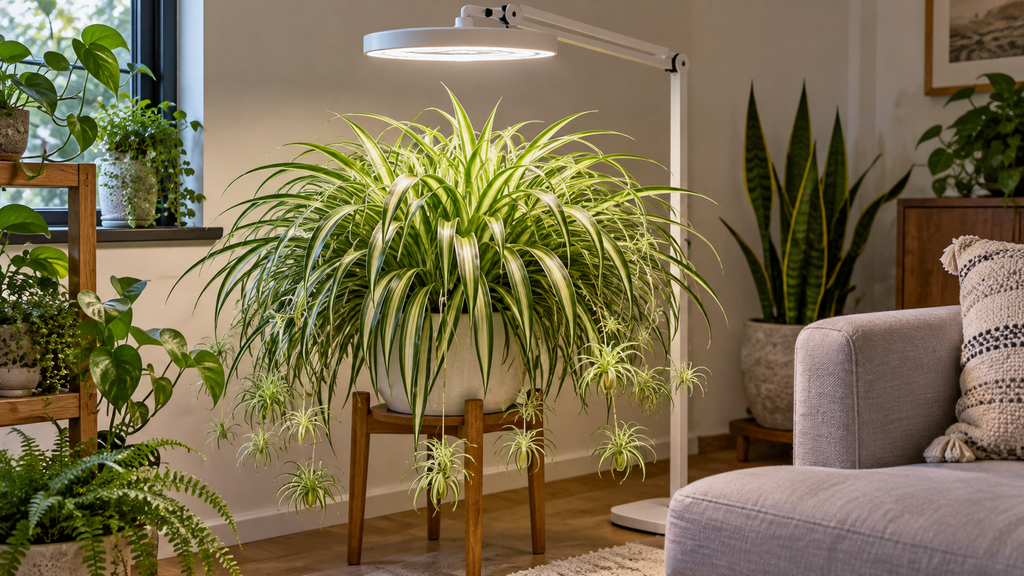
For one spider plant, keep the setup simple:
- Choose a white or balanced LED.
- Position it above or slightly beside the plant.
- Follow the manufacturer’s recommended distance.
- Use a timer.
- If artificial light is the main source, start around 12 to 14 total light hours per day.
- Account for any existing window light.
- Watch the next leaves and adjust gradually.
Avoid changing lighting, watering, fertilizer, potting mix, and temperature at the same time.
When several variables change together, it becomes difficult to know which adjustment helped or caused a new problem.
Recheck the setup as the plant grows. A mature spider plant may become much wider than the fixture’s original coverage area.
Light and Water Work Together
Spider plants appreciate regular moisture but do not need constantly wet soil.
Their water use changes with light, temperature, season, pot size, root density, potting mix, and humidity.
A plant beside a bright window may dry much faster than the same plant in a shaded room. This is why fixed instructions such as “water every seven days” are unreliable.
When suitable light increases, growth may become more active and the plant may use water faster.
When light decreases, growth usually slows and the potting mix may stay damp longer.
If you move a spider plant from a bright window into a dark room, do not assume its old watering schedule still fits.
Likewise, after adding a grow light, do not immediately increase watering. Watch the plant, monitor how quickly the soil dries, and adjust only when actual water use changes.
Brown tips also do not automatically mean the plant needs more water. Watering extremes, dry air, accumulated salts, and strong sun can produce similar symptoms.
Signs of Too Little and Too Much Light
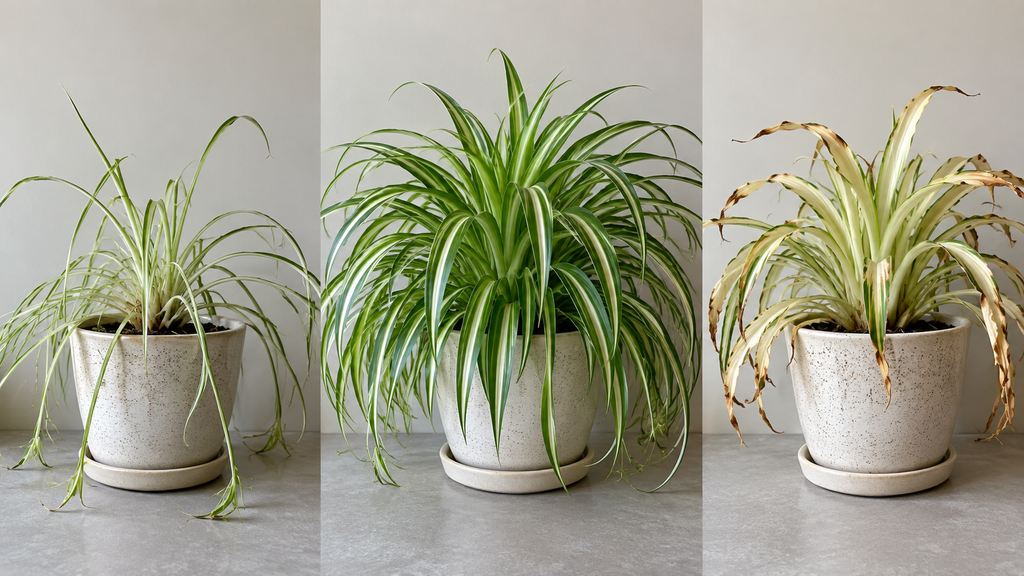
Common signs of too little light include:
- Slow active-season growth
- Weak new leaves
- Sparse foliage
- Strong leaning
- Fading variegation
- Fewer flowers or plantlets
- Soil staying wet much longer than before
A useful test is controlled relocation.
Move the plant into stronger indirect light while keeping other care factors as stable as possible. If the next leaves are stronger and denser, inadequate light was likely contributing to the problem.
Too much light can cause:
- Pale leaves
- Bleaching
- Yellowing
- Dry tan patches
- Scorch
- Damage concentrated on exposed foliage
If only the leaves closest to a grow lamp are affected, increase the distance or reduce intensity.
If window-facing leaves burn while shaded leaves remain healthy, strong direct sun may be the cause.
Brown tips alone do not prove either too little or too much light.
Can a Grow Light Help Spider Plants Make Babies?
It can help if inadequate light is limiting the mother plant, but simply increasing light hours does not guarantee more spiderettes.
Plantlet production also depends on:
- Plant maturity
- Temperature
- Pot conditions
- Nutrition
- Cultivar
- Photoperiod
NC State notes that spider plant runners and plantlets respond to shorter days and long uninterrupted nights.
For healthy foliage, provide enough light. For plantlet production, remember that day length can influence the response.
If a mature plant already has healthy foliage but produces no runners, investigate maturity, temperature, pot size, and photoperiod rather than simply increasing lamp intensity.
Should You Buy a Grow Light?
A grow light makes sense when insufficient light is genuinely limiting the plant or when you want to keep it somewhere natural daylight cannot support healthy growth.
It is especially useful when:
- There is no useful window
- The decorative location cannot change
- Seasonal darkness is significant
- Weak growth clearly corresponds with low light
- Moving closer to daylight is impractical
You probably do not need one if the spider plant is already thriving, moving it closer to a window solves the problem, or the symptoms point more strongly to watering, roots, pests, or temperature.
For one spider plant, a huge horticultural panel is usually unnecessary.
A moderate, adjustable LED with good canopy coverage is often enough.
The Best Spider Plant Light Routine
For most homes, a simple routine works well:
- Provide medium to bright indirect light
- Protect the leaves from prolonged harsh sun
- Water according to actual soil moisture
- Make seasonal adjustments when daylight changes
- Maintain a regular dark period
- Add artificial light only when natural light is insufficient
The most important connection is between light and water.
A spider plant in bright indirect light may use water relatively quickly, while the same plant in a darker winter position may remain wet much longer.
Good spider plant care works as a system rather than as a collection of fixed schedules.
Final Answer
Spider plants do not inherently need a grow light. They need enough usable light.
If your plant is producing healthy new leaves beside a bright indirect window, extra lighting is unnecessary.
If it sits in a dark room, windowless space, deep shelf, or heavily shaded position and shows weak growth, a grow light can be an effective solution.
Start with the simplest fix: improve natural light if practical.
If that is not possible, use a balanced white LED, cover most of the canopy, follow the manufacturer’s distance guidance, use a timer, and observe the new growth before making further changes.
The simplest rule is:
Spider plants are low-light tolerant, not darkness-loving.
Spider Plant Grow Light FAQs
Can I use a regular LED bulb for a spider plant?
Yes, if it is bright enough and positioned close enough to the foliage. A dedicated grow light is more predictable when artificial light is the main source.
Can spider plants grow under artificial light only?
Yes. They can grow without window light if artificial lighting provides adequate intensity and a consistent daily light period.
What color grow light is best?
A white or balanced full-spectrum LED is a simple choice for healthy foliage growth and natural-looking indoor illumination.
Can a spider plant grow in a room with no windows?
Yes, if artificial lighting replaces the missing daylight. A grow light on a timer is more dependable than occasional household lighting.
What is the best window for a spider plant?
Choose a window that provides bright indirect or filtered light without prolonged hot direct sun. Actual brightness matters more than window direction alone.
Why is my spider plant losing its variegation?
Insufficient light can make variegation less distinct. Move the plant gradually into stronger indirect light and judge the new foliage.
Why is my spider plant not producing babies under a grow light?
Light may not be the limiting factor. Plant age, temperature, pot size, nutrition, cultivar, and photoperiod can all affect plantlet production.
Should I move my spider plant or buy a grow light?
Move it closer to a suitable window first if practical. Use a grow light when the desired location cannot provide enough natural illumination.
Can I use window light and a grow light together?
Yes. Let natural daylight provide part of the plant’s needs and use artificial light to supplement darker periods.
How do I know if my spider plant needs more light?
Look for weak new growth, strong leaning, fading variegation, slower growth, or soil remaining wet much longer than before.
What is the simplest grow-light setup for one spider plant?
Use a balanced white LED on a timer, illuminate most of the canopy, follow the manufacturer’s recommended distance, and adjust the setup according to new growth.
Myra is the founder and lead writer of Plantsaholic. She shares practical, research-backed advice on indoor plants, outdoor gardening, flowers, herbs, succulents, and everyday plant care. Her goal is to help gardeners of all experience levels grow healthier plants through simple, easy-to-follow gardening guides.