The most reliable way to propagate aloe is to separate a healthy pup or offset from the mother plant, preserve as many roots as possible, and plant it in fast-draining succulent soil. Rootless pups can also establish successfully, but detached Aloe vera leaves and water propagation are much less dependable.
The main source of confusion is the word “cutting.” A rooted pup, rootless pup, detached leaf, crown, rhizome, branching stem, and flower stalk are different plant structures. They should not all be propagated the same way.
For most home growers learning how to propagate aloe, pups and offsets are the best starting point. They already contain a growing point, leaves, and often roots, making them much more likely to establish than an isolated leaf.
What Part of Aloe Can You Propagate?
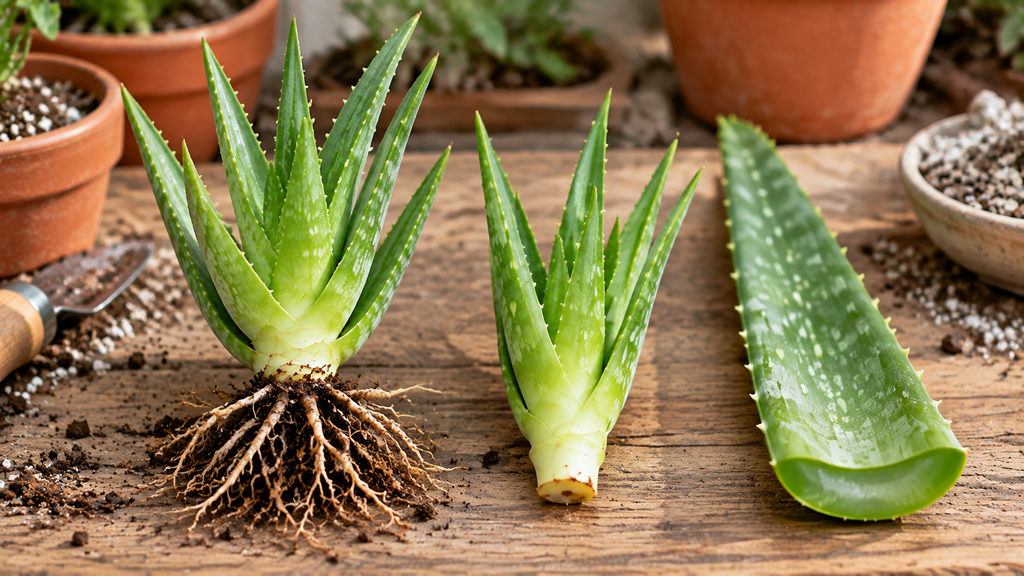
Identifying the plant part should come before choosing a propagation method.
A healthy aloe pup is essentially a miniature plant. A detached leaf is mostly water-storing tissue. Rhizomes are underground vegetative stems, while some branching aloe species produce stems that can genuinely be used as cuttings.
Use this quick guide:
| Plant material | Best decision |
| Rooted aloe pup | Separate and pot |
| Rootless aloe pup | Allow wounds to heal and reroot |
| Detached Aloe vera leaf | Do not rely on it for propagation |
| Healthy crown or base | Possible salvage and rerooting |
| Rhizome material | Specialized vegetative propagation |
| Branching aloe stem | Species-specific propagation |
| Flower stalk | Seed pathway, not a normal cutting |
| Viable seed | Seed propagation |
The most important distinction is whether the plant material contains a healthy growing point or suitable vegetative stem tissue.
If you have a complete pup, propagation is usually straightforward. If you only have a detached Aloe vera leaf, the outcome is far less predictable.
What Is the Best Way to Propagate Aloe?
Separating pups or offsets is the best propagation method for most Aloe vera plants.
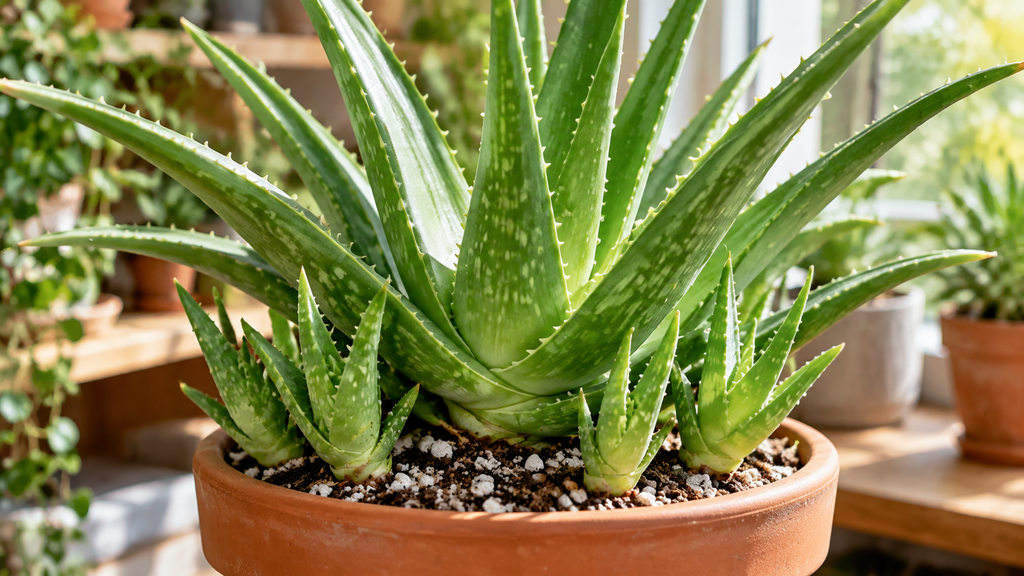
Mature aloe plants commonly produce small rosettes around their base. These offsets gradually develop leaves, a central growing point, and their own roots while still attached to the mother plant.
That gives pups a major advantage over leaves. You are not asking an isolated piece of tissue to create an entire new plant. You are separating a young plant that is already structurally complete.
For home propagation, use this order of preference:
- Rooted pup: easiest and most dependable.
- Healthy rootless pup: good candidate for rerooting.
- Rooted division from a crowded clump: reliable.
- Healthy crown or basal material: possible salvage.
- Rhizome material: documented but rarely necessary at home.
- Branching stem: useful for suitable aloe species.
- Detached Aloe vera leaf: unreliable.
- Flower stalk: not a vegetative propagation method.
If your Aloe vera already produces pups, there is little reason to remove healthy leaves simply to experiment with propagation.
When Should You Propagate Aloe?
Propagate aloe when the plant is actively growing and conditions provide enough warmth and light for root recovery.
Spring and early summer are convenient in many temperate climates, but plant condition matters more than a specific month. An Aloe vera growing indoors in consistently warm, bright conditions may remain active outside the traditional spring growing period.
Good propagation conditions include:
- a healthy mother plant;
- a mature pup;
- adequate warmth;
- strong usable light;
- a free-draining growing medium;
- no serious active disease.
Delay optional propagation if the aloe is severely stressed, cold, badly dehydrated, sunburned, or waterlogged.
The exception is emergency propagation. If rot is spreading through the root system or base, saving healthy pups or crown tissue may be more important than waiting for ideal seasonal conditions.
For international growers, think in terms of active growth rather than calendar dates.
When Is an Aloe Pup Ready?
An aloe pup is ready to separate when it looks like a small independent plant rather than a newly emerging shoot.
A good candidate usually has several developed leaves, a recognizable rosette, a healthy central growing point, and preferably some roots of its own.
Separate the pup when:
- several firm leaves are present;
- the rosette is clearly formed;
- the base feels healthy and firm;
- roots have started developing;
- the plant is large enough to handle safely.
Leave it attached longer when:
- it has only one or two tiny leaves;
- the base is barely developed;
- there are no visible signs of independent growth;
- removing it would badly damage the parent;
- the mother plant is already stressed.
There is rarely an advantage in removing a very young offset early. A better-developed pup has more stored resources and normally establishes more easily.
How to Propagate Aloe Pups
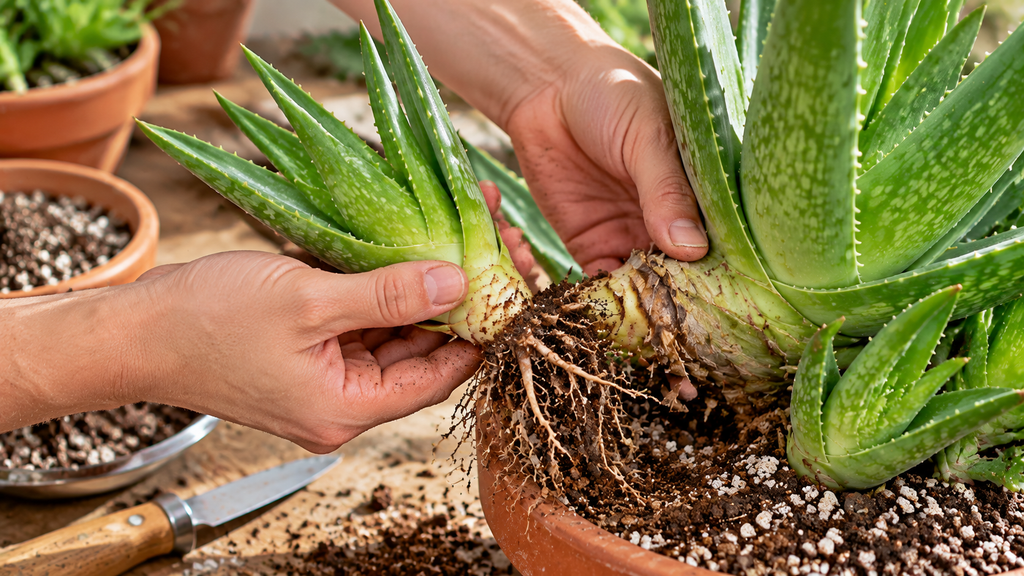
Start when the potting mix is reasonably dry rather than saturated.
Step 1: Remove the Mother Plant
Support the aloe around its base and gently slide the root ball from the pot. Avoid pulling the plant upward by individual leaves.
Step 2: Expose the Pup
Loosen enough soil to see where the pup connects to the mother plant. You do not need to strip every root completely clean.
Step 3: Inspect the Roots
Look for healthy roots belonging to the pup. Keep as many intact as possible.
Firm roots are useful. Black, mushy, or foul-smelling roots may indicate rot.
Step 4: Separate the Pup
If the pup releases easily, separate it gently by hand.
If the connection is strong, use a clean, sharp knife rather than repeatedly twisting or tearing the tissue.
Step 5: Check the Wound
A naturally separated pup with roots may have very little damage.
If cutting created a large fresh wound, leave the pup in a dry, shaded, ventilated location until the exposed tissue has dried and sealed.
Step 6: Prepare the Pot
Use a small container with at least one working drainage hole.
Fill it with a porous cactus or succulent mix.
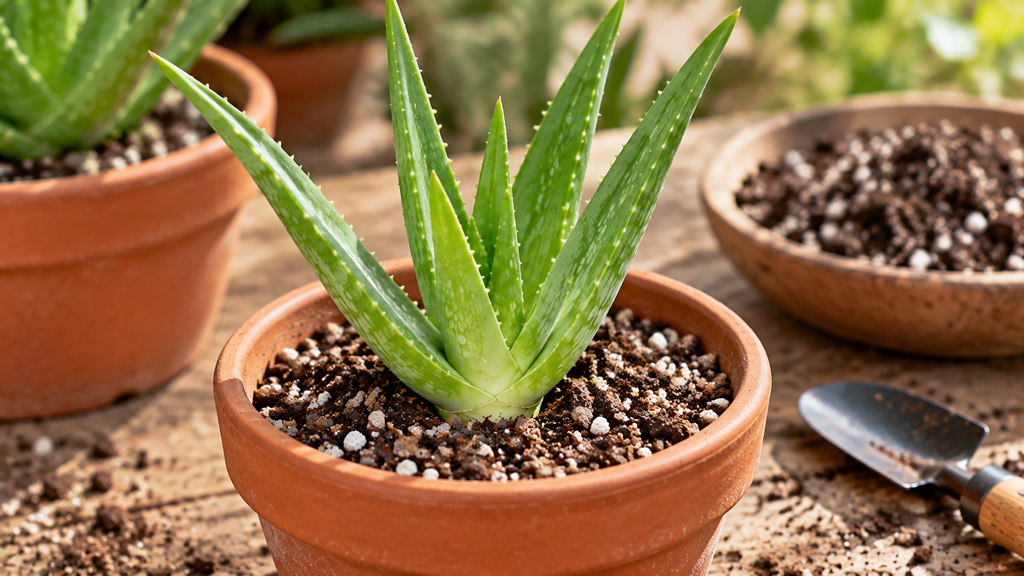
Step 7: Plant at the Correct Depth
Spread the roots naturally beneath the soil and keep the crown and fleshy leaf bases above the surface.
Do not bury the plant deeply just because it feels unstable.
Step 8: Stabilize the Pup
If necessary, use small stones around the base to hold the plant upright until roots anchor it.
Step 9: Place It in Bright Conditions
Give the newly propagated aloe bright light and warmth, but avoid suddenly moving a heavily disturbed plant into extreme midday sun.
Should You Water Aloe After Propagation?
Watering should depend on the condition of the roots and wound, not on a fixed schedule.
A rooted pup with little damage behaves much like a small repotted plant. A rootless pup with a fresh cut needs more caution.
| Root condition | Wound condition | Best action |
| Healthy roots | Minimal wound | Pot normally; light settling water may be appropriate |
| Healthy roots | Large fresh cut | Let the wound seal first |
| Few roots | Healed base | Water conservatively |
| No roots | Healthy sealed base | Begin rerooting |
| No roots | Fresh wound | Allow it to callus first |
| Any | Rot present | Remove decay before normal propagation |
Avoid rules such as “always water immediately” or “never water for seven days.”
Read the plant first.
A rooted aloe can absorb moisture. A rootless aloe cannot use water efficiently yet, and continuously wet tissue is more vulnerable to decay.
How to Propagate Aloe Without Roots
A healthy rootless aloe pup can often establish successfully if the central growing point and basal tissue remain intact.
First make sure the plant is a complete pup rather than a detached leaf.
Inspect the base carefully. Firm tissue is a good sign. If the base is freshly cut, allow the wound to dry and seal before planting.
If any area is dark, translucent, soft, or foul-smelling, remove the damaged tissue with a clean blade.
Place the healed base shallowly into a small pot of porous succulent mix. Keep the crown above the soil surface.
Use stones for support if necessary rather than planting the aloe too deeply.
Do not keep adding water because the plant has no roots. A rootless aloe initially relies partly on moisture stored in its leaves while producing a new root system.
Also avoid repeatedly pulling the plant from the pot to check for roots. Newly developing roots are fragile and can easily be damaged.
What Does an Aloe Cutting Mean?
“Aloe cutting” is an imprecise term because several different plant parts may be described as cuttings.
Aloe Vera Leaf
This is the fleshy leaf blade. It is not the propagation material home growers should depend on.
Aloe Pup or Sucker
This is a complete young plant growing beside the mother plant. It is the preferred practical propagation material.
Aloe Rhizome
A rhizome is vegetative underground stem tissue. It can be used for propagation, but this is generally unnecessary for home growers when pups are available.
Crown or Basal Material
A healthy upper rosette with viable basal tissue may sometimes be rerooted after root loss or damage.
This is more of a salvage method than a routine propagation technique.
Branching Aloe Stem
Some aloe species naturally produce stems and branches that can be rooted. This is species specific and should not be confused with planting a detached Aloe vera leaf.
Understanding these differences resolves much of the conflicting advice about how to propagate aloe from cuttings.
Can You Propagate Aloe From a Leaf?
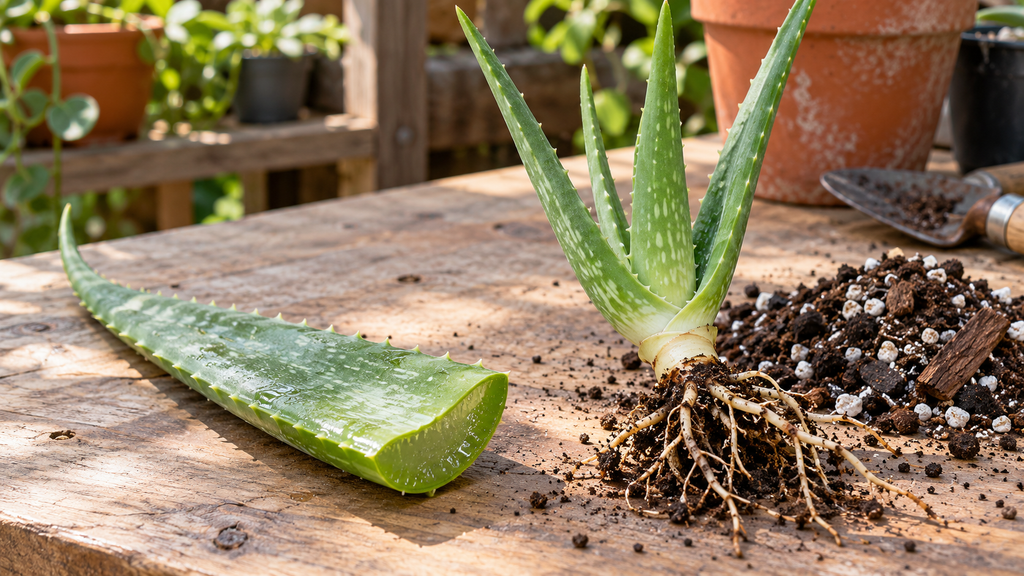
A detached Aloe vera leaf is not a reliable method for producing another complete plant.
This is important because many other succulents can be propagated easily from individual leaves. Aloe should not automatically be grouped with them.
A detached aloe leaf may remain alive for a long time because it stores moisture. In some situations it may even produce roots, but root production does not necessarily mean a new complete rosette will form.
If a leaf breaks accidentally:
- keep the wound on the mother plant clean;
- avoid leaving the damaged area constantly wet;
- do not remove additional leaves for propagation experiments;
- use a pup when one becomes available.
The practical distinction is simple: a pup is already a young plant, while a leaf is not.
Can You Propagate Aloe in Water?
Water propagation is not the preferred method for Aloe vera.
Mainstream horticultural guidance favors offsets or divisions established in suitable free-draining growing media.
Placing a cut leaf into water does not make it behave like a pothos or philodendron cutting. Aloe leaves already store substantial moisture, and keeping damaged succulent tissue continuously wet can increase the risk of breakdown and rot.
A complete rootless pup is more promising than a detached leaf, but even then there is little reason to make water propagation the default approach.
For predictable results, use:
healthy pup + small draining pot + porous succulent mix.
Treat water-rooting demonstrations as experiments rather than the standard way to propagate Aloe vera.
Can You Propagate Tree Aloe From Cuttings?
Some branching and shrub-like aloes can genuinely be propagated from stem or branch cuttings.
This is one reason blanket statements such as “aloe cannot grow from cuttings” are inaccurate.
Aloe arborescens, for example, forms branching stems and can be propagated from healthy stem material after the cut surface has dried and sealed.
Before taking a stem cutting:
- Identify the aloe species.
- Confirm that stem propagation is appropriate.
- Choose healthy, firm material.
- Make a clean cut.
- Let the wound heal.
- Use highly free-draining rooting conditions.
- Avoid excessive watering before roots form.
Do not automatically apply this technique to Aloe vera.
Plant architecture matters.
A naturally branching stem is structurally different from one detached fleshy leaf.
Can You Propagate Aloe From a Flower Stalk?
The flower stalk is not a normal vegetative cutting.
Flowers belong to the aloe’s sexual reproduction pathway. If pollination succeeds, seed-containing fruits may develop.
The difference is:
- Pup → vegetative clone.
- Suitable vegetative stem material → vegetative propagation.
- Pollinated flower → seed.
- Cut flower stalk → not the normal route to another aloe.
Seed propagation is possible, but it is slower and produces genetically variable seedlings rather than straightforward clones of the mother plant.
For most home growers, pups are much easier.
What Soil and Pot Are Best?
Use a porous cactus or succulent mix in a pot with a functional drainage hole.
The growing medium should:
- drain freely;
- maintain air around roots;
- resist heavy compaction;
- hold enough moisture for developing roots;
- dry appropriately between waterings.
Commercial succulent mix is a useful starting point. If it stays wet too long in your conditions, additional pumice, perlite, or horticultural grit can improve aeration.
Choose a pot only slightly larger than the pup’s current root system.
An oversized pot creates a large volume of wet substrate around a small plant and can make moisture control more difficult.
Pot material matters less than drainage and watering habits.
Terracotta may dry faster than glazed ceramic or plastic, but growing conditions vary.
The most useful rule is:
Choose the pot for the roots the aloe has now, not the size it may reach later.
How to Care for Aloe After Propagation
Newly propagated aloe needs a short establishment period before returning to normal care.
Immediately After Separation
Check whether the plant has roots and whether a significant wound is present.
Keep the aloe warm and bright without abruptly moving a stressed plant into extremely intense sunlight.
While Roots Establish
Watch the base.
It should remain firm.
A rootless pup may temporarily lose some leaf plumpness because it is relying on stored moisture.
Do not repeatedly water, fertilize, or disturb it in an attempt to force faster root growth.
Once New Growth Appears
When the aloe becomes more stable and begins producing healthy central growth, gradually transition it toward normal Aloe vera care.
Increase stronger light gradually if necessary.
Water thoroughly when appropriate, then allow the medium to dry rather than keeping it constantly damp.
Rooting hormone is usually unnecessary for ordinary aloe pups. Healthy plant material, good drainage, appropriate light, and moisture management are more important.
How Long Does Aloe Take to Root?
Aloe generally establishes over several weeks rather than several days.
Around a month can be a useful reference for a separated offset under favorable conditions, but rooting speed varies.
A pup that retains several roots may stabilize faster because it is extending an existing root system.
A completely rootless pup needs time to:
- heal;
- initiate new roots;
- extend those roots;
- anchor into the potting mix;
- resume stronger top growth.
Cool conditions, poor light, serious tissue damage, or excessive moisture can slow the process.
Do not assume propagation has failed simply because the aloe has not produced new leaves after a week or two.
How Do You Know Aloe Has Rooted?
Look for several signs together.
Positive signs include:
- increasing stability in the pot;
- a firm healthy base;
- a healthy central growing point;
- reduced progressive shriveling;
- new growth from the center;
- normal growth gradually resuming.
Avoid repeatedly removing the plant from the soil to look for roots.
A newly rooted aloe may have very fine roots that are easily damaged.
The plant becoming more anchored over time is one of the safest indicators that establishment is progressing.
Why Does Aloe Propagation Fail?
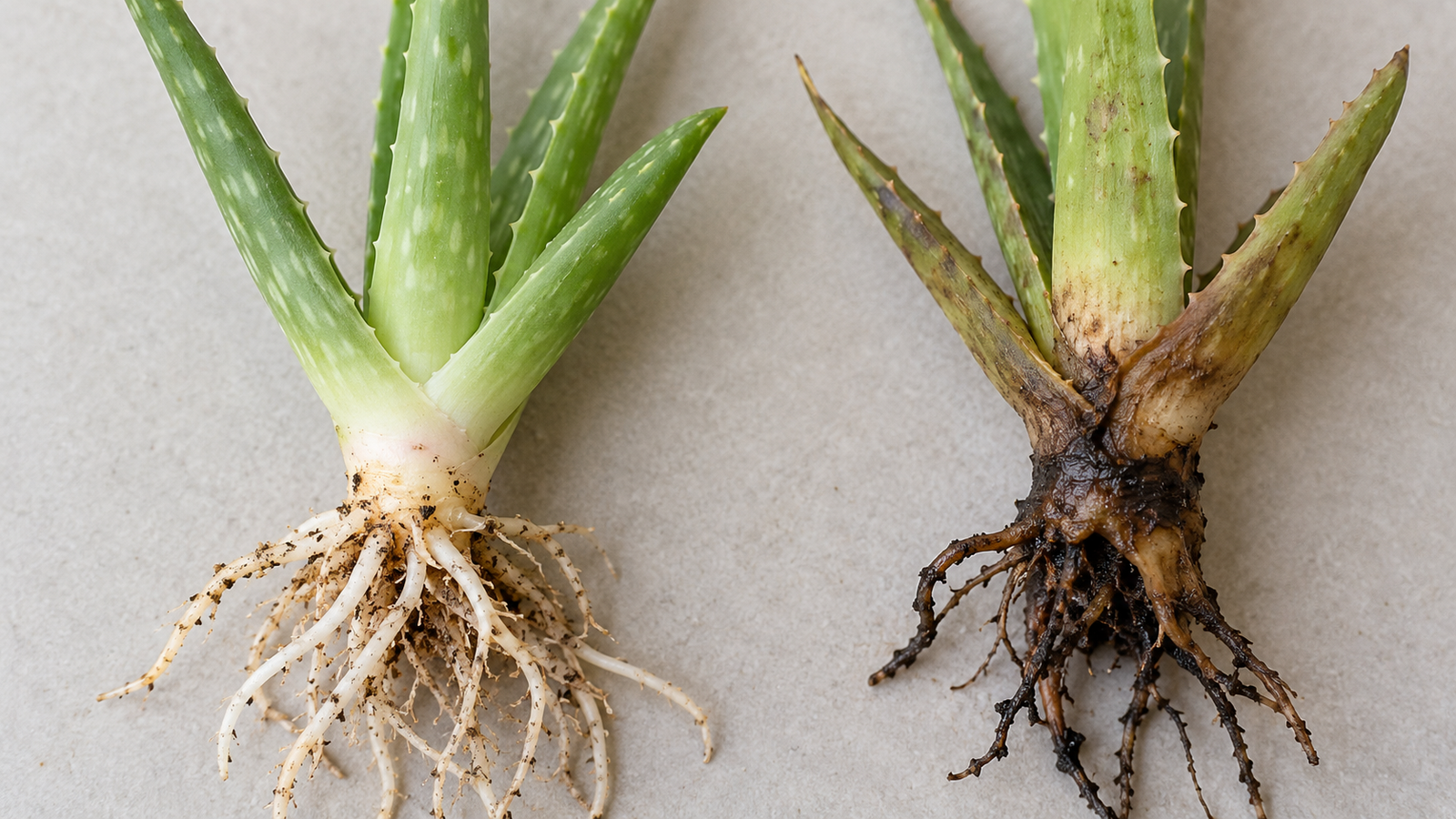
Most aloe propagation problems can be traced to one of four causes:
wrong plant material, poor wound management, excessive moisture, or unsuitable establishment conditions.
Use the symptoms rather than guessing.
| Symptom | Likely issue | Best response |
| Mild shriveling with firm base | Root-establishment stress | Monitor |
| Plant still wobbles | Roots not anchored yet | Leave undisturbed |
| New central growth | Establishment progressing | Continue care |
| Mushy base | Possible rot | Inspect immediately |
| Black soft roots | Root rot | Remove damaged tissue |
| Bleached patches | Sudden intense light | Acclimate gradually |
| Firm plant with no growth yet | Slow rooting | Give more time |
| Collapsed crown | Severe tissue failure | Salvage healthy material if possible |
The most important distinction is shriveling versus rot.
A slightly shriveled but firm aloe may simply be using stored moisture while roots develop.
A soft, translucent, dark, or foul-smelling base indicates tissue breakdown.
Do not respond to both situations by adding more water.
How to Care for the Mother Aloe
The mother plant also experiences disturbance when pups are removed.
While it is out of the pot:
- inspect the remaining roots;
- remove clearly dead or rotten tissue;
- replace compacted or waterlogged soil if necessary;
- confirm that the pot drains properly;
- keep major fresh wounds from remaining saturated.
Return the mother aloe to suitable light and normal care gradually.
Do not automatically increase water or fertilizer because offsets were removed.
Its roots also need time to recover.
A healthy mother plant can continue growing normally and may eventually produce additional pups.
How Climate Affects Aloe Propagation
A global guide should not assume every grower has the same seasons or humidity.
Adjust the method to your conditions.
| Growing conditions | Adjustment |
| Warm and bright | Propagate when the pup is mature |
| Cool and dim | Delay optional propagation |
| Hot and intense sun | Protect newly disturbed plants at first |
| Humid | Prioritize airflow and drainage |
| Very dry | Monitor small pots for faster drying |
| Frost-prone | Establish pups under protection |
| Heavy wet season | Keep moisture controllable |
| Active rot | Rescue healthy tissue regardless of season |
The goal everywhere is the same: enough warmth and light to support growth without leaving wounded or weak tissue continuously wet.
FAQs About How to Propagate Aloe
What Is the Easiest Way to Propagate Aloe Vera?
Separate a healthy pup with roots and pot it in fast-draining succulent soil. This is the simplest and most dependable method for most home growers.
How Big Should an Aloe Pup Be?
Choose a well-developed pup with several leaves and preferably roots. Plant development matters more than an exact height.
Do Aloe Pups Need Roots?
Not absolutely, but rooted pups establish more easily. A healthy rootless pup can still produce roots if its base and growing point remain intact.
Can You Propagate Aloe From One Leaf?
A detached Aloe vera leaf is not a dependable propagation method. Use a healthy pup or offset whenever possible.
Can You Root Aloe in Water?
Water propagation is not the preferred method for Aloe vera. A healthy pup planted in porous succulent mix is more dependable.
How Do You Propagate Aloe Without Roots?
Allow fresh wounds on a complete rootless pup to heal, then place the healthy base shallowly into free-draining soil and keep the crown above the surface.
Should Aloe Pups Callus Before Planting?
Allow a pup to callus if separation creates a significant fresh wound. A minimally damaged rooted pup does not require the same treatment.
Should You Water Aloe After Propagation?
It depends on roots and wound condition. A rooted, minimally damaged pup can be watered lightly, while a freshly cut rootless pup should heal first.
How Long Does Aloe Take to Root?
Expect several weeks. Rooted pups may establish faster, while completely rootless pups can take longer.
How Do You Know Aloe Has Rooted?
The plant becomes more firmly anchored and eventually produces healthy central growth. Avoid repeatedly unpotting it to check.
Can Tree Aloe Grow From Cuttings?
Some branching aloes can be propagated from healthy stems. Confirm the species first and allow the cut surface to heal before planting.
Can Aloe Grow From a Flower Stalk?
The flower stalk itself is not a normal vegetative cutting. Pollinated flowers may instead produce seeds for seed propagation.
A healthy rooted pup remains the best choice when deciding how to propagate aloe. Identify the plant part first, preserve existing roots, manage fresh wounds carefully, use a fast-draining medium, and avoid excessive watering or disturbance while the plant establishes.
When you are dealing with a rootless pup, branching stem, rhizome, or seed instead, adjust the method to the plant structure you actually have rather than applying one generic “aloe cutting” technique to every situation.

Myra is the founder and lead writer of Plantsaholic. She shares practical, research-backed advice on indoor plants, outdoor gardening, flowers, herbs, succulents, and everyday plant care. Her goal is to help gardeners of all experience levels grow healthier plants through simple, easy-to-follow gardening guides.