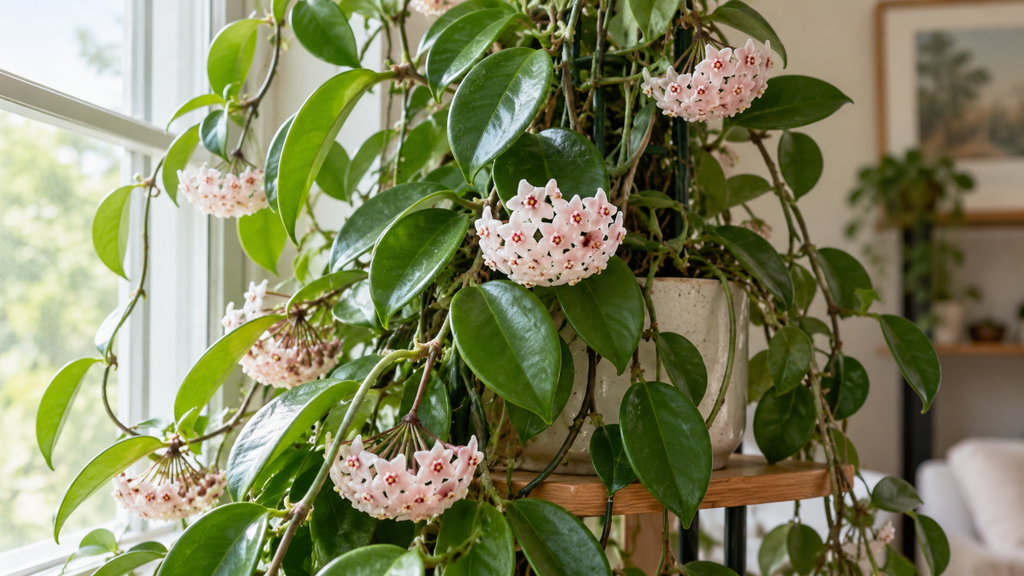
Hoya carnosa, commonly called the wax plant or porcelain flower, is a long-lived climbing or trailing houseplant known for its thick glossy leaves, fragrant star-shaped flowers, and ability to adapt well to indoor conditions.
Although Hoya carnosa is considered relatively easy to grow, it performs best when its natural habits are understood. The plant prefers bright indirect light, an airy fast-draining potting mix, careful watering, warm temperatures, moderate humidity, and stable conditions.
Many Hoya problems happen because the plant is treated like a typical tropical houseplant. Unlike plants that need constantly moist soil, Hoya carnosa stores water in its thick leaves and prefers a balance between moisture and airflow around its roots.
The goal is not constant moisture. The ideal care cycle is:
Bright light → thorough watering → drainage → drying → watering again
Good Hoya care is less about following a strict schedule and more about observing what the plant needs.
What Is Hoya Carnosa?
Hoya carnosa is an evergreen climbing species in the genus Hoya and family Apocynaceae. In its natural environment, it grows as a climbing epiphyte or lithophyte, meaning its roots often experience airflow rather than sitting in dense, permanently wet soil.
This explains why indoor Hoya carnosa usually grows better in loose, oxygen-rich mixes instead of heavy garden soil.
Important characteristics include:
- Thick semi-succulent leaves that store moisture
- Long vines that naturally climb or trail
- Persistent flower peduncles that can produce flowers repeatedly
- Roots that need both moisture and oxygen
- A preference for warm growing conditions
Understanding these traits makes care much easier. Instead of reacting to every symptom, use the plant’s growth pattern and environment to identify what has changed.
How to Care for Hoya Carnosa
Successful Hoya carnosa care depends on balancing several factors:
- Bright indirect light
- A chunky, well-aerated potting mix
- Thorough watering followed by drying
- Good drainage
- Warm temperatures
- Moderate humidity
- Light feeding during active growth
- Proper support for vines
- Preservation of flower peduncles
Avoid changing care before identifying the actual problem.
For example:
- Wrinkled leaves do not always mean the plant needs water.
- Yellow leaves do not always mean fertilizer is needed.
- Long bare vines are not always dead.
Always check moisture, roots, light, and recent changes before taking action.
How Much Light Does Hoya Carnosa Need?
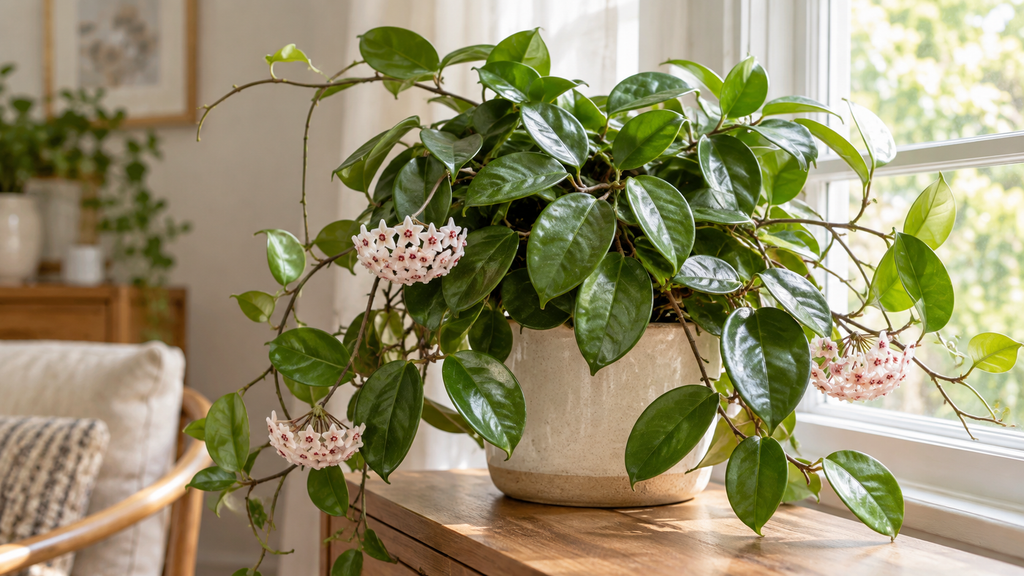
Hoya carnosa grows best in bright indirect light. Gentle morning or late-afternoon sunlight can improve growth and flowering, but sudden exposure to strong direct sun can scorch leaves.
An east-facing window is often ideal because it provides bright light with softer morning sun. South- and west-facing windows can also work, but stronger light should be introduced gradually.
Signs your Hoya may need more light include:
- Long spaces between leaves
- Thin weak vines
- Growth leaning strongly toward a window
- Slow growth during active periods
- Reduced variegation in variegated varieties
- A mature plant that does not flower
Signs of excessive light include:
- Bleached leaves
- Pale patches
- Dry scorched areas after moving into stronger sunlight
A room can appear bright to people while still providing insufficient light for plants. Light intensity decreases quickly as a plant is moved farther from a window.
If a mature Hoya produces healthy leaves but does not bloom, evaluate light before increasing fertilizer.
Grow lights can also help when natural light is limited. Judge success by the plant’s response: stretched growth suggests insufficient light, while bleaching suggests excessive intensity.
How to Water Hoya Carnosa
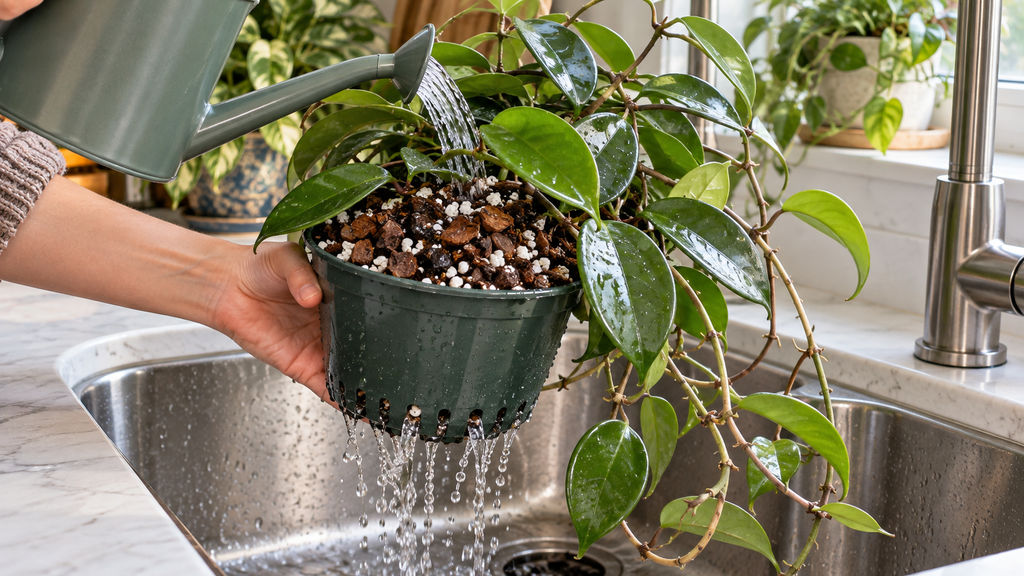
Water Hoya carnosa thoroughly after most of the growing medium has dried, then allow excess water to drain completely.
Avoid watering on a fixed schedule because drying speed changes depending on:
- Temperature
- Season
- Light levels
- Pot size
- Root growth
- Soil composition
Instead of asking:
“Has it been a week?”
ask:
“Has the root zone dried enough?”
A useful method is lifting the pot after watering and noticing its weight. After several days, a lighter container usually indicates that moisture has been used or evaporated.
The goal is:
Deep watering + good drainage + substantial drying + timely rewatering
How Often Should You Water Hoya Carnosa?
There is no universal watering interval.
A Hoya growing in warm bright conditions may dry quickly, while the same plant in cooler or darker conditions may remain moist much longer.
Before watering, check:
- Is the pot lightweight?
- Is the mix mostly dry?
- Are the leaves firm or soft?
- Has growth slowed?
A dry root zone with wrinkled leaves usually indicates the plant needs water.
A wet heavy pot with wrinkled leaves suggests a different issue, such as root damage preventing proper water absorption.
Is My Hoya Carnosa Too Wet or Too Dry?
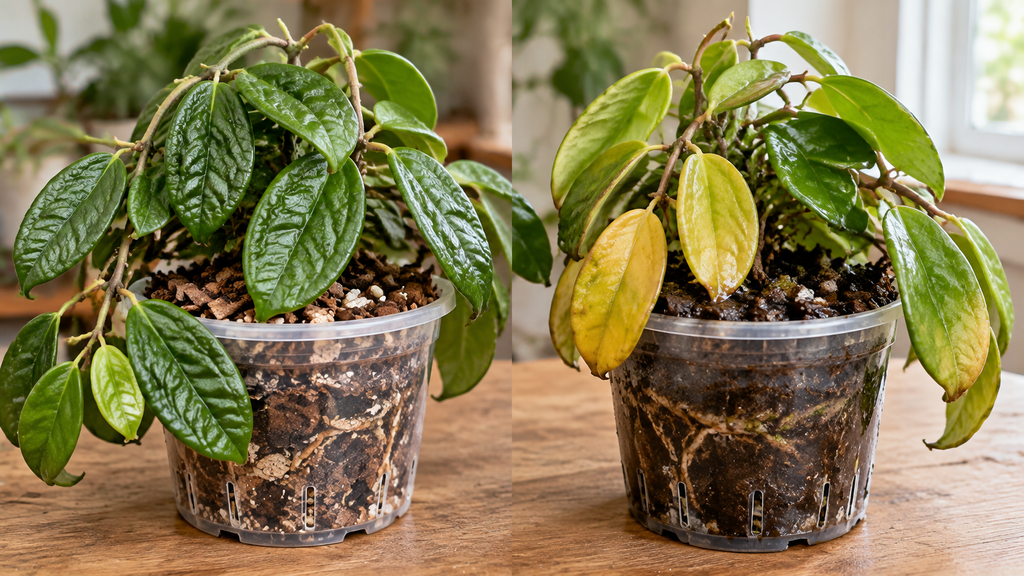
Use both the foliage and the root zone to diagnose problems.
Wrinkled leaves + dry soil
Likely cause:
- Water shortage
Action:
- Water thoroughly
- Allow excess water to drain
Wrinkled leaves + wet soil
Possible cause:
- Root stress or poor root function
Action:
- Check drainage
- Inspect roots if needed
Yellow soft leaves + wet soil
Possible cause:
- Overwatering or root problems
Action:
- Improve drainage and review watering habits
Firm leaves + mostly dry mix
Usually:
- No urgent problem
Continue monitoring.
Very slow drying
Possible causes:
- Dense soil
- Oversized pot
- Low light
- Slow growth
Very fast drying
Possible causes:
- Small root system
- Root-filled pot
- Very coarse mix
- Strong light and warmth
This distinction matters because damaged roots can make a plant appear thirsty even when the soil is still wet.
What Soil Is Best for Hoya Carnosa?
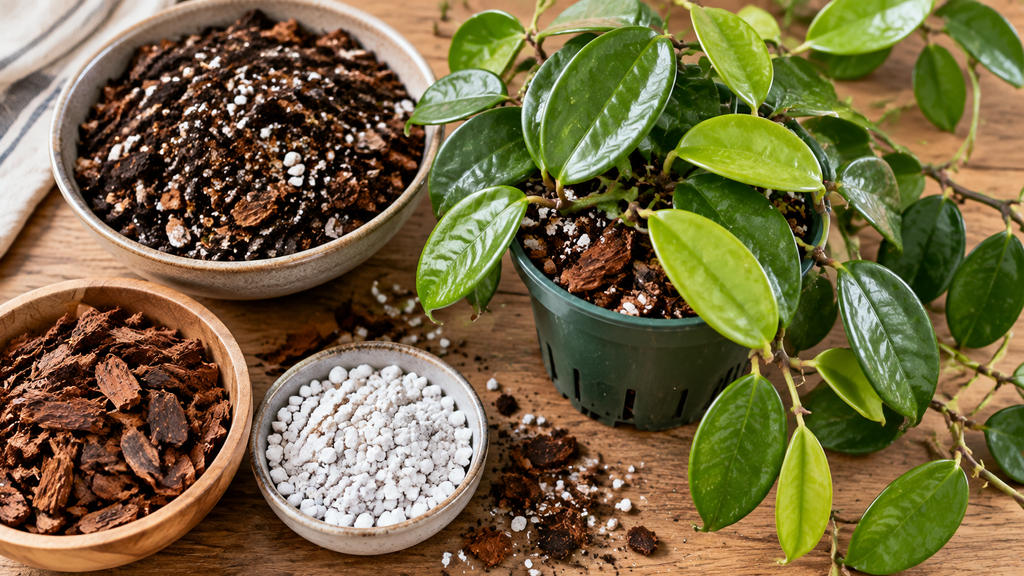
The best soil for Hoya carnosa is loose, chunky, and well aerated. The mix should retain enough moisture for the plant to absorb water while allowing excess moisture to escape and oxygen to reach the roots.
A practical starting mix is:
- 1 part indoor potting mix
- 1 part orchid bark
- 1 part perlite
Each ingredient has a role:
- Potting mix provides moisture retention and nutrients.
- Orchid bark creates air pockets and improves structure.
- Perlite improves drainage and prevents compaction.
Regular houseplant soil can work in some conditions, but dense mixes often stay wet too long. Instead of judging soil by its label, observe how it behaves after watering.
If the mix stays wet for many days, possible causes include:
- Dense soil
- A pot that is too large
- Low light
- Slow growth conditions
If the mix dries extremely quickly, possible causes include:
- A root-filled pot
- An overly coarse mix
- Strong light and warm temperatures increasing water use
Always use a pot with drainage holes. Terracotta usually dries faster, while plastic and glazed ceramic retain moisture longer. Neither material is automatically better; choose based on your environment and watering habits.
Avoid moving a small Hoya into an oversized container. Excess unused soil can remain wet around a small root system and increase the risk of root problems.
Hoya Carnosa Humidity and Temperature
Hoya carnosa grows well in warm indoor conditions with moderate humidity.
A practical range is:
- Humidity: around 40–60%
- Temperature: about 65–80°F (18–27°C)
The plant does not usually need greenhouse-level humidity. Many homes already provide suitable conditions.
If a Hoya develops:
- Yellow leaves
- Slow growth
- Wrinkled foliage
Check these factors first:
- Root health
- Watering habits
- Light levels
- Temperature changes
Humidity is rarely the first problem unless the air is extremely dry.
A humidifier can help in very dry heated or air-conditioned rooms, but frequent misting is unnecessary. Misting only provides temporary surface moisture and does not replace correct watering.
Temperature affects how quickly soil dries. Warm plants in bright light usually use water faster, while cool plants in lower light remain wet longer.
During slower growth periods:
- Water less often
- Reduce or pause fertilizer
- Avoid unnecessary repotting
- Protect from cold drafts
- Continue providing suitable light
Focus on whether the plant is actively growing rather than following a strict seasonal calendar.
Hoya Carnosa Indoor Care
Indoor Hoya carnosa care becomes easier when the plant has a stable location with enough light and space for its vines.
A bright east-facing window often provides excellent conditions. South- and west-facing windows can also work, but stronger sunlight may require gradual adjustment.
Useful indoor placements include:
East Window
- Bright light
- Gentle morning sun
- Lower risk of scorching
South or West Window
- Stronger light
- Good flowering potential
- Monitor for leaf damage
High Shelves
- Suitable for trailing vines
- Only if enough light reaches the foliage
Low-Light Rooms
- May require a grow light
Avoid placing Hoya carnosa directly beside:
- Heating vents
- Air conditioners
- Cold drafts
Once flower buds appear, stability becomes especially important. Sudden changes in light, moisture, or temperature can contribute to bud drop.
During slower growth periods, allow the soil to dry more before watering again rather than giving frequent small amounts.
Hoya Carnosa Outdoor Care
Hoya carnosa can enjoy outdoor conditions during warm weather if it is introduced gradually.
Do not move an indoor Hoya directly into full outdoor sun. Outdoor light is much stronger than filtered indoor light and can quickly damage leaves.
A safer transition:
- Start in bright shade.
- Introduce gentle morning sunlight gradually.
- Monitor watering because wind and warmth increase drying.
- Check the pot after heavy rain.
- Protect from strong wind.
- Bring indoors before cold temperatures arrive.
Before bringing the plant inside, inspect:
- Stems
- Leaf undersides
- Nodes
- Potting mix
This helps prevent bringing pests indoors.
Hoya carnosa can remain outdoors year-round only in reliably warm, frost-free climates. In cooler regions, treat it as a houseplant that can spend warm seasons outside.
Should Hoya Carnosa Climb or Hang?
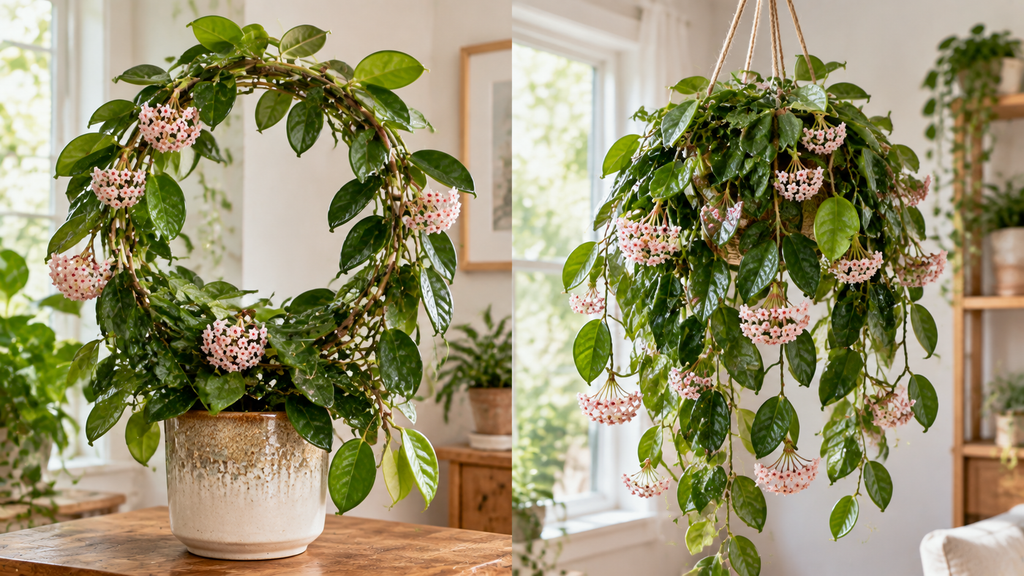
Hoya carnosa naturally produces climbing vines, but it can also grow successfully as a trailing plant.
The best choice depends on your space and growing style.
Choose climbing when:
- Vines need organization
- Vertical space is available
- You want a compact display
- Stems naturally grow upward
A hoop, trellis, or stake can help guide vines. Support young flexible stems gently and avoid forcing sharp bends.
Choose trailing when:
- You prefer cascading growth
- A hanging position receives enough light
- Long vines have room to extend
- The plant remains easy to access
Do not remove long leafless vines automatically. A green, firm vine may simply be exploratory growth searching for support and may produce leaves later.
Climbing is not required for flowering. A trailing Hoya with enough light, healthy roots, and mature growth can bloom successfully.
How to Fertilize Hoya Carnosa
Fertilize Hoya carnosa lightly during active growth. Fertilizer should support a healthy plant, not compensate for poor light, weak roots, or incorrect watering.
A diluted general-purpose houseplant fertilizer is usually enough.
Use this approach:
Healthy plant + active growth
→ Light feeding is appropriate.
Growth has slowed
→ Reduce or pause fertilizer.
Roots are unhealthy
→ Fix root problems before feeding.
Healthy plant but no flowers
→ Check light and maturity first.
Avoid assuming bloom fertilizer is necessary. A plant growing in insufficient light is unlikely to flower simply because it receives more phosphorus.
Excess fertilizer can also cause salt buildup around roots, especially when feeding is too strong or too frequent.
The best rule:
Environment first, fertilizer second.
How to Get Hoya Carnosa to Bloom
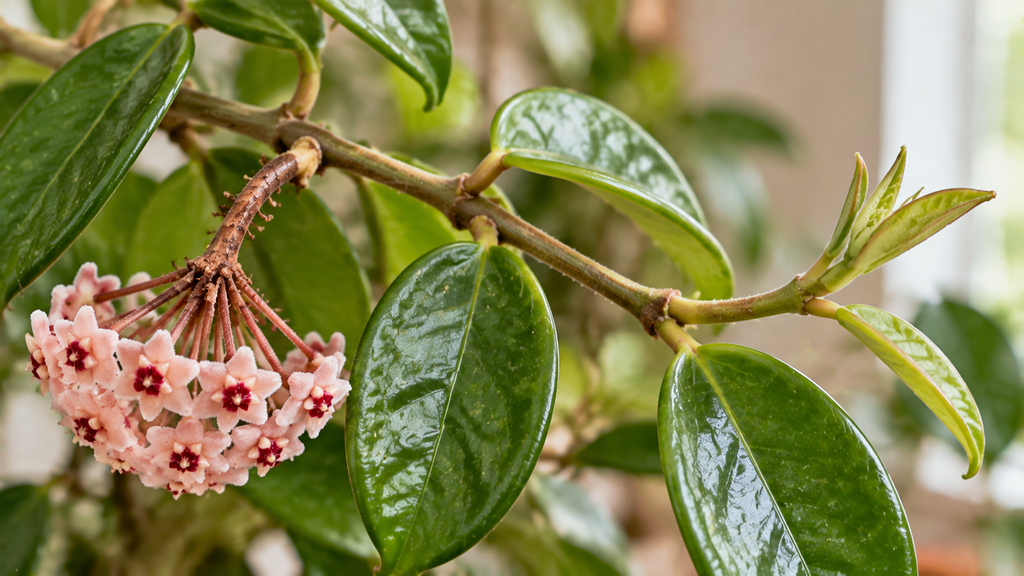
Hoya carnosa flowers most reliably when it is mature, receives strong light, has healthy roots, and remains under stable conditions.
Young plants may simply need time. A mature plant with healthy vines but no flowers usually needs its environment reviewed.
Check flowering problems in this order:
1. Maturity
Young Hoyas may require years before flowering.
2. Light
A plant can survive in moderate light but still lack enough energy to bloom.
3. Root Health
Plants struggling with damaged or waterlogged roots should recover before flowering is expected.
4. Flower Peduncles
Hoya flowers develop from persistent structures called peduncles or flower spurs.
Never remove healthy peduncles after flowering. New flower clusters can develop from the same structures later.
5. Stability
Avoid major changes once buds appear.
Do not suddenly:
- Move the plant
- Change watering habits
- Repot unnecessarily
- Alter temperatures
6. Nutrition
Light feeding during active growth is enough. Heavy fertilization does not replace good light.
The key flowering rule:
Remove faded flowers, but preserve healthy peduncles.
How to Prune Hoya Carnosa
Prune Hoya carnosa lightly to control size, remove damaged growth, or improve shape.
Before cutting, identify what you are removing.
A vine may be:
- Healthy growing stem
- Exploratory leafless vine
- Flower peduncle
- Dead stem
A healthy exploratory vine is usually:
- Green
- Flexible
- Firm
- Actively extending
A dead stem is:
- Brown
- Dry
- Brittle
- No longer growing
Pruning may encourage branching, but propagating healthy cuttings and returning them to the pot can also create a fuller plant.
Simple pruning rule:
- Healthy and manageable → leave it
- Healthy but too large → prune lightly
- Dead or damaged → remove
- Flower peduncle → preserve
Wear gloves if your skin is sensitive because Hoya sap may cause irritation.
How to Propagate Hoya Carnosa
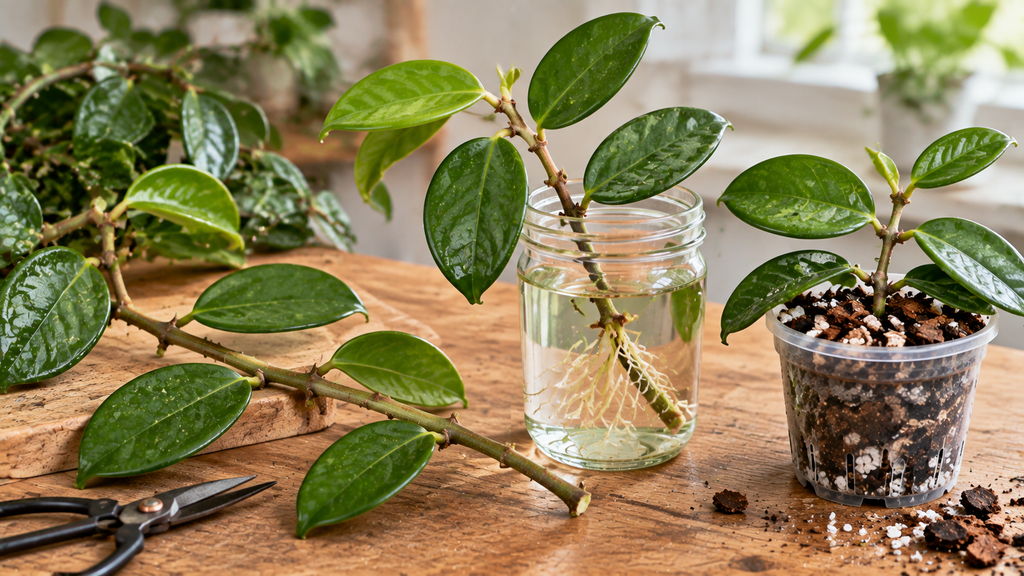
Stem cuttings are the most reliable way to propagate Hoya carnosa.
A successful cutting should contain a healthy vine section with at least one viable node.
Basic method:
- Select a healthy pest-free vine.
- Cut a section containing a node.
- Remove leaves below the rooting area.
- Place the cutting in water or an airy propagation medium.
- Keep it warm with bright indirect light.
- Keep the medium lightly moist, not saturated.
- Transfer to an airy Hoya mix after roots develop.
The node is essential because it contains the growth tissue needed to produce a new vine.
A detached leaf may produce roots, but a leaf without a viable node often will not create a complete new plant.
For reliable propagation:
Use a stem cutting with a node, not only a leaf.
When to Repot Hoya Carnosa
Repot Hoya carnosa only when the plant genuinely needs it. Avoid repotting simply because a certain amount of time has passed.
Useful signs that repotting may be needed:
- Roots filling the container
- Very little potting mix remaining
- Water draining unusually fast
- Old soil becoming compacted
- Poor drainage
- An unstable container
Hoya carnosa often grows well when slightly root-bound, but severely restricted roots can eventually affect growth.
The goal is:
Slightly snug, not severely constricted.
When repotting:
- Choose a pot only slightly larger
- Use a fresh airy mix
- Keep drainage holes clear
- Avoid burying the stem too deeply
A very large pot can create problems because excess soil stays wet longer around a smaller root system.
Avoid repotting when:
- Flower buds are forming
- The plant is actively flowering
- The plant is healthy and growing well
A stable Hoya is usually better than a frequently disturbed one.
Common Hoya Carnosa Problems
The best way to solve Hoya problems is to identify the cause instead of treating symptoms alone.
Always check:
- Soil moisture
- Root condition
- Light levels
- Temperature changes
- Recent care changes
- Pests
Why Are Hoya Carnosa Leaves Turning Yellow?
Yellow leaves can happen for several reasons.
Several yellow leaves combined with wet soil often suggest root stress caused by excess moisture or poor drainage.
A single older leaf turning yellow while the rest of the plant looks healthy may simply be natural aging.
Before adding fertilizer, check:
- Is the pot staying wet too long?
- Has light decreased?
- Was the plant exposed to cold?
- Was it recently repotted?
- Has watering changed?
Do not assume yellow leaves automatically mean nutrient deficiency.
Why Are Hoya Carnosa Leaves Wrinkled?
Wrinkled leaves require checking the root zone first.
Wrinkled leaves + dry soil
Possible cause:
- Lack of water
Action:
- Water thoroughly
- Allow excess water to drain
Wrinkled leaves + wet soil
Possible cause:
- Root damage preventing proper water absorption
Action:
- Inspect roots
- Improve drainage
- Allow recovery time
A wrinkled Hoya does not always need more water. Adding water to a plant with unhealthy roots can make the problem worse.
Why Is Hoya Carnosa Dropping Leaves?
Leaf drop can result from:
- Prolonged dryness
- Overwatering
- Root problems
- Cold exposure
- Sudden environmental changes
Look at what changed before leaf drop occurred.
Possible triggers include:
- Moving the plant
- Changing light conditions
- Repotting
- Temperature fluctuations
- Watering changes
A sudden environmental change is often more important than the leaf loss itself.
What Pests Affect Hoya Carnosa?
Although Hoya carnosa is generally resilient, pests can still appear.
Common pests include:
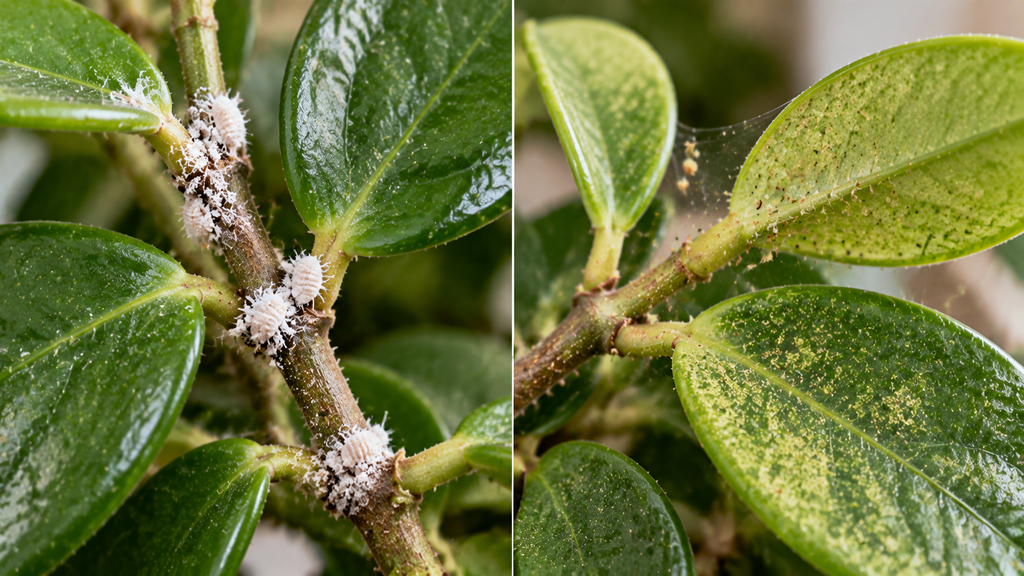
Mealybugs
Signs:
- White cotton-like clusters
- Usually around nodes and leaf joints
- Sticky residue may appear
Scale
Signs:
- Small fixed bumps on stems or leaves
- Possible sticky residue
Spider Mites
Signs:
- Fine webbing
- Small dots or stippling on leaves
- Damage often begins on leaf undersides
Fungus Gnats
Signs:
- Small flies around the pot
- Often linked to constantly damp soil
Early detection makes pest control easier.
Inspect regularly:
- Leaf undersides
- Stem joints
- New growth
- Flower areas
Where to Grow Hoya Carnosa Indoors
Hoya carnosa can grow successfully in many indoor locations as long as light requirements are met.
Suitable locations include:
- Trellises
- Hanging baskets
- Shelves
- Plant stands
- Bright windowsills
Choose a trellis when:
- Vertical space is available
- Vines grow upward naturally
- You want a more organized display
Choose a hanging basket when:
- The area receives enough light
- Long vines can cascade
- The plant remains easy to access
A beautiful location is not useful if the plant receives poor light or becomes difficult to maintain.
Accessibility matters because you need to:
- Check soil moisture
- Inspect for pests
- Monitor new growth
Is Hoya Carnosa Pet Friendly?
The ASPCA lists Hoya carnosa as non-toxic to cats and dogs.
This makes it a suitable choice for many pet households. However, pets should still be discouraged from repeatedly chewing houseplants because plant material can cause digestive upset.
Is Hoya Carnosa a Wax Plant?
Yes. Hoya carnosa is commonly called:
- Wax plant
- Porcelain flower
- Honey plant
The name refers to its thick glossy leaves and wax-like flowers.
Popular forms include:
Hoya Carnosa ‘Compacta’
Also known as Hindu rope.
Characteristics:
- Curled rope-like leaves
- Dense growth
- Similar basic care requirements
Because the foliage is dense, pests can sometimes be harder to detect.
Variegated Hoya Carnosa
Examples include:
- Krimson Queen
- Krimson Princess
These varieties follow the same basic care principles:
- Bright filtered light
- Airy soil
- Controlled watering
- Protection from cold temperatures
A Simple Hoya Carnosa Care Decision Process
The best Hoya care routine is not based on a calendar. It is based on observation.
Use this sequence:
Observe → Check Roots → Check Light → Identify Growth Stage → Eliminate Causes → Adjust → Reassess
Observe
Look at:
- Leaf firmness
- Leaf color
- New growth
- Buds
- Flower peduncles
- Pests
- Drying speed
Check the Root Zone
Before watering, determine whether the pot is:
- Wet
- lightly moist
- Mostly dry
This prevents many common mistakes.
Check Light
Ask:
- Was the plant moved?
- Has seasonal light changed?
- Are nearby plants blocking it?
- Is it farther from the window?
Identify Growth Stage
Active growth:
- New leaves
- New vines
- Faster drying
Slow growth:
- Less new growth
- Slower drying
- Lower fertilizer needs
Eliminate the Wrong Action
Before acting, ask:
- Does it actually need water?
- Are roots healthy enough for fertilizer?
- Is the bare vine really dead?
- Does it truly need repotting?
- Is poor light causing the problem?
Adjust One Variable
Examples:
Healthy vines but no flowers:
→ Improve light and patience.
Wrinkled leaves and dry soil:
→ Water thoroughly.
Wrinkled leaves and wet soil:
→ Inspect roots.
Long green bare vine:
→ Provide support and wait.
Avoid changing several conditions at once because you will not know what helped.
Hoya Carnosa FAQs
How do you care for Hoya carnosa?
Provide bright indirect light, an airy fast-draining mix, warm temperatures, moderate humidity, and a wet-dry watering cycle. Feed lightly during active growth and preserve old flower peduncles.
How often should I water Hoya carnosa?
Water when most of the growing medium has dried. Water thoroughly and allow excess moisture to drain.
Does Hoya carnosa need direct sunlight?
Bright indirect light is best. Gentle morning or late-afternoon sun can help flowering, but strong direct sun may scorch leaves.
Why is my Hoya carnosa not blooming?
Common causes include:
- Young age
- Insufficient light
- Unhealthy roots
- Unstable conditions
- Removed flower peduncles
How can I make Hoya carnosa bloom?
Provide strong suitable light, healthy roots, stable care, and patience. Preserve existing flower peduncles because they can produce future blooms.
Does Hoya carnosa climb or hang?
It can do both. It naturally climbs but also grows well as a trailing plant when light conditions are suitable.
Does Hoya carnosa like being root-bound?
It tolerates a slightly snug root system but should not remain severely restricted.
Does Hoya carnosa need high humidity?
No. Moderate household humidity around 40–60% is usually suitable.
What temperature is best for Hoya carnosa?
Around 65–80°F (18–27°C) works well. Protect the plant from cold drafts and prolonged cold temperatures.
Can Hoya carnosa live outside?
Yes, during warm periods. Acclimate it gradually and protect it from harsh sun, wind, heavy rain, and cold.
When should I repot Hoya carnosa?
Repot when roots fill the container, soil breaks down, or drainage becomes poor.
Can you propagate Hoya carnosa from a leaf?
A leaf may root, but reliable new plant growth usually requires a stem cutting with a viable node.
Is Hoya carnosa toxic to cats and dogs?
Hoya carnosa is considered non-toxic to cats and dogs.
Why is my Hoya carnosa sticky?
Sticky residue near flowers may come from nectar. Sticky leaves or stems away from flowers should be checked for pests.
What is the biggest Hoya carnosa care mistake?
The biggest mistake is changing care before identifying the actual problem.
Check:
- Moisture
- Roots
- Light
- Temperature
- Growth stage
before watering, fertilizing, pruning, or repotting.
Final Thoughts
Hoya carnosa care becomes simple when you understand what the plant needs.
Provide:
- Bright indirect light
- A breathable soil mix
- Proper drying between waterings
- Warm temperatures
- Moderate humidity
- Stable conditions
The most successful growers do not follow rigid schedules. They observe the plant, check the evidence, and make small adjustments.
The most useful question is not:
“What should I do to my Hoya today?”
It is:
“What evidence shows that my Hoya needs something changed?”
That approach leads to healthier roots, stronger growth, and more reliable flowering.
Myra is the founder and lead writer of Plantsaholic. She shares practical, research-backed advice on indoor plants, outdoor gardening, flowers, herbs, succulents, and everyday plant care. Her goal is to help gardeners of all experience levels grow healthier plants through simple, easy-to-follow gardening guides.