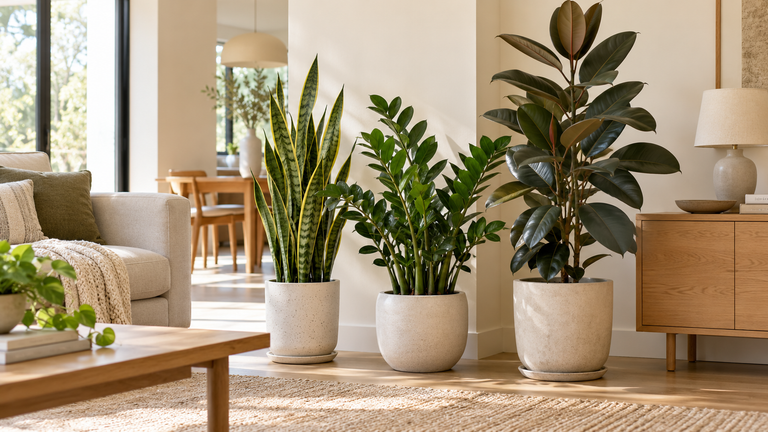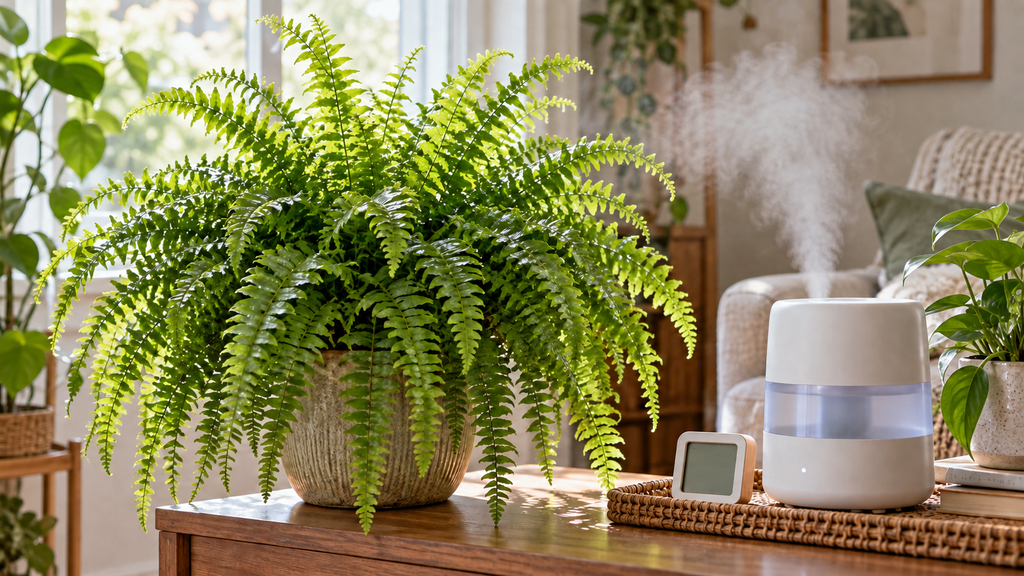
Many indoor ferns benefit from a humidifier when household air becomes too dry, but not every fern needs one. For many commonly grown indoor ferns, around 40–50% relative humidity (RH) is a useful starting range, while humidity-sensitive species may prefer a more humid local environment.
The important step is to measure humidity before trying to increase it. Brown or crispy fern tips can also result from underwatering, fertilizer salts, damaged roots, direct sunlight, hot airflow or inconsistent care. A humidifier should solve a confirmed humidity problem rather than become the automatic answer to every damaged frond.
A digital thermo-hygrometer, correct watering, suitable light, good drainage and controlled humidity provide a much more reliable fern-care system than visible mist alone.
Do Ferns Need a Humidifier?
Ferns do not automatically need humidifiers indoors. They need suitable atmospheric humidity, and a humidifier is simply one way to provide it when household air is too dry. Purdue University Extension identifies approximately 40–50% RH as a desirable range for indoor ferns and notes that very low humidity can contribute to brown, drying frond tips.
The need for a humidifier depends more on the environment than on the word “fern.” A Boston fern in a bright bathroom that stays near 50% RH may need no extra humidification, while the same plant in a heated office that falls below 30% RH may benefit considerably.
A humidifier becomes more useful when indoor RH repeatedly falls below roughly 40%, heating or air conditioning dries the room, crispy tips appear despite correct watering, or you grow particularly humidity-sensitive ferns. It can also be useful when several tropical plants share the same growing area.
It may be unnecessary when humidity is already suitable, the fern produces healthy new growth, dry soil is the real problem, roots are waterlogged, strong direct sun is damaging the foliage, or simply moving the plant away from a heater or vent solves the issue.
The practical rule is simple: measure first, diagnose second and humidify only when the environment actually requires it.
What Humidity Is Best for Ferns?
For many indoor ferns, 40–50% RH is a practical baseline, but species differ. Some tolerate ordinary household humidity, while others grow better in a more humid microclimate.
Bird’s nest fern is a useful example. The Royal Horticultural Society recommends around 60% humidity or higher, showing why one universal target does not suit every fern.
- General indoor ferns: Start around 40–50% RH and increase only when plant response suggests it is needed.
- Boston fern: Moderate to high humidity; dry heating and air conditioning can cause stress.
- Bird’s nest fern: Higher local humidity; avoid allowing water to sit in the center of the rosette.
- Maidenhair fern: Humidity-sensitive, but consistent soil moisture matters just as much.
- Rabbit’s foot fern: Moderate to high humidity with well-drained growing media.
- Staghorn and other epiphytic ferns: Warm, humid air with good airflow and root aeration.
For many adaptable ferns, 40% RH can be enough if the plant is producing healthy new fronds. About 50% RH suits many indoor ferns and is often a practical compromise between plant needs and normal household conditions. Around 60% RH can be especially useful for humidity-loving tropical species.
Seventy percent RH is not automatically harmful in a controlled terrarium or plant cabinet, but it can be excessive in an ordinary room if it causes condensation, damp surfaces or poor air quality. The correct humidity target must work for both the fern and the room.
Temperature Matters Too
Relative humidity changes with temperature, so RH readings should not be interpreted alone. When room temperature falls, relative humidity can rise even if the actual amount of moisture in the air has not changed.
A humidifier setting that works during a warm afternoon may therefore create excessive humidity after the room cools at night.
Temperature also affects plant water loss. Warm, dry conditions can accelerate transpiration, while cool conditions combined with high humidity can encourage condensation. Radiators create localized dry air, cold drafts can damage foliage even when humidity is adequate, and air conditioning changes both temperature and moisture levels.
A digital thermo-hygrometer is more useful than a humidity-only meter because it lets you evaluate both conditions together.
Why Humidity Is Important for Ferns
Humidity influences how quickly a fern loses water through its foliage. Water absorbed by the roots moves through the plant and eventually leaves through transpiration. When the surrounding air is extremely dry, delicate fern fronds may lose moisture faster than the roots can replace it.
This helps explain why tips can become dry even when the soil still contains moisture.
Humidity and watering are related, but they are not the same thing. Dry soil plus dry air creates a strong dehydration risk. Wet soil plus dry air can produce dry-air stress while roots simultaneously suffer from poor aeration. Humid air cannot compensate for soil that is too dry.
Many tropical ferns naturally grow in humid air while their roots still receive excellent drainage and oxygen. Indoor fern care therefore involves two separate systems:
Atmospheric moisture: Humidity around the foliage.
Root-zone moisture: Water and air around the roots.
A humidifier controls the first. Watering, drainage and potting mix control the second.
How to Tell Whether Your Fern Needs More Humidity
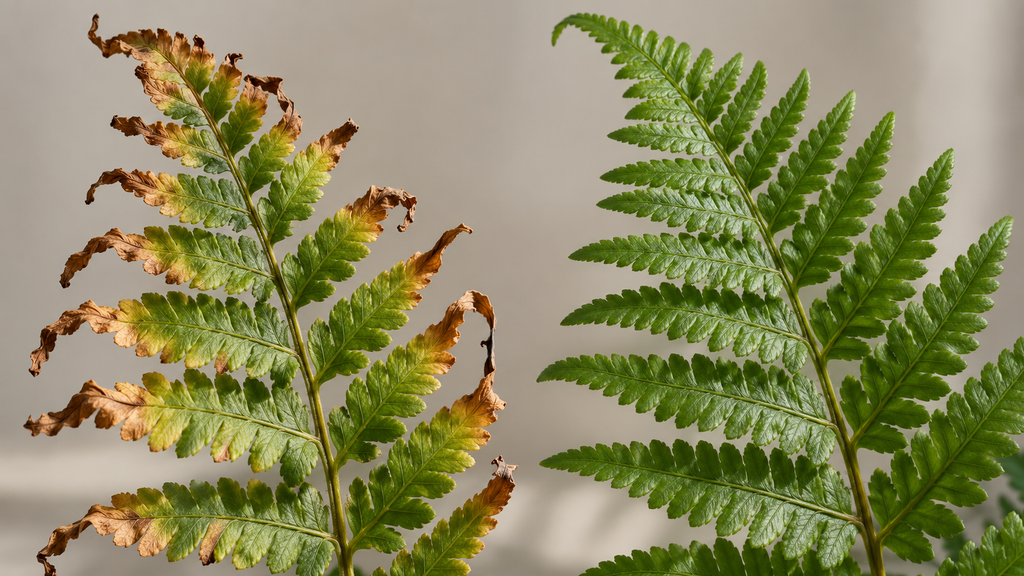
Brown, crispy frond tips can indicate low humidity, but they can also result from several other problems. Diagnosis should combine visible symptoms with environmental measurements.
Use this sequence before increasing humidity:
- Measure RH near the fern. Place a hygrometer around foliage height but outside the direct mist stream.
- Check the soil. Determine whether the growing medium is dry, appropriately moist or constantly saturated.
- Check the environment. Look for direct sun, radiators, heating vents, air-conditioning outlets and cold drafts.
- Review care history. Consider fertilizer buildup, hard-water deposits and inconsistent watering.
- Inspect for pests. Spider mites and other pests can produce foliage damage that resembles environmental stress.
A few patterns are especially useful. Crispy tips with RH below about 35–40% may point toward dry air if watering and light are correct. Crispy tips with very dry soil call for better watering first.
Yellowing in constantly wet soil suggests a drainage or root problem rather than a need for more humidity. Brown patches facing the window may indicate sun damage, while browning beside a radiator may result from hot, dry airflow. Mineral crust around the pot can point toward fertilizer or water-salt buildup.
The strongest low-humidity pattern is:
Low measured RH + correctly moist soil + suitable light + crispy exposed frond tips.
Existing brown tissue will not turn green again. Judge improvement by the quality of new growth.
Humidifier vs. Misting for Ferns
For maintaining stable atmospheric humidity, a humidifier is generally more effective than occasional misting.
Misting briefly wets the foliage and surrounding air, whereas a correctly sized humidifier can maintain measurable RH for several hours.
A pebble tray may provide a small local humidity increase, and grouping plants can create a mild shared microclimate, but neither is likely to correct a very dry room. Plant cabinets can maintain higher local humidity but require ventilation. A naturally humid bathroom can work well if it also provides suitable light.
If a room remains at 28% RH after you mist the fern, the underlying humidity problem has not been solved.
The goal is humid air, not permanently wet leaves.
What Is the Best Humidifier for Ferns?
The best humidifier is one that can maintain the desired RH in the plant’s actual growing area without soaking foliage, creating condensation or becoming difficult to maintain.
It does not need to be marketed specifically as a “plant humidifier.”
Useful features include:
- Adjustable output
- A built-in humidistat where possible
- Automatic shutoff
- Appropriate room coverage
- Easy tank access
- Straightforward cleaning
- Quiet operation for bedrooms or offices
- Replaceable filters or wicks where required
- Directional output
A separate hygrometer remains useful even when the humidifier has its own sensor. The device may measure humidity beside the machine while the fern sits several feet away.
Tank capacity and humidification ability are also different. A large reservoir reduces refill frequency, but output and room coverage determine whether the unit can actually change RH.
Match the humidifier to the space rather than plant count alone. A compact adjustable unit may suit one fern on a desk, while several grouped ferns or a larger room may need a medium- or high-capacity model.
In a hard-water home, prioritize a model that is easy to descale. For a humidity-sensitive fern, creating a localized microclimate may be more practical than humidifying an entire room.
The most useful buying question is:
Can this humidifier maintain suitable humidity at fern height in this room without creating excessive moisture?
Cool-Mist, Ultrasonic or Evaporative?
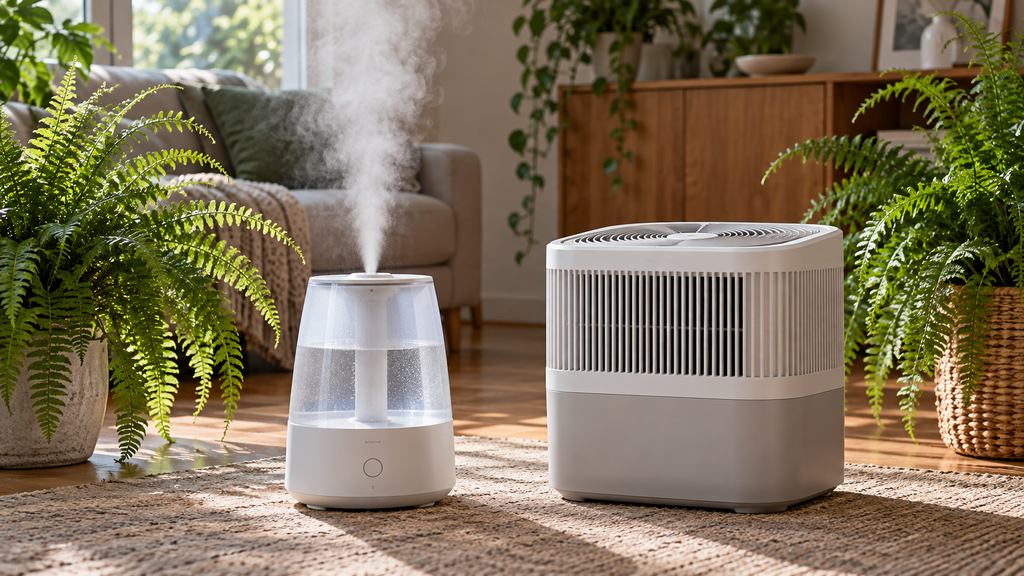
Both ultrasonic and evaporative cool-mist humidifiers can work well for indoor ferns.
Ultrasonic humidifiers are often quiet and compact. They create visible mist through high-frequency vibration, but mineral-rich water can produce white dust in some models.
Evaporative humidifiers move air across a wet wick or filter. They usually produce little visible mist and can be practical for broader room humidification, although fan noise and filter replacement may be considerations.
Warm-mist units can also raise humidity, but hot steam is not inherently better for ferns and introduces a burn hazard.
Choose based on room size, water quality, noise, maintenance and the level of humidity control you need.
Where Should You Place a Humidifier?
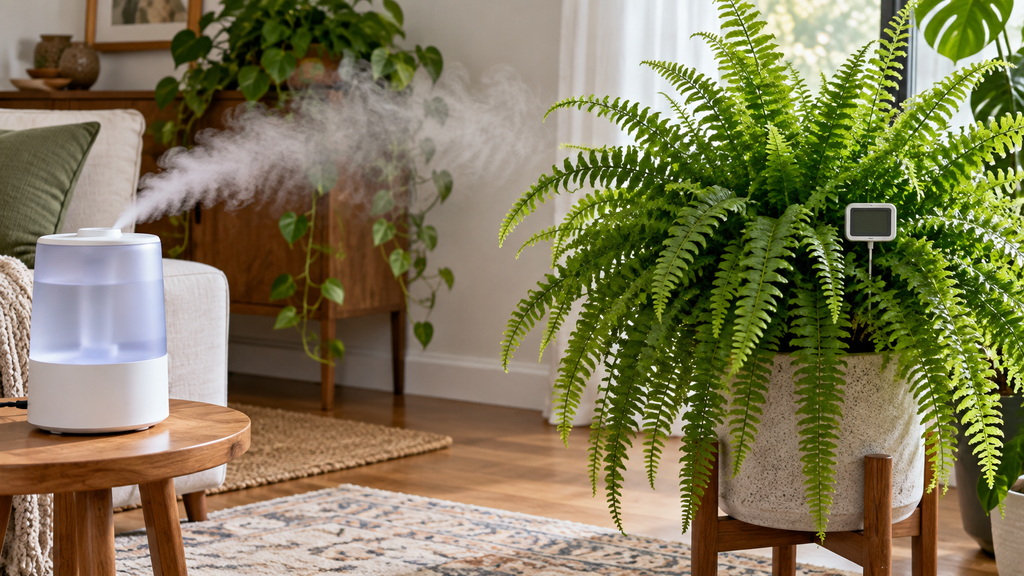
Place the humidifier close enough to raise RH around the fern but far enough away that visible mist does not continually collect on leaves, soil, walls or furniture.
A useful arrangement is:
Humidifier → open mixing space → fern → hygrometer near foliage height
Avoid placing the unit directly against the fern, beneath shelving that traps moisture, beside electronics, against damp-sensitive walls, on unprotected wooden furniture, next to a heater or where pets or children can easily overturn it.
Good placement passes three tests:
- Humidity near the fern reaches the desired range.
- Leaves and surrounding surfaces stay mostly dry.
- Windows and walls do not develop persistent condensation.
If the only way to increase RH is to place the humidifier directly against the plant, the unit may be too small for the space.
How Long Should a Humidifier Run?
There is no universal number of hours. Runtime depends on baseline humidity, room size, airflow, heating, air conditioning, outdoor weather and humidifier output.
Use RH instead of time.
When humidity is below the target, run the humidifier. As it approaches the target, reduce output or let the humidistat cycle. Once the desired range is stable, maintain it rather than continuing to increase it.
If condensation appears, reduce output. If RH barely changes after hours of operation, the unit may be undersized.
A humidistat is therefore more useful than an arbitrary timer.
Should You Run a Humidifier at Night?
Only when nighttime measurements show that humidity remains too low.
Because RH can rise as room temperature falls, an afternoon setting may be unnecessary overnight. Night operation can make sense when heating remains active and the room stays dry.
Reduce or stop humidification if windows fog, surrounding surfaces become damp or RH rises beyond the desired range.
Base nighttime use on nighttime measurements, not daytime assumptions.
What Water Should You Use?
Follow the humidifier manufacturer’s instructions.
Low-mineral or distilled water can be particularly useful in ultrasonic humidifiers because it reduces mineral scale and white residue compared with hard tap water.
Tap water may still be acceptable if the manufacturer permits it and mineral buildup is manageable.
Never add fertilizer, pesticides, leaf-shine products or essential oils to an ordinary humidifier unless the manufacturer specifically allows them. A humidifier is designed to manage atmospheric moisture, not deliver plant treatments.
How to Clean a Plant Humidifier
Regular cleaning is essential because humidifiers continually hold water.
Unplug the machine, empty old water rather than continually topping it up, refill with fresh appropriate water, clean the tank and water-contact surfaces according to the manual, remove mineral scale and replace filters or wicks when needed.
Rinse away cleaning residue thoroughly and dry the unit before long-term storage.
Inspect the tank for odor, slime or discoloration. Cleanability should influence which humidifier you buy. A simple machine that is easy to maintain can be a better long-term choice than a more powerful model with an awkward reservoir.
Can Too Much Humidity Harm Ferns?
Yes. High humidity becomes problematic when combined with stagnant air, persistent wet foliage, condensation or saturated soil.
Warning signs include:
- Window condensation
- Damp walls or furniture
- Musty odors
- Leaves remaining wet for long periods
- Mold or algae around the plant area
- Potting mix drying much more slowly than before
High atmospheric humidity does not directly mean root rot, but it can slow evaporation from the potting mix. If the soil stays moist longer after adding a humidifier, your watering schedule may need to change.
Whenever humidity changes substantially, reassess watering.
Are Pebble Trays Enough?
Pebble trays can provide a modest local humidity increase but are unlikely to correct a very dry room.
If you use one, keep the pot above the water line rather than sitting in standing water, refill the tray as water evaporates and clean it periodically.
Use a pebble tray for modest support. Use a humidifier when you need a measurable increase in RH.
Seasonal Changes in Fern Humidity
Indoor conditions often change more than the fern’s biological requirements.
Winter: Heating can dramatically reduce RH. Move ferns away from radiators, monitor humidity and use controlled humidification when needed.
Summer: Do not assume indoor humidity is automatically adequate. Air conditioning can create dry conditions even when outdoor air is humid.
Spring and fall: Reassess humidifier settings when heating or cooling systems switch off.
Respond to actual humidity measurements, not the calendar.
How to Set Up a Humidifier for Ferns
A reliable setup is straightforward:
- Identify the fern. Different species have different humidity tolerances.
- Measure temperature and RH. Monitor the growing area for several days when possible.
- Correct obvious problems. Move the plant away from radiators, strong AC airflow, direct sun and cold drafts.
- Confirm that humidity is genuinely low. Do not assume every crispy tip means dry air.
- Choose suitable capacity. Match the humidifier to the room, not just the number of plants.
- Position it correctly. Let moisture mix with the surrounding air instead of pointing mist directly at the fronds.
- Increase humidity gradually. Avoid immediately running the machine at maximum output.
- Recheck watering. Higher humidity may slow soil drying.
- Evaluate new growth. Existing brown tissue will not recover.
Success means healthier new fronds, stable RH, normal soil moisture and no persistent condensation.
Common Humidifier Mistakes
The most common mistakes are running a humidifier without measuring RH, pointing mist directly at the fern, keeping foliage constantly wet, assuming all brown tips mean low humidity, increasing watering simply because the room is dry, running maximum output continuously and ignoring condensation.
Other avoidable problems include leaving stale water in the tank, neglecting mineral deposits, buying solely because a product is labeled “plant humidifier,” using a tiny unit in a large room, forgetting to adjust watering after humidity rises and trying to compensate for a radiator instead of moving the plant.
The best troubleshooting rule is to correct the simplest environmental problem first.
Best Humidity Setup for Indoor Ferns
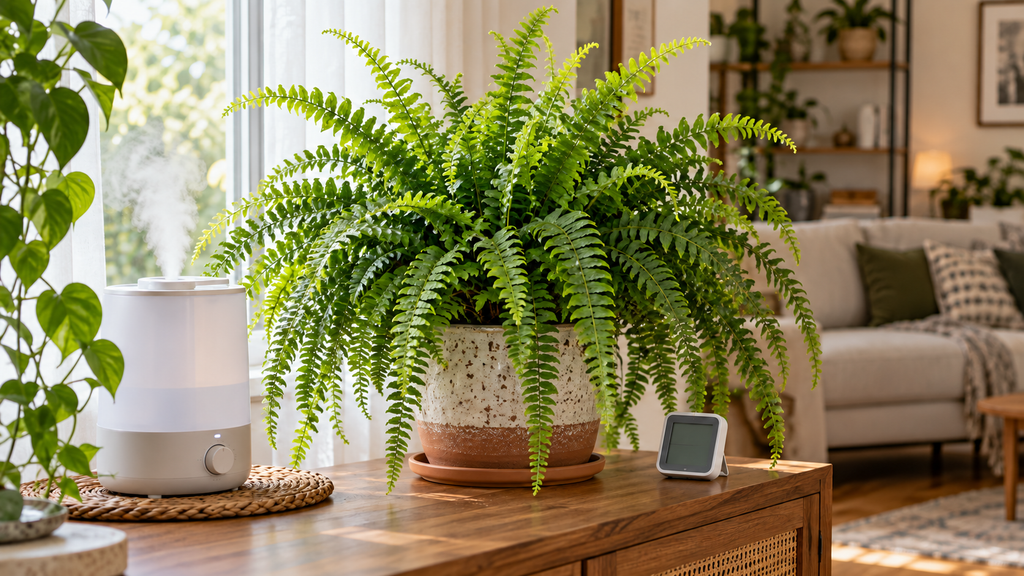
A reliable fern setup combines correct species identification, suitable indirect light, moist but aerated growing media, functional drainage, a digital thermo-hygrometer, controlled humidification when needed, gentle air circulation, routine humidifier cleaning, seasonal adjustments and watering based on actual soil conditions.
For many indoor ferns, start around 40–50% RH and observe the plant. Humidity-sensitive species may need a localized environment with higher RH rather than excessive whole-room humidity.
The strongest performance indicator is new growth. Healthy emerging fronds, appropriate RH, normal soil drying and an absence of condensation indicate that the system is working.
Manage measurable humidity, not visible mist.
Humidifier for Ferns FAQs
Do Boston Ferns Need a Humidifier?
Not always. Boston ferns appreciate relatively humid air and may benefit from one in dry heated or air-conditioned rooms, but a humidifier is unnecessary if RH is already suitable and the plant is growing well.
Do Maidenhair Ferns Need a Humidifier?
They often benefit from additional humidity in dry homes, but consistent root moisture is equally important. Do not use higher humidity to compensate for repeatedly dry soil.
Do Bird’s Nest Ferns Need a Humidifier?
They may benefit from one when household air is dry. Bird’s nest ferns generally prefer a more humid microclimate than many ordinary indoor plants.
Is 50% Humidity Good for Ferns?
Yes. Around 50% RH suits many commonly grown indoor ferns.
Is 60% Humidity Good for Ferns?
Yes, especially for some tropical species. If whole-room humidity becomes excessive, use a localized microclimate instead.
Is a Humidifier Better Than Misting Ferns?
Yes, for maintaining atmospheric humidity. Misting has a short-lived effect, while a humidifier can maintain measurable RH.
How Close Should a Humidifier Be to a Fern?
Close enough to influence RH but far enough away that mist does not continually wet the leaves or nearby surfaces.
Can I Use Tap Water?
Yes, if the manufacturer allows it. Hard water may create mineral scale or white dust in some ultrasonic models.
Final Thoughts
A humidifier can be highly useful when indoor air becomes genuinely too dry, but it should solve a measured environmental problem rather than operate simply because the plant is a fern.
For many indoor ferns, approximately 40–50% RH provides a useful starting point. Some tropical species prefer higher local humidity, while ordinary living spaces may need to remain drier to avoid condensation and moisture problems.
Keep four concepts separate:
Humidity = moisture in the surrounding air.
Watering = moisture around the roots.
Misting = temporary surface moisture.
A humidifier = controlled adjustment of ambient RH.
Use a simple process:
Measure → Diagnose → Eliminate → Match → Control → Recheck
Measure temperature and humidity. Diagnose the actual problem. Eliminate incorrect watering, excessive light, root damage, fertilizer salts, pests and heat exposure. Match the solution to the fern and the room. Control humidity instead of chasing visible mist. Recheck the quality of new growth.
When new fronds remain healthy, RH stays within an appropriate range, soil moisture behaves normally and the surrounding room remains free of condensation, your fern humidity setup is working.
Sources and References
Purdue University Extension — Ferns for Indoors
Royal Horticultural Society — Bird’s Nest Fern
Royal Horticultural Society — Epiphytic Ferns
North Carolina State Extension — Boston Fern
University of Connecticut Home & Garden Education Center — Growing Indoor Ferns
U.S. Environmental Protection Agency — Use and Care of Home Humidifiers

Myra is the founder and lead writer of Plantsaholic. She shares practical, research-backed advice on indoor plants, outdoor gardening, flowers, herbs, succulents, and everyday plant care. Her goal is to help gardeners of all experience levels grow healthier plants through simple, easy-to-follow gardening guides.