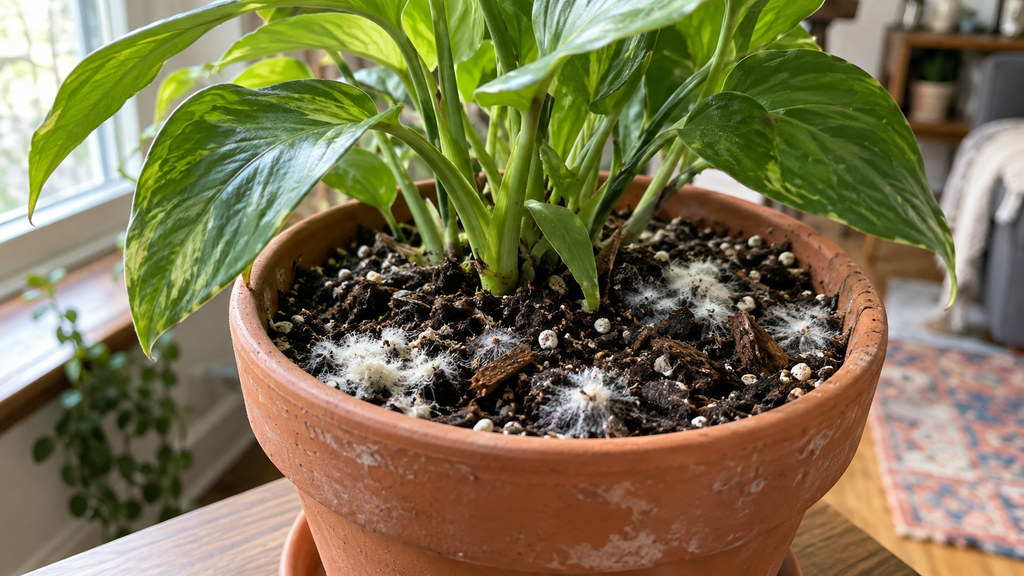
Mold grows on plant soil when the potting mix stays damp long enough for fungi to grow on organic material such as bark, peat, coir, composted ingredients, or dead plant tissue. White fuzzy growth confined to the soil is often surface decomposer fungus rather than a disease attacking the plant, but repeated growth can signal a moisture, drainage, substrate, or root-zone problem.
The important question is not simply how to remove the visible mold. You first need to determine what the growth is, why the pot is staying favorable for it, and whether the plant itself is still healthy.
A small patch on an otherwise healthy plant often needs only a minor correction. White growth combined with slow-drying soil, rotten smells, damaged roots, wilting, or growth on living plant tissue deserves closer attention.
Why Is Mold Growing on Plant Soil?
Visible mold usually develops when the potting mix remains moist for longer than it normally should. Houseplant mixes contain organic ingredients that fungi can decompose, and fungal spores are naturally present in indoor environments.
The problem is usually not the presence of fungal organisms themselves. It is the combination of available organic matter and prolonged moisture that allows their growth to become visible.
Common reasons include:
- watering before the root zone has dried appropriately;
- water remaining inside a decorative outer pot;
- blocked or slow drainage;
- an oversized container around a small root system;
- lower light that slows plant water use;
- cooler seasonal conditions;
- dense or aging potting mix;
- dead leaves or plant debris on the soil;
- limited air movement around crowded plants.
A plant can develop mold even if you have not increased watering. For example, the same amount of water that worked well during bright summer conditions may keep the soil wet much longer during cooler, darker months.
Instead of asking only, “Am I watering too much?” ask:
Why is this pot drying more slowly than it should?
That question usually leads to the real cause.
What Is Growing on Plant Soil?
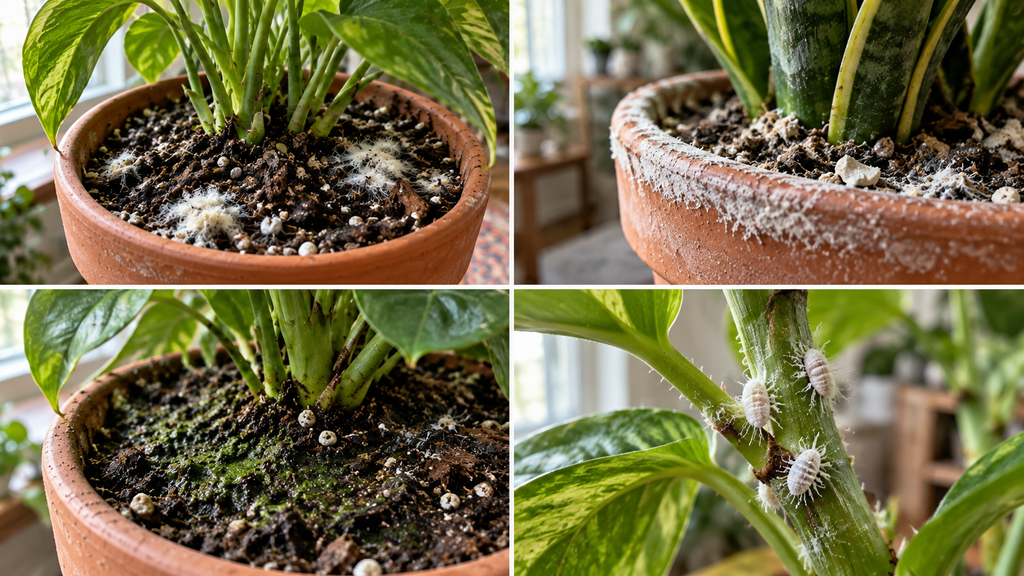
White fuzzy material on potting soil is often fungal mycelium produced by fungi that feed on decomposing organic matter. These organisms are commonly described as saprotrophic or saprophytic fungi.
They may appear as:
- soft white fuzz;
- fine web-like threads;
- grayish patches;
- growth concentrated around bark or dead material.
This does not automatically mean the plant has a fungal disease.
Is White Crust Mold?
Not always.
Hard, chalky, or crystalline white material is more likely to be mineral or fertilizer buildup than fungal growth.
Mineral deposits often collect:
- along the soil surface;
- around the pot rim;
- on terracotta;
- where water repeatedly evaporates.
The texture is one of the easiest ways to tell them apart.
Soft and fuzzy suggests fungal growth.
Hard and crusty suggests mineral buildup.
Could White Material Be Mealybugs?
Yes.
Cottony clusters attached directly to stems, leaf joints, crowns, or roots may be mealybugs rather than mold.
If the white material appears on living plant tissue rather than simply across the potting mix, inspect it closely for insects.
Is White Mold on Plant Soil a Disease?
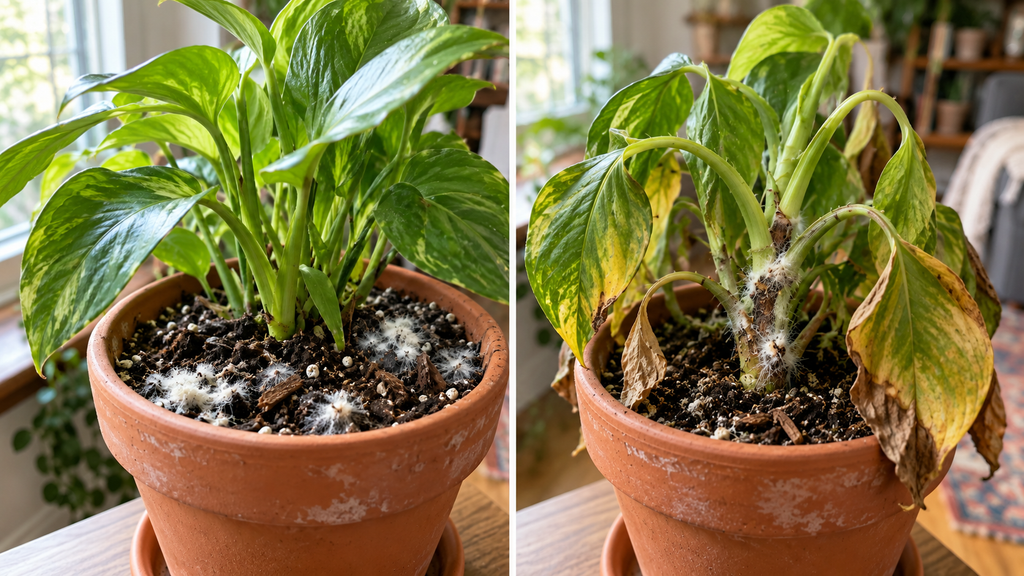
White growth on the soil is not necessarily plant disease.
Surface fungi can live on decomposing organic matter without infecting healthy roots or stems. However, the term white mold is also used for genuine fungal diseases that affect living plant tissue.
The safest distinction is based on where the growth occurs and how the plant is behaving.
Growth Only on Soil
Surface decomposer fungi are more likely when:
- the growth remains on the potting mix;
- leaves look healthy;
- stems remain firm;
- the plant continues growing;
- roots have no obvious decay.
In that situation, inspect the pot environment first.
Growth on Living Tissue
A disease problem becomes more concerning when fungal-looking growth occurs together with:
- wilting;
- soft or discolored stems;
- crown decay;
- root decay;
- lesions;
- collapsing plant tissue.
Do not diagnose fungal problems by color alone.
A useful rule is:
If the growth is limited to the potting medium, investigate the growing conditions. If living plant tissue is being damaged, investigate disease.
What Keeps Plant Soil Too Wet?
Wet soil is not always caused by watering too frequently. Several parts of the potting system affect how quickly moisture disappears.
Poor Drainage
Check whether water can leave the pot freely.
Problems may come from:
- blocked drainage holes;
- compacted soil;
- a pot with no drainage;
- standing water inside a cachepot;
- dense substrate at the bottom of the container.
A nursery pot can drain normally and still remain too wet if it sits in water hidden inside a decorative outer pot.
Too Much Soil for the Roots
A small root system cannot use water from a large volume of potting mix quickly.
This is particularly important after moving a small plant into a much larger container.
The soil around the roots may remain damp long after the plant has used what it needs.
Low Light or Seasonal Changes
Plants generally use water more slowly under lower light.
That means soil that dried normally during brighter conditions may stay wet much longer after:
- moving the plant farther from a window;
- shorter winter days;
- cooler indoor temperatures;
- reduced growth.
Aging Potting Mix
Potting mixes change over time.
Organic particles break down and smaller particles can fill spaces that previously allowed air and water to move easily.
Watch for:
- slower drainage than before;
- dense or muddy texture;
- soil remaining heavy for longer;
- recurring mold despite changing watering habits.
If the soil has stopped functioning well, refreshing or replacing it may be more useful than repeatedly treating surface mold.
How Fast Should Plant Soil Dry?
There is no single number of days that applies to every houseplant.
A succulent in a gritty mix may need substantial drying, while a fern may perform better with more consistent moisture.
Instead of following a universal schedule, compare the pot with its own normal drying pattern.
After Watering
Check whether water leaves the drainage holes freely.
If the pot sits in excess water, empty it after drainage has finished.
During Drying
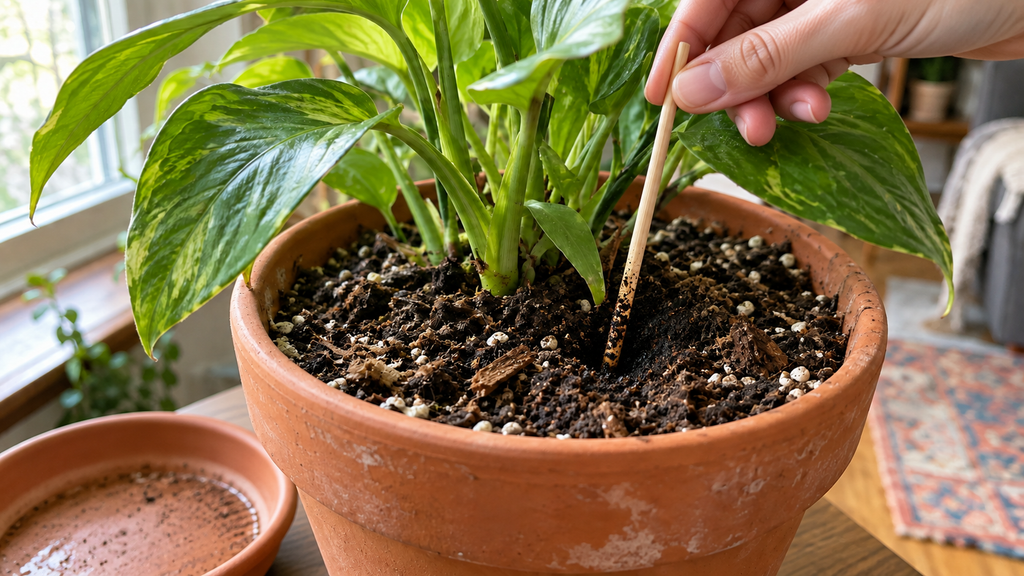
Do not judge the entire pot by the top layer.
The surface may look dry while the deeper root zone remains wet.
Useful clues include:
- pot weight;
- moisture below the surface;
- how long the soil remains cool and damp;
- whether the plant is actively growing.
Before Watering Again
Ask:
- Has the soil reached the moisture level appropriate for this plant?
- Is the pot lighter?
- Does the plant actually need more water?
If the pot suddenly takes much longer to dry than it did before, investigate changes in light, temperature, roots, pot size, drainage, or substrate condition.
Is Mold on Plant Soil Harmful?
A small amount of surface fungal growth is often less harmful than the wet conditions that encouraged it.
If the plant is healthy and the mold is limited to the top of the soil, it may be mainly a warning that the surface has remained damp.
Lower-Concern Signs
- healthy leaves;
- active growth;
- firm stems;
- normal drainage;
- no rotten smell;
- soil drying normally after watering.
Higher-Concern Signs
- wilting despite wet soil;
- persistent yellowing;
- unexplained leaf drop;
- soft lower stems;
- foul-smelling soil;
- dark or mushy roots;
- soil remaining wet for an unusually long time.
Surface mold and root rot are not the same condition.
However, both can occur when a pot stays excessively wet, which is why recurring mold should encourage you to check the root-zone environment.
Can Mold on Plant Soil Make You Sick?
Some people may experience no symptoms around small amounts of mold, while others can be sensitive to mold spores or fungal particles.
Potential reactions can include:
- nasal irritation;
- coughing;
- wheezing;
- eye irritation;
- skin irritation.
People with asthma, known mold allergies, chronic lung conditions, or weakened immune systems should be more cautious.
For normal plant handling:
- avoid putting your face directly over moldy soil;
- avoid blowing on dry fungal growth;
- disturb heavily moldy soil gently;
- wash your hands afterward;
- handle badly moldy pots in a ventilated location where practical.
A small moldy plant pot is different from widespread household mold.
If mold is also appearing on walls, windows, furniture, ceilings, or flooring, investigate the broader indoor moisture problem rather than focusing only on the plant.
How Do You Remove Mold From Plant Soil?
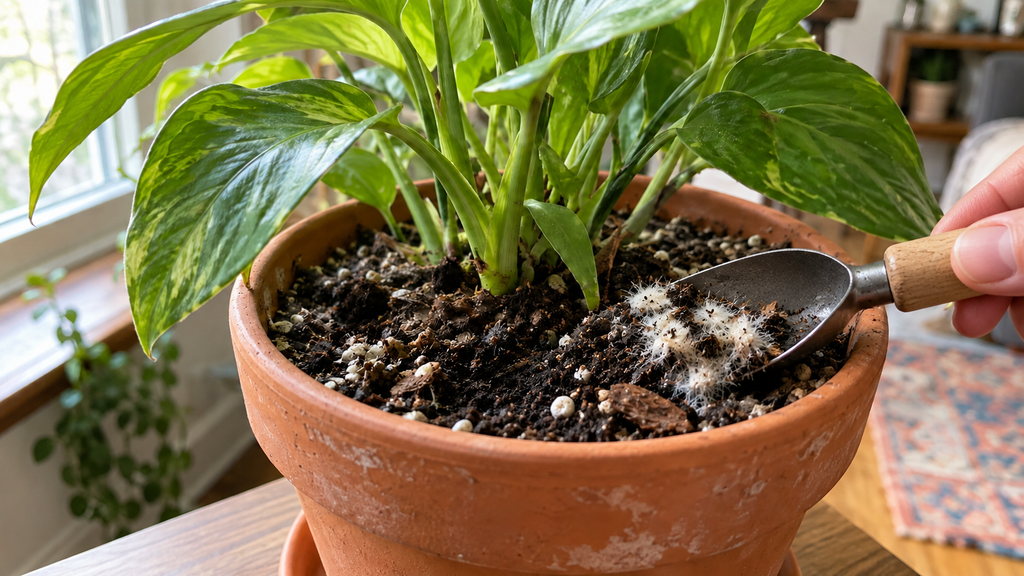
Start with the least disruptive treatment appropriate for the condition of the plant.
For a Healthy Plant With Surface Mold
- Remove the visible fungal layer and a thin amount of affected surface soil.
- Remove dead leaves and debris.
- Check moisture deeper in the pot.
- Empty standing water.
- Let the substrate dry to the level appropriate for the plant.
- Monitor the next watering cycle.
You usually do not need to remove all of the soil because of one superficial patch.
If Mold Keeps Returning
Investigate:
- drainage;
- pot size;
- hidden standing water;
- root mass;
- substrate compaction;
- reduced light;
- unusually slow dry-down.
Repeated mold means the underlying condition has probably not been corrected.
When Is Repotting Necessary?
Repot when:
- drainage has failed;
- the mix remains waterlogged;
- the soil smells rotten;
- roots are damaged;
- substrate structure has badly broken down;
- the plant continues declining.
Do not repot automatically when the plant is healthy and the problem is limited to the surface.
Do You Need Fungicide?
For ordinary surface decomposer fungi on an otherwise healthy plant, fungicide is usually not the first priority.
A fungicide cannot correct poor drainage, standing water, oversized pots, compacted soil, or an inappropriate watering routine.
If living plant tissue is infected, identify the disease before selecting any treatment.
How Do You Get Rid of Mold Naturally?
The most useful natural strategy is to change the conditions that favor the growth.
That usually means:
- removing heavy surface growth;
- correcting slow dry-down;
- improving drainage;
- emptying standing water;
- removing dead plant material;
- adjusting watering to the plant’s actual needs.
Household remedies should not replace diagnosis.
Does Cinnamon Kill Mold in Soil?
Cinnamon contains compounds with antifungal properties, but ordinary kitchen cinnamon is not a universal cure for every fungus in potting soil.
If you choose to use a light amount on minor surface growth, first correct the moisture problem.
If the mold returns after every watering, cinnamon is not addressing the main cause.
Should You Use Vinegar?
Pouring vinegar into houseplant soil can alter the root environment and potentially damage sensitive roots.
It should not be treated as a routine solution for superficial soil mold.
What About Hydrogen Peroxide?
Hydrogen peroxide is sometimes used in plant care, but concentration and plant sensitivity matter.
For a healthy plant with simple surface growth, correcting the growing conditions is a more targeted first step.
Does Bottom Watering Prevent Mold?
Not necessarily.
Bottom watering may keep the soil surface drier, but deeper soil can still remain too wet.
A bottom-watered plant can still develop moisture problems if:
- the pot sits in water too long;
- the substrate is dense;
- drainage is poor;
- the container is oversized;
- the root system is small.
Judge the method by how the entire pot dries, not just by how the surface looks.
What Does Green Mold on Plant Soil Mean?
Green growth on potting soil is often algae rather than fungal mold.
Algae benefits from:
- light;
- moisture;
- available nutrients.
A thin layer may not directly harm the plant, but it shows that the soil surface remains damp enough to support continued growth.
A heavy green mat can also make it harder to judge soil moisture and may interfere with water entering the potting mix evenly.
If green growth develops:
- remove a heavy surface mat;
- review watering frequency;
- check drainage;
- allow appropriate surface drying;
- monitor whether it returns.
Do not move the plant into unsuitable low light just to stop algae.
The goal is to reduce persistent moisture while maintaining the light the plant needs.
Why Do Mold and Fungus Gnats Appear Together?
Mold does not directly cause fungus gnats, but both often benefit from the same environment.
Fungus gnat larvae live in moist organic growing media and can feed on fungi, algae, and decomposing material.
That means a pot with:
- persistent moisture;
- fungal growth;
- decaying organic material;
can also become favorable for fungus gnats.
If you see mold but no insects, focus on the moisture problem.
If you also see small dark flies repeatedly emerging from the pot, move to a dedicated fungus gnat diagnosis rather than treating only the mold.
Why Does Mold Keep Coming Back?
Recurring mold usually means one part of the growing system remains unresolved.
Common patterns include:
Returns after every watering
Check the overall dry-down rate.
Surface dries but deeper soil stays wet
Investigate root-zone moisture.
Returns despite watering less often
Check pot size and substrate structure.
Returns with water in the cachepot
Fix standing-water management.
Started after moving to lower light
The plant may now use water more slowly.
Returns while the plant declines
Inspect roots and living tissue.
Do not assume stronger treatment is needed simply because the mold returns.
Recurrence is often a signal to improve diagnosis.
Can Moldy Potting Soil Be Saved?
Yes, when the mold is superficial and the growing medium still functions properly.
Keep the Soil When
- roots are healthy;
- drainage works;
- there is no rotten smell;
- mold is limited to the surface;
- the soil still has useful structure.
Replace the Soil When
- it remains waterlogged;
- it smells sour or rotten;
- roots are decaying;
- the mix has become dense and collapsed;
- drainage is no longer effective.
What About Moldy Bagged Soil?
A lightly affected bag of organic potting mix is not automatically useless.
However, avoid using material that is:
- heavily colonized;
- foul-smelling;
- saturated;
- pest-infested;
- poorly stored.
For valuable indoor plants, fresh mix is often the simpler option when the condition of old soil is uncertain.
When Is Mold on Plant Soil Serious?
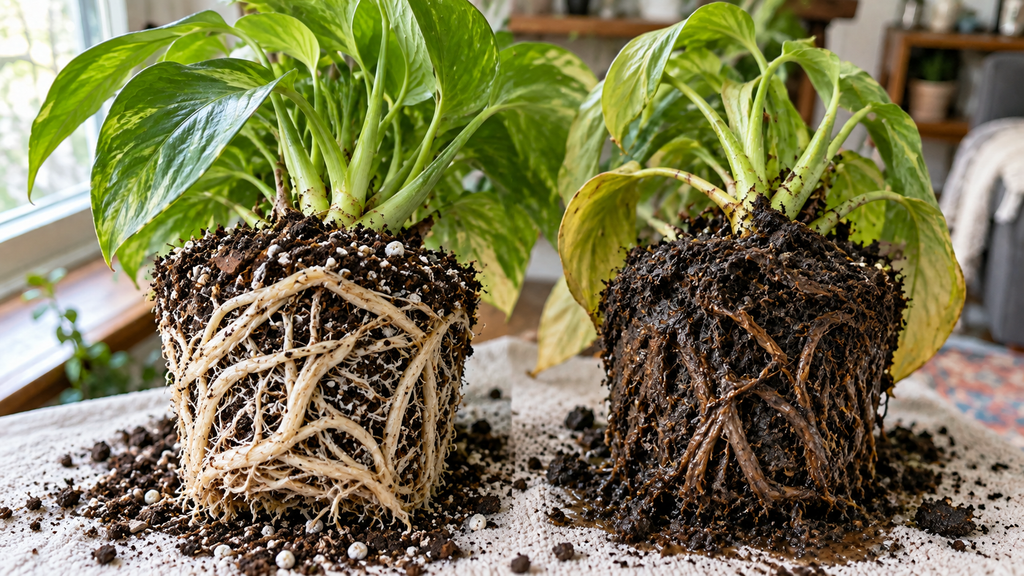
Use the plant’s condition to judge severity.
Surface-Level Problem
Signs:
- small localized patch;
- healthy plant;
- normal drainage;
- no bad smell.
Action: clean if needed, correct moisture conditions, and monitor.
Pot-Environment Problem
Signs:
- repeated mold;
- slow drying;
- compacted substrate;
- standing water;
- fungus gnats.
Action: inspect drainage, pot size, substrate, and root activity.
Root or Plant-Tissue Problem
Signs:
- wilting while the soil is wet;
- persistent yellowing;
- soft stems;
- damaged roots;
- rotten smell;
- fungal growth on living tissue.
Action: switch from a soil-mold diagnosis to root, pest, or plant-disease diagnosis.
Plantsaholic Mold Triage Test
Ask:
- Is the material fuzzy, green, crusty, or cottony?
- Is it only on the soil or also on living tissue?
- Is the soil drying normally?
- Does the plant look healthy?
- Are the roots firm and normal?
Healthy plant + surface growth
→ correct the environment.
Recurring growth + slow dry-down
→ investigate the pot and substrate.
Damaged roots or living tissue
→ investigate a different plant problem.
How Does Plant Type Change the Fix?
Not every plant should dry to the same degree.
Many cacti and succulents tolerate substantial drying, while some ferns and moisture-loving plants prefer more consistent moisture.
The aim is not to make every pot dry completely.
It is to prevent prolonged saturation beyond what the species tolerates.
Consider:
- plant type;
- pot size;
- substrate;
- root density;
- light;
- temperature;
- humidity.
A universal “water every seven days” rule is therefore less useful than learning how your particular plant and pot behave.
What Should You Avoid With Moldy Soil?
Avoid these common mistakes:
throwing away a healthy plant because of one fuzzy patch;
- assuming every white deposit is mold;
- diagnosing fungus by color alone;
- watering on a rigid calendar;
- leaving water inside a decorative pot;
- repeatedly treating the surface while ignoring wet soil;
- pouring concentrated household products into the root zone;
- repotting a healthy plant unnecessarily;
- assuming bottom watering automatically solves the problem;
- ignoring rotten roots or fungal growth on living tissue.
The treatment should match the severity of the problem.
What Is the Best Fix for Moldy Plant Soil?
Use a simple sequence:
Identify → Check location → Check dry-down → Assess plant health → Correct the smallest relevant problem → Monitor.
If the growth remains on the soil and the plant is healthy, focus on the pot environment.
If mold repeatedly returns, investigate why moisture is lingering.
If roots, stems, crowns, or leaves begin showing damage, stop treating only the soil surface and move to the appropriate plant diagnosis.
The most useful rule is:
Treat the pot environment when the problem stays in the potting mix. Investigate roots or plant disease when the plant itself begins to decline.
FAQs About Mold on Plant Soil
Why is mold growing on the soil of my indoor plant?
The potting mix is probably staying favorable for fungal growth for too long. Check drainage, soil dry-down, pot size, light, and substrate condition.
Is white fuzzy mold on plant soil harmful?
Usually, superficial white growth is more of a moisture warning than a direct threat. Concern increases when the plant also wilts, yellows, smells rotten, or develops damaged roots.
How can I tell mold from mineral buildup?
Mold is usually soft, fuzzy, or threadlike. Mineral and fertilizer deposits tend to be hard, chalky, or crystalline.
Does mold on plant soil mean root rot?
No. Surface mold and root rot are different problems, although both can occur in excessively wet conditions. Mushy or foul-smelling roots require a root-rot diagnosis.
Can mold on plant soil make you sick?
Some people may have no reaction, while mold-sensitive individuals can experience irritation or allergic symptoms. People with asthma or mold allergies should use additional caution.
Does cinnamon kill mold in soil?
Cinnamon has antifungal properties, but it is not a universal cure. Fixing moisture and drainage problems is more important for preventing recurrence.
Does bottom watering prevent mold?
Not always. It may keep the surface drier, but deeper soil can still remain too wet if drainage, pot size, or substrate structure is poor.
Why does mold keep coming back?
Recurring mold usually means the underlying moisture problem remains. Check deeper soil wetness, drainage, pot size, light, and substrate condition.
Is green mold on soil really mold?
Often it is algae rather than fungal mold. Green surface growth usually indicates persistent moisture at the top of the pot.
Can moldy potting soil be saved?
Yes, if the growth is superficial and the mix still drains and supports healthy roots. Replace it if it is waterlogged, rotten-smelling, badly degraded, or associated with root damage.
Myra is the founder and lead writer of Plantsaholic. She shares practical, research-backed advice on indoor plants, outdoor gardening, flowers, herbs, succulents, and everyday plant care. Her goal is to help gardeners of all experience levels grow healthier plants through simple, easy-to-follow gardening guides.