Indoor plants are one of the easiest ways to improve a room without changing furniture, paint, or layout. They add texture, soften hard interiors, create visual warmth, and make indoor spaces feel more natural. But many plant owners get frustrated when plants stay small for months and fail to create the decorative effect they expected.
That is why fast-growing indoor plants are a smart choice. They establish quickly, show visible progress sooner, and help a room feel fuller in less time. The best options are not just fast. They also stay attractive, adapt well indoors, and remain easy to manage.
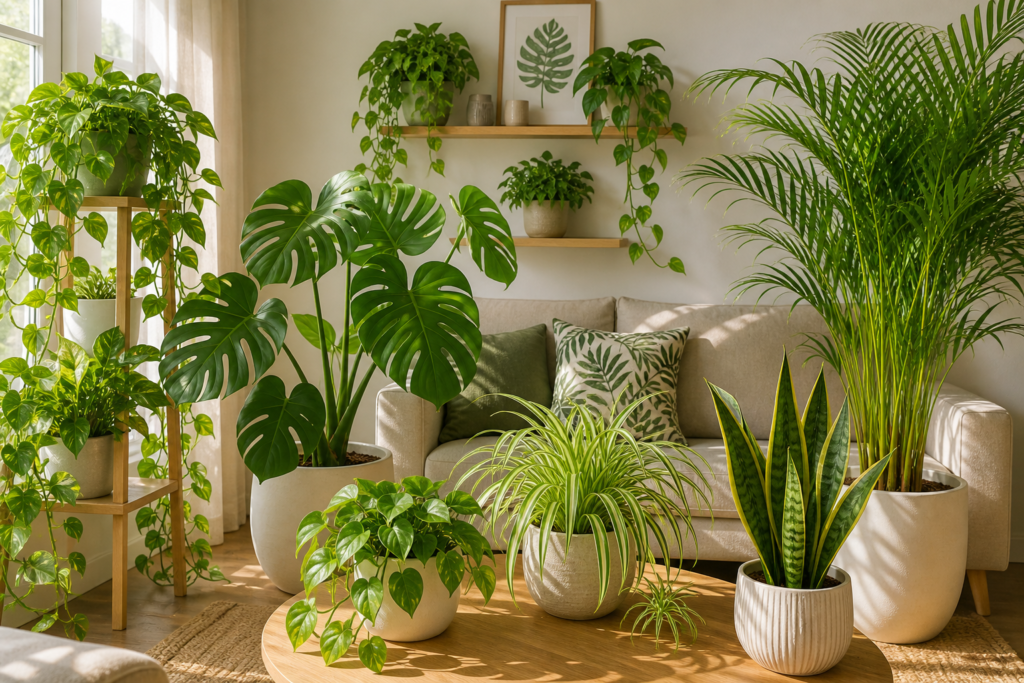
Plants like Pothos, Monstera deliciosa, Philodendron, Spider Plant, Snake Plant, ZZ Plant, Rubber Plant, and Tradescantia zebrina are strong choices because they combine speed, beauty, and practical indoor care.
Which Indoor Plants Grow the Fastest?
Fast-growing indoor plants usually share one major trait: they use light efficiently to produce new stems, leaves, and roots. This is especially common in tropical vines because their natural growth pattern helps them climb or spread toward brighter light. That is why many of the fastest indoor plants are trailing or climbing plants.
The fastest indoor plants are not always the biggest. A trailing Pothos can fill a shelf faster than a large Monstera deliciosa because its vines spread quickly. Philodendron also grows steadily from nodes, making it ideal for quick visual coverage.
Fastest-performing indoor plants:
- Pothos
- Philodendron
- Tradescantia zebrina
- Spider Plant
- Monstera deliciosa
- Rubber Plant
Growth speed comparison:
- Pothos: 8–18 inches monthly
- Philodendron: 8–15 inches monthly
- Spider Plant: visible fullness in 4–8 weeks
- Monstera deliciosa: 1–2 feet yearly
- Rubber Plant: 12–24 inches yearly
Decision clarity: If speed is your main goal, choose Pothos. If you want fast growth with stronger statement value, choose Monstera deliciosa.
Which Fast-Growing Indoor Plants Look the Most Beautiful?
Growth speed matters, but beauty decides whether a plant stays valuable in your home long term. A fast-growing plant should improve the look of a room, not just occupy space. Beauty usually comes from leaf shape, texture, color, structure, and movement.
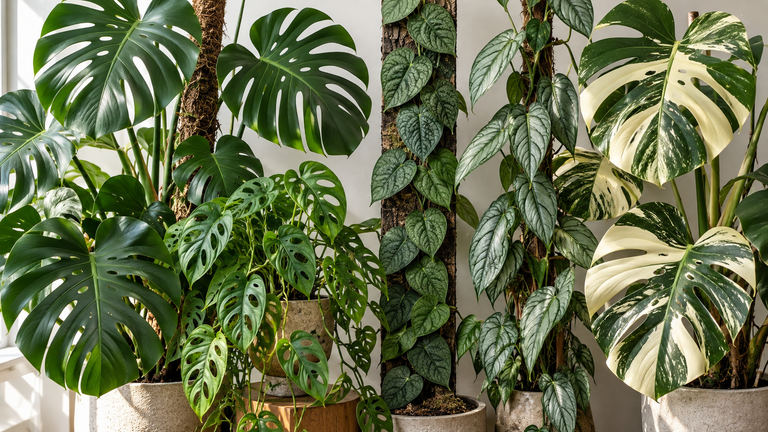
Large-leaf plants like Monstera deliciosa create bold architectural style. Trailing plants like Pothos and Philodendron add softness and movement. Structured plants like Snake Plant create clean vertical lines for modern rooms. Colorful plants like Aglaonema, Croton, and Tradescantia zebrina add stronger contrast.
Best beautiful fast growers by style:
Large-leaf beauty
- Monstera deliciosa
- Philodendron selloum
Trailing beauty
- Pothos
- Philodendron
- Tradescantia zebrina
Structured beauty
- Snake Plant
- ZZ Plant
Best uses:
- Living rooms
- Shelves
- Hanging baskets
- Minimalist interiors
- Offices
- Bedrooms
Decision clarity: For the strongest visual impact, choose Monstera deliciosa. For balanced beauty and speed, Pothos is the best all-around option.
Comparison Table: Growth Speed vs Beauty vs Maintenance
Choosing the right indoor plant becomes easier when you compare speed, beauty, and maintenance together. Many buyers focus only on appearance, then later struggle with watering, pruning, or slow growth. Others choose fast growers that do not fit their room style.
A balanced plant performs better in real indoor conditions. Pothos ranks high because it grows quickly, looks attractive, and stays easy to maintain. Monstera deliciosa gives the strongest visual impact but needs more room. Snake Plant and ZZ Plant grow slower but are extremely forgiving.
| Plant | Speed | Beauty | Maintenance |
|---|---|---|---|
| Pothos | 10/10 | 9/10 | Easy |
| Monstera deliciosa | 8/10 | 10/10 | Moderate |
| Philodendron | 9/10 | 9/10 | Easy |
| Spider Plant | 8/10 | 8/10 | Easy |
| Snake Plant | 6/10 | 9/10 | Very easy |
| ZZ Plant | 5/10 | 8/10 | Very easy |
| Tradescantia zebrina | 10/10 | 9/10 | Easy |
Quick buyer guide:
- Fastest overall: Pothos
- Most beautiful: Monstera deliciosa
- Lowest maintenance: Snake Plant
- Best for low light: ZZ Plant
- Best for hanging decor: Spider Plant
Decision clarity: If you want one plant that balances speed, beauty, and ease, Pothos is the safest first choice.
Best Indoor Plants That Grow Fast and Stay Easy to Maintain
Fast growth is only useful if the plant stays manageable. Some plants grow quickly but become messy, leggy, or difficult to care for. The best indoor plants continue growing without needing perfect conditions.
Low-maintenance fast growers tolerate inconsistent watering, average humidity, and normal indoor light changes. Pothos and Philodendron keep producing new growth after small care mistakes. Spider Plant recovers well from dryness and produces baby plants. Snake Plant and ZZ Plant grow slower but are best for neglect tolerance.
Best low-maintenance fast growers:
- Pothos → fastest and easiest
- Philodendron → elegant and forgiving
- Spider Plant → fast and self-propagating
- Snake Plant → low-water survivor
- ZZ Plant → strongest neglect tolerance
Best for different users:
- Beginners → Pothos
- Busy people → ZZ Plant
- Decorative shelves → Philodendron
- Hanging baskets → Spider Plant
Decision clarity: Choose Pothos for easy fast growth. Choose ZZ Plant if survival matters more than speed.
Which Fast Indoor Plants Work Best in Low Light?
Low light is one of the biggest indoor plant challenges. Apartments, bedrooms, offices, and hallways often do not receive strong natural sunlight. This slows growth and makes plant choice more important.
Low-light tolerant plants do not grow fast in darkness, but they perform better than sensitive plants in weaker indoor light. Pothos and Philodendron adapt well because they naturally tolerate filtered light. ZZ Plant and Snake Plant survive very well, though their visible growth is slower.
Best fast-growing low-light indoor plants:
- Pothos
- Philodendron
- ZZ Plant
- Snake Plant
- Chinese Evergreen
- Peace Lily
Low-light warning signs:
- Smaller leaves
- Slow growth
- Long gaps between leaves
- Weak stems
Decision clarity: For the best low-light growth speed, choose Pothos. For low-light survival, choose ZZ Plant.
Which Fast-Growing Indoor Plants Are Safe for Pets?
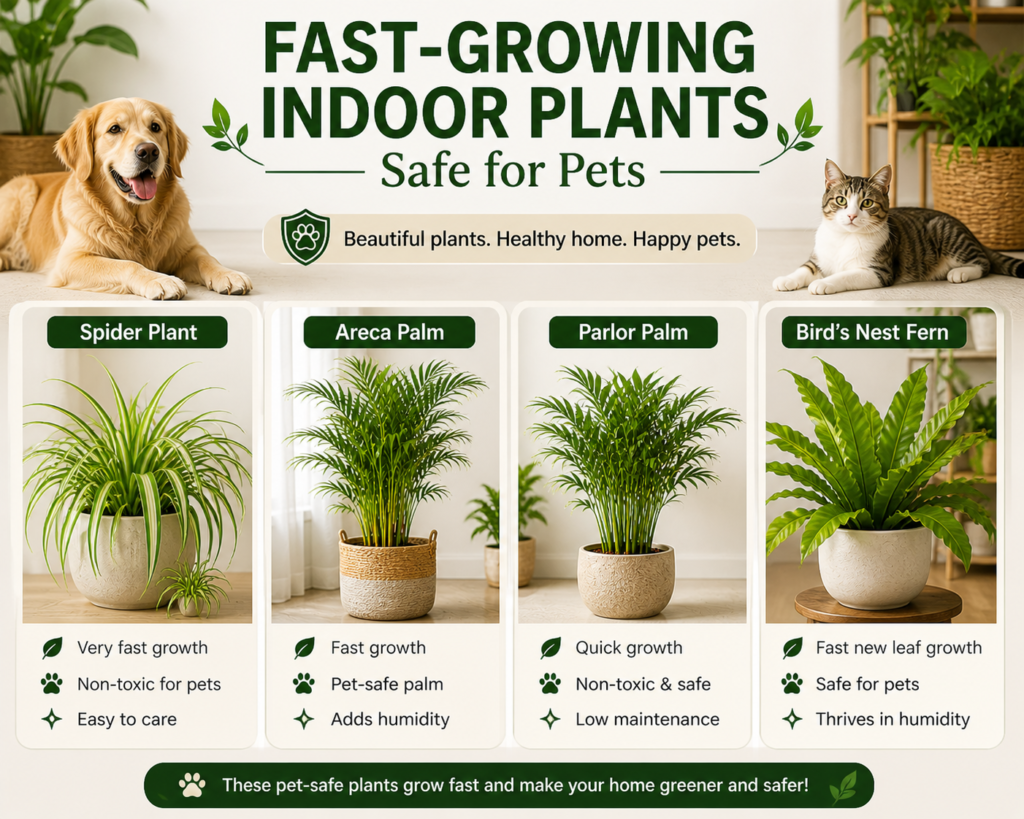
Pet safety is important because many popular fast-growing indoor plants are toxic to cats and dogs. Pets may chew trailing vines, lower leaves, or fallen plant pieces. A plant that looks harmless can still cause mouth irritation, vomiting, or digestive discomfort.
Pet-safe fast-growing plants do exist, but the list is smaller. These plants allow pet owners to enjoy indoor greenery with less worry. Still, even pet-safe plants should be placed carefully because chewing any plant can upset a pet’s stomach.
Best fast-growing pet-safe indoor plants:
- Spider Plant
- Areca Palm
- Parlor Palm
- Bird’s Nest Fern
Common toxic fast growers to avoid around pets:
- Pothos
- Philodendron
- Peace Lily
- Monstera deliciosa
Pet-safe buying checklist:
- Confirm toxicity before purchase
- Place plants out of chewing range
- Watch for fallen leaves
- Avoid toxic trailing vines near pets
Decision clarity: If you have pets, start with Spider Plant. It combines speed, easy care, and pet safety better than most options.
Best Fast-Growing Indoor Plants for Beginners
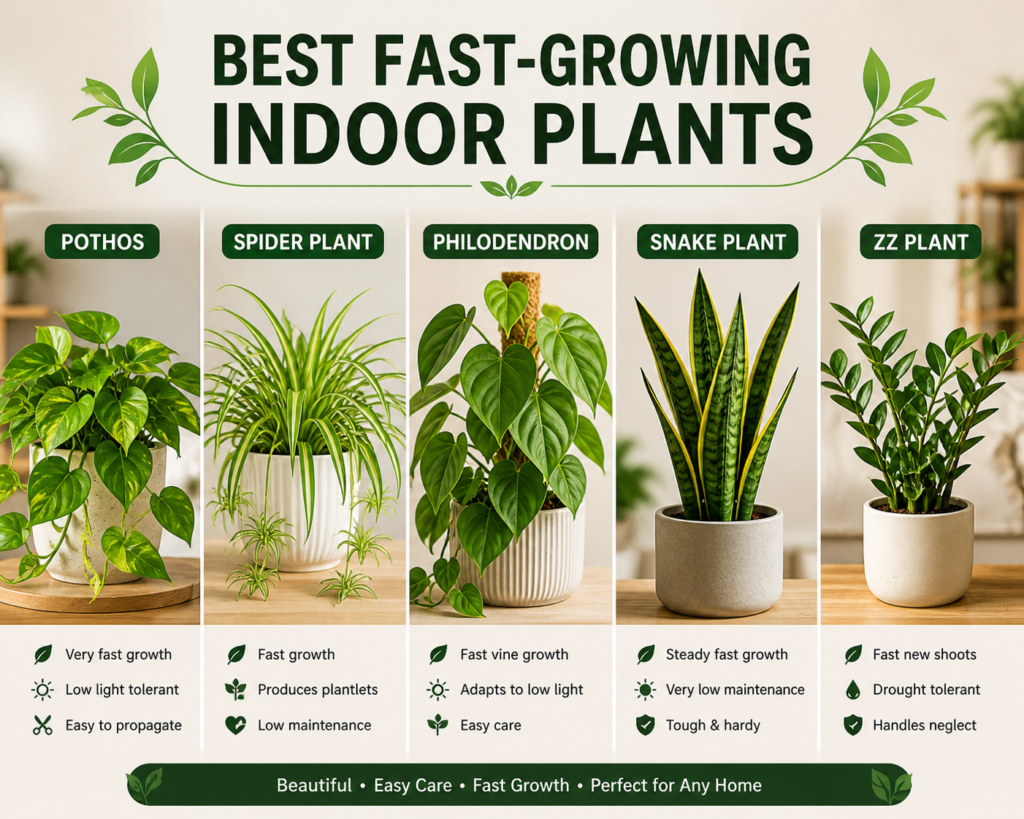
Beginners need plants that grow visibly and forgive mistakes. Fast growth builds confidence because you can see progress. But beginner plants also need strong recovery because watering and light mistakes are common.
The best beginner plants are simple, adaptable, and easy to read. Vining plants like Pothos and Philodendron show growth quickly and propagate easily. Spider Plant is also strong because it recovers well and produces plantlets.
Best beginner fast-growing indoor plants:
Pothos
- Fast visible growth
- Easy watering
- Easy propagation
Spider Plant
- Fast multiplication
- Strong recovery
- Easy care
Philodendron
- Elegant vines
- Strong adaptability
Snake Plant
- Tough survival
- Minimal watering
ZZ Plant
- Handles neglect
- Very forgiving
Beginner rules:
- Start with one plant
- Learn watering rhythm
- Watch light response
- Expand slowly
Decision clarity: For most beginners, Pothos is the best first indoor plant because it grows fast and forgives mistakes.
How Fast Do Popular Indoor Plants Grow Indoors in Real Conditions?
Plant growth expectations are often exaggerated. Some plants grow by extending vines, while others grow by producing bigger leaves or stronger roots first. That means growth should be measured differently depending on the plant.
A fast-growing plant in weak light may behave like a slow plant. A moderate grower in bright indirect light may outperform expectations. Pothos can grow over a foot per month in good conditions, while Monstera deliciosa grows slower in stem length but creates stronger leaf impact.
Real indoor growth rates:
- Pothos → 8–18 inches monthly
- Philodendron → 8–15 inches monthly
- Spider Plant → visible fullness in 4–8 weeks
- Monstera deliciosa → 1–2 feet yearly
- Rubber Plant → 12–24 inches yearly
- Snake Plant → slower but steady blade growth
Growth accelerators:
- Better light
- Correct watering
- Seasonal fertilizer
- Repotting
- Stable warmth
Decision clarity: Choose trailing plants for fast coverage. Choose Monstera deliciosa for larger statement leaves.
Mini Case Study: Which Plant Performs Best in Real Busy-Life Conditions?
Plant care advice often assumes perfect routines, but most people live with imperfect schedules. Work, travel, AC, missed watering, and changing light all affect indoor plant growth. That is why real-world performance matters.
Three plants were compared under realistic apartment conditions: Pothos, Spider Plant, and ZZ Plant. Conditions included irregular watering, indirect apartment light, AC-controlled air, and weekly observation. After six weeks, Pothos showed the fastest visible growth. Spider Plant recovered well and produced strong fullness. ZZ Plant stayed healthy but grew the slowest.
Test conditions:
- Irregular watering
- Apartment light
- AC environment
- Weekly observation
Results after 6 weeks:
Pothos
- Fastest growth
- New leaves weekly
- Strong vine extension
Spider Plant
- Strong recovery
- New plantlets
- Good fullness increase
ZZ Plant
- Healthiest survival
- Slowest visible growth
- Strongest drought tolerance
Decision clarity: For real-life fast results, Pothos wins. For resilience-first homes, ZZ Plant is the toughest choice.
Which Indoor Plants Propagate Fastest?
Propagation is one of the biggest advantages of fast-growing indoor plants. A plant that propagates easily gives more long-term value because one healthy plant can become many. This reduces buying costs and helps you expand your indoor plant collection faster.
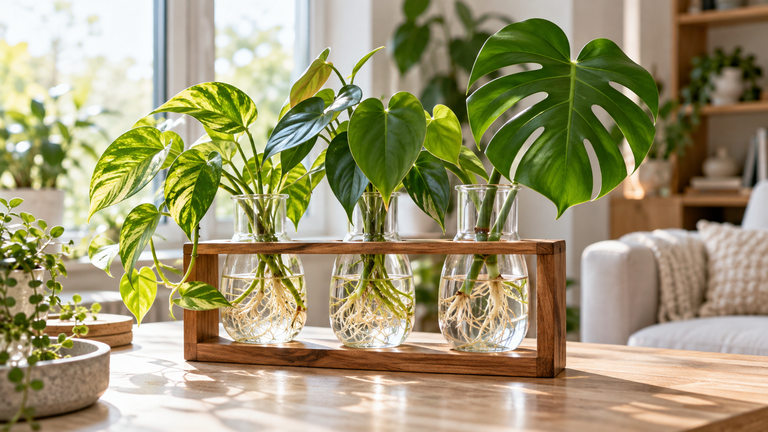
The fastest propagating plants usually root from nodes, offsets, or plantlets. Vining plants are especially easy because their nodes root quickly in water or soil. Pothos and Philodendron are among the easiest. Spider Plant naturally produces plantlets, making propagation almost automatic.
Fastest propagating indoor plants:
- Pothos
- Spider Plant
- Philodendron
- Tradescantia zebrina
- Syngonium podophyllum
Best propagation methods:
- Water propagation → Pothos, Philodendron
- Plantlet separation → Spider Plant
- Stem cuttings → Tradescantia zebrina, Syngonium podophyllum
Propagation mistakes:
- No node included
- Dirty water
- Weak lighting
- Planting too early
Decision clarity: For easiest propagation, choose Pothos because it roots fast and recovers quickly.
What Makes Indoor Plants Grow Faster?
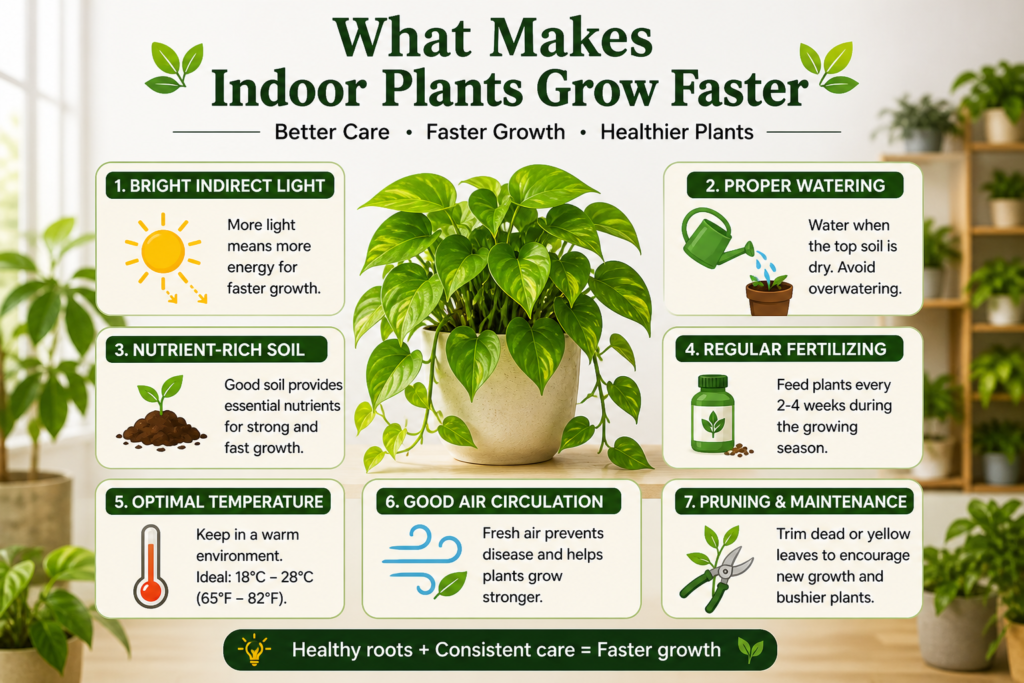
Fast-growing indoor plants still need the right conditions to reach their full potential. A plant with strong growth genetics can become weak, slow, or leggy if the environment is poor. Growth depends on how well a plant converts light, water, and nutrients into new leaves and roots.
The five biggest growth drivers are light, watering consistency, nutrients, root space, and temperature stability. Light is the strongest factor because it powers photosynthesis. Watering protects root health. Fertilizer supports new leaf production. Root space allows expansion, and warmth keeps plant metabolism active.
Growth accelerators:
- Bright indirect light
- Proper watering intervals
- Seasonal fertilizer
- Repotting when root-bound
- Stable room temperatures
- Better humidity
Common growth blockers:
- Dark rooms
- Wet soil
- Cold drafts
- Poor drainage
Decision clarity: If your plant is growing slowly, improve light first. Most indoor growth problems start there.
Where Should You Place Fast-Growing Indoor Plants?
Plant placement affects both growth speed and visual impact. Many people place plants only for decoration, but plants also need the right environment. A beautiful plant in the wrong spot may become weak, stretched, or slow-growing.
Different rooms offer different advantages. Bedrooms are calmer and usually have stable temperatures. Living rooms often provide better light and space for larger plants. Offices need low-maintenance plants. Kitchens often have higher humidity, which benefits tropical growers.
Best room-based placements:
Bedroom
- Best plants: Snake Plant, Pothos, Peace Lily
- Best placement: bedside, window corner, shelf
Living room
- Best plants: Monstera deliciosa, Rubber Plant, Areca Palm
- Best placement: bright corners, floor pots, near windows
Office
- Best plants: ZZ Plant, Snake Plant, Pothos
- Best placement: desks, shelves, corners
Decision clarity: Match your room first, then choose the plant. Good placement often matters more than plant type.
Common Mistakes That Slow Indoor Plant Growth
Many indoor plants are naturally fast growers, but common mistakes reduce growth. Overwatering, poor light, wrong pot size, heavy soil, and cold drafts are the most common reasons plants slow down.
The biggest mistake is overwatering. Roots need oxygen, and wet soil removes that oxygen. Damaged roots cannot move nutrients properly, so growth stops. Poor light is another major issue because plants cannot create enough energy.
Top mistakes:
- Overwatering
- Poor light placement
- Root-bound pots
- Heavy compact soil
- Lack of fertilizer
- Cold drafts
- Poor drainage
- Over-pruning
Signs of slowed growth:
- Yellow leaves
- Smaller new leaves
- Weak stems
- Leaf drop
- Slow new growth
Quick fixes:
- Improve light
- Reduce watering
- Repot if root-bound
- Use better soil
- Feed during growing season
Decision clarity: When growth slows, check light, roots, and watering before assuming the plant is unhealthy.
Growth Acceleration Checklist
Fast-growing indoor plants respond well to small, consistent improvements. A checklist helps you avoid guessing and keeps care simple. It also makes troubleshooting easier when a plant slows down.
Consistency matters more than intensity. Small correct actions repeated over time create stronger plant growth than random heavy watering or overfeeding.
Growth checklist:
- Bright indirect light
- Correct watering schedule
- Drainage holes
- Seasonal fertilizer
- Root inspections
- Humidity support
- Stable temperatures
- Occasional pruning
- Seasonal repotting
- Good airflow
Best monthly habits:
- Check roots
- Rotate plant for even light
- Clean leaves
- Inspect pests
- Adjust watering by season
Decision clarity: Healthy fast growth is not luck. It is a system. Build the system, and the plant follows.
Fast-Growing Indoor Plants vs Slow-Growing Indoor Plants
Not every indoor plant grows at the same speed. Fast-growing plants create quicker decorative impact and fill empty spaces faster. Slow-growing plants usually offer stronger structure, easier control, and less pruning.
Neither type is better for everyone. The right choice depends on your goal. If you want fast transformation, choose fast growers. If you want easy long-term control, choose slower plants.
Fast-growing plants:
- Pothos
- Philodendron
- Spider Plant
- Tradescantia zebrina
Slow-growing plants:
- Snake Plant
- ZZ Plant
- Dracaena marginata
Best for fast growth:
- Quick room styling
- Fast propagation
- Faster decorative fullness
Best for slow growth:
- Minimal pruning
- Stable structure
- Long-term shape control
Decision clarity: Choose fast growers for quick results. Choose slow growers for easier long-term management.
Which Indoor Plants Are Best for Air Purification and Fast Growth?
Many people buy indoor plants for beauty, but air quality is another common reason. Houseplants should not replace ventilation, but dense foliage can improve the feeling of freshness and support humidity balance indoors.
Fast-growing air-supporting plants are useful because they build leaf mass quickly. More foliage means more visual fullness and stronger room presence. Pothos, Spider Plant, Peace Lily, Snake Plant, Philodendron, and Areca Palm are strong choices.
Best air-supporting fast growers:
- Pothos
- Spider Plant
- Peace Lily
- Snake Plant
- Philodendron
- Areca Palm
Best room matching:
- Bedrooms → Snake Plant
- Living rooms → Areca Palm
- Kitchens → Spider Plant
- Offices → Pothos
Decision clarity: If you want fast growth plus fuller indoor greenery, Pothos is the strongest all-around choice.
How Much Do Fast-Growing Indoor Plants Cost?
Indoor plant prices vary by size, maturity, rarity, and local availability. Starter plants are affordable but take longer to fill a room. Larger plants cost more but provide instant decorative impact.
Fast-growing plants are usually affordable because many propagate easily. Pothos and Spider Plant are often inexpensive. Larger statement plants like Monstera deliciosa and Rubber Plant cost more, especially when mature.
Typical indoor plant price ranges:
- Starter plants: $5–15
- Medium decorative plants: $15–40
- Large floor plants: $40–120
- Rare or variegated plants: $100–300+
Smart buying tips:
- Buy healthy roots over bigger leaves
- Avoid damaged discount plants
- Compare nursery and online pricing
Decision clarity: For the best value, medium-sized Pothos and Philodendron usually offer the strongest price-to-growth ratio.
Where to Buy Healthy Indoor Plants
Buying a healthy plant matters more than choosing the perfect species. A weak plant with pests, damaged roots, or poor structure can fail even with good care. Many indoor plant problems begin at purchase.
You can buy from local nurseries, garden centers, or online plant shops. Local nurseries are often best for beginners because you can inspect the plant before buying. Online stores are useful for rare plants, but shipping stress can affect condition.
Best places to buy:
- Local nurseries
- Garden centers
- Online specialty plant shops
Healthy plant checklist:
- White or light healthy roots
- Firm upright stems
- Even leaf spread
- No yellowing
- No pest damage
- No bad root smell
Avoid buying if you see:
- Soft stems
- Fungus gnats
- Brown root rot
- Severe leaf damage
Decision clarity: For beginners, local nurseries are usually safest because plant inspection is easier.
How to Choose the Right Fast-Growing Indoor Plant
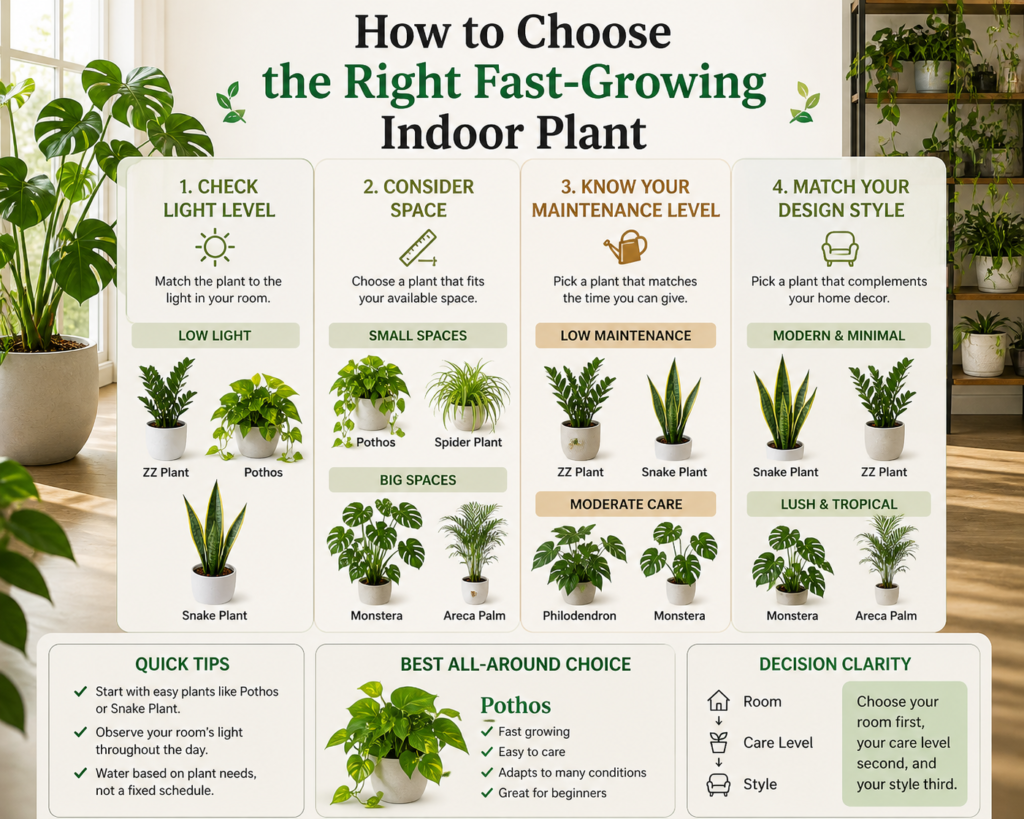
Choosing the right indoor plant is less about trends and more about matching the plant to your room and habits. Many plant failures happen because people choose based on looks only. A beautiful plant in the wrong room will still struggle.
The best choice depends on four things: light, space, maintenance level, and design style. Small spaces benefit from structured plants like Snake Plant or ZZ Plant. Larger rooms can handle Monstera deliciosa, Areca Palm, or Rubber Plant. Weak-light rooms need adaptable plants like Pothos and Philodendron.
Low light
- Pothos
- Philodendron
- ZZ Plant
Small spaces
- Snake Plant
- Spider Plant
Big spaces
- Monstera deliciosa
- Areca Palm
- Rubber Plant
Beginners
- Pothos
- Spider Plant
Decision clarity: Choose your room first, your care level second, and your style third.
Final Thoughts
Fast-growing indoor plants solve one of the biggest indoor gardening frustrations: waiting too long for visible results. They create quicker decorative change, stronger greenery, and faster satisfaction.
The best plant depends on your goal. If speed matters most, choose Pothos. If beauty matters most, choose Monstera deliciosa. If low maintenance matters most, choose ZZ Plant or Snake Plant. If you want an easy beginner plant, choose Spider Plant or Pothos.
Best final picks:
- Fastest overall → Pothos
- Most beautiful → Monstera deliciosa
- Lowest maintenance → ZZ Plant
- Best beginner plant → Spider Plant
- Best structured look → Snake Plant
Decision clarity: For most people, Pothos remains the best first indoor plant because it offers the strongest balance of speed, beauty, and forgiveness.
FAQ SECTION
What is the fastest-growing indoor plant?
Pothos is one of the fastest-growing indoor plants, often producing 8–18 inches of vine growth per month in bright indirect light.
Which indoor plants grow fast in low light?
Pothos, Philodendron, and ZZ Plant are strong low-light performers. They keep growing steadily in filtered or weaker indoor light.
Which fast-growing indoor plants are safe for pets?
Spider Plant, Areca Palm, and Parlor Palm are safer choices for homes with pets. Avoid Pothos and Philodendron around cats and dogs.
Which indoor plant grows fastest for beginners?
Pothos is the best beginner-friendly fast grower because it is easy to care for, grows quickly, and recovers well from mistakes.
How often should I repot fast-growing indoor plants?
Most fast-growing indoor plants need repotting every 12–18 months. If roots are crowded or growth slows, move to a slightly larger pot.
Why is my fast-growing indoor plant growing slowly?
Slow growth is usually caused by poor light, overwatering, crowded roots, or lack of nutrients. Check light first.
Can grow lights make indoor plants grow faster?
Yes. Full-spectrum grow lights can support faster growth when natural light is weak, especially in apartments and offices.
Which indoor plant grows fastest in apartments?
Pothos, Philodendron, and Spider Plant grow well in apartments because they adapt to indoor light and smaller spaces.
Which indoor plants grow fastest in water?
Pothos and Philodendron root and grow quickly in water. Change the water regularly to prevent weak roots.
Which indoor plants look the most expensive?
Monstera deliciosa, Rubber Plant, and Areca Palm create a premium indoor look because of their large, structured foliage.
Myra is the founder and lead writer of Plantsaholic. She shares practical, research-backed advice on indoor plants, outdoor gardening, flowers, herbs, succulents, and everyday plant care. Her goal is to help gardeners of all experience levels grow healthier plants through simple, easy-to-follow gardening guides.