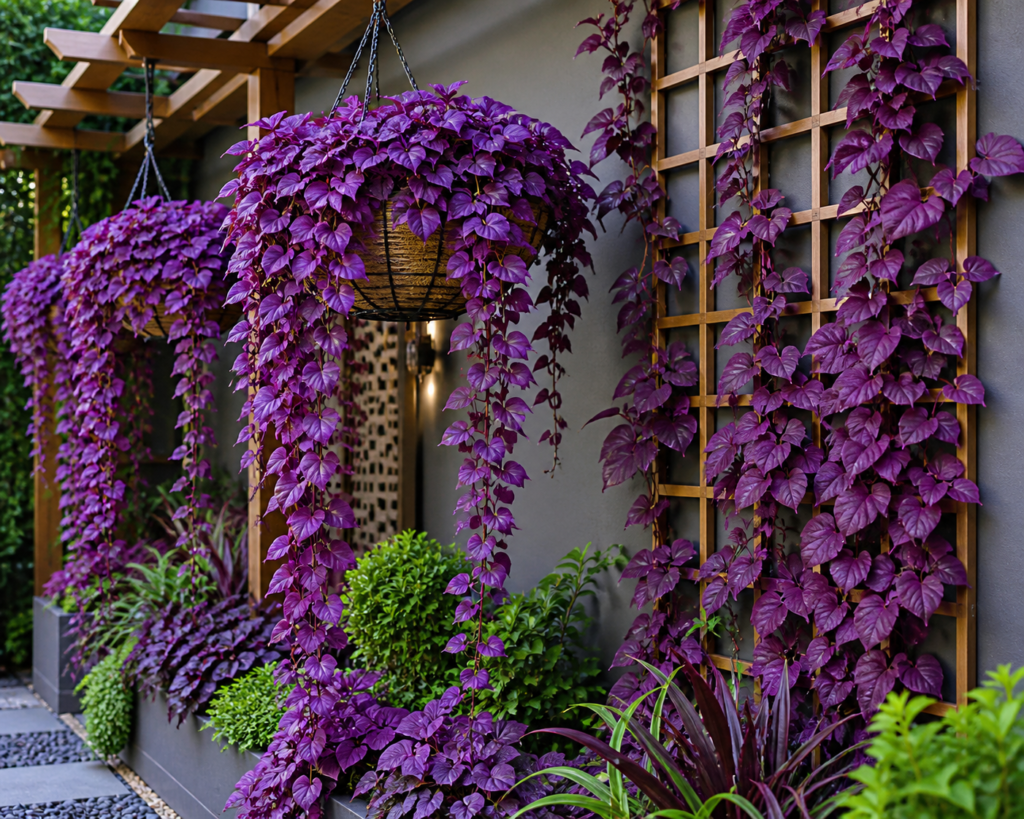
These plants can climb trellises, spill from hanging baskets, soften fences, cover balcony rails, trail indoors, or spread as colorful ground cover. Their shades range from plum and burgundy to deep violet-black, making them useful against green, silver, white, and yellow companion plants.
The purple color usually comes from anthocyanins, natural pigments that help plants respond to light, temperature, and stress. This guide explains the best purple vine plants, how to grow them, where to use them, and how to avoid common mistakes.
What Are Vine Purple Leaf Plants?
Vine purple leaf plants are climbing, trailing, or creeping ornamentals valued mainly for purple-toned foliage. Some also flower, but their strongest visual feature is usually the leaves. The word “vine” includes several habits: some plants climb upward, some cascade from baskets, and others spread across soil as ground cover.
They are especially useful when a garden looks too flat or too green. Dark purple foliage creates contrast, separates layers, and makes fences, walls, containers, and balconies look more intentional.
Common growth habits include:
- Climbing growth
- Cascading growth
- Ground-creeping spread
- Container spill-over
- Indoor shelf trailing
Common uses include trellis decoration, hanging baskets, fence coverage, ground cover, patio planters, balcony railing coverage, and indoor styling. A plain wooden fence covered only with green vines may disappear into the background, but adding Tradescantia pallida or Rhodochiton atrosanguineus creates depth and stronger visual interest.
Decision clarity: purple leaf vines are best for gardeners who want color beyond flowering seasons.
How Long Do Purple Vine Plants Live?
Purple vine lifespan depends on species, climate, and growing method. Some are true perennials in warm climates and can live for many years. Others are treated as annuals in cold regions because frost damages or kills the top growth.
Tradescantia pallida can live for years in warm zones with pruning and propagation. In colder areas, it may need indoor protection or seasonal replacement. Container vines often live for a shorter time because roots dry faster and have limited space.
Average lifespan by type:
- Short-term: ornamental annual vines and frost-sensitive tropical vines
- Medium-term: container-grown tropical vines and indoor trailing vines
- Long-term: perennial outdoor vines with healthy root systems
To extend lifespan, prune regularly, refresh soil every 1–2 years, use proper drainage, protect plants from frost, and divide crowded roots when needed. Many growers think a vine died early when the real issue was root congestion in a small pot.
Decision clarity: purple vines can be short-lived or long-lived depending on how well the growing environment matches their natural needs.
Why Are Purple Leaf Vines Popular in Landscaping?
Purple leaf vines are popular because they provide color, movement, and space efficiency at the same time. Modern gardens increasingly use foliage-based design because flowers are seasonal, while foliage gives structure for a longer period.
Purple foliage creates immediate separation because it is darker than green. This helps plants stand out instead of blending into one flat mass. Purple vines also soften hard structures such as fences, walls, balcony rails, pergolas, and patio edges.
Key advantages include:
- Long ornamental season
- Strong contrast
- Fast growth
- Vertical coverage
- Easy propagation
- Better container performance
- Lower replacement cost
In urban balcony gardening, purple vines allow growers to use upward and downward space instead of only floor area. A strong design pairing is Tradescantia pallida with Dichondra argentea, where dark purple foliage contrasts with silver trailing foliage.
Decision clarity: purple vines are popular because they solve color, movement, and space problems in one plant category.
Which Purple Leaf Vine Plants Are Best for Different Uses?
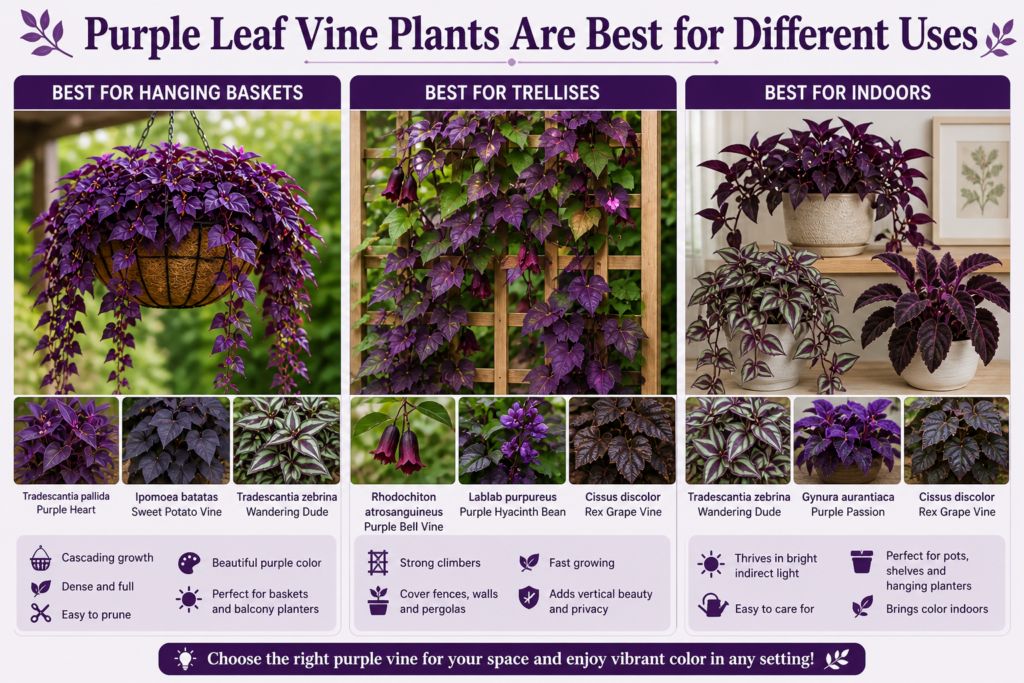
The best purple vine depends on how you want to use it. A plant that looks beautiful in a hanging basket may not climb well on a trellis, and a strong outdoor vine may become too aggressive indoors. Choose by function first, beauty second.
Best for Hanging Baskets
Hanging baskets need trailing density, color retention, and balanced spill. The goal is cascading movement, not climbing.
- Tradescantia pallida — best all-around hanging purple vine
- Ipomoea batatas — dramatic large leaves and fast spill
- Tradescantia zebrina — compact, striped, and beginner-friendly
Use at least a 10–12 inch basket because smaller baskets dry too quickly.
Best for Trellises
Trellises need vines with climbing behavior, flexible stems, and good vertical coverage. Best choices include Rhodochiton atrosanguineus, Lablab purpureus, and Cissus discolor in protected areas.
Use strong support materials such as metal, cedar, or coated wire. Avoid weak plastic supports because mature vines gain weight.
Best for Indoors
Indoor vines need bright indirect light, compact growth, and container adaptability. Good choices include Tradescantia zebrina, Gynura aurantiaca, Cissus discolor, and Tradescantia pallida in strong light.
Decision clarity: match the vine to the use case before buying.
Are Purple Vine Plants Fast Growing?
Many purple vine plants are fast growers, but speed depends on species, temperature, light, root space, and moisture. Fast growth is useful for quick coverage, but it also means more pruning.
The fastest common purple foliage vine is Ipomoea batatas. In warm weather and strong light, it can quickly fill containers or garden beds. This makes it excellent for fast visual impact but less ideal for tiny indoor spaces.
- Fast growers: Sweet Potato Vine and Purple Hyacinth Bean
- Moderate-fast growers: Purple Heart and Wandering Dude
- Slower growers: Purple Passion and Rex Begonia Vine
Growth improves with warm temperatures, longer daylight, balanced feeding, root space, and consistent moisture. Fast vines look impressive early, but without pruning they can become messy. Moderate growers often provide the best balance for home gardeners.
Decision clarity: choose fast growers for quick coverage and moderate growers for easier control.
How Do You Choose the Right Purple Vine for Your Space?
The right purple vine is not always the prettiest one. It is the one that fits your space, climate, light, and maintenance level. Before buying, ask whether the space is indoor or outdoor, whether the vine needs to hang, climb, or spread, how much light the area receives, and whether you can prune regularly.
- Sun-heavy spaces: Purple Heart and Sweet Potato Vine
- Partial shade spaces: Wandering Dude and Purple Passion
- Low-maintenance choices: Purple Heart and Wandering Dude
- Higher-maintenance choices: Purple Bell Vine and Rex Begonia Vine
Climate Zones
Purple vine performance depends heavily on climate. Many are tropical or subtropical, so frost protection matters. Purple Heart and Wandering Dude often perform well in warmer zones, while Sweet Potato Vine and Purple Passion prefer mild to warm conditions. Rex Begonia Vine and Purple Passion are often safer as protected indoor plants in colder regions.
A balcony with harsh afternoon sun may burn sensitive vines like Rex Begonia Vine but support Purple Heart well. A vine that thrives outdoors in warm climates may need indoor winter protection elsewhere.
Decision clarity: climate mismatch causes more plant failure than most care mistakes.
What Makes Purple Leaves Purple?
Purple coloration usually comes from anthocyanins, plant pigments responsible for red, purple, and blue tones in leaves, stems, flowers, and fruits. These pigments help plants respond to light, temperature, and environmental pressure.
Purple intensity is not fixed. It changes based on growing conditions. Higher light often deepens purple pigment, while low light usually makes foliage greener. Cooler nights may strengthen purple tones in some plants, especially Sweet Potato Vine. Too much nitrogen can increase chlorophyll and reduce purple intensity.
Genetics also matter. Some plants naturally produce stronger pigment than others. Strong examples include Tradescantia pallida and Gynura aurantiaca.
Gardeners often think a purple plant is failing when leaves turn green. In many cases, the plant is simply responding to reduced light or excess nitrogen.
Decision clarity: purple color is partly genetic, but environment controls how strong it appears.
How Do You Care for Purple Leaf Vine Plants?
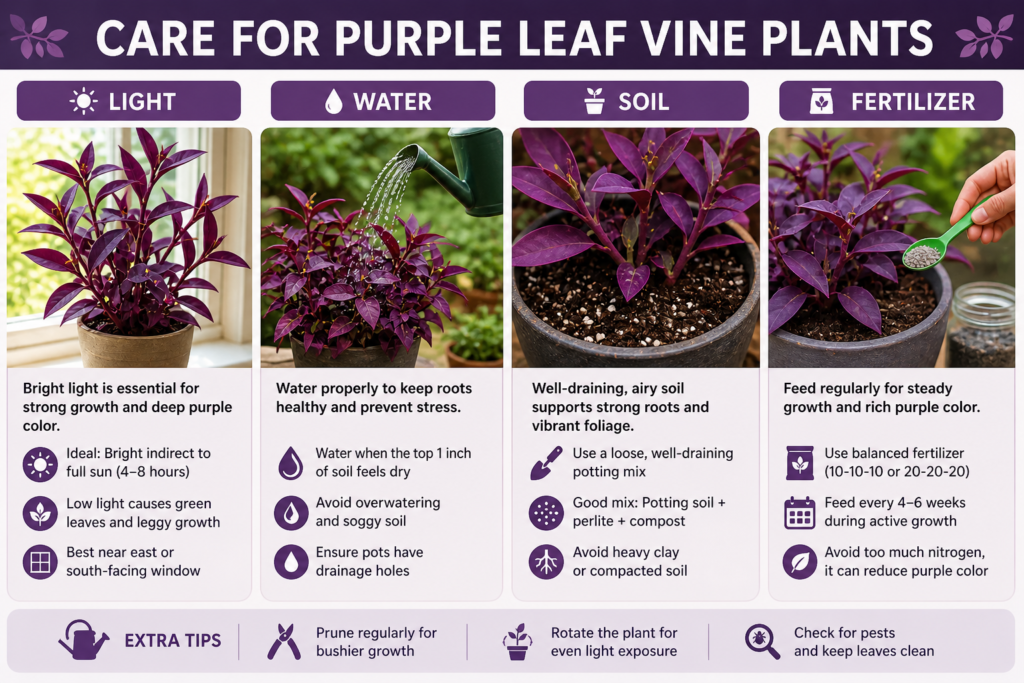
Purple vine care depends on species, but most need good light, careful watering, airy soil, and balanced feeding. The goal is steady growth, strong color, and healthy roots.
Light
Light is the biggest factor affecting foliage density and purple color. Without enough light, stems stretch, leaves space out, and purple tones fade. Tradescantia pallida and Ipomoea batatas handle stronger light, while Tradescantia zebrina and Gynura aurantiaca prefer bright filtered light. Indoors, east-facing windows often work best.
Water
Water when the top inch of soil feels dry. Do not water by calendar alone. Overwatering causes yellow leaves, soft stems, fungus gnats, and root rot. Underwatering causes curling leaves, crispy edges, and dull color. Hanging baskets dry faster than ground soil because air surrounds the root zone.
Soil
Purple vines perform best in airy, fast-draining soil. A good container mix includes potting soil, perlite, compost, and bark fines. Avoid heavy clay, waterlogged soil, hard-packed beds, and salt-heavy potting mixes.
Fertilizer
Feed for stability, not speed. Too much nitrogen can reduce purple color. Use balanced fertilizer, diluted liquid feed, compost, worm castings, or fish emulsion during active growth. Feed every 4–6 weeks and avoid heavy winter feeding.
Decision clarity: healthy purple vines depend more on balanced care than aggressive feeding.
How Do You Prune and Propagate Purple Vine Plants?
Pruning and propagation are two major advantages of purple vines. Pruning keeps plants full, while propagation lets you create more plants from cuttings.
Pruning
Without pruning, many vines become leggy, sparse, and weak-looking. Regular trimming improves density, shape, airflow, and pest control. Tradescantia pallida and Tradescantia zebrina respond especially well to pruning.
Cut above leaf nodes because nodes trigger branching. Light pruning every 2–4 weeks during active growth is better than rare heavy pruning.
Propagation
The easiest propagation method is stem cuttings. Tradescantia pallida and Tradescantia zebrina root very easily in water or moist soil.
- Cut a 4–6 inch stem.
- Remove lower leaves.
- Place nodes in water.
- Keep in bright light.
- Wait for roots.
Rooting often takes 5–14 days. Soil propagation also works well for Ipomoea batatas. Insert cuttings into moist soil and keep conditions stable.
Decision clarity: purple vines are among the easiest ornamental plants to multiply.
What Pests and Diseases Affect Purple Vine Plants?
Purple vines are generally strong, but they can suffer from pests and diseases when conditions are poor. Most problems begin with dry air, overwatering, weak airflow, or crowded growth.
Common pests include spider mites, aphids, mealybugs, whiteflies, and fungus gnats. Spider mites are common indoors, especially in dry air. Aphids target fresh growth and often leave sticky residue. Mealybugs hide around nodes and stem joints.
Common treatments include neem oil, insecticidal soap, alcohol swabs for mealybugs, better airflow, and regular inspection. Common diseases include root rot, powdery mildew, and fungal leaf spots. Root rot usually comes from overwatering or poor drainage, while powdery mildew often appears when humidity is high and airflow is weak.
Prevention checklist:
- Water properly
- Use drainage holes
- Improve airflow
- Prune crowded stems
- Inspect leaves weekly
Decision clarity: Most pest and disease problems are preventable through better environment control.
How Do Purple Vine Plants Perform Across Seasons?
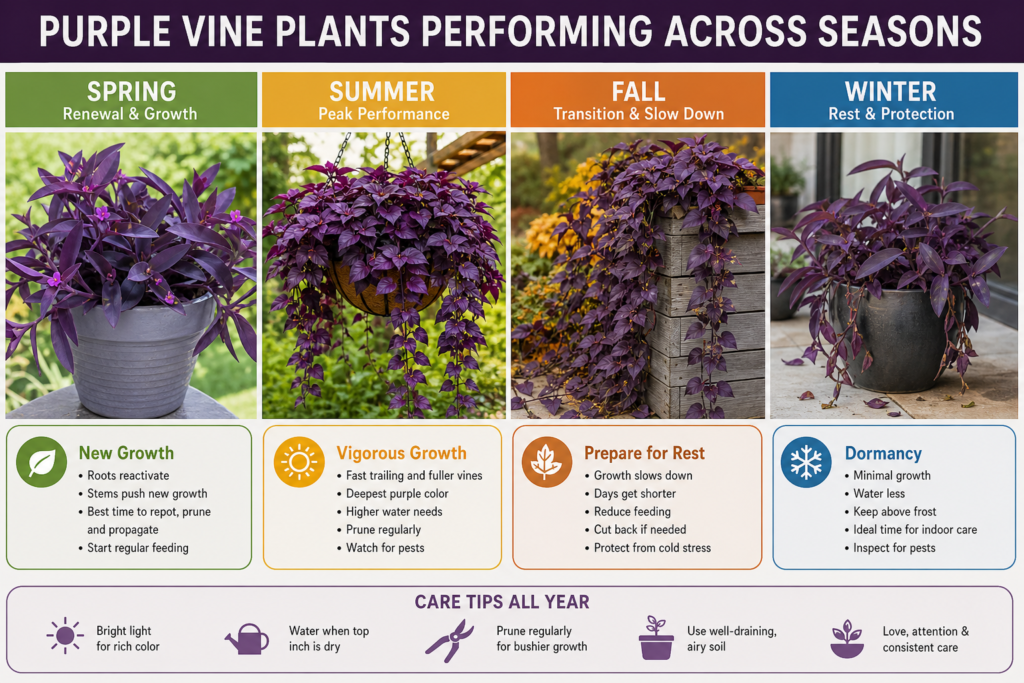
Purple vine plants change through the year. Growth speed, color strength, water use, and pruning response all shift with seasonal conditions.
Spring is the best recovery period. Roots reactivate, stems push new growth, and pruning wounds heal faster. It is the ideal season for repotting, fertilizing, dividing, and propagation.
Summer is peak performance season. Expect faster trailing, stronger color, higher water use, and more frequent pruning. This is when purple foliage often reaches its strongest visual impact.
Fall is a transition period. Growth slows, temperatures change, and plants prepare for reduced activity. Reduce fertilizer and watch for cold stress.
Winter is dormancy or semi-dormancy for many purple vines. Water less, avoid heavy pruning, and protect tropical vines from frost.
- Spring: repot, prune, propagate, fertilize
- Summer: monitor water, watch pests, support fast growth
- Fall: reduce feeding, watch cold stress
- Winter: protect from frost, reduce watering
Decision clarity: purple vine care should change with the season.
How Can You Use Purple Leaf Vine Plants in Landscape Design?
Purple vines work best as contrast tools. They combine movement with color stability, making them valuable for fences, containers, ground cover, trellises, balconies, and vertical accents.
In landscape design, purple acts as a dark anchor. It improves depth, layering, focal contrast, and spatial definition. Best design uses include fence softening, pergola coverage, entry framing, retaining wall spill, vertical accents, and balcony rails.
Containers
Purple vines are classic spiller plants. They soften pot edges and add movement. Good choices include Tradescantia pallida, Tradescantia zebrina, and Ipomoea batatas. Use hanging baskets, tall ceramic pots, wall planters, or raised containers with drainage holes.
Ground Cover
Some purple vines also work as ground cover because they spread horizontally and root at nodes. Purple Heart and Sweet Potato Vine can cover soil, suppress weeds, stabilize roots, and provide color consistency. Use spread control because aggressive vines can overtake nearby plants.
Companion Planting
Purple vines pair well with Dichondra argentea, Heuchera, petunia, coleus, silver foliage plants, and white flowers. The best formula is dark foliage plus bright contrast plus texture diversity.
Decision clarity: use purple vines as accents and contrast layers, not as the only dominant color.
Can Purple Vine Plants Grow Successfully Indoors?
Yes, many purple vines grow well indoors if they receive bright indirect light, proper drainage, and stable humidity. Indoor growth is usually slower, but the plants can remain very decorative.
Best indoor species include Gynura aurantiaca, Tradescantia zebrina, Cissus discolor, and Tradescantia pallida. Best indoor locations include window shelves, hanging planters, plant stands, and bright decorative corners.
East-facing windows are ideal. South-facing windows can work with filtering. North-facing windows are often too weak. Humidity matters for Rex Begonia Vine and Purple Passion, so pebble trays, humidifiers, and plant grouping can help.
Are Purple Vine Plants Toxic to Pets or Children?
Some purple vine plants may cause mild irritation if chewed or handled. Tradescantia zebrina and Tradescantia pallida can irritate some pets or sensitive skin.
- Keep trailing vines out of pet reach
- Use hanging baskets
- Wash hands after pruning
- Verify species safety before buying
Decision clarity: indoor purple vines are beautiful, but pet households should check plant safety first.
What Are the Most Common Mistakes with Purple Leaf Vine Plants?
Most purple vine failures come from care mistakes, not weak plants. These vines are resilient, but poor management creates predictable problems.
- Too little light
- Overwatering
- Too much nitrogen fertilizer
- No pruning
- Poor drainage
- Wrong climate placement
- No pest inspection
Low light causes faded color, longer stems, and weak growth. Overwatering causes root rot, fungus gnats, and stem collapse. Too much nitrogen creates greener growth and reduces purple intensity.
Prevent these problems by checking soil before watering, using drainage holes, pruning regularly, rotating indoor pots, watching leaf color changes, and inspecting for pests weekly.
Decision clarity: most purple vine problems can be prevented with small routine adjustments.
How Much Do Purple Leaf Vine Plants Cost?
Purple leaf vines are usually affordable because many grow quickly, propagate easily, and are widely available. Prices vary by size, rarity, cultivar demand, and source.
- Starter cuttings: $5–15, best for budget growers and propagation plans
- Young nursery plants: $15–35, common for Ipomoea batatas and Gynura aurantiaca
- Mature specialty plants: $35–100+, common for Cissus discolor and rare cultivars
Buying Healthy Plants
Healthy roots matter more than beautiful leaves. Look for white or light tan roots, firm texture, and no sour smell. Avoid black roots, mushy roots, rotten odor, heavy root circling, webbing, holes, and leaf spotting.
Avoiding Transplant Shock
Transplant failure often comes from sudden environmental change, not bad plant quality. Common causes include root damage, soil change shock, water imbalance, light change, and temperature shift. Reduce shock by watering before transplanting, avoiding midday heat, matching light gradually, and waiting before fertilizing.
Decision clarity: buy smaller healthy plants over larger stressed plants.
Purple Vine Plants vs Green Vine Plants: Which Is Better?
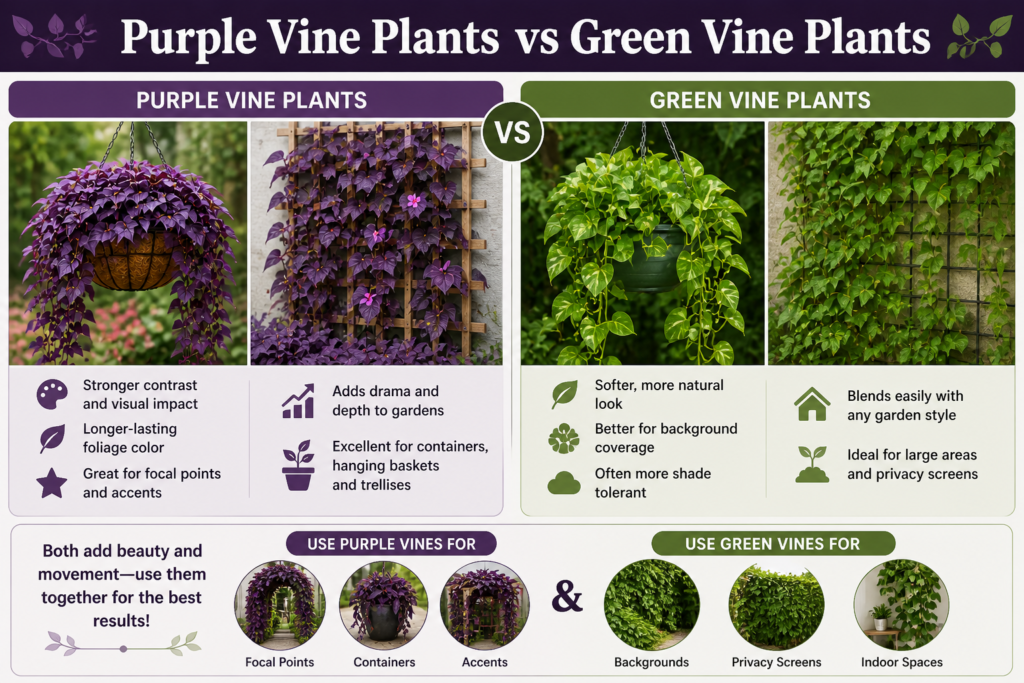
Purple vines and green vines serve different ornamental roles. Neither is universally better. Purple vines are stronger for contrast, while green vines are better for blending.
- Purple vine advantages: stronger contrast, longer color interest, better focal impact, dramatic containers
- Green vine advantages: softer transitions, easier background coverage, better shade tolerance, neutral appearance
Examples of green comparison vines include Philodendron hederaceum, pothos, and clematis. Use purple vines for focal points, green vines for background coverage, and both together for stronger hierarchy.
Decision clarity: purple vines are better for impact, while green vines are better for blending.
Are Purple Leaf Vine Plants Worth Growing?
Yes, purple leaf vines are worth growing for gardeners who want long-lasting color, flexible placement, and strong visual contrast. They offer more consistent ornamental value than many flower-only vines.
- Beginners: Tradescantia zebrina
- Low-maintenance growers: Tradescantia pallida
- Collectors: Cissus discolor
- Fast coverage: Lablab purpureus and Ipomoea batatas
Potential downsides include frequent pruning, color loss in low light, and frost sensitivity. However, these issues are manageable when the right plant is matched to the right space.
Decision clarity: purple vines are one of the smartest foliage-first investments for ornamental gardening.
Final Thoughts: Should You Grow Purple Leaf Vine Plants?
Purple leaf vine plants offer one of the strongest combinations of ornamental value and flexibility in gardening. They provide color without depending on flower cycles, movement without requiring large shrubs, and propagation opportunities that reduce long-term plant costs.
They work in hanging baskets, trellises, fences, containers, indoor shelves, vertical gardens, and ground-cover systems. Best starter choice is Tradescantia pallida. Best indoor choice is Gynura aurantiaca. Best trellis choice is Rhodochiton atrosanguineus. Best fast grower is Ipomoea batatas.
Start with one easy species, learn its behavior, then expand through propagation. This builds experience with lower cost.
Final decision clarity: Purple leaf vines are worth growing if your goal is stronger foliage contrast, longer ornamental seasons, and better vertical garden design.
Frequently Asked Questions About Purple Leaf Vine Plants
Which purple vine plant is easiest for beginners?
Tradescantia zebrina is one of the easiest because it grows fast, roots easily, and tolerates common care mistakes.
Which purple vine grows the fastest?
Ipomoea batatas is one of the fastest-growing purple vines in warm weather and strong light.
Why are my purple vine leaves turning green?
Purple leaves usually turn green because of low light or too much nitrogen fertilizer. Better light and balanced feeding often restore stronger color.
Can purple vine plants grow indoors?
Yes. Many grow indoors with bright indirect light and proper drainage. Tradescantia zebrina and Gynura aurantiaca are strong indoor choices.
Do purple vine plants need full sun?
Not all need full sun, but most need bright light to maintain strong color. Tradescantia pallida develops deeper purple in stronger light.
How often should I water purple vine plants?
Water when the top inch of soil feels dry. Avoid fixed schedules because overwatering is a main cause of root rot.
Are purple vine plants toxic to cats and dogs?
Some may cause mild irritation or stomach upset if chewed. Always verify the exact species before placing trailing vines near pets.

Myra is the founder and lead writer of Plantsaholic. She shares practical, research-backed advice on indoor plants, outdoor gardening, flowers, herbs, succulents, and everyday plant care. Her goal is to help gardeners of all experience levels grow healthier plants through simple, easy-to-follow gardening guides.