Indoor plants rarely decline without warning. Before serious damage happens, they show stress signals. One of the most overlooked causes is inadequate light. Many plant owners focus on watering first because it feels easier to manage, while light problems are harder to identify.
But light controls almost everything. Without enough usable light, plants produce less energy, leading to weaker roots, slower growth, smaller leaves, fewer flowers, and slower recovery.
Low-light stress often looks like other problems. Pale leaves may resemble nutrient issues, wet soil may seem like overwatering, and slow growth may look like dormancy. That confusion delays the right fix.
This guide covers the clearest signs of low-light stress, how to confirm them, and how to fix them before plant growth declines further.
What Happens When a Plant Doesn’t Get Enough Light?
A plant without enough light reduces energy production, shifts priorities, and enters survival mode.
How Low Light Reduces Plant Energy Production
Plants depend on Photosynthesis to convert light into sugars. Those sugars fuel roots, stems, leaves, flowering, defense, and repair. When light drops below the plant’s minimum requirement, sugar production slows.
That changes everything.
How Plants Reprioritize Growth Under Low Light
Plants work on energy priorities.
When energy is abundant, growth expands.
When energy is limited, growth contracts.
The plant protects essentials first.
That energy hierarchy usually follows this order:
- root survival
- leaf maintenance
- stem support
- flowering
- expansion growth
That means flowering and larger leaves are often reduced first.
Growth slows.
Leaf size shrinks.
Root development weakens.
Why Low Light Causes Etiolation
This often triggers Etiolation.
Etiolation is emergency growth.
Not healthy growth.
Signs include:
- stretched stems
- pale foliage
- wider internodes
- weaker support
- unstable structure
How Low Light Affects Root Strength and Water Use
How Low Light Reduces Energy Reserves
Low light also affects carbohydrate storage.
Plants store extra sugars when light is strong.
That stored energy helps recovery during stress.
But weak light reduces storage.
And when stored sugars drop too low, resilience drops too.
This often leads to:
- weaker recovery after pruning
- slower healing
- slower new growth
Why Root Growth Slows in Weak Light
Root systems also slow.
Roots depend on sugars produced in leaves.
Less light means fewer sugars.
Fewer sugars mean slower roots.
And slower roots absorb water more slowly.
That explains why light problems often create watering symptoms.
Low light also slows transpiration.
Transpiration moves water upward through the plant.
When transpiration slows, it causes:
- soil dries slower
- roots stay wetter
- oxygen levels drop
That creates root stress.
And root stress slows growth further.
This creates a cycle:
low light → weak sugar production → slower roots → slower water use → wetter soil → more stress
Real-World Example: How Snake Plants Perform in Different Light Levels
Real-world example:
A Snake Plant tolerates low light well.
But tolerance is not performance.
Compare one beside an east-facing window versus one in a dark hallway.
The brighter plant grows thicker, stronger, and faster.
The darker plant survives.
But barely develops.
That difference is light performance.
Why Does Your Plant Become Leggy in Low Light?
Leggy growth happens because the plant stretches toward light faster than it can build strong structure.
Why Low Light Causes Leggy Growth
Legginess is one of the strongest low-light signals.
It is driven by Phototropism.
Phototropism is the process where plants bend toward light.
That is normal.
But low light exaggerates it.
The plant stretches harder.
What Leggy Growth Looks Like
That creates:
- thin stems
- sparse foliage
- weak support
- wider internodes
Leggy growth is not random.
It is a survival strategy.
The plant is trying to locate stronger light.
How Internode Spacing Reveals Low-Light Stress
Internodes are one of the easiest ways to confirm it.
Internodes are the spaces between leaves.
Healthy light creates tighter internodes.
Weak light creates wider internodes.
That spacing reveals plant behavior.
The wider the spacing, the stronger the stretch response.
Which Plants Show Leggy Growth the Fastest?
This pattern is especially visible in:
- Pothos
- Philodendron
- Tradescantia
- Coleus
Stem thickness matters too.
Low-light stems often become thinner because the plant spends energy on length, not strength.
That creates weak support.
This makes stems bend more easily.
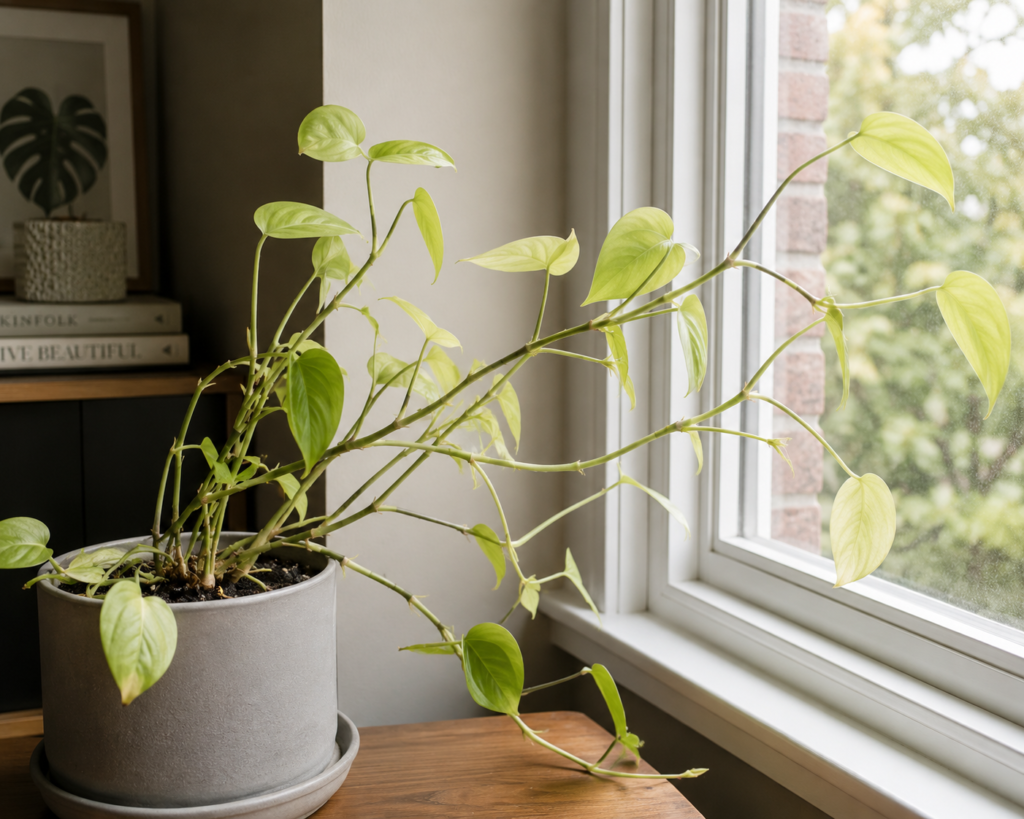
Real-World Example: Why Pothos Gets Leggy in Low Light
A healthy Pothos in bright indirect light grows compactly.
Leaves stack closer.
Vines stay fuller.
Move it deeper into the room and it stretches.
Leaves become spaced apart.
Stems weaken.
Same plant.
Same soil.
Same water.
Different light.
That proves the cause.
Can Leggy Growth Be Fixed?
Important reality:
Leggy growth does not reverse.
Stretched stems stay stretched.
Recovery requires:
- better light
- pruning
- stronger future growth
That is why early correction matters.
Why Are New Leaves Smaller Than Before?
Smaller new leaves usually mean the plant is reducing growth investment because energy production is lower.
Why Low Light Causes Smaller New Leaves
Leaf size reflects plant energy.
Healthy plants often scale upward.
That means newer leaves become equal or larger than older ones.
Low-light plants often scale downward.
That means newer leaves become smaller.
Why?
Because larger leaves cost more energy.
They require:
- more sugar
- more water
- more structural support
When energy drops, the plant lowers its growth cost.
Smaller leaves are cheaper.
That is survival.
Not ideal growth.
What Smaller New Leaves Usually Look Like
Watch for:
- smaller new leaves
- thinner texture
- weaker expansion
- softer structure
How to Use Leaf Progression to Confirm Low-Light Stress
The strongest diagnostic method is leaf progression.
Look at the last 3–5 leaves.
Compare:
- size
- thickness
- texture
- shape
Patterns matter.
Example:
Leaf 1 = large
Leaf 2 = slightly smaller
Leaf 3 = smaller
Leaf 4 = noticeably smaller
That trend often signals energy decline.
Node spacing helps too.
Smaller leaves plus wider internodes strongly point to low light.
Real-World Example: How Monstera Shows Smaller Leaf Growth in Low Light
Strong example:
Monstera deliciosa is one of the clearest visual examples.
In strong light:
- larger leaves
- deeper fenestrations
- stronger stems
In weak light:
- smaller leaves
- fewer splits
- thinner stems
How to Tell Low-Light Small Leaves From Nutrient Problems
Important distinction:
Small leaves from low light often come with:
- legginess
- pale color
- slower growth
Small leaves from nutrient issues often come with:
- spotting
- edge damage
- unusual color patterns
That difference helps diagnosis.
Many owners add fertilizer first.
But fertilizer supports energy.
It does not create energy.
Light creates energy.
Fix light first.
Why Are Plant Leaves Turning Pale or Losing Color?
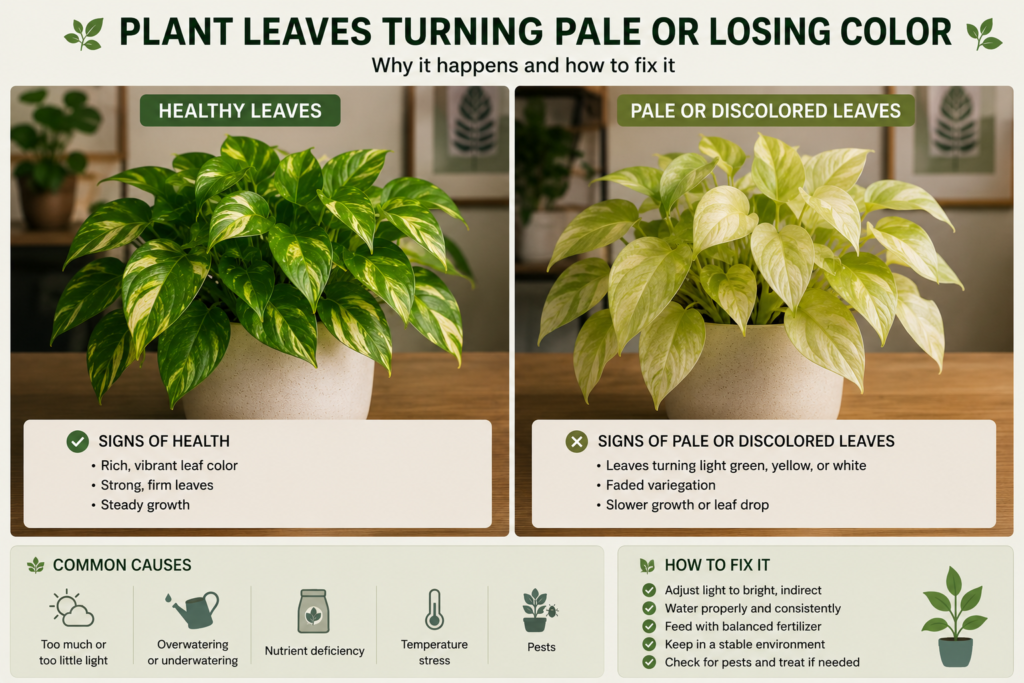
Pale leaves often mean the plant is producing less chlorophyll because usable light is too low.
Why Low Light Causes Leaves to Lose Color
Leaf color reflects internal energy.
Healthy green leaves depend on Chlorophyll.
Chlorophyll captures light and powers Photosynthesis.
When usable light drops, chlorophyll efficiency drops too.
That creates pale foliage.
Not dead foliage.
Just weaker foliage.
What Pale Leaf Stress Looks Like
Common signs include:
- faded green
- dull surface
- thinner leaves
- washed-out appearance
This often happens slowly.
That makes it easy to miss.
The plant adapts gradually.
And the owner normalizes the decline.
How to Tell Pale Leaves From Overwatering or Nutrient Deficiency
Important distinction:
Pale from low light is different from yellow from overwatering.
Low-light pale leaves usually look:
- evenly faded
- thinner
- weaker green
Overwatering yellowing often looks:
- softer tissue
- mushier stems
- wet soil
Nutrient deficiency often looks:
- patterned discoloration
- vein contrast
- patchy color changes
That distinction matters.
Low light may contribute to all three.
But pale fading often appears first.
That makes it an early warning sign.
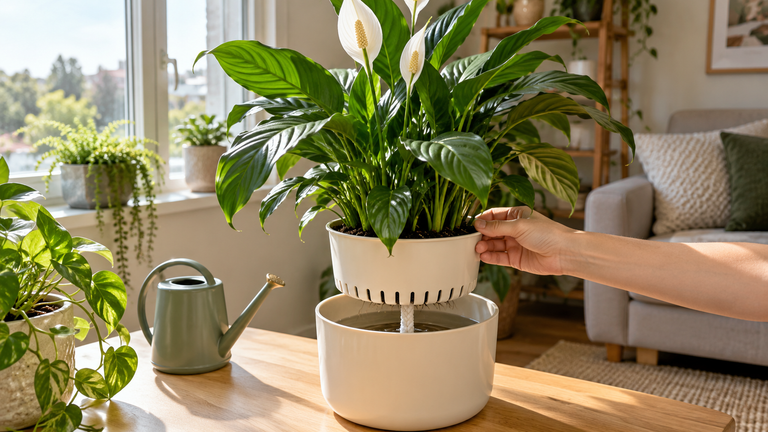
Real-World Example: How Peace Lily Shows Light-Related Color Loss
A Peace Lily in bright indirect light often has rich glossy green leaves.
Move it into weak light for months and that richness fades.
The plant survives.
But looks weaker.
That appearance matters.
Check the newest leaves.
They reveal the current environment better than old leaves.
Why Is Your Plant Leaning Toward the Window?
A plant leaning toward a window is searching for stronger light.
Why Low Light Causes Plants to Lean
Leaning is one of the strongest physical signs of low-light stress.
It is another form of Phototropism.
Plants naturally grow toward light.
Balanced light creates balanced structure.
Weak side-light creates bending.
What Leaning Growth Looks Like
Signs include:
- tilted stems
- uneven branching
- leaves facing one direction
- lopsided growth
How Window Position Changes Plant Growth Direction
Indoor windows create directional light.
And light intensity drops quickly with distance.
A plant three feet away from a bright window may receive much less usable light than one beside it.
That difference changes growth direction.
Real-World Example: Why Monstera Leans in Low Light
Monstera deliciosa often leans dramatically when placed too far from light.
The stem stretches.
Leaves angle heavily.
Growth becomes one-sided.
That is a visible map of light direction.
Rotation helps balance shape.
But rotation does not fix weak light.
Better light fixes weak light.
Why Has Plant Growth Slowed Down?
Slow growth often means the plant has reduced energy production.
Why Low Light Slows Plant Growth
Growth depends on surplus energy.
Every new root, leaf, and stem requires sugars produced through Photosynthesis.
When light drops, sugar production drops.
Growth slows.
Sometimes dramatically.
Signs Your Plant Has Stalled From Low Light
Signs include:
- no new leaves
- stalled vines
- delayed unfurling
- paused roots
- slower stems
Many owners mistake slow growth for stability.
But stable does not always mean healthy.
When Slow Growth Is Normal and When It Is a Light Problem
Healthy plants usually show visible progress during active growing seasons.
Especially spring and summer.
Season matters.
Winter naturally slows growth.
That is normal.
But slow growth in spring or summer often points to weak light.
Growth speed should match season.
That is a strong rule.
Real-World Example: How Light Affects Philodendron Growth Speed
A healthy Philodendron in bright indirect light may push new leaves every few weeks.
Move it into weaker light and growth may stop for months.
Alive.
But underperforming.
That performance gap matters.
Which Plants Show Low-Light Stress the Fastest?
Why Some Plants Show Light Stress Faster Than Others
Not all plants show low-light stress at the same speed.
Fast-growing plants reveal problems sooner because their energy demand is higher.
Slow-growing plants may hide stress longer.
Fast-Growing Indoor Plants That Show Low-Light Stress First
Fast-reacting plants include:
- Pothos → leggy vines
- Monstera deliciosa → smaller leaves
- Fiddle Leaf Fig → leaf drop
- Coleus → fading color
- Peace Lily → fewer blooms
Why Slow-Growing Plants Can Hide Light Problems Longer
Slower growers like Snake Plant and ZZ Plant may hide stress longer.
But tolerance does not equal healthy performance.
That distinction matters.
Fast growers act as room-light indicators.
Watch them closely.
Why Is Your Plant Dropping Healthy Leaves?
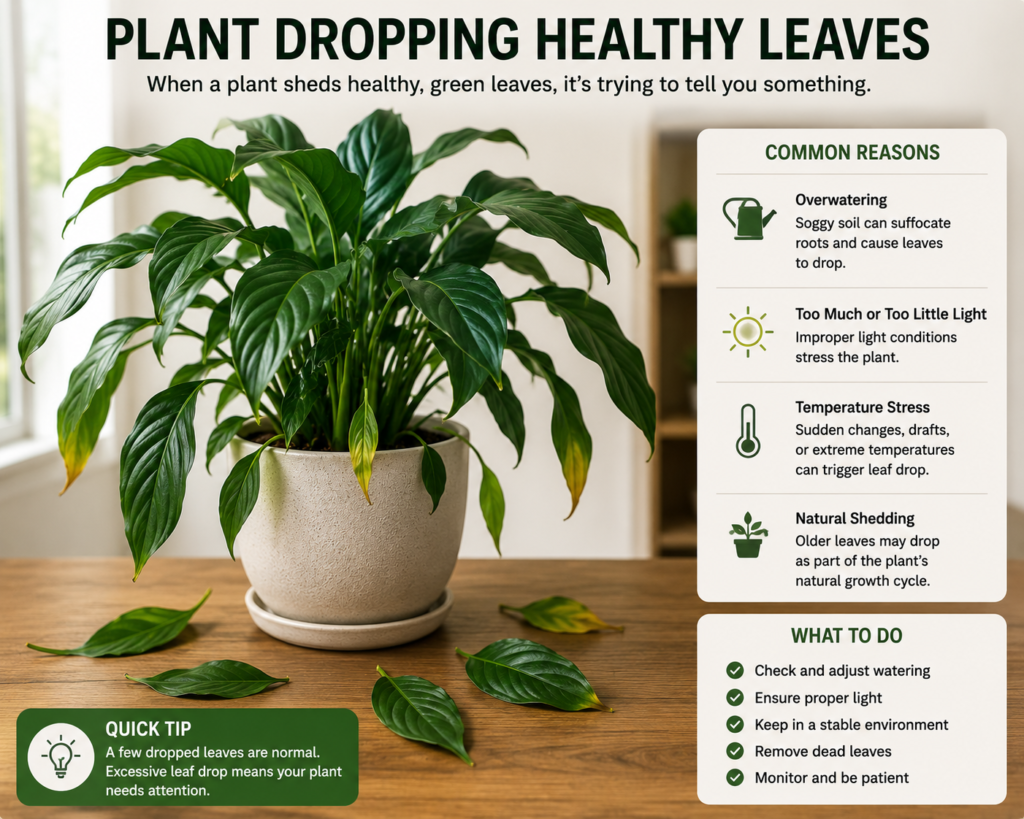
A plant under low-light stress may drop leaves because it cannot afford their energy cost.
Why Low Light Causes Healthy Leaves to Drop
Leaves are expensive.
Every leaf requires maintenance.
That maintenance costs energy.
That energy comes from Photosynthesis.
When light becomes limited, the plant cuts costs.
One fast way to cut costs is dropping leaves.
This is survival.
Not failure.
What Leaf Drop Patterns Suggest a Light Problem?
Common patterns include:
- lower leaf drop
- thinning from the bottom
- healthy-looking fallen leaves
- firm stems
This confuses plant owners because the fallen leaves may look healthy.
But healthy-looking fallen leaves often point to energy budgeting.
Real-World Example: Why Ficus Drops Leaves in Low Light
Ficus benjamina is famous for dropping leaves after moving into dimmer rooms.
Not because it is weak.
Because it adapts quickly.
That pattern often points back to light.
What Healthy Leaf Drop Looks Like in Low Light
for:
- lower leaf drop
- thinning from bottom
- healthy-looking fallen leaves
- firm stems
How Ficus Responds to Lower Light Levels
for:
- Ficus benjamina example
- moving into dim rooms
- adaptation response
- light adjustment
Why Is Your Plant Not Flowering?
Flowering stops when the plant lacks enough surplus energy.
Why Low Light Reduces Flowering Energy
Flowers are optional.
Roots are essential.
Leaves are essential.
Stems are essential.
Plants protect essentials first.
Flowering happens when surplus energy exists.
That surplus depends on strong Photosynthesis.
Weak light lowers that surplus.
That delays flowering.
Signs Your Plant Is Failing to Flower From Low Light
Signs include:
- fewer blooms
- delayed flowers
- dropped buds
- no flowering cycle
Which Flowering Houseplants Show This Problem Most?
This is common in:
- Peace Lily
- African Violet
- Orchid
- Anthurium
Why Fertilizer Cannot Replace Light
Many owners add fertilizer.
But fertilizer supports growth.
It does not create energy.
Light creates energy.
That order matters.
Why Is the Soil Staying Wet Too Long?
Soil that stays wet too long often means the plant is using less water because light is weak.
Why Low Light Slows Soil Drying
Wet soil does not always mean overwatering.
Watering frequency is only half the system.
Water usage is the other half.
And water usage depends heavily on light.
Strong light increases transpiration.
Weak light slows transpiration.
That means:
low light → slower water use → slower drying → higher root stress
Signs Wet Soil Is Caused by Low Light
Watch for:
- longer drying time
- slower growth
- smaller leaves
- unchanged watering habits
Real-World Example: How Light Changes Soil Drying Speed
A Pothos near strong light may dry in 5–6 days.
Move it deeper into the room and drying time may double.
Same pot.
Same soil.
Different light.
That pattern matters.
Can Low Light Look Like Overwatering?
Why Low Light and Overwatering Look Similar
Yes.
And this causes many diagnosis mistakes.
Low light and overwatering often create similar symptoms.
That creates confusion.
Common overlap:
- yellow leaves
- wet soil
- slow growth
How to Tell the Difference Between Low Light and Overwatering
But the causes differ.
Low-light signs:
- leggy growth
- pale leaves
- smaller leaves
- leaning
Overwatering signs:
- mushy stems
- root rot
- bad smell
- collapsing growth
Check the Roots for Final Confirmation
The roots tell the truth.
Firm roots usually point to light issues.
Rotting roots usually point to watering issues.
That difference matters.
How to Confirm If Light Is the Real Problem
Confirm low-light stress through symptom patterns, plant position, and light testing.
Check for Multiple Low-Light Symptoms
Never diagnose from one symptom.
Patterns are stronger.
Use this checklist:
- leggy stems
- wide internodes
- smaller leaves
- pale foliage
- leaning
- slow growth
- no flowers
- leaf drop
- wet soil staying longer
If three or more symptoms appear together, low light becomes highly likely.
Evaluate Plant Placement and Window Exposure
Next, check placement.
Window distance matters.
General indoor light zones:
- 0–2 feet = strong
- 2–4 feet = moderate
- 5–6 feet = weak
- 6+ feet = low light
Window direction matters.
South-facing windows usually provide the strongest light.
East-facing windows provide softer morning light.
West-facing windows can be strong but hotter.
North-facing windows are often weakest.
Identify Environmental Light Blockers
Environmental blockers matter too.
These reduce usable light:
- curtains
- blinds
- tinted windows
- nearby buildings
- furniture shadows
- deep room placement
Season matters too.
Winter changes sun angle.
Winter shortens light duration.
A plant that thrives in summer may struggle in winter in the exact same spot.
That seasonal shift matters.
Use Simple Light Tests to Confirm the Problem
Use the shadow test.
Place your hand between the plant and the light.
Check the shadow:
- sharp shadow = strong light
- soft shadow = moderate light
- blurry shadow = weak light
- invisible shadow = very weak light
A Light meter gives better accuracy.
But observation often works.
Track new growth too.
New growth reveals environmental change faster than old leaves.
How to Fix a Plant That Needs More Light
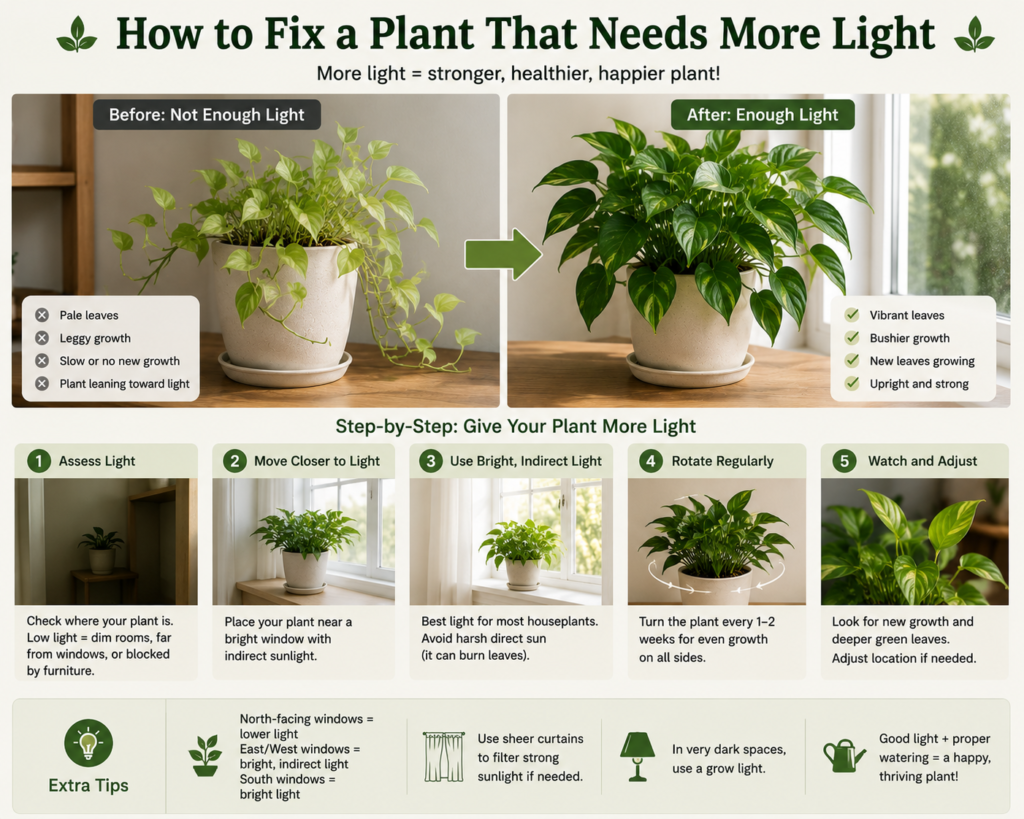
Improve light, prune weak growth, and support stronger future growth.
Low-light stress is often reversible.
But recovery moves forward.
Old damage stays.
New growth improves.
That is the recovery model.
Step 1: Move closer to usable light
Window priority:
- south-facing
- east-facing
- west-facing
- north-facing
Even moving a plant 2–3 feet closer can significantly increase usable light.
That changes:
- growth speed
- leaf size
- stem strength
- color depth
Move gradually if the plant has been in low light for months.
Sudden strong light can shock weak leaves.
Transition matters.
Increase exposure over several days.
This prevents light shock.
Step 2: Prune leggy growth
Pruning redirects energy.
Useful for:
- Pothos
- Philodendron
- Tradescantia
Cut weak sections first.
That encourages stronger replacement growth.
Prune during active growing season when possible.
That improves recovery speed.
Step 3: Reset watering
More light increases water use.
Do not follow the same watering schedule.
Watch the soil.
Not the calendar.
Drying speed changes with light.
Watering must adapt.
Step 4: Track recovery
Check every 7–14 days.
Look for:
- tighter internodes
- larger leaves
- richer color
- stronger stems
- faster growth
Recovery signs appear in new growth first.
Old damage rarely disappears.
Judge progress forward.
When Should You Use Grow Lights?
Use grow lights when natural light is weak, inconsistent, or unavailable.
Not every home provides strong natural light.
That is normal.
Apartments, shaded homes, deep interiors, and winter months often create low-light limitations.
That is where grow lights become practical.
Which Indoor Plants Benefit Most From Grow Lights?
Modern LED grow lights can support many indoor plants.
Especially:
- Monstera deliciosa
- Philodendron
- Pothos
- African Violet
- Succulent
Basic grow light rules:
- 10–14 hours daily
- full-spectrum LED
- proper hanging distance
- consistent timing
Distance matters.
Too far reduces effectiveness.
Too close increases stress.
Timer systems help maintain consistency.
Random schedules confuse plant growth cycles.
Why Grow Lights Matter More in Winter
Winter matters.
Daylight becomes shorter.
Intensity becomes weaker.
Even healthy plants may suddenly struggle.
That seasonal drop explains many sudden symptoms.
Grow lights help fill that gap.
How to Measure Plant Recovery Under Grow Lights
How to measure improvement:
- larger new leaves
- stronger color
- tighter internodes
- faster growth
Plants need intensity.
Not just visible brightness.
That distinction matters.
Final Verdict: How to Know If Your Plant Needs More Light
Plants do not hide low-light stress.
They show it.
Through growth.
Through structure.
Through color.
The Most Reliable Warning Signs
The strongest warning signs include:
- stretched stems
- smaller leaves
- pale foliage
- leaning growth
- slow growth
- fewer flowers
- leaf drop
- slower soil drying
Why Light Is the Root Cause
Each symptom points back to energy.
And energy begins with light.
Common Mistakes Plant Owners Make
The biggest mistake plant owners make is treating symptoms instead of causes.
More water for yellow leaves.
More fertilizer for smaller leaves.
Repotting for slow growth.
Sometimes those actions help.
But if light is the root issue, those actions delay recovery.
Light should be part of diagnosis early.
Not last.
Thriving Starts With Enough Light
Because once a plant loses structure through Etiolation, recovery takes longer.
The goal is not survival.
It is thriving.
And thriving starts with enough light.
FAQ section
How do I know if my plant needs more light?
Look for multiple symptoms together such as legginess, pale leaves, smaller new growth, leaning, and slower growth.
Can low light kill houseplants?
Yes. Not always quickly, but over time reduced energy production weakens roots, growth, and recovery.
Why is my plant growing tall but weak?
This usually indicates Etiolation. The plant is stretching toward light instead of building strong structure.
Will my plant recover if I give it more light?
Yes. New growth can improve. Old stretched growth usually remains.
Can grow lights replace sunlight?
Yes. Quality LED grow lights can provide usable plant energy when used correctly.
Why are my new leaves smaller?
Smaller new leaves often mean lower energy production. Low light is a common cause.
Why is my plant leaning to one side?
This is often Phototropism, where the plant grows toward stronger light.
Is a bright room enough for houseplants?
Not always. Human eyes adapt easily, but plants need usable light intensity at leaf level.

Myra is the founder and lead writer of Plantsaholic. She shares practical, research-backed advice on indoor plants, outdoor gardening, flowers, herbs, succulents, and everyday plant care. Her goal is to help gardeners of all experience levels grow healthier plants through simple, easy-to-follow gardening guides.