Yes, indoor plants can survive in low light, but survival and healthy growth are not the same thing. Many plant owners assume that if a plant remains green and alive, it must be doing well. In reality, plants often stay alive while operating in survival mode. Low light reduces the plant’s ability to perform Photosynthesis, which means less energy for leaf production, root development, and recovery from stress. This is why some plants in dim rooms look stable for months but show little to no growth.
The good news is that many houseplants evolved in shaded tropical environments, making them naturally better adapted to indoor lighting conditions. Plants like Sansevieria trifasciata, Zamioculcas zamiifolia, and Epipremnum aureum can tolerate weaker light because they conserve energy efficiently. But even these plants need usable light. Low light does not mean darkness. The goal is not just plant survival—it is stable, healthy adaptation.
Important Truths About Low-Light Indoor Plant Survival
- low light is reduced light, not no light
- some plants tolerate it better than others
- growth slows naturally
- watering habits must adjust
- placement determines success
What Does Low Light Mean for Indoor Plants?
Low light means a plant receives enough ambient light to survive but not enough for strong active growth. This usually happens in rooms with indirect daylight, shaded windows, or areas farther from natural light sources. Many people misunderstand low light because their eyes adapt easily, but plants rely on measurable light intensity for energy.
In practical terms, low light usually falls between 200 and 800 lux. That may be enough for tough indoor plants, but it limits growth speed and leaf production. Window direction changes this too. North-facing windows usually provide softer light, while east-facing windows offer gentler morning light. Even moving a plant a few feet farther from a window can reduce its usable light significantly.
Common Low-Light Areas in a Home for Indoor Plants
- bedrooms with shaded windows
- office desks away from windows
- hallways with indirect daylight
- bathrooms with frosted windows
- living room corners
Low light is manageable.
But understanding it correctly prevents common care mistakes.
Low Light vs Bright Indirect Light: What’s the Difference?
Low light and bright indirect light are not the same. Low light provides enough energy for survival. Bright indirect light provides enough energy for healthy growth. This distinction matters because many plants sold as “low-light plants” actually perform much better in bright indirect conditions.
For example, Epipremnum aureum may survive in a dim corner, but near a bright window with filtered light, it grows faster, fuller, and healthier. This shows the difference between tolerance and preference. Many indoor plants tolerate low light but prefer stronger indirect light.
Low Light vs Bright Indirect Light Comparison
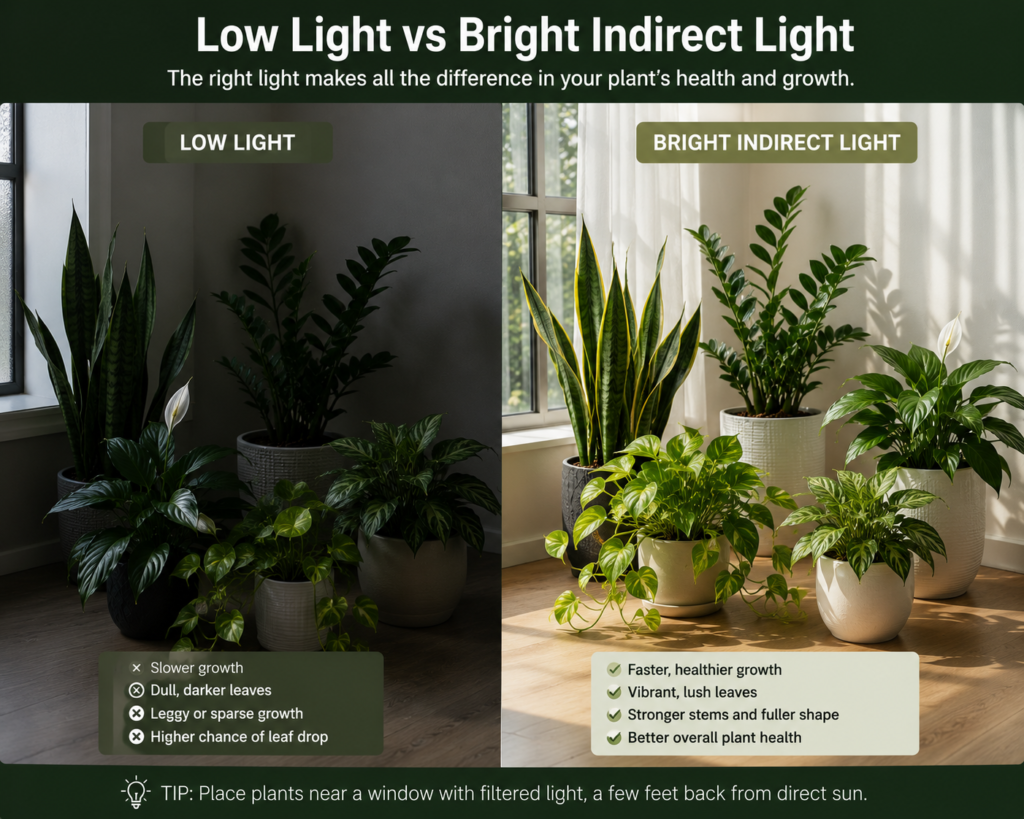
Low Light
- slower growth
- smaller leaves
- less water use
- stretching risk
Bright Indirect Light Conditions for Indoor Plants
- stronger growth
- healthier foliage
- fuller shape
- stronger roots
Low light helps survival.
Bright indirect light supports thriving.
Can Plants Thrive in Low Light or Only Survive?
Most indoor plants survive in low light better than they thrive in it. Thriving means active new growth, strong roots, and stable leaf production. Surviving means conserving energy and slowing growth to maintain basic function. This difference changes expectations. If you expect fast growth in a dim room, you will likely be disappointed.
A plant like pothos may grow quickly in bright indirect light but much slower in low light. That slower growth is normal. But if leaves become smaller, stems become leggy, or color fades, the plant is under stress rather than simply growing slowly. Understanding this difference helps you evaluate plant health more accurately.
Signs Your Indoor Plant Is Thriving in Low Light
- steady new growth
- strong leaf color
- stable structure
Signs Your Indoor Plant Is Only Surviving in Low Light
- slow growth
- fewer leaves
- stretched stems
A slow plant can still be healthy.
But structural decline means stress.
Why Can Some Indoor Plants Handle Low Light Better Than Others?
The answer is natural habitat. Plants that evolved under tree canopies adapted to weaker light. They developed larger leaf surfaces, stronger Chlorophyll efficiency, and slower energy use. These traits help them survive indoors.
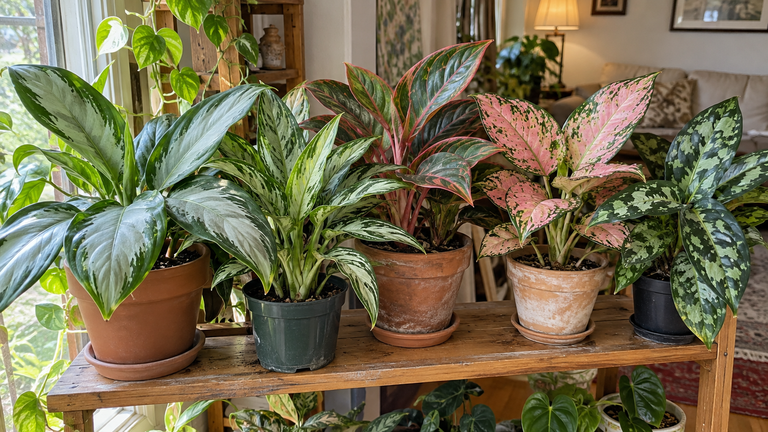
Plants like Aglaonema and Spathiphyllum naturally grow in shaded forest floors, making them ideal for lower-light rooms. By contrast, succulents evolved in open, bright environments and usually struggle indoors unless light is stronger.
Traits of Indoor Plants That Adapt Well to Low Light
- broad leaves
- darker green foliage
- slower metabolism
- efficient energy use
Plant origin predicts plant performance.
That makes plant biology a smart buying filter.
What Happens to Plants in Low Light?
Low light affects the plant’s energy system first. Less light means less Photosynthesis, which means slower growth, weaker root expansion, and reduced recovery ability. Plants respond by slowing down and conserving resources.
One visible effect is stretching, known as Phototropism. Plants grow toward the strongest available light source. This creates leggy stems and wider gaps between leaves. Older leaves may yellow and fall because the plant cannot support all its foliage.
Common Effects of Low Light on Indoor Plants
- slower growth
- smaller leaves
- leaf drop
- pale color
- leggy growth
These are warning signals.
Not random problems.
Signs Your Indoor Plant Is Not Getting Enough Light
Plants show clear signs when light becomes too weak. One of the first is stretching. This happens when stems grow longer and leaf spacing increases as the plant searches for better light. Another sign is leaning toward the nearest window.
Leaf quality also changes. New leaves may emerge smaller, older leaves may yellow, and growth slows down. These symptoms are often confused with watering problems, which is why many plant owners treat the wrong issue first.
Common Signs of Low-Light Stress in Indoor Plants
- leaning toward light
- stretched stems
- small new leaves
- yellow lower leaves
- slow growth
Early detection matters.
Small placement changes can often reverse the problem.
How Can You Measure Indoor Light for Plants?
Measuring light is one of the simplest ways to improve indoor plant care because guessing often leads to bad placement. A room may feel bright to you, but plants depend on measurable light intensity—not human comfort. Without enough usable light, even tough plants slow down, stretch, or decline.
The easiest tool is a lux meter, but smartphone apps can also help estimate brightness. A simple shadow test works too: place your hand between the light source and the plant. A sharp shadow usually means stronger light, while a soft blurry shadow usually means low light. This helps compare different spots in the same room.
Indoor Light Levels for Houseplants (Lux Guide)
- 200–800 lux = low light
- 800–2,000 lux = medium indirect light
- 2,000+ lux = bright indirect light
Best Ways to Measure Indoor Plant Light
- lux meter
- phone light apps
- shadow test
- distance from windows
Always measure at plant level.
That is where the leaves receive light.
How Long Can Indoor Plants Survive in Low Light?
Indoor plants can survive in low light for months or even years depending on species and care. Tough plants like Zamioculcas zamiifolia and Sansevieria trifasciata survive longer because they store water and energy.
But survival is not the same as long-term health. A plant may remain alive while slowly losing strength. Growth slows, leaf production decreases, and roots become weaker over time. This is why plant health should be judged by quality, not just lifespan.
Factors That Affect How Long Indoor Plants Survive in Low Light
- species type
- root health
- watering habits
- room temperature
- light consistency
Signs Your Low-Light Plant Is Still Healthy
- stable leaves
- occasional new growth
- firm stems
Long life alone does not prove health.
Plant quality tells the real story.
Where Should You Place Low-Light Plants Indoors?
Placement changes everything because indoor light weakens quickly with distance. A plant placed one foot from a window may receive much more usable light than the same plant placed five feet away. This is one of the biggest hidden reasons plants fail.
North-facing windows are usually ideal for low-light plants because they provide stable, softer light. East-facing windows are also useful because morning sunlight is gentler. Bathrooms with windows can work well because humidity helps tropical foliage. Offices are possible too if there is nearby daylight.
Best Indoor Placement Spots for Low-Light Plants
- north-facing windows
- east-facing windows
- bathroom shelves near windows
- office desks near daylight
- bright room corners
Where Not to Place Low-Light Indoor Plants
- dark hallways
- closed shelves
- blocked windows
Placement controls energy.
Energy controls growth.
Can Artificial Grow Lights Replace Natural Light?
Yes, grow lights can replace natural sunlight for many indoor plants if used properly. Modern full-spectrum LED grow lights provide the light wavelengths plants need for energy production and healthy growth.
This is especially useful for apartments, offices, and darker rooms. Plants like Epipremnum aureum, Philodendron hederaceum, and Aglaonema respond very well to grow lights.
Best grow light practices:
- use full-spectrum LEDs
- keep lights 6–18 inches away
- use timers
- provide 10–14 hours daily
Grow lights are not emergency tools.
They are long-term plant solutions.
How Should You Water Plants in Low Light?
Low light reduces water use because plants grow more slowly and use less energy. That means the soil stays wet longer. If you water on the same schedule used in brighter conditions, root problems become much more likely.
This is why low-light plants should be watered based on soil condition, not a calendar. Check dryness with your finger or by lifting the pot. Plants like Sansevieria trifasciata and Zamioculcas zamiifolia prefer drying between waterings.
Low-light watering rules:
- check soil first
- water less often
- use drainage holes
- avoid standing water
Overwatering signs:
- yellow leaves
- soggy soil
- soft stems
Watering should follow light.
Not routine.
How to Adjust Low-Light Plant Care in Winter
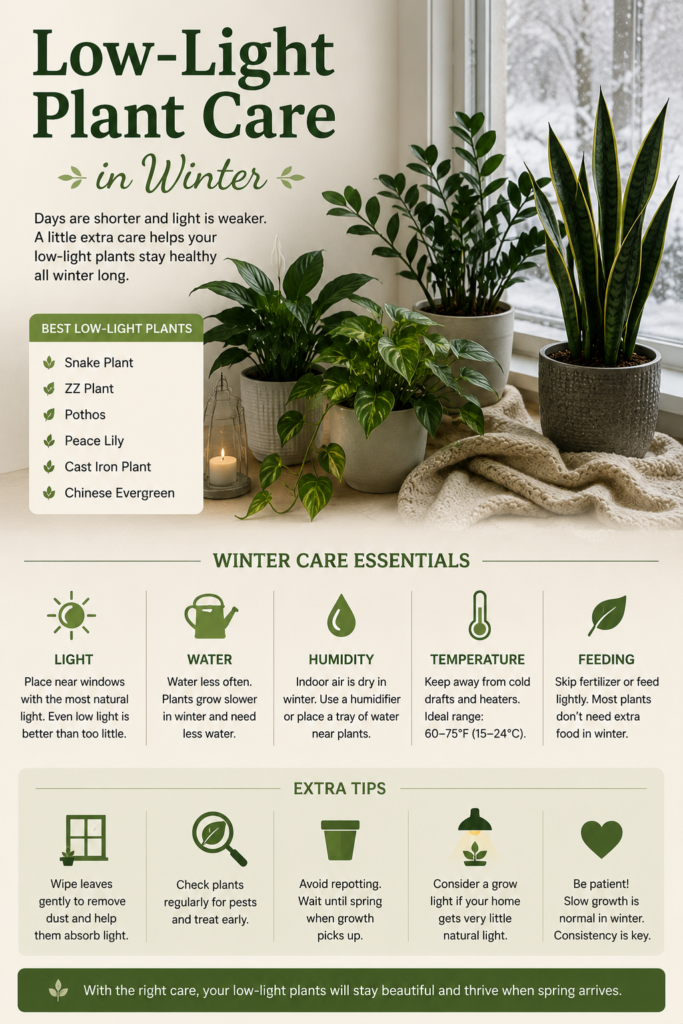
Winter reduces natural light significantly. Days become shorter, sunlight becomes weaker, and indoor heating changes humidity. This makes winter one of the hardest seasons for low-light plants.
A room that works in summer may become stressful in winter. Plants often need less water and more access to windows. Moving plants closer to natural light helps. Grow lights become especially useful during winter months.
Winter care adjustments:
- reduce watering
- move plants closer to windows
- stop heavy fertilizing
- monitor dry air
Winter stress signs:
- yellow leaves
- leaf drop
- slower drying soil
Winter changes plant behavior.
Your care should change too.
Can Indoor Plants Recover from Low-Light Stress?
Yes, many indoor plants can recover if the roots are still healthy and the stress is caught early. Recovery depends on improving the environment gradually. Sudden changes, like placing a stressed plant in direct sunlight, can cause more damage.
The best recovery method is moving the plant into brighter indirect light or adding a grow light. Pruning leggy growth helps redirect energy into healthier new growth. Correct watering is also important because low-light stress and overwatering often happen together.
Low-Light Plant Recovery Checklist
- improve light slowly
- prune weak growth
- inspect roots
- reduce overwatering
- improve drainage
Recovery takes time.
Plants rebuild slowly.
But healthy roots make recovery possible.
What Are the Best Low-Light Plants for Each Room?
Choosing the right low-light plant depends on the room because each room creates different growing conditions. A bedroom usually offers stable temperature and softer light. A bathroom provides humidity but may have weaker airflow. Offices often combine artificial light with dry air. Living rooms usually provide the most flexible placement options.
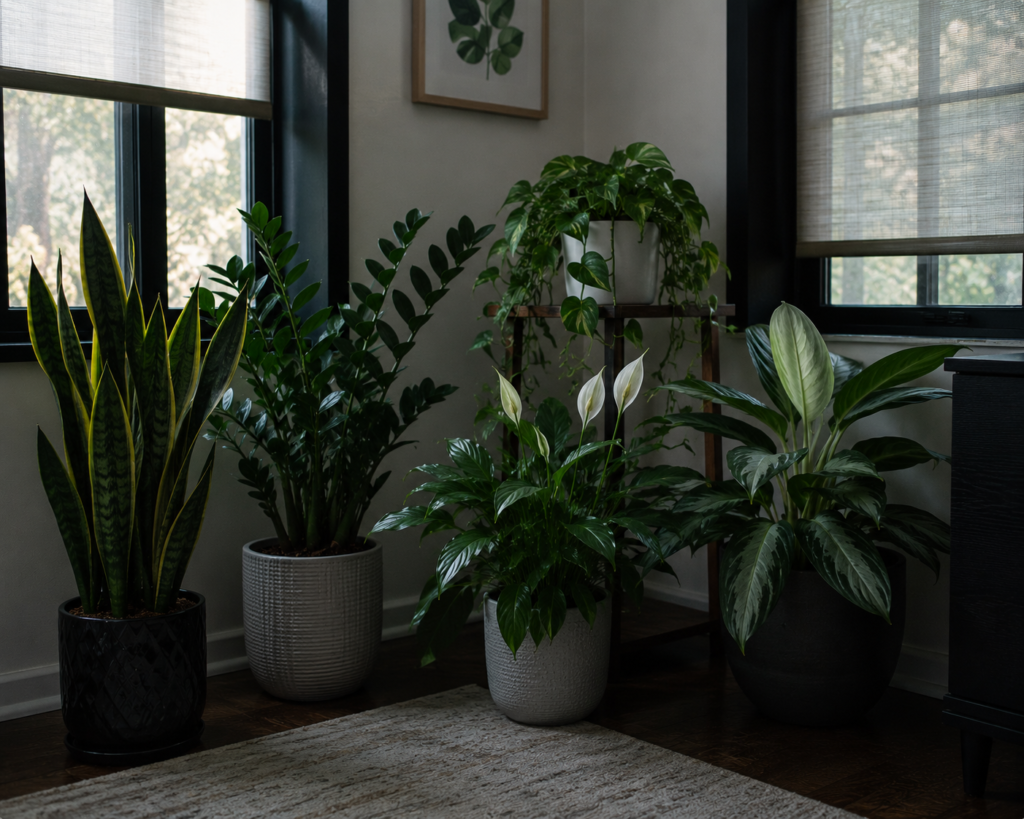
Matching the plant to the room improves survival and reduces stress. For bedrooms, Sansevieria trifasciata and Zamioculcas zamiifolia work well because they are low maintenance. Bathrooms support tropical plants like Spathiphyllum because humidity reduces leaf stress. Offices benefit from tougher species like Aspidistra elatior. Living rooms are ideal for trailing plants like Epipremnum aureum.
Best Low-Light Indoor Plants by Room
Bedroom
- Snake Plant
- ZZ Plant
Bathroom
- Peace Lily
- Philodendron
Office
- Cast Iron Plant
- Snake Plant
Living Room
- Pothos
- Aglaonema
Choosing by room improves plant performance.
Not every plant fits every space.
How Should Beginners Choose a Low-Light Plant?
Beginners should choose plants based on care habits, not just appearance. This is the easiest way to avoid plant failure. If you forget to water often, choose drought-tolerant plants. If you want visible growth, choose faster-growing species. If you want decorative leaves, choose foliage-focused plants.
For low-maintenance care, Zamioculcas zamiifolia and Sansevieria trifasciata are the safest beginner options. If you want faster growth and easier propagation, pothos is a strong choice. If decorative foliage matters most, Aglaonema is excellent.
Beginner Checklist for Choosing the Right Low-Light Plant
- how often do you water?
- how bright is your room?
- do you want fast growth?
- do you want flowers or foliage?
Best Low-Light Indoor Plants for Beginners
- ZZ Plant
- Snake Plant
- Pothos
- Chinese Evergreen
Choose for your lifestyle.
Not just for looks.
Low-Light Indoor Plant Comparison Table
Comparing low-light plants makes plant selection easier because each plant offers different benefits. Some are tougher but slower. Others grow faster but need more attention. Knowing these trade-offs helps set realistic expectations.
For example, Sansevieria trifasciata is highly durable but grows slowly. Epipremnum aureum grows faster but usually wants slightly more regular watering. Aspidistra elatior is extremely resilient but very slow-growing.
| Plant | Survival Strength | Growth Speed | Water Need | Best For |
|---|---|---|---|---|
| Snake Plant | Excellent | Slow | Low | Beginners |
| ZZ Plant | Excellent | Slow | Low | Offices |
| Pothos | Very Good | Medium | Moderate | Decor |
| Peace Lily | Very Good | Medium | Moderate | Bathrooms |
| Chinese Evergreen | Excellent | Slow | Moderate | Decorative rooms |
| Cast Iron Plant | Excellent | Slow | Low | Tough spaces |
Quick decisions: Which Low-Light Plant Should You Choose?
- want easy? choose ZZ
- want fast? choose pothos
- want strong durability? choose snake plant
Plant choice should match expectations.
Which Low-Light Plants Are Safe for Cats and Dogs?
Pet safety matters because many common houseplants can be harmful if chewed. Some low-light plants are better choices for homes with cats and dogs, especially if pets like exploring leaves.
Safer options include Aspidistra elatior and Chamaedorea elegans. Plants like pothos, philodendrons, and peace lilies can cause irritation or digestive problems if eaten. That does not mean you cannot keep them—but placement becomes important.
Pet-Safe Low-Light Indoor Plant Options
- Cast Iron Plant
- Parlor Palm
Low-Light Plants to Use With Caution Around Pets
- Pothos
- Peace Lily
- Philodendron
Pet-friendly plant care starts with smart plant selection.
Safety should always be part of the decision.
Common Myths About Low-Light Indoor Plants
One of the biggest myths is that low-light plants need almost no light. That is false. Low-light plants need less light, not zero light. Every plant still needs usable energy for Photosynthesis.
Another myth is that normal room lighting is enough. Most decorative bulbs help humans see but do not provide enough energy for plants. A third myth is that yellow leaves always mean overwatering. Sometimes they do—but low light can also reduce water use and create secondary root stress.
Biggest Myths About Low-Light Plant Care
- low light means no light
- regular bulbs are enough
- yellow leaves always mean water issues
Truth matters.
Plant biology is stronger than plant myths.
How Do You Troubleshoot Low-Light Plant Problems?
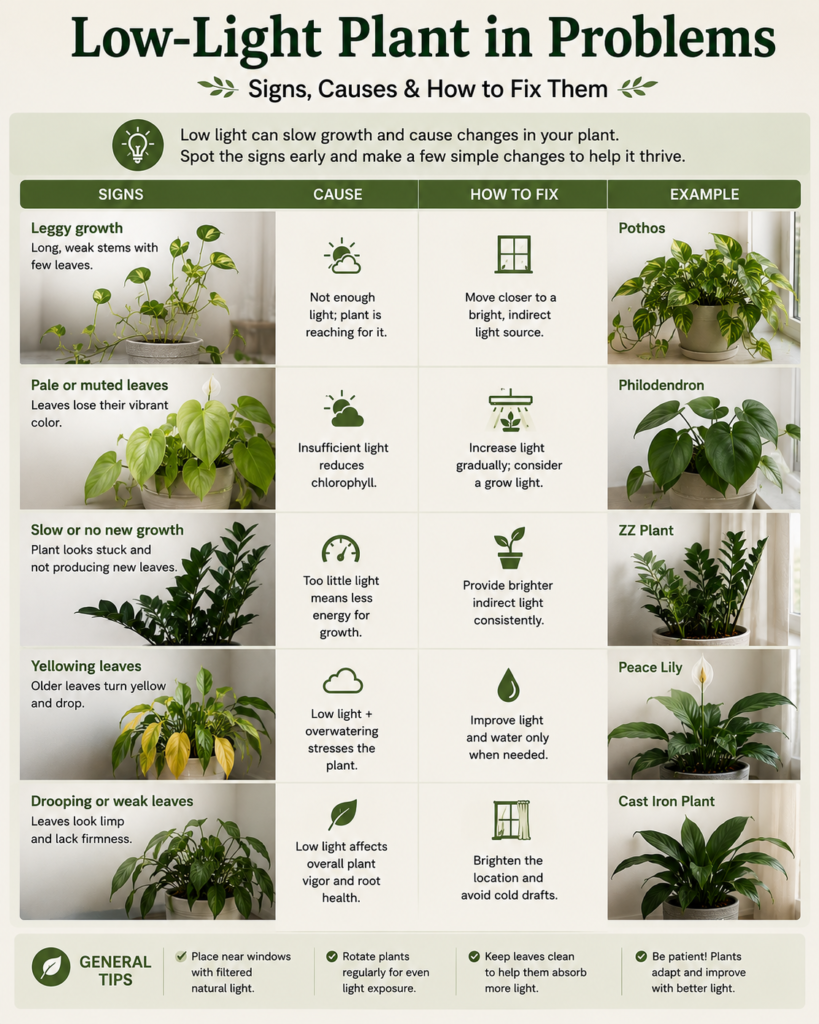
Troubleshooting starts with observation. Many plant problems look similar, so guessing often makes things worse. Yellow leaves, drooping, and slow growth can all have multiple causes. That is why checking light first is important.
Start by asking simple questions. Is the plant producing new growth? Is it leaning? Are leaves smaller than before? Is the soil staying wet too long? These questions help identify the root cause faster. Environmental fixes usually work better than random watering or fertilizer changes.
Low-Light Plant Troubleshooting Checklist
- check light level
- inspect soil moisture
- inspect roots
- review watering habits
- observe new growth
Quick Symptom Guide for Low-Light Plant Issues
- stretching = low light
- yellow leaves = stress
- soft stems = root trouble
Diagnosis saves plants faster than random action.
Low-Light Plant Care Checklist
Low-light plant care becomes much easier when you follow a simple repeatable system. Many plant problems happen because owners react only after visible damage appears. By then, the plant may already be stressed for weeks. A checklist helps prevent that by creating consistency. Prevention is always easier than recovery because low-light plants already operate with less energy.
Think of this as a monthly plant health routine. It helps you monitor light, water, and plant behavior without overcomplicating care. Even five minutes of checking can prevent major problems like root rot, leaf drop, or severe stretching.
Monthly Low-Light Plant Maintenance Checklist
- measure light at plant level
- check soil before watering
- clean leaves to improve light absorption
- rotate the plant every 1–2 weeks
- inspect drainage holes
- check under leaves for pests
- review seasonal light changes
- monitor new growth
Quick Self-Check for Low-Light Plant Health
- Is the plant leaning?
- Are leaves shrinking?
- Is soil staying wet too long?
- Is new growth healthy?
Consistency creates healthier plants.
Small checks prevent bigger problems.
Real-World Example: Why One Snake Plant Thrived and Another Failed in the Same Home
Imagine two Sansevieria trifasciata plants in the same apartment. Same owner. Same watering schedule. Same soil. Same pot size. But one thrives while the other struggles. This happens more often than people realize.
The difference is usually placement. One plant sits near an east-facing window and gets strong indirect morning light. The other sits in a darker hallway far from natural light. Because light controls Photosynthesis, the darker plant uses less water and grows slower. But if both are watered the same way, the darker plant stays wet longer, creating root stress. The owner sees yellow leaves and assumes watering is the issue—but the real cause started with light.
Key Lesson from This Snake Plant Example
What Light Controls in Indoor Plant Health
- water use
- growth speed
- root behavior
- recovery power
Same care does not create the same result.
Environment changes plant behavior.
Final Verdict: Can Indoor Plants Really Survive in Low Light?
Yes, indoor plants can survive in low light, but success depends on choosing the right species and adjusting care to fit the environment. The strongest low-light plants are usually those that evolved in shaded forest environments. These species naturally conserve energy and tolerate slower growth.
Plants like Zamioculcas zamiifolia, Sansevieria trifasciata, Aspidistra elatior, and Aglaonema are among the best choices. But even the toughest plant still needs usable light. No plant survives permanent darkness. The goal is not forcing fast growth—it is creating stable, healthy long-term survival.
Low-light success formula:
- choose shade-adapted plants
- reduce watering frequency
- improve light where possible
- monitor seasonal changes
- use grow lights if needed
Low-light plant care works best when expectations stay realistic.
Healthy stability matters more than fast growth.
FAQ section
Can indoor plants survive in low light permanently?
Yes, some indoor plants can survive in low light for years if their minimum light needs are met. Tough plants like Zamioculcas zamiifolia and Sansevieria trifasciata adapt especially well.
What is the best indoor plant for very low light?
The best choices are ZZ plants, snake plants, and Aspidistra elatior because they tolerate weaker light better than most houseplants.
How do I know if my room is too dark for plants?
If you cannot comfortably read during daytime without artificial lights, it may be too dark for most plants. A lux meter or app gives a more accurate answer.
Do low-light plants need less water?
Yes, low-light plants usually need less water because growth and energy production are slower. This means the soil stays wet longer.
Can grow lights fully replace sunlight?
Yes, full-spectrum LED grow lights can replace sunlight for many indoor plants when used consistently.
Why are my low-light plant leaves turning yellow?
Yellow leaves usually signal stress from overwatering, poor drainage, or weak light. Check the environment before changing care.
Are low-light plants safe for pets?
Some are, like cast iron plants and Chamaedorea elegans. Others like pothos and peace lilies may be harmful if chewed.
What is the darkest room a plant can survive in?
A plant can survive only if some usable light exists. Fully dark rooms require grow lights.
Myra is the founder and lead writer of Plantsaholic. She shares practical, research-backed advice on indoor plants, outdoor gardening, flowers, herbs, succulents, and everyday plant care. Her goal is to help gardeners of all experience levels grow healthier plants through simple, easy-to-follow gardening guides.