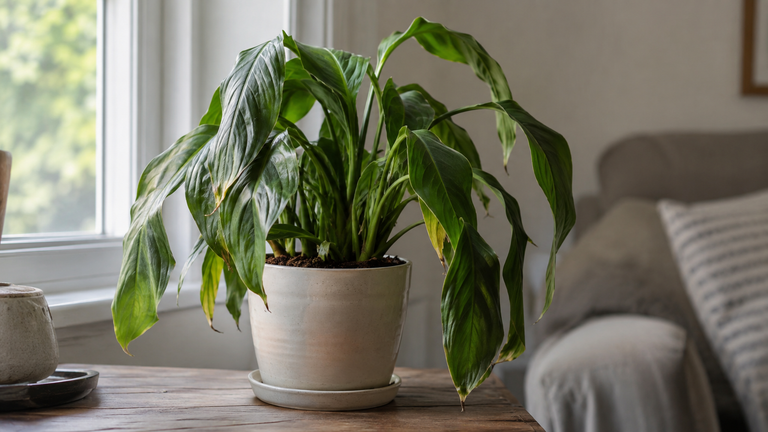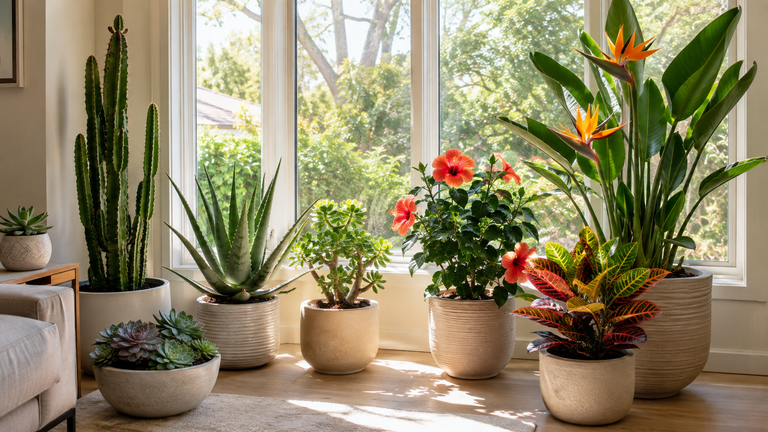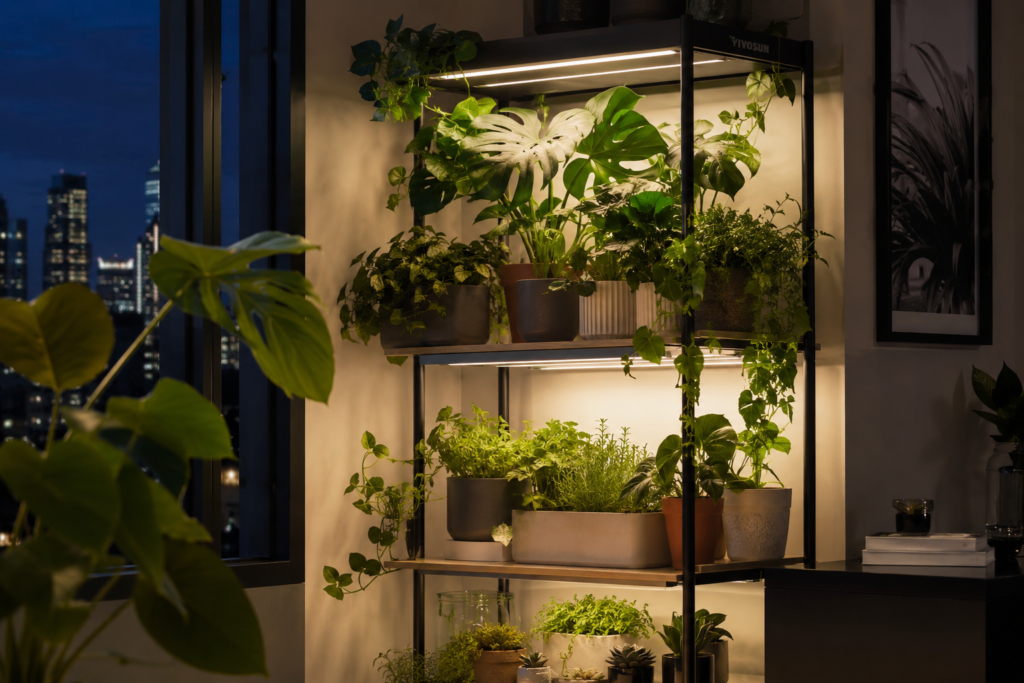
Indoor plants often struggle in homes, apartments, and offices where natural sunlight remains limited for much of the day. Even with proper watering and fertilizing, weak lighting can lead to stretched growth, fading leaves, slower development, and reduced overall plant performance. Grow lights help solve this problem by providing consistent artificial lighting that supports stronger foliage, compact growth, indoor propagation, and healthier plant maintenance throughout the year.
LED grow lights now make indoor growing far more practical for houseplant owners, herb growers, propagation shelves, and winter plant care setups. Whether growing pothos, philodendrons, succulents, orchids, or indoor herbs, selecting the right grow light significantly improves indoor growing reliability and helps plants maintain stable development in low-light environments.
What Makes a Grow Light Good for Indoor Plants?
A good grow light provides the correct spectrum, PPFD, coverage, and efficiency needed to support indoor plants in low-light environments. Many decorative lights appear bright but fail to deliver enough usable light for healthy plant development.
Different plants also require different light strengths. Pothos and philodendrons tolerate moderate lighting, while succulents, cacti, and indoor herbs usually need stronger intensity to prevent stretching and weak growth.
Important characteristics of a good grow light include:
- Full-spectrum output
- Stable PPFD
- Proper coverage
- Efficient operation
- Timer compatibility
Many indoor plant problems are linked to insufficient lighting conditions.
Why Are Full-Spectrum LED Grow Lights Usually the Best Choice?
Full-spectrum LEDs remain one of the most balanced options for indoor plant lighting because they combine useful plant wavelengths with efficient long-term performance. LED bars are especially popular for shelves and compact indoor setups.
Many tropical foliage plants, including pothos, philodendrons, and peace lilies, respond well to balanced full-spectrum lighting because it supports fuller leaf growth and healthier coloration. Variegated plants also benefit from stronger consistent lighting that helps preserve clearer patterns.
White-spectrum LEDs integrate more naturally into indoor spaces than older blurple systems.
How Do Different Indoor Plants Need Different Grow Lights?
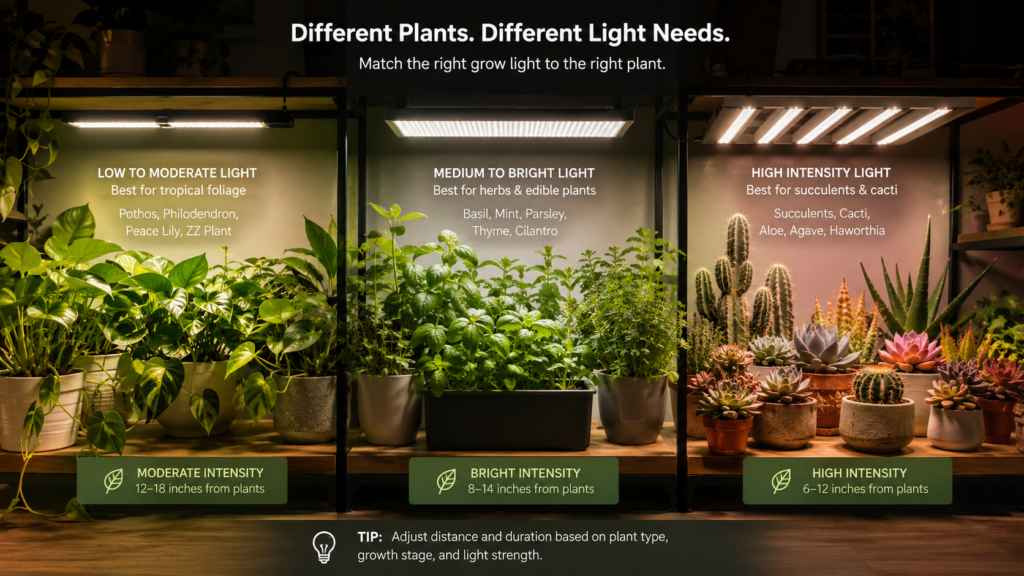
Different indoor plants require different light intensities depending on their natural growth habits. Some tolerate moderate indoor lighting, while others require much stronger exposure for healthy development.
Low-light tropical plants such as pothos, philodendrons, peace lilies, and ZZ plants usually perform well under moderate-intensity full-spectrum LEDs. Succulents, cacti, herbs, and citrus plants typically require stronger lighting indoors to prevent stretching, faded color, and weak growth.
Plant-specific lighting differences include:
- Tropical foliage prefers moderate intensity
- Succulents require strong PPFD
- Herbs need brighter overhead coverage
- Seedlings require longer photoperiods
- Orchids prefer filtered moderate lighting
- Variegated plants benefit from stronger consistency
- Propagation trays need even distribution
Proper lighting intensity helps plants maintain fuller foliage, stronger stems, and healthier indoor growth over time.
Which Grow Light Type Is Best for Your Specific Indoor Setup?
The best grow light depends on plant type, growing space, and coverage needs. A single pothos on a desk requires a much different setup than a propagation shelf, succulent collection, greenhouse cabinet, or indoor herb station.
Choosing the right fixture early helps improve plant health, reduce weak growth, and avoid wasting money on underpowered lighting.
Quick Grow Light Matching Guide
| Situation | Recommended Grow Light |
| Single pothos on desk | Clip-on LED |
| Small shelf with tropicals | LED light bars |
| Succulent collection | High-PPFD LED panel |
| Seedling trays | T5 or LED bars |
| Herbs in kitchen | Full-spectrum hanging LED |
| Greenhouse cabinet | Slim LED bars |
| Large indoor plant wall | Wide LED panel |
| Decorative room plants | White full-spectrum LEDs |
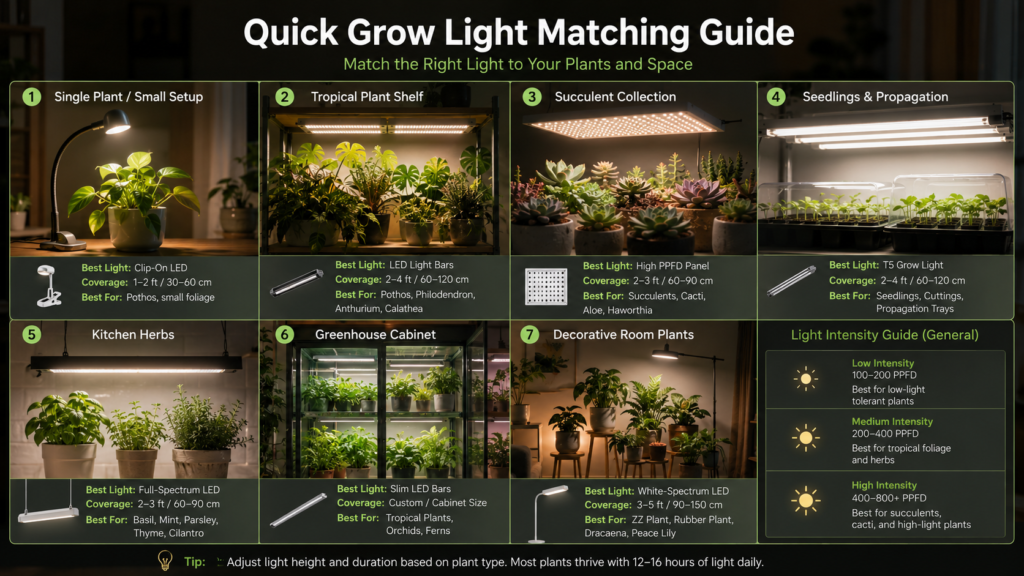
LED bars work especially well for shelves because they spread light evenly across multiple plants, while overhead LED panels provide broader coverage for larger displays and taller plants.
Best Beginner Strategy
- Start with full-spectrum white LEDs
- Prioritize coverage over advertised wattage
- Avoid weak decorative bulbs
- Use timer automation
- Choose adjustable mounting systems
- Buy realistic PPFD-tested fixtures
- Match light intensity to plant type
Consistent lighting and proper coverage usually matter more than buying the most expensive fixture.
What Is PAR Lighting and Why Does It Matter for Indoor Plants?
PAR refers to the wavelengths plants use for photosynthesis rather than how bright a light appears to humans. Understanding PAR helps indoor gardeners evaluate real grow light performance more accurately.
PAR includes wavelengths between 400–700 nanometers, covering the blue and red regions most important for plant growth. Blue wavelengths support vegetative growth, stronger stems, leaf production, and compact development. Red wavelengths help flowering, root development, and energy production during photosynthesis.
Important PAR-related concepts include:
- photosynthetic efficiency
- usable light energy
- canopy penetration
- spectrum balance
- wavelength distribution
- light absorption
- foliage response
- growth optimization
PAR helps indoor gardeners choose grow lights based on actual plant performance rather than misleading brightness measurements alone. This section adds strong topical depth because it connects wavelengths, photosynthesis mechanics, and plant-response behavior — all critical semantic entities in authoritative indoor grow light content.
How Do Kelvin Temperature Ratings Affect Indoor Plant Growth?
Kelvin ratings describe the visual color temperature of grow lights and influence different growth stages.
Lower Kelvin temperatures such as 3000K produce warmer yellow-red light, which supports flowering and root activity. Higher Kelvin temperatures like 5000K or 6500K create cooler daylight-style illumination that encourages vegetative growth, compact foliage, and stronger stem development.
Common Kelvin Ranges
| Kelvin Rating | Light Appearance | Typical Plant Benefit |
| 3000K | Warm white | Flowering support |
| 4000K | Neutral white | Balanced growth |
| 5000K | Daylight white | Vegetative growth |
| 6500K | Cool daylight | Seedlings & foliage |
Most indoor growers prefer white-spectrum LEDs for cleaner indoor visibility.
Kelvin temperature affects both plant performance and the visual atmosphere of indoor growing spaces.
Are LED Grow Lights Better Than Fluorescent Grow Lights?
LED grow lights now outperform fluorescent systems in efficiency, lifespan, and overall usability. Fluorescent fixtures once dominated indoor gardening, especially for seedlings and propagation trays, but LEDs gradually replaced them because of stronger long-term performance.
LEDs convert electricity more efficiently while producing less excess heat.
LED systems also last much longer than fluorescent bulbs. Quality LEDs commonly operate for 30,000–50,000 hours before major output degradation occurs, while fluorescent bulbs weaken faster and require more frequent replacement.
Key LED Advantages
- Lower electricity costs
- Reduced heat production
- Longer operational lifespan
- Better full-spectrum coverage
- Improved shelf compatibility
- Higher long-term value
- More compact installation options
LED bars and panels provide cleaner installation for shelves and cabinets.
Fluorescent systems still work adequately for seedlings and propagation, but LEDs now outperform them in most indoor growing environments.
How Much Light Do Indoor Plants Actually Need?
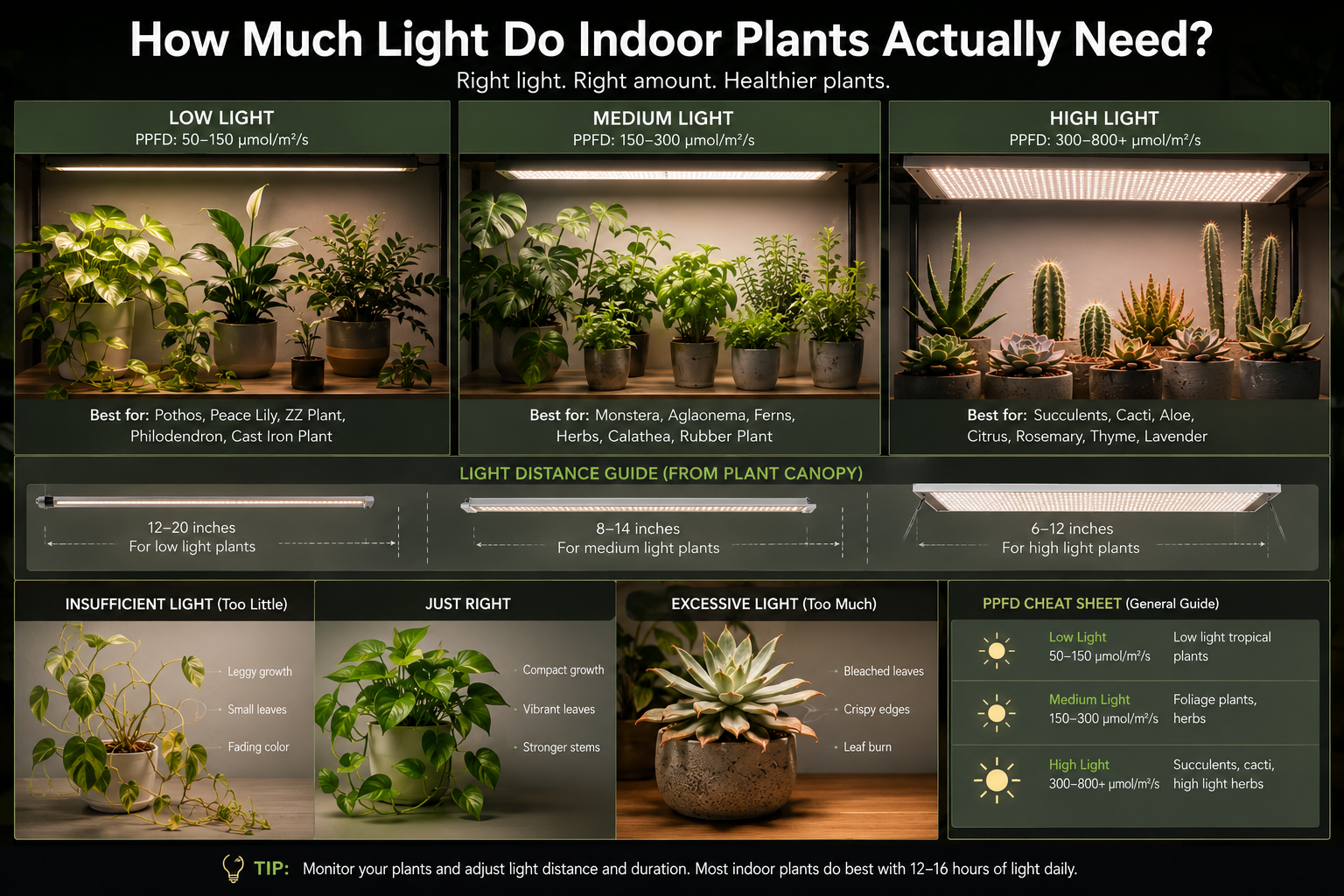
Indoor plants require sufficient light intensity for healthy growth and photosynthesis. Proper lighting helps prevent weak stems, pale foliage, and slow development indoors.
PPFD, or Photosynthetic Photon Flux Density, measures usable plant light reaching a surface area. Different plants require different PPFD levels depending on their growth habits and natural environments.
General PPFD Recommendations
- Low-light tropicals: 25–100
- Foliage houseplants: 100–250
- Herbs and vegetables: 200–400
- Succulents and cacti: 300–600
Signs of Insufficient Light
- Stretched stems
- Small leaves
- Pale coloration
- Slow growth
- Leaning plants
Signs of Excessive Light
- Bleached foliage
- Crispy edges
- Curling
- Heat stress
Most tropical foliage plants perform well with 10–12 hours of daily light, while herbs, vegetables, and seedlings often need 14–16 hours. Consistent schedules help maintain stable indoor growth.
Insufficient lighting remains one of the most common hidden causes of indoor plant decline.
How Does Daily Light Integral (DLI) Affect Indoor Plant Health?
Daily Light Integral (DLI) measures the total amount of usable light a plant receives throughout the day. While PPFD measures light intensity at a specific moment, DLI helps indoor gardeners evaluate overall daily light exposure.
Plants can sometimes tolerate moderate light intensity if exposure duration remains long enough. However, extremely weak lighting cannot fully compensate through extended schedules because photosynthesis eventually reaches efficiency limits.
Factors affecting DLI include:
- PPFD intensity
- daily exposure hours
- hanging height
- canopy density
- reflective efficiency
- seasonal lighting changes
- plant growth stage
Different plants generally require different DLI ranges:
- Low-light tropicals need lower DLI
- Herbs and vegetables require moderate DLI
- Succulents demand higher DLI
- Seedlings benefit from extended exposure
Practical Ways to Improve DLI Indoors
- Increase photoperiod slightly
- Improve light distribution
- Reduce canopy shading
- Upgrade weak fixtures
- Optimize hanging distance
- Use reflective shelving
- Rotate plants regularly
Plants respond to total daily light exposure rather than isolated brightness alone.
How Far Should Grow Lights Be from Indoor Plants?
Proper hanging distance helps maintain balanced intensity without stressing foliage.
Weak decorative fixtures usually need to remain closer to foliage because their output is limited. Stronger LED panels often require more hanging space to prevent excessive intensity and concentrated hotspot exposure. Succulents and cacti usually tolerate closer lighting, while tropical foliage plants often perform better with slightly greater distance.
Common Signs Lights Are Too Far Away
- Stretching stems
- Leaning growth
- Sparse foliage
- Small leaves
- Weak coloration
- Long internodes
Signs Lights Are Too Close
- Bleached leaves
- Crispy edges
- Curling foliage
- Burned leaf surfaces
- Heat stress
General Hanging Recommendations
- Weak clip-ons: 6–12 inches
- Medium LEDs: 12–24 inches
- High-power panels: 18–36 inches
Indoor gardeners usually achieve better results by adjusting light distance gradually while monitoring leaf color, stem structure, and overall growth patterns.
Decision clarity matters because incorrect hanging distance can weaken plant growth and reduce grow light effectiveness.
Can Grow Lights Replace Natural Sunlight Completely?
High-quality full-spectrum LED grow lights can successfully replace sunlight for many indoor plants when intensity, coverage, and daily schedules are managed properly. Tropical foliage plants, herbs, seedlings, succulents, and many houseplants can grow entirely under artificial lighting.
Grow lights also provide more consistent exposure than seasonal window light, especially during winter or in darker indoor spaces.
Benefits of Artificial Grow Lighting
- Consistent year-round lighting
- Controlled intensity and schedules
- Better plant placement flexibility
- Improved propagation success
- More reliable winter growth
- Stable indoor tropical plant maintenance
Some extremely high-light plants, including desert cacti and citrus trees, may still benefit from supplemental natural sunlight or occasional outdoor exposure.
Why Grow Lights Become More Important During Winter
Indoor plants often struggle during winter because shorter days and weaker window light reduce overall light exposure. Many plants begin developing stretched growth, yellowing leaves, slower development, or increased leaf drop during darker months.
Grow lights help maintain stable photosynthesis and healthier indoor growth when natural sunlight becomes less reliable.
Common Winter Plant Problems Caused by Weak Light
- Leggy stretched growth
- Smaller new leaves
- Yellowing foliage
- Increased leaf drop
- Leaning toward windows
- Pale coloration
- Slower overall growth
Insufficient light is often mistaken for watering or humidity problems during winter. Reduced photosynthesis also limits how efficiently plants use water and nutrients indoors.
Best Winter Grow Light Strategies
- Increase daily light duration slightly
- Lower lights closer to the canopy
- Supplement weak windows early
- Use timers consistently
- Rotate plants regularly
- Clean dusty leaves
- Improve shelf reflectivity
Many indoor growers notice healthier foliage and more stable winter growth soon after improving artificial lighting.
Common Grow Light Marketing Tricks Beginners Should Avoid
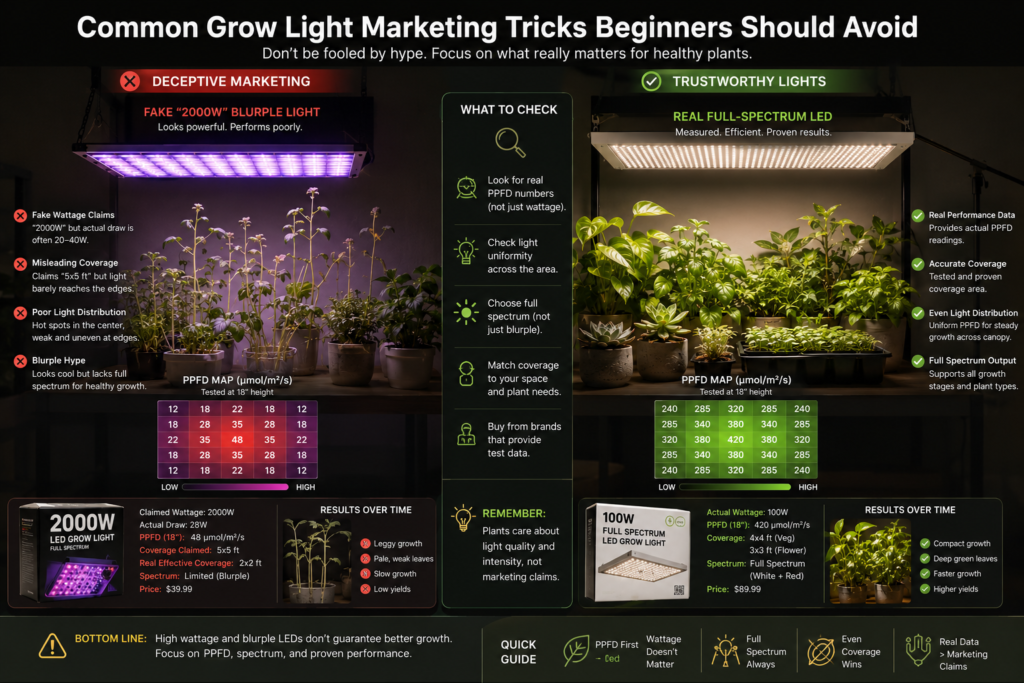
Many grow light listings use exaggerated specifications that make weak fixtures appear far more powerful than they actually are. One of the most common tactics is advertising inflated “equivalent wattage” instead of true power consumption or usable PPFD output. A light promoted as “2000W” may only draw a fraction of that power in real use.
Coverage claims can also be misleading. Some fixtures provide strong intensity only in the center while outer areas receive weak light, leading to uneven growth and stretched foliage.
Warning Signs of Weak Grow Lights
- No PPFD chart or hanging height recommendations
- No true wattage listed
- Unrealistic coverage claims
- Generic stock product photos
- No independent testing or safety certifications
- Extremely short warranties
- No diode specifications
Trustworthy manufacturers usually publish realistic PPFD maps, true wattage, beam angles, and recommended hanging distances instead of relying mainly on oversized wattage claims.
Common Signs of Insufficient Grow Light Performance
- Stretched stems
- Pale foliage
- Leaning growth
- Slow development
- Weak root systems
- Poor leaf density
Smarter Buying Habits for Beginners
- Compare true wattage instead of advertised equivalents
- Look for published PPFD maps
- Prioritize full-spectrum LEDs
- Research real user reviews
- Avoid suspiciously cheap “high wattage” fixtures
- Focus on actual canopy coverage
- Match lighting intensity to plant needs
Choosing realistic, properly tested grow lights helps improve long-term plant health and prevents wasted money on underpowered fixtures.
How Much Do Grow Lights Cost to Run Monthly?
Most modern LED grow lights are inexpensive to run compared to older fluorescent or HID systems. Monthly electricity cost depends mainly on wattage, daily usage time, and local electricity rates.
For example, a 40-watt LED grow light running 12 hours per day typically uses around 14–15 kWh per month, which usually results in only a few dollars in electricity costs depending on your region.
What Affects Running Costs
- Grow light wattage (higher wattage = higher cost)
- Daily runtime (longer photoperiods increase usage)
- Electricity rates in your area
- Number of active fixtures
Simple Ways to Reduce Costs
- Use efficient full-spectrum LEDs
- Run lights on timers to avoid overuse
- Match light intensity to plant needs
- Avoid oversized fixtures for small plant setups
Are Cheap Grow Lights Worth Buying?
Cheap grow lights can work for low-light plants or beginner setups, but many lack sufficient intensity for long-term healthy growth.
Budget lights may work for:
- low-light plants
- propagation trays
- supplemental lighting
Common limitations include:
- weak output
- uneven coverage
- short lifespan
What Features Should You Look for Before Buying a Grow Light?
Many grow light listings contain exaggerated marketing claims, so it is important to focus on real performance metrics instead of advertised wattage alone.
- True wattage affects actual light intensity and coverage
- PPFD charts help evaluate usable canopy coverage and hanging performance
- Timers and dimmers improve lighting consistency and intensity control for different plant stages
Reliable grow light brands usually publish realistic wattage, PPFD maps, and hanging recommendations instead of relying mainly on oversized marketing claims.
When Are Budget Grow Lights Acceptable?
Budget LED grow lights work well for low-light plants like pothos, peace lilies, moss propagation, and simple beginner setups where only moderate light levels are needed.
They are also a practical upgrade from standard room lighting for casual indoor gardening, but they are not ideal for high-light plants or demanding growth setups.
When Should You Upgrade to Premium Grow Lights?
Premium grow lights are worth upgrading to when you are growing high-light or high-value plants such as succulents, rare aroids, seedlings, or indoor vegetables, or when managing larger plant collections that need consistent coverage.
They provide stronger efficiency, more stable output, better heat management, higher-quality diodes, and longer lifespans, making them more reliable for demanding or long-term indoor growing setups.
Best Grow Lights by Plant Type
Different plants need different light intensity and coverage. Matching the grow light to the plant type helps prevent weak growth, stretching, and uneven development.
Best Grow Lights for Pothos and Philodendrons
These tropical plants grow best under balanced, moderate lighting that supports steady foliage growth without stressing the leaves.
- Medium-intensity full-spectrum LEDs
- White light (4000K–6500K)
- 10–12 hour daily photoperiod
- Even canopy coverage (LED bars work well)
LED light bars are especially effective because they distribute light evenly across trailing vines and multi-plant setups.
Best Grow Lights for Succulents and Cacti
Succulents and cacti need high light intensity to maintain compact growth and strong coloration.
- High-intensity LED panels
- High PPFD output (strong direct light)
- Closer hanging distance
- Longer daily exposure (12–16 hours)
Strong full-spectrum LEDs help prevent stretching and produce tighter, healthier plant structure.
Best Grow Lights for Herbs
Herbs require consistent, bright lighting to support fast, dense, edible growth.
- Bright overhead full-spectrum LEDs
- Moderate-to-high intensity lighting
- Consistent daily schedules
- Even multi-container coverage
Overhead LED bars or panels work best because they provide uniform light for multiple herb pots at once.
Best Grow Lights for Seedlings
Seedlings need gentle, even lighting with longer exposure times to prevent stretching and weak early growth.
- Even tray-wide light coverage
- Moderate intensity lighting
- 14–16 hour photoperiods
- Adjustable mounting height
LED bars and T5-style fixtures are commonly used because they provide uniform coverage and stable conditions for early plant development.
Common Indoor Grow Light Mistakes
Many indoor plant problems come from a few repeated lighting mistakes that reduce growth quality and overall plant health.
Using decorative bulbs instead of real grow lights
Decorative or “bright-looking” bulbs often lack the intensity and spectrum needed for plant growth, causing slow decline over time.
Ignoring plant-specific light needs
Different plants require different light levels; using weak lighting for succulents or overly strong light for tropicals can lead to stress and poor development.
Running lights inconsistently
Irregular lighting schedules disrupt plant growth cycles, while stable daily timing supports healthier and more predictable development.
What Are the Most Trusted Grow Light Brands for Indoor Plants?
Several grow light brands are frequently recommended because they provide reliable performance, transparent specifications, and consistent long-term output.
Reliable brands usually publish PPFD charts, true wattage, coverage maps, and hanging recommendations, helping buyers compare fixtures more accurately.
Popular Grow Light Brands Frequently Recommended
- Barrina
- Spider Farmer
- Mars Hydro
- GE Grow Lights
- Sansi
- Viparspectra
- Soltech Solutions
- Monios-L
Barrina LED bars are popular for shelves and cabinets, while Spider Farmer and Mars Hydro are commonly used for stronger canopy coverage and larger indoor collections.
Final Thoughts on the Best Grow Lights for Indoor Plants
Full-spectrum LEDs remain the most practical solution for indoor plant lighting. Proper intensity, coverage, and consistent schedules matter more than exaggerated wattage claims.
FAQ Section
What type of grow light is best for most indoor plants?
Full-spectrum LED grow lights are the best choice because they provide balanced wavelengths for healthy plant growth while remaining energy efficient.
How long should grow lights stay on each day?
Most indoor plants need 10–16 hours of light daily depending on the plant type and light intensity.
How far should grow lights be placed from plants?
Light distance depends on strength: 6–12 inches for weak lights and 18–36 inches for stronger LED panels.
Can grow lights replace natural sunlight?
Yes, many indoor plants can grow fully under grow lights if intensity and duration are properly managed.
Why are my indoor plants getting leggy under grow lights?
This usually means the light is too weak or placed too far away, causing plants to stretch toward the light source.
Do grow lights increase electricity bills?
Modern LED grow lights are energy efficient and typically have a low impact on electricity bills.
What is the best grow light setup for beginners?
Full-spectrum LED bars or panels are ideal for beginners because they are easy to install and provide even coverage.
Myra is the founder and lead writer of Plantsaholic. She shares practical, research-backed advice on indoor plants, outdoor gardening, flowers, herbs, succulents, and everyday plant care. Her goal is to help gardeners of all experience levels grow healthier plants through simple, easy-to-follow gardening guides.