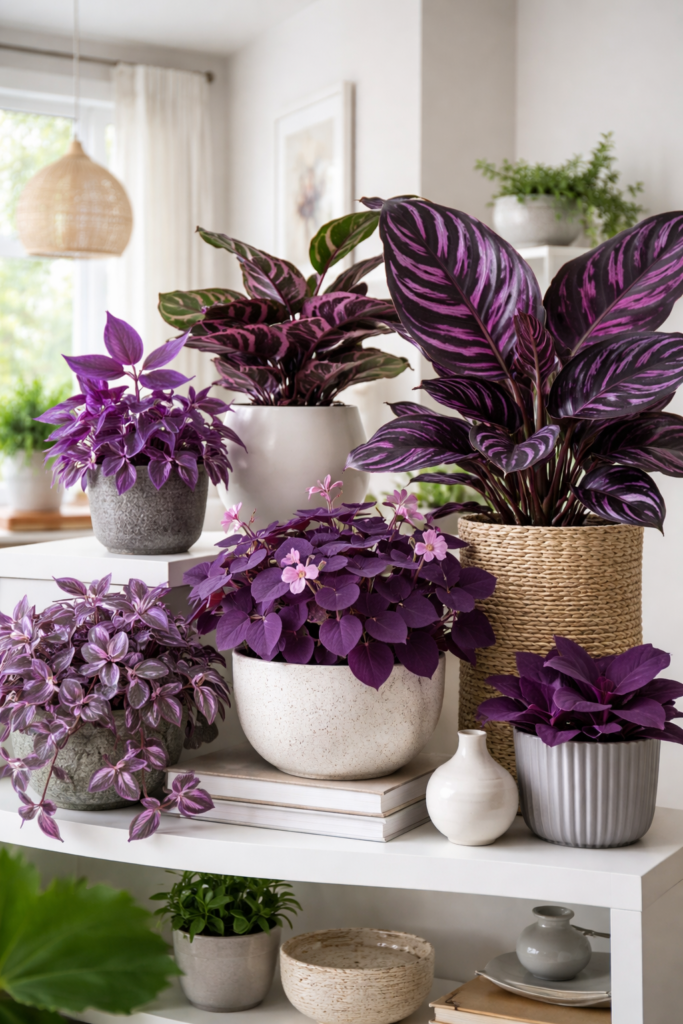
Purple house plants are indoor plants with violet or burgundy foliage caused by anthocyanin pigments. Popular varieties include Tradescantia zebrina, Oxalis triangularis, and Persian shield. They require bright indirect light, balanced watering, and stable conditions to maintain their vibrant color.
Purple house plants are one of the most visually striking plant categories. Their deep tones create contrast, depth, and a modern aesthetic that standard green plants cannot match. Whether used as accent plants or focal pieces, they instantly elevate indoor spaces.
Unlike regular houseplants, their color is directly tied to environmental conditions. This makes them both beautiful and slightly more sensitive, requiring proper care to maintain their signature purple tones.
What Are Purple House Plants?
Purple house plants are indoor plants that display shades of purple, violet, or burgundy in their foliage. This coloration is caused by anthocyanins, pigments that protect plant tissues and influence how they absorb light. These pigments are often present in both the upper and lower leaf surfaces, creating dramatic visual contrast.
In many species, the purple coloration appears alongside green or patterned areas, making each plant unique. Some plants have fully purple leaves, while others show purple undersides or streaks. This variation makes them highly desirable for decorative indoor use.
Key characteristics of purple house plants:
- Purple or burgundy leaf pigmentation
- Anthocyanin-based coloration
- Often combined with green or silver patterns
- Light-sensitive color intensity
- Strong decorative and aesthetic value
Why Do Some Plants Have Purple Leaves?
Purple coloration in plants is a natural adaptation that helps them manage light exposure. Anthocyanins act as a protective filter, reducing damage from excessive light while allowing the plant to maintain efficient photosynthesis. This adaptation is especially common in tropical environments where light intensity can fluctuate.
In indoor environments, this means that purple plants rely heavily on proper lighting to maintain their color. When light levels drop, the plant produces more chlorophyll to compensate, causing leaves to turn greener. This shift is not a problem but a survival response.
Reasons behind purple pigmentation:
- Protection from intense light exposure
- Improved light absorption efficiency
- Natural genetic adaptation
- Environmental stress response
- Enhanced moisture retention in leaves
The color of the plant reflects how it interacts with light.
Best Purple House Plants
Purple house plants come in a wide range of shapes, textures, and growth habits. Some are trailing, while others grow upright or remain compact. Choosing the right plant depends on your space, lighting conditions, and experience level.
Many of these plants are popular because they combine strong color with relatively easy care. However, some varieties require more attention to maintain their appearance and health.
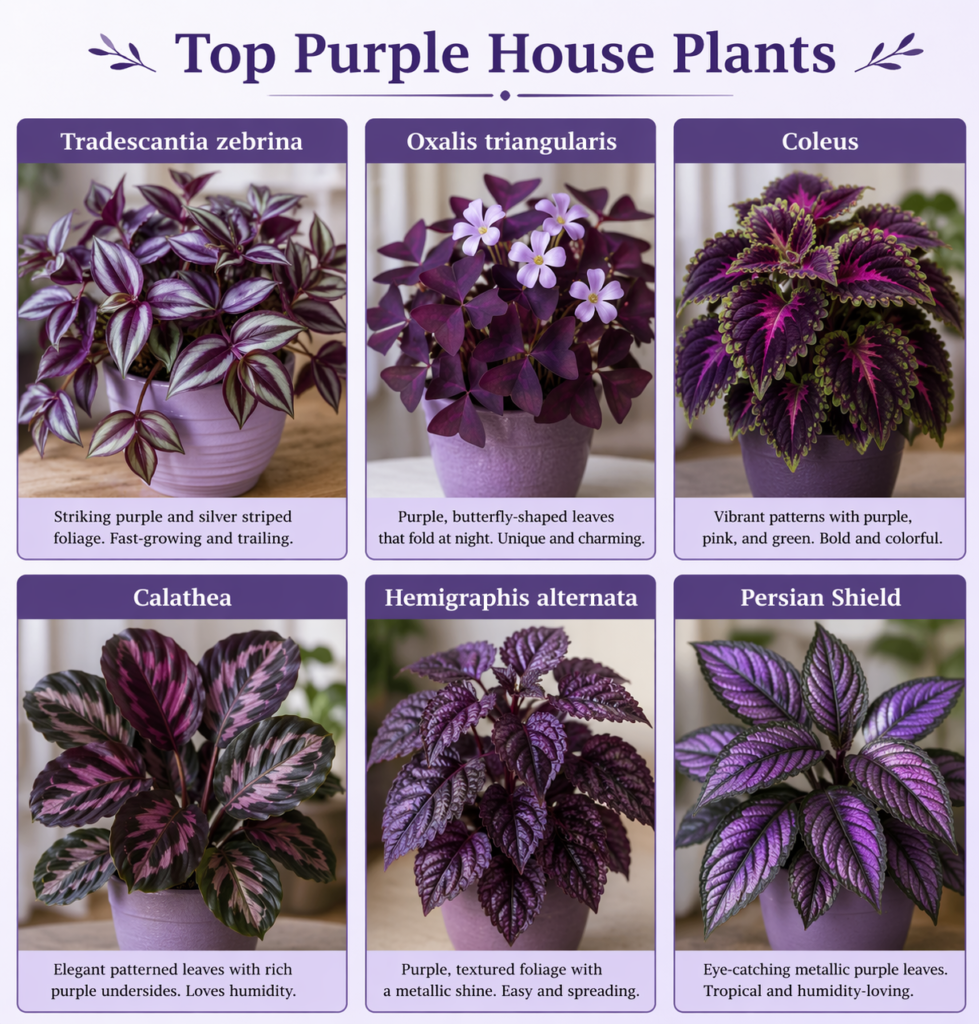
Top purple house plants:
- Tradescantia zebrina: fast-growing, trailing, beginner-friendly
- Oxalis triangularis: compact with unique leaf movement
- Coleus: highly variable patterns and colors
- Calathea: patterned leaves with purple undersides
- Hemigraphis alternata: textured and compact
- Persian shield: bold, iridescent foliage
Each plant offers a different balance of color, care level, and visual impact.
Types of Purple Foliage (Important for Care)
Not all purple foliage behaves the same way. Some plants maintain deep coloration consistently, while others change based on environmental conditions. Understanding these differences is essential for proper care.
Fully purple leaves tend to require more light to maintain their color, while plants with purple undersides can tolerate slightly lower light levels. Mixed-pattern plants offer a balance between color and stability.
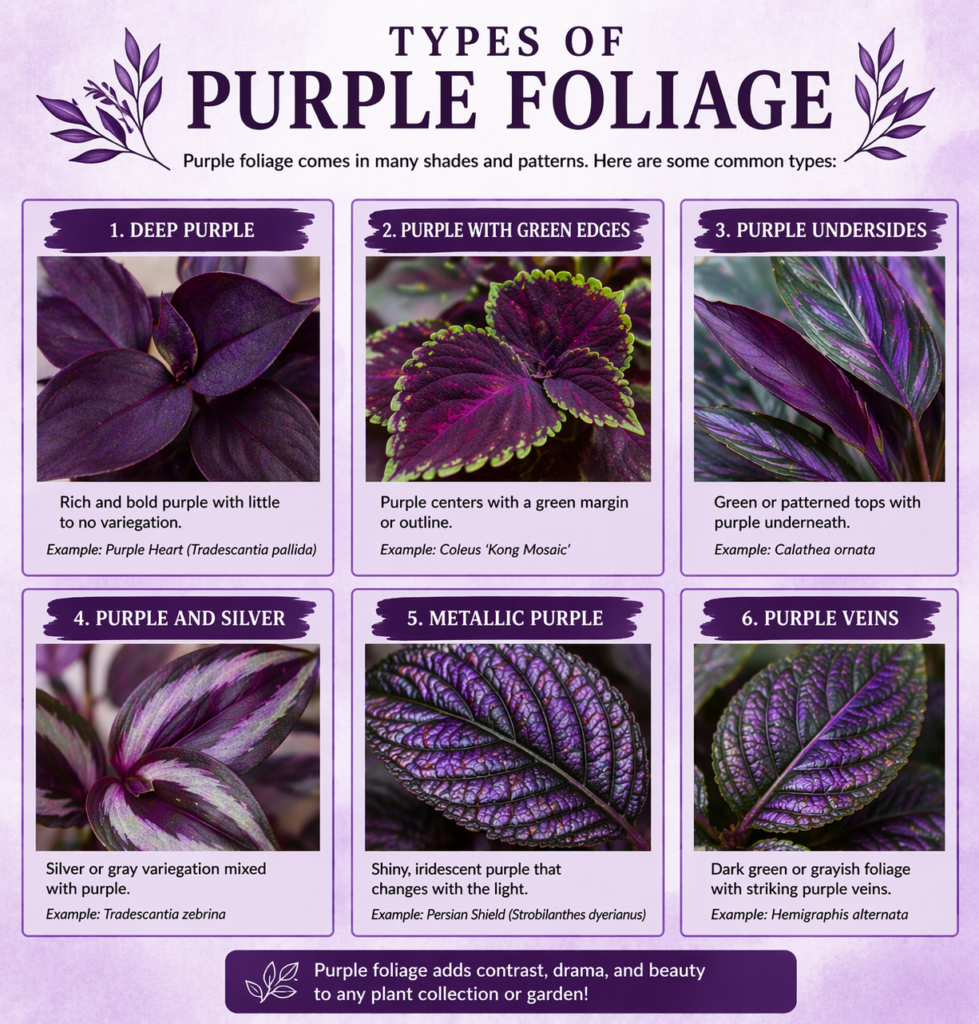
Types of purple foliage:
- Fully purple leaves with high pigment concentration
- Purple undersides with green tops
- Mixed purple and green patterns
- Light-responsive color variation
- Seasonal or stress-based color changes
The type of foliage determines how sensitive the plant is to light and care.
Light Requirements for Purple House Plants
Light is the most important factor in maintaining purple coloration. Since anthocyanins depend on light intensity, proper placement directly affects how vibrant the plant appears. Without sufficient light, the plant will gradually lose its purple tones and become greener.
At the same time, excessive direct sunlight can damage the leaves, especially in plants with high pigment concentration. The goal is to provide strong but filtered light that supports both color and growth.
Lighting guidelines:
- Bright indirect light is ideal
- Avoid harsh direct sunlight
- Place near east or south-facing windows
- Use sheer curtains to diffuse light
- Rotate plants for even exposure
Balanced lighting keeps colors vibrant without causing damage.
Watering and Soil Needs
Purple house plants require consistent moisture, but overwatering can quickly damage their roots. Since many of these plants originate from tropical environments, they prefer slightly moist soil combined with good drainage.
The key is to maintain a balance where the soil never becomes completely dry or overly saturated. Proper soil composition also plays a role in ensuring root health and nutrient absorption.
Watering and soil tips:
- Water when top layer of soil dries slightly
- Avoid waterlogging and standing water
- Use well-draining soil mix
- Add perlite or bark for aeration
- Maintain moderate humidity levels
Consistent moisture supports both color and growth stability.
How to Keep Purple Color Strong
Maintaining vibrant purple color requires consistency in environmental conditions. Any stress, whether from poor lighting or irregular watering, can reduce color intensity and overall plant health.
Regular observation is important. By monitoring changes in leaf color, you can quickly adjust care before the plant loses its vibrancy.
Best practices for strong color:
- Provide stable, bright light conditions
- Avoid sudden environmental changes
- Maintain consistent watering routine
- Prune faded or damaged leaves
- Ensure proper airflow and humidity
Healthy plants naturally maintain stronger color.
Common Problems and Fixes
Purple house plants can develop issues if their environment is not properly managed. Most problems are related to light, water, or temperature changes.
Identifying these issues early allows you to correct them before they affect the plant’s long-term health.
Common problems:
- Leaves turning green due to low light
- Faded color from stress
- Leaf burn from direct sunlight
- Drooping leaves from watering imbalance
- Slow growth from poor conditions
Fixes:
- Adjust light placement
- Maintain consistent watering
- Improve airflow
- Stabilize temperature and humidity
Most issues are solved by restoring balance.
Do Purple House Plants Stay Purple? (Stability Explained)
Purple house plants do not always stay purple permanently. Their color depends on how well environmental conditions support anthocyanin pigments. While some species maintain deep purple tones consistently, others shift between purple and green depending on light, temperature, and overall plant health.
In stable conditions with sufficient light, plants retain their vibrant color. However, when light levels drop, the plant increases chlorophyll production to survive, causing leaves to turn greener. This is not a failure in care but a natural biological response. Some plants, like Tradescantia zebrina, maintain color more reliably, while others are more sensitive.
Factors affecting color stability:
- Light intensity and duration
- Plant species and genetics
- Temperature consistency
- Watering balance
- Overall plant health
Purple color is not fixed; it reflects how well the plant’s needs are met.
How to Restore Purple Color (Step-by-Step)
If a purple house plant starts losing its color, it can often be restored by adjusting environmental conditions. The most common cause of fading is insufficient light, which leads the plant to produce more chlorophyll. Restoring color requires reversing these conditions gradually.
The first step is to improve light exposure without shocking the plant. Sudden changes can stress the plant further. Instead, move it closer to a bright window or introduce a grow light. Over time, new growth will regain its purple tone, although older leaves may remain faded.
Steps to restore purple color:
- Increase light exposure gradually
- Move plant closer to a window
- Use indirect bright light, not direct sun
- Maintain consistent watering
- Prune severely faded leaves
Color recovery takes time, new growth shows improvement first.
Propagating Purple Plants (Will They Keep Color?)
Propagation of purple house plants is similar to other plants, but maintaining color adds an extra layer of complexity. The pigmentation must be present in the cutting for the new plant to retain its purple tones.
If you propagate from a faded or green section, the new plant may not develop strong purple coloration. This makes it important to select healthy, vibrant cuttings. Even with proper selection, environmental conditions during propagation will influence the final result.
Propagation tips for color retention:
- Choose cuttings with strong purple coloration
- Avoid faded or green sections
- Ensure nodes are healthy
- Provide bright light during rooting
- Maintain humidity for better success
Color inheritance depends on both genetics and environment.
Anthocyanin vs Chlorophyll (Color Science Explained)
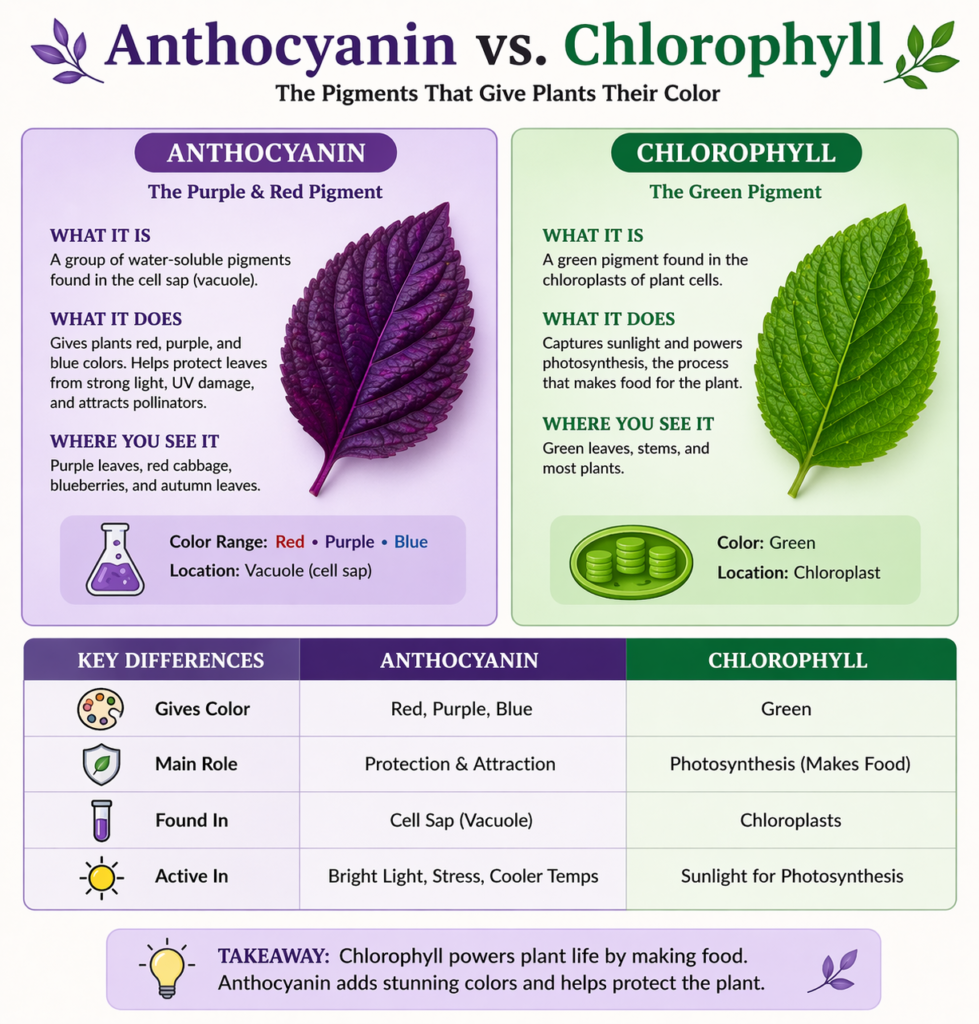
The color of purple house plants is controlled by the balance between anthocyanins and chlorophyll. Anthocyanins create purple tones, while chlorophyll produces green color. These two systems compete depending on environmental conditions.
In high light, anthocyanins are more active, producing deeper purple shades. In low light, chlorophyll dominates, turning leaves greener to improve energy production. This balance explains why the same plant can look completely different in different environments.
Color interaction explained:
- Anthocyanins produce purple tones
- Chlorophyll produces green color
- High light strengthens purple pigmentation
- Low light increases green production
- Balance shifts based on environment
This competition model explains most color changes.
Exact Lighting Setup (Window + Distance Guide)
Providing the right lighting setup is essential for maintaining purple color. Not all bright light is equal, and the position of the plant relative to the window plays a major role in performance.
East-facing windows provide gentle, consistent light that works well for most purple plants. South-facing windows offer stronger light but may require filtering. The distance from the window also matters, as light intensity drops quickly with distance.
Lighting setup guidelines:
- East-facing window: ideal for balanced light
- South-facing window: use sheer curtains
- West-facing window: monitor for heat stress
- Keep plant within 1–2 meters of window
- Use grow lights in low-light rooms
Correct positioning ensures stable and vibrant color.
Why Some Purple Plants Are Rare and Expensive
Purple house plants can be more expensive due to their unique pigmentation and slower growth rate. Since they rely on anthocyanins, which limit energy efficiency, they grow more slowly than green plants. This reduces supply and increases value.
In addition, some species are harder to propagate while maintaining their color. Collector demand also plays a significant role, especially for plants with intense or unusual shades of purple.
Factors influencing rarity and price:
- Slower growth rate
- Limited propagation success
- High collector demand
- Unique color patterns
- Limited availability in market
Price reflects both rarity and growing difficulty.
Healthy vs Faded Purple Leaves (Visual Indicators)
Understanding the difference between healthy and faded leaves helps you monitor plant condition. Healthy purple leaves appear deep, vibrant, and consistent in color. Faded leaves look dull and may show more green tones.
These visual changes are early indicators of environmental imbalance. By recognizing them quickly, you can adjust care before the plant’s health declines further.
Visual indicators:
- Healthy leaves: deep purple, strong color
- Faded leaves: dull, less vibrant
- Green shift: sign of low light
- Burnt edges: too much direct sun
- Drooping leaves: watering issues
Leaf color is the fastest way to diagnose problems.
How Purple Plants Grow Differently from Green Plants
Purple house plants behave differently from green plants due to their reduced chlorophyll levels. This affects their growth rate, energy production, and sensitivity to environmental changes.
They typically grow slower and require more stable conditions. While green plants can tolerate fluctuations, purple plants react more quickly to stress, making consistency more important.
Growth differences:
- Slower growth rate
- Higher light requirement
- Greater sensitivity to stress
- More noticeable color changes
- Stronger visual response to environment
Their behavior is directly linked to their pigmentation.
Purple vs Green House Plants
Purple house plants differ significantly from standard green plants in both appearance and care requirements. While green plants are generally more forgiving, purple plants offer a more dramatic visual impact.
Their slower growth and higher sensitivity make them slightly more demanding, but also more rewarding for those who maintain proper conditions.
Comparison insights:
- Purple plants have higher light requirements
- Green plants grow faster
- Purple plants offer stronger visual contrast
- Green plants are easier to maintain
- Purple plants require more consistency
Choosing between them depends on your experience and goals.
Are Purple House Plants Beginner-Friendly?
Some purple house plants are suitable for beginners, while others require more attention. Starting with resilient species helps build confidence before moving to more sensitive varieties.
Plants like Tradescantia and Coleus are forgiving and adaptable, making them ideal for beginners. More delicate plants like Calathea or Persian shield require more controlled environments.
Beginner tips:
- Start with easy-care species
- Focus on proper lighting
- Maintain consistent watering
- Avoid overcomplicating care
- Observe plant behavior regularly
Experience improves success with more advanced plants.
Expert Insight: Color Reflects Plant Health
Purple coloration is not just decorative, it is a direct indicator of plant health and environmental conditions. Changes in color often signal adjustments the plant is making to survive.
By paying attention to these changes, you can fine-tune care and maintain optimal conditions.
Key insight:
- Deep purple = optimal light and health
- Green shift = insufficient light
- Fading = environmental stress
The plant’s color is its way of communicating with you.
Final Thoughts
Purple house plants are a powerful way to add color, contrast, and personality to indoor spaces. Their unique pigmentation sets them apart from traditional houseplants, making them a favorite among plant enthusiasts.
With proper care and attention, they maintain their vibrant appearance and become long-lasting decorative elements. While they require slightly more effort, the visual impact makes them well worth it.
FAQ Section
What are purple house plants?
Indoor plants with purple foliage caused by anthocyanin pigments.
Why do purple plants turn green?
Due to low light conditions.
Do purple plants need more light?
Yes, they require bright indirect light.
Are they hard to care for?
Moderate difficulty depending on species.
What is the easiest purple plant?
Tradescantia is beginner-friendly.
Myra is the founder and lead writer of Plantsaholic. She shares practical, research-backed advice on indoor plants, outdoor gardening, flowers, herbs, succulents, and everyday plant care. Her goal is to help gardeners of all experience levels grow healthier plants through simple, easy-to-follow gardening guides.