The best self-watering pots for indoor plants combine a reliable reservoir, effective wick or sub-irrigation system, good root aeration, correct pot size, and an easy way to monitor water. They work especially well for houseplants that prefer relatively consistent moisture, but they are usually less suitable for cacti, succulents, and other plants that need substantial dry periods.
The most important decision is not the brand name. It is whether the planter’s watering system matches the plant’s natural moisture needs, your indoor conditions, and the problem you are trying to solve. A peace lily that repeatedly wilts between waterings may benefit greatly from a reservoir planter. A snake plant that already thrives with infrequent watering probably does not need one.
Plantsaholic recommends choosing in this order: plant moisture needs, watering problem, system type, pot size, reservoir design, and finally brand.
Quick Self-Watering Pot Selector
| Situation | Best Starting Choice |
|---|---|
| Moisture-loving individual plant | Reservoir or sub-irrigated planter |
| Small plant that dries quickly | Compact wick planter |
| Large tropical floor plant | Large reservoir planter with indicator |
| Hanging plant | Hanging self-watering planter |
| Pothos or flexible tropical plant | Reservoir system with controlled dry phase |
| Cactus, aloe, or most succulents | Traditional drainage pot |
| Several small plants | Capillary mat or shared watering system |
| Large indoor collection | Automatic drip system |
| Two-week vacation | Pre-tested reservoir or automatic system |
| Outdoor container | Reservoir planter with overflow |
A self-watering pot should solve a genuine watering problem. If a plant already grows well with occasional manual watering, a reservoir may add complexity without providing much benefit.
Does Your Plant Need a Self-Watering Pot?
Start by identifying what goes wrong with your current watering routine. Self-watering pots are most useful when plants repeatedly become too dry, watering access is difficult, frequent travel interrupts care, or a moisture-sensitive species suffers from inconsistent watering.
They are strongest for plants that prefer relatively even moisture. Reservoir systems are less useful when the plant naturally requires pronounced dry-down or when your growing conditions already keep the soil wet for long periods.
A self-watering pot may be useful when:
- the plant regularly wilts between waterings;
- you often forget to water;
- small pots dry rapidly;
- hanging plants are difficult to reach;
- travel disrupts your routine;
- the plant prefers steady moisture;
- a large floor plant is difficult to move.
Reconsider self-watering when:
- the plant needs strong dry periods;
- the potting mix remains wet for many days;
- the plant receives very little light;
- the container is oversized;
- the reservoir cannot be cleaned properly.
The best question is simple: will controlled access to stored water improve the way this plant is currently being watered?
Best Self-Watering Pots for Indoor Plants
Rather than recommending a long list of nearly identical products, Plantsaholic focuses on different use cases.
| Pot | Best For | System | Indicator | Main Advantage | Main Limitation |
|---|---|---|---|---|---|
| LECHUZA CLASSICO Color | Best overall | Integrated reservoir | Yes | Strong irrigation design and multiple sizes | Higher cost |
| LECHUZA CUBE Color 16 | Small plants | Stick irrigation | Yes | Compact and easy to monitor | Limited to smaller plants |
| IKEA VÅRDTRÄD | Budget buyers | Reservoir system | Varies by model | Affordable and simple | Fewer premium features |
| Mayne Caprio Hanging Planter | Hanging plants | Built-in reservoir | Yes | Large reservoir and overflow | Relatively heavy |
| LECHUZA CLASSICO Premium LS | Large plants | Integrated reservoir | Yes | Removable liner and large sizes | Premium price |
These are research-based editorial recommendations, not Plantsaholic firsthand test results.
Best Overall: LECHUZA CLASSICO Color
The LECHUZA CLASSICO Color is a strong all-around choice because it combines an integrated reservoir, irrigation layer, and water-level indicator. It is available in multiple sizes, making the same system suitable for both smaller foliage plants and larger decorative houseplants.
Best for:
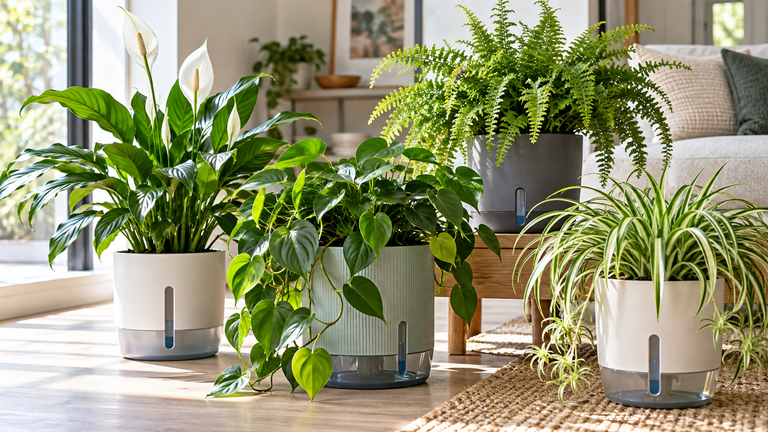
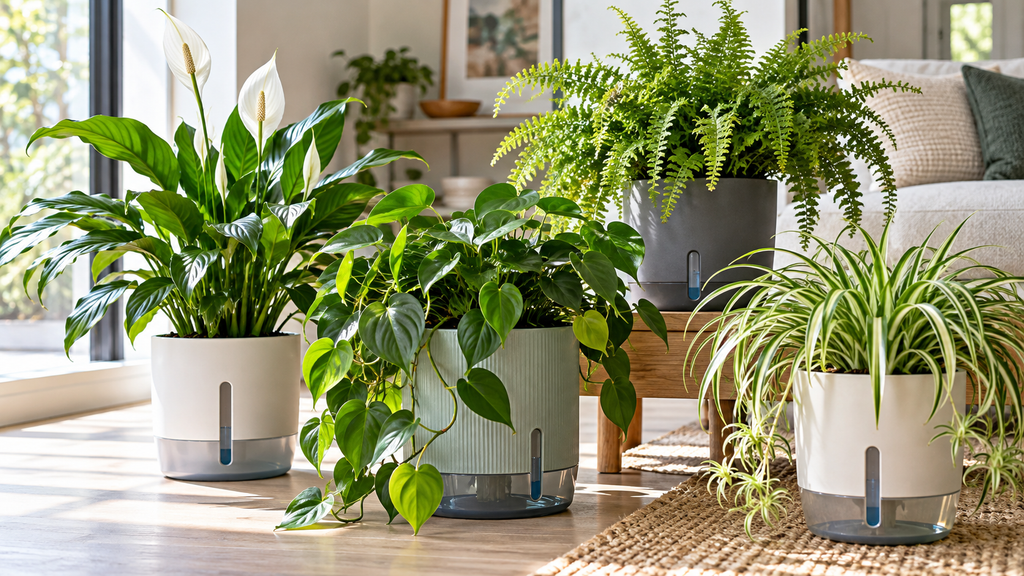
- peace lilies;
- many ferns;
- philodendrons;
- prayer plants;
- other tropical foliage plants that appreciate steady moisture.
The main advantage is visibility. A water-level indicator gives a clearer refill signal than a completely hidden reservoir. The main drawback is cost compared with simpler wick pots.
Best for Small Plants: LECHUZA CUBE Color 16
The CUBE Color 16 uses a compact stick-based irrigation system with a water-level indicator. It is well suited to shelves, desks, small tropical plants, herbs, and other compact indoor plants.
Choose it when space is limited and you want a more controlled system than a basic decorative reservoir pot.
Avoid it for plants that need significantly deeper or wider root space.
Best Budget Option: IKEA VÅRDTRÄD
The IKEA VÅRDTRÄD range offers simpler self-watering functionality at a lower price point than many premium planters.
It is best for buyers who want a functional reservoir system without paying for removable liners, advanced irrigation components, or premium finishes.
The tradeoff is that simpler systems generally provide less control and fewer specialized features.
Best Hanging Option: Mayne Caprio
Hanging plants can be inconvenient to water because they often need to be lifted down or reached with a stool. The Mayne Caprio combines a hanging format with a built-in reservoir, water-level indicator, removable planting insert, and overflow design.
It makes sense for larger hanging plants that otherwise dry too quickly or are difficult to water regularly.
Its main limitation is weight, especially once the soil and reservoir are full.
Best Premium Option: LECHUZA CLASSICO Premium LS
The CLASSICO Premium LS is better suited to larger decorative indoor plants. Its removable liner, integrated irrigation system, and water-level indicator make large plants easier to maintain without moving the entire outer planter.
It is most useful when appearance, large size, reservoir control, and maintenance convenience justify the higher price.
How Do Self-Watering Pots Work?
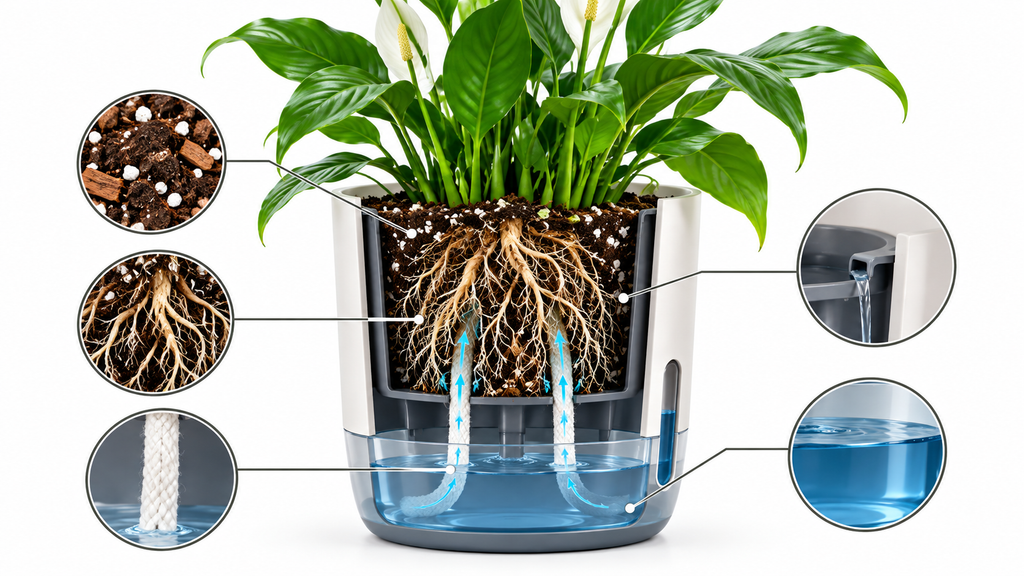
Most self-watering pots store water below the main growing medium and move moisture upward through a wick, capillary material, or irrigation layer.
The basic system usually includes:
- the plant and roots;
- potting medium;
- wick or capillary zone;
- separator or inner liner;
- water reservoir;
- sometimes an overflow;
- sometimes a water-level indicator.
As the growing medium dries, water moves upward from the reservoir through capillary action.
The potting mix is critical. A dense mix can remain wet for too long, while an overly coarse mix may not wick enough water. For many tropical houseplants, ingredients such as indoor potting mix, bark, perlite, pumice, or coco-based materials can provide a better balance of moisture and air.
A good reservoir cannot compensate for unsuitable soil.
Best Plants for Self-Watering Pots
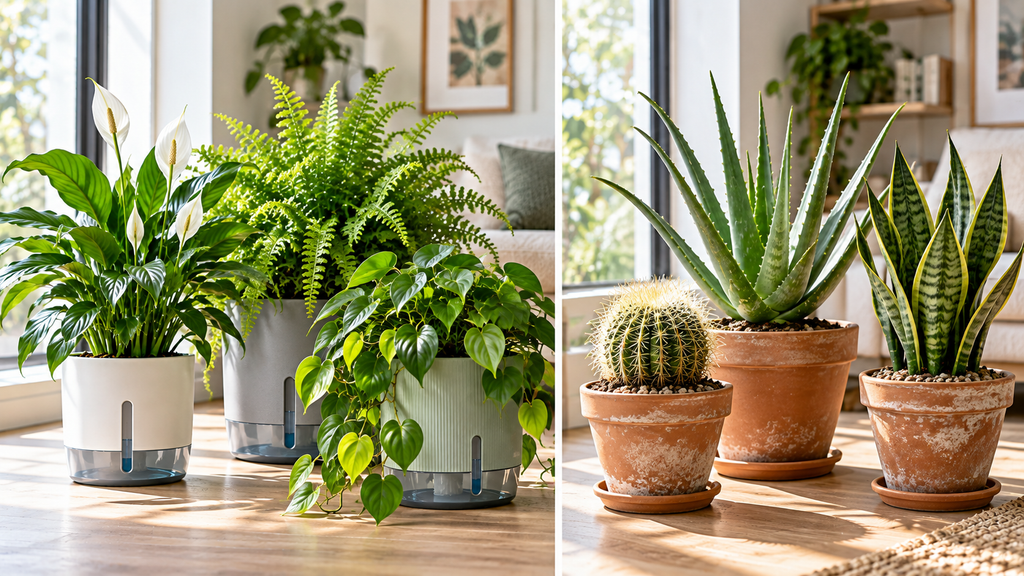
The strongest candidates are plants that prefer relatively even moisture without sitting in stagnant, saturated soil.
Good candidates include:
- peace lilies;
- maidenhair and many other ferns;
- prayer plants;
- many philodendrons;
- spider plants;
- syngoniums;
- some other tropical foliage plants.
Peace Lilies
Peace lilies are among the strongest candidates because they commonly react badly to severe drying. A reservoir system can reduce repeated cycles of wilting and heavy watering.
Ferns
Many ferns prefer steady moisture and can decline quickly after prolonged drying. A properly managed self-watering system can keep their root zone more consistent.
Philodendrons
Many philodendrons adapt well to reservoir watering when the potting medium remains airy and the plant receives appropriate light.
Pothos
Pothos is more flexible. It can grow successfully in self-watering systems, but it also tolerates partial dry-down. Allowing the reservoir to decline rather than keeping it permanently full usually provides better control.
Self-Watering Plant Fit
| Plant | Fit | Why |
|---|---|---|
| Peace lily | Strong fit | Prefers relatively even moisture |
| Maidenhair fern | Strong fit | Sensitive to severe drying |
| Prayer plant | Strong fit | Benefits from consistent moisture |
| Philodendron | Usually suitable | Many types adapt well |
| Spider plant | Usually suitable | Tolerates even moisture |
| Syngonium | Usually suitable | Likes regular moisture |
| Pothos | Conditional | Often benefits from partial dry-down |
| Peperomia | Conditional to poor | Many types store water |
| Snake plant | Usually avoid | Prefers stronger dry-down |
| Aloe | Usually avoid | Drought adapted |
| Desert cactus | Usually avoid | Needs pronounced drying |
Plants to Avoid in Self-Watering Pots
Dry-adapted plants are usually the weakest candidates for reservoir systems.
These include:
- most desert cacti;
- many succulents;
- aloe;
- jade plants;
- snake plants;
- many peperomias;
- other drought-tolerant species.
The issue is not that these plants can never grow in a self-watering planter. The problem is that continuous access to moisture often conflicts with their natural watering requirements.
If you must deliberately leave the reservoir empty for long periods to keep the plant healthy, the self-watering feature provides little advantage.
For most drought-tolerant plants, a traditional pot with strong drainage is easier to manage.
Best Self-Watering Pot Features
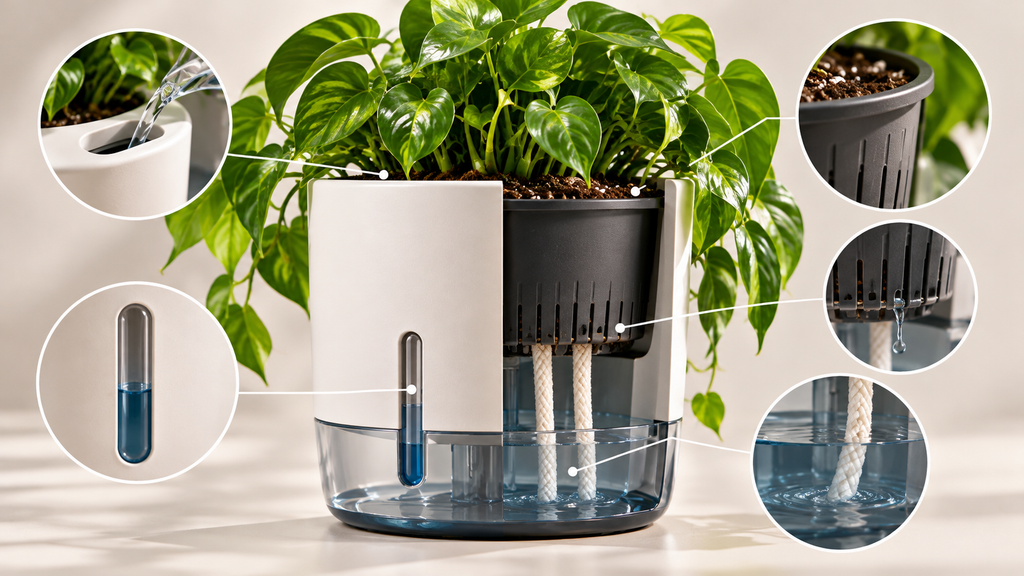
A good self-watering pot should be judged by function rather than appearance alone.
Water-Level Indicator
A visible indicator helps you avoid unnecessary refilling and shows whether the plant is actually using reservoir water.
Accessible Reservoir
A refill opening is particularly useful for large plants that are difficult to lift or move.
Overflow Protection
Overflow prevents excess rain or accidental overfilling from keeping the root zone permanently saturated.
Reliable Wick or Irrigation Layer
A reservoir is useless if moisture cannot reach the growing medium consistently.
Correct Reservoir Size
Large reservoirs are useful for high-demand plants, but bigger is not always better. A small plant in low light may use water very slowly.
Removable Liner
A removable liner makes root inspection, cleaning, repotting, and moving large plants easier.
Easy Cleaning
Reservoirs can collect algae, mineral deposits, fertilizer residue, and organic debris.
Correct Pot Size
Do not move a small root system into a dramatically larger pot just because the planter looks attractive.
Downsides of Self-Watering Pots
Self-watering pots make watering easier, but they are not maintenance-free.
Common disadvantages include:
- excess moisture when the system and plant are mismatched;
- mineral and fertilizer salt buildup;
- algae or reservoir residue;
- fungus gnats if the surface remains too wet;
- wick or component maintenance;
- higher initial cost;
- seasonal changes in water use.
They can also create a false sense of security. A reservoir indicator tells you how much water remains in the container, but it does not tell you whether the roots are healthy.
Root problems become more likely when dense soil, low light, oversized containers, cool temperatures, and constantly full reservoirs occur together.
Warning signs include:
- yellowing leaves;
- unexpected leaf drop;
- soft stems;
- stale or sour smell;
- soil that never becomes less wet;
- reservoir level that barely changes;
- dark or soft roots.
If these symptoms appear, stop automatically refilling the reservoir and inspect the root zone before adding fertilizer or more water.
Self-Watering Pot Problems and Fixes
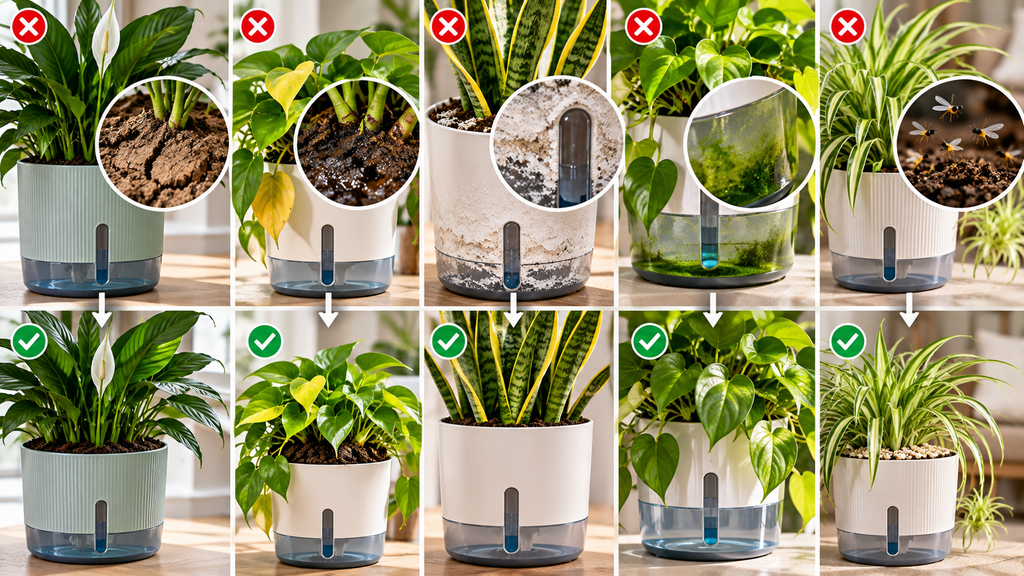
| Problem | Likely Cause | What to Check |
|---|---|---|
| Reservoir full but soil dry | Wick failure | Wick contact |
| Soil stays soaked | Dense mix or low water demand | Light and substrate |
| Yellow leaves with wet soil | Excess root-zone moisture | Roots and aeration |
| White crust | Mineral or fertilizer salts | Water and fertilizer use |
| Green reservoir | Algae or biofilm | Reservoir cleanliness |
| Fungus gnats increase | Persistent surface moisture | Top layer and airflow |
| Reservoir empties quickly | High water demand | Plant size, heat, light |
| Reservoir never empties | Low water demand | Light, season, roots |
| Hanging planter leaks | Overfill or drainage issue | Fill level and overflow |
Use one troubleshooting sequence:
Observe → diagnose → inspect → correct → monitor.
Avoid changing several variables at the same time.
How to Use Self-Watering Pots
1. Match the Pot to the Plant
Decide whether the plant prefers consistent moisture, moderate dry-down, or strong dry-down.
Reservoir systems are easiest to manage with the first group.
2. Use an Airy Potting Mix
The medium should move water while still maintaining oxygen around roots.
3. Avoid Oversized Pots
Large volumes of unused wet substrate can stay moist longer than the roots require.
4. Establish the Plant Correctly
Some systems require top watering after repotting while roots become established and make effective contact with the irrigation zone.
Always follow the planter manufacturer’s setup instructions.
5. Track Reservoir Use
During the first several refill cycles, notice how long the reservoir takes to reach minimum.
This gives you a more useful watering pattern than a fixed weekly schedule.
6. Allow Appropriate Dry-Down
Many systems benefit from allowing the reservoir level to fall before refilling.
How long you wait depends on the plant, season, temperature, and light.
7. Clean and Flush
Clean reservoirs periodically and inspect the wick.
Occasional top watering may also help reduce soluble-salt buildup when the planter allows excess water to drain safely.
Can Fertilizer Go in the Reservoir?
Only add fertilizer directly to the reservoir when the manufacturer specifically recommends it.
Repeated bottom feeding can increase salt accumulation, so use fertilizer according to the plant’s needs rather than assuming every reservoir should contain nutrients.
Can Roots Grow Into the Reservoir?
Yes. Roots may naturally grow toward available moisture in some systems.
Healthy roots entering the lower irrigation area are not automatically a problem. Intervene only if roots block components, interfere with maintenance, or become unhealthy.
Are Self-Watering Pots Worth It?
Self-watering pots are worth the money when they solve a real problem.
They make the most sense for:
- moisture-sensitive plants;
- frequent travelers;
- forgetful plant owners;
- large tropical plants;
- difficult-to-reach hanging plants;
- plants that repeatedly dry too far.
They provide less value when:
- you grow mostly cacti or succulents;
- your current watering routine already works;
- plants naturally remain moist for long periods;
- you own only a few easy-care plants.
Premium systems may justify their price through better indicators, removable liners, larger size ranges, refill shafts, or improved overflow control.
However, a simple wick planter can still be the better purchase when that is all the plant needs.
Pay for the watering problem you need to solve, not for unnecessary complexity.
Self-Watering Pots for a Two-Week Vacation
A self-watering pot can help during a two-week absence, but reservoir duration should never be assumed.
Water use changes with:
- reservoir capacity;
- plant size;
- leaf area;
- temperature;
- light;
- humidity;
- airflow;
- potting medium;
- season.
The safest approach is to run a trial before traveling.
Fill the reservoir normally and record how long it takes to reach minimum under your usual indoor conditions.
If it reliably lasts longer than two weeks, it may be suitable for the trip.
If it lasts only five or six days, use another method such as a larger external reservoir, capillary mat, watering stake, automatic drip system, or someone who can refill the planter.
Do not heavily overwater a drought-tolerant plant before leaving.
Self-Watering vs Automatic Watering
| System | Best Use | Scale | Main Limitation |
|---|---|---|---|
| Self-watering pot | Individual plants | Small | Separate reservoir per pot |
| Wick + external container | DIY or vacation use | Small | Flow varies |
| Capillary mat | Groups of small plants | Medium | Similar moisture needs required |
| Watering stake | Temporary individual use | Small | Needs testing |
| Pump drip system | Larger collections | Large | More setup |
| Smart irrigation | Controlled multi-plant watering | Large | Higher cost |
Choose a self-watering pot when you have a few individual plants and want a simple, permanent system without tubing or electricity.
Choose an automatic system when many plants need watering from a shared reservoir or programmable delivery is important.
For three plants in a living room, individual reservoir pots may be simpler.
For 30 or 40 plants, centralized irrigation may be more practical.
Choosing Self-Watering Pots Globally
Specific products are not available in every country, so global buyers should match function rather than brand.
If a recommended model is unavailable, look for:
- the same watering mechanism;
- suitable pot diameter;
- accessible reservoir;
- visible water level where possible;
- overflow protection;
- easy cleaning access;
- available replacement wicks;
- stable construction.
Avoid substitutes when the reservoir design is unclear, the wick cannot make reliable contact, the planter is dramatically oversized, or there is no safe overflow for outdoor use.
The goal is not to find the closest-looking product.
Find the closest functional equivalent.
Self-Watering Pot FAQs
Are self-watering pots good for houseplants?
Yes. They work well for houseplants that prefer consistent moisture, especially moisture-loving tropical plants. Dry-loving plants are usually better in conventional pots.
What plants don’t like self-watering pots?
Cacti, many succulents, snake plants, aloe, and other drought-tolerant plants generally prefer substantial dry-down between waterings.
Can you overwater plants in self-watering pots?
Yes. Dense soil, low light, oversized containers, or continuously full reservoirs can keep the root zone too wet.
Can self-watering pots cause root rot?
They can contribute to root problems when the soil remains saturated and poorly aerated for too long.
How often should you refill a self-watering pot?
Refill according to the reservoir level and actual plant demand rather than a fixed weekly schedule.
Should the reservoir stay full all the time?
Usually not. Many plants benefit from allowing the reservoir level to fall before refilling.
How long does water last?
There is no universal duration. Reservoir size, plant demand, temperature, light, humidity, and season all affect refill intervals.
Can a self-watering pot last two weeks?
It can, but test the system before traveling. If the reservoir empties sooner, use a backup watering method.
Can you use regular potting soil?
Yes, if it remains sufficiently airy. Dense mixes that stay saturated for long periods are poor choices.
Do self-watering pots attract fungus gnats?
They can if the growing medium remains unnecessarily wet. Reduce excess surface moisture instead of keeping the reservoir constantly full.
What if the reservoir is full but the soil stays dry?
The wick or capillary connection may not be working. Check that it contacts both the water and the growing medium.
Are self-watering pots worth the money?
Yes, when they solve repeated drying, travel, accessibility, or moisture-consistency problems. They are less useful for drought-tolerant plants.
Can self-watering pots be used outdoors?
Yes, but outdoor systems need effective overflow so heavy rain cannot flood the root zone.
Best Self-Watering Pots: Final Verdict
The best self-watering pots for indoor plants are the ones that match the plant’s moisture needs, root environment, pot size, and your actual watering problem.
For peace lilies, many ferns, prayer plants, spider plants, philodendrons, and other moisture-responsive tropical plants, a well-designed reservoir can reduce severe drying and make watering more consistent.
For cacti, aloe, snake plants, and many succulents, conventional drainage pots are usually easier and better suited to their natural watering cycle.
Before buying, ask:
- Does this plant benefit from steadier moisture?
- Does the planter provide reliable water transfer?
- Can I monitor and clean the reservoir?
- Is the pot correctly sized?
- Will the system still make sense as light and temperature change?
If the answers support reservoir watering, a self-watering pot can be a practical investment.
If they do not, traditional watering is probably the better choice.
Match the watering system to the plant before matching the pot to your décor.
Myra is the founder and lead writer of Plantsaholic. She shares practical, research-backed advice on indoor plants, outdoor gardening, flowers, herbs, succulents, and everyday plant care. Her goal is to help gardeners of all experience levels grow healthier plants through simple, easy-to-follow gardening guides.