Indoor plant care in summer is different because heat changes how fast plants use water, how quickly soil dries, and how much stress roots and leaves experience. The goal is not simply to water more. The goal is to manage light, humidity, airflow, soil moisture, and temperature together.
Summer heat can make healthy plants droop, curl, yellow, or develop crispy edges. These symptoms often look like watering problems, but the real cause may be hot windows, dry AC air, low humidity, or overheated roots.
Good summer care depends on observation. A plant with dry soil may need water. A plant with moist soil and drooping leaves may need cooler placement, better airflow, or higher humidity.
Summer plant care depends on controlling:
- soil moisture
- heat exposure
- humidity levels
- airflow quality
- root-zone temperature
- sunlight intensity
The best rule is simple: diagnose before acting. Check soil dryness, heat exposure, humidity, airflow, and light intensity before adding more water.
Summer Indoor Plant Stress Comparison
Summer plant stress symptoms often look similar, but their causes are different. Correct diagnosis prevents wrong treatment.
| Symptom | Looks Like | Actual Cause |
|---|---|---|
| Drooping | Thirst | Heat stress or dry soil |
| Yellowing | Overwatering | Root heat or drainage issues |
| Curling | Dryness | Low humidity or heat exposure |
| Brown tips | Underwatering | AC dryness or humidity loss |
| Soft stems | Dehydration | Root rot |
Symptoms are signals, not instructions. If a plant droops, do not water automatically. Check whether the soil is actually dry. If soil is wet, the problem may be heat stress, drainage trouble, or root damage.
How Does Summer Heat Affect Indoor Plants?
Summer heat affects indoor plants by increasing water loss, warming the root zone, and intensifying stress responses. Most people notice leaf damage first, but the problem often begins below the soil surface.
Plants lose water through transpiration. In hot weather, transpiration speeds up. At the same time, soil water evaporates faster. This creates double moisture loss: the plant loses water through leaves while soil dries faster around the roots.
Heat also affects root efficiency. Roots work best in stable conditions. When soil becomes too warm, roots may struggle to absorb moisture properly. This can make a plant droop even when soil is still damp.
Common summer heat stress symptoms include:
- drooping leaves
- curling edges
- crispy tips
- yellowing
- faded leaf color
- slower growth
- leaf shedding
Heat stress often gets confused with underwatering, overwatering, or fertilizer deficiency. For example, a Peace Lily drooping from root-zone heat may receive extra water, but the real solution is cooler placement.
How Often Should You Water Indoor Plants in Summer?
Indoor plants usually need more frequent watering in summer, but there is no universal schedule. The right frequency depends on how fast the plant’s environment removes moisture.
The biggest mistake is calendar watering. Watering every Sunday may feel organized, but plants respond to temperature, humidity, light exposure, soil mix, pot size, and airflow.
General summer watering ranges:
| Plant | Summer Frequency |
|---|---|
| Snake Plant | 10–14 days |
| ZZ plant | 10–14 days |
| Pothos | 5–7 days |
| Peace Lily | 3–5 days |
| Monstera deliciosa | 5–8 days |
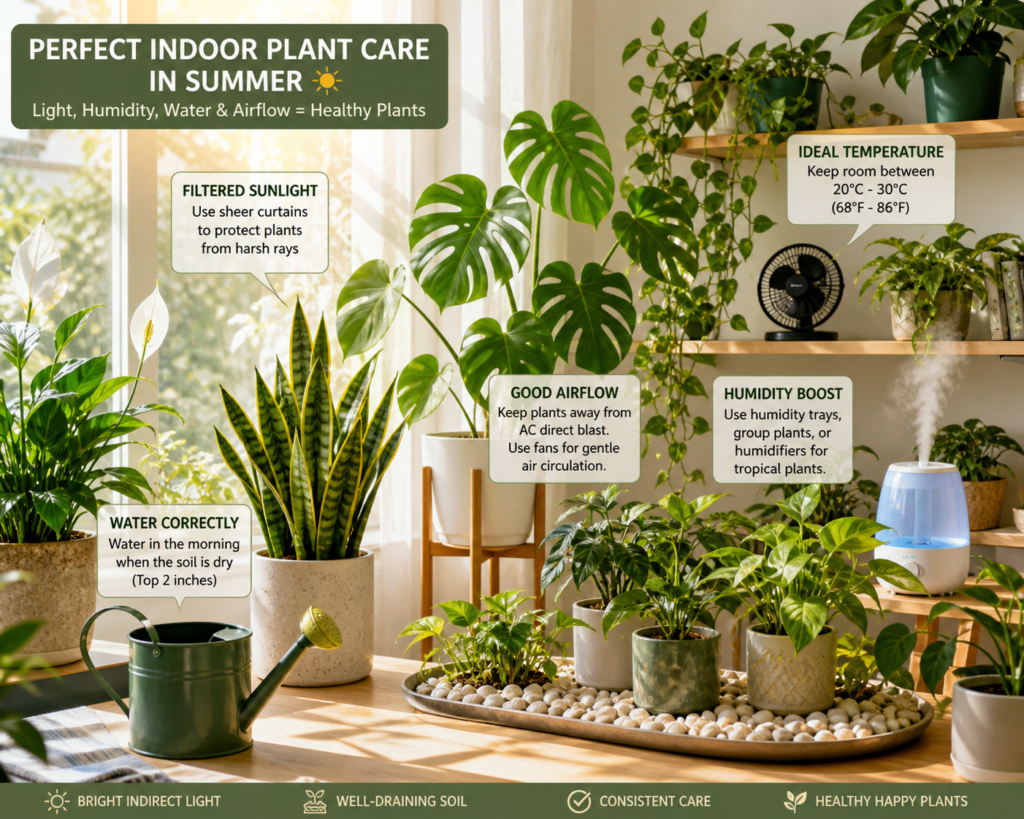
Use the finger test before watering. Insert your finger about 2 inches into the soil. If it feels dry, water deeply. If it feels moist, wait.
Best summer watering practices:
- water deeply
- water in the morning
- allow full drainage
- empty trays
- avoid shallow watering
Deep watering encourages roots to grow lower, where the soil stays cooler. Shallow watering keeps roots near the hot surface and creates weaker plants.
What Is the Best Time of Day to Water Indoor Plants in Summer?
The best time to water indoor plants in summer is early morning. Temperatures are lower, evaporation is slower, and roots have more time to absorb moisture before the hottest part of the day.
Morning watering gives plants better hydration stability. Roots absorb water before peak heat begins, helping the plant handle stronger transpiration later.
Best watering timing options:
Early morning
Best range:
- 6 AM–9 AM
- lower evaporation
- stronger absorption
- lower fungal risk
Late afternoon
Acceptable if soil is dry, airflow is good, and humidity is balanced.
Midday
Avoid when possible because soil warms faster, water evaporates faster, and roots may experience heat stress.
Decision rule: if your room gets hot by noon, water before 9 AM.
Should You Move Indoor Plants Away From Windows in Summer?
Yes, many indoor plants should be moved away from hot windows in summer. Light that feels safe in spring can become damaging by mid-summer.
Glass intensifies both light and heat. This creates stress quickly, especially near west- and south-facing windows.
Window direction matters:
South-facing windows
Strong all-day exposure. Good for tougher plants, but sensitive plants should be moved back.
West-facing windows
Highest summer heat risk. Afternoon sun is harsh and often causes leaf burn.
East-facing windows
Usually safer because morning light is softer.
North-facing windows
Lowest intensity and safest for sensitive plants.
Plants most vulnerable to hot-window stress include:
- Calathea
- Peace Lily
- Boston Fern
More tolerant plants include:
- Snake Plant
- Rubber Plant
- Aloe vera
Signs a plant is too close to a hot window:
- white leaf spots
- brown dry edges
- curling
- faded color
Moving plants 2–4 feet back often stops further damage.
Can You Move Indoor Plants Outside During Summer?
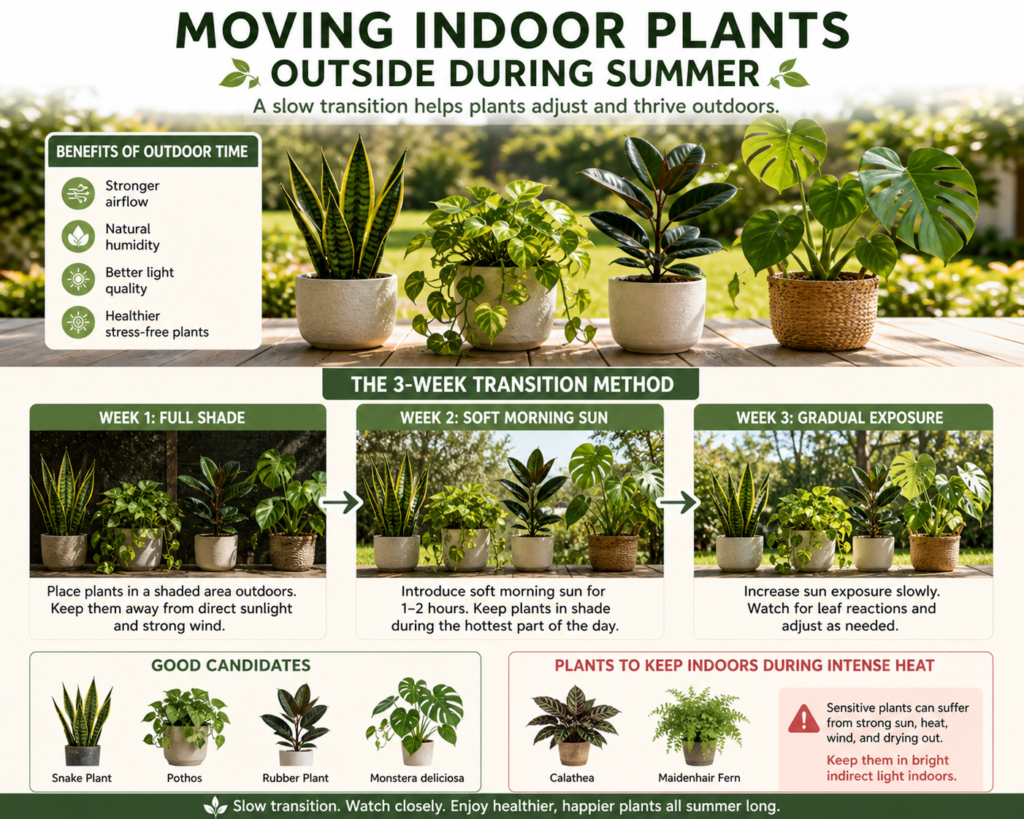
Yes, many indoor plants can benefit from being moved outside in summer, but they must be transitioned slowly. Sudden outdoor exposure can shock leaves, roots, and stems.
Outdoor conditions offer stronger airflow, natural humidity, and better light quality. But they also bring stronger UV exposure, pests, rain imbalance, and wind stress.
Best transition method:
Week 1
Place the plant in full shade.
Week 2
Introduce soft morning sun for 1–2 hours.
Week 3
Increase exposure slowly while watching leaf reactions.
Good candidates for outdoor summer transition:
- Snake Plant
- Pothos
- Rubber Plant
- Monstera deliciosa
Avoid moving very sensitive plants outside during intense heat, especially Calathea and Maidenhair Fern.
A Pothos moved directly into afternoon sun can burn within one day. Shade transition prevents this.
How Can You Increase Humidity for Indoor Plants in Summer?
Humidity is one of the most underestimated parts of summer indoor plant care. Many people assume summer means humid air, but indoor AC can make rooms very dry.
AC removes moisture from the air. Dry air increases plant stress, especially for tropical plants. Humidity affects how quickly moisture leaves the leaves.
Low humidity causes:
- crispy tips
- curled edges
- weak growth
- browning margins
- faster dehydration
Plants that need stable humidity include:
- Calathea
- Peace Lily
- Philodendron
- Boston Fern
Best humidity strategies:
Group plants together
Plants release moisture naturally. Grouping creates a small humidity zone.
Use pebble trays
Pebble trays provide passive humidity and work well for small plant groups.
Use a humidifier
This is the most consistent option for tropical plants.
Avoid relying on misting alone. Misting creates only temporary moisture.
Target humidity levels:
- tropical plants: 60–70%
- standard houseplants: 40–60%
- succulents: 30–40%
If leaf edges brown while soil stays moist, check humidity before watering more.
Can Air Conditioning Harm Indoor Plants?
Yes, air conditioning can harm indoor plants when airflow is direct or humidity drops too low. AC lowers heat, but it often creates dry-air stress.
The room may feel cooler to you, but the plant may feel drier. AC affects plants through dry airflow, humidity loss, cold drafts, and sudden temperature changes.
AC damage symptoms include:
- dry leaf tips
- curling leaves
- drooping
- brittle edges
- slow growth
Most vulnerable plants:
- Calathea
- Peace Lily
- Boston Fern
More tolerant plants:
- Snake Plant
- ZZ plant
- Aloe vera
Never place plants directly under vents, beside cooling outlets, or in fan-blast zones. Keep plants around 3–6 feet away from AC output when possible.
If leaf tips brown but watering is correct, check airflow direction.
Should You Fertilize Indoor Plants During Summer Heat?
Yes, indoor plants can be fertilized during summer because it is usually their active growing season. But summer fertilizing needs precision because heat changes root behavior.
The biggest mistake is fertilizing a stressed plant. A stressed plant is not nutrient-hungry; it is survival-focused. Fertilizer increases root activity, and if the plant is already struggling, feeding can add pressure.
Signs a plant is ready for summer feeding:
- active new leaves
- stronger stem growth
- stable hydration
- healthy leaf color
- no visible stress
Delay fertilizing if you see:
- drooping
- curling
- yellowing
- burnt edges
- transplant shock
Best summer fertilizer practices:
- water the soil first
- feed in the morning
- reduce fertilizer strength by 25%
- avoid feeding during heatwaves
- flush soil monthly to reduce salt buildup
Decision rule: growing strongly means feed. Recovering means wait. Stressed means stop.
Is Summer a Good Time to Repot Indoor Plants?
Summer can be a good time to repot indoor plants because active growth helps roots establish faster. But heat increases transplant stress, so timing matters.
Repotting during summer is about plant condition, not the season alone. A healthy growing plant can adapt. A stressed plant may struggle.
Best reasons to repot in summer:
- roots circling heavily
- roots growing from drainage holes
- soil drying too fast
- poor drainage
- root-bound growth slowdown
Avoid summer repotting if:
- a heatwave is active
- the plant is dehydrated
- the plant is recovering from stress
- pests are present
Best summer repotting practices:
- repot in the morning
- keep away from direct sun for 5–7 days
- increase humidity temporarily
- avoid fertilizing immediately
Healthy and root-bound means repot. Heat-stressed means wait.
Which Indoor Plants Handle Summer Heat Best?
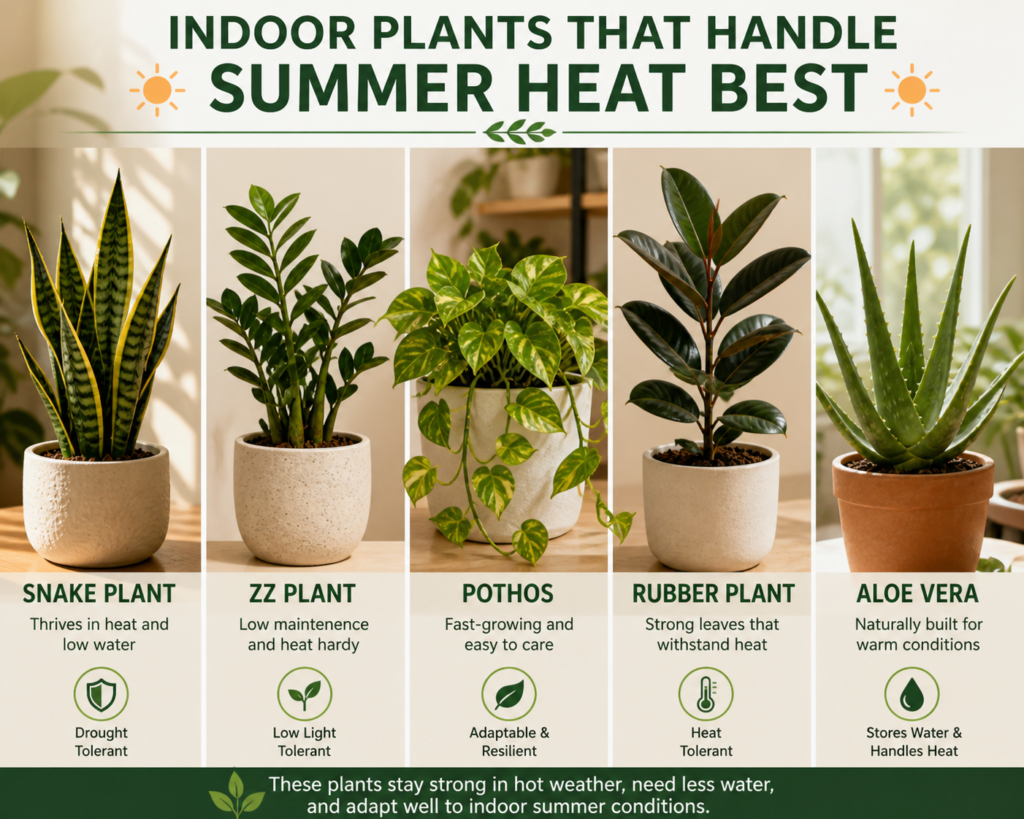
Some indoor plants handle summer heat better because they evolved in warm, dry, or changing climates. These plants regulate moisture loss better and recover faster from temporary stress.
Best Heat-Tolerant Indoor Plants:
Snake Plant
One of the strongest heat performers. It stores water in its leaves and handles hot rooms well.
ZZ plant
Low water demand, strong drought tolerance, and good resistance to dry air.
Pothos
Highly adaptable, fast-growing, and quick to recover from temporary stress.
Rubber Plant
Thick foliage protects moisture and often grows strongly in warm bright rooms.
Aloe vera
Naturally designed for heat and bright spaces.
Best for direct bright light:
- Aloe vera
- Snake Plant
Best for warm indirect light:
- Pothos
- ZZ plant
If your home runs warm, choose stronger plants. Plant choice reduces maintenance pressure.
Which Indoor Plants Struggle Most During Summer Heat?
Which Indoor Plants Struggle Most During Summer Heat?
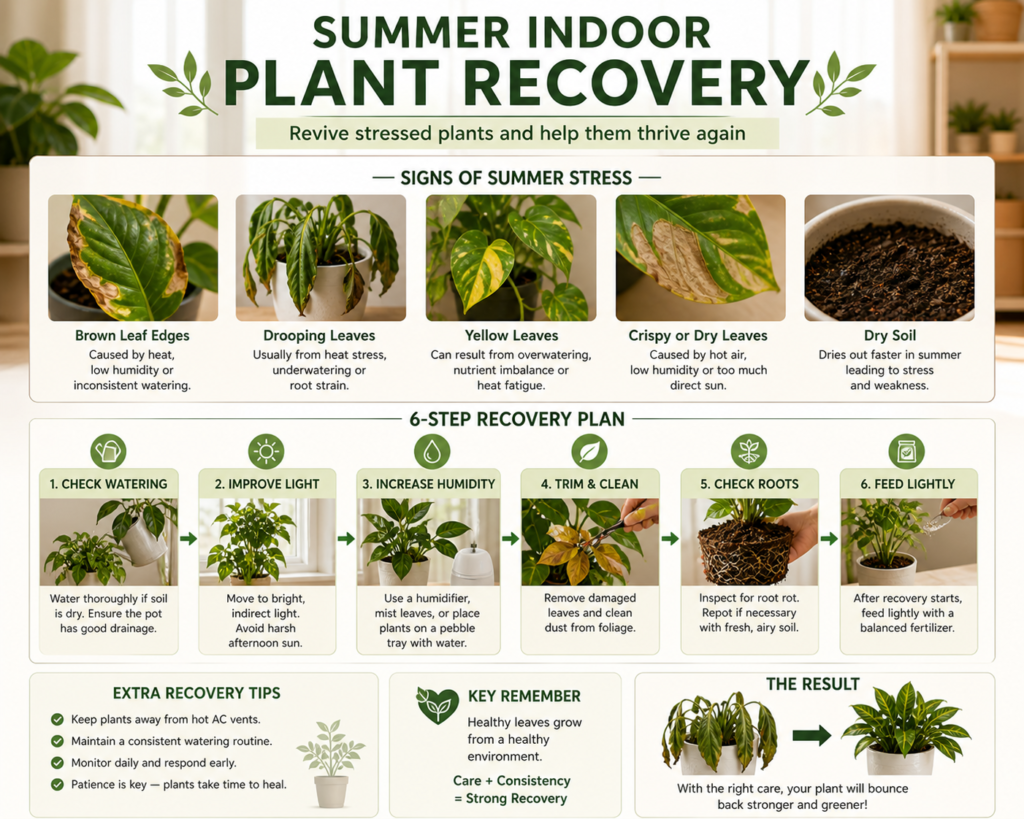
Heat-sensitive plants struggle because they often come from stable, shaded, humid environments. Indoor summer heat can remove those conditions quickly.
Most heat-sensitive indoor plants:
Calathea
Very sensitive to humidity drops. Edge browning and leaf curl can appear quickly.
Maidenhair Fern
Needs consistent moisture and does not recover well from drying out.
Peace Lily
High water demand, quick drooping, and sensitivity to root heat.
Fittonia
Collapses quickly in dry air and needs stable humidity.
Boston Fern
Poor AC tolerance and high moisture needs.
Signs of heat struggle:
- brown edges
- curling
- drooping
- leaf thinning
- color loss
Best protection strategies:
- move away from hot windows
- increase humidity
- reduce AC exposure
- monitor soil often
- avoid temperature swings
Sensitive plant plus hot room means humidity priority, not watering priority.
How Do You Prevent Summer Pest Outbreaks on Indoor Plants?
Summer increases pest outbreaks because warm conditions speed up insect reproduction. Heat stress also weakens plant defenses.
Pests often target weaker plants first. A healthy plant resists better, while a stressed plant attracts more pests.
What Are the Most Common Summer Indoor Plant Pests?
Spider mites
They love dry air and spread quickly in summer. Signs include webbing, pale dots, and leaf damage.
Fungus gnats
They appear in wet soil and are common when plants are overwatered.
Mealybugs
They hide in plant joints and leave cotton-like residue.
Scale insects
They attach to stems and can be difficult to remove if ignored.
Weekly pest inspection checklist:
- inspect leaf undersides
- check stem joints
- inspect topsoil
- remove dead leaves
- wipe leaf surfaces
Best prevention methods:
- keep humidity stable
- improve airflow
- water correctly
- clean dusty leaves
- isolate infected plants quickly
Pest control starts before pests appear.
What Is the Best Pot Type for Summer Plant Care?
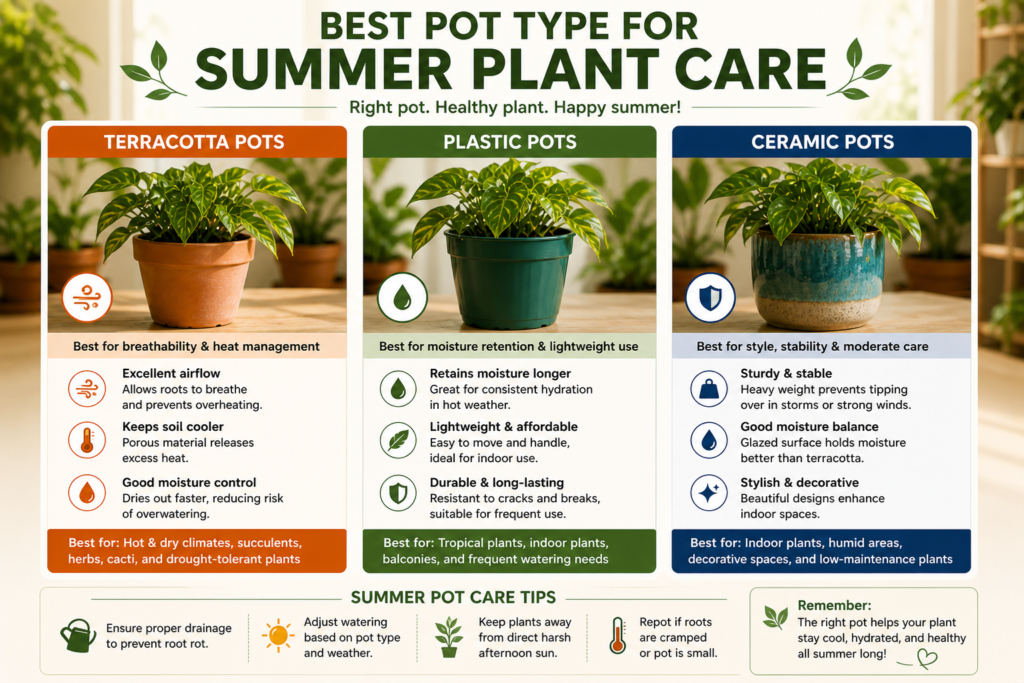
Pot type affects how fast water evaporates, how roots breathe, and how stable root temperature stays. This makes pot choice important in summer.
Terracotta pots
Pros:
- breathable
- good oxygen flow
- helps prevent waterlogging
Cons:
- dries fast
- heats faster
Best for Snake Plant and Aloe vera.
Plastic pots
Pros:
- holds moisture longer
- lightweight
- slower drying
Best for Peace Lily and Pothos.
Ceramic pots
Pros:
- balanced moisture
- better insulation
- stable root temperature
If soil dries too fast, use plastic or glazed ceramic. If soil stays wet too long, use terracotta. Always use drainage holes and avoid metal containers in hot areas.
What Is the Best Soil Mix for Indoor Plants in Summer?
The best summer soil mix balances moisture retention and airflow. In hot weather, soil dries faster, but roots still need oxygen.
Bad soil can create fast dehydration, root suffocation, fungal issues, or unstable watering cycles.
A strong summer soil mix should provide:
- moisture retention
- drainage
- root aeration
- temperature stability
Perlite
Improves airflow, prevents compaction, and supports drainage.
Coco coir
Holds moisture evenly and helps stabilize summer watering.
Bark chips
Creates air pockets and supports tropical roots.
Best Summer Soil Mix Formula:
- 40% potting mix
- 25% perlite
- 20% coco coir
- 15% bark
Succulents need more drainage, so increase perlite or coarse sand.
What Should You Do During a Summer Heatwave?
A heatwave is not regular summer warmth. It is a concentrated stress event where indoor temperatures stay high for several days and plants get fewer recovery periods.
During a heatwave, the plant’s priority changes. Growth slows or stops. Protection becomes the goal.
Emergency heatwave protocol:
- move plants away from hot glass and direct afternoon sun
- check soil daily
- increase humidity with humidifiers, pebble trays, or grouped plants
- improve gentle airflow
- pause fertilizing
Avoid during heatwaves:
- repotting
- heavy pruning
- constant relocation
- fertilizer application
Heatwave care means reduce stress. Do less, stabilize more.
How Do You Help Indoor Plants Recover After Heat Stress?
Recovery starts with diagnosis. Many summer plant losses happen after the heat event because owners react incorrectly.
The most common mistake is overwatering after stress. A stressed plant does not always need more water. It needs the right correction.
First identify the source:
- dry soil
- hot roots
- direct sun
- AC dehydration
- humidity collapse
Recovery steps:
- Remove the stress source.
- Check moisture correctly.
- Raise humidity.
- Trim dead tissue only.
- Pause feeding.
Signs of recovery:
- firmer leaves
- reduced curling
- stronger posture
- new leaf growth
Correct diagnosis controls recovery speed.
Can Indoor Plants Recover Fully From Heat Damage?
Yes, indoor plants can recover from heat stress, but not all damage is reversible. Recovery depends on how long the stress lasted and which tissues were affected.
Recoverable signs:
- drooping
- mild curling
- slowed growth
- temporary softness
Permanent damage signs:
- brown burnt patches
- crispy edges
- white bleached spots
- dead stems
A plant can recover function even if damaged leaves remain unattractive. Burnt leaves usually do not turn green again. The best sign of recovery is healthy new growth.
Plants recover by growing forward, not by repairing damaged old leaves.
What Is a Real Example of Summer Indoor Plant Recovery?
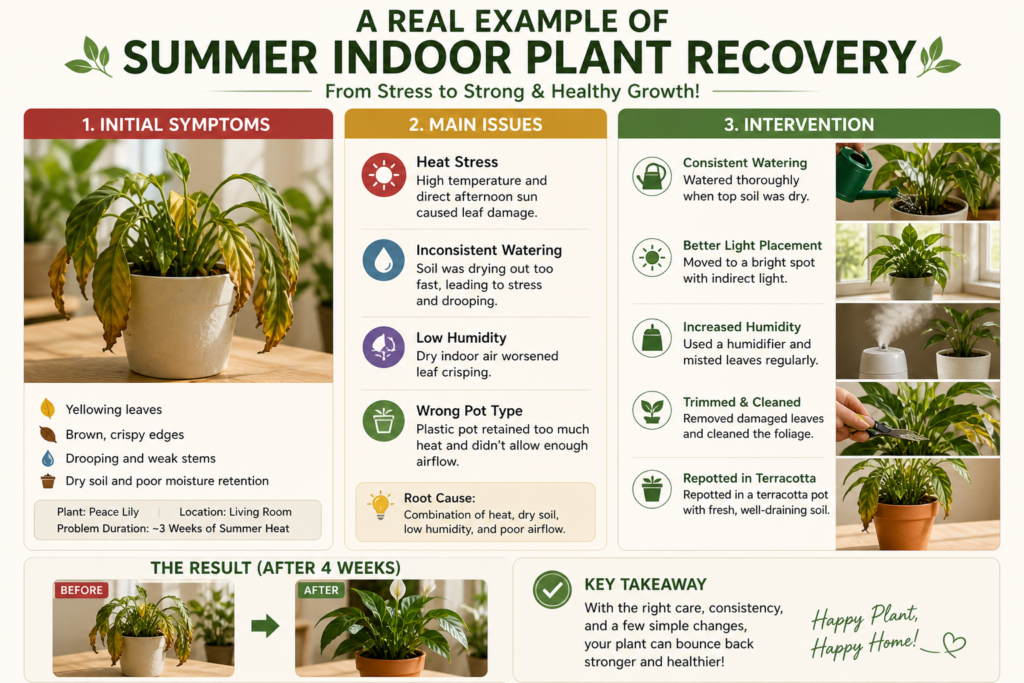
A real-world recovery example shows why environmental correction often works better than simply watering more.
Plant tested: Pothos.
Environment: west-facing window, daily AC, low humidity, outdoor temperatures above 90°F.
Initial symptoms:
- curling leaves
- brown tips
- afternoon drooping
- soil drying every 48 hours
The first reaction was more watering. The problem became worse because the plant was under environmental stress.
Main issues:
- excessive radiant heat
- low humidity
- fast soil drying from terracotta pot
Intervention:
- moved plant 3 feet from window
- added sheer curtain
- switched terracotta to plastic
- added pebble tray
- improved airflow
Results after 9 days:
- leaf firmness returned
- drooping reduced
- curling slowed
- new growth resumed
Key lesson: watering was not the main problem. The environment was.
What Is the Best Summer Indoor Plant Care Checklist?
A summer checklist creates consistency. Heat changes plant conditions quickly, so structured observation prevents problems.
Weekly summer checklist:
- check soil moisture every 2–3 days
- review light exposure
- inspect leaf undersides, stems, and soil surface
- check humidity if AC runs daily
- empty drainage trays after watering
- rotate plants for even growth
- clean dusty leaves
- remove dead foliage
Heatwave checklist:
- check moisture daily
- move plants away from windows
- pause feeding
- increase humidity
Routine beats reaction. Plant care improves when observation becomes a habit.
What Are the Most Common Summer Indoor Plant Mistakes?
Most summer plant damage comes from predictable mistakes, not impossible growing conditions.
Common mistakes include:
- overwatering because heat looks like thirst
- ignoring humidity
- leaving plants in harsh windows
- fertilizing stressed plants
- ignoring AC airflow
- delaying pest inspection
- choosing the wrong pot
Better decision process:
- Check soil
- Check heat
- Check light
- Check airflow
- Check humidity
Symptoms are clues, not causes. Better interpretation leads to better care.
What Is the Best Expert Strategy for Summer Indoor Plant Care?
The best expert strategy is prevention through environmental control. Expert growers think in systems, not isolated actions.
Best summer control system:
- control light to prevent leaf burn
- control water based on soil dryness
- control humidity for tropical plants
- control airflow without direct blasts
- control root temperature with better pots and placement
- control observation through weekly checks
Plantsaholic recommends building seasonal care systems, not relying on random fixes. Systems reduce stress, improve growth, and build long-term resilience.
Healthy plants are rarely lucky. They are managed well.
FAQ section
How often should I water indoor plants in summer?
Water when the top 2 inches of soil feel dry. Summer heat increases evaporation, so check more often but avoid fixed schedules.
What is the best time of day to water indoor plants in summer?
Early morning is best because temperatures are lower and roots absorb moisture before peak heat.
Can indoor plants get sunburn through windows?
Yes. Strong summer sun through glass can cause bleached spots, crispy edges, and curled leaves.
Why are my indoor plant leaves curling in summer?
Leaf curling usually signals heat stress, dry air, underwatering, or harsh light.
Should I mist indoor plants in summer?
Misting helps temporarily but does not replace proper humidity.
Is air conditioning bad for indoor plants?
Direct AC airflow can dry leaves and reduce humidity. Keep plants away from vents.
Which indoor plants handle summer heat best?
Snake Plant, ZZ plant, Pothos, and Aloe vera are among the best heat-tolerant indoor plants.
What temperature is too hot for indoor plants?
Most indoor plants prefer 65–85°F. Temperatures above 90°F for long periods can trigger heat stress.
Myra is the founder and lead writer of Plantsaholic. She shares practical, research-backed advice on indoor plants, outdoor gardening, flowers, herbs, succulents, and everyday plant care. Her goal is to help gardeners of all experience levels grow healthier plants through simple, easy-to-follow gardening guides.