
Indoor Asian plants are one of the most powerful ways to transform your home into a visually balanced, calming, and design-forward space. These plants combine cultural symbolism, natural adaptability, and aesthetic clarity, making them ideal for modern interiors. In this expanded guide, every section goes deeper—giving you real-world clarity, decision frameworks, and practical insights that go beyond surface-level plant advice.
What Are Indoor Asian Plants & Why Are They So Popular?
Indoor Asian plants are houseplants native to Asian climates that thrive indoors due to their natural adaptation to shade, humidity, and compact growth environments.
Indoor Asian plants have become dominant in global interior design because they align perfectly with modern living constraints and aesthetic preferences. Most homes today don’t offer direct sunlight, large outdoor access, or consistent environmental conditions. Asian plants evolved under forest canopies where light is filtered, moisture is balanced, and space is competitive—exactly like indoor environments. This natural compatibility removes friction for beginners while still delivering high-end visual impact.
Beyond adaptability, cultural symbolism amplifies their appeal. Plants like Dracaena sanderiana and Ficus microcarpa are deeply connected to philosophies like Feng Shui and Japanese minimalism. This introduces meaning into design, not just decoration. When placed intentionally, these plants can influence how a space feels—calmer, more focused, or more welcoming.
Why They Dominate Modern Interiors:
- Naturally adapted to low-light indoor environments
- Compact growth makes them space-efficient
- Strong symbolic value enhances emotional connection
- Align with Japandi, Zen, and minimalist trends
Deeper Insight (Real-World):
In high-end interior projects, designers rarely treat plants as accessories. Instead, they use Asian plants as structural design elements—guiding eye movement, balancing symmetry, and creating visual pauses. This is why even a single well-placed plant often outperforms multiple random ones.
Why Asian Plants Thrive Indoors (Biological Advantage)
Asian plants thrive indoors because they evolved in shaded, humid forest ecosystems where light is indirect, airflow is controlled, and root systems are adapted to oxygen-rich environments.
Most indoor Asian plants originate from tropical and subtropical forest floors, where sunlight is filtered through dense canopies. This means they are biologically optimized for low-light survival, unlike many outdoor ornamental plants that require direct sun. Their leaves are designed to capture diffused light efficiently, allowing them to photosynthesize even in shaded corners of a room. This single adaptation is the core reason they outperform non-Asian plants indoors.
Another critical advantage lies in their root systems. Plants like Aglaonema and Sansevieria trifasciata evolved in environments where soil is loose and aerated. Their roots require oxygen as much as water, which is why they tolerate inconsistent watering better than dense-root plants. Indoors, where overwatering is common, this trait becomes a survival advantage.
Biological Advantages That Matter Indoors:
- Efficient use of indirect light
- High tolerance to humidity fluctuations
- Roots adapted to aeration (less prone to rot if managed correctly)
- Slower, controlled growth suitable for confined spaces
Real-World Insight:
Most beginners fail with plants not because of lack of care—but because they choose species that are not biologically suited for indoor life. Asian plants remove that mismatch, making success more predictable.
Top Indoor Asian Plants That Elevate Home Aesthetics
The most impactful indoor Asian plants are chosen based on their design role—structure, softness, color, or focal presence—rather than appearance alone.
When selecting indoor Asian plants, the goal isn’t just greenery—it’s intentional visual composition. High-performing interiors use plants as design tools to shape space, guide attention, and create balance. Instead of randomly placing plants, you assign each one a role, ensuring the room feels cohesive rather than cluttered. This strategic approach is what separates average plant setups from professionally styled interiors.
In real-world interior design, plants are layered to build depth and hierarchy. A room typically needs one dominant visual anchor, a supporting element, and a subtle accent. This creates a natural flow that feels balanced without overwhelming the space. By thinking in roles instead of individual plants, you simplify decision-making and dramatically improve results.
Strategic Plant Roles:
- Minimalist Statement → Dracaena sanderiana
- Artistic Focal Point → Ficus microcarpa
- Structural Anchor → Sansevieria trifasciata
- Softening Element → Spathiphyllum
- Color Accent → Aglaonema
Real-World Application:
- One tall structural plant creates height and presence
- One medium foliage plant fills visual gaps
- One small accent plant adds detail and contrast
Decision Clarity:
- If your room feels empty → add a structural anchor
- If your room feels harsh → add a softening plant
- If your room feels dull → add a color accent
Best Indoor Asian Plants for Specific Needs
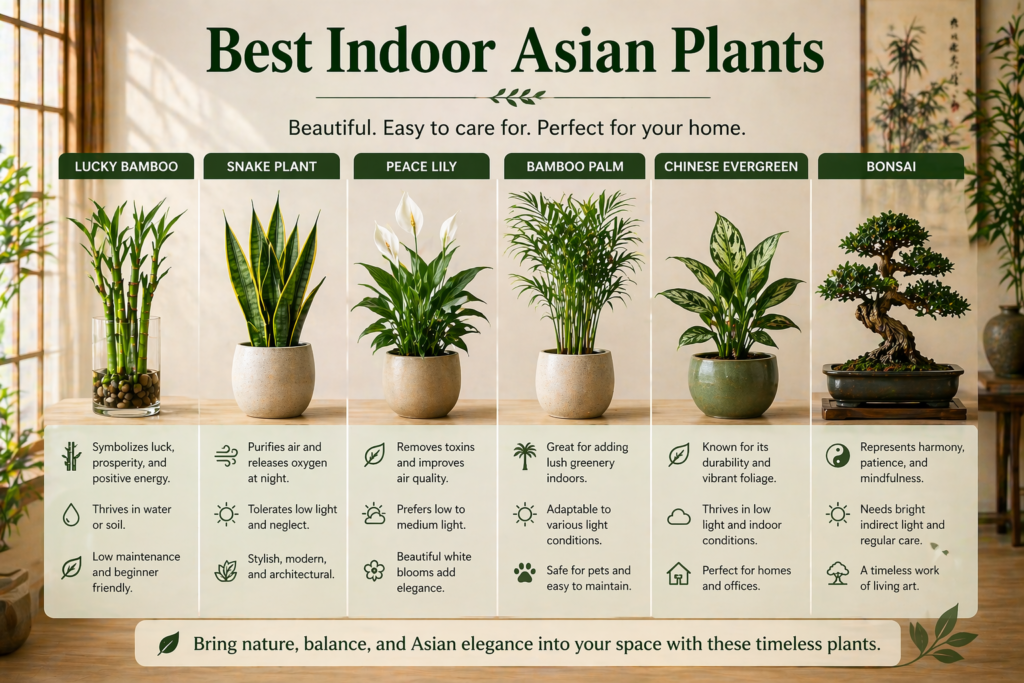
The best plant depends on your specific goal—ease, aesthetics, space, or lighting conditions.
Choosing plants without context leads to poor results. Instead, categorize plants based on use-case scenarios. This is how designers and experienced plant owners make decisions.
Plants like Sansevieria trifasciata and Aglaonema dominate beginner setups, while Ficus microcarpa is ideal for advanced decorative setups.
Best by Category:
- Best for beginners: Snake plant, Chinese evergreen
- Best for low light: Aglaonema, peace lily
- Best for small apartments: Lucky bamboo, bonsai
- Best for visual impact: Snake plant, areca palm
- Best for air quality: Peace lily, snake plant
Real-World Insight:
Most homes need a mix, not one plant type. Combining categories creates a layered and functional setup.
Decision Clarity:
Start with 2 categories:
- One easy-care plant
- One visual-impact plant
This balances success + aesthetics.
More Indoor Asian Plants Worth Considering
Expanding beyond common plants increases design flexibility and improves your indoor ecosystem.
While popular plants dominate beginner guides, there are several powerful alternatives that offer unique visual and functional benefits. Expanding your plant selection allows you to create more dynamic and personalized interiors.
Plants like Zamioculcas zamiifolia and Epipremnum aureum are extremely resilient, while Calathea adds movement and pattern to spaces.
Additional High-Value Plants:
- ZZ Plant → ultra-low maintenance
- Pothos → fast-growing and versatile
- Calathea → decorative leaf movement
- Areca Palm → tropical, airy feel
Real-World Insight:
Advanced interiors use variety strategically:
- Structural plant
- Flowing plant
- Patterned plant
This creates a complete ecosystem visually.
Decision Clarity:
If your setup feels repetitive → add a contrasting plant type.
How Indoor Asian Plants Improve Your Home
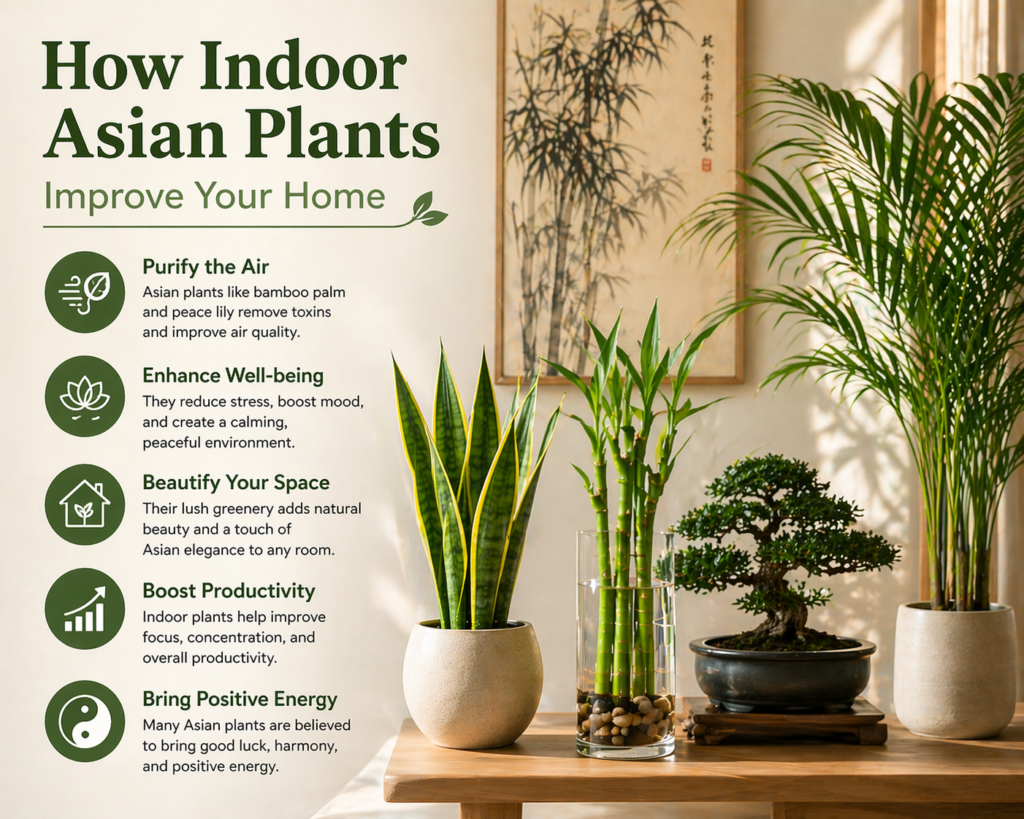
Indoor Asian plants enhance visual harmony, improve environmental quality, and support mental well-being.
The value of indoor plants extends far beyond aesthetics. They actively influence how a space functions and how you feel within it. Asian plants are particularly effective because they are both visually calming and environmentally adaptive.
From a design perspective, plants introduce organic irregularity into structured environments. Straight lines, flat surfaces, and rigid furniture can feel sterile. Plants break this pattern, creating visual rhythm and natural balance.
Functional Benefits:
- Improve perceived air quality
- Increase humidity in dry spaces
- Reduce visual fatigue
- Enhance spatial depth
Mental & Behavioral Impact:
Studies show that indoor plants:
- Lower cortisol (stress hormone)
- Improve focus and productivity
- Increase satisfaction with living spaces
Real-World Insight:
In office environments, productivity improvements are often linked not to the plant itself—but to the visual relief it provides. Even a single plant in a workspace can reduce cognitive fatigue caused by screens and artificial environments.
Decision Clarity:
If your space feels stressful → add greenery
If your space feels lifeless → add texture (plants)
If your space lacks depth → add layered plants
Hidden Questions People Don’t Ask (But Should)
The most important plant-care decisions often come from questions beginners don’t think to ask—yet these determine long-term success.
Many guides focus on basic care, but high-ranking content answers latent questions—the ones users don’t explicitly search but still need answered. For example, indoor environments vary drastically: air conditioning, artificial lighting, and sealed rooms all affect plant health. Without addressing these factors, even “easy plants” can fail.
Plants like Dracaena sanderiana and Spathiphyllum behave differently depending on environment stressors. Understanding these hidden variables gives you a massive advantage over typical plant owners.
High-Impact Hidden Questions:
- Are these plants safe for pets? → Some (like peace lily) are toxic
- Can they survive AC rooms? → Yes, but avoid direct airflow
- Do they attract insects? → Only if overwatered or poorly ventilated
- Can they grow in water? → Some (lucky bamboo, pothos) can
- What’s their lifespan indoors? → Many last 5–20+ years
- Do they need repotting? → Yes, but infrequently
Real-World Insight:
Most plant problems are environmental—not biological. People blame the plant, when the real issue is airflow, watering pattern, or placement.
Decision Clarity:
If you understand these hidden factors, you move from guessing → controlling outcomes.
How to Choose the Right Asian Plant for Your Home
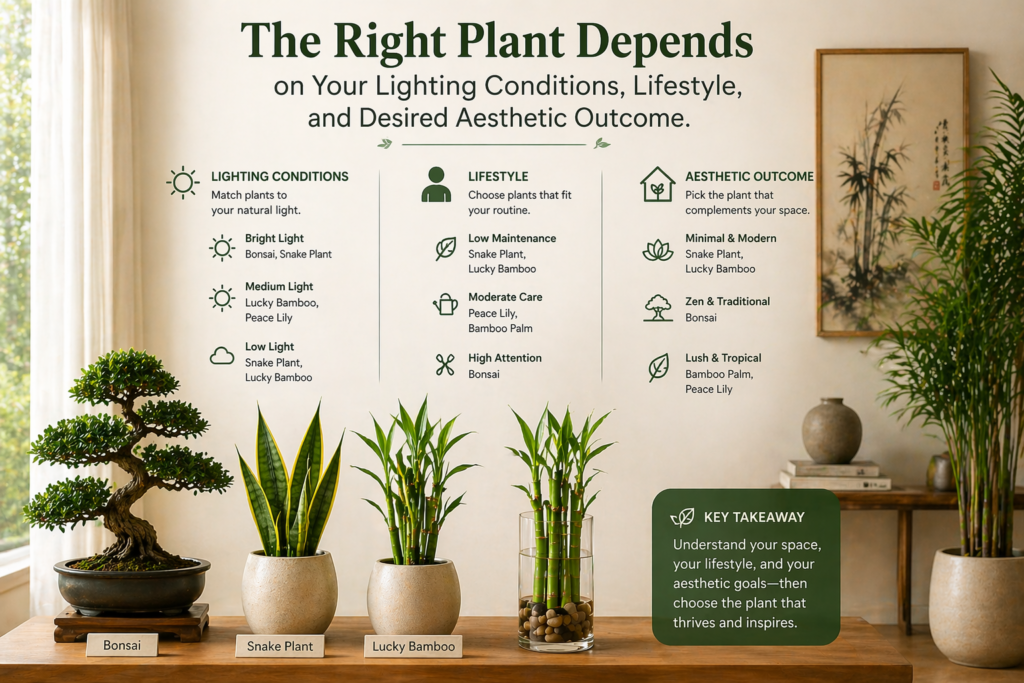
The right plant depends on your lighting conditions, lifestyle, and desired aesthetic outcome.
Choosing the wrong plant is the fastest way to fail—even if the plant itself is “easy.” The key is alignment between your environment and the plant’s natural behavior.
Core Decision Factors:
- Light availability (low, medium, bright indirect)
- Time commitment (low vs moderate care)
- Design goal (minimalist, bold, soft, colorful)
Practical Matching System:
- Low light + busy lifestyle → Aglaonema
- Forgetful watering habits → Sansevieria trifasciata
- Design centerpiece → Ficus microcarpa
- Symbolic placement → Dracaena sanderiana
Real-World Insight:
Most plant failures are not due to lack of effort—they’re due to misalignment. For example, placing a bonsai in a dark room guarantees failure, no matter how carefully it’s watered.
Decision Clarity Framework:
Ask yourself:
- How much light do I actually have?
- How often will I realistically care for this plant?
- Do I want visual impact or simplicity?
Answer these honestly, and your success rate increases dramatically.
Buying Guide: What to Look for Before You Purchase
The best plant purchase decisions are based on root health, pot size, and growth stage—not just appearance.
Buying the wrong plant at the start creates long-term problems. A plant may look healthy on top while having weak or damaged roots, which leads to failure weeks later. This is why experienced buyers focus less on leaves and more on structure and foundation.
For example, when selecting Ficus microcarpa or Sansevieria trifasciata, you should always check whether the plant is root-bound or overly wet. These early indicators predict how well the plant will adapt to your home.
What to Check Before Buying:
- Firm, healthy leaves (no yellowing or mushiness)
- No foul smell from soil (sign of root rot)
- Proper drainage holes in pot
- Balanced plant shape (not leaning or stressed)
Price & Size Insight:
- Small plants = cheaper but slower visual impact
- Medium plants = best balance (recommended)
- Large plants = expensive but instant aesthetic upgrade
Real-World Tip:
Avoid buying plants right after shipment (in stores). They are often stressed and more likely to decline at home.
Decision Clarity:
If unsure → choose medium-sized, healthy-root plants with stable structure.
Step-by-Step: How to Style Asian Plants Indoors
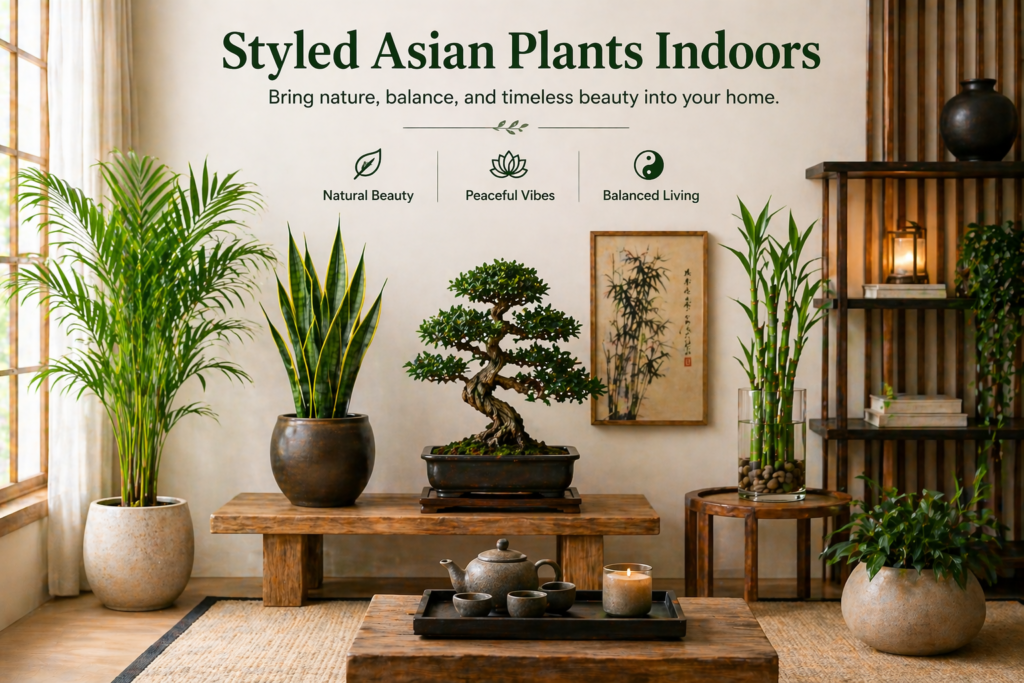
Effective styling combines placement, spacing, and contrast to maximize visual impact.
Plant styling is where most people underperform. Even the best plants lose impact when placed incorrectly. Styling is about intentional composition, not decoration.
Step-by-Step System:
- Choose a focal plant (centerpiece)
- Select complementary secondary plants
- Use neutral or natural containers
- Place near indirect light sources
- Maintain negative space
Key Styling Principles:
- Less is more → Avoid overcrowding
- Height variation → Creates depth
- Consistency → Match pots with decor theme
Real-World Application:
Designers often follow the rule of three:
- One tall plant
- One medium plant
- One small accent
This creates a balanced composition that feels natural yet intentional.
Decision Clarity:
If your setup looks messy → reduce plants
If your setup looks flat → add height variation
If your setup feels random → unify containers
Comparison Table (Decision Clarity)
Comparing plants helps identify the best match based on lifestyle and environment.
| Plant | Light | Maintenance | Role |
| Lucky Bamboo | Low | Very Easy | Minimalist |
| Bonsai | Medium | Moderate | Artistic |
| Snake Plant | Low | Very Easy | Structural |
| Peace Lily | Low-Medium | Easy | Soft |
| Chinese Evergreen | Low | Very Easy | Color |
Interpretation Insight:
- Beginners should prioritize low maintenance + low light plants
- Designers should prioritize visual role over ease
- Busy users should avoid bonsai initially
Real-World Decision:
If unsure, start with:
- Snake plant
- Chinese evergreen
Then expand once confidence builds.
Real Failure Scenarios (What Actually Goes Wrong)
Most plant failures are caused by environmental mismatch, not lack of care.
Understanding real-world failure patterns gives you a major advantage. Instead of reacting after problems appear, you can prevent them entirely.
For example, placing Sansevieria trifasciata in direct harsh sunlight often leads to leaf burn, while overwatering Spathiphyllum causes root suffocation—not dehydration.
Common Real Failures:
- Snake plant turning yellow → overwatering
- Bonsai drying out → inconsistent watering
- Peace lily drooping constantly → root stress
- Lucky bamboo rotting → stagnant water
Real-World Insight:
Most people misinterpret plant signals:
- Drooping ≠ always needs water
- Yellow leaves ≠ always lack nutrients
Fix Strategy:
- Observe patterns, not single symptoms
- Adjust environment first, not just watering
- Make one change at a time
Decision Clarity:
If a plant declines → check environment before assuming care mistake.
Common Mistakes to Avoid
Direct Answer: Most indoor plant failures come from overwatering and poor placement.
Critical Mistakes:
- Overwatering (root rot risk)
- Ignoring light requirements
- Using pots without drainage
- Choosing plants based only on looks
Deeper Insight:
Overwatering is often caused by care anxiety—people think more water equals better care. In reality, most Asian plants prefer controlled moisture, not saturation.
Real-World Fix:
- Water less frequently, but deeply
- Check soil before watering
- Observe plant signals (drooping, yellowing)
Decision Clarity:
If unsure → wait before watering
If leaves yellow → reduce water
If growth slows → check light
What to Do Next (Action Path)
Start small, observe results, and expand strategically.
Indoor plant success is not about buying many plants—it’s about building a system gradually. Starting with too many plants increases complexity and failure risk. Instead, controlled growth leads to long-term success.
Action Plan:
- Start with 1–2 beginner-friendly plants
- Test lighting conditions in your home
- Observe watering cycles
- Add new plants gradually
Growth Strategy:
- Month 1 → Learn plant behavior
- Month 2 → Adjust environment
- Month 3 → Expand setup
Real-World Insight:
Experienced plant owners don’t rush—they iterate. Each plant teaches something about your environment.
Decision Clarity:
Master a few plants → then scale
Don’t scale → then learn
FAQs Section
What are indoor Asian plants?
Indoor Asian plants are houseplants native to Asian regions that thrive in low to moderate light and indoor humidity, making them ideal for apartments and modern homes.
What are the best indoor Asian plants?
Top choices include Sansevieria trifasciata, Dracaena sanderiana, Ficus microcarpa, Spathiphyllum, and Aglaonema due to their adaptability and visual appeal.
Which indoor Asian plants are best for beginners?
Beginner-friendly options include Sansevieria trifasciata and Aglaonema because they tolerate low light, irregular watering, and minimal maintenance.
Do indoor Asian plants improve air quality?
Plants like Spathiphyllum and Sansevieria trifasciata can help reduce indoor pollutants, but their biggest benefit is improving humidity and overall indoor comfort.
Can indoor Asian plants survive in low light?
Yes, many species like Aglaonema and Dracaena sanderiana are adapted to shaded environments and grow well in low-light indoor spaces.
Are indoor Asian plants safe for pets?
Not all are safe—plants like Spathiphyllum can be toxic to cats and dogs, so always check pet safety before placing them at home.
Can indoor Asian plants grow in water instead of soil?
Some plants, such as Dracaena sanderiana, can grow in water, but most perform better long-term in well-draining soil with proper nutrients.
How often should I water indoor Asian plants?
Most indoor Asian plants should be watered only when the top layer of soil dries out—typically every 1–2 weeks depending on light, humidity, and plant type.
Why are my indoor Asian plants turning yellow?
Yellowing leaves are usually caused by overwatering, poor drainage, or insufficient light rather than lack of fertilizer.
Do indoor Asian plants need fertilizer?
Yes, but sparingly—apply diluted fertilizer every 4–6 weeks during the growing season to support healthy growth without damaging roots.
Do indoor Asian plants attract bugs?
Healthy plants rarely attract pests, but overwatering, stagnant air, or poor soil conditions can lead to fungus gnats or mites.
Can indoor Asian plants survive in air-conditioned rooms?
Yes, but avoid placing them directly in cold drafts, as dry air and temperature fluctuations can stress the plant over time.
How long do indoor Asian plants live?
With proper care, many indoor Asian plants can live for years or even decades, especially species like snake plants and bonsai.
