Indoor vine plants are among the most adaptable houseplants because they grow upward, downward, or sideways depending on how you style them. Unlike upright plants that need floor space, vines use shelves, walls, hanging baskets, trellises, and moss poles, making them ideal for apartments, offices, bedrooms, kitchens, and compact homes.
They are also beginner-friendly because many species grow fast, propagate easily, and recover well from small care mistakes. Popular choices like Pothos Plant, Philodendron hederaceum, Monstera adansonii, String of Hearts, English Ivy, and Hoya carnosa offer different benefits depending on your light, watering habits, pets, and styling goals.
What Are Indoor Vine Plants?
Indoor vine plants are houseplants with long, flexible stems that either trail downward or climb upward using support. In nature, many vines grow beneath forest canopies and climb trees to reach brighter filtered light. Indoors, they use moss poles, wall clips, trellises, shelves, hanging planters, or plant stands to create the same climbing or trailing effect.
Their biggest advantage is flexibility. You can train them, prune them, propagate them, redirect their stems, or use them as living decor. A vine plant on a shelf can create a soft cascading effect, while the same plant on a moss pole may grow larger leaves and stronger stems.
Core characteristics include:
- Flexible stems
- Climbing or trailing growth
- Easy propagation through nodes
- Good adaptability indoors
- Strong decorative value
- Useful growth for small spaces
Common indoor vine categories include tropical climbers, hanging vines, cascading shelf plants, and aerial-root climbers. If your goal is fast greenery, easy styling, and flexible placement, indoor vines are one of the best houseplant groups to start with.
Why Are Indoor Vine Plants So Popular?
Indoor vine plants are popular because they solve several problems at once. They save space, grow quickly, soften interiors, and create a lush natural look without requiring a large plant corner. Instead of occupying floor area, they use vertical surfaces and empty shelf edges.
They also give visible progress. Many beginners enjoy vines because plants like Pothos Plant and Philodendron hederaceum can produce noticeable new growth within weeks. That visible change keeps plant care rewarding and encourages consistency.
People love indoor vine plants because:
- They grow faster than many houseplants
- They are easy to propagate
- They work well in hanging baskets
- They soften sharp furniture edges
- They make shelves and corners feel alive
- Many tolerate beginner mistakes
Designers also use vines because they create movement. A plain bookshelf becomes more natural with trailing stems. A blank corner becomes more attractive with climbing greenery. Indoor vines are not just plants; they are flexible design tools.
How to Choose the Right Indoor Vine Plant for Your Home
How to Choose the Right Indoor Vine Plant for Your Home
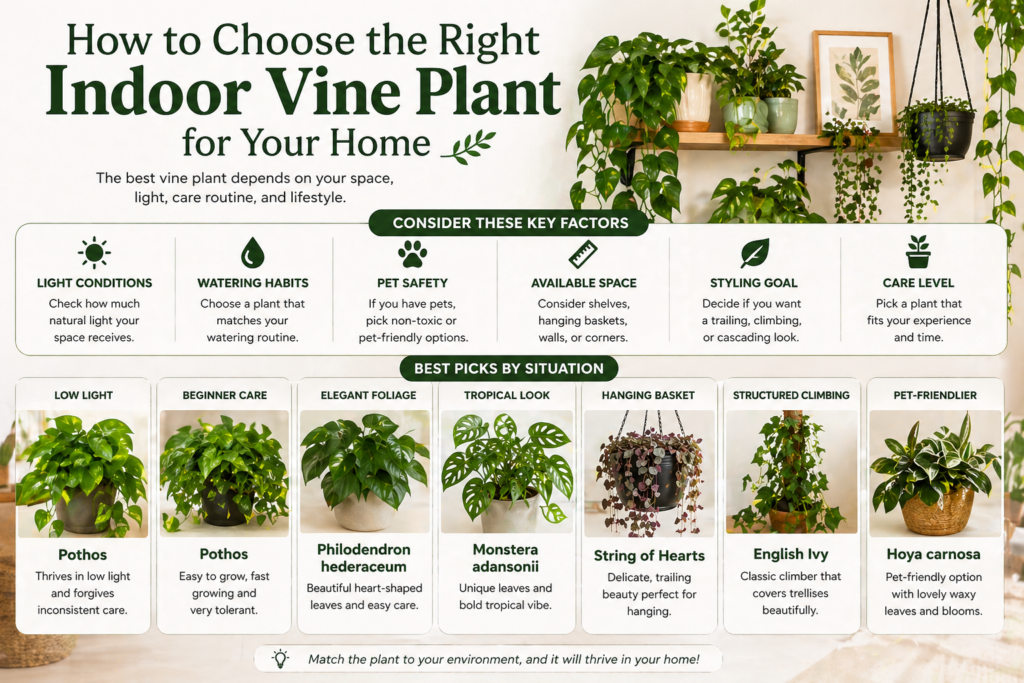
Choosing the right indoor vine plant should start with your home conditions, not the plant’s appearance. A beautiful bright-light vine will struggle in a dark room, while a low-light tolerant vine may thrive there with minimal effort.
The best selection order is:
- Light conditions
- Watering habits
- Pet safety
- Available space
- Styling goal
Best choices by situation:
| Situation | Best Indoor Vine Plant |
|---|---|
| Low light | Pothos Plant |
| Beginner care | Pothos Plant |
| Elegant foliage | Philodendron hederaceum |
| Tropical look | Monstera adansonii |
| Hanging basket | String of Hearts |
| Structured climbing | English Ivy |
| Pet-friendlier option | Hoya carnosa |
If you forget watering, choose Pothos Plant or Hoya carnosa. If you have bright indirect light and want a bold tropical look, choose Monstera adansonii. If you want delicate hanging beauty, choose String of Hearts.
What Are the Best Indoor Vine Plants?
The best indoor vine plants balance beauty, resilience, growth speed, and care difficulty. Some vines are better for beginners, while others are better for styling or collecting.
Top indoor vine plants include:
- Pothos Plant
- Philodendron hederaceum
- Monstera adansonii
- String of Hearts
- English Ivy
- Hoya carnosa
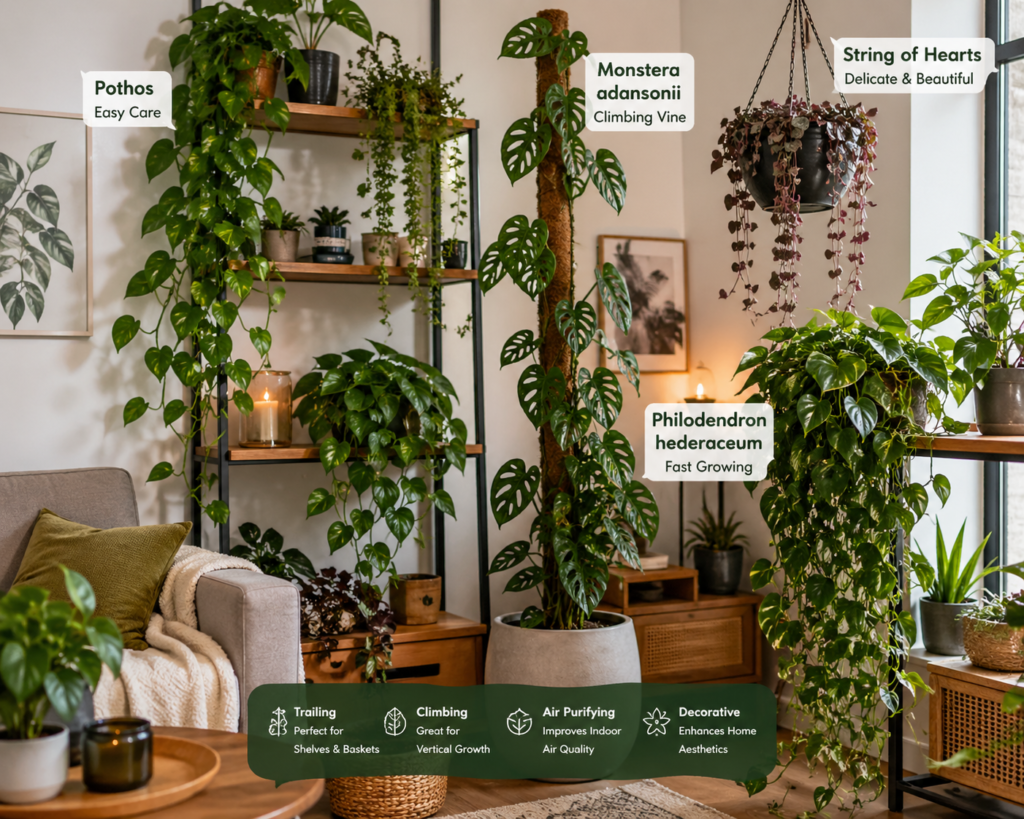
Each plant has a different strength. Pothos Plant is the easiest starter option. Philodendron hederaceum gives softer heart-shaped foliage. Monstera adansonii creates a tropical statement with fenestrated leaves. String of Hearts is excellent for hanging baskets. English Ivy is useful for structured climbing, and Hoya carnosa is a strong pet-friendlier choice.
When comparing indoor vine plants, consider light tolerance, watering needs, growth speed, pest resistance, toxicity, styling purpose, and propagation ease. For most beginners, Pothos Plant and Philodendron hederaceum are the safest starting points.
Is Pothos Plant the Best Indoor Vine Plant?
Pothos Plant is one of the best indoor vine plants for beginners because it tolerates low light, missed watering, and inconsistent indoor conditions. It grows quickly, roots easily in water, and recovers well from pruning.
It also offers several attractive varieties, including Golden Pothos, Marble Queen, Neon Pothos, and Satin Pothos. This gives plant owners different looks without needing a completely different care routine.
Why Pothos Plant is popular:
- Beginner-friendly
- Fast-growing
- Low-light tolerant
- Easy to propagate
- Good for shelves and baskets
- Strong recovery after neglect
Best care conditions:
- Light: low to medium indirect light
- Water: when the top 1–2 inches of soil dry
- Humidity: average household humidity
- Placement: shelves, desks, kitchens, bedrooms, offices
Choose Pothos Plant if you want a forgiving vine that grows quickly and does not punish occasional mistakes.
Why Is Philodendron hederaceum a Top Choice?
Philodendron hederaceum is a top indoor vine because it combines easy care with elegant heart-shaped leaves. It has a softer look than pothos and fits beautifully in bedrooms, shelves, wall planters, and hanging baskets.
It can trail naturally or climb with support. When trained upward, it may produce larger leaves and stronger stems. This makes it useful for both casual plant owners and people who want a more designed indoor plant display.
Why Philodendron hederaceum performs well indoors:
- Attractive heart-shaped foliage
- Good low to medium light tolerance
- Easy propagation
- Strong pruning response
- Flexible climbing or trailing growth
- Reliable beginner performance
Best conditions:
- Light: medium indirect light
- Water: when upper soil dries
- Humidity: moderate humidity preferred
- Placement: floating shelves, bedrooms, wall planters, hanging baskets
Choose Philodendron hederaceum if you want an easy vine with a softer, more refined appearance than pothos.
Is Monstera adansonii Worth Growing Indoors?
Monstera adansonii is worth growing indoors if you want a stronger tropical look. Its natural leaf holes, called fenestrations, make it one of the most visually distinctive indoor vines. It looks especially good on moss poles, trellises, or plant walls.
Compared with pothos, Monstera adansonii needs more consistent care. It prefers bright indirect light, stable watering, and moderate to high humidity. It is not the easiest vine, but it is highly rewarding when conditions are right.
Why Monstera adansonii is valuable:
- Unique fenestrated leaves
- Strong tropical appearance
- Excellent climbing response
- High decorative impact
- Works well on moss poles
- Good for bright living spaces
Best conditions:
- Bright indirect light
- Well-draining soil
- Moderate to high humidity
- Stable watering cycles
Choose Monstera adansonii if aesthetics matter most and you can provide better light and humidity.
Is String of Hearts Good for Indoor Spaces?
String of Hearts is excellent for indoor hanging displays. Its thin trailing stems and small heart-shaped leaves create a delicate cascading effect that works well in minimalist, bright, and modern interiors.
Unlike many tropical vines, String of Hearts has semi-succulent leaves and prefers to dry more between watering. Overwatering is the main mistake with this plant. It does best in bright indirect light and a well-draining mix.
Why String of Hearts stands out:
- Elegant trailing stems
- Heart-shaped leaves
- Great for hanging baskets
- Lower watering needs
- Compact root system
- Strong decorative appeal
Best conditions:
- Light: bright indirect light
- Water: allow soil to dry well
- Humidity: average indoor humidity
- Placement: hanging planters, window corners, floating shelves
Choose String of Hearts if you want a delicate, trailing plant and you tend to water less often.
Is English Ivy a Good Indoor Vine?
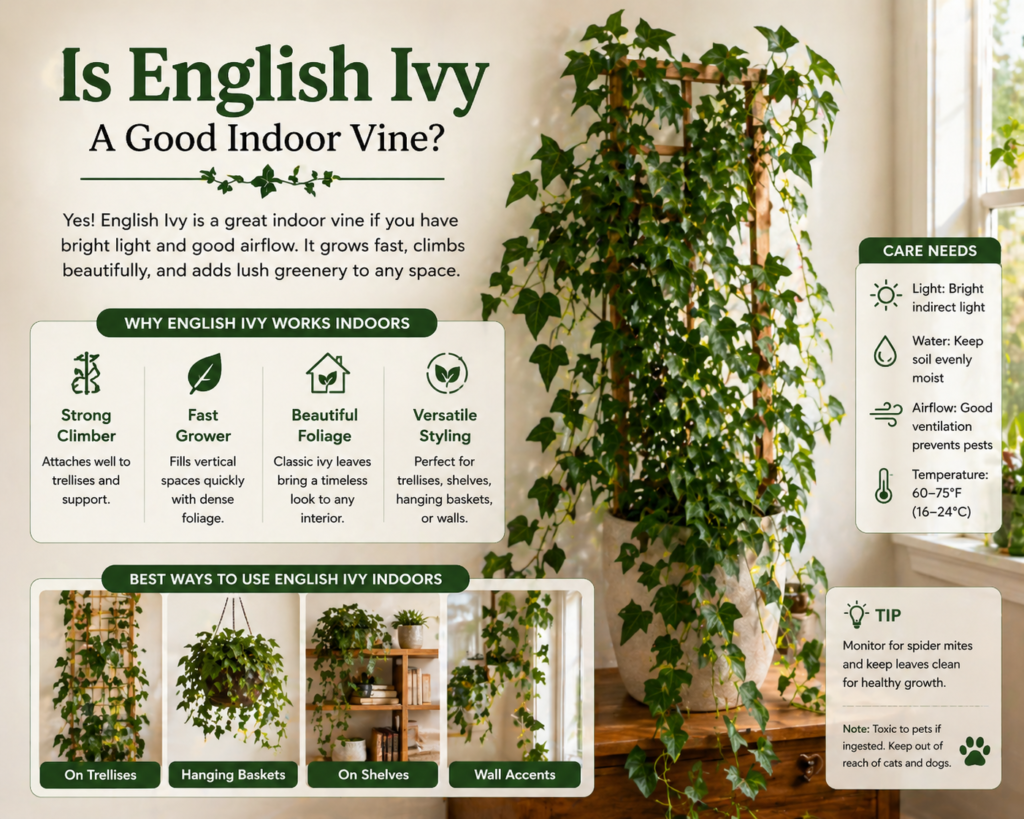
English Ivy is a strong indoor climbing vine, especially for trellises and structured plant displays. It creates dense foliage and can fill vertical frames faster than many other vines.
However, English Ivy is more demanding than pothos or philodendron. It needs brighter indirect light, good airflow, and consistent monitoring for pests such as spider mites. It is not the best choice for dark, stagnant rooms.
Why English Ivy works indoors:
- Strong climbing habit
- Dense foliage
- Classic decorative look
- Good for trellises
- Fast growth in bright rooms
Best conditions:
- Bright indirect light
- Good air circulation
- Moderate watering
- Cooler indoor temperatures
Choose English Ivy if you want structured vertical greenery and are willing to monitor light, airflow, and pests carefully.
How Much Light Do Indoor Vine Plants Need?
Most indoor vine plants prefer bright indirect light, but some tolerate lower light better than others. Light affects leaf size, color, growth speed, and stem spacing. Many problems that look like watering issues are actually light problems.
Low-light tolerant vines include:
- Pothos Plant
- Philodendron hederaceum
Bright indirect light lovers include:
- Monstera adansonii
- String of Hearts
- Hoya carnosa
Signs of poor light include long gaps between leaves, small leaves, pale growth, slow growth, and weak stems. Best placements include east-facing windows, bright north-facing rooms, and filtered south-facing light. Avoid harsh afternoon sun because it can burn leaves.
If your room is dim, choose Pothos Plant or Philodendron hederaceum. If your room is bright, Monstera adansonii, String of Hearts, and Hoya carnosa will perform better.
How Often Should You Water Indoor Vine Plants?
Most indoor vine plants need watering every 5–14 days, depending on season, pot type, light, humidity, and soil mix. The safest rule is to check the soil before watering instead of following a fixed calendar.
Water when the top 1–2 inches of soil feel dry for most tropical vines. For String of Hearts and similar semi-succulent vines, allow more drying before watering.
General watering guide:
- Spring/Summer: every 5–7 days
- Fall/Winter: every 10–14 days
- Terracotta pots: dry faster
- Plastic pots: hold moisture longer
Signs of overwatering include yellow leaves, wet soil smell, soft stems, fungus gnats, and root rot. Signs of underwatering include crispy leaves, curling, drooping, and a lightweight pot.
Watering should match the environment. A vine near bright light dries faster than one in a shaded office. Always check the soil first.
What Soil Is Best for Indoor Vine Plants?
Indoor vine plants need loose, well-draining soil that holds some moisture but still allows oxygen to reach the roots. Dense soil stays wet too long and increases the risk of root rot.
A good indoor vine soil mix:
- 40% potting soil
- 30% perlite
- 20% orchid bark
- 10% compost
This mix improves drainage, airflow, root expansion, and moisture control. For beginners, terracotta pots can help reduce overwatering because they dry faster. Plastic pots are better for people who underwater because they hold moisture longer.
Avoid heavy garden soil, dense compacted soil, pots without drainage, and overly moisture-retentive mixes. If you overwater, use extra perlite and terracotta. If you underwater, use plastic pots and a slightly more moisture-retentive mix.
When Should You Repot Indoor Vine Plants?
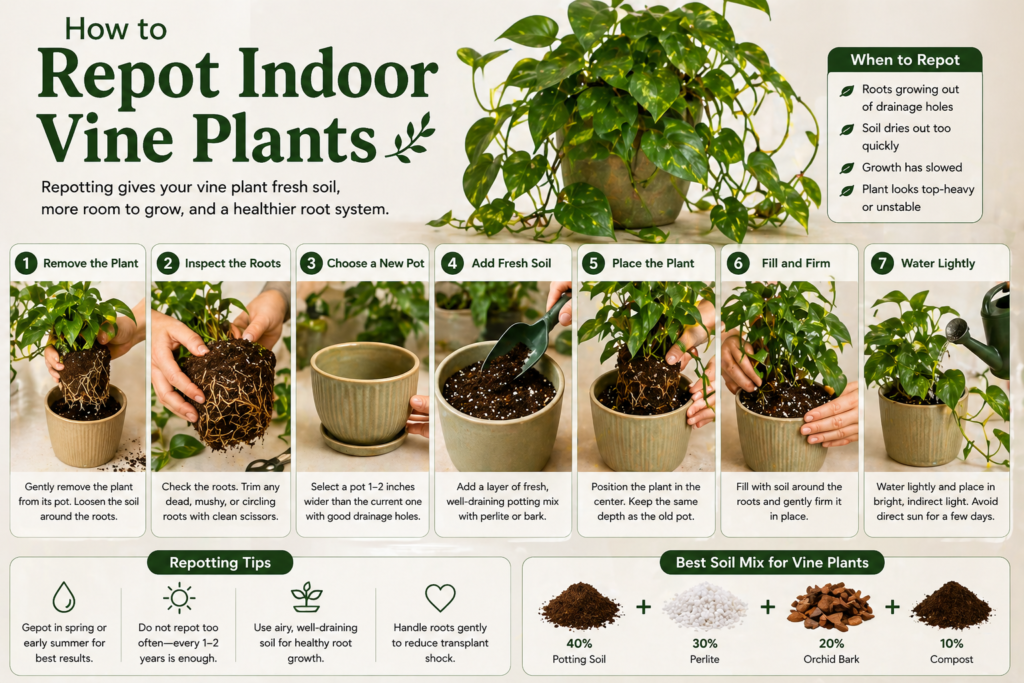
Repot indoor vine plants when roots outgrow the pot, growth slows, or the soil dries too quickly. Rootbound vines may survive for a while, but crowded roots eventually reduce growth, water absorption, and nutrient uptake.
Signs your vine needs repotting:
- Roots coming from drainage holes
- Soil dries very fast
- Growth slows suddenly
- Leaves become smaller
- Roots circle tightly inside the pot
The best time to repot is spring or early summer. Choose a pot only 1–2 inches wider than the current one because oversized pots hold too much wet soil and increase root rot risk.
Repotting steps:
- Remove the plant gently
- Inspect roots
- Trim dead or mushy roots
- Add fresh airy soil
- Replant at the same depth
- Water lightly after repotting
Should Indoor Vine Plants Climb or Trail?
Indoor vine plants can either climb or trail, and each option creates a different result. Climbing often encourages larger leaves, stronger stems, and more mature growth. Trailing creates softer decorative movement and works well for shelves and hanging baskets.
Benefits of climbing:
- Larger leaves
- Stronger stems
- Better vertical growth
- More natural for many tropical vines
- Good for moss poles and trellises
Benefits of trailing:
- Easier setup
- Better for shelves
- Softer visual flow
- Great for hanging baskets
- Less structural maintenance
Choose climbing if you want bigger foliage and vertical impact. Choose trailing if you want easy styling and natural cascading greenery.
What Are the Best Support Systems for Climbing Vine Plants?
Support systems help climbing vines grow upward and develop stronger structure. In nature, vines attach to trees and bark. Indoors, moss poles, coco poles, trellises, bamboo ladders, wall clips, and wood planks replace that natural support.
Best support options:
- Moss pole: best for aerial roots and larger leaves
- Coco pole: good for basic vertical support
- Trellis: best for decorative shaping
- Bamboo ladder: good for structured climbing
- Wall clips: best for guiding lightweight vines
- Wood plank: useful for stronger root anchoring
Monstera adansonii and Philodendron hederaceum usually benefit most from moss poles. English Ivy works well on trellises and wall frames. Use support early while stems are flexible.
How Do You Propagate Indoor Vine Plants?
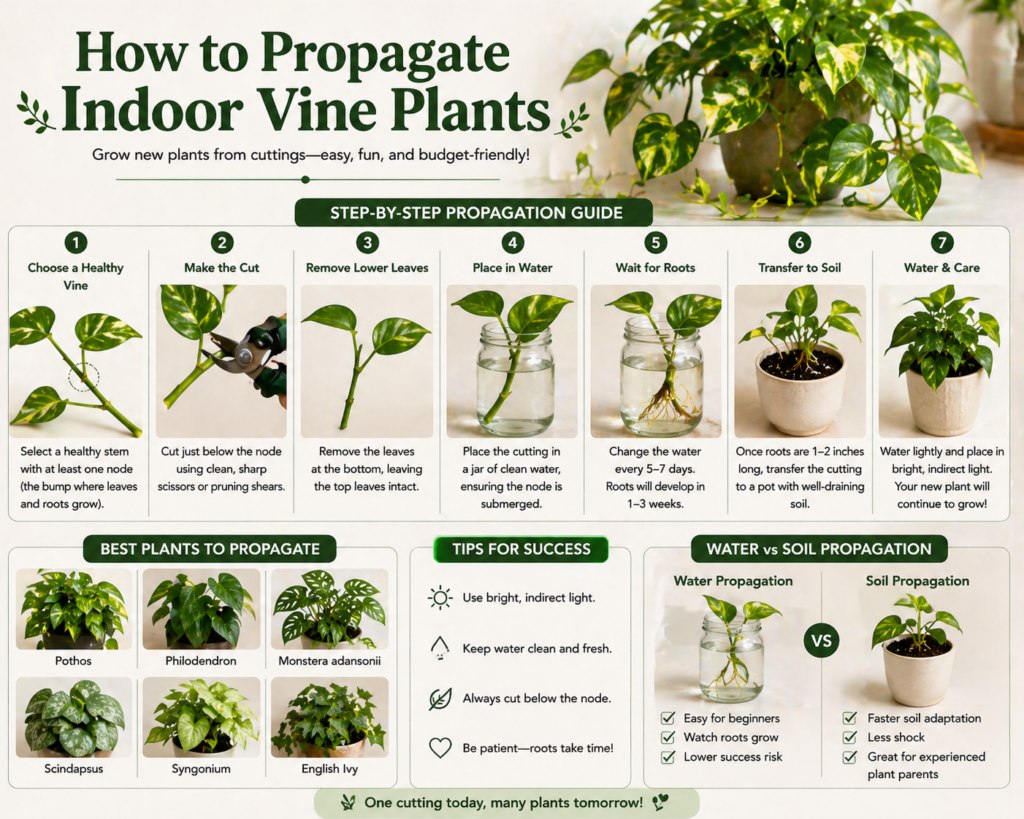
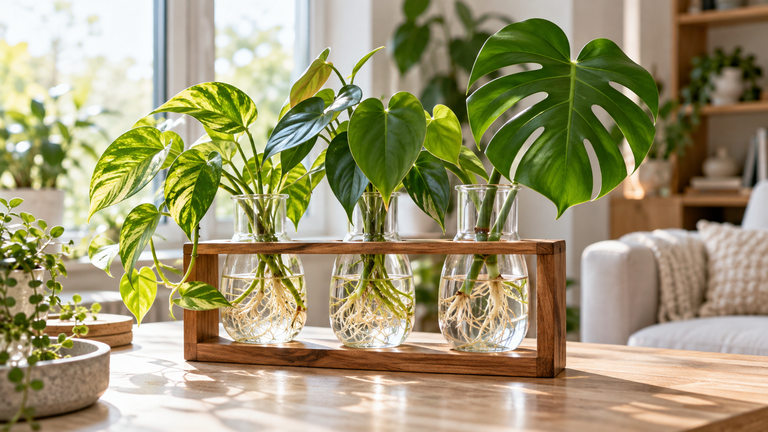
Most indoor vine plants are easy to propagate because they grow from nodes. A node is the point on the stem where leaves, roots, and new growth can emerge. Without a node, most cuttings will not root successfully.
Step-by-step propagation:
- Find a healthy node
- Cut below the node
- Remove lower leaves
- Place the node in water
- Change water weekly
- Wait for roots
- Transfer to soil
Best plants for propagation include Pothos Plant, Philodendron hederaceum, and Monstera adansonii. The best season is spring or early summer.
Water propagation is best for beginners because roots are visible. Soil propagation is useful for experienced growers because cuttings adapt to soil faster.
How Should You Care for Indoor Vine Plants in Different Seasons?
Indoor vine care should change with the season because light, temperature, and growth speed change throughout the year.
Spring is the growth restart season. This is the best time for pruning, repotting, fertilizing, and propagation. Summer is peak growth season, so plants usually need more water, regular feeding, and closer pest monitoring.
Autumn is a transition period. Growth slows, so reduce fertilizer and begin watering less often. Winter is the slowest season. Most indoor vines need less water and little to no fertilizer. Cold drafts and overwatering are the biggest winter risks.
Seasonal care summary:
- Spring: prune, repot, propagate, fertilize
- Summer: water consistently and monitor pests
- Autumn: reduce fertilizer and watering
- Winter: protect from cold and avoid overwatering
What Problems Do Indoor Vine Plants Usually Have?
Indoor vine problems usually come from water, light, humidity, airflow, or pests. The key is to treat the cause, not just the symptom.
Common problems:
- Yellow leaves: overwatering or poor drainage
- Leggy growth: low light
- Brown tips: low humidity or inconsistent watering
- Leaf drop: environmental stress
- Slow growth: low light or low nutrients
- Curling leaves: watering stress or pests
Common pests include spider mites, mealybugs, aphids, and fungus gnats. Check soil moisture, inspect roots, review light exposure, look under leaves, and check airflow before guessing.
Common Indoor Vine Plant Mistakes Beginners Make
Most indoor vine failures come from repeated simple mistakes. Beginners often water too often, use pots without drainage, place plants in poor light, or avoid pruning.
Common mistakes:
- Watering on a fixed schedule
- Using pots without drainage
- Choosing plants only by appearance
- Ignoring low light symptoms
- Skipping pruning
- Using oversized pots
- Ignoring pests until they spread
- Treating all vines the same
To avoid these mistakes, check soil before watering, match the plant to your light, use airy soil, prune regularly, inspect leaves weekly, and choose the correct pot size.
Indoor Vine Plant Problem Diagnosis Table
| Problem | Likely Cause | Best Fix |
|---|---|---|
| Yellow leaves | Overwatering | Check roots and reduce watering |
| Brown tips | Low humidity or inconsistent watering | Improve humidity and water evenly |
| Leggy growth | Low light | Move closer to bright indirect light |
| Curling leaves | Water stress or pests | Check soil and inspect leaves |
| Slow growth | Low light or low nutrients | Improve light and fertilize in season |
| Root smell | Root rot | Remove damaged roots and repot |
| Fungus gnats | Wet soil | Let soil dry and improve drainage |
| Pale leaves | Nutrient issue or poor light | Adjust fertilizer and light |
Are Indoor Vine Plants Safe for Pets?
Some indoor vine plants are toxic to pets, especially if cats or dogs chew the leaves. Pothos Plant, Philodendron hederaceum, Monstera adansonii, and English Ivy can cause irritation if ingested.
Common toxic indoor vines:
- Pothos Plant
- Philodendron hederaceum
- Monstera adansonii
- English Ivy
Pet-friendlier options include Hoya carnosa and String of Hearts. To reduce risk, use hanging baskets, keep vines elevated, choose pet-safe species, trim long trailing stems, and avoid placing toxic vines near curious pets.
How Should You Style Indoor Vine Plants?
Indoor vine plants are excellent for styling because they create softness, height, and movement. The best styling method depends on whether the plant naturally trails or climbs.
Best styling methods:
- Hanging baskets for String of Hearts and Pothos Plant
- Floating shelves for trailing vines
- Moss poles for Monstera adansonii and Philodendron hederaceum
- Wall clips for guided vine patterns
- Trellises for English Ivy
- Bookshelf edges for cascading greenery
Good styling starts with light. A plant may look perfect in a dark corner, but it will not stay healthy there. Place the plant where it receives suitable light first, then style around that placement.
Recommended Indoor Vine Plant Starter Setup
A good starter setup makes indoor vine care easier and prevents common problems. Beginners should focus on drainage, soil quality, light, and simple tools.
Recommended setup:
- Pot with drainage holes
- Airy soil mix with perlite and bark
- Bright indirect light location
- Basic pruning scissors
- Balanced liquid fertilizer
- Moss pole or hanging basket if needed
- Watering based on soil dryness
Best beginner plants are Pothos Plant and Philodendron hederaceum. Use terracotta if you overwater and plastic if you underwater.
Should You Fertilize Indoor Vine Plants?
Yes, indoor vine plants benefit from fertilizer during active growth. Potting soil loses nutrients over time, and fast-growing vines use nutrients quickly.
Best fertilizer:
- Balanced liquid fertilizer
- 10-10-10 or 20-20-20 diluted
Best schedule:
- Spring: once every 4 weeks
- Summer: once every 4 weeks
- Fall: reduce feeding
- Winter: little to none
Do not overfertilize. Fertilizer should support healthy growth, not force weak growth.
Should You Prune Indoor Vine Plants?
Yes. Pruning helps indoor vine plants grow fuller and healthier. Many vines become long and sparse if they are never trimmed.
Benefits of pruning:
- Fuller growth
- Better shape
- More branching
- Better airflow
- Easy propagation cuttings
- Removal of damaged leaves
Cut above a healthy node to encourage new growth. The best time to prune is spring or summer. Remove yellow leaves, leggy stems, weak growth, and pest-damaged sections.
How Fast Do Indoor Vine Plants Grow?
Growth speed depends on species, light, water, nutrients, temperature, and root space.
Fast-growing indoor vines:
- Pothos Plant
- Philodendron hederaceum
- English Ivy
Moderate growers:
- Monstera adansonii
- Hoya carnosa
Slower or more delicate growers:
- String of Hearts
To increase growth, improve light, use airy soil, fertilize during growing season, prune regularly, avoid overwatering, and repot when rootbound.
Expert Tips for Growing Indoor Vine Plants Successfully
Long-term success comes from simple habits done consistently. Indoor vines do not need complicated care, but they do need observation.
Expert tips:
- Rotate plants weekly for even growth
- Clean leaves every 2 weeks
- Prune regularly
- Inspect pests weekly
- Use supports early
- Check soil before watering
- Keep plants away from cold drafts
- Repot when roots become crowded
Stable light, proper watering, and good airflow prevent most problems. Consistency beats complexity.
Final Thoughts: Which Indoor Vine Plant Should You Choose?
The best indoor vine plant depends on your environment and lifestyle. If you are a beginner, choose Pothos Plant. If you want elegant foliage, choose Philodendron hederaceum. If you want a tropical statement, choose Monstera adansonii. If you want a hanging display, choose String of Hearts. If you want structured climbing, choose English Ivy. If you want a pet-friendlier option, choose Hoya carnosa.
Final decision framework:
- Low light: Pothos Plant
- Beginner care: Pothos Plant
- Elegant look: Philodendron hederaceum
- Tropical style: Monstera adansonii
- Hanging basket: String of Hearts
- Climbing display: English Ivy
- Pet-friendlier choice: Hoya carnosa
The right vine plant is not the trendiest one. It is the one that matches your light, watering style, space, and safety needs.
FAQs
Which indoor vine plant grows the fastest?
Pothos Plant and Philodendron hederaceum are among the fastest-growing indoor vines. Strong light and regular watering support faster growth.
Can indoor vine plants survive in low light?
Yes, some indoor vine plants like Pothos Plant and Philodendron hederaceum adapt well to low light. Growth may slow, but they usually stay healthy.
How often should I water indoor vine plants?
Most indoor vine plants need watering every 5–14 days depending on season, light, and humidity. Always check soil before watering.
Are indoor vine plants toxic to pets?
Some are toxic, including Pothos Plant and Philodendron hederaceum. Pet-friendlier options include Hoya carnosa.
Can I propagate indoor vine plants in water?
Yes. Water propagation works very well for many indoor vine plants, especially pothos and philodendron, as long as the cutting has a healthy node.
Why are my indoor vine plant leaves turning yellow?
Yellow leaves usually indicate overwatering, poor drainage, or root stress. Check soil moisture and root condition first.
Should I let my indoor vine plant climb or trail?
Let it climb if you want larger leaves and stronger growth. Let it trail if you want decorative hanging or shelf styling.
How long do indoor vine plants live?
With proper care, indoor vine plants can live for many years. Regular pruning, repotting, and stable care extend their lifespan.
How do I make my indoor vine plant bushier?
Prune above nodes and improve light exposure. Regular trimming encourages branching and fuller growth.
What is the best indoor vine plant for hanging baskets?
String of Hearts and Pothos Plant are excellent for hanging baskets because of their natural trailing growth.
Can indoor vine plants grow under artificial lights?
Yes, many indoor vine plants grow well under LED grow lights. Use them for 10–12 hours daily for healthy growth.
Should I fertilize indoor vine plants?
Yes, especially during spring and summer. A balanced liquid fertilizer once a month usually supports healthy growth.
When should I repot indoor vine plants?
Repot when roots outgrow the pot, soil dries too quickly, or growth slows. Spring is usually the best time.
Do indoor vine plants need direct sunlight?
No. Most indoor vine plants prefer bright indirect light. Direct afternoon sun can burn leaves and damage foliage.
Myra is the founder and lead writer of Plantsaholic. She shares practical, research-backed advice on indoor plants, outdoor gardening, flowers, herbs, succulents, and everyday plant care. Her goal is to help gardeners of all experience levels grow healthier plants through simple, easy-to-follow gardening guides.