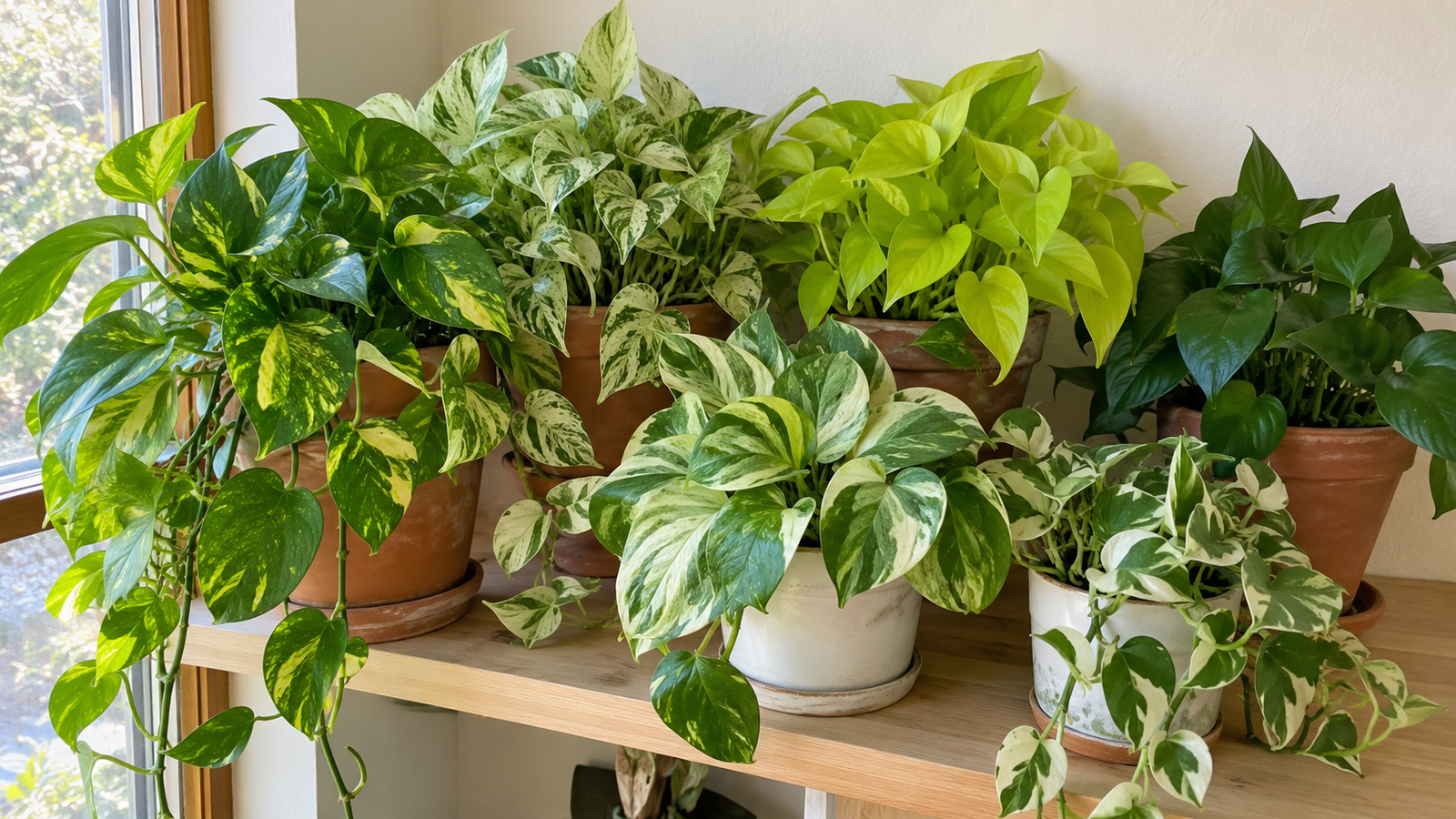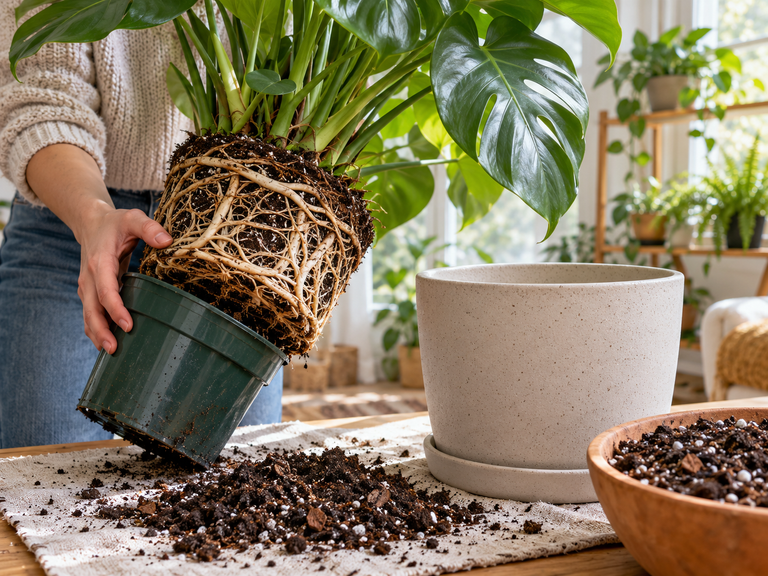
Propagating a vine plant means creating a new plant from an existing parent plant using stems, nodes, and roots instead of seeds. For most indoor vines, this is the fastest and most reliable way to grow new plants because the cutting keeps the same traits as the parent plant.
Most vine plants naturally root from nodes when they trail, climb, or touch moist surfaces. That is why plants like Pothos, Heartleaf Philodendron, English Ivy, Monstera Adansonii, and String of Hearts are popular for propagation.
Propagation is useful because it helps you:
- Create new plants for free
- Fix leggy vine growth
- Make pots look fuller
- Rescue broken stems
- Control plant shape
- Share cuttings with others
A long, sparse pothos vine can be trimmed, rooted, and replanted into the same pot to make the plant look fuller within weeks. Propagation is not just plant multiplication; it is also plant maintenance.
How Do You Know If a Vine Plant Is Ready for Propagation?
A vine plant is ready for propagation when it is actively growing, healthy, and stable enough to handle cutting. If the parent plant is weak, pest-infested, recently repotted, or yellowing, the cuttings may root slowly or fail.
The best sign is active growth. If the vine is producing new leaves, extending stems, and keeping healthy color, it is usually ready.
Signs your vine is ready:
- Active new growth
- Mature visible nodes
- Strong green stems
- Healthy leaves
- No active pests
- Stable root system
Wait before propagating if:
- Leaves are yellowing
- The plant has root rot
- Pests are present
- It was recently repotted
- It is dormant in winter
Decision clarity: only propagate a struggling plant if you are trying to rescue healthy sections before the plant declines further.
Which Vine Plants Are Easiest to Propagate?
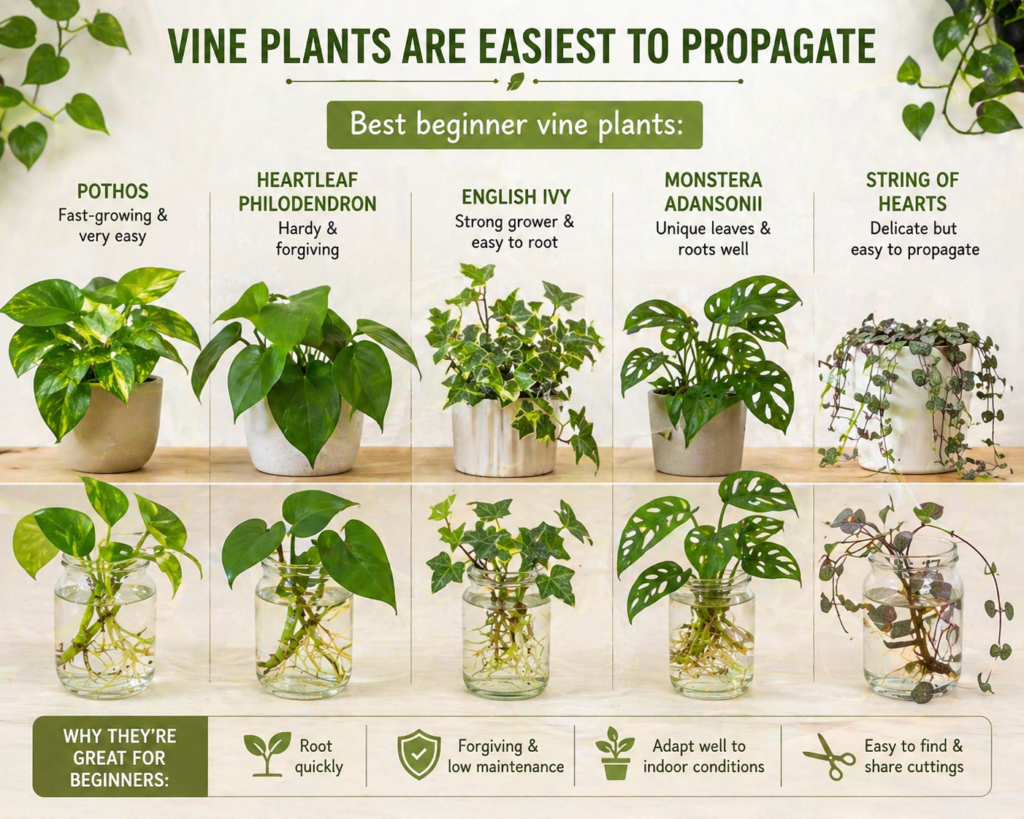
Some vines root much faster than others. Soft-stemmed tropical vines usually propagate best because their nodes activate quickly and they tolerate cutting well.
Best beginner vine plants:
- Pothos
- Heartleaf Philodendron
- English Ivy
- Monstera Adansonii
- String of Hearts
Pothos is one of the easiest because it roots quickly in both water and soil. Heartleaf Philodendron is also forgiving and works well for beginners. English Ivy and Monstera Adansonii root reliably but may need more stable humidity.
Harder vines to propagate:
- Hoya
- Jasmine
- Bougainvillea
- Mature woody vines
Decision clarity: start with Pothos or Heartleaf Philodendron if you are learning propagation for the first time.
When Is the Best Time to Propagate Vine Plants?
The best time to propagate vine plants is during active growth, usually spring through summer. During this period, plants naturally produce more energy, hormones, leaves, and roots.
Spring is the best season because the plant is waking up. Early summer is also excellent because warmth speeds root production.
Best seasons:
- Spring
- Early summer
- Mid-summer
Avoid propagating during:
- Heavy winter dormancy
- Pest outbreaks
- Repotting stress
- Extreme heat
- Root rot recovery
A philodendron cutting taken in spring may root in 10–14 days, while the same cutting in winter may take 3–4 weeks.
Decision clarity: propagate during spring or summer for the highest success rate.
Can You Propagate Vine Plants in Winter?
Yes, vine plants can be propagated in winter, but rooting is usually slower. Shorter daylight, cooler temperatures, and dry indoor air reduce plant activity.
Winter propagation works better indoors when you control warmth, light, and humidity.
Tips for winter propagation:
- Keep temperature above 65°F
- Use bright indirect light
- Add a grow light if needed
- Keep cuttings away from cold drafts
- Maintain stable humidity
Winter risks:
- Slow rooting
- Stem rot from cold water
- Low light stress
- Dry indoor air
Decision clarity: winter propagation is possible, but expect slower results and provide extra warmth and light.
How Do You Identify a Node on a Vine Plant?
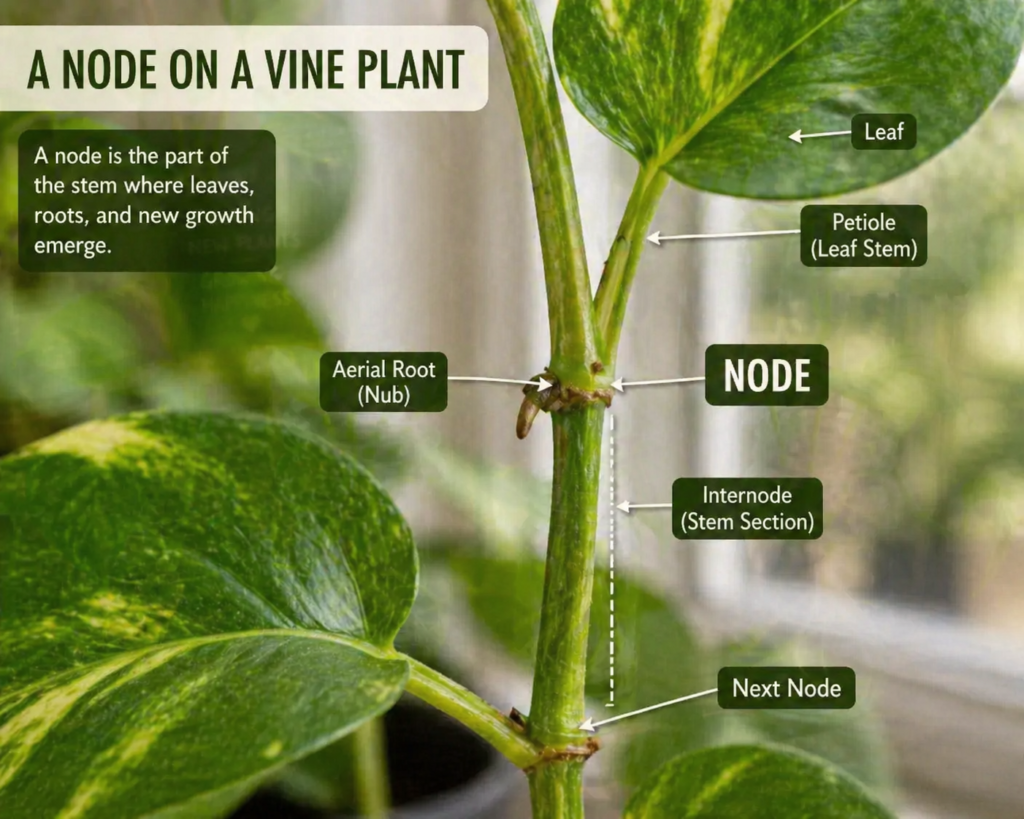
A node is the most important part of a vine cutting. It is the point on the stem where roots, leaves, or branches can grow. Without a node, most vine cuttings cannot root.
On Pothos, nodes often look like small brown bumps or aerial root points. On Philodendron, they appear near the place where a leaf attaches to the stem.
Signs of a node:
- Small bump on the stem
- Leaf attachment point
- Tiny root nub
- Slight stem thickening
- Branching point
Cutting rule:
- Cut ¼–½ inch below the node
- Keep the node intact
- Do not damage aerial roots
Decision clarity: a short cutting with a healthy node is better than a long cutting without one.
Which Part of the Vine Should You Cut?
The best section to cut is usually the healthy middle-to-top part of the vine. Very young tips can be too soft, while very old woody stems may root slowly. The ideal cutting is firm, green, mature, and actively growing.
For Pothos and Heartleaf Philodendron, a good cutting is usually 4–6 inches long with 2–3 nodes and 1–2 healthy leaves.
Best sections to cut:
- Middle stem sections
- Upper mature growth
- Green stems with visible nodes
- Firm but flexible stems
Avoid cutting:
- Very soft new growth
- Old woody stems
- Flowering stems
- Yellowing or damaged sections
Decision clarity: choose a healthy middle section with visible nodes for the strongest results.
Does Node Age Affect Propagation Success?
Yes, node age affects rooting. Very young nodes may be soft and weak, while very old woody nodes may be slow or inactive. The best nodes are mature, green, firm, and active.
A mature node has stored energy and enough strength to support root development. These nodes often root faster and survive better after transplanting.
Best node types:
- Mature green nodes
- Firm active nodes
- Nodes with aerial root nubs
- Nodes connected to healthy leaves
Avoid:
- Soft immature nodes
- Damaged nodes
- Dry or shriveled nodes
- Woody dormant nodes
Decision clarity: choose mature active nodes, not the youngest or oldest parts of the vine.
What Tools Do You Need for Vine Plant Propagation?
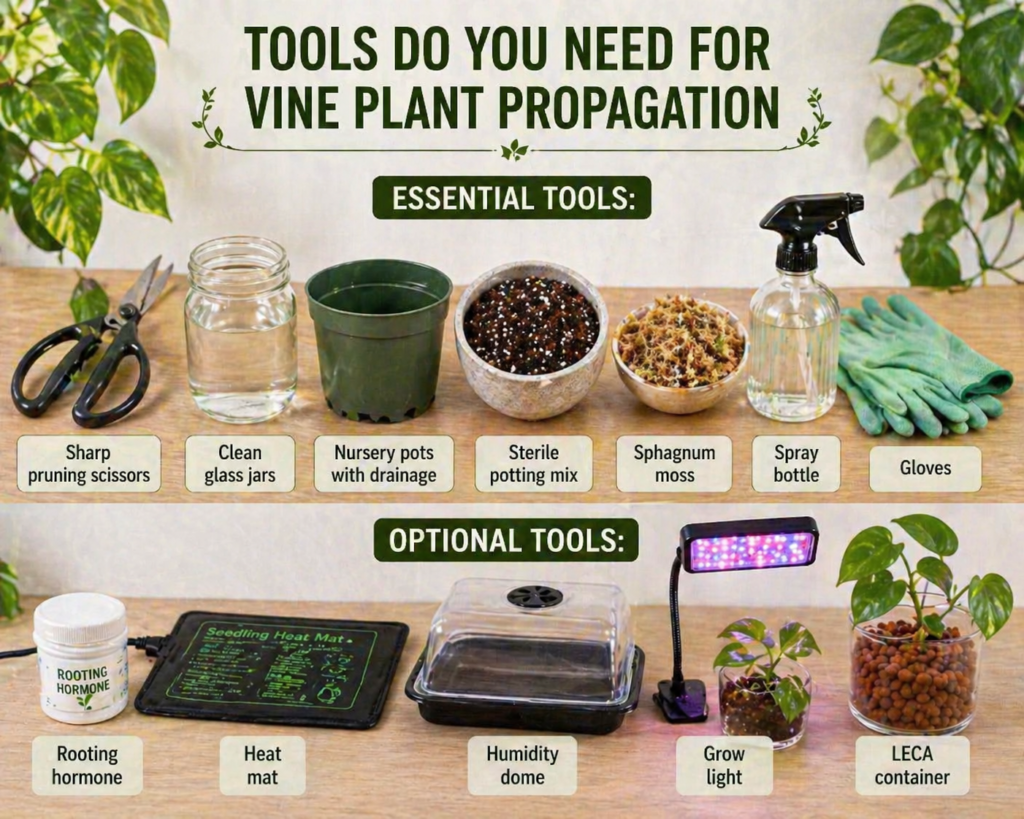
You do not need expensive tools, but clean tools matter. Dull scissors crush stems and increase rot risk. Sharp, sterilized tools make clean cuts and help the cutting heal faster.
Essential tools:
- Sharp pruning scissors
- Clean glass jars
- Nursery pots with drainage
- Sterile potting mix
- Sphagnum moss
- Spray bottle
- Gloves
Optional tools:
- Rooting hormone
- Heat mat
- Humidity dome
- Grow light
- LECA container
Decision clarity: clean, sharp tools and a stable rooting setup matter more than expensive propagation accessories.
How Does Water Propagation Work?
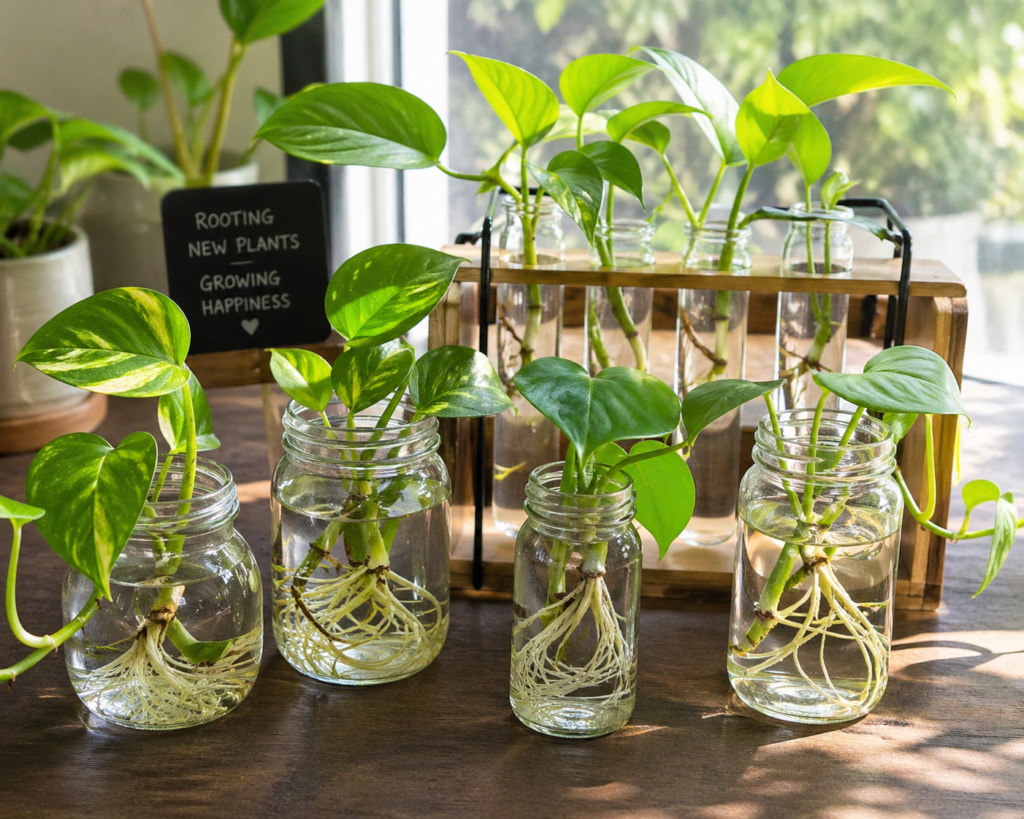
Water propagation means placing a vine cutting in water so the node stays submerged while the leaves remain above water. This method is popular because you can watch roots grow and catch problems early.
Water roots are usually soft and delicate, so cuttings should be moved to soil before roots become too long.
Water propagation steps:
- Cut below a healthy node
- Remove lower leaves
- Place the node in clean water
- Keep leaves above water
- Use bright indirect light
- Change water every 3–5 days
Best plants for water propagation:
- Pothos
- Heartleaf Philodendron
- Monstera Adansonii
- String of Hearts
Decision clarity: choose water propagation if you are a beginner and want to see root progress clearly.
What Type of Water Is Best for Propagation?
Filtered water is usually best because it reduces chlorine and excess minerals. Many vines can root in tap water, but hard water or softened water may stress delicate cuttings.
Best water choices:
- Filtered water
- Rainwater
- Dechlorinated tap water
Less ideal choices:
- Hard tap water
- Softened water
- Highly chlorinated water
Water rules:
- Use room-temperature water
- Change water every 3–5 days
- Rinse the container each time
- Keep only nodes underwater
Decision clarity: if your cuttings often rot or root slowly, switch to filtered water.
Does Container Size Matter for Propagation?
Yes, container size affects water stability, oxygen levels, and spacing. A container that is too large may hold too much stagnant water, while one that is too small may crowd roots.
For water propagation, narrow or medium glass jars work well because they hold the cutting upright and keep the node submerged.
Best container choices:
- Small glass jars
- Narrow-neck propagation bottles
- Clear containers
- Small nursery pots for soil propagation
Avoid:
- Oversized deep jars
- Crowded jars
- Dirty containers
- Soil containers without drainage
Decision clarity: use a clean container just large enough to support the cutting without overcrowding.
How Does Soil Propagation Work?
Soil propagation means placing the cutting directly into moist soil. The roots grow in the medium they will stay in, which reduces transplant shock.
The downside is that you cannot see the roots developing, so you must monitor moisture, light, and cutting health carefully.
Soil propagation steps:
- Use airy potting mix
- Insert the node into soil
- Keep leaves above soil
- Water lightly
- Maintain humidity
- Place in bright indirect light
Simple soil mix:
- 40% potting mix
- 30% perlite
- 20% coco coir
- 10% bark
Decision clarity: choose soil propagation if you want stronger long-term roots and less transplant stress.
How Does Moss Propagation Work?
Sphagnum moss propagation works well because moss holds moisture while allowing airflow. This makes it useful for tropical vines and plants with aerial roots.
Moss is especially helpful for Monstera Adansonii, Hoya, and some Philodendrons because it supports root development without keeping the stem too wet.
Moss propagation benefits:
- Good airflow
- Strong moisture retention
- Lower rot risk than dense soil
- Useful for aerial roots
Best for:
- Monstera Adansonii
- Hoya
- Philodendron
Decision clarity: use moss when you want moisture plus airflow, especially for tropical or rare vines.
How Does Layering Propagation Work?
Layering is a safer propagation method because the stem stays attached to the parent plant while roots form. The cutting continues receiving water and nutrients until it is ready to separate.
Main types:
- Ground layering
- Air layering
Best plants for layering:
- Ivy
- Hoya
- Jasmine
- Mature climbing vines
Air layering often uses moist moss wrapped around a node until roots develop.
Decision clarity: layering is best for rare, mature, or slow-rooting vines where you do not want to risk losing a cutting.
How Do You Propagate a Vine Plant Step by Step?
Successful propagation follows a simple system. Most failures happen when people cut randomly, skip nodes, use dirty water, or ignore light and warmth.
Step-by-step system:
- Choose a healthy parent vine
- Find mature nodes
- Sterilize scissors
- Cut ¼–½ inch below a node
- Remove lower leaves
- Choose water, soil, moss, or layering
- Keep cuttings in bright indirect light
- Maintain warmth and humidity
- Monitor roots and rot
- Transfer when roots are ready
Decision clarity: propagation is not luck. It works best when you follow the same clean process every time.
How Do You Care for the Parent Vine After Taking Cuttings?
After taking cuttings, the parent vine needs recovery care. The plant has less foliage, so it may use less water. Overwatering after pruning is a common mistake.
Bright indirect light helps the parent plant recover and push new side growth. For Pothos and Philodendron, cutting often encourages fuller growth from lower nodes.
Parent plant care:
- Keep watering balanced
- Provide bright indirect light
- Watch cut points for rot
- Rotate the pot
- Remove damaged leaves
Avoid:
- Overwatering
- Fertilizing immediately
- Repotting right after cutting
- Harsh direct sunlight
Decision clarity: caring for the parent plant helps it recover and become fuller after propagation.
Water vs Soil Propagation: Which Is Better?
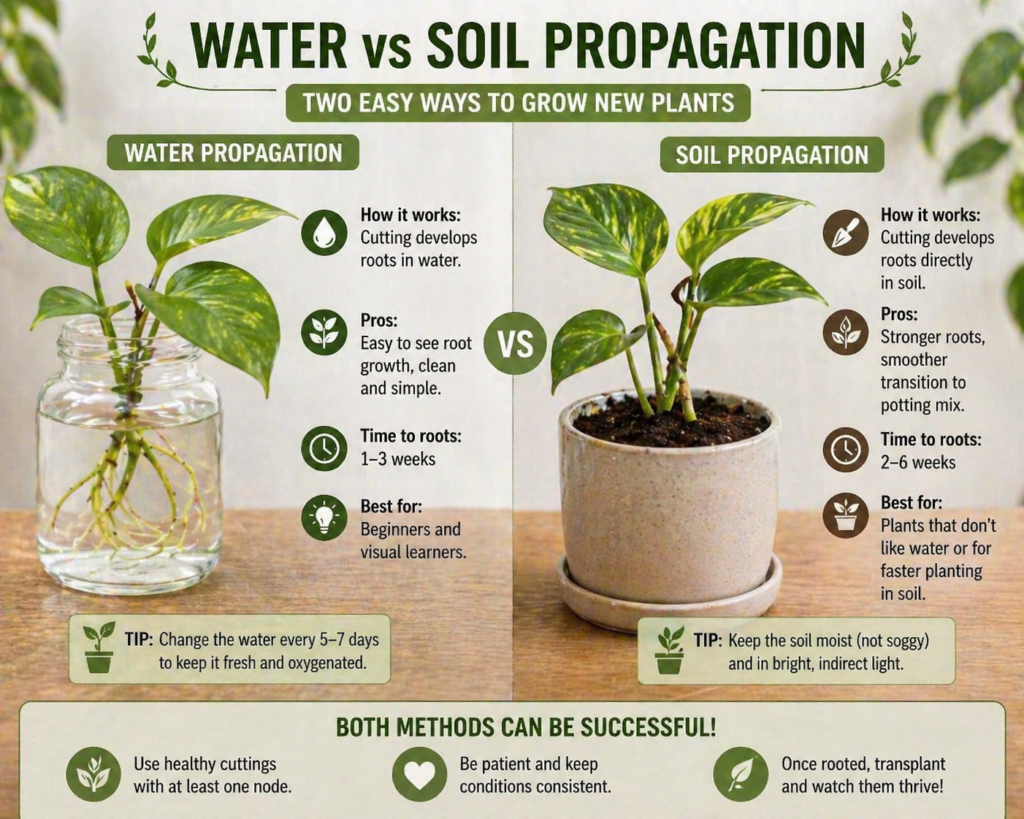
Water propagation is easier because you can see roots. Soil propagation is stronger because roots adapt to soil from the beginning. Neither is always better; it depends on your goal.
Water propagation is best if you want:
- Easy monitoring
- Faster visible roots
- Beginner-friendly results
Soil propagation is best if you want:
- Stronger roots
- Less transplant shock
- Better long-term establishment
Many growers use a hybrid method: start in water, then move to soil when roots are 2–3 inches long.
Decision clarity: use water for learning and soil for stronger long-term growth.
Best Propagation Method for Different Vine Plants
Different vines root best in different media. Matching the method to the plant improves success.
| Vine Plant | Best Method | Why It Works |
|---|---|---|
| Pothos | Water | Fast visible roots |
| Heartleaf Philodendron | Water or soil | Flexible and easy |
| English Ivy | Soil | Stronger root adaptation |
| Monstera Adansonii | Moss | Better humidity balance |
| String of Hearts | Water or soil | Quick delicate rooting |
| Hoya | Moss or layering | Better moisture control |
Quick rule:
- Use water for fast-rooting vines
- Use soil for stronger roots
- Use moss for tropical vines
- Use layering for rare or mature vines
Decision clarity: the best method is the one that matches the plant’s natural rooting behavior.
How Long Does Vine Plant Propagation Take?
Most vine cuttings root within 1–8 weeks depending on species and conditions.
Average rooting times:
- Pothos: 7–14 days
- Philodendron: 10–21 days
- Ivy: 14–28 days
- Hoya: 3–6 weeks
- Woody vines: 4–8 weeks
Rooting speed depends on:
- Warmth
- Humidity
- Light
- Node health
- Water quality
- Parent plant condition
Decision clarity: fast roots are good, but healthy roots matter more than speed.
How Do You Know If New Roots Are Healthy?

Healthy roots should look clean, firm, and actively growing. Root quality matters because weak roots may fail after transplanting.
Healthy roots look like:
- White or cream
- Firm
- Slightly thick
- Branching
- Growing from multiple points
Unhealthy roots look like:
- Brown or black
- Slimy
- Mushy
- Smelly
- Unbranched
A cutting with several 2-inch branching roots is usually better than one long weak root.
Decision clarity: transplant when roots are firm, clean, and branching.
Why Is My Vine Cutting Not Rooting?
A cutting usually fails because something is wrong with the cutting or environment. The most common issue is no node.
Common reasons:
- No node
- Low light
- Cold temperature
- Dirty water
- Rot
- Weak parent plant
- Poor airflow
Quick fixes:
- Recut below a healthy node
- Refresh water
- Increase warmth
- Improve indirect light
- Use a cleaner container
Decision clarity: failed propagation is feedback. Fix the condition before starting again.
Can You Save a Failed Vine Cutting?
Sometimes, yes. If the stem and node are still healthy, you can restart the cutting.
How to save it:
- Cut off rotted tissue
- Recut below a healthy node
- Use sterile scissors
- Replace dirty water
- Switch to fresh medium
- Increase warmth and humidity
Signs it may still survive:
- Firm green stem
- Healthy node
- No foul smell
- Stable leaves
Decision clarity: if the node is still healthy, the cutting still has a chance.
Why Are My Propagated Leaves Turning Yellow?
Yellow leaves during propagation usually mean stress. One yellow leaf can be normal because the cutting is redirecting energy into root growth. Multiple yellow leaves usually mean a care issue.
Common causes:
- Root rot
- Dirty water
- Low light
- Overwatering
- Temperature shock
- Natural energy shift
Fixes:
- Change water
- Check stem base
- Improve indirect light
- Keep temperature stable
- Remove dead leaves
Decision clarity: one yellow leaf is usually fine; repeated yellowing means the environment needs adjustment.
Do You Need Rooting Hormone?
Rooting hormone is optional for most easy indoor vines. Pothos and Philodendron usually root well without it.
Rooting hormone is more useful for slow, woody, or difficult vines.
Helpful for:
- Hoya
- Jasmine
- Woody ivy
- Mature stems
Usually unnecessary for:
- Pothos
- Heartleaf Philodendron
- Monstera Adansonii
Decision clarity: rooting hormone is a booster, not a requirement.
How Much Light Do Propagating Vines Need?
Propagating vines need bright indirect light. Low light slows rooting, while harsh direct sun can dry or burn cuttings.
Best light:
- East-facing window
- Bright filtered light
- Grow light if needed
Avoid:
- Hot afternoon sun
- Dark rooms
- Cold windowsills
- Drafty areas
Decision clarity: bright indirect light gives cuttings energy without stressing them.
When Should You Move Rooted Cuttings to Soil?
Move water-rooted cuttings to soil when roots are about 2–3 inches long and starting to branch. Do not wait too long because long water roots can struggle to adapt to soil.
Transplant signs:
- Roots are 2–3 inches long
- Multiple roots are visible
- Roots are firm and white
- Branching has started
After transplant:
- Keep soil lightly moist
- Maintain humidity
- Avoid fertilizer at first
- Keep in indirect light
Decision clarity: early transfer improves soil adaptation.
How Do You Make Vine Plants Fuller After Propagation?
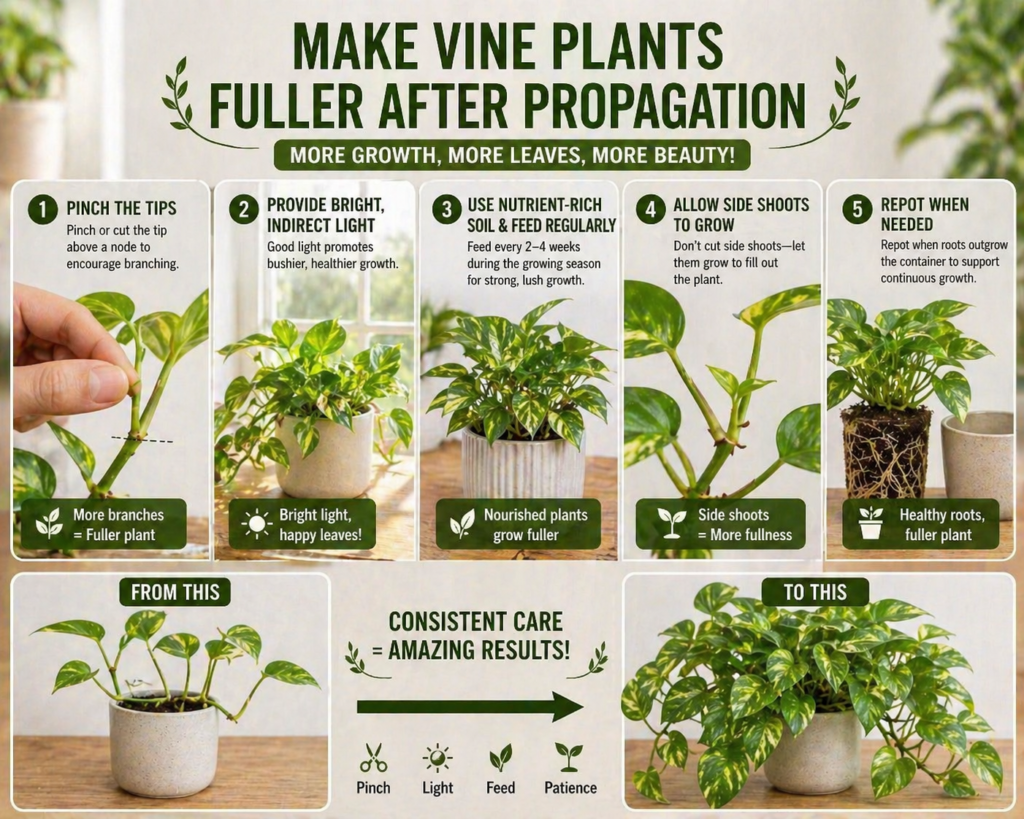
To make a vine plant fuller, root cuttings and replant them into the same pot. This creates more stems and more growth points.
Fullness system:
- Trim leggy stems
- Root cuttings
- Replant into the original pot
- Rotate the pot regularly
- Repeat every growing season
This works especially well for Pothos and Heartleaf Philodendron.
Decision clarity: pruning plus propagation is the fastest way to make a vine plant bushier.
Biggest Vine Propagation Mistakes to Avoid
Most propagation mistakes are simple but easy to repeat.
Common mistakes:
- Cutting without a node
- Using dirty scissors
- Leaving leaves underwater
- Using cold water
- Keeping cuttings in low light
- Overcrowding jars
- Waiting too long to transplant
- Using compact soil
Prevention checklist:
- Confirm the node
- Sterilize tools
- Use clean water
- Provide warmth
- Give bright indirect light
- Watch for rot
Decision clarity: small mistakes cause most propagation failures.
What I Learned After Propagating 100+ Vine Cuttings
After propagating many vine cuttings, the biggest lesson is that consistency matters more than expensive tools. Healthy nodes, clean cuts, warmth, and patience create the best results.
Medium-length cuttings with mature nodes usually perform better than very short or overly long cuttings. Water propagation is useful for beginners, but transferring at the right time is important.
Biggest lessons:
- Node quality matters most
- Clean tools prevent rot
- Warmth speeds rooting
- Branching roots transplant better
- Overcrowding increases failure
- Early soil transfer improves success
Decision clarity: simple, repeatable habits outperform complicated techniques.
Final Thoughts
Propagating vine plants is one of the easiest ways to grow more plants, fix leggy growth, and make existing vines fuller. The key is understanding nodes, choosing healthy cuttings, using clean tools, and giving the cutting stable light, warmth, and moisture.
For beginners, start with Pothos or Heartleaf Philodendron. Use water propagation first if you want to watch roots form, then move the cutting to soil when roots are 2–3 inches long.
Best beginner action plan:
- Start with Pothos
- Choose a healthy node
- Use clean scissors
- Root in water
- Transfer early
- Replant cuttings for fullness
One healthy vine can become many new plants within a season. That is the power of propagation.
FAQ SECTION
Can all vine plants be propagated?
- Most indoor vine plants can be propagated if they have healthy stem nodes.
- Soft-stemmed vines like pothos and philodendron root faster than woody vines.
Can you propagate a vine plant without a node?
- No, a node is where new roots form.
- A cutting without a node usually will not root.
Is water propagation better than soil propagation?
- Water propagation is easier for beginners because root growth is visible.
- Soil propagation creates stronger roots and reduces transplant shock.
How long does it take for vine cuttings to root?
- Most vine cuttings root within 1–4 weeks.
- Fast-growing vines like pothos often root in under two weeks.
What type of water is best for plant propagation?
- Filtered water is best because it reduces chlorine and mineral buildup.
- Rainwater and dechlorinated tap water also work well.
How do you know when propagated roots are ready for soil?
- Roots are ready when they reach 2–3 inches long.
- Multiple branching roots transplant better than one long root.
Why is my vine cutting not rooting?
- Common reasons include missing nodes, poor light, low warmth, dirty water, or stem rot.
- Healthy nodes and stable conditions improve success.
How do you make a vine plant fuller after propagation?
- Root the cuttings and replant them into the same pot.
- This creates more stems and makes the plant look fuller over time.

Myra is the founder and lead writer of Plantsaholic. She shares practical, research-backed advice on indoor plants, outdoor gardening, flowers, herbs, succulents, and everyday plant care. Her goal is to help gardeners of all experience levels grow healthier plants through simple, easy-to-follow gardening guides.