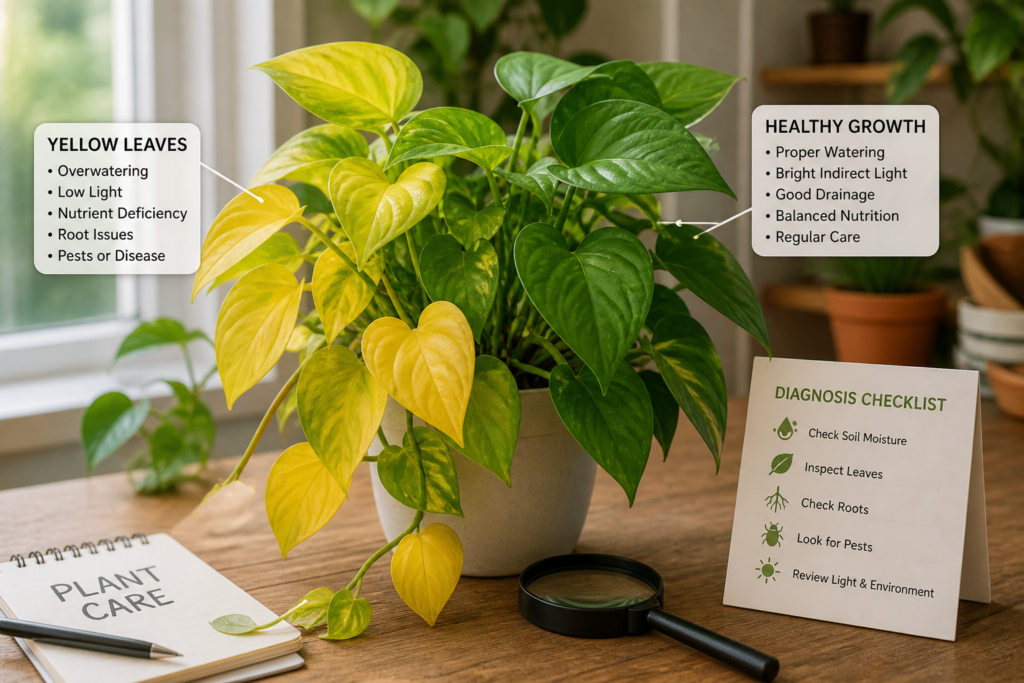
Plant leaves turn yellow when something disrupts normal plant function. The cause may be water stress, root damage, poor drainage, weak light, too much sun, nutrient deficiency, pests, disease, temperature shock, repotting stress, or natural aging.
Yellowing leaves are not the main problem. They are a signal. The goal is to find what is stressing the plant and fix that cause before the problem spreads.
Healthy diagnosis starts with:
- checking soil moisture
- inspecting leaf texture
- reading the yellowing pattern
- checking roots
- inspecting pests
- reviewing light and environment
This guide explains the main reasons plant leaves turn yellow and how to fix each one correctly.
Why Are My Plant Leaves Turning Yellow?
Plant leaves turn yellow because they are losing chlorophyll, the green pigment that supports photosynthesis. This process is called chlorosis. Chlorosis is not a disease by itself. It is a visible symptom of another problem affecting the plant.
The cause may be simple, like one old lower leaf naturally aging. It may also be serious, like root rot, pest damage, or nutrient lockout. The yellowing pattern gives the best clue.
Common causes include:
- overwatering
- underwatering
- root rot
- poor drainage
- low light
- too much direct sun
- nutrient deficiency
- pests
- disease
- temperature shock
- repotting stress
- natural aging
One yellow leaf is usually observation. Several yellow leaves need diagnosis.
What Is the Fastest Way to Diagnose Yellow Leaves?
The fastest way to diagnose yellow leaves is to inspect the plant in order instead of guessing. Many plant owners make the problem worse by watering more, fertilizing too soon, or moving the plant repeatedly.
Start with the soil. Push your finger 2–3 inches into the potting mix. Wet soil may mean overwatering or poor drainage. Bone-dry soil may mean underwatering. Then check leaf texture. Soft yellow leaves usually point to excess water. Crispy yellow leaves often point to dryness, sun damage, or mineral buildup.
Check the yellowing location:
- lower leaves: aging, overwatering, low light, nitrogen deficiency
- new leaves: iron deficiency, pH issue, root stress
- yellow edges: underwatering, salt buildup, potassium issue
- random yellow spots: pests or disease
Inspect roots if yellowing spreads. Healthy roots are white or cream-colored and firm. Rotten roots are brown, black, soft, slimy, or smelly.
Diagnosis checklist:
- Is the soil wet or dry?
- Are leaves soft or crispy?
- Are lower or new leaves yellowing?
- Are roots healthy?
- Are pests present?
- Did the plant move, get repotted, or face temperature change?
This process prevents overcorrection.
What Does the Yellowing Pattern Tell You?
The yellowing pattern often tells you more than the yellow color itself. Many plant problems create yellow leaves, but the location and shape of yellowing help narrow the cause quickly.
If the whole leaf turns yellow, common causes include overwatering, aging, or nitrogen deficiency. If edges turn yellow first, the plant may be underwatered, salt-stressed, or low in potassium. If yellowing appears between green veins, magnesium or iron issues may be involved. If yellow spots appear randomly, pests or fungal disease become more likely.
Common patterns:
- whole yellow leaf: overwatering, aging, nitrogen deficiency
- yellow edges: underwatering, salt buildup, potassium imbalance
- yellow between veins: magnesium or iron deficiency
- yellow spots: pests or fungal disease
- yellow tips first: fertilizer burn, mineral buildup, inconsistent watering
Example: a pothos develops yellow crispy edges while the soil is dry. That points to underwatering, not excess water.
Pattern recognition creates better decisions.
Is Overwatering Causing Yellow Leaves?
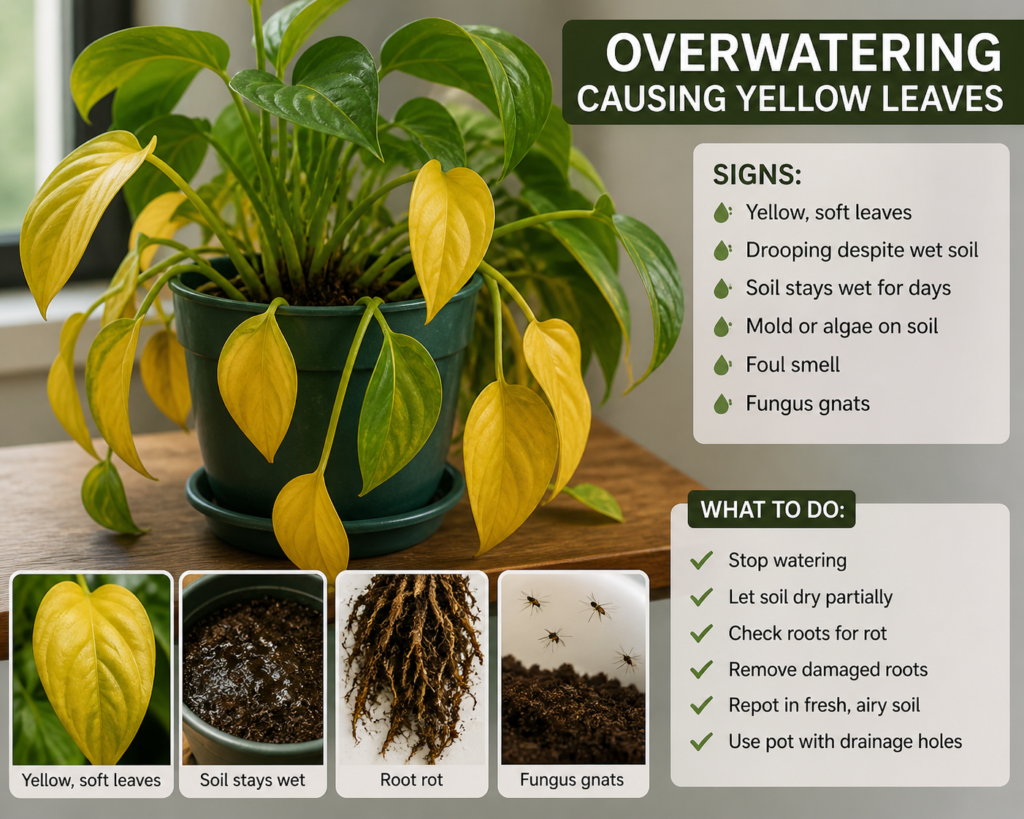
Overwatering is one of the most common reasons plant leaves turn yellow. Roots need oxygen as much as water. When soil stays wet too long, air spaces fill with water, roots lose oxygen, and nutrient uptake slows.
Overwatering is tricky because the plant may droop and look thirsty. Many owners water again, which makes the problem worse and can lead to root rot.
Signs of overwatering include:
- soft yellow leaves
- wet soil for several days
- drooping despite moist soil
- fungus gnats
- mold on soil
- weak stems
- leaf drop
- slow growth
Overwatered leaves usually feel soft, not crispy.
To fix overwatering:
- stop watering temporarily
- let soil partially dry
- increase airflow
- move to brighter indirect light
- check roots if yellowing spreads
- repot if roots are damaged
Prevention is better than rescue. Use drainage holes, avoid oversized containers, and water by soil condition instead of a fixed schedule.
Can Underwatering Cause Yellow Leaves?
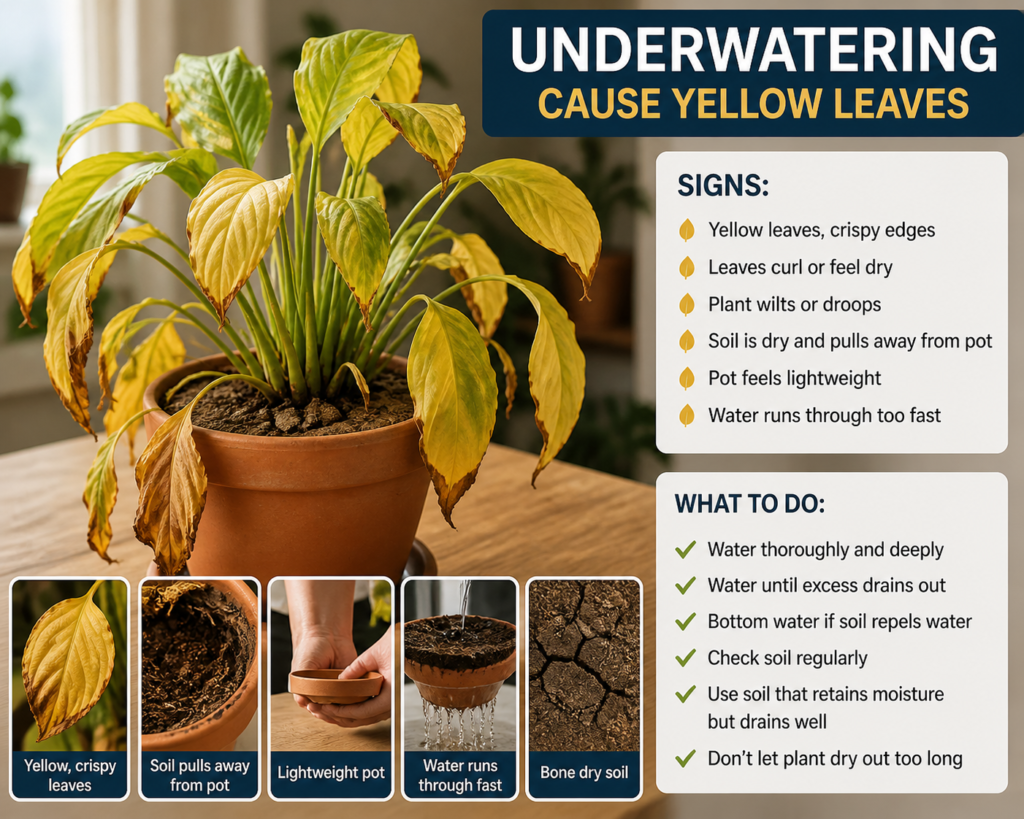
Yes. Underwatering can turn leaves yellow before they become brown and crispy. When roots cannot access enough moisture, nutrient movement slows, cell pressure drops, and chlorophyll breaks down.
Underwatering usually follows this sequence: drooping, yellowing, crisping, browning, and leaf drop. Plants like peace lily and calathea show it quickly, while snake plant and ZZ plant may take longer.
Signs include:
- dry soil
- soil pulling from pot edges
- curled leaves
- crispy yellow edges
- lightweight pot
- wilted stems
- fast runoff
- dry root ball
To fix underwatering, water deeply until the soil is evenly moist and excess water drains out. If soil repels water, bottom-water for 20–30 minutes, then drain.
Better habits include:
- checking soil weekly
- watering deeply
- avoiding long dry periods
- using airy soil that still holds some moisture
Deep watering builds stronger roots.
Are Yellow Leaves a Sign of Poor Drainage?
Yes. Poor drainage can cause yellow leaves even if your watering frequency seems correct. The issue may not be how often you water. It may be that water cannot escape or air cannot reach the roots.
Drainage controls oxygen. When water sits in the pot too long, roots remain wet, oxygen drops, and root function weakens. This creates the same symptoms as overwatering.
Common drainage problems include:
- no drainage holes
- heavy dense soil
- oversized pots
- compacted root ball
- decorative pots holding water
- old degraded potting mix
Signs include:
- soil stays wet 5–7 days
- yellow lower leaves
- sour soil smell
- fungus gnats
- mold
- weak stems
- slow growth
To fix poor drainage:
- move to a pot with drainage holes
- use fresh airy soil
- add perlite, bark, or pumice
- avoid oversized pots
- empty cachepots
Good drainage protects roots.
Do Yellow Leaves Mean Root Rot?
Sometimes. Root rot is one of the most serious causes of yellow leaves because it damages the plant’s foundation. Once roots rot, water and nutrient movement become unstable. The plant may look thirsty even while sitting in wet soil.
Signs include:
- spreading yellow leaves
- wet soil that stays wet
- bad smell
- mushy roots
- black or brown roots
- drooping despite moisture
- soft stem base
- leaf drop
Healthy roots are white, cream-colored, and firm. Rotten roots are brown, black, slimy, soft, and smelly.
To fix root rot:
- remove the plant from the pot
- wash roots gently
- cut off mushy roots
- sterilize scissors
- repot in fresh airy mix
- use a drainage pot
- delay watering briefly
Recovery depends on how many healthy roots remain. Never ignore yellowing when soil stays wet and smells bad.
Can Repotting Cause Yellow Leaves?
Yes. Repotting can cause yellow leaves because it disturbs roots and changes moisture behavior. Even careful repotting can trigger temporary transplant shock.
After repotting, roots need time to connect with the new soil. During that adjustment, water absorption may weaken. The plant may pause growth, droop slightly, or lose a few older leaves.
Signs include:
- yellow leaves after repotting
- mild drooping
- slow growth
- temporary leaf drop
- stable roots but weak top growth
Mild yellowing for 1–3 weeks after repotting can be normal. Long-term decline, mushy roots, or spreading yellowing means something else is wrong.
To reduce shock:
- avoid oversized pots
- disturb roots as little as possible
- water carefully
- keep light stable
- avoid fertilizer immediately
Patience matters after repotting.
Can Temperature Changes Cause Yellow Leaves?
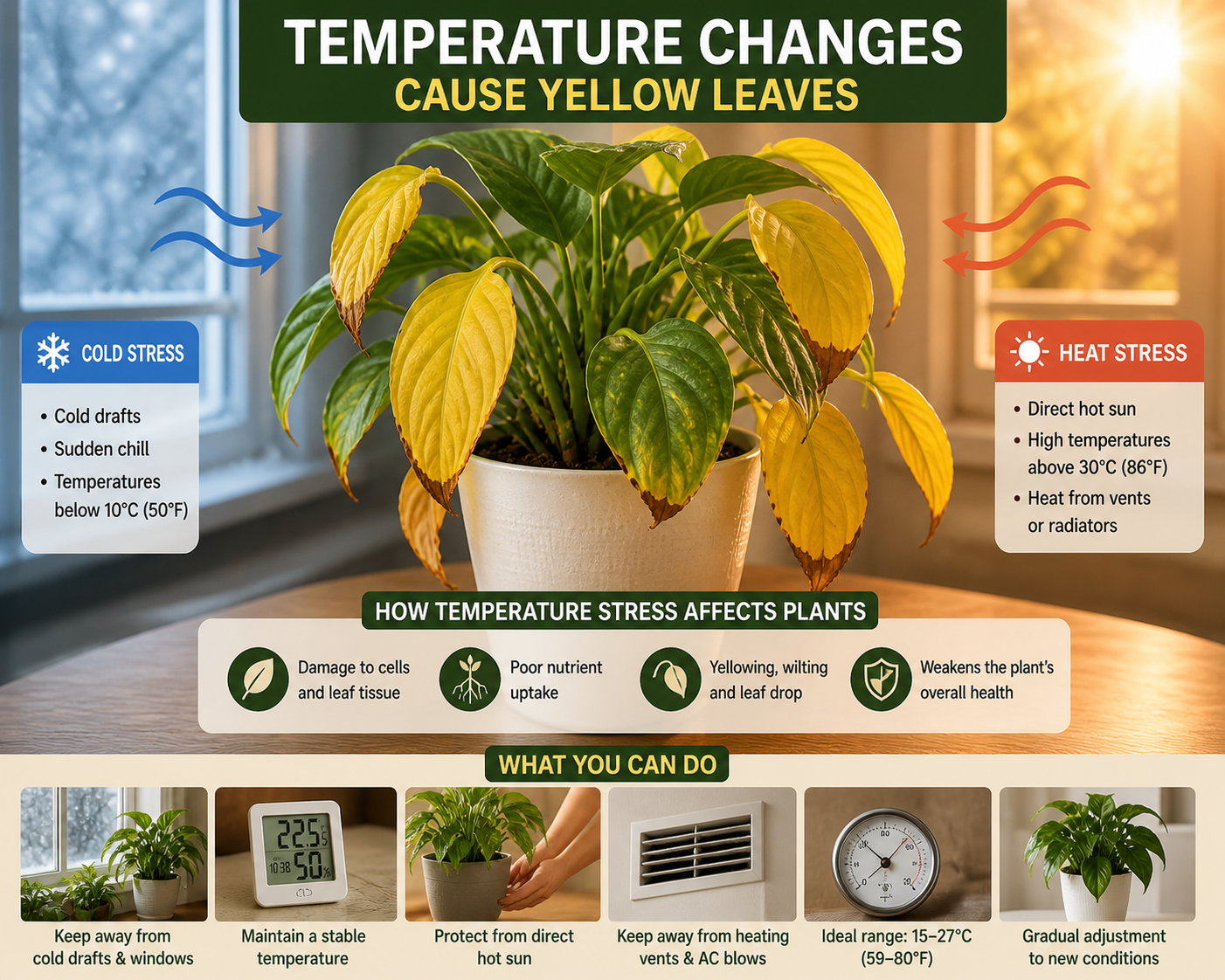
Yes. Sudden temperature changes can stress plant tissue and cause yellow leaves. Indoor plants prefer stable conditions. Cold drafts, hot air, AC vents, heater vents, and sudden room changes can disrupt water movement and cellular function.
Temperature stress often causes sudden yellowing, curling, leaf drop, or soft patches. Tropical plants like peace lily, calathea, and philodendron are especially sensitive.
Common triggers include:
- cold windows at night
- AC vents
- heater vents
- hot afternoon windows
- frequent door drafts
- sudden seasonal changes
To prevent temperature stress:
- keep plants away from vents
- avoid freezing windows
- protect from heat blasts
- maintain stable room temperatures
- avoid sudden location changes
Plants recover best in stable environments.
Can Low Light Cause Yellow Leaves?
Yes. Low light can cause leaves to yellow because light is the plant’s energy source. Without enough light, photosynthesis slows and the plant cannot support all its leaves. It may sacrifice older lower leaves first.
Low-light yellowing is often gradual. The plant may grow slowly, stretch toward windows, produce smaller leaves, and keep wet soil for longer. This is why low light and overwatering often appear together.
Signs include:
- slow or no growth
- stretched stems
- pale leaves
- smaller new leaves
- lower yellowing
- slow-drying soil
- leaning toward light
To fix it:
- move closer to bright indirect light
- rotate weekly
- reduce watering frequency
- use a grow light if needed
- remove dead leaves
Even low-light tolerant plants still need enough light to stay healthy.
Can Too Much Sun Cause Yellow Leaves?
Yes. Too much direct sun can bleach chlorophyll, overheat leaf tissue, and create yellow patches. This is common in indoor plants that prefer filtered light.
Sun damage is usually directional. Leaves facing the window may yellow, bleach, brown, or crisp, while shaded leaves remain healthier.
Signs include:
- yellow patches
- bleached spots
- brown dry edges
- crispy surfaces
- curling upward
- damage on the sun-facing side
Plants like calathea, peace lily, ferns, and fittonia are sensitive to harsh afternoon sun.
To fix sun stress:
- move the plant back
- use sheer curtains
- avoid strong afternoon sun
- remove badly damaged leaves
- maintain stable moisture
The goal is bright light, not harsh light.
What Nutrient Deficiency Causes Yellow Leaves?
Nutrient deficiency can cause yellow leaves because nutrients support chlorophyll, roots, and new growth. But not all nutrient yellowing looks the same.
Nitrogen deficiency usually affects older lower leaves first because nitrogen moves from old leaves to new growth. Iron deficiency often affects new leaves first and may leave veins greener. Magnesium deficiency can cause yellowing between veins. Potassium deficiency may create yellow edges and brown tips.
Quick guide:
- older leaves yellow first: nitrogen deficiency
- new leaves yellow first: iron deficiency
- yellow between veins: magnesium issue
- yellow edges: potassium imbalance
Before fertilizing, check roots and soil moisture. Fertilizer will not fix root rot or overwatering.
To fix nutrient yellowing:
- identify the pattern
- use balanced fertilizer
- avoid overfeeding
- flush salt buildup if needed
- refresh old soil
- feed during active growth
Plants need the right nutrient at the right time.
Can Soil pH Cause Yellow Leaves?
Yes. Soil pH can cause yellow leaves even when nutrients are already present. Roots absorb nutrients only within a suitable pH range. If soil becomes too acidic or too alkaline, nutrients can become locked in the soil and unavailable.
This is nutrient lockout. A plant may look deficient even after fertilizing because roots cannot access the nutrients.
General pH ranges:
- most houseplants: 6.0–7.0
- tropical plants: 5.5–6.8
- acid-loving plants: 5.0–6.5
Signs pH may be involved:
- fertilizer does not help
- new leaves stay yellow
- weak growth
- chlorosis keeps returning
- roots seem normal
To fix pH issues:
- test soil pH
- flush excess salts
- repot if soil is old
- use suitable fertilizer
- avoid random feeding
Sometimes nutrients are present, but roots cannot access them.
Can Tap Water Cause Yellow Leaves?
Yes. Tap water can contribute to yellow leaves, especially in sensitive plants. Hard water, chlorine, fluoride, and mineral salts may build up in soil over time. This can affect roots, leaf tips, and nutrient availability.
Sensitive plants include:
- calathea
- peace lily
- spider plant
- dracaena
Signs include:
- yellow tips
- brown edges
- white crust on soil
- mineral residue on pot
- repeated leaf damage
A calathea with correct watering and light may still develop yellow-brown edges if water is high in minerals. Switching to filtered, distilled, rain, or dechlorinated water can reduce new damage.
Water quality is often overlooked because decline is slow.
Can Pests Make Plant Leaves Yellow?
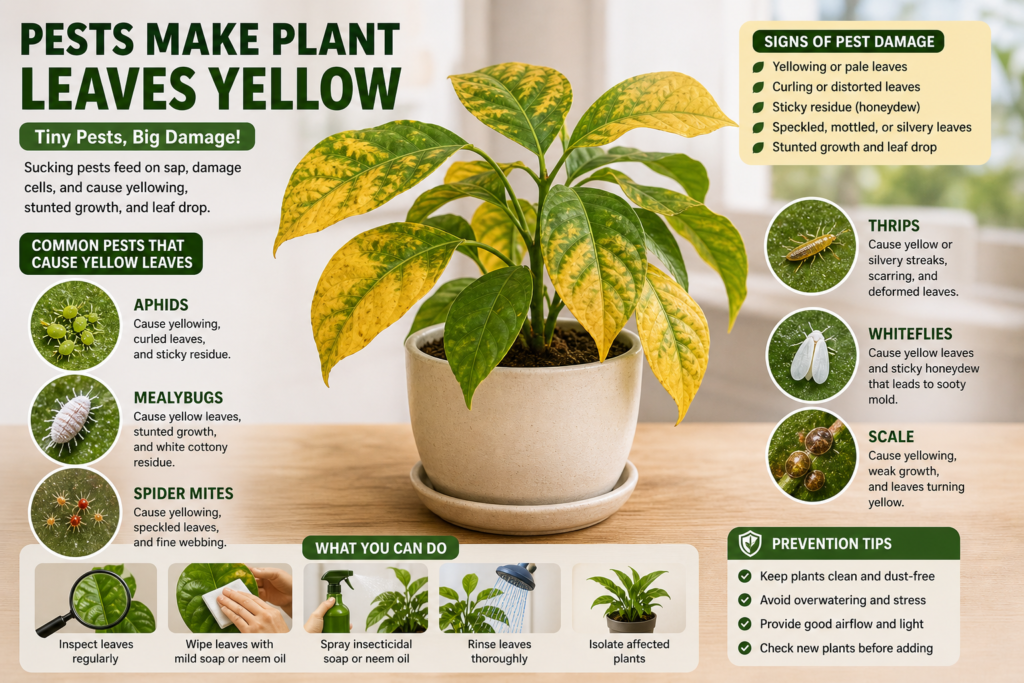
Yes. Pests can cause yellow leaves by feeding on plant sap. They remove moisture, nutrients, and sugars, weakening leaf tissue and causing yellowing, curling, spots, and leaf drop.
Pest yellowing often looks irregular or patchy. Unlike watering problems, it may affect random leaves.
Common pests include:
- spider mites
- aphids
- thrips
- scale
- whiteflies
- mealybugs
Signs include:
- yellow speckles
- sticky residue
- fine webbing
- tiny moving insects
- bumps on stems
- curled leaves
Check leaf undersides, stem joints, and new growth.
To fix pests:
- isolate the plant
- rinse leaves
- remove visible pests
- use insecticidal soap if needed
- repeat treatment weekly
One treatment is rarely enough.
Do Yellow Leaves With Brown Spots Mean Disease?
Sometimes. Yellow leaves with brown spots, yellow halos, black spots, or spreading lesions can point to fungal or bacterial disease. Disease damage usually spreads and creates visible marks inside leaf tissue.
Risk factors include:
- wet leaves
- poor airflow
- crowded plants
- contaminated scissors
- reused infected soil
Signs include:
- brown spots with yellow edges
- soft spreading lesions
- blackened tissue
- wet-looking spots
- rapid leaf decline
- multiple affected leaves
To manage disease:
- remove infected leaves
- isolate the plant
- improve airflow
- avoid wetting leaves unnecessarily
- sterilize tools
- avoid overcrowding
Early removal matters because disease gets harder to control once it spreads.
Are Lower Yellow Leaves Normal?
Sometimes yes. Plants naturally shed older leaves as they grow. Older lower leaves become less useful, so the plant redirects energy toward newer growth.
Normal yellowing is usually slow and limited.
Signs normal aging is likely:
- one or two lower leaves
- slow color change
- healthy new growth
- strong stems
- no spreading symptoms
When lower yellow leaves are not normal:
- many leaves yellow together
- yellowing spreads upward
- leaves droop
- soil stays wet
- growth stops
- roots smell bad
If the rest of the plant is strong, remove the old leaf and monitor. Sometimes the best response is not overreacting.
Should I Cut Off Yellow Leaves?
Usually yes, but timing matters. A fully yellow leaf is no longer producing much energy. Removing it can improve appearance, airflow, and disease control.
Partially green leaves may still help the plant photosynthesize, especially if it is weak or recovering.
Remove leaves when they are:
- fully yellow
- brown and dry
- diseased
- pest-damaged
- broken
Keep leaves when they are:
- partly green
- lightly damaged
- supporting a weak plant
Use clean scissors and cut near the base. Sterilize tools if disease is present.
Avoid removing more than 25–30% of foliage at once. Pruning removes the symptom, not the cause.
Can Yellow Leaves Turn Green Again?
Usually no. Once a leaf turns fully yellow, the chlorophyll has broken down. In most cases, that leaf will not return to healthy green.
Recovery means the plant stops producing new yellow leaves and begins growing healthy new foliage. A partially pale leaf may improve slightly if the cause is corrected early, but fully yellow leaves usually continue declining.
Recovery signs include:
- new green leaves
- stronger stems
- stable roots
- better water use
- yellowing stops spreading
Do not judge recovery by old yellow leaves. Judge it by new growth.
How Do I Fix Yellow Leaves Step by Step?
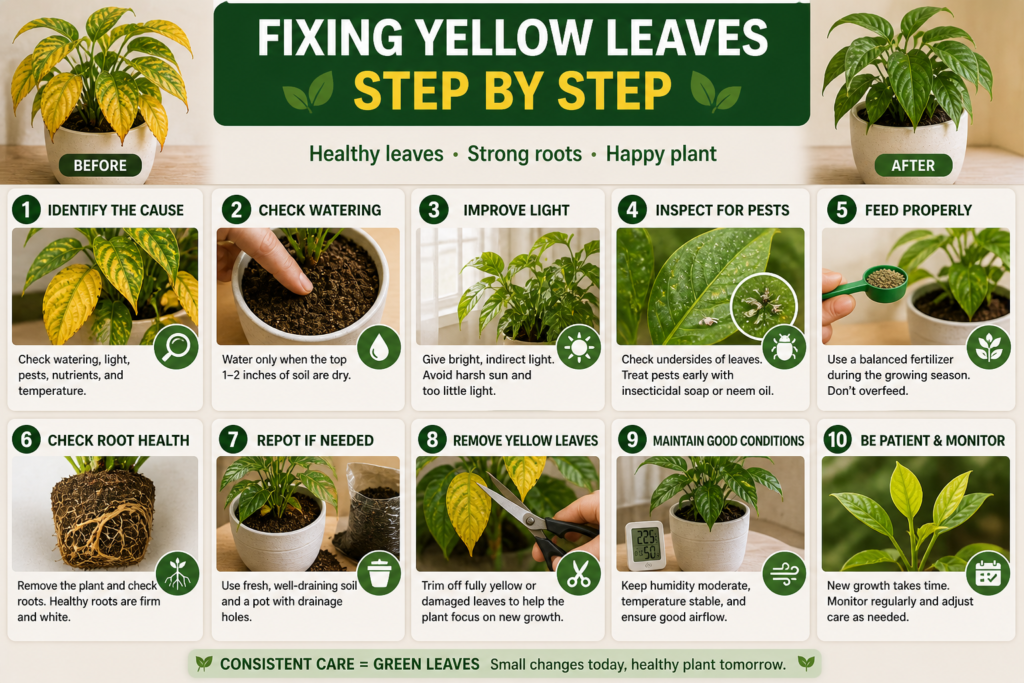
Fixing yellow leaves means correcting the cause, not treating every plant the same way. Random changes create more stress.
Use this recovery system:
- Check soil moisture
- Inspect leaf texture
- Look at the yellowing pattern
- Check roots if needed
- Correct light exposure
- Inspect pests
- Improve drainage
- Remove dead or diseased leaves
- Fertilize only after root stability
- Monitor for 2–4 weeks
Do not fertilize immediately if roots are damaged. Do not repot unless roots, soil, or drainage require it. Keep conditions stable.
How Long Does It Take for Yellow Leaf Problems to Improve?
Recovery time depends on the cause. Some problems improve quickly, while others take weeks.
General timelines:
- watering issue: 3–10 days
- transplant shock: 1–3 weeks
- root recovery: 2–4 weeks
- nutrient correction: 2–6 weeks
- pest recovery: 2–8 weeks
- root rot recovery: 3–8 weeks
Old yellow leaves usually do not heal. New growth is the real recovery signal.
Look for:
- fewer new yellow leaves
- stronger stems
- better soil drying rhythm
- healthy new foliage
- improved growth
Plants recover gradually.
What Mistakes Keep Making Yellow Leaves Worse?
Many yellow leaf problems get worse because of the response, not the original issue. Panic care causes more stress.
Common mistakes include:
- watering again too soon
- fertilizing stressed roots
- repotting unnecessarily
- pruning too heavily
- ignoring root inspection
- changing light too aggressively
- overusing pest sprays
- changing too many things at once
Better response:
- diagnose first
- correct the main cause
- keep care stable
- wait and observe
Plants recover better from one accurate fix than five random fixes.
How Can I Prevent Yellow Leaves in the Future?
Preventing yellow leaves is easier than fixing them. Most yellowing comes from repeated care mistakes rather than one random event.
Prevention checklist:
- water by soil condition
- use drainage pots
- use airy soil
- match the plant to the right light
- inspect pests weekly
- avoid sudden moves
- keep plants away from vents
- repot before severe rootbinding
- feed during active growth only
Seasonal changes matter. In spring and summer, plants grow faster and use more water. In winter, growth slows and water use drops. Adjust care instead of following the same schedule all year.
Observation prevents major yellowing.
Which Plant Type Is Turning Yellow?
Different plants yellow for different reasons. Knowing the plant type helps narrow diagnosis faster.
| Plant | Most Common Cause |
|---|---|
| Pothos | Overwatering or low light |
| Snake Plant | Root rot or excess water |
| Peace Lily | Water stress or direct sun |
| Monstera deliciosa | Drainage or light imbalance |
| Calathea | Water quality or humidity stress |
| Spider Plant | Tap water minerals or dryness |
| Dracaena | Fluoride sensitivity or dry soil |
A snake plant with yellow leaves and wet soil strongly suggests root stress. A calathea with yellow-brown edges may point toward water quality.
Plant type makes diagnosis faster.
FAQ section
Why are my plant leaves turning yellow all of a sudden?
Sudden yellowing usually points to recent stress like overwatering, underwatering, pests, temperature shock, or sudden light changes.
Do yellow leaves always mean overwatering?
No. Yellow leaves can also result from underwatering, low light, nutrient problems, pests, disease, or natural aging.
Can underwatering make leaves yellow before turning brown?
Yes. Dehydration can disrupt nutrient movement and chlorophyll production before leaves become dry and brown.
Why are only the bottom leaves turning yellow?
Lower leaves are older, so some yellowing is normal. Multiple yellow lower leaves may suggest watering or nutrient problems.
Why are new leaves turning yellow?
New yellow leaves often point to iron deficiency, pH imbalance, root stress, or nutrient lockout.
Can yellow leaves turn green again?
Usually no. Fully yellow leaves rarely recover. Healthy new growth is the real sign of recovery.
Should I cut off yellow leaves?
Yes, if they are fully yellow, dead, or diseased. Keep partially green leaves if the plant is still recovering.
How do I know if yellow leaves mean root rot?
Yellow leaves with wet soil, mushy roots, bad smell, and drooping often indicate root rot.
Can too much or too little light cause yellow leaves?
Yes. Low light weakens photosynthesis, while harsh direct sun can bleach and burn leaves, causing yellowing.
How long does it take a yellowing plant to recover?
Minor watering issues may improve in days, while root, pest, or nutrient-related problems can take several weeks.

Myra is the founder and lead writer of Plantsaholic. She shares practical, research-backed advice on indoor plants, outdoor gardening, flowers, herbs, succulents, and everyday plant care. Her goal is to help gardeners of all experience levels grow healthier plants through simple, easy-to-follow gardening guides.