Watering is the foundation of indoor plant health because water controls nearly every major process inside a plant. It is not only about stopping the soil from becoming dry. Water is the system that carries nutrients from the soil into the roots and then upward through stems, leaves, flowers, and new growth points. Without correct watering, even a plant placed in good light and rich soil can struggle because its internal transport system becomes unstable.
Indoor plants depend completely on human care because they do not receive natural rainfall cycles. In nature, roots experience a balance between moisture and oxygen. Indoors, that balance can easily break. Overwatering removes oxygen from the soil, while underwatering interrupts nutrient movement and weakens leaf pressure. Both problems create symptoms that may look like fertilizer deficiency, light stress, or disease.
Proper watering supports:
- Nutrient transport
- Leaf pressure
- Root oxygen balance
- Steady growth
- Flower production
- Stress recovery
- Pest resistance
Many plant owners add fertilizer when a plant looks weak, but fertilizer cannot work well if watering is incorrect.
Decision clarity: If you improve only one plant care habit, improve watering accuracy first.
How Do Indoor Plants Actually Use Water?
Plants use water through a structured internal system. Roots absorb moisture from the soil, and water moves upward through vascular tissues called xylem. This movement carries dissolved nutrients such as nitrogen, phosphorus, potassium, calcium, and magnesium to active plant tissues.
Water also supports transpiration. During transpiration, moisture exits through leaf pores called stomata. This process helps regulate temperature, supports internal movement, and keeps the plant functioning. When light is stronger, temperature is higher, or humidity is lower, transpiration increases. That means the plant loses water faster and may need more frequent moisture checks.
Plants use water for:
- Root nutrient absorption
- Internal nutrient movement
- Leaf cooling
- Photosynthesis support
- Cell expansion
- Stem pressure
- New growth development
A plant near a sunny window usually dries faster than the same plant in a low-light room because transpiration increases under stronger light.
Decision clarity: Watering becomes easier when you connect plant function with environment.
How Do You Know When Your Indoor Plant Needs Water?
Knowing when to water is more important than knowing how often to water. Most watering mistakes happen because people water too early. A plant sitting in constantly wet soil often suffers more than one allowed to dry slightly between watering cycles.
The most reliable method is checking below the soil surface. Surface dryness can be misleading because deeper soil may still be moist. Root systems live below the top layer, so the root zone matters most. Leaf symptoms can help, but they are not enough because overwatering and underwatering can both cause drooping and yellowing.
Best ways to check water need:
- Finger test 1–2 inches deep
- Moisture meter
- Pot weight method
- Wooden skewer test
- Drainage hole inspection
- Soil texture observation
Signs watering may be needed:
- Slight drooping
- Dull leaves
- Lightweight pot
- Dry soil below surface
- Slower growth
- Soil pulling from pot edges
A pothos may look droopy from thirst, but if the soil is wet, the real issue may be root stress from overwatering.
Decision clarity: Never water by leaf symptoms alone. Always verify with soil.
Why Dry Topsoil Does Not Always Mean Dry Roots
Dry topsoil can easily mislead indoor plant owners. The upper soil layer dries much faster because it is exposed to air, warmth, light, and surface evaporation. However, the deeper root zone may still hold moisture for several days.
This is especially true in larger pots. A big pot can have dry surface soil while the lower soil remains wet. If you water every time the top looks dry, the lower root zone can stay constantly saturated, increasing the risk of root rot.
Topsoil dries faster because of:
- Air exposure
- Surface evaporation
- Sunlight
- Warm airflow
Better ways to check the root zone:
- Push your finger deeper
- Use a moisture meter
- Insert a wooden skewer
- Check drainage holes
A large Monstera deliciosa may have dry topsoil but moist lower roots for several more days.
Decision clarity: Surface dryness is a clue, not the final answer.
How Much Water Should You Give Indoor Plants?
The amount of water matters because roots need full access to moisture. A common beginner mistake is shallow watering, where only the top layer becomes wet. This encourages weak surface roots while deeper roots remain dry.
The goal is complete root-zone hydration. Water should move through the full soil column and drain from the bottom. Drainage confirms that the soil has been thoroughly hydrated. It also helps flush fertilizer salts and mineral buildup that can damage roots over time.
Factors affecting water amount:
- Pot size
- Root density
- Soil type
- Plant species
- Temperature
- Humidity
- Growth stage
Proper watering means:
- Water slowly
- Saturate the full root zone
- Let excess water drain
- Empty saucers
- Avoid shallow splashes
A root-bound peace lily may need more water than a loosely rooted snake plant in the same pot size because root mass affects water use.
Decision clarity: Water deeply, not frequently.
How Does Plant Size Change Watering Needs?
Plant size strongly affects watering needs. Larger plants usually have more leaves, bigger stems, and more active roots. More leaf surface means higher transpiration, so the plant loses water faster.
A small plant with limited foliage uses water slowly. A mature floor plant with broad leaves may dry much faster because its internal water movement is more active. Many people focus only on pot size, but plant mass is just as important.
How Plant Size Affects Water Use:
- Transpiration speed
- Root demand
- Moisture use
- Drying speed
- Recovery speed
How Small Plants Use Water:
- Use less water
- Need smaller water volume
- May dry slowly if lightly rooted
How Large Plants Use Water:
- Use more water
- Dry faster through leaf mass
- Need deeper watering
A mature Monstera deliciosa can use much more water than a younger plant in the same room.
Decision clarity: Assess leaf mass, not just pot size.
What Is the Best Way to Water Indoor Plants?
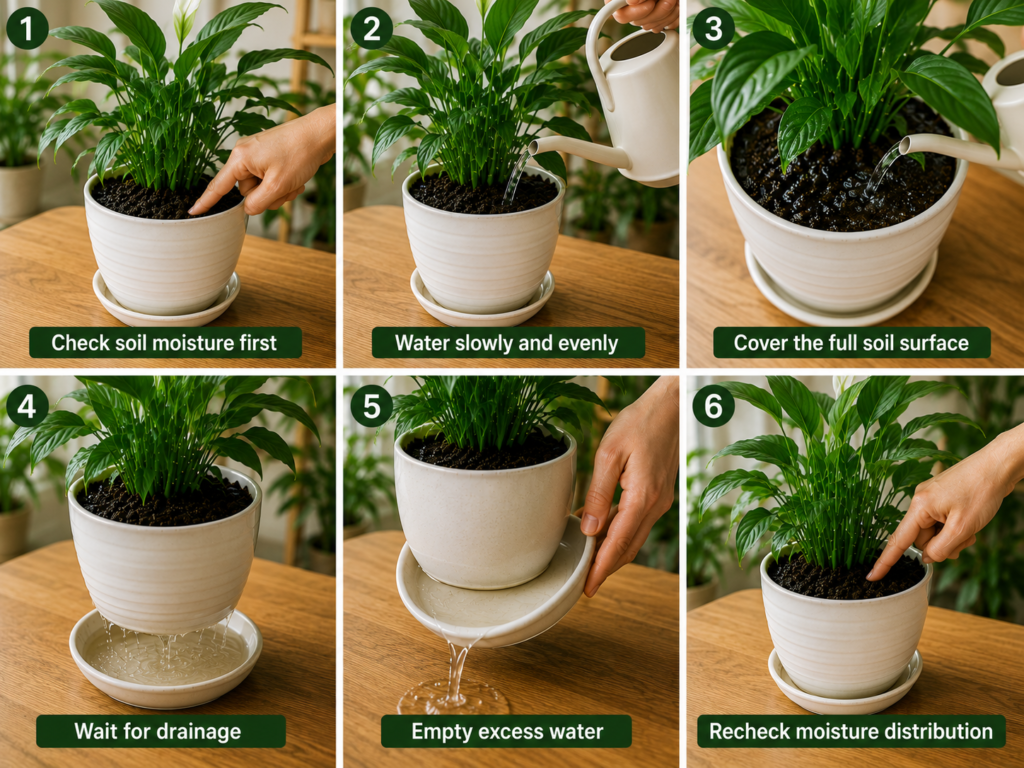
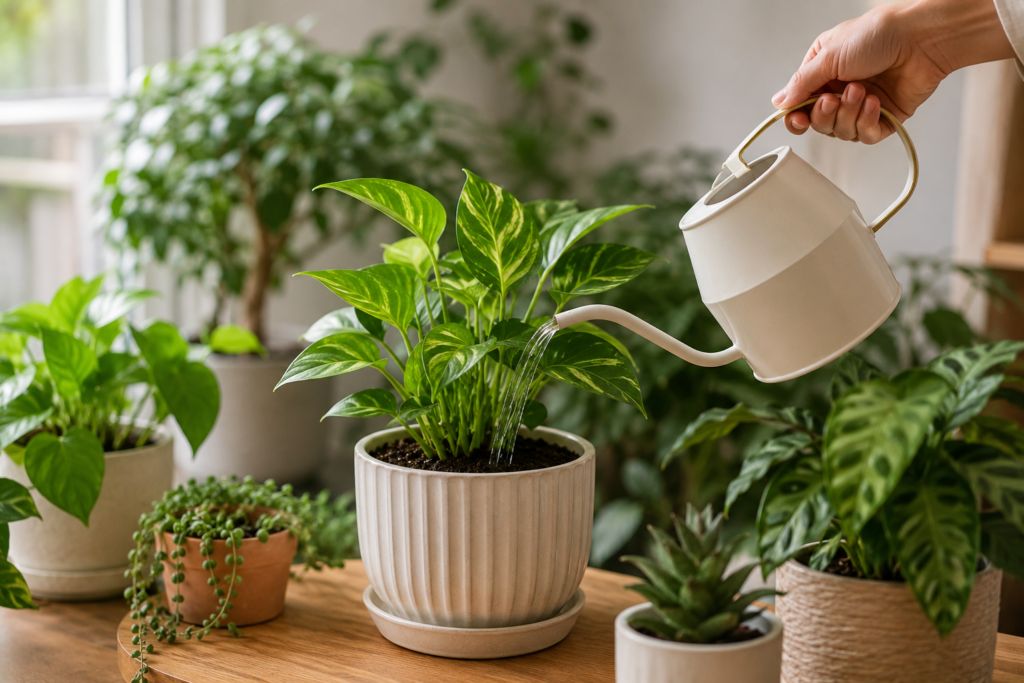
The best general watering method is slow top watering. This allows water to spread evenly through the soil and fully hydrate the root zone. Fast watering often creates channels where water runs down one side and exits the drainage hole without soaking the soil properly.
Slow watering mimics natural rainfall. It gives soil time to absorb moisture and helps roots access water evenly. After watering, excess water should never remain in saucers because standing water increases root rot risk.
Best watering process:
- Check soil moisture first
- Water slowly and evenly
- Cover the full soil surface
- Wait for drainage
- Empty excess water
- Recheck moisture distribution
Top watering works well because it:
- Flushes salts
- Encourages even root spread
- Fully saturates soil
- Supports natural root behavior
Chunky soil mixes need especially slow watering because water moves quickly through air spaces.
Decision clarity: Use top watering as your default. Use bottom watering only as support.
Why Drainage Holes Matter More Than Watering Frequency
Drainage holes control root survival because they remove excess moisture and preserve oxygen spaces inside the soil. Without drainage, water collects at the bottom of the pot and creates a hidden wet zone where roots suffocate.
Many plant owners blame watering frequency when the real issue is poor drainage. Even good watering habits fail in a pot that cannot release excess water. Decorative cachepots can also trap water under nursery pots, creating root stress while the topsoil looks dry.
Drainage protects roots by:
- Removing excess water
- Preserving oxygen pockets
- Reducing rot risk
- Preventing stagnant soil
Drainage warning signs:
- Soggy lower soil
- Bad root smell
- Yellow leaves
- Fungus gnats
- Mold growth
A healthy Epipremnum aureum can decline quickly if its nursery pot sits in trapped decorative-pot water.
Decision clarity: Drainage holes are not optional. They are part of watering itself.
Should You Bottom Water Indoor Plants?
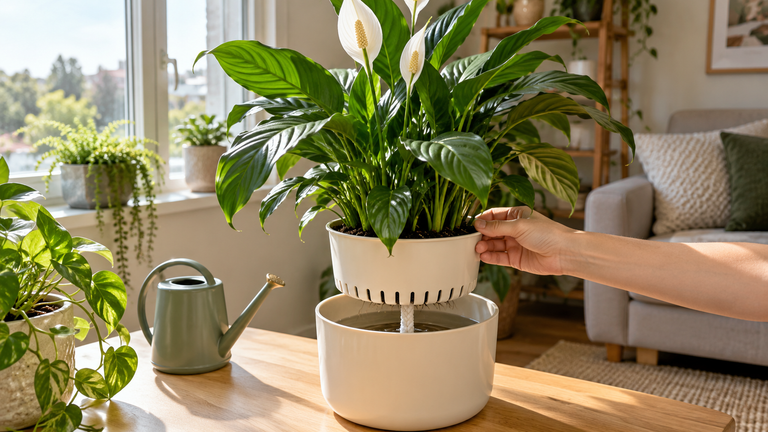
Bottom watering is useful when done correctly. It works by placing the pot in a shallow tray of water so the soil absorbs moisture upward through capillary action. This method is helpful when soil has become very dry, compact, or hydrophobic.
However, bottom watering should not fully replace top watering. Fertilizer salts and mineral residues can build up in the upper soil layers. Top watering helps flush those salts through drainage holes, while bottom watering does not.
Best situations for bottom watering:
- Hydrophobic dry soil
- Seedlings
- Young roots
- Small nursery pots
- Plants sensitive to wet crowns
Benefits of bottom watering:
- Rehydrates dry soil evenly
- Reduces soil disturbance
- Encourages deeper root pull
- Prevents splashing
A severely dried-out Spathiphyllum may repel top watering, but bottom watering can help restore even moisture.
Decision clarity: Use bottom watering strategically, not as the main system.
Does Pot Size Affect Watering Frequency?
Pot size changes watering behavior because soil volume controls moisture retention. Larger pots hold more soil, and more soil holds more water. Smaller pots dry faster because there is less soil to store moisture.
But bigger pots are not always safer. A small plant in an oversized pot cannot use all the water held by the extra soil. That unused moisture stays wet too long and increases root rot risk.
Pot size affects:
- Water retention
- Root oxygen
- Drying speed
- Moisture consistency
- Root expansion
Small pots:
- Dry faster
- Need frequent checks
- Warm up quicker
Large pots:
- Hold moisture longer
- Need slower watering
- Can increase overwatering risk
A young Monstera in a large decorative pot may stay wet for 10–14 days, while the same plant in a smaller nursery pot may dry in 5–7 days.
Decision clarity: Match pot size to root size.
How Does Soil Type Affect Watering?
Soil structure controls watering efficiency. It determines how water moves, how long it stays, and how much oxygen remains available to roots. Many watering problems are actually soil problems.
Dense soil stays wet too long. Very loose soil may dry too quickly. A good indoor plant mix balances moisture retention with drainage and airflow.
Common soil components:
- Peat moss
- Coco coir
- Perlite
- Orchid bark
- Compost
- Pumice
- Sand
Water-retentive mixes work best for:
- Ferns
- Calatheas
- Prayer plants
Fast-draining mixes work best for:
- Succulents
- Cactus
- Snake plants
A Sansevieria trifasciata in dense peat-heavy soil is more likely to rot than one in a chunky cactus mix.
Decision clarity: Before changing watering frequency, evaluate the soil.
How Does Season Affect Indoor Plant Watering?
Plants do not use water at the same rate all year. Their growth cycle changes with light, temperature, and metabolism.
In spring and summer, growth increases. Plants produce new roots, stems, and leaves. Water demand rises because transpiration and evaporation increase. In autumn and winter, growth slows, root absorption decreases, and soil stays wet longer.
Seasonal changes:
Spring
- Increased root growth
- Faster drying
- Higher water use
Summer
- Maximum transpiration
- Fast evaporation
- Frequent moisture checks
Autumn
- Slower growth
- Gradual water reduction
Winter
- Low metabolism
- Reduced watering frequency
- Higher overwatering risk
An Epipremnum aureum may need water every 5 days in summer but every 12 days in winter.
Decision clarity: Seasonal awareness prevents overwatering.
What Time of Day Is Best to Water Indoor Plants?
Morning is usually the best time to water indoor plants. It matches the plant’s active daily cycle. As daylight increases, photosynthesis begins, stomata open, and water movement becomes active.
Night watering is not always harmful, but it can keep soil cool and wet for longer, especially in winter. Since plants use less water at night, wet soil may remain saturated longer. Afternoon watering can work, but in bright heat some moisture may evaporate faster.
Best watering times:
- Early morning
- Mid-morning
- Early afternoon if needed
Less ideal:
- Late night
- Cold evenings
Morning watering supports:
- Active root absorption
- Better daytime use
- Faster recovery
A thirsty Spathiphyllum watered in the morning often regains leaf pressure faster.
Decision clarity: Morning watering is usually best.
Does Temperature and Humidity Affect Watering?
Temperature and humidity directly control how fast plants lose water. Higher temperatures increase evaporation from soil and transpiration from leaves. Low humidity speeds moisture loss from foliage.
Indoor microclimates vary. A plant near a heater, radiator, sunny window, fan, or air conditioner may dry much faster than one in a shaded or humid room.
Low humidity causes:
- Faster transpiration
- Crispy leaf edges
- Faster soil drying
High humidity causes:
- Slower water loss
- Longer soil moisture retention
- Reduced watering frequency
Temperature effects:
- Heat speeds drying
- Cool slows drying
- Warm airflow increases evaporation
A Nephrolepis exaltata near an air conditioner often dries faster than one in a humid bathroom.
Decision clarity: Watering depends on microclimate, not just plant species.
How Room Placement Changes Watering Frequency
Room placement changes watering because each room creates its own microclimate. A plant in a bathroom may experience higher humidity and slower drying, while one near a sunny window may dry faster because of stronger light and heat.
Bathrooms usually provide humid air. Kitchens may offer warmth and occasional moisture. Bedrooms are often more stable. Offices may be dry because of air conditioning.
Room placement affects:
- Light intensity
- Humidity
- Temperature
- Airflow
- Drying speed
Fast-drying areas:
- Bright windows
- Near heaters
- Near fans
- Dry offices
Slow-drying areas:
- Bathrooms
- Shaded corners
- Cool rooms
A fern in a bathroom may need less watering than the same fern in a dry office.
Decision clarity: Water according to room conditions.
What Type of Water Is Best for Indoor Plants?
Water quality matters because minerals, chlorine, fluoride, and salts can slowly affect roots, soil condition, and leaf health. Sensitive tropical plants may show brown tips or edge burn when exposed to mineral-heavy water for a long time.
Common water types:
- Tap water
- Filtered water
- Distilled water
- Rainwater
- Reverse osmosis water
Tap water is convenient and acceptable for many houseplants. Filtered water is often better for sensitive plants. Distilled water removes nearly all dissolved minerals. Rainwater is usually soft and plant-friendly when collected safely.
Best water choices:
- Room-temperature tap water for most plants
- Filtered water for sensitive species
- Rainwater when available
Plants sensitive to hard water:
- Calathea orbifolia
- Dracaena marginata
- Maranta leuconeura
Brown tips on calatheas often improve after switching from hard tap water to filtered water.
Decision clarity: If leaf tips repeatedly burn, check water quality.
Does Water Temperature Matter?
Water temperature affects roots because roots are living tissues. Very cold water can shock tropical plants and slow nutrient uptake. Very warm water can irritate roots and disturb soil microbes.
Room-temperature water is usually the safest choice. It keeps root absorption stable and avoids sudden stress, especially during winter when roots are already working more slowly.
Best practices:
- Use room-temperature water
- Avoid icy water
- Avoid hot water
Cold water risks:
- Root shock
- Slowed absorption
- Stress response
Warm water risks:
- Root irritation
- Microbial imbalance
Sensitive tropical plants such as Calathea orbifolia often respond better to stable water temperature.
Decision clarity: Water quality matters, but temperature also affects root comfort.
How to Tell If Water Quality Is Hurting Your Plant
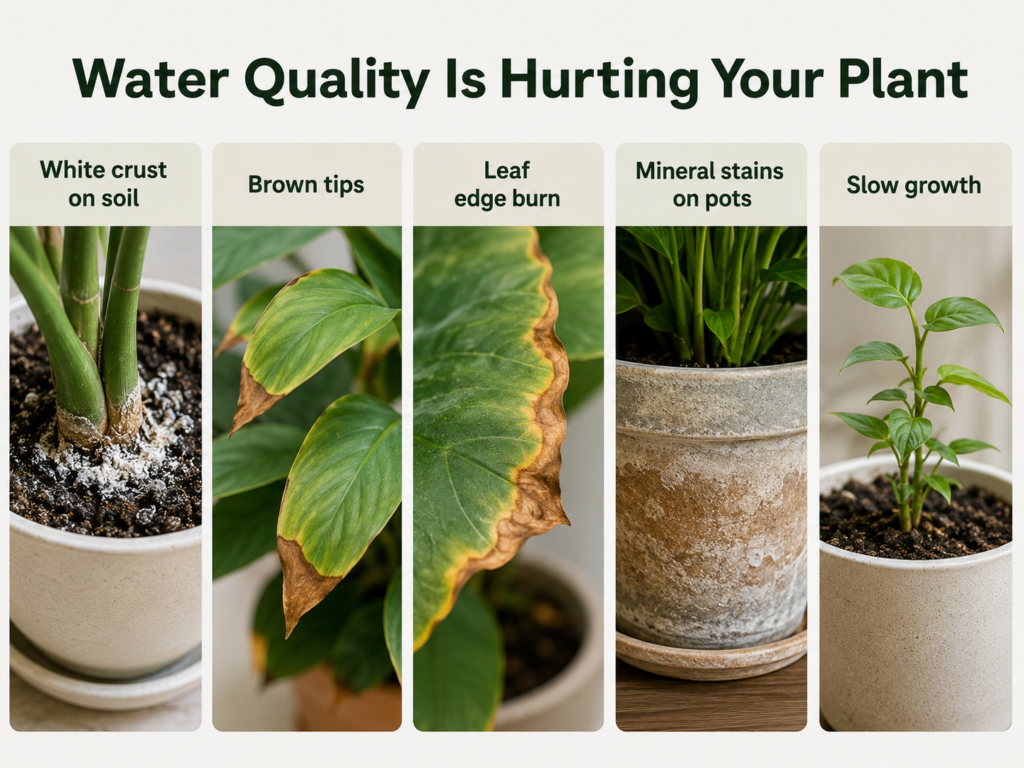
Poor water quality often creates slow symptoms. Mineral-heavy water can cause salt buildup, which affects root absorption and may create nutrient lockout.
Signs water quality may be a problem:
- White crust on soil
- Brown tips
- Leaf edge burn
- Mineral stains on pots
- Slow growth
Regular flushing can help, but changing the water source may solve the problem faster.
Decision clarity: If watering is correct but symptoms continue, investigate the water itself.
What Are the Signs of Overwatering?
Overwatering happens when roots remain wet too long and oxygen disappears from the soil. Its symptoms often look like underwatering, so many people accidentally make it worse by adding more water.
The damage usually begins below the soil before leaves show symptoms. By the time leaves yellow or stems soften, root stress may already be progressing.
Main overwatering symptoms:
- Yellow leaves
- Soft stems
- Mushy roots
- Wet heavy soil
- Bad smell
- Fungus gnats
- Leaf drop
- Mold growth
Root rot indicators:
- Brown roots
- Black roots
- Slimy root texture
A Monstera deliciosa with yellow lower leaves and wet soil for over a week often points to overwatering.
Decision clarity: Wet soil plus yellow leaves usually means wait, not water.
What Are the Signs of Underwatering?
Underwatering happens when plants lose more water than roots can replace. This causes cell pressure to drop, leaves to weaken, and growth to slow.
Plants under drought stress may curl leaves, drop lower leaves, or stop growing. Some recover quickly after watering, while others suffer if drought stress is repeated.
Main underwatering symptoms:
- Dry crispy leaves
- Brown edges
- Curling leaves
- Soil shrinking from pot walls
- Lightweight pot
- Wilting
- Slow growth
- Leaf drop
Severe dehydration signs:
- Brittle stems
- Hard dry soil
- Delayed recovery
A thirsty Spathiphyllum often droops dramatically but recovers quickly after deep watering.
Decision clarity: Dry soil plus drooping usually means hydrate deeply.
How Do Different Indoor Plants Need Different Watering?
Different plants evolved in different environments. A rainforest plant does not need the same watering pattern as a desert succulent.
Tropical plants often prefer consistent moisture with partial drying. Succulents and cactus prefer deep watering followed by full drying. Ferns usually need higher moisture consistency. Flowering plants may need more water during blooming.
Plant-specific groups:
Tropical plants
- Philodendron hederaceum
- Epipremnum aureum
- Monstera deliciosa
Succulents
- Echeveria elegans
- Haworthia fasciata
Ferns
- Nephrolepis exaltata
Flowering plants
- Anthurium andraeanum
- Spathiphyllum
A pothos may tolerate moderate dryness, while a fern may decline quickly in the same condition.
Decision clarity: Water according to plant biology.
What Tools Help Water Indoor Plants Correctly?
Watering tools reduce guesswork and improve consistency. They are especially useful for beginners or people managing multiple plants.
Useful tools:
- Moisture meter
- Narrow-spout watering can
- Drainage tray
- Humidity meter
- Smart soil sensor
- Self-watering pot
- Plant journal
Best beginner tools:
- Moisture meter
- Watering can
- Humidity meter
| Tool | Accuracy | Best For |
|---|---|---|
| Finger test | Medium | Small pots |
| Moisture meter | High | Beginners |
| Pot weight method | High | Experienced growers |
| Wooden skewer | Medium | Deep pots |
| Humidity meter | Medium | Tropical plants |
| Smart soil sensor | Very High | Large collections |
A moisture meter often prevents overwatering in large floor plants where finger testing is unreliable.
Decision clarity: Tools support observation; they do not replace it.
Common Indoor Plant Watering Mistakes to Avoid
Most watering failures come from habits. Watering on schedule is the biggest mistake because plants respond to changing conditions, not fixed days.
Common mistakes:
- Watering on schedule
- Ignoring soil moisture
- Using pots without drainage
- Watering too lightly
- Leaving water in saucers
- Ignoring seasonal changes
- Ignoring humidity
- Using cold water
A plant watered every Sunday may rot in winter because its drying speed changed.
Decision clarity: Build watering habits around observation, not routine.
How to Recover an Overwatered or Underwatered Plant
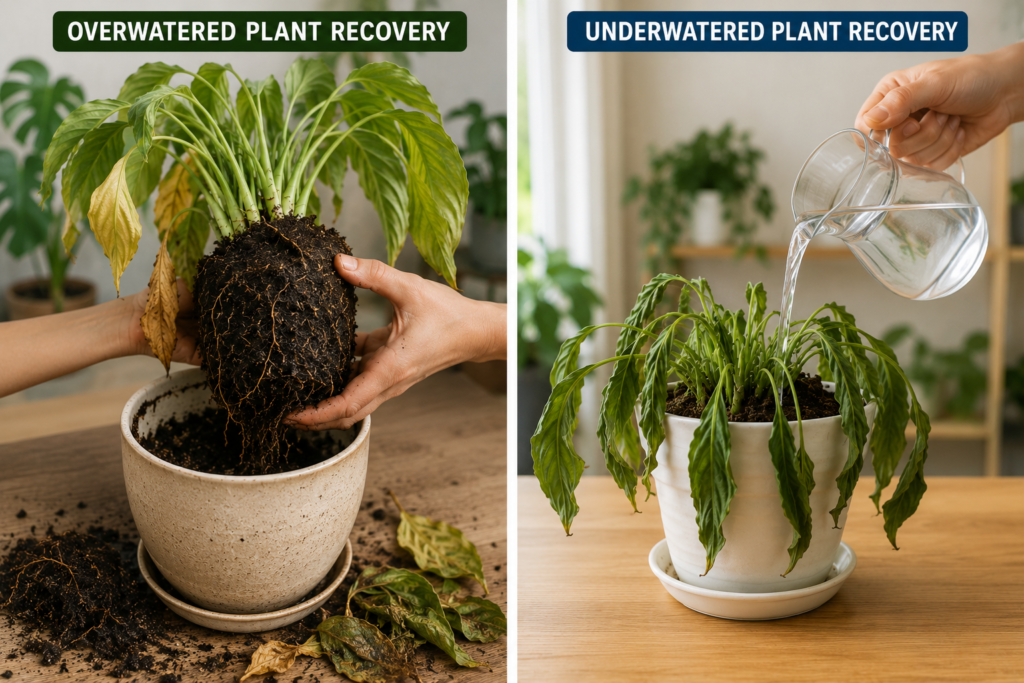
Recovery depends on correct diagnosis. Overwatered plants need oxygen restoration. Underwatered plants need moisture restoration.
Overwatering recovery:
- Stop watering
- Remove wet soil if severe
- Inspect roots
- Trim rotten roots
- Repot into fresh soil
- Improve drainage
Underwatering recovery:
- Deep soak the root zone
- Rehydrate dry compact soil
- Remove dead leaves
- Stabilize temperature
- Increase monitoring
A root-bound pothos may recover from underwatering within 24 hours, while overwatering recovery may take weeks.
Decision clarity: Diagnose first. Recovery depends on accuracy.
How Long Does Recovery Take?
Recovery time depends on stress type, root damage, and plant species. Mild underwatering often recovers quickly because roots are still functional. Overwatering usually takes longer because oxygen loss weakens roots.
Typical recovery timelines:
- Mild thirst: 1–3 days
- Moderate dehydration: 3–7 days
- Mild overwatering: 1–2 weeks
- Root rot recovery: 2–8 weeks
Recovery factors:
- Root health
- Temperature
- Humidity
- Light quality
A dehydrated Spathiphyllum may recover within a day, while a root-rot pothos may need weeks.
Decision clarity: Recovery speed depends on root condition, not leaf appearance alone.
How Should You Water a Plant After Repotting?
Repotting changes root stability and soil behavior. Even careful repotting can disturb roots. The first watering helps settle soil around roots and remove air gaps.
The first watering after repotting should be deep and thorough. After that, watering should be controlled because disturbed roots may absorb moisture differently.
Post-repot watering tips:
- Water deeply once
- Ensure drainage works
- Monitor drying speed
- Reduce frequency initially
Watch for:
- Transplant droop
- Slow recovery
- Uneven drying
A repotted Philodendron hederaceum often needs one full soak, then careful monitoring.
Decision clarity: First watering should settle roots, not drown them.
Final Watering Checklist for Indoor Plants
A checklist prevents emotional watering and creates a repeatable system. Instead of watering because a plant “looks thirsty,” check the conditions first.
Before watering, check:
- Soil moisture
- Pot weight
- Leaf condition
- Drainage
- Temperature
- Humidity
- Season
- Plant type
- Pot size
- Soil condition
After watering:
- Empty saucers
- Check recovery
- Monitor drying speed
Experienced plant owners often follow this process mentally. Beginners benefit from writing it down.
Decision clarity: Systems create consistency. Consistency creates healthy plants.
FAQ Section
How do I know if my indoor plant needs water?
Check the soil 1–2 inches deep. If it feels dry, it is usually time to water.
How often should indoor plants be watered?
It depends on plant type, soil, pot size, season, and room conditions.
Can overwatering and underwatering look the same?
Yes. Both can cause yellow leaves and drooping. Soil moisture tells the difference.
Should I water indoor plants from the top or bottom?
Top watering is best for regular care. Bottom watering helps very dry soil rehydrate.
Why is my plant drooping after watering?
It may be root stress, overwatering, or transplant shock. Check soil and roots.
Does pot size affect watering frequency?
Yes. Small pots dry faster, while large pots hold moisture longer.
Is tap water safe for indoor plants?
Most plants tolerate tap water. Sensitive plants may prefer filtered or rainwater.
What is the best time of day to water indoor plants?
Morning is best because plants use water actively during daylight.
Can root rot be reversed?
Yes, if caught early. Remove rotten roots, repot, and improve drainage.
What is the biggest watering mistake?
Watering on a schedule instead of checking soil moisture first.
Myra is the founder and lead writer of Plantsaholic. She shares practical, research-backed advice on indoor plants, outdoor gardening, flowers, herbs, succulents, and everyday plant care. Her goal is to help gardeners of all experience levels grow healthier plants through simple, easy-to-follow gardening guides.