Indoor plant success depends heavily on light. Many plant owners focus on watering first, but light is the true foundation of plant health. Water supports life, but light powers it.
Without enough light, plants cannot perform Photosynthesis efficiently. That means weaker roots, smaller leaves, slower growth, poor recovery, and reduced flowering.
A plant can survive in low light for months, which often creates a false sense of success. But survival is not the same as healthy growth.
Healthy indoor plants need enough usable light energy every day to sustain growth and maintain metabolism.
Light affects:
- energy production
- watering needs
- nutrient absorption
- leaf production
- root strength
- flowering
- structural stability
Understanding light helps you make smarter decisions about plant placement, species selection, seasonal care, and grow-light support.
This guide breaks indoor plant lighting into practical, usable strategies.
What Does Plant Light Requirement Actually Mean?
A plant’s light requirement is the amount of usable light it needs daily to support healthy biological activity.
Most people think light requirement means simple labels like:
- low light
- medium light
- bright light
But light requirement is more complex.
It depends on:
- intensity
- duration
- consistency
- plant species
- leaf structure
- chlorophyll levels
A plant in weak light for 12 hours may still receive less usable energy than one in strong light for 5 hours.
That’s why light quality matters just as much as light duration.
Different plants evolved in different environments.
For example:
Monstera deliciosa evolved under tropical forest canopies where filtered bright light dominates.
Dracaena trifasciata evolved in tougher, drier environments and can tolerate lower light.
But tolerate does not mean prefer.
This is one of the biggest plant-care misunderstandings.
Low-light plants can survive lower light.
They usually grow better in better light.
Signs a plant’s light requirement is being met:
- regular new growth
- stable leaf size
- rich green color
- compact growth
- stronger stems
Light requirement should be judged by growth quality.
Not survival.
Why Do Plants Need Light?
Plants need light because light fuels Photosynthesis.
Photosynthesis converts:
light + water + carbon dioxide = glucose
Glucose is plant fuel.
That fuel supports:
- leaf production
- root expansion
- repair
- flowering
- nutrient movement
- structural development
Without enough light, plants cannot create enough energy.
Everything slows.
This causes:
- slow growth
- pale leaves
- smaller foliage
- weak stems
- root weakness
Light also affects how plants use water.
If a plant has low light:
- metabolism slows
- water use slows
- soil stays wet longer
That is why overwatering often happens in low-light conditions.
The plant cannot process water fast enough.
Real-world example:
Spathiphyllum in medium light often flowers.
The same plant in low light may survive but stop flowering.
That is not success.
That is energy conservation.
Light is the fuel source behind all visible plant behavior.
How Many Hours of Light Do Indoor Plants Need?
Most indoor plants need between 6–14 hours of usable light daily.
The exact amount depends on plant type.
General guide:
Low-light plants
6–8 hours
Examples:
- Zamioculcas zamiifolia
- Dracaena trifasciata
Medium-light plants
8–12 hours
Examples:
- Epipremnum aureum
- Philodendron hederaceum
Bright-light plants
12–14 hours
Examples:
- Codiaeum variegatum
- Strelitzia nicolai
Flowering plants
12–16 hours
Flowering requires more energy.
That means more light.
Important:
Plants also need darkness.
Dark periods help:
- hormone regulation
- tissue repair
- energy balancing
Running grow lights 24/7 creates stress.
Consistency matters more than excess.
How Light Affects Watering Frequency
Light and watering are directly connected.
Higher light = faster water use.
Lower light = slower water use.
This happens because stronger light increases:
- photosynthesis
- evaporation
- transpiration
- root activity
Higher light means:
- soil dries faster
- roots work harder
- leaves release more moisture
Lower light means:
- soil stays wet longer
- roots absorb less
- plant growth slows
Example:
A Spathiphyllum in bright light may need water every 5–7 days.
The same plant in lower light may need water every 10–14 days.
This is why watering schedules fail.
Watering should follow environmental conditions.
Not the calendar.
Quick check before watering:
- Has light changed?
- Did weather change?
- Did seasons shift?
- Did you move the plant?
Light controls water rhythm.
Always remember that.
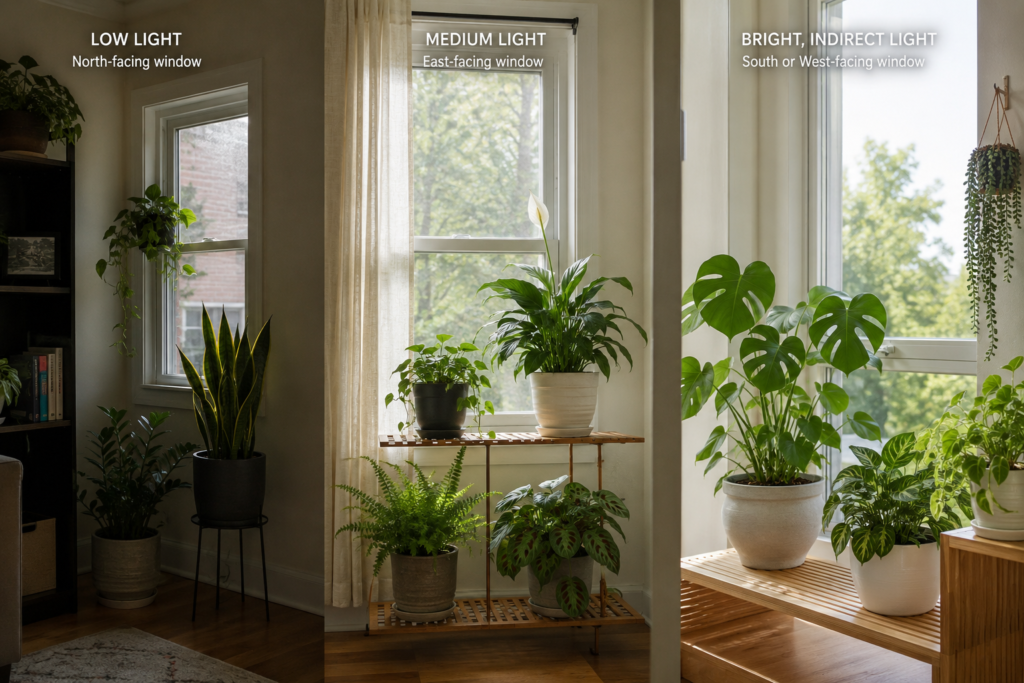
Low Light vs Medium Light vs Bright Indirect Light
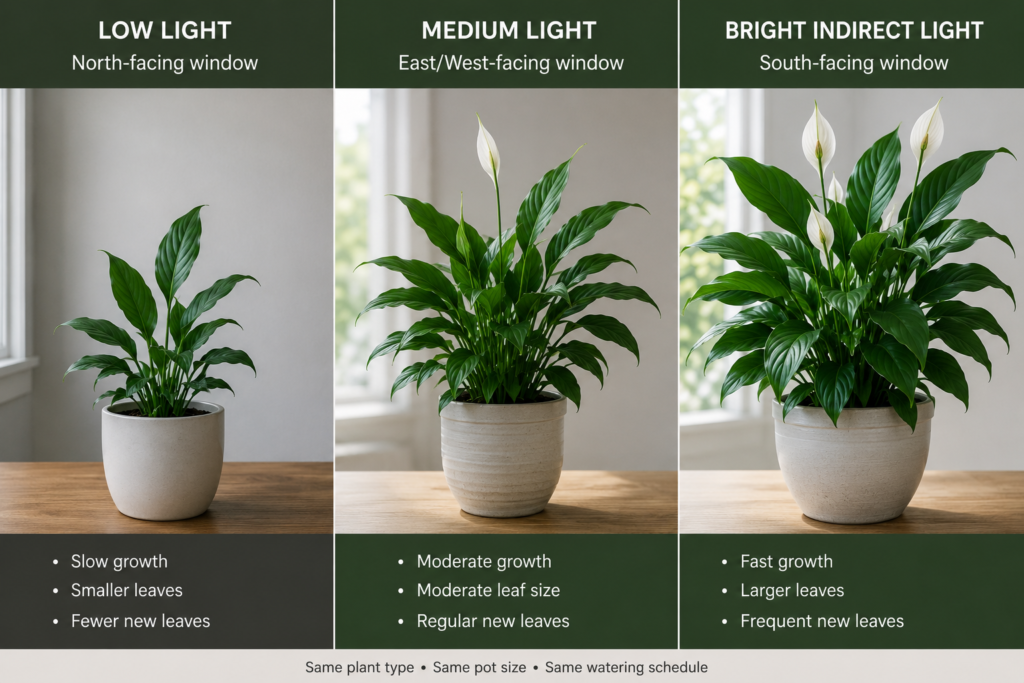
These are intensity categories.
Not decoration terms.
Low Light
Low light means usable daylight, but weaker energy.
Examples:
- north-facing rooms
- shaded corners near windows
- rooms with indirect ambient light
Best plants:
- Zamioculcas zamiifolia
- Dracaena trifasciata
Effects:
- slower growth
- lower water demand
- smaller leaves
Low light is not darkness.
Dark corners are usually too dark.
Medium Light
Medium light means stable brightness without harsh direct exposure.
Examples:
- east-facing windows
- filtered bright rooms
Best plants:
- Chlorophytum comosum
- Epipremnum aureum
Benefits:
- stable growth
- balanced watering
- strong foliage
Bright Indirect Light
Bright indirect light means strong brightness without direct sun hitting leaves.
This is the ideal zone for many tropical plants.
Examples:
- south-facing window with sheer curtain
- bright east-facing room
Best plants:
- Monstera deliciosa
- Ficus lyrata
Benefits:
- bigger leaves
- faster growth
- better variegation
- stronger stems
Important:
The same room can contain all three light levels.
Distance changes everything.
Move a plant 3 feet away from a window and usable light drops significantly.
Placement precision matters.
How Window Direction Changes Plant Light
Window direction changes light intensity, heat, and duration.
This affects plant growth directly.
North-facing windows
Weakest and most stable light.
Best for:
- Dracaena trifasciata
- Zamioculcas zamiifolia
Pros:
- low burn risk
- stable light
Cons:
- slower growth
East-facing windows
Gentle morning light.
Best beginner option.
Best for:
- Monstera deliciosa
- Epipremnum aureum
Benefits:
- softer sun
- lower heat
- strong usable light
South-facing windows
Strongest exposure.
Best for:
- Ficus lyrata
- Strelitzia nicolai
Benefits:
- strongest growth
- longer light duration
Risk:
- burn if unfiltered
West-facing windows
Strong afternoon sun.
Higher heat.
Works for tougher plants but may stress sensitive tropicals.
East-facing windows are often safest.
Best balance of strength and safety.
How Far Should Indoor Plants Be from a Window?
Distance from a window changes usable light more than most people realize.
A plant sitting one foot from a window can receive several times more usable light than the same plant placed five feet away.
This happens because light intensity drops fast as distance increases.
That means window direction alone is not enough.
Distance matters too.
A south-facing window may provide excellent light, but if your plant is placed too far back, much of that advantage disappears.
This is why many people say:
“My room is bright, but my plant is struggling.”
The room may be bright for humans.
But not for plants.
Best distance guide:
0–1 feet from the window
Best for high-light plants.
Examples:
- Strelitzia nicolai
- Codiaeum variegatum
- succulents
Benefits:
- stronger growth
- faster drying
- better flowering
Watch for direct sun burn.
2–4 feet from the window
Ideal for most tropical plants.
Examples:
- Monstera deliciosa
- Epipremnum aureum
- Philodendron hederaceum
Benefits:
- balanced light
- lower stress
- stable growth
5+ feet from the window
Only suitable for low-light tolerant plants.
Examples:
- Dracaena trifasciata
- Zamioculcas zamiifolia
Important:
Measure distance from leaf height.
Not window height.
That is where light matters.
How to Measure Light for Indoor Plants
Visual guessing is unreliable.
Human eyes adjust brightness automatically.
Plants do not.
A room that feels bright may still be too dim for healthy plant growth.
The best way to measure light:
Light meter
A light meter measures brightness in lux.
General plant ranges:
Low light:
500–2,500 lux
Medium light:
2,500–10,000 lux
Bright indirect light:
10,000–20,000 lux
Direct light:
20,000+ lux
Light meters are simple and affordable.
Good for:
- beginners
- plant shelves
- placement testing
PAR meter
A PAR meter measures plant-usable light.
Photosynthetically Active Radiation
This is more accurate than lux.
Best for:
- rare plants
- propagation
- grow-light setups
Shadow test
No tools?
Use shadows.
Sharp shadow = bright light
Soft shadow = medium light
Weak shadow = low light
No shadow = very poor light
Always measure at plant level.
Not near the glass.
That changes everything.
Best Light for Popular Indoor Plants
Different species evolved differently.
That means different light preferences.
Generic advice often fails.
Here’s the practical guide.
Epipremnum aureum
Best light:
medium to bright indirect light
Can tolerate low light.
Best results in brighter areas.
Better light gives:
- bigger leaves
- faster vines
- stronger color
Monstera deliciosa
Best light:
bright indirect light
Needs stronger light for mature fenestrations.
Low light causes:
- smaller leaves
- delayed splits
- slower growth
Dracaena trifasciata
Best light:
medium light
Can tolerate low light.
But growth improves with stronger light.
Ficus lyrata
Best light:
bright indirect light
Needs stable positioning.
Does not like sudden relocation.
Best near strong windows.
Spathiphyllum
Best light:
medium indirect light
Tolerates low light.
Flowers better with stronger light.
Best practice:
Check your room first.
Buy the plant second.
Not the other way around.
How Different Plant Categories Need Different Light
Grouping plants by category makes plant care easier.
Plants in the same group often share light behavior.
Tropical foliage plants
Best light:
medium to bright indirect light
Examples:
- Monstera deliciosa
- Philodendron hederaceum
These evolved under forest canopies.
They prefer filtered brightness.
Succulents
Best light:
bright direct or strong indirect light
Examples:
- Aloe vera
- Echeveria
These evolved in exposed sunlight.
Weak light causes stretching.
Flowering houseplants
Best light:
bright indirect to direct light
Examples:
- Phalaenopsis
- Saintpaulia
Flowering needs higher energy.
That means stronger light.
Herbs
Best light:
strong bright light
Examples:
- Ocimum basilicum
- Mentha
Fast growth means high energy demand.
Categories simplify plant decisions.
Do Variegated Plants Need More Light?
Yes.
Variegated plants usually need more light.
Why?
Because variegation means less chlorophyll.
Less chlorophyll means less energy production.
That means the plant must work harder.
Common variegated plants:
- variegated Epipremnum aureum
- variegated Monstera deliciosa
- variegated Philodendron hederaceum
Signs they need more light:
- fading patterns
- greener new growth
- smaller leaves
- slower growth
- stretching
Best placement:
- bright indirect light
- east-facing windows
- filtered south-facing windows
Real-world example:
A variegated pothos in low light often turns greener over time.
That is adaptation.
Not random.
The plant is trying to survive.
Variegated plants are less forgiving.
Light quality matters more.
Signs Your Plant Needs More Light
Plants usually show low-light stress before major decline.
Learning these signals helps prevent problems.
Leggy growth
Long spaces between leaves.
This means the plant is stretching.
Common in:
- Epipremnum aureum
- Philodendron hederaceum
This is a strong warning sign.
Smaller new leaves
If new leaves are smaller than older ones:
energy production is dropping.
That usually means low light.
Leaning toward the window
Plants grow toward stronger light.
This is called Phototropism.
Leaning means the plant wants more.
Rotation helps.
Better light solves it.
Slow growth
During spring or summer:
slow growth often means insufficient light.
Especially if:
- roots are healthy
- watering is correct
- temperature is stable
Light becomes the likely issue.
Pale leaves
Weak light reduces chlorophyll efficiency.
Leaves may become lighter.
Less vibrant.
Leaf drop
Older leaves may drop first.
This is energy-saving behavior.
Common in:
- Ficus lyrata
- Ficus elastica
Quick light check:
- too far from window?
- changed seasons?
- curtains blocking light?
- furniture blocking exposure?
Do not fertilize first.
Check light first.
Signs Your Plant Is Getting Too Much Light
Low light is common indoors, but too much light can also cause damage.
This usually happens when plants receive harsh direct sun for too long, especially through glass.
Glass can intensify heat and create stronger exposure.
That becomes stressful for many tropical plants.
Especially forest-origin species.
Watch for these signs:
Leaf burn
Brown, dry patches on leaves.
Usually where sun hits directly.
Common in:
- Spathiphyllum
- Calathea orbifolia
This is one of the clearest signs.
Bleached leaves
Leaves lose color.
They look faded.
This means pigments are breaking down.
Too much exposure causes this.
Crispy edges
Strong light increases water loss.
If roots cannot keep up, edges dry first.
Very common symptom.
Curling leaves
A plant defense response.
Curling reduces surface exposure.
It helps reduce moisture loss.
Heat stress
Leaves may feel warm or hot.
Especially near west-facing windows.
Real-world example:
A fern placed against an uncovered south-facing window can develop brown edges quickly.
Quick fixes:
- move the plant back
- use sheer curtains
- reduce afternoon sun
- reposition seasonally
More light is not always better.
Correct light is better.
How Seasonal Changes Affect Plant Light
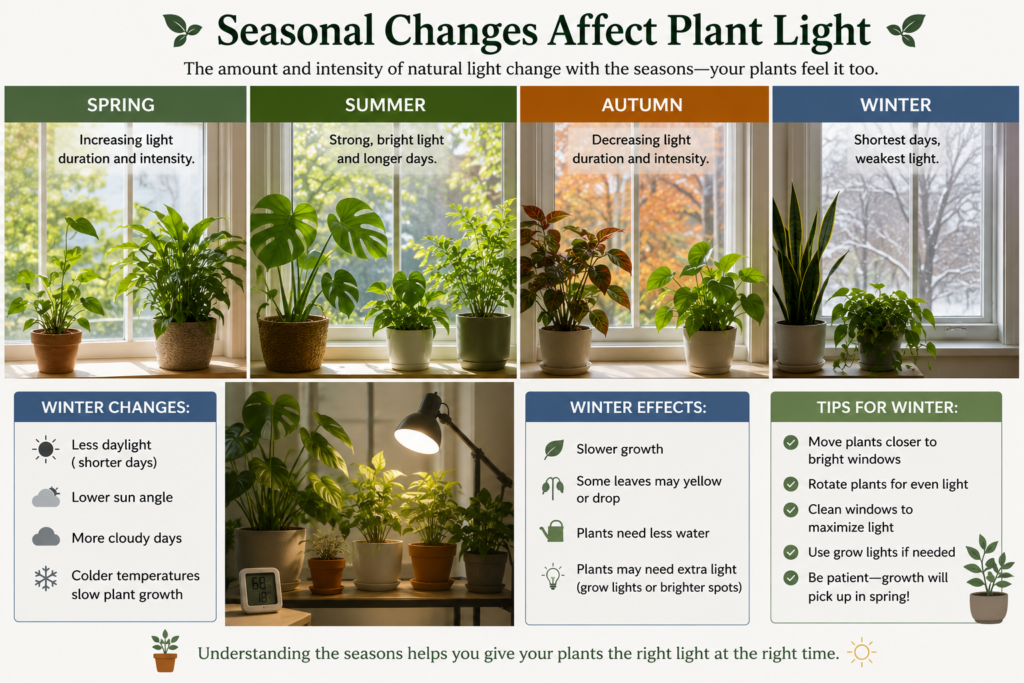
Light changes through the year.
Even if the plant stays in the same place.
This is one of the most ignored parts of indoor plant care.
Winter changes:
- shorter days
- weaker sunlight
- lower angle of light
- less energy
That means less usable light.
Plants respond immediately.
Winter effects:
- slower growth
- less water use
- lower nutrient demand
- smaller new growth
Seasonal adjustments help.
Move plants closer in winter
Winter light is weaker.
Plants often benefit from being closer to windows.
Watch cold drafts.
Add grow lights
Great for:
- apartments
- cloudy weather
- deep rooms
Grow lights stabilize winter care.
Adjust watering
Lower light means lower water use.
Keep summer watering in winter and root rot becomes more likely.
Clean windows
Dust reduces usable light.
Simple fix.
Big impact.
Real-world example:
Monstera deliciosa may grow aggressively in summer and pause in winter.
That is normal.
Plants follow available energy.
Care should adapt.
Can Grow Lights Replace Sunlight?
Yes.
Good grow lights can fully replace natural sunlight for many indoor plants.
This is especially useful in homes with poor light.
Modern LED systems are powerful.
They support:
- leaf growth
- root development
- flowering
- propagation
Three factors matter most.
Spectrum
Full-spectrum lights are best.
They imitate sunlight better.
They support complete growth.
Duration
Most indoor plants need:
8–14 hours daily.
Timers help.
Consistency improves results.
Distance
Too far weakens effectiveness.
Best range:
8–18 inches.
Depends on strength.
Real-world example:
A Epipremnum aureum under proper LED lighting in an office often grows better than one in weak natural light.
Artificial light is no longer second-best.
It is a practical solution.
Can Grow Lights Burn Plants?
Yes.
Grow lights can stress plants if misused.
Especially strong LEDs.
Common symptoms:
- bleaching
- crispy edges
- faded color
- curled leaves
- dry spots
Sensitive plants:
- Calathea orbifolia
- fern
- Spathiphyllum
Prevention:
- maintain distance
- use timers
- monitor heat
- raise gradually
Typical safe range:
8–18 inches
Real-world example:
A strong LED placed 4 inches above a calathea may bleach leaves within days.
Grow lights work.
But setup matters.
Best Grow-Light Setup for Indoor Plants
A successful grow-light system is simple:
light + distance + timer + plant match
That is the formula.
Best practical setups:
Shelf setup
Best for plant collections.
Use:
- full-spectrum LED
- adjustable height
- timer
Best for:
- Philodendron hederaceum
- Epipremnum aureum
- Chlorophytum comosum
Window + supplemental light
Best hybrid method.
Natural by day.
LED support later.
Great in winter.
Dedicated plant corner
Best for dark homes.
Use:
- standing grow lights
- grouped plants
- reflective walls
Improves efficiency.
Best practices:
- monitor leaves
- adjust distance
- avoid overheating
- maintain routine
Good lighting reduces plant loss.
That saves money.
Natural Light vs Grow Lights
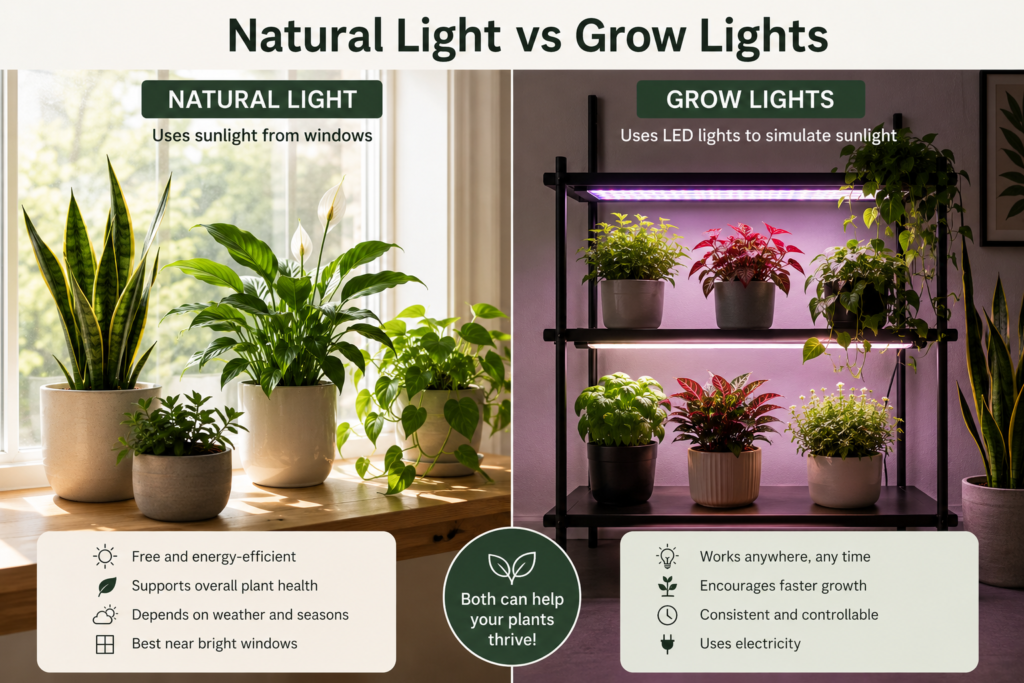
Both can grow healthy plants.
Each has advantages.
Natural light:
Pros:
- free
- powerful
- broad spectrum
Cons:
- seasonal
- inconsistent
- weather-dependent
Grow lights:
Pros:
- stable
- controlled
- predictable
Cons:
- setup cost
- electricity
Best for natural light:
window-rich homes
Best for grow lights:
dark rooms
offices
winter care
Best system?
Hybrid.
Natural light + artificial support.
That creates the strongest consistency.
Best Room-by-Room Plant Placement
Every room behaves differently.
Light changes room by room.
Plant placement should follow light.
Not decoration.
Living room
Usually brightest.
Best for:
- Monstera deliciosa
- Ficus elastica
- Strelitzia nicolai
Best near:
- east-facing windows
- filtered south windows
Bedroom
Usually softer light.
Best for:
- Dracaena trifasciata
- Epipremnum aureum
- Spathiphyllum
Kitchen
Often bright and humid.
Best for:
- Ocimum basilicum
- herbs
- spider plants
Avoid heat-heavy zones.
Bathroom
Humidity helps.
But light still matters.
Best for:
- fern
- Calathea orbifolia
No window?
Use grow lights.
Light first. Style second. Always.
Biggest Indoor Plant Light Myths
Plant care myths create bad decisions.
Here are the biggest ones.
Myth 1: Low-light plants need almost no light
False.
Low-light plants still need usable light.
They just need less.
Examples:
- Zamioculcas zamiifolia
- Dracaena trifasciata
They grow better in brighter conditions.
Myth 2: Any window is enough
False.
Window direction matters.
Distance matters.
Season matters.
Not all windows are equal.
Myth 3: More light is always better
False.
Too much light burns plants.
Especially tropical shade plants.
Examples:
- Calathea orbifolia
- fern
Myth 4: Grow lights are inferior
False.
Modern LED grow lights are highly effective.
Sometimes better than weak natural light.
Understanding these myths improves plant success fast.
Can Plants Survive in Dark Rooms?
Only with artificial light.
Dark rooms lack enough energy for Photosynthesis.
Without light:
- growth slows
- stems stretch
- leaves shrink
- energy drops
Dark spaces include:
- hallways
- offices
- interior apartments
Best solutions:
Use grow lights
Most effective.
Best long-term answer.
Rotate plants
Temporary support.
Not permanent.
Choose tolerant species
Best examples:
- Dracaena trifasciata
- Zamioculcas zamiifolia
Even these still need light.
Dark rooms are grow-light zones.
That is the honest truth.
Final Verdict: How Much Light Do Indoor Plants Really Need?
Indoor plants need enough usable light to meet their energy needs.
That amount depends on:
- species
- placement
- season
- environment
But most healthy indoor plants perform best with:
- 6–12 hours of usable light
- stable light schedules
- correct placement
- seasonal adjustments
- artificial support when needed
The goal is not maximum light.
It is correct light.
When light is correct:
- watering becomes easier
- growth becomes stronger
- roots become healthier
- leaves become fuller
- plant stress decreases
Light is the foundation of indoor plant care.
Everything else depends on it.
Master light first.
Plant care becomes easier after that.
FAQ Section
How much light do indoor plants need daily?
Most indoor plants need 6–12 hours of usable light daily. High-light or flowering plants may need more.
What is bright indirect light?
Bright indirect light is strong natural brightness without direct sunlight touching leaves.
Is window light enough for indoor plants?
Sometimes. It depends on direction, distance, and season.
Can grow lights replace sunlight?
Yes. High-quality LED grow lights can fully support plant growth.
Why is my plant stretching?
Stretching usually means low light. The plant is reaching for stronger energy.
Do plants need darkness?
Yes. Darkness helps hormone balance and recovery.
Can too much light hurt indoor plants?
Yes. Too much direct sun can burn leaves and increase stress.
Do variegated plants need more light?
Yes. They have less chlorophyll and need brighter conditions to maintain color.
Should I move plants in winter?
Usually yes. Winter light weakens, so closer placement or grow-light support helps.
Myra is the founder and lead writer of Plantsaholic. She shares practical, research-backed advice on indoor plants, outdoor gardening, flowers, herbs, succulents, and everyday plant care. Her goal is to help gardeners of all experience levels grow healthier plants through simple, easy-to-follow gardening guides.