The best way to clean indoor plant leaves is to use lukewarm water and a soft microfiber cloth for smooth foliage, a gentle rinse for plants with many small leaves, and a soft brush for fuzzy leaves. Avoid routinely using milk, vinegar, oils, dish soap, or leaf-shine products. If residue keeps returning, identify the cause before trying anything stronger.
Indoor plant leaves naturally collect dust, pet hair, fibers, cooking residue, mineral deposits, and other particles. Cleaning helps restore their natural appearance and gives you a chance to inspect the plant for pests or damage.
The important part is knowing that not everything visible on a leaf should be wiped away. Loose dust, white mineral deposits, sticky honeydew, natural wax, pests, and damaged tissue can look similar but need different responses.
Use this simple Plantsaholic rule:
Observe → Classify → Clean → Recheck → Escalate only when necessary.
What’s on Your Plant Leaves?
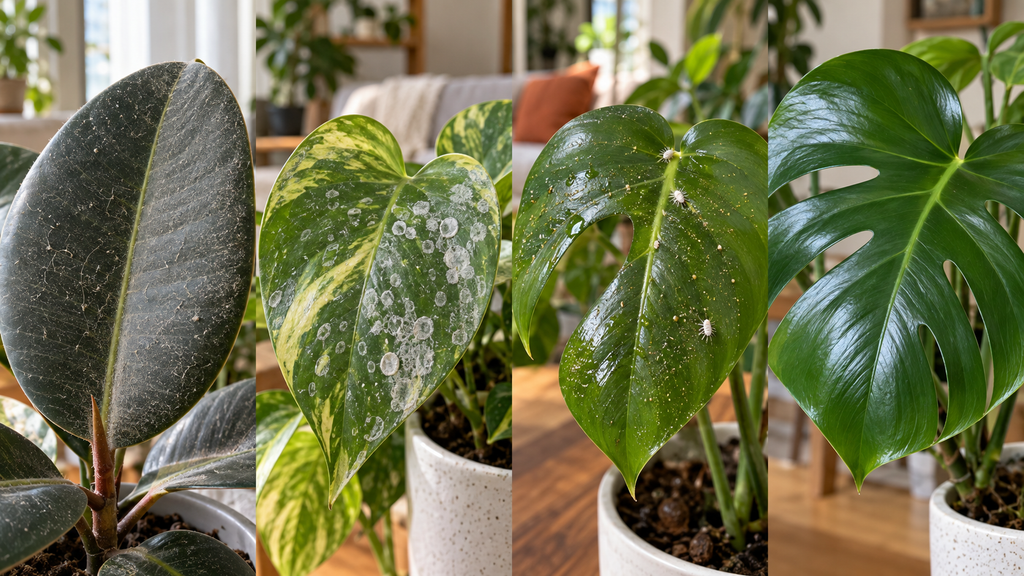
Before choosing a cleaner, determine what you are actually seeing.
Ordinary dust usually forms a loose gray film that transfers onto a damp cloth. Mineral residue may appear as pale rings or chalky marks where water droplets have dried. Sticky leaves can result from plant sap or honeydew from sap-feeding pests. Brown, yellow, or bleached areas are usually changes within the leaf and cannot be cleaned away.
Use three questions:
- Transfer: Does the material come off onto a damp cloth?
- Return: Does it come back soon after cleaning?
- Pattern: Is it random dust, dried droplets, sticky residue, attached insects, or discoloration within the tissue?
A loose gray film usually means dust.
Chalky rings suggest mineral residue.
Sticky material that quickly returns may point to pests.
Cotton-like clusters, shell-like bumps, or fine webbing should be treated as possible pest signs.
Brown or yellow areas that do not transfer should be diagnosed rather than scrubbed.
A uniform powdery coating on certain succulents may be natural wax and should not automatically be removed.
The most important decision is knowing when the problem is actually a cleaning issue.
How to Clean Indoor Plant Leaves
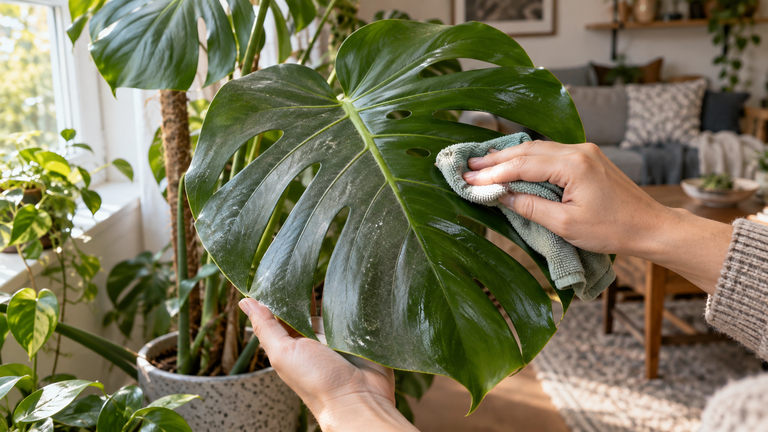
For most smooth-leaved houseplants, use a soft microfiber or lint-free cloth dampened with lukewarm water.
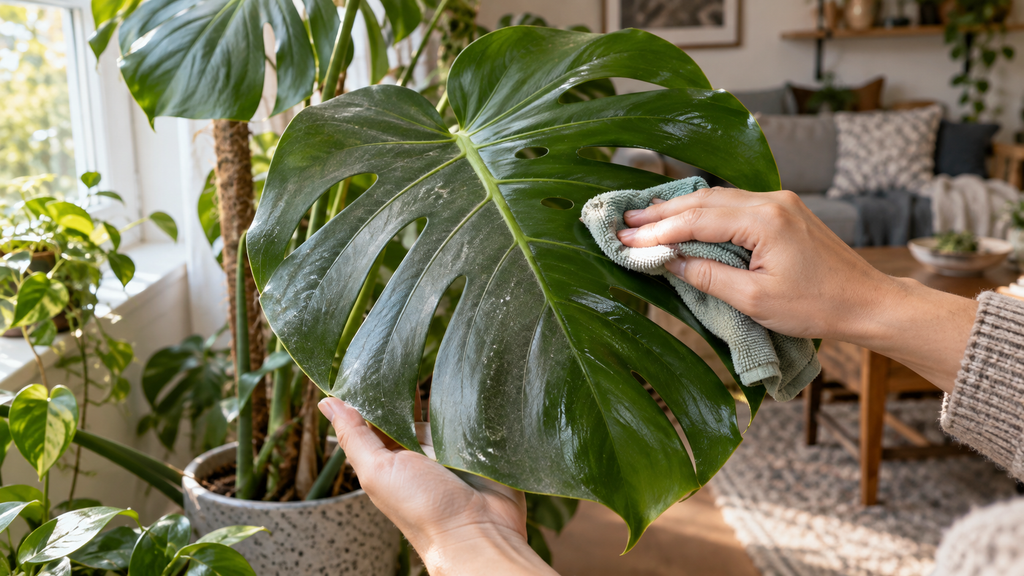
Support the leaf from underneath with one hand and wipe gently from the base toward the tip. Avoid squeezing, folding, or aggressively rubbing the leaf.
Clean the underside when practical because pests often hide around veins, leaf joints, and lower surfaces.
Use the method that matches the foliage:
- Broad smooth leaves: damp cloth.
- Many small leaves: gentle rinse.
- Thin leaves: light pressure and good support.
- Fuzzy leaves: soft brush.
- Naturally glossy leaves: water is usually enough.
- Powdery or wax-coated leaves: identify the coating first.
- Visible pests: move from cleaning to diagnosis.
- Permanent discoloration: do not scrub.
The safest rule is simple:
If plain water solves the problem, stop there.
Stronger household mixtures are unnecessary for ordinary dust and may leave residue or damage delicate leaf surfaces.
Choose the Right Cleaning Method
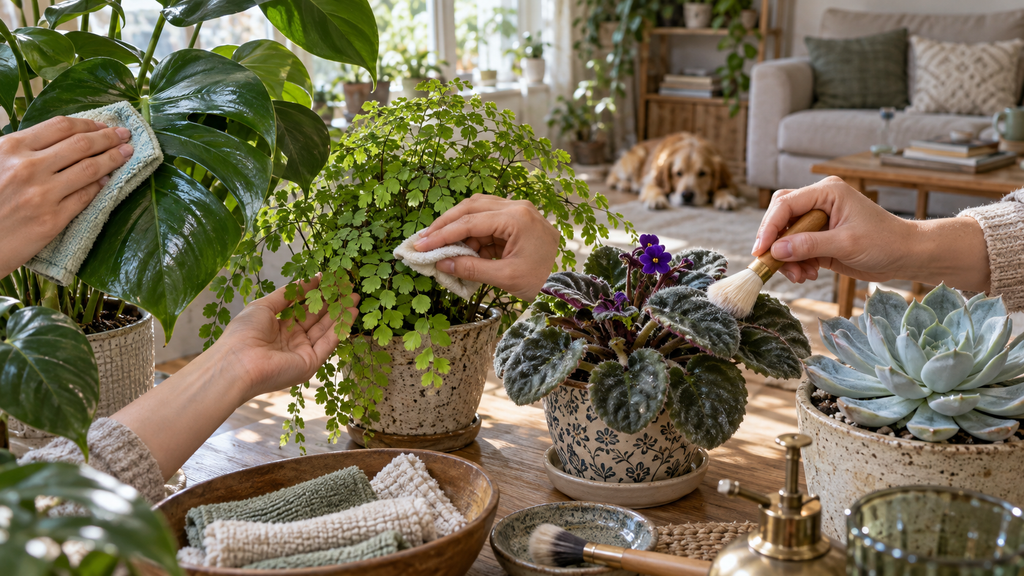
Different leaf surfaces need different handling.
Smooth Leaves
Broad, firm leaves such as those found on many Monstera, rubber plants, ZZ plants, pothos, and philodendrons are usually easy to wipe.
Support the leaf and gently clean it with a damp microfiber cloth.
Naturally glossy foliage usually regains its shine once dust is removed.
Thin Leaves
Thin leaves are easier to crease or tear.
Use very light pressure and avoid gripping them between your fingers and the cloth.
If a plant has many thin leaves, gentle rinsing may be easier and safer.
Fuzzy Leaves
Hairy or fuzzy leaves trap dust between surface hairs.
Use a very soft, clean brush instead of rubbing them aggressively.
Do not try to polish fuzzy foliage. Its texture is part of its natural appearance.
Small-Leaved Plants
Plants with dozens or hundreds of small leaves can be difficult to wipe individually.
A gentle lukewarm rinse is usually more practical if the plant tolerates wet foliage.
Allow excess water to drain after cleaning.
Waxy or Powdery Leaves
Some plants naturally develop a pale waxy or powdery coating.
Do not assume this is dust.
Certain succulents have a natural surface layer that can be disturbed by rubbing.
Identify the plant before removing anything that appears uniform and naturally distributed.
New or Damaged Leaves
New leaves are softer and easier to damage.
Avoid unnecessary handling while they are still unfurling.
Likewise, brown spots, scars, yellow tissue, or damaged edges cannot be repaired through cleaning.
How to Remove Dust From Plant Leaves
Ordinary dust is the easiest problem to correct.
Look at the plant under good light. Dust usually appears as an even dull or gray layer rather than individual spots.
For broad leaves:
- Inspect both sides.
- Dampen a soft cloth with lukewarm water.
- Support the leaf underneath.
- Wipe gently from base to tip.
- Rinse the cloth when it becomes dirty.
- Check the underside for pests.
- Reinspect the leaf after cleaning.
If the leaf is heavily dusty, make two gentle passes rather than one hard scrub.
Do not keep using the same dirty cloth across multiple plants, especially if one plant appears infested.
You can also use the finger test.
Run one clean finger gently across a mature leaf. If it creates a clear clean streak through the dust, the plant is ready to be cleaned.
If the mark does not move, investigate before rubbing harder.
Why Clean Indoor Plant Leaves?
Indoor plants do not receive natural rain that regularly washes outdoor foliage.
Dust can come from open windows, fabrics, pets, heating systems, kitchens, and normal household activity.
Removing visible dust keeps the leaf surface cleaner and helps you inspect the plant more accurately.
While cleaning, check:
- leaf undersides;
- veins;
- stem joints;
- new growth;
- sticky residue;
- fine webbing;
- unusual bumps;
- discoloration.
This is useful because early pest problems can be difficult to see from a distance.
Cleaning should therefore be treated as both maintenance and inspection.
It is not simply about making the plant look shiny.
How to Clean Plant Leaves Without Wiping
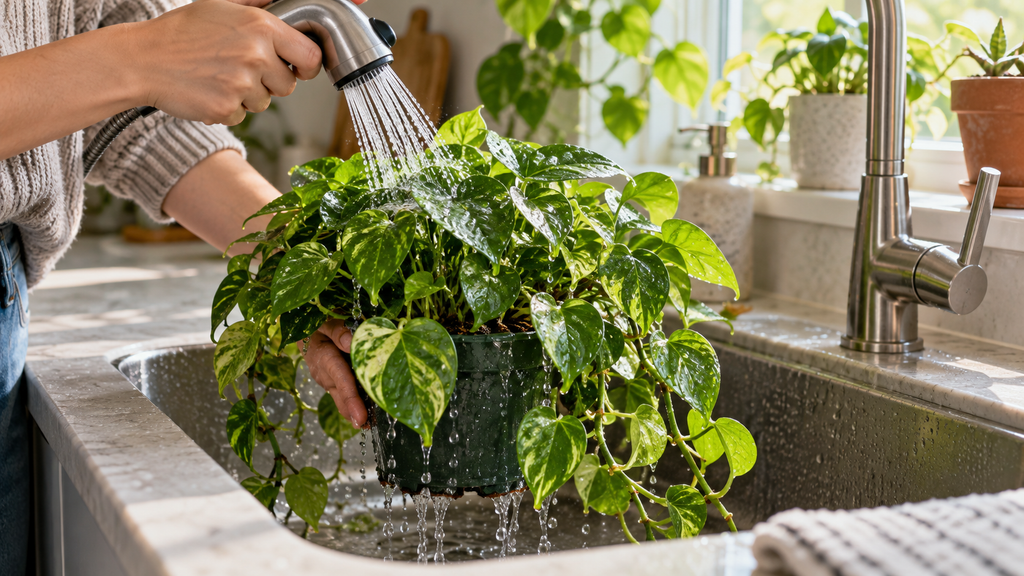
If a plant has many leaves, you can clean it without wiping every leaf individually.
Move the plant to a sink, shower, or bathtub and use a gentle stream of lukewarm water.
Keep the pressure low enough that leaves and stems are not bent or damaged.
For safe rinsing:
- use lukewarm water;
- keep pressure gentle;
- angle the plant so water reaches more than the upper surface;
- avoid saturating already-wet soil;
- let excess water drain completely;
- empty the saucer afterward;
- allow leaves to dry normally.
A spray bottle is not the same as proper rinsing.
Fine mist may wet the dust without removing it, and mineral-rich water can leave white marks after drying.
Use rinsing when you want to physically remove material from the foliage.
How to Make Plant Leaves Shiny Naturally
The safest way to make indoor plant leaves look shiny is to remove the dust hiding their natural surface.
Many tropical plants already have naturally glossy foliage.
Once dust is removed, the leaf often appears greener and brighter without any added product.
For natural shine:
- clean with plain water;
- let the leaf dry naturally;
- gently remove water spots if needed;
- avoid cooking oils;
- avoid aggressive buffing;
- do not polish fuzzy foliage.
A rubber plant may naturally look glossy while an African violet does not.
Shine is not a universal sign of plant health.
If a clean leaf remains matte but otherwise looks healthy, that may be completely normal.
Are Homemade Leaf Cleaners Safe?
Most indoor plant leaves do not need a complicated homemade cleaner.
For ordinary dust, plain lukewarm water is usually enough.
Can You Use Baby Wipes?
Some baby wipes may be usable, but their ingredients vary.
They can contain fragrances, moisturizers, oils, or surfactants.
A clean damp microfiber cloth is a simpler and more predictable option.
Can You Use Milk?
Milk is unnecessary for routine leaf cleaning.
It can leave fats and solids behind, creating temporary gloss rather than actually improving plant health.
Use water instead.
Can You Use Vinegar?
Vinegar should not be used as an everyday leaf cleaner.
If white marks are present, first determine whether they are mineral deposits, dried residue, pests, or actual leaf damage.
Do not automatically treat every white spot with acid.
Can You Use Dish Soap?
Dish soap is unnecessary for ordinary dust.
Household detergents may be harsher on foliage than plain water.
If pests are present, identify them first and use an appropriate pest-control method instead of turning regular cleaning into an improvised pesticide treatment.
Can You Use Neem Oil?
Neem oil is a pest-management product, not a routine cleaning product.
Do not use it simply to remove dust or create shine.
If you have identified a pest problem and neem is appropriate, follow the product directions.
Can You Use Oil for Shine?
Cooking oils create gloss because they coat the leaf surface.
That does not mean the plant is cleaner or healthier.
Oil can also attract dust and make future cleaning more difficult.
Best Homemade Plant Leaf Cleaner
For normal household dust, the best homemade plant leaf cleaner is simply:
Clean lukewarm water.
Use it with the correct tool:
- microfiber cloth for smooth foliage;
- gentle rinse for many small leaves;
- soft brush for fuzzy leaves;
- minimal handling for delicate foliage.
If water does not solve the problem, identify what remains before trying a stronger cleaner.
Sticky residue may point to pests.
White rings may be mineral deposits.
Brown marks may be damaged tissue.
Cottony material may be mealybugs.
A uniform powdery coating may be natural.
The safest sequence is:
Water first → diagnose second → specialized treatment only when necessary.
Why Does Leaf Residue Return?
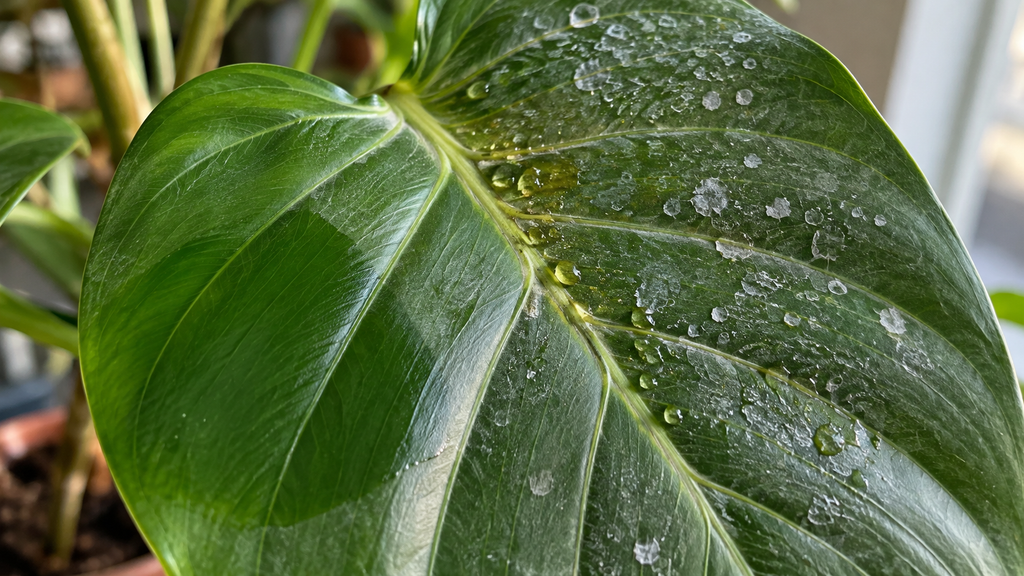
Residue that returns quickly after cleaning usually has an ongoing source.
Use the Transfer → Return → Pattern method.
Transfer
Does it come off onto a damp cloth?
If yes, it is probably sitting on the surface.
If no, it may be tissue damage, pigmentation, scarring, or a natural leaf feature.
Return
Clean one representative leaf completely and check it again later.
If the same material returns, investigate what is producing it.
Pattern
Look at where the residue appears.
Droplet-shaped white marks can suggest mineral buildup.
Sticky material may indicate sap or pest honeydew.
Fine webbing can indicate spider mites.
Cottony clusters can indicate mealybugs.
Uniform bluish powder on some succulents may be natural.
Remember:
If it transfers and stays gone, it was probably a cleaning problem.
If it returns, investigate the source.
If it never transfers, cleaning may not be the correct solution.
Why Are Plant Leaves Sticky?
Sticky leaves may result from plant sap, household residue, or honeydew from sap-feeding insects.
If the stickiness comes back after cleaning, inspect:
- leaf undersides;
- new growth;
- veins;
- stem joints;
- sheltered crevices;
- nearby plants.
Look for aphids, mealybugs, scale insects, whiteflies, or black sooty growth.
Do not repeatedly wipe away sticky residue while ignoring the source.
If insects are found, move to proper pest identification and treatment.
Cleaning removes the visible residue.
It does not necessarily solve the underlying problem.
Why Do Plant Leaves Have White Spots?
White marks may be caused by mineral deposits, dried sprays, pests, natural coatings, fungal growth, or plant damage.
Ask:
- Does the mark wipe away?
- Does it follow dried water droplets?
- Is similar residue visible on the pot?
- Is the plant frequently misted?
- Does the material look cottony?
- Is the discoloration inside the leaf?
If the mark disappears with water, stronger cleaning was unnecessary.
If white residue repeatedly returns after misting or rinsing, investigate the water source.
If the discoloration remains inside the tissue, stop scrubbing.
Does Water Quality Matter?
For most routine cleaning, ordinary clean water is sufficient.
Water quality becomes important when it repeatedly leaves visible deposits behind.
Hard water may contain minerals that remain on the leaf after droplets evaporate.
You do not need special water unless there is a clear reason.
Consider changing the water used on foliage if:
- white rings keep returning;
- misting leaves cloudy marks;
- mineral crust also develops on the pot;
- your water is highly mineralized;
- sensitive foliage consistently develops residue.
A simple rule works globally:
If your normal water cleans the leaves without leaving persistent marks, keep using it.
How to Clean Bugs From Plant Leaves
When insects or mites are present, cleaning becomes part of pest management.
Move the affected plant away from healthy plants and inspect:
- leaf undersides;
- veins;
- new growth;
- stem joints;
- hidden crevices.
A gentle rinse can physically remove some exposed soft-bodied pests.
Use this sequence:
Isolate → Identify → Remove → Reinspect → Treat if needed.
Possible clues include:
- aphids on new growth;
- spider-mite webbing;
- cottony mealybugs;
- brown scale insects;
- silvery thrips damage.
Do not rely on repeated washing if pests continue to return.
Once an infestation is confirmed, use a dedicated pest-identification and treatment guide.
When Should You Stop Cleaning Leaves?
Stop cleaning when the problem is no longer sitting on the surface.
Do not keep rubbing when:
- brown tissue remains;
- yellow areas do not change;
- leaves are bleached or scorched;
- curling continues after cleaning;
- fine stippling remains;
- lesions are embedded in the tissue;
- scale insects remain attached;
- sticky residue keeps returning;
- a natural wax coating may be present;
- the leaf is still soft and unfurling.
At that point, diagnose the underlying problem.
Brown spots may relate to watering, light, salts, pests, disease, or physical damage.
Curling may be caused by watering problems, heat, roots, pests, humidity, or environmental stress.
Visible pests require pest management.
Recurring mineral deposits require a water-quality review.
The key rule is:
Clean what is on the leaf. Diagnose what is happening to the leaf.
Should You Clean Powdery Succulent Leaves?
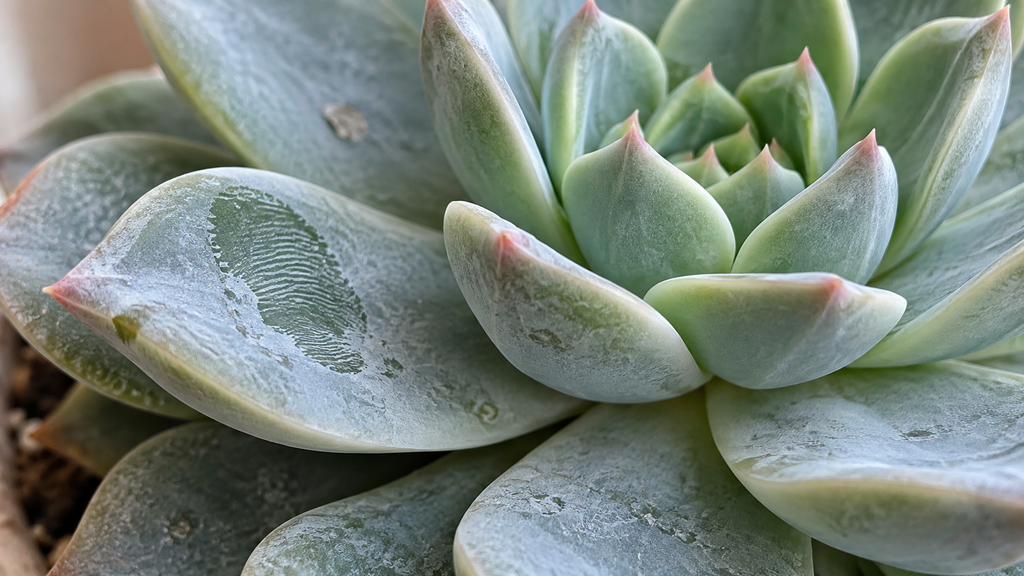
Not automatically.
Some succulents naturally develop a pale bluish or powdery wax coating often called farina.
This may be part of the normal leaf surface rather than dust.
Before wiping a powdery succulent:
- identify the plant;
- check whether the coating is uniform;
- compare healthy new and old leaves;
- avoid unnecessary handling;
- do not assume every pale coating is mineral residue.
Investigate only when the material appears irregular, sticky, moving, unusually fuzzy, or associated with plant decline.
Should You Clean New Leaves?
New leaves are softer and easier to damage than mature foliage.
Avoid pressing, flattening, or repeatedly wiping a leaf while it is still unfurling.
If it is only lightly dusty, allow it to mature before routine cleaning when possible.
Be especially careful when:
- the leaf is still curled;
- the tissue feels soft;
- the petiole has not hardened;
- the surface tears easily;
- the plant is already stressed.
If pests are suspected, inspect carefully without forcing the leaf open.
How Often Should You Clean Plant Leaves?
There is no universal cleaning schedule.
Clean according to visible buildup and the plant’s environment.
Plants near open windows, pets, kitchens, heating vents, fireplaces, or construction may gather dust faster.
Clean when:
- a visible gray layer develops;
- the finger test leaves a clear streak;
- pet hair or fibers collect on leaves;
- residue needs diagnosis;
- pest inspection is needed.
Do not repeatedly polish already-clean leaves.
The better rule is:
Inspect regularly; clean when there is something to remove.
FAQs About Cleaning Plant Leaves
What is the best way to clean indoor plant leaves?
Use lukewarm water and a soft microfiber cloth for smooth leaves. Use a gentle rinse for plants with many small leaves and a soft brush for fuzzy foliage.
What can I use to clean indoor plant leaves naturally?
Plain lukewarm water is usually enough for ordinary dust. It cleans the leaf without leaving unnecessary oils, milk, vinegar, or other residue.
How do I make indoor plant leaves shiny naturally?
Remove dust with a damp cloth and let the leaf’s natural surface provide the shine. Avoid oils or polish, especially on naturally matte or fuzzy foliage.
How can I clean plant leaves without wiping them?
Gently rinse suitable plants with lukewarm water in a sink or shower. Keep the pressure low and allow excess water to drain completely.
Can I use baby wipes on plant leaves?
Some simple wipes may be usable, but their ingredients vary. A damp microfiber cloth is a safer and more predictable option for routine cleaning.
Can I clean plant leaves with milk?
Milk is unnecessary for routine cleaning and may leave residue behind. Plain water is usually enough to remove dust and restore natural shine.
Can I clean plant leaves with vinegar?
Vinegar should not be used as a routine leaf cleaner. First determine whether white marks are mineral deposits, pests, or actual tissue damage.
Can I use dish soap to clean plant leaves?
Dish soap is unnecessary for ordinary dust and may affect the leaf surface. Use plain water unless you are treating a specifically identified pest problem.
How often should I clean indoor plant leaves?
Clean leaves when visible dust or residue develops rather than following a strict schedule. If a finger leaves a clean streak through the dust, the plant is ready.
Why are my plant leaves sticky after cleaning?
Recurring stickiness may indicate plant sap or honeydew from pests. If it returns quickly, inspect the plant instead of repeatedly wiping the leaves.
How to Clean Indoor Plant Leaves Safely
For most houseplants, safe leaf cleaning is simple: use lukewarm water and the least aggressive method suitable for the foliage.
Use a damp cloth for smooth leaves, a gentle rinse for plants with many small leaves, and a soft brush for fuzzy foliage. Avoid unnecessary milk, vinegar, oils, dish soap, neem, or leaf-shine products when plain water already solves the problem.
Most importantly, watch what happens after cleaning.
Use the Plantsaholic diagnostic rule:
Does it transfer? → Does it return? → What pattern does it follow?
If the material disappears and stays gone, it was probably a surface-cleaning problem.
If it returns, stays inside the tissue, looks like an insect, forms webbing, follows dried droplets, or appears to be part of the plant’s natural surface, stop increasing the strength of the cleaner.
Clean what is on the leaf. Diagnose what is happening to the leaf.
Myra is the founder and lead writer of Plantsaholic. She shares practical, research-backed advice on indoor plants, outdoor gardening, flowers, herbs, succulents, and everyday plant care. Her goal is to help gardeners of all experience levels grow healthier plants through simple, easy-to-follow gardening guides.