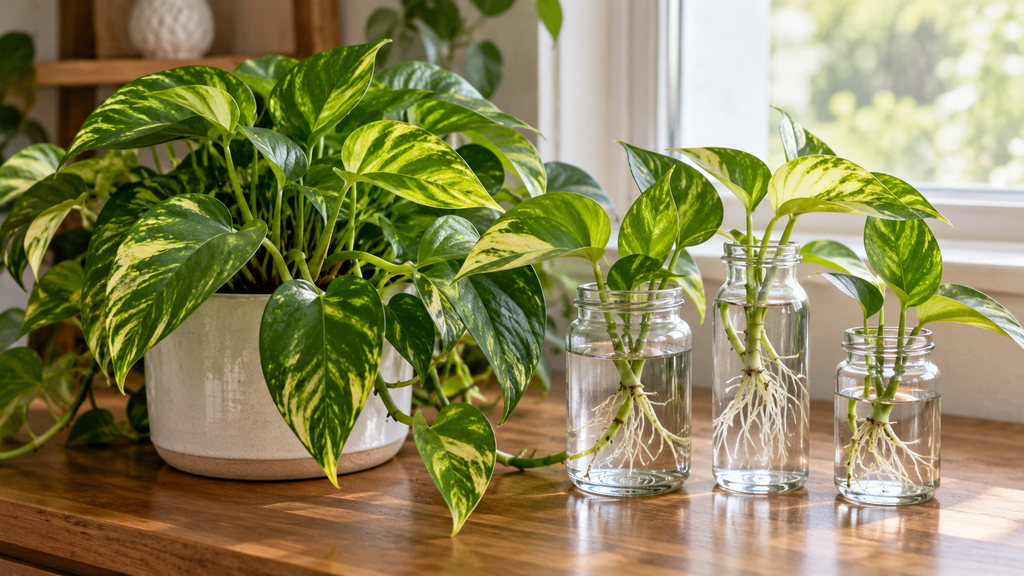
The easiest way to propagate pothos is to cut a healthy vine just below a node and place that node in water or moist potting mix. Water is easiest for beginners because you can watch roots develop, while soil avoids transplanting later. The most important part of any cutting is a healthy node because this is where new roots and growth develop.
Pothos (Epipremnum aureum) is one of the easiest houseplants to propagate from stem cuttings. A single healthy vine can often produce several new plants, making propagation useful for filling a sparse pot, rescuing healthy growth from damaged roots, shortening long vines, or creating additional plants.
The process is simple once you understand the difference between the stem, node, petiole, and aerial root. Most propagation problems come from cutting the wrong part of the vine, using unhealthy material, or expecting roots too quickly.
How to Propagate Pothos: Quick Guide
For most people, water propagation is the simplest place to start.
| Question | Quick Answer |
| Easiest method | Water propagation |
| Essential cutting part | At least one healthy node |
| Where to cut | Just below the node |
| Best light | Bright indirect light |
| Typical rooting time | Around 3–4 weeks under favorable conditions |
| When to pot | Once an adequate root system forms |
| Can cuttings go straight into soil? | Yes |
| Can pothos root without existing roots? | Yes |
| Can leafless stems root? | Sometimes, if a viable node remains |
| Is rooting hormone required? | Usually no |
UF/IFAS reports bud break in roughly two to three weeks and root development around three to four weeks in commercial pothos propagation. Household cuttings can be faster or slower depending on temperature, light, cultivar, and plant health.
Pothos Propagation Basics
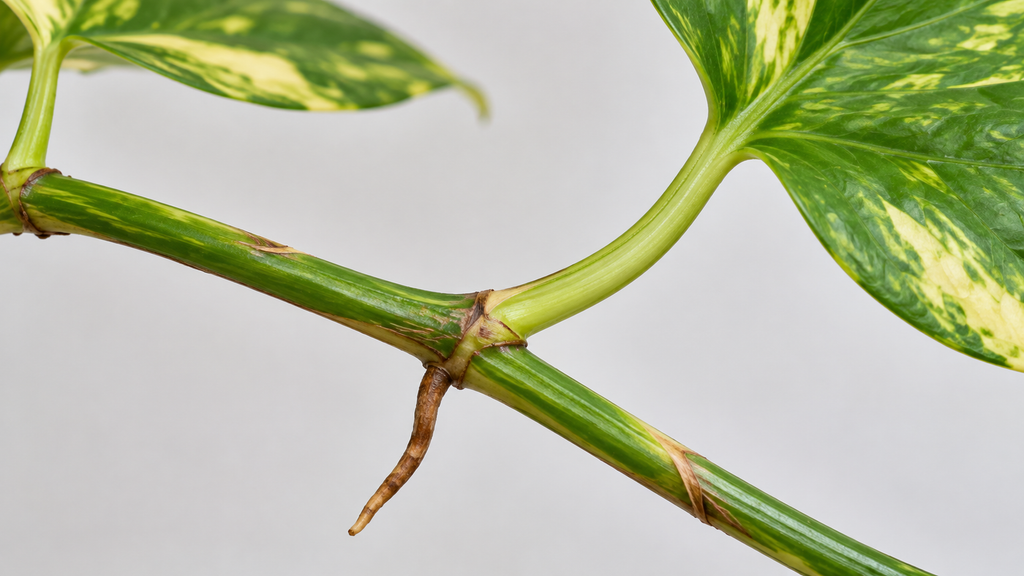
A pothos vine contains several important parts.
The stem is the main trailing vine. The petiole connects a leaf to the stem. The node is the joint where the petiole meets the vine, and a small brown or beige aerial-root nub may also appear there. The section between two nodes is the internode.
The node is the part you need to preserve when taking a cutting. Clemson Extension recommends at least one node for successful pothos stem propagation.
Before cutting, check that the vine has:
- Firm, healthy stem tissue
- At least one visible node
- Healthy leaves when available
- No soft black or collapsing tissue
- Enough stem below the node to make a clean cut
Aerial roots are useful for identifying nodes, but a large existing root is not required.
The easiest rule to remember is:
No existing roots is usually fine. No viable node is not.
How to Cut Pothos for Propagation
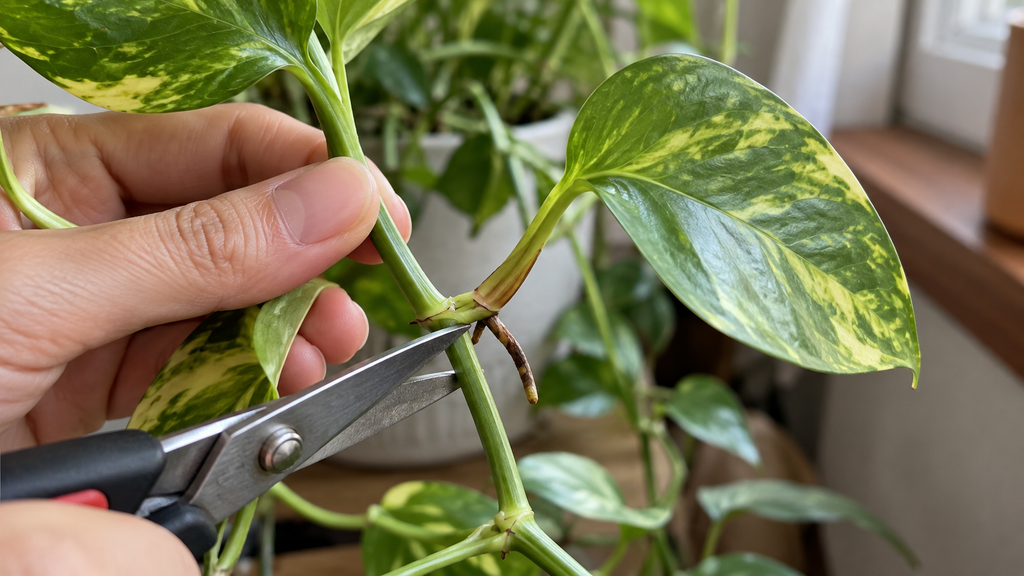
Choose a healthy vine and locate the node you want to keep. Make your lower cut just below that node, leaving a short section of stem beneath it.
Do not cut directly through the node.
A long vine can remain as one cutting, but dividing it into several smaller sections often gives you more new plants and more growing points for creating a fuller pot.
UF/IFAS describes commercial propagation using short pothos cuttings containing a node and attached leaf, showing that a very long cutting is not necessary.
A practical cutting usually has:
- At least one healthy node
- One or more healthy leaves
- A short length of stem below the node
- No rotten or severely damaged tissue
How Many Nodes Should a Cutting Have?
One healthy node is enough for pothos propagation.
A two-node cutting can be easier for beginners because it provides more stem to handle, but extra nodes do not automatically mean faster rooting.
Use:
- One node when maximizing the number of cuttings
- Two nodes when you want easier handling
- Several nodes when preserving a longer vine matters
If there is no node, use another piece of stem.
Where to Cut Pothos for Water Propagation
Cut slightly below a healthy node so the node remains on the piece going into water.
Place the node and any small aerial-root nub below the waterline, but keep the leaf blades above the surface. Leaves left underwater can deteriorate and contaminate the water.
Do not worry if the aerial root is small or brown. Brown aerial roots are normal and should not automatically be mistaken for rot.
Also watch the water level. Evaporation can leave the node exposed even when there is still water in the container.
Fastest Way to Propagate Pothos
Water propagation is usually the fastest way to confirm that a pothos cutting is rooting because you can see new roots forming.
That does not mean water always produces roots biologically faster than soil. Temperature, light, parent-plant health, season, cultivar, and node condition all influence rooting speed.
For reliable propagation:
- Start with healthy growth
- Use at least one viable node
- Give bright indirect light
- Keep the cutting warm
- Maintain consistent moisture
- Avoid strong fertilizer
- Avoid constant handling
The fastest successful propagation is not the cutting that produces the first tiny root. It is the cutting that develops enough healthy roots to survive the next stage.
How to Propagate Pothos in Water
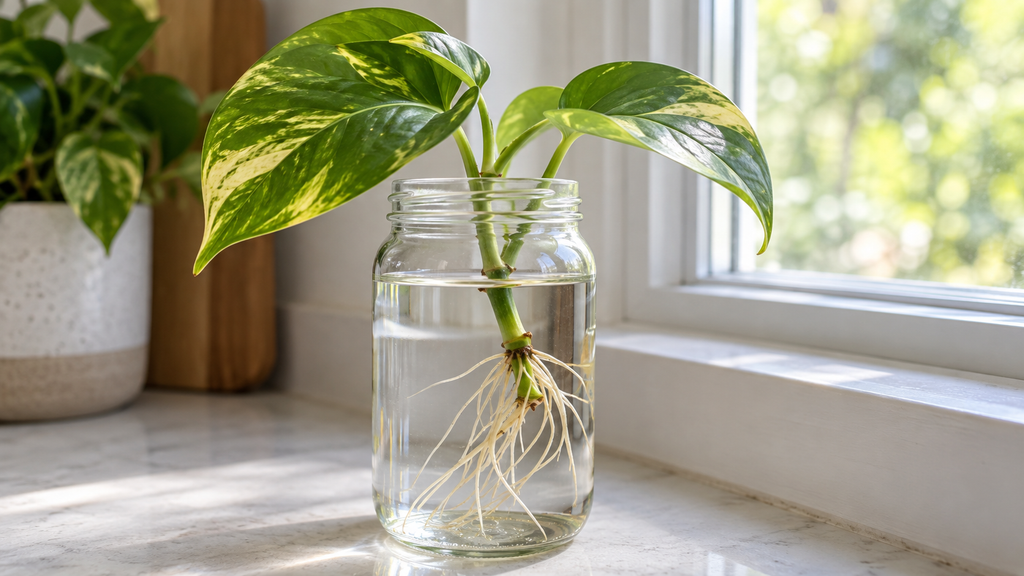
Water propagation is beginner-friendly because you can see the node, stem, and roots throughout the process.
Start with a healthy vine and identify a node. Cut just below it using clean scissors. Remove any lower leaf that would sit underwater.
Place the node in clean water while keeping the leaves above the surface.
Set the container in bright indirect light rather than strong direct sun. Direct sunlight can heat a small jar and stress the cutting.
Keep the water level high enough to cover the node. Iowa State Extension recommends changing water for water-rooted cuttings about once or twice per week.
Change it sooner if:
- It becomes heavily cloudy
- It develops an unpleasant smell
- Leaves begin decomposing underwater
- Slime develops around damaged stem tissue
Top up the container when evaporation is the only problem.
Do not panic if nothing happens during the first week. Pothos commonly needs several weeks to produce a useful root system.
Pothos Propagation: Water vs Soil
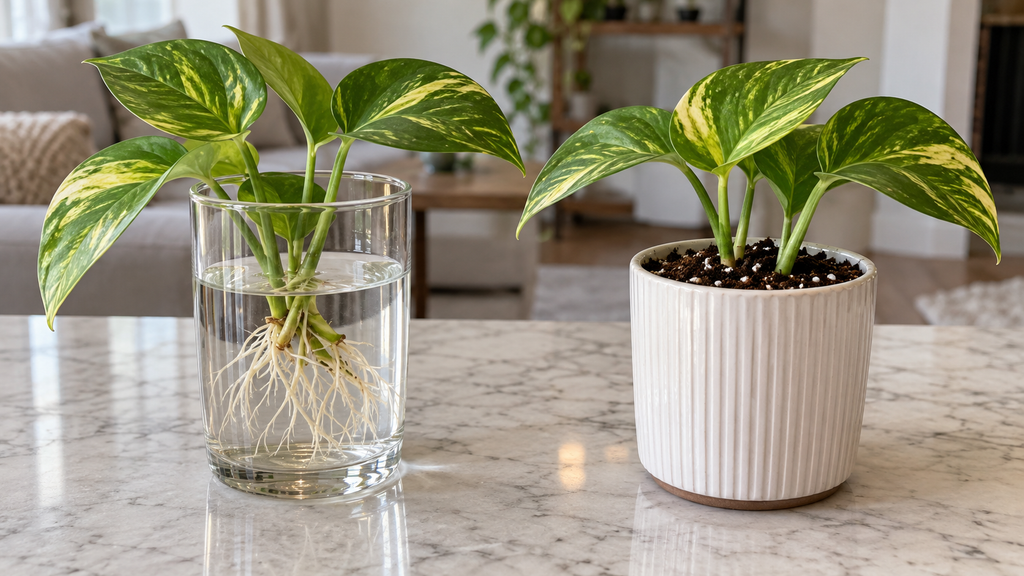
Both water and soil can successfully root pothos.
| Factor | Water | Soil |
| Root visibility | Excellent | Hidden |
| Beginner-friendly | Very | Moderate |
| Detecting problems | Easy | Harder |
| Later transplant | Usually required | No |
| Best for rescue cuttings | Excellent | Good |
| Best for filling an existing pot | Good | Excellent |
Choose water if you want to watch root development or are propagating pothos for the first time.
Choose soil when you want the cutting to establish directly in its final medium.
The cutting quality matters more than the container. A healthy node in a simple jar can outperform a damaged node in an elaborate propagation setup.
How to Propagate Pothos in Soil
Pothos cuttings can be planted directly into moist potting mix without rooting in water first.
Use a small container with drainage and an airy, well-draining houseplant mix. Insert at least one node into the medium while keeping leaves above the soil.
During early rooting:
- Keep the mix lightly moist
- Avoid waterlogging
- Provide bright indirect light
- Keep the cutting warm
- Avoid strong fertilizer
A fresh cutting should not be treated exactly like an established pothos. Without a developed root system, it cannot search through dry soil for moisture.
Once new growth or firm resistance indicates that roots have developed, gradually return to a normal pothos watering routine.
How to Propagate Pothos Without Roots
Existing roots are not required.
A healthy node can produce an entirely new root system after the cutting is removed from the mother plant.
A rootless cutting needs:
- Healthy stem tissue
- At least one viable node
- Moisture
- Warmth
- Bright indirect light
- Time
An aerial-root nub can make node identification easier, but it is not essential.
If you are choosing between a cutting with a large aerial root but damaged node tissue and another with no visible roots but a healthy node, the healthy node is usually the better choice.
Can Pothos Grow From a Leaf Without a Node?
A leaf without viable stem-node tissue is not a reliable way to produce a complete new pothos vine.
A detached leaf may remain green in water for a long time, which can create the impression that propagation is working. However, staying alive and producing a new vine are not the same thing.
Before propagating a single leaf, check whether it includes:
- A section of the main stem
- A visible node
- The joint where the petiole meets the vine
- Healthy surrounding stem tissue
A petiole alone is not enough.
If your goal is a new plant, use a true node-bearing stem cutting.
How to Propagate Leafless Pothos Stems
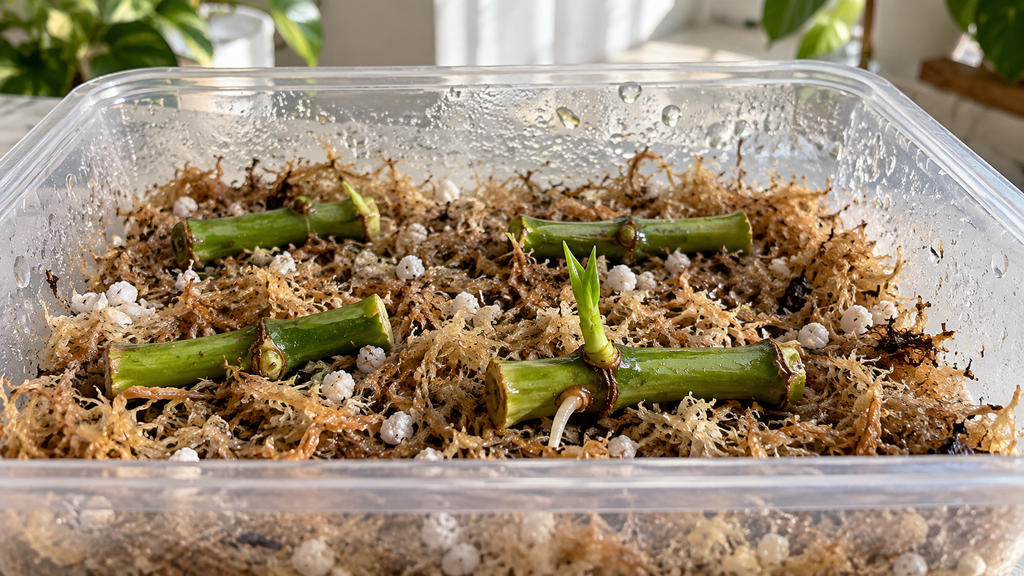
Leafless pothos stems can sometimes be propagated if healthy nodes remain. Houseplant growers commonly call these pieces wet sticks.
Wet-stick propagation is useful for long bare vines or rescue situations where leaves have already been lost.
Cut the vine into sections containing at least one healthy node, leaving some stem on both sides. Place the node against lightly moist propagation material such as perlite, sphagnum moss, or a light potting medium.
Provide:
- Warm conditions
- Bright indirect light
- Consistent moisture
- Moderate humidity
- Enough airflow to reduce mold and rot
Leafless nodes may take longer than leafy cuttings because they have less active photosynthetic tissue.
Wet-stick propagation is best treated as a rescue or multiplication technique rather than the first choice when healthy leafy cuttings are available.
How Long Does Pothos Take to Root?
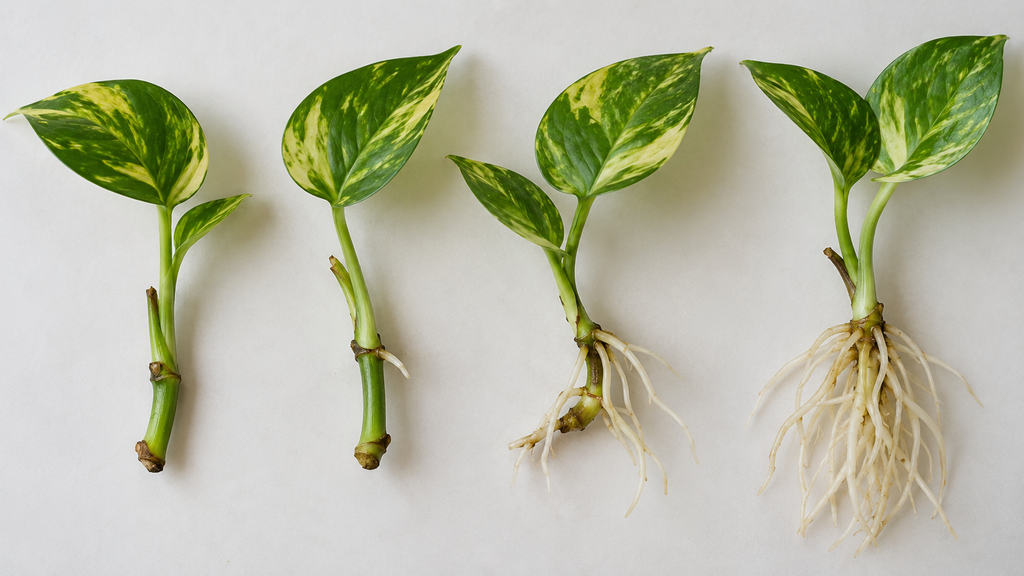
Expect several weeks.
UF/IFAS reports pothos root development around three to four weeks under commercial growing conditions, but household results vary.
A practical progression looks like this:
| Stage | What You May See |
| Day 0 | Fresh cutting |
| Week 1 | Little visible change |
| Weeks 2–3 | Root nub or bud activity |
| Weeks 3–4 | More obvious root growth |
| Established roots | Cutting becomes ready for transplant |
Temperature, light, cultivar, season, and node health all influence rooting speed.
A firm cutting that has not rooted after one week may simply need more time.
A soft, blackening cutting is a different problem and should be inspected for rot.
When to Move Pothos From Water to Soil
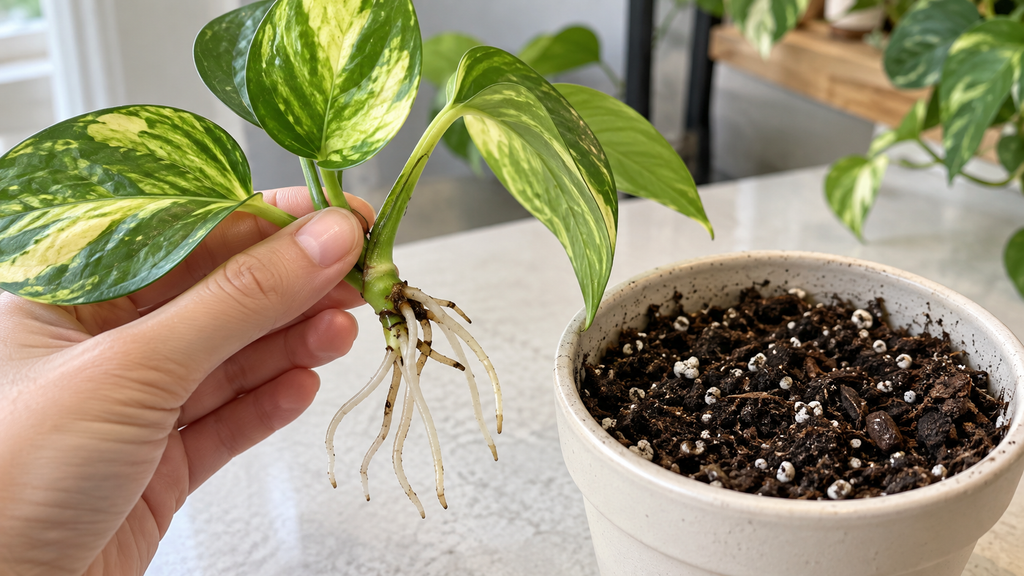
Move the cutting into soil after it has developed an adequate root system rather than transplanting it as soon as you see the first tiny root.
Iowa State Extension uses roots around 1 inch long as a useful transplant reference for water-rooted cuttings.
Several healthy roots can make the transition easier.
To transplant:
- Prepare a small pot with drainage.
- Add an airy potting mix.
- Make space for the roots.
- Position the cutting gently.
- Backfill around the roots.
- Water thoroughly.
- Allow excess water to drain.
- Keep the mix reasonably moist during early adjustment.
Do not wait until the jar contains an enormous tangled root mass unless you intend to keep the plant in water.
Can Pothos Live in Water Permanently?
Yes, pothos can remain in water for long periods.
However, permanent water culture is different from temporary propagation. A cutting can initially rely on stored resources, while long-term water-grown pothos eventually needs attention to nutrients, water quality, root health, light, and container cleanliness.
Keep leaves above the waterline and remove decomposing roots or foliage.
If your goal is an ordinary potted houseplant, transferring established roots to soil remains the simplest option.
Do Pothos Varieties Propagate Differently?
Most common Epipremnum aureum cultivars use the same basic node-bearing stem-cutting method.
This includes varieties such as Golden, Marble Queen, Neon, Jade, N’Joy, and Pearls and Jade.
However, not every plant sold with “pothos” in its common name belongs to Epipremnum aureum.
Cebu Blue is Epipremnum pinnatum, while Satin Pothos is Scindapsus pictus. Both can also be propagated from stem cuttings, but they should not be described as cultivars of E. aureum.
The propagation principle remains similar: healthy stem tissue, viable nodes, moisture, suitable light, warmth, and time.
How to Propagate Pothos in an Aquarium
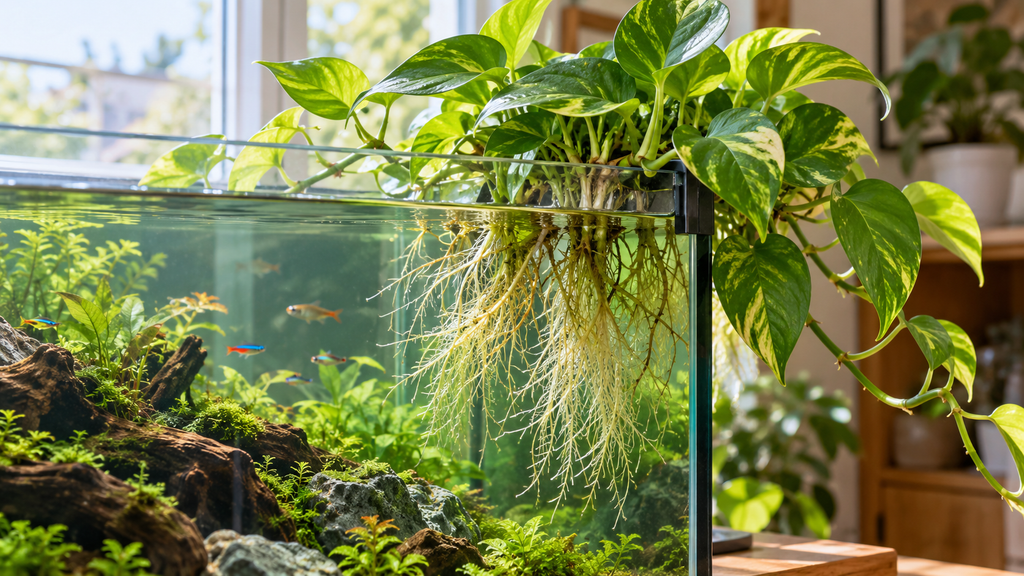
Pothos can develop roots in freshwater while its leaves remain above the aquarium.
Keep the plant emersed, meaning the roots are in water while the foliage stays in air.
To start:
- Use a clean node-bearing cutting
- Remove leaves that would remain underwater
- Secure the vine at the tank edge
- Keep the node or roots in the water
- Keep leaves above the surface
- Keep potting soil out of the aquarium
Avoid introducing recently treated nursery plants into tanks containing fish or shrimp if pesticides, systemic insecticides, fertilizers, or other residues may be present.
Pothos can absorb nutrients from aquarium water, but it should not replace normal filtration, testing, and aquarium maintenance.
How to Make Pothos Fuller With Cuttings
Propagation can make a sparse pothos look fuller by increasing the number of growing points in the pot.
Instead of allowing one vine to become extremely long, cut healthy sections, root several of them, and plant them back around the original plant.
A simple approach is:
- Trim long vines.
- Divide them into healthy node cuttings.
- Root the cuttings.
- Plant several around empty areas of the mother pot.
Several shorter rooted cuttings usually create more visual fullness than one extremely long vine.
How to Propagate Pothos by Layering
Layering allows a node to develop roots while the vine remains attached to the mother plant.
Place a healthy node against moist potting mix and secure it gently. Once roots develop, cut the connection to the original vine.
Layering is useful when you want to reduce the risk of losing a valuable vine.
Traditional cuttings are better when you want to create several new plants quickly.
Best Time to Propagate Pothos
Spring and summer usually provide favorable conditions because pothos is actively growing and indoor environments tend to be warmer and brighter.
However, indoor pothos can be propagated at other times if temperatures and light are suitable.
Use this rule:
Planned propagation: spring and summer are easiest.
Rescue propagation: take healthy cuttings immediately if root rot, breakage, or severe decline threatens the plant.
Do not wait for the perfect season if healthy stem tissue may be lost.
Is Your Pothos Cutting Still Viable?
When a cutting looks unhealthy, decide whether to wait, reset, recut, or discard it.
Wait
Wait when the stem is firm, the node is intact, and there is no foul smell or spreading rot.
A cutting with no visible roots after only one or two weeks may simply need more time.
Reset
Reset the environment when the cutting is healthy but:
- Water is dirty
- The node rose above the waterline
- Soil dried excessively
- Conditions are too cold or dark
Correct the environment without cutting healthy tissue.
Recut
Recut when the bottom of the stem is rotting but another healthy node remains higher on the vine.
Remove damaged tissue with clean scissors and restart the healthy section.
Discard
Discard or restart when the only node has completely rotted or the piece never contained a viable node.
| Symptom | Decision |
| Firm stem, no roots after one week | Wait |
| Tiny healthy root nub | Wait |
| Dirty water, healthy stem | Reset |
| Waterline below node | Reset |
| Rotten lower stem, healthy node above | Recut |
| Only node completely rotten | Discard |
Why Is My Pothos Cutting Not Rooting?
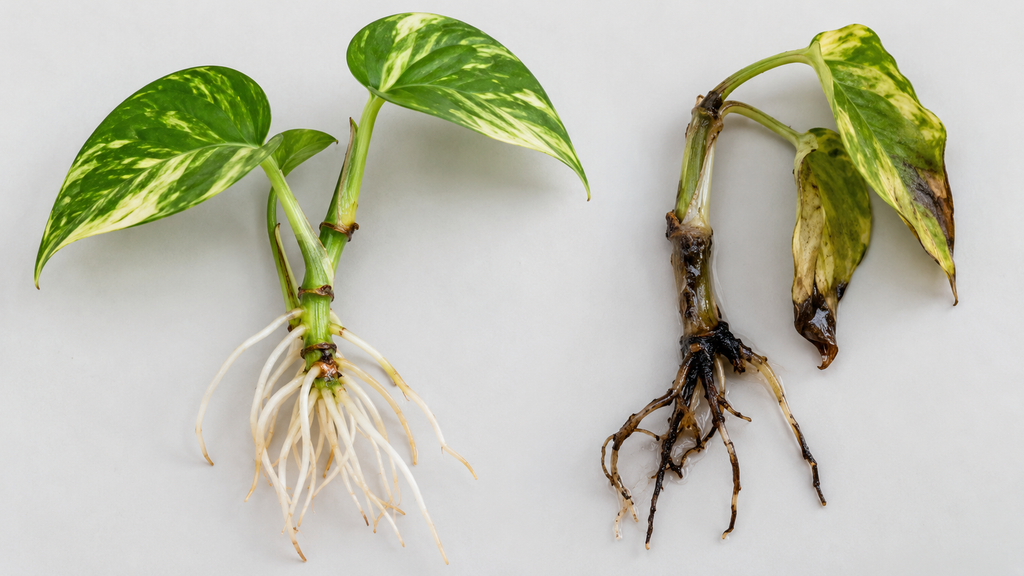
Check the node first.
If the node is healthy, common reasons for slow rooting include:
- Low temperature
- Very low light
- Weak parent material
- Node above the waterline
- Damaged stem tissue
- Simply not enough time
Do not change methods every few days. Constant disturbance can be more harmful than patience.
Why Is My Pothos Cutting Rotting?
Rotting stem tissue usually becomes soft, black, translucent, slimy, or foul-smelling.
A brown aerial root is not automatically rot. Texture is more useful than color.
If rot affects only the bottom of the stem and a healthy node remains above it, cut back into firm tissue with clean scissors and restart the cutting.
If the only node has become soft and decomposed, start again with healthier material.
Why Are Pothos Cuttings Turning Yellow?
A single yellowing leaf does not automatically mean the cutting has failed.
Look at the entire cutting.
Yellow leaf + healthy roots and firm stem: continue monitoring.
Yellow leaf + soft node or collapsing stem: inspect for rot.
Also check for:
- Submerged foliage
- Harsh direct sunlight
- Cold conditions
- Very low light
- Dry soil around a new cutting
- Waterlogged soil
Is Pothos Safe to Propagate?
Pothos contains calcium oxalate crystals in its leaves, stems, and roots, which can irritate skin and oral tissues.
Wash your hands after handling cut stems and consider gloves if your skin is sensitive.
Keep cuttings and discarded leaves away from pets and small children.
Propagation jars can make the plant more accessible than a mature pothos hanging high above the floor.
Is It Illegal to Propagate Pothos?
There is no general worldwide ban on propagating pothos, but specific protected cultivars may have legal restrictions.
In the United States, plant patents can protect new asexually reproduced plant varieties, and rooting cuttings is considered a form of asexual reproduction.
For ordinary household propagation of common pothos, this is rarely a practical issue.
For proprietary cultivars, especially when producing plants for sale, check:
- Cultivar name
- Patent information
- Nursery labeling
- Current legal status
- Local regulations
This is general horticultural information, not legal advice.
Best Pothos Propagation Method for Beginners
For beginners, the simplest method is a healthy leafy cutting with at least one node rooted in clear water under bright indirect light.
Use this sequence:
Find node → cut below node → place node in water → keep leaves above water → provide bright indirect light → maintain clean water → wait for established roots → move into soil.
Once you understand what healthy root development looks like, direct soil propagation, wet sticks, layering, and aquarium propagation become easier to manage.
The container is not the secret.
Successful propagation depends on:
healthy stem + viable node + moisture + warmth + suitable light + time.
Pothos Propagation FAQs
Can You Propagate Pothos From One Node?
Yes. One healthy node is enough to produce roots and new growth. A two-node cutting may simply be easier to handle.
Where Should You Cut Pothos?
Cut just below the node you want to keep. Leave a short section of stem below it and avoid cutting through the node.
Can You Propagate a Pothos Leaf Without a Node?
Not reliably. A leaf may remain green, but without viable node tissue it will not normally produce a complete new vine.
Is Water or Soil Better for Pothos Propagation?
Both work. Water is easier for monitoring roots, while soil avoids the later transplant step.
Can Pothos Cuttings Go Straight Into Soil?
Yes. Place at least one node into moist, airy potting mix and keep the medium consistently moist while roots form.
How Long Does Pothos Take to Root?
Usually several weeks. Around three to four weeks is a useful reference under favorable conditions, but household results vary.
How Long Should Pothos Roots Be Before Planting?
Around 1 inch provides a useful minimum reference. Several healthy roots can make transplanting easier.
How Often Should You Change Pothos Propagation Water?
About once or twice per week is a useful starting point. Change it sooner if it becomes dirty, cloudy, or foul-smelling.
Can You Propagate Pothos Without Roots?
Yes. Existing roots are not required because a healthy node can produce a new root system.
Can You Propagate Pothos Without Leaves?
Yes, if the stem still contains a healthy node. Leafless wet sticks may take longer than normal leafy cuttings.
Why Is My Pothos Cutting Not Rooting?
Check the node, warmth, light, water level, and time. A firm cutting may simply need several more weeks.
Does Pothos Need Rooting Hormone?
Usually not. Healthy pothos nodes root readily when moisture, warmth, and light are appropriate.
Can Pothos Stay in Water Permanently?
Yes, but long-term water culture requires more attention to nutrition, water quality, root health, and light.
Can You Propagate Pothos in an Aquarium?
Yes. Keep the node or roots in freshwater while keeping the leaves above the waterline.
What Is the Easiest Way to Propagate Pothos?
For beginners, use a healthy leafy cutting with at least one node and root it in clear water under bright indirect light.

Myra is the founder and lead writer of Plantsaholic. She shares practical, research-backed advice on indoor plants, outdoor gardening, flowers, herbs, succulents, and everyday plant care. Her goal is to help gardeners of all experience levels grow healthier plants through simple, easy-to-follow gardening guides.