Improve soil drainage for houseplants by increasing soil porosity, using chunky amendments like Perlite, Pumice, and Orchid bark, choosing pots with drainage holes, and avoiding oversized containers. Better drainage improves root oxygen, prevents waterlogging, and reduces the risk of Root rot.
Most houseplant problems start below the soil surface. Yellow leaves, drooping stems, weak growth, and slow recovery after watering often point to one hidden issue: poor drainage. Many plant owners focus on watering schedules, but water amount is only one part of plant care. The bigger factor is how the soil manages water after it is applied.
That confusion causes one of the most common houseplant mistakes: watering more when the roots are already drowning.
This guide explains how to improve soil drainage, how to identify drainage problems, what causes them, and how to rebuild healthier soil systems for stronger houseplants.
What Causes Poor Soil Drainage in Houseplants?
Poor soil drainage starts when soil structure begins to collapse. Water does not move through solid particles. It moves through empty spaces between them. Those empty spaces control both water movement and oxygen flow.
Most indoor potting mixes contain organic materials like peat moss, compost, and Coco coir. These materials naturally break down over time. As they decompose, their particle size becomes smaller. Smaller particles settle into air gaps, reducing drainage and increasing density.
Compaction reduces airflow and slows drainage, increasing root stress.
Main causes of poor drainage
The most common causes include:
- peat-heavy potting mixes
- old decomposed soil
- watering too frequently
- oversized pots
- blocked drainage holes
- low light reducing water use
- root-bound plants compressing the soil
What is soil porosity and why does it matter?
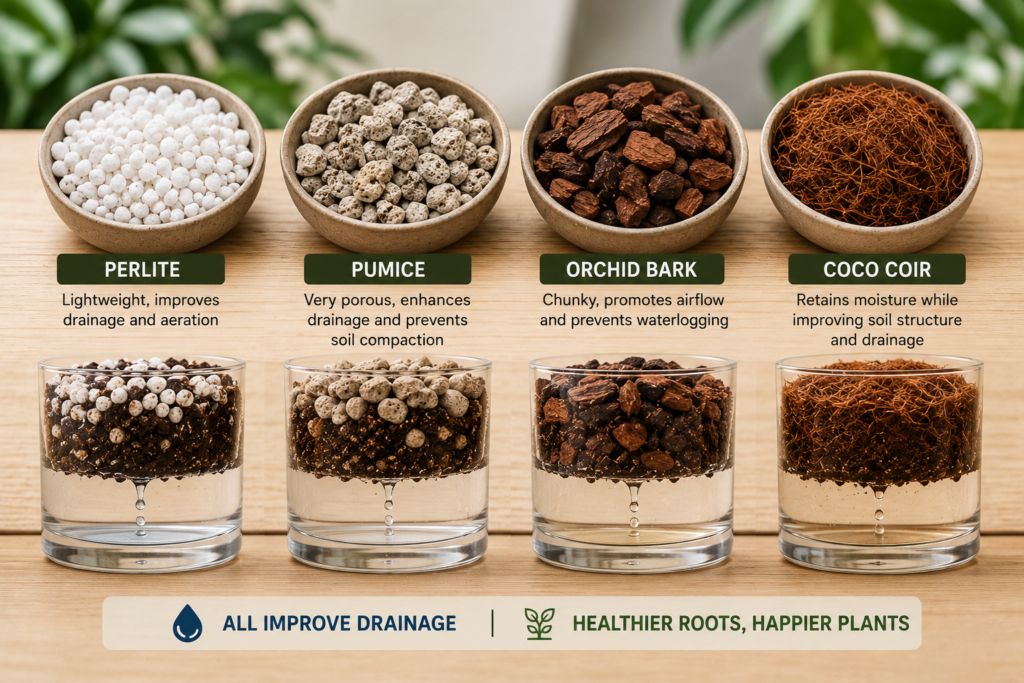
Soil porosity is the amount of empty space between soil particles. These spaces are critical because they control drainage and oxygen movement.
Good porosity improves drainage and oxygen flow, while low porosity traps moisture and increases root stress.
This explains why two different soils can hold similar moisture but behave differently.
Materials that improve porosity include:
- perlite
- pumice
- orchid bark
- coarse coco chips
How Can You Tell If Houseplant Soil Has Drainage Problems?
Drainage problems usually show visible symptoms before root failure becomes severe. The problem is that these symptoms often look like other plant problems.
A plant with drainage issues may look thirsty even when the soil is wet.
This happens because roots need oxygen to absorb water efficiently.
Without oxygen, wet roots function poorly.
That makes the plant wilt.
Recognizing the signs early prevents bigger damage.
Plant symptoms of poor drainage
Watch for these warning signs:
- yellow lower leaves
- drooping after watering
- soft weak stems
- slow growth
- leaf drop
Yellow leaves combined with wet soil are one of the strongest drainage warnings.
That usually signals root oxygen stress.
Not dryness.
Soil symptoms of poor drainage
The soil often reveals the truth before the leaves do.
Look for:
- water pooling on the surface
- slow water absorption
- muddy texture after watering
- sour smell
- heavy pot weight for days
- wet lower soil after a week
Healthy soil feels textured and airy.
Failing soil feels dense, sticky, and cold.
That difference matters.
How to check deep moisture correctly
Surface dryness does not reflect root-zone moisture. Use a wooden stick to test deeper moisture. Wet, muddy residue after days signals poor drainage.
What Is the Fastest Way to Improve Soil Drainage?
The fastest way to improve drainage is changing the soil structure.
That is why repotting into a better soil mix is the fastest fix.
Repotting removes the failed soil system and restores:
- airflow
- water movement
- oxygen access
- root-zone balance
Soil structure is often the deeper issue behind watering problems.
Best fast-acting drainage materials
The best materials for immediate drainage improvement are:
- Perlite
- Pumice
- Orchid bark
These materials create larger pore spaces.
Larger pore spaces improve gravitational drainage.
That means excess water leaves faster.
Fast soil upgrade formula
Tropical Plant Formula:
- 50% potting soil
- 25% perlite
- 15% bark
- 10% coco coir
These formulas improve drainage while keeping enough moisture for root absorption.
Which Soil Amendments Improve Drainage Best?
Not all soil amendments improve drainage the same way.
Different amendments improve drainage in different ways.
The best amendment depends on the plant’s root behavior.
A tropical plant does not need the same drainage speed as a succulent.
Choosing the right amendment improves root health faster.
Choosing the wrong one can create new problems.
Best Drainage Amendments
Perlite
Best for:
fast drainage improvement
lightweight soil systems
tropical plants
Perlite increases air pockets quickly.
It is one of the fastest drainage fixes.
Pumice
Best for:
long-term structural support
heavier root systems
larger pots
Pumice stays stable longer than perlite.
It does not float upward.
Orchid bark
Best for:
chunky structure
strong aeration
aroid root systems
Bark creates larger air channels.
It improves both drainage and root stability.
Coco coir
Coco coir improves water retention while maintaining moderate drainage.
Many growers combine perlite and bark because bark builds structure while perlite keeps air moving.
Together, they create a stronger root environment.
Does Perlite Improve Soil Drainage Better Than Pumice?
Both Perlite and Pumice improve soil drainage, but they work differently. Many plant owners treat them as interchangeable, but their structure, weight, and long-term behavior inside soil make them better suited for different situations.
Perlite is lightweight and expands into porous white particles. Its biggest advantage is speed. It creates air pockets immediately and reduces soil density fast. If your potting mix feels heavy or compacted, perlite can improve drainage almost instantly.
Perlite is lighter but shifts upward over time, reducing deep-zone stability.
Pumice behaves differently.
Pumice is heavier, more stable, and naturally porous. It improves drainage while maintaining structure longer. It stays evenly distributed through the soil and supports stronger root systems in larger pots.
Perlite vs pumice: practical differences
Use perlite if:
- you need faster drainage correction
- the plant is lightweight
- you repot often
- the soil feels compacted
Use pumice if:
- the plant is large
- the pot is heavy
- you want long-term structure
- you repot less often
Perlite improves drainage faster, while pumice offers longer structural stability. Choose based on pot size, plant weight, and repotting frequency.
Can You Improve Drainage Without Repotting?
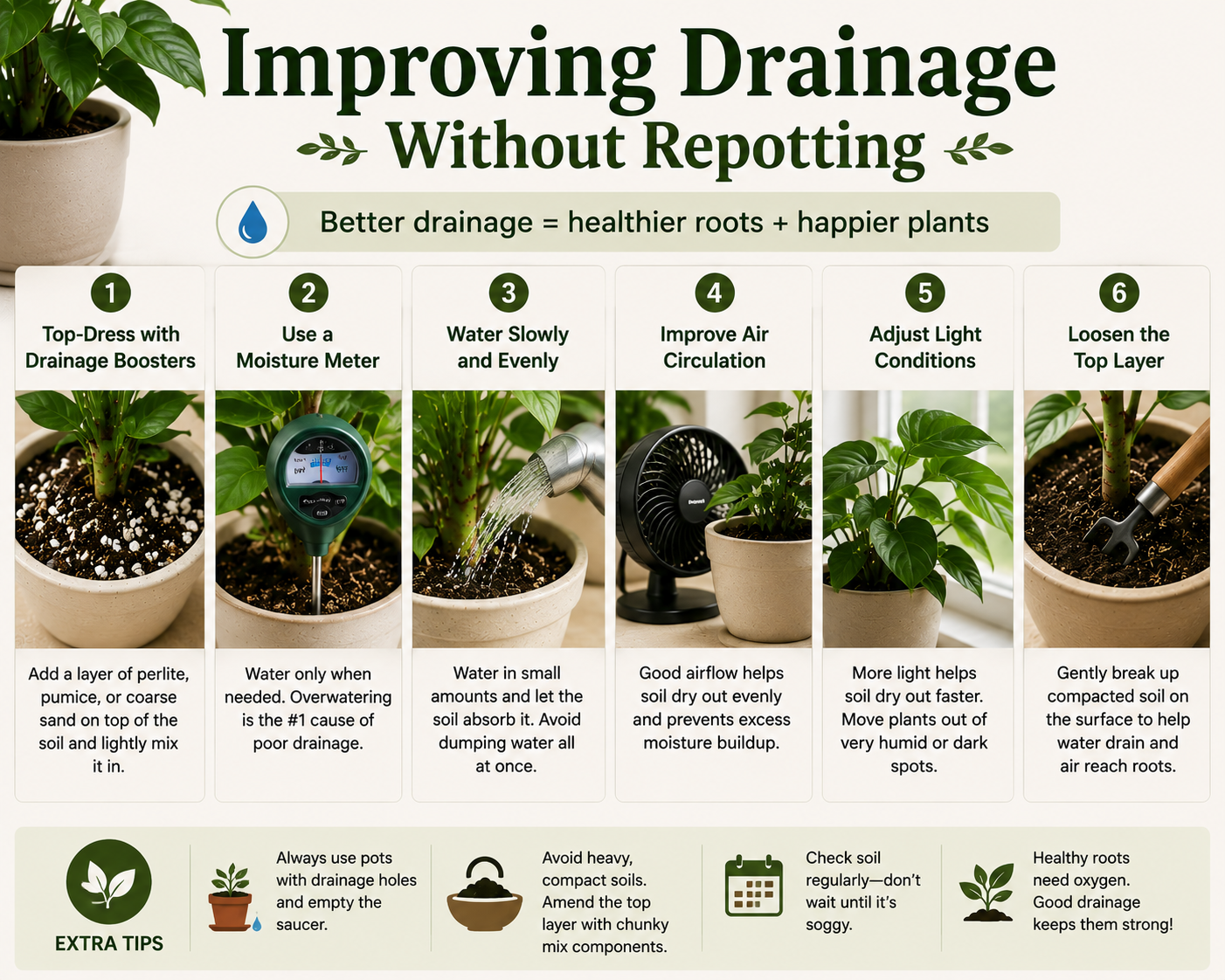
Yes, but only when the problem is still mild.
If the soil structure has fully broken down, repotting is the strongest fix. But if the drainage issue is caused by environmental conditions or minor compaction, temporary improvements can help.
That difference matters.
Low light, low airflow, and cool temperatures all slow the drying cycle. That means the soil stays wet longer, even when the structure is still healthy.
Improving the environment can speed drying.
Ways to improve drainage without repotting
Try these first:
- increase light exposure
- improve room airflow
- reduce watering frequency
- empty standing runoff water
- raise the pot for better air circulation
- aerate the top layer of soil
More light and airflow speed drying by increasing water use and evaporation.
Can compacted soil be saved?
Sometimes.
Mild compaction can be improved if the roots are still healthy.
Use a chopstick or wooden skewer to create air channels through the soil.
This improves temporary airflow but does not rebuild structure.
If roots are healthy, improve the environment first. If roots are failing, replace the soil.
Do Drainage Holes Really Matter?
Yes.
Drainage holes are one of the most important parts of the drainage system.
Without them, excess water has nowhere to go.
That means the lower root zone stays saturated.
Even good soil cannot fix that.
Water movement depends on gravity and an exit path.
Drainage holes create that exit.
Without them, the root zone stays wetter than it should.
That increases root stress.
How drainage holes improve root health
Drainage holes remove excess water and restore oxygen after watering.
This improves root-zone balance after watering.
Roots recover faster when excess water leaves quickly.
Should You Put Rocks at the Bottom of Pots?
No.
This is one of the oldest and most common drainage myths.
Rocks at the bottom do not improve drainage.
They reduce root space and raise the wet zone higher into the pot.
This makes root problems worse.
The reason is simple:
Water moves differently between fine soil and coarse rock.
Fine soil holds water tightly.
Coarse rock creates larger spaces.
Water resists moving into those larger spaces until the upper soil becomes saturated.
This creates a Perched water table.
That perched water table keeps roots wetter.
Not drier.
Why the rock layer myth fails
Problems with bottom rocks:
- reduce usable root space
- raise moisture higher into the root zone
- create uneven moisture layers
- increase root rot risk
The wet zone shifts upward.
That is the opposite of what most plant owners want.
What to do instead
Instead of rocks:
- improve the full soil mix
- add bark or perlite
- use the right pot size
- refresh old soil
- use proper drainage holes
These fix the real drainage problem.
Rocks do not.
What Is the Best Soil Mix for Better Drainage?
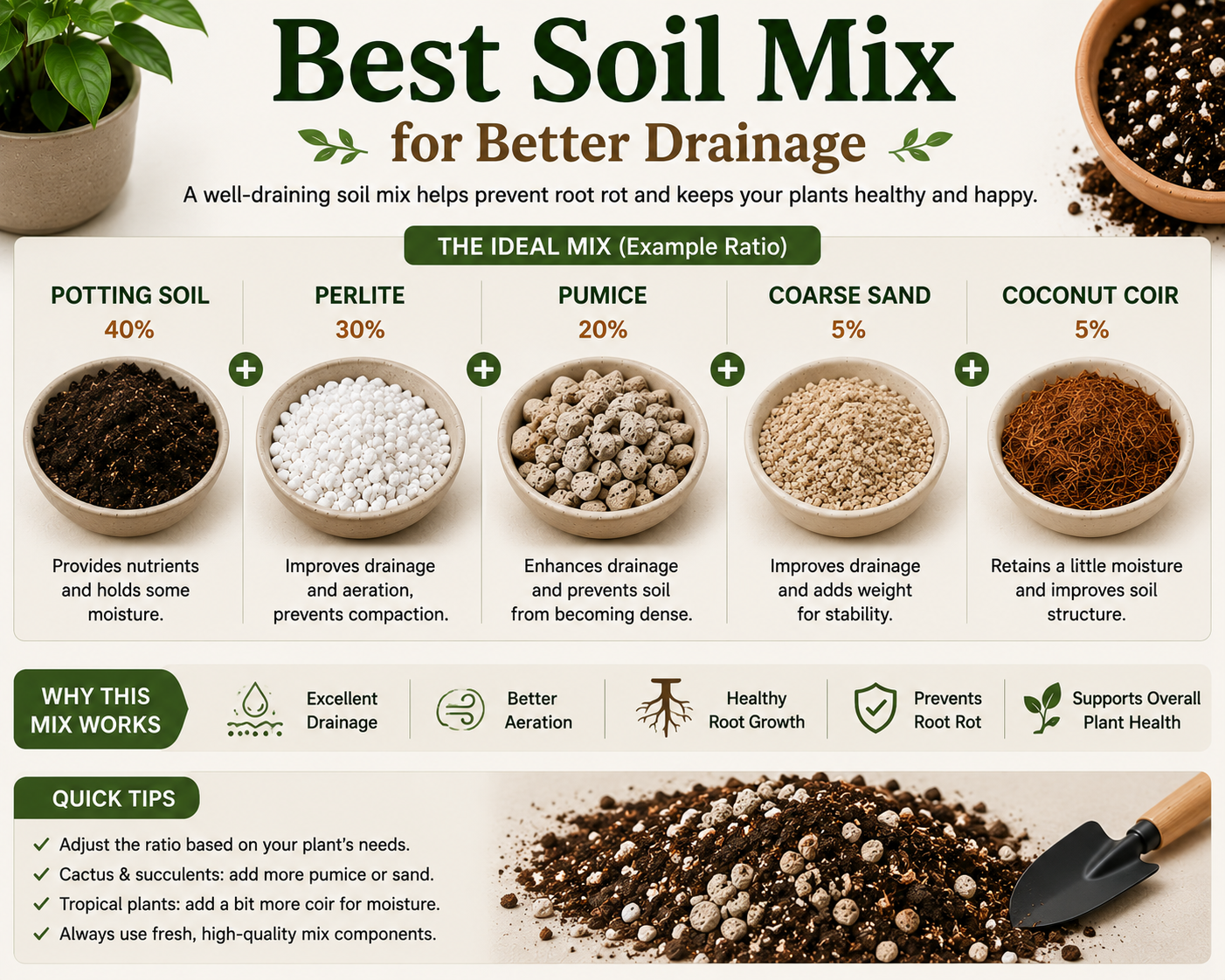
The best soil mix for drainage is not the one that dries the fastest. It is the one that creates balance between moisture retention, airflow, and root stability. Healthy roots need water, but they also need oxygen. A good drainage mix allows both.
That balance comes from structure.
A strong soil mix combines different particle sizes. Fine particles hold moisture. Medium particles stabilize roots. Coarse particles create air channels.
When those materials work together, water moves better and roots stay healthier.
If the soil contains too many fine particles, it compacts.
If it contains too many coarse particles, it dries too fast.
The goal is balance.
Best soil recipes by plant type
tropical plants soil mix:
- 50% potting soil
- 25% perlite
- 15% bark
- 10% coco coir
aroids soil mix:
- 40% potting soil
- 30% bark
- 20% perlite
- 10% charcoal
succulents soil mix:
- 40% cactus mix
- 30% pumice
- 20% coarse sand
- 10% bark
Each mix supports different root behavior.
That matters more than general watering advice.
Soil drying speed comparison by mix type
Different mixes dry at different speeds.
That affects root health.
Chunkier mixes dry faster than dense peat-heavy mixes, especially under stronger light and airflow.
These averages change based on light, airflow, and temperature.
How Do Different Plants Need Different Drainage Levels?
Not all plants want the same drainage speed because not all roots evolved in the same environment.
A succulent and a fern process water differently.
Their roots expect different moisture patterns.
That is why one universal potting mix often creates problems.
Root biology should control drainage.
Not convenience.
Plants adapted to dry climates need fast drainage.
Plants adapted to humid forests need balanced drainage.
Plants adapted to constant moisture still need airflow.
Understanding this prevents root stress.
Tropical Plants Need Balanced Drainage
Tropical plants naturally grow in humid environments with loose organic debris and high airflow.
Their roots expect:
- consistent moisture
- oxygen-rich root zones
- loose decomposing material
Best drainage type:
Medium-fast drainage.
This keeps roots moist without suffocation.
Succulents need fast drainage
Succulents evolved in dry climates where water drains quickly.
Their roots expect:
- short hydration cycles
- fast drying
- low moisture exposure
Dense wet soil quickly increases Root rot risk.
Best drainage type:
Fast to very fast.
Ferns need moisture with airflow
Ferns need moisture, but they still need oxygen.
Their soil should:
- stay moist
- stay airy
- avoid saturation
Best drainage type:
Moderate drainage.
This keeps roots stable.
How Do You Test Soil Drainage at Home?
Testing drainage helps you find problems before roots begin failing.
Most plant owners wait for visible symptoms.
That is often too late.
A simple drainage test gives a better picture of the root environment.
It shows how water moves.
It shows where water stays.
That tells you how healthy the soil structure is.
The Full Drainage Test
Use this method:
- Water the plant fully until runoff appears
- Watch how quickly the water absorbs
- Check how quickly runoff exits
- Lift the pot after a few days to check weight
- Use a wooden stick to test deeper moisture
Healthy drainage usually means:
- quick surface absorption
- visible runoff within seconds
- lighter pot weight in 3–5 days
- gradual top-to-bottom drying
Bad drainage usually means:
- water pooling on the surface
- slow runoff
- heavy wet pots after days
- wet lower root zones
These patterns reveal hidden saturation.
Why top soil dries faster than bottom soil
The top layer loses moisture through evaporation.
The bottom layer loses moisture through root absorption and gravity.
That takes longer.
This is why the top may feel dry while the bottom stays wet.
That creates hidden root stress.
This is common in dense soil.
What Mistakes Make Soil Drainage Worse?
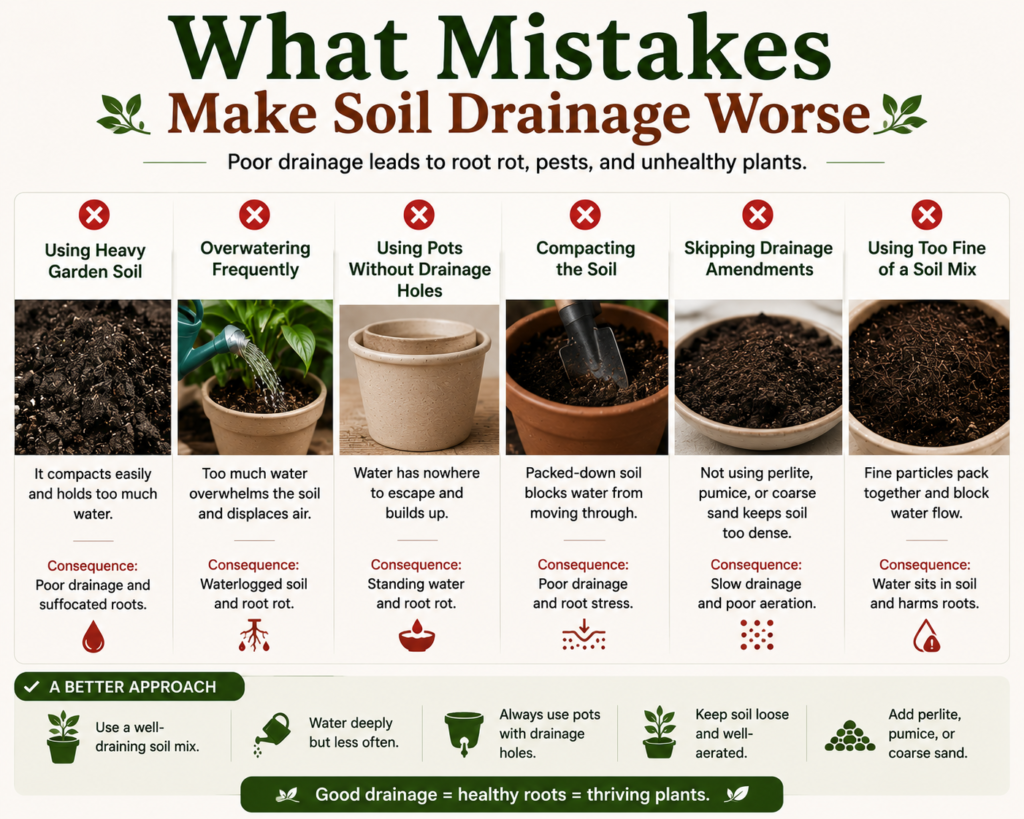
Many drainage problems are caused by plant care habits.
Not just bad soil.
Small mistakes repeated over time slowly weaken soil structure and root health.
That makes drainage worse.
Most people focus on how much they water.
But how often, where the plant sits, and what soil it grows in matter just as much.
The most common drainage mistakes
Major mistakes include:
- watering on schedule instead of checking soil
- using oversized pots
- keeping old soil too long
- using decorative pots that trap runoff
- using garden soil indoors
- adding rocks at the bottom
- ignoring root-bound plants
Each mistake increases moisture imbalance.
That increases root stress.
Why repeated overwatering increases compaction
Repeated saturation changes particle behavior.
Organic materials soften.
Fine particles settle.
This increases Soil compaction.
More compaction means:
- less airflow
- slower drainage
- weaker roots
This creates a cycle.
Wet soil causes compaction.
Compaction causes wetter soil.
That cycle keeps repeating.
How Do You Know If Your Pot Is Too Big?
Pot size directly affects drainage.
A pot that is too large holds more soil than the roots can manage.
More soil means more stored moisture.
If the roots cannot absorb it fast enough, the soil stays wet longer.
Signs your pot is oversized:
- soil stays wet for many days
- roots occupy less than half the pot
- slow growth after repotting
- yellowing after watering
Best rule:
Choose a pot only 1–2 inches wider than the root ball.
How Can Better Drainage Prevent Root Rot?
Root rot is one of the most common and destructive results of poor drainage. It does not start because roots touch water. It starts because roots stay in oxygen-poor soil for too long.
Roots need oxygen for respiration.
Respiration powers:
- nutrient absorption
- water movement
- root repair
- energy production
When soil stays saturated, pore spaces fill with water instead of air.
That blocks oxygen movement.
Once oxygen drops, roots weaken.
Weak roots become vulnerable to fungal attack.
That is when root rot begins.
This process often starts slowly.
But once root tissue begins collapsing, damage spreads fast.
That is why prevention matters more than treatment.
The root rot chain reaction
Poor drainage traps water, removes oxygen, weakens roots, and increases fungal infection risk.
What happens to roots when soil loses oxygen?
When oxygen disappears, roots enter survival mode.
Instead of efficient respiration, they switch into Anaerobic respiration.
This process produces less energy.
That weakens the root system.
Weak roots absorb less water.
That is why wet plants can still wilt.
Signs roots are losing oxygen:
- drooping with wet soil
- yellowing lower leaves
- slow recovery after watering
- weak new growth
- black root tips
This is one of the strongest hidden signals of drainage failure.
How better drainage protects roots
Healthy drainage improves:
- oxygen return after watering
- root tissue recovery
- microbial balance
- nutrient movement
- stronger root growth
Healthy wet-dry cycles strengthen roots.
Constant saturation weakens them.
Final Decision: When Should You Replace the Soil Completely?
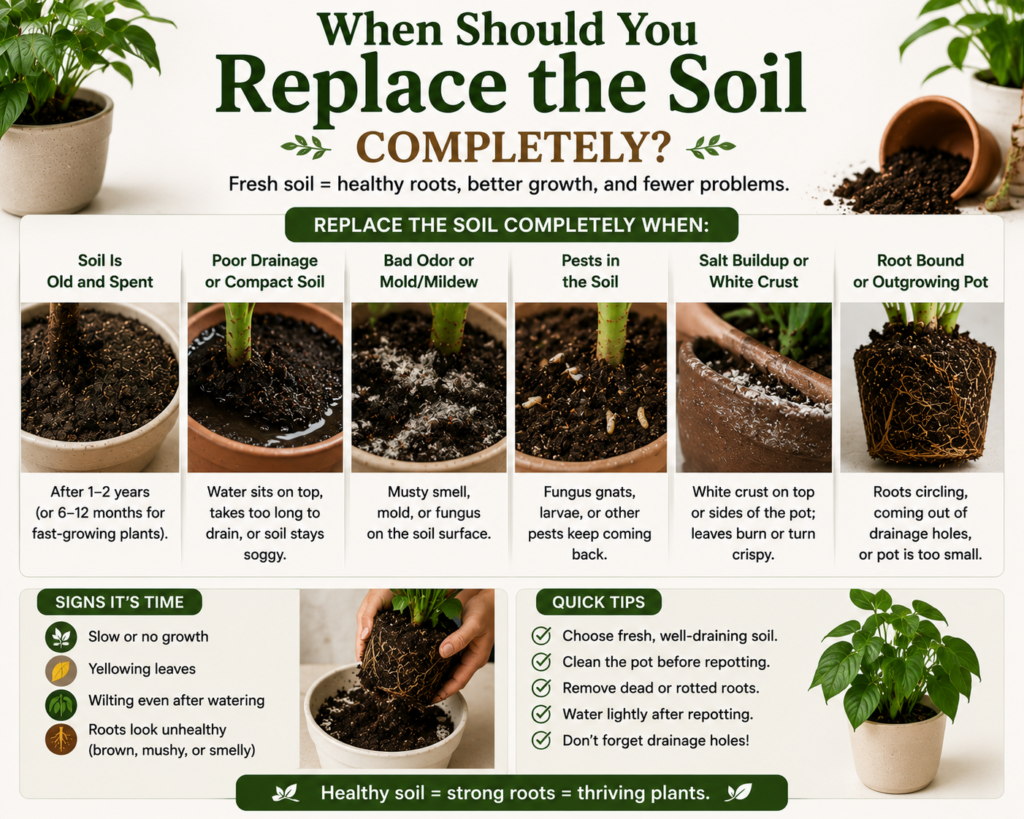
Not all drainage problems can be fixed with small changes.
Sometimes the soil structure has completely failed.
When that happens, replacing the soil is the best option.
Old soil changes physically over time.
Organic matter breaks down.
Fine particles build up.
Pore spaces disappear.
Water movement slows.
That changes the entire root environment.
Even if the plant still looks stable, the soil may already be failing.
Replacing the soil resets the root system.
It restores:
- airflow
- drainage
- structure
- root balance
This gives roots a healthier recovery environment.
Signs the soil needs full replacement
Replace the soil if:
- soil stays wet for over 10 days
- water pools on the surface
- the soil smells sour
- roots feel mushy
- fungus gnats keep returning
- the mix feels muddy
- plant decline continues despite corrections
These are strong structural failure signs.
At that point, adding small amounts of perlite will not fix the deeper issue.
The whole system needs rebuilding.
How to replace the soil properly
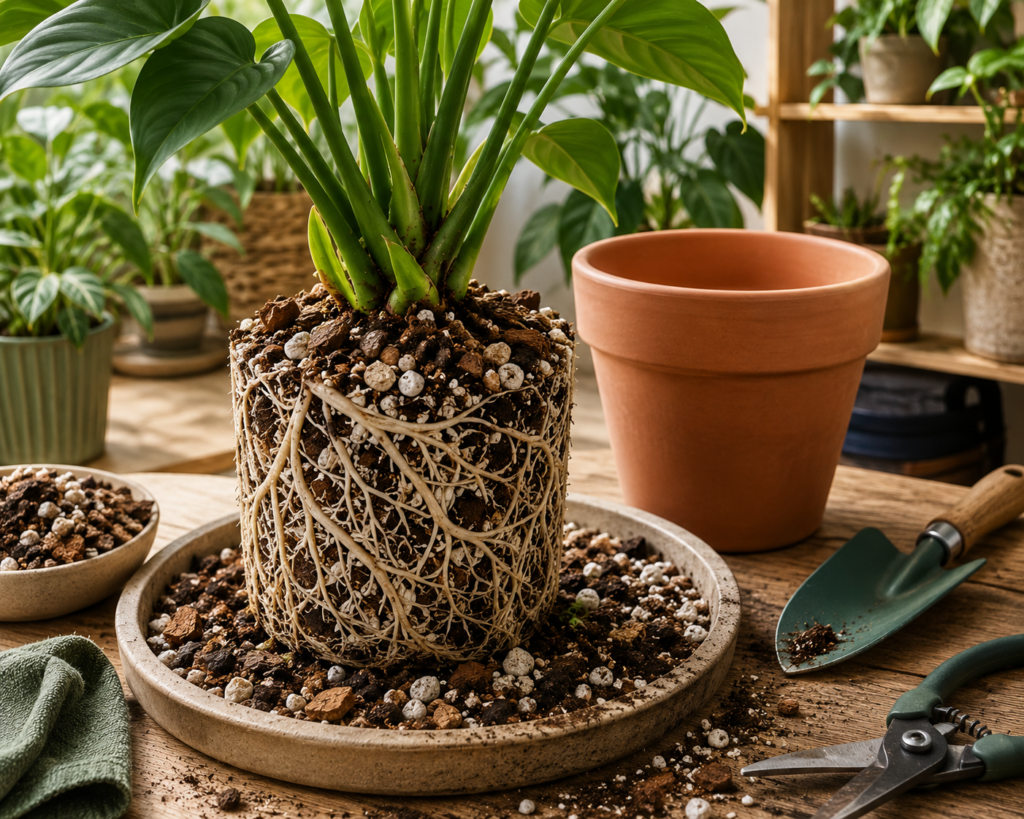
Follow this process:
- Remove the plant carefully
- Shake off old soil
- Inspect root health
- Trim damaged roots
- Clean the pot
- Check drainage holes
- Build fresh soil mix
- Repot and water thoroughly
Best rebuilding materials:
- Perlite
- Pumice
- Orchid bark
- Coco coir
This rebuilds the root environment from the ground up.
Preventive soil replacement timeline
Even healthy plants benefit from fresh soil.
General timeline:
- tropical plants: every 12–18 months
- fast growers: every 12 months
- succulents: every 18–24 months
- orchids: every 12–24 months
Preventive replacement is easier than root recovery.
Best Ready-Made Soil Mixes for Better Drainage
Not every plant owner wants to build a custom mix.
Ready-made soil blends can work well if they match the plant’s root behavior.
The key is choosing based on structure, not marketing labels.
What to Look for in a Ready-Made Soil Mix
- chunky texture
- visible bark
- perlite or pumice
- balanced moisture retention
Best Ready-Made Soil Mixes by Plant Type
- tropical plants → chunky indoor plant mix
- aroids → bark-heavy aroid mix
- succulents → cactus and pumice mix
- orchids → bark-based orchid mix
A ready-made mix is only useful if its drainage behavior matches the plant.
FAQ section
How do I improve soil drainage for houseplants quickly?
Repot into a chunkier mix using Perlite, Pumice, or Orchid bark. These create air spaces and help excess water leave faster.
Why does my houseplant soil stay wet for so long?
This usually happens because of compaction, oversized pots, low light, or weak drainage holes. These slow water movement and keep roots wet longer.
Can poor drainage kill houseplants?
Yes. Poor drainage can cause root oxygen loss and Root rot. If untreated, roots may fail completely.
Is perlite or pumice better for soil drainage?
Perlite improves drainage faster. Pumice offers stronger long-term structure. The better choice depends on the plant and pot size.
Do drainage holes really matter?
Yes. Drainage holes allow excess water to escape and prevent the lower root zone from staying saturated.
Can root rot be reversed by improving drainage?
Yes, if caught early. Remove damaged roots, replace the soil, and improve drainage so healthy roots can regrow.
Myra is the founder and lead writer of Plantsaholic. She shares practical, research-backed advice on indoor plants, outdoor gardening, flowers, herbs, succulents, and everyday plant care. Her goal is to help gardeners of all experience levels grow healthier plants through simple, easy-to-follow gardening guides.