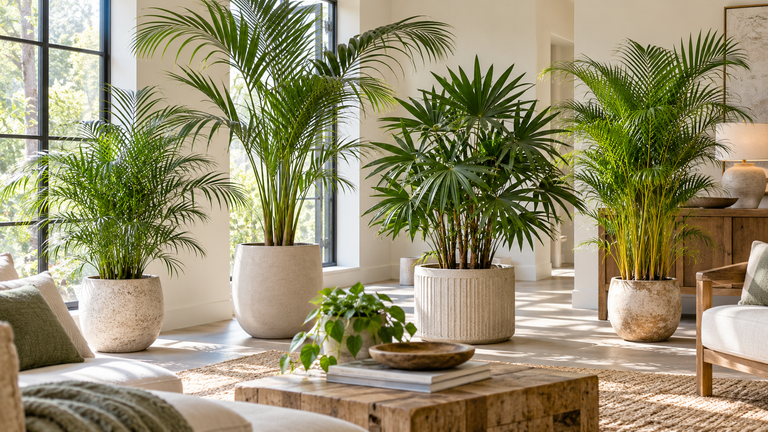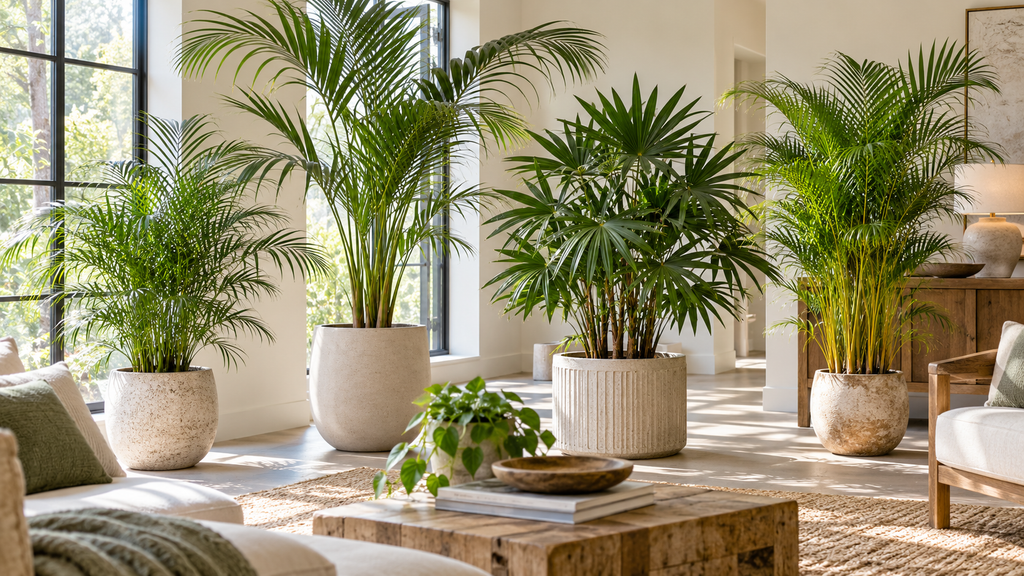
Indoor palm plants add height, soft greenery, and a tropical feel to a room. But the best indoor palm is not simply the one that looks most attractive at the nursery.
Parlor palm, kentia palm, lady palm, and areca palm are among the strongest indoor choices because they suit different combinations of light, available space, and maintenance.
The right choice depends mainly on:
- How much usable natural light your room receives
- How much space mature fronds will have
- How much ongoing care you can realistically provide
Some palms tolerate lower light and smaller rooms, while others need brighter conditions and considerably more space.
This guide covers the best indoor palm plants, low-light options, small palms, identification, care, common problems, pet safety, benefits, and how to choose a healthy palm for your home.
Best Indoor Palm Plants
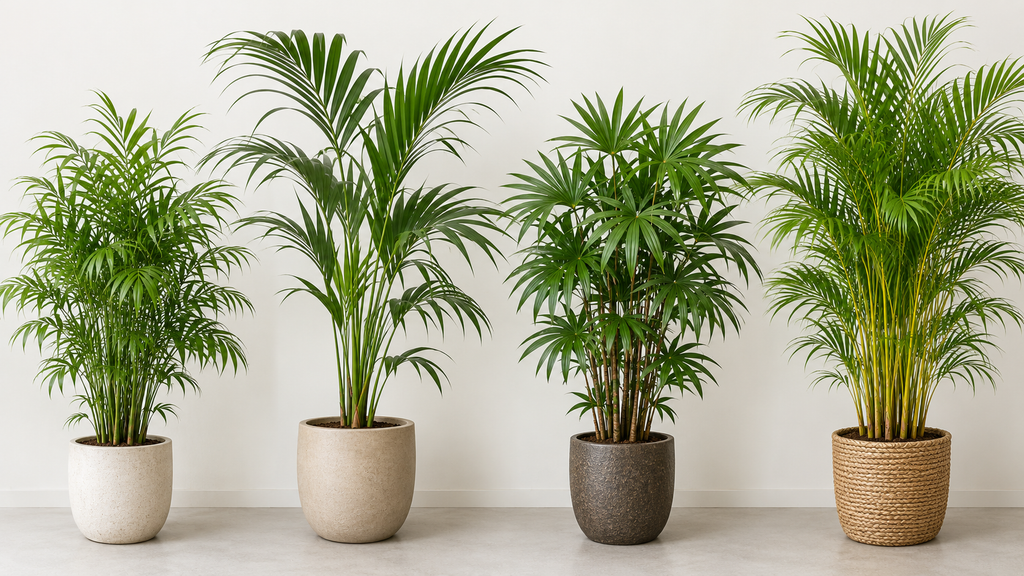
There is no single best palm for every home. A compact apartment, shaded office, bright living room, and large open-plan interior all provide different growing conditions.
For most homes, four palms provide the strongest starting point:
- Parlor palm
- Kentia palm
- Lady palm
- Areca palm
1. Parlor Palm
The parlor palm (Chamaedorea elegans) is one of the best indoor palms for beginners and smaller homes.
It grows slowly, stays relatively compact, and tolerates lower indoor light better than many tropical palms.
Its fine, feather-like fronds create a graceful appearance without taking up as much room as larger species.
Choose a parlor palm if you want:
- A compact indoor palm
- Better lower-light tolerance
- Slow growth
- Fine green foliage
- A beginner-friendly houseplant
- A palm suitable for bedrooms or apartments
Parlor palm is also commonly listed as non-toxic to cats and dogs.
2. Kentia Palm
Kentia palm (Howea forsteriana) is a better choice when you want a taller statement plant.
Its dark green, arching fronds create an elegant, tree-like appearance that works especially well in:
- Living rooms
- Entryways
- Offices
- Large bedrooms
- Open-plan interiors
Kentia palms grow slowly and tolerate indoor growing conditions better than many large tropical palms.
Choose kentia palm if you want:
- A large floor plant
- Graceful arching foliage
- Moderate light tolerance
- Slow growth
- A long-term statement plant
3. Lady Palm
Lady palm (Rhapis excelsa) looks quite different from feather-leaved palms.
It produces divided, fan-shaped leaves and grows in a clumping form, giving it a more structured and architectural appearance.
Lady palm is particularly useful if you want:
- Fan-shaped foliage
- Lower-light tolerance
- Upright growth
- A medium-sized indoor palm
- Strong architectural texture
4. Areca Palm
Areca palm (Chrysalidocarpus lutescens) produces multiple yellow-green stems and dense, feathery foliage.
You may also see the older botanical name Dypsis lutescens on plant labels.
Areca palms generally perform best in brighter indirect light and require more width than parlor palms.
Choose an areca palm if you have:
- Bright indirect light
- Medium to large floor space
- Room for spreading fronds
- A preference for dense tropical foliage
For a quick decision:
Parlor palm → smaller or lower-light rooms
Kentia palm → large elegant statement plant
Lady palm → fan-shaped foliage
Areca palm → bright interiors and lush foliage
Best Indoor Palms by Light and Size
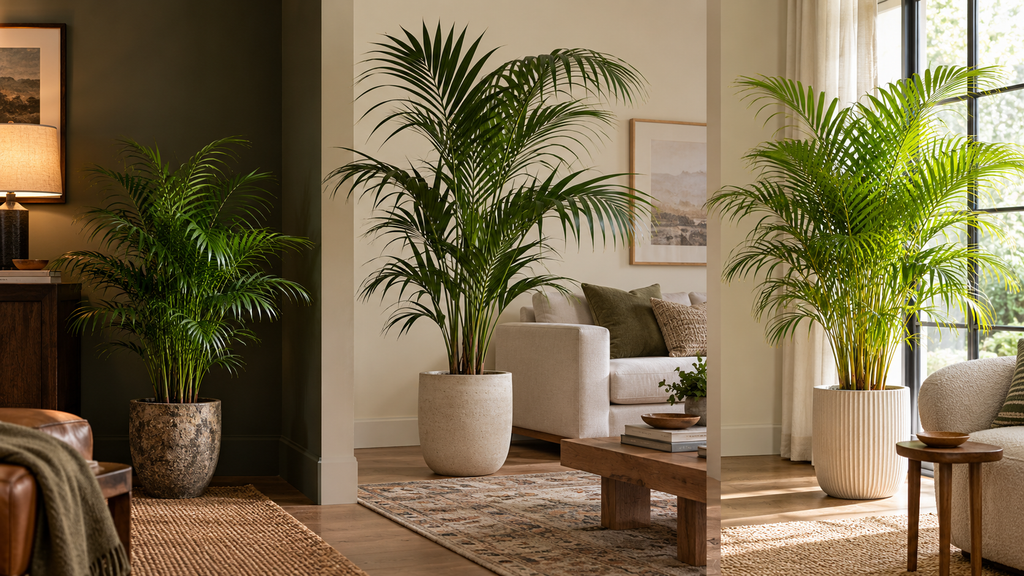
Nursery size can be misleading because most palms are sold while young.
Mature height, frond spread, growth habit, and light requirements are much more useful when deciding whether a palm will fit your room long term.
| Palm | Light | Indoor Size | Care | Best For |
|---|---|---|---|---|
| Parlor Palm | Low to bright indirect | Small-medium | Easier | Small rooms |
| Kentia Palm | Moderate to bright indirect | Large | Moderate | Statement spaces |
| Lady Palm | Low to bright indirect | Medium | Moderate | Shadier rooms |
| Areca Palm | Bright indirect | Medium-large | Moderate | Bright interiors |
| Bamboo Palm | Medium indirect | Medium-large | Moderate | Upright greenery |
| Cat Palm | Bright indirect | Medium | Moderate | Dense foliage |
| Majesty Palm | Bright indirect | Large | More demanding | Large bright rooms |
| Pygmy Date Palm | Bright indirect | Small-medium | Moderate | Compact tree form |
| Chinese Fan Palm | Bright indirect | Medium-large | Moderate | Fan foliage |
| Fishtail Palm | Bright indirect | Large | Moderate | Unusual foliage |
Parlor palm is usually the strongest choice where space is limited.
Kentia palm works better where vertical room is available, while areca palm requires both height and width because its fronds spread outward.
Majesty palm is commonly sold as a houseplant, but it is generally more demanding than parlor or kentia palm.
Also consider width, not just height. A 4-foot palm with broad fronds may require more usable room than a taller but narrower palm.
How to Choose the Right Indoor Palm
Start with the room rather than choosing a palm based only on appearance.
Before buying, check:
- Available natural light
- Distance from the nearest window
- Ceiling height
- Available floor width
- Heating or air-conditioning vents
- Normal room temperature
- Pets or children
- How often you realistically check your plants
For a lower-light room, start with:
- Parlor palm
- Lady palm
- Kentia palm
For a bright room with filtered light, areca palm becomes a stronger option.
Avoid choosing a palm if its mature fronds will constantly block walkways or brush furniture.
Large palms also cannot simply be cut shorter later in the same way as many branching houseplants.
The most reliable rule is:
Choose the palm that already matches your home rather than buying a difficult species and trying to compensate later.
Low-Light Indoor Palm Plants
Parlor palm, lady palm, and kentia palm are among the best indoor palms for lower-light conditions.
However, low-light tolerant does not mean no light. Palms still need usable light for photosynthesis, and their growth generally slows as light decreases.
Parlor Palm in Low Light
Parlor palm is one of the strongest choices for dimmer rooms.
It may grow more slowly in low light, but it generally tolerates those conditions better than many tropical palms.
Lady Palm in Low Light
Lady palm combines useful shade tolerance with larger fan-shaped foliage.
It can work well in offices and indoor spaces where stronger sunlight is unavailable.
Kentia Palm in Low Light
Kentia palm is particularly useful because it can provide the look of a large statement palm without requiring extremely bright light.
Areca Palm in Low Light
Areca palm is not the strongest option for genuinely dim rooms.
It generally performs better in bright indirect or filtered light.
For darker interiors, shortlist parlor, lady, and kentia palms before areca.
Small Indoor Palm Plants
Parlor palm is one of the most practical small indoor palm plants because it grows slowly and stays manageable for a long time.
Young parlor palms can work:
- On plant stands
- Beside desks
- In bedrooms
- In compact living rooms
They can later transition into small floor plants.
Pygmy Date Palm
Pygmy date palm (Phoenix roebelenii) is another relatively compact option if you want a more traditional palm-tree appearance.
It generally requires brighter light than parlor palm and may have sharp structures around the bases of its leaves.
Avoid placing it directly beside busy walkways.
Young lady palms may also suit moderate spaces, although their clumping habit eventually requires more width.
Do not attempt to keep a naturally large palm permanently small by using an undersized pot.
Choose a naturally compact palm instead.
How to Identify Indoor Palm Plants
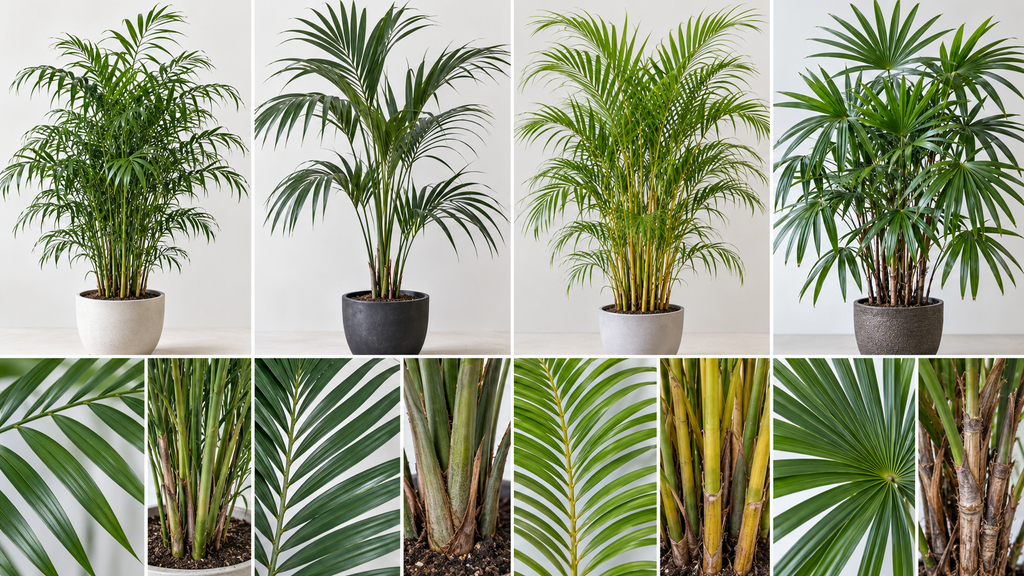
Indoor palms are easier to identify when you look at several features together rather than relying on one characteristic.
Check:
- Frond shape
- Leaflet arrangement
- Stem structure
- Overall growth habit
Check the Frond Shape
Feather-Shaped Palms
These are also called pinnate palms.
Examples include:
- Parlor palm
- Kentia palm
- Areca palm
- Pygmy date palm
Fan-Shaped Palms
These are also called palmate palms.
Examples include:
- Lady palm
- Chinese fan palm
Frond shape is usually one of the quickest ways to narrow down identification.
Check the Stems
Look for:
- One main trunk
- Several slender canes
- Bamboo-like nodes
- A clumping habit
- Yellow-green stems
Areca palms commonly show multiple cane-like stems, while kentia palms have a more tree-like appearance.
Check the Leaflets
Compare:
- Width
- Length
- Spacing
- Color
- Texture
- Degree of arching
Kentia palm foliage generally appears broader and more relaxed than the finer foliage of parlor palm.
Important Parlor Palm Identification Note
Parlor palm may appear naturally clumping because commercial growers frequently place several individual seedlings in one pot.
Each Chamaedorea elegans plant is naturally solitary.
Several stems emerging from one nursery container therefore do not automatically mean the species naturally produces a clump.
For accurate palm identification, photograph:
- The entire plant
- Plant base
- One complete frond
- Leaflet close-up
- Stem or trunk
Indoor Palm Plants Names
Common names can sometimes be confusing, so botanical names are more reliable.
| Common Name | Botanical Name |
|---|---|
| Parlor Palm | Chamaedorea elegans |
| Kentia Palm | Howea forsteriana |
| Lady Palm | Rhapis excelsa |
| Areca Palm | Chrysalidocarpus lutescens |
| Bamboo Palm | Chamaedorea seifrizii |
| Cat Palm | Chamaedorea cataractarum |
| Majesty Palm | Ravenea rivularis |
| Pygmy Date Palm | Phoenix roebelenii |
| Chinese Fan Palm | Livistona chinensis |
| Fishtail Palm | Caryota mitis |
Not every plant with “palm” in its common name is a true palm.
True palms belong to the family Arecaceae.
Sago palm (Cycas revoluta), for example, is a cycad rather than a true palm, and this distinction is important because sago palm is highly toxic to pets.
How to Care for Indoor Palm Plants
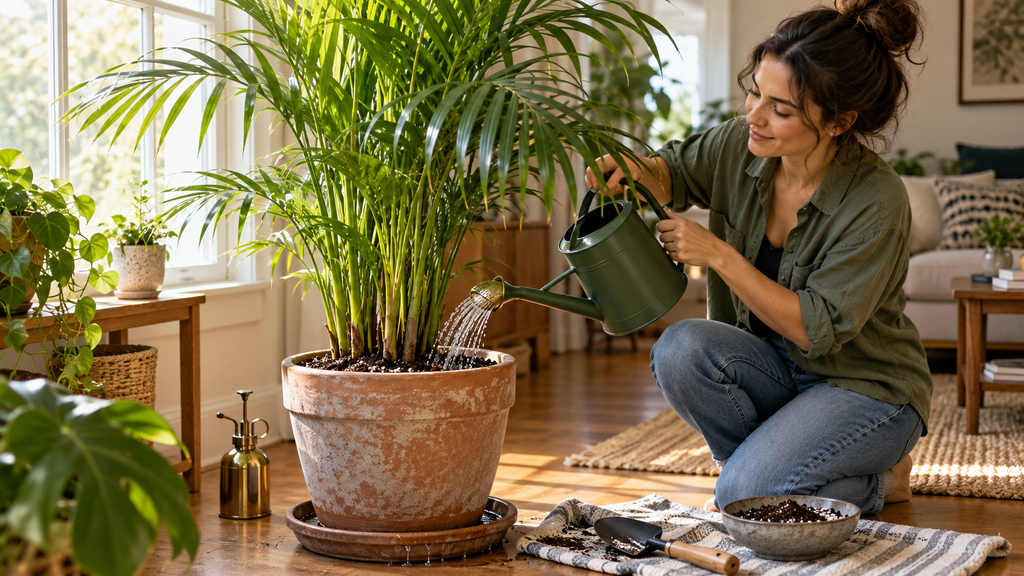
Successful indoor palm care depends on balancing:
- Light
- Water
- Drainage
- Temperature
- Humidity
- Nutrition
Light
Most indoor palms perform best in bright filtered or indirect light, although some tolerate lower light.
As a general guide:
| Palm | Preferred Light |
|---|---|
| Parlor Palm | Low to bright indirect |
| Kentia Palm | Moderate to bright indirect |
| Lady Palm | Low to bright indirect |
| Areca Palm | Bright indirect |
Avoid suddenly moving a shade-grown palm into strong direct sunlight through glass because the foliage can scorch.
Water
Do not water indoor palms according to a fixed weekly schedule.
Instead:
- Check the growing medium.
- Consider how quickly it dried previously.
- Water thoroughly when appropriate.
- Let excess water drain.
- Empty standing water from saucers or decorative pots.
Water use changes depending on:
- Season
- Temperature
- Plant size
- Light
- Container size
A palm growing in bright summer conditions may dry much faster than the same species during winter.
Soil and Drainage
Indoor palms need a potting medium that holds some moisture but also allows excess water and air to move through the roots.
Avoid:
- Dense garden soil
- Containers without drainage
Humidity and Temperature
Many palms appreciate moderate humidity and relatively stable warmth.
Keep palms away from:
- Heating vents
- Radiators
- Strong air-conditioning
- Cold drafts
- Sudden temperature changes
If indoor air is genuinely dry, a room humidifier can be more effective than repeatedly misting the foliage.
Fertilizer
Feed appropriately during active growth and follow the fertilizer directions.
More fertilizer is not automatically better. Excess fertilizer may contribute to salt buildup and damaged foliage.
Repotting
Repot when:
- Roots densely fill the pot
- The plant becomes unstable
- Potting mix breaks down
- The root ball begins drying unusually quickly
Move the palm into a moderately larger container instead of jumping to an oversized pot.
Pruning and Cleaning
Remove completely dead or severely damaged fronds when necessary.
Do not cut healthy foliage simply to control size, and avoid damaging the main growing point.
Clean dusty leaves gently and inspect for:
- Spider mites
- Scale
- Mealybugs
- Sticky residue
- Webbing
- Damaged new growth
Avoid depending on commercial leaf-shine products to make the foliage look healthy.
Adjust Indoor Palm Care to Your Climate
Indoor conditions vary significantly.
Hot or Dry Homes
Monitor:
- Rapid soil drying
- Very low humidity
- Strong air-conditioning
Humid Climates
Watch for:
- Slow soil drying
- Waterlogged growing medium
- Poor airflow
Cooler Climates
Palms generally use less water during darker winter months.
Always respond to the conditions around the actual plant rather than copying another grower’s watering schedule.
Why Indoor Palm Leaves Turn Brown or Yellow
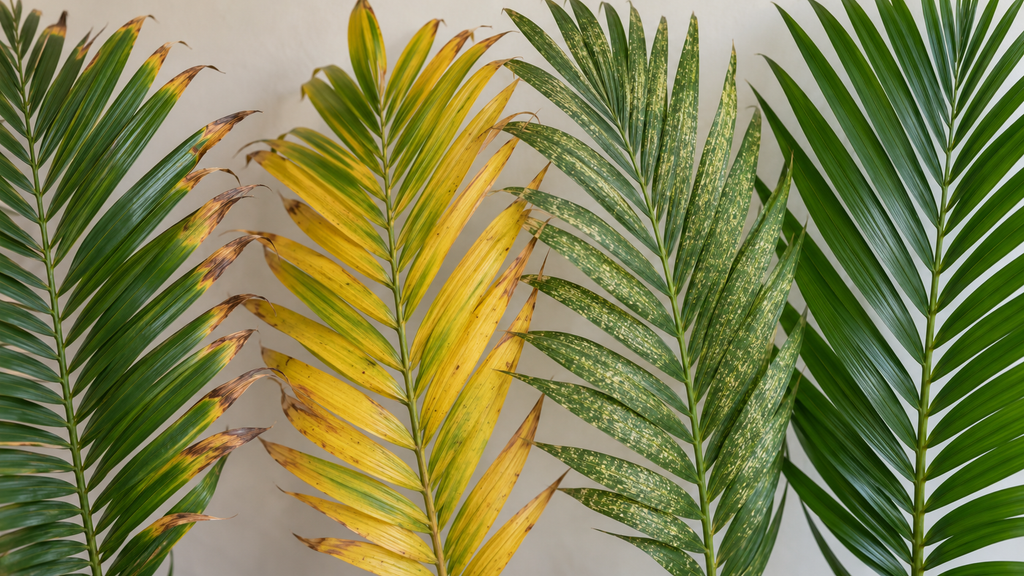
Brown and yellow leaves are symptoms, not diagnoses.
Several different problems can create similar-looking damage.
| Symptom | Possible Causes | First Check |
|---|---|---|
| Brown tips | Dryness, salts, inconsistent watering | Soil and environment |
| Yellow leaves | Moisture, drainage, aging | Root zone |
| Crispy foliage | Dry conditions | Soil moisture |
| Pale foliage | Light or nutrition | Plant location |
| Fine webbing | Spider mites | Leaf undersides |
| Sticky leaves | Scale insects | Stems and leaves |
Brown Palm Tips
Brown tips can result from:
- Inconsistent watering
- Dry air
- Fertilizer buildup
- Mineral salts
- Root stress
- Environmental changes
Damaged tissue will not turn green again.
Focus on preventing the problem from appearing on new growth.
Yellow Palm Leaves
Yellowing can result from:
- Excess moisture
- Poor drainage
- Insufficient light
- Nutrient problems
- Root stress
- Natural aging
One lower frond gradually turning yellow is much less concerning than rapid yellowing across the entire plant.
Check Which Fronds Are Affected
Older foliage developing problems may indicate:
- Natural aging
- Long-term stress
- Some nutritional issues
Problems appearing primarily in new growth deserve closer attention to:
- Root health
- Nutrient availability
- Growing conditions
Always examine the pattern before adding fertilizer, pesticides, or extra water.
Common Indoor Palm Pests
Indoor palms may attract:
- Spider mites
- Scale insects
- Mealybugs
Regularly inspect:
- Leaf undersides
- Stems
- Areas around new growth
Early detection usually makes pest problems easier to manage.
Are Indoor Palm Plants Pet Safe?
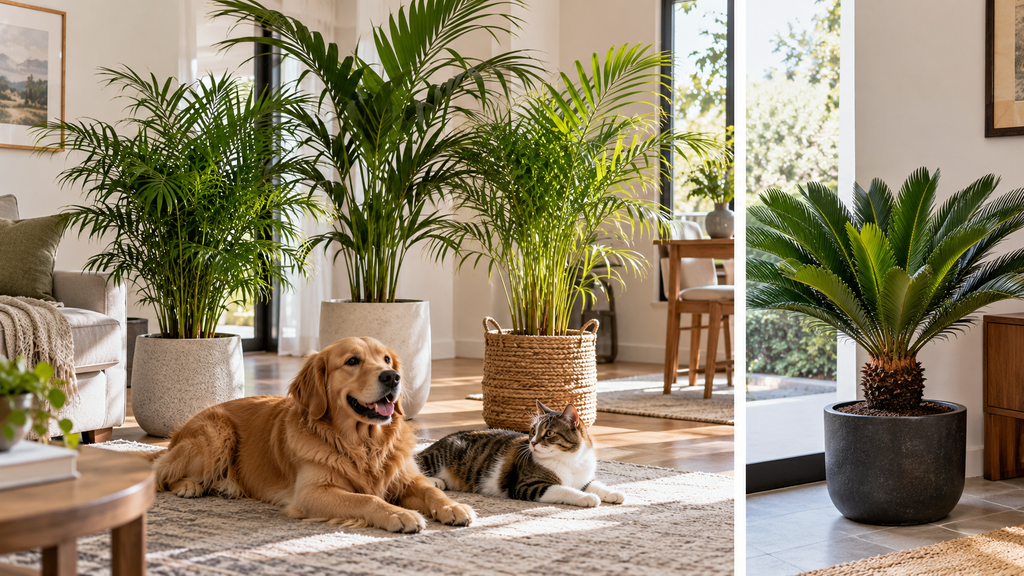
Pet safety depends on the exact species.
Parlor palm, areca palm, and kentia palm are commonly listed as non-toxic to cats and dogs.
However, never assume that every plant containing the word “palm” in its common name is safe.
The most important example is sago palm (Cycas revoluta).
Sago palm is actually a cycad rather than a true palm and is highly toxic to cats and dogs.
Always verify the botanical name when buying plants for a home with pets.
Even non-toxic plants should not intentionally be offered to pets because consuming large amounts of plant material may still cause digestive upset.
Indoor Palm Plant Benefits
The most dependable benefits of indoor palm plants are visual rather than medical.
Palms can provide:
- Vertical greenery
- Tropical character
- Natural texture
- Softer contrast against walls and furniture
- Strong architectural shapes
- Greater visual connection with natural forms indoors
Different species create different effects.
Kentia palm provides elegant height.
Areca palm creates lush fullness.
Lady palm provides structured fan foliage.
Parlor palm brings fine greenery into smaller rooms.
Do Indoor Palms Purify the Air?
Plants can interact with airborne compounds under controlled experimental conditions, but ordinary numbers of houseplants should not be treated as substitutes for proper ventilation or effective air filtration.
Grow indoor palms primarily because you enjoy their foliage and appearance rather than expecting several plants to function like mechanical air cleaners.
Do Palms Increase Humidity?
Plants release moisture through transpiration, but one palm usually has a limited effect on the humidity of an entire room.
The effect depends on:
- Room size
- Ventilation
- Temperature
- Plant size
If your room is genuinely too dry, use an appropriate humidity solution rather than depending on a single palm.
How to Buy a Healthy Indoor Palm
Once you know which species suits your room, inspect the individual plant before buying.
Check:
- New growth
- Leaf undersides
- Stems
- Growing point
- Overall leaf color
- Pest activity
- Soil condition
- Plant stability
- Botanical label
Avoid plants showing:
- Widespread unexplained yellowing
- Heavy webbing
- Obvious scale insects
- Severely damaged new growth
- Permanently saturated soil
A few brown tips on older foliage are not always a major problem.
Active pests and damage to new growth are more concerning.
Also consider long-term size rather than simply choosing the biggest specimen available.
The best purchase is the healthiest palm that matches your room.
Indoor Palm Plants Photos and Identification
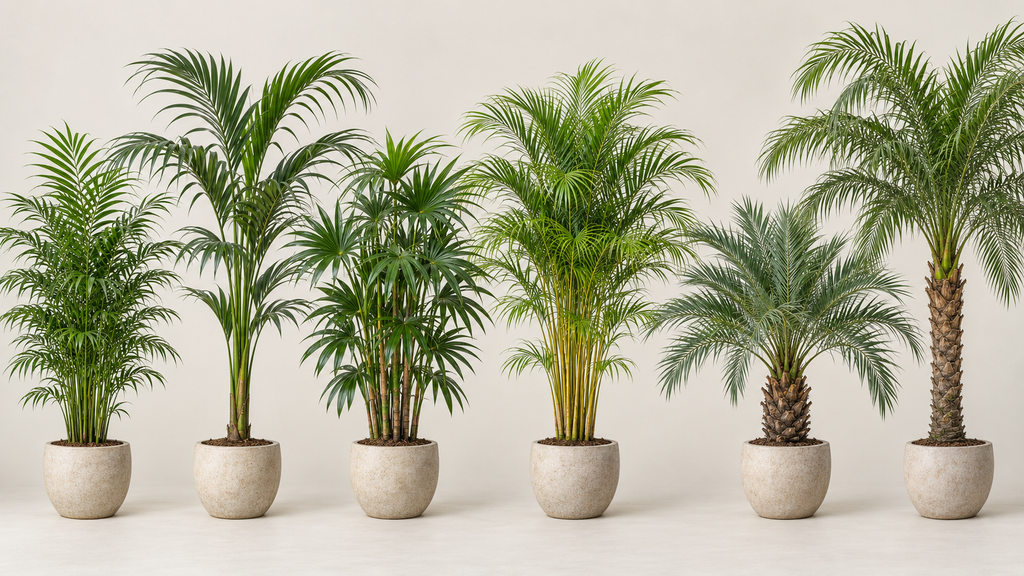
Palm photos are most useful when they help identify the species rather than simply decorate an article.
For each major palm, photograph the full plant and its key identifying features.
Parlor Palm
Look for:
- Fine feather-like foliage
- Narrow leaflets
- Compact appearance
Nursery pots frequently contain several individual seedlings.
Kentia Palm
Look for:
- Long arching fronds
- Broader leaflets
- Graceful tree-like appearance
Lady Palm
Look for:
- Divided fan-shaped leaves
- Multiple upright stems
- Dense clumping growth
Areca Palm
Look for:
- Narrow feather-like leaflets
- Multiple yellow-green stems
- Full bushy appearance
Pygmy Date Palm
Look for:
- Traditional small palm-tree form
- Narrow leaflets
- Possible sharp structures near lower leaf bases
For the strongest identification photo, capture:
- Entire plant
- Base
- Full frond
- Leaflet close-up
- Stem or trunk
Indoor Palm Plants FAQs
What is the best indoor palm for most homes?
Parlor palm is one of the strongest all-round choices because it remains manageable and tolerates lower light. Kentia palm is better when you want a larger statement plant.
Which indoor palm is easiest to care for?
Parlor palm is usually one of the easiest options for beginners. It grows slowly and adapts to ordinary indoor conditions better than many more demanding palms.
Which indoor palm is best for low light?
Parlor, lady, and kentia palms are among the strongest lower-light choices. They still need usable natural light and should not be placed in complete darkness.
Do indoor palms need direct sunlight?
Most popular indoor palms prefer bright filtered or indirect light. Strong direct sunlight through glass can damage the foliage of some species.
How often should I water an indoor palm?
Water according to the condition of the growing medium rather than following a fixed calendar. Check the soil first, water thoroughly when appropriate, and allow excess water to drain.
Why are my palm leaves turning brown?
Brown tips can result from inconsistent watering, dry air, salt buildup, root stress, or environmental changes. Check the whole growing environment before treating one suspected cause.
Why are my palm leaves turning yellow?
Yellow foliage can result from wet soil, poor drainage, low light, nutrient problems, root stress, or natural aging. The location and pattern of yellowing can help narrow down the cause.
Should I mist my indoor palm?
Misting is optional and only provides short-term surface moisture. Improving overall room humidity and keeping palms away from heating or cooling vents is more useful when the air is genuinely dry.
Which indoor palm stays small?
Parlor palm is one of the most practical compact options. Pygmy date palm is another relatively small choice when brighter light is available.
Are indoor palms safe for pets?
Parlor, kentia, and areca palms are generally considered non-toxic to cats and dogs. Sago palm is different because it is a toxic cycad rather than a true palm.
Can you cut the top off an indoor palm?
No. Damaging the main growing point can seriously injure or kill the palm. Choose a naturally smaller species if mature height is a concern.
Can indoor palms grow from cuttings?
Most palms cannot be propagated from ordinary stem cuttings. Many are grown from seed, while some naturally clumping palms may be divided or produce offsets.
Final Thoughts: Choosing the Best Indoor Palm
The best indoor palm is the one whose light requirements, mature size, growth habit, and maintenance needs already match your home.
Choose:
- Parlor palm for small spaces, beginners, and lower light
- Kentia palm for an elegant large floor plant
- Lady palm for fan-shaped foliage and relatively shaded rooms
- Areca palm for bright indirect light and lush tropical foliage
- Pygmy date palm for a smaller tree-like appearance in brighter conditions
Once you choose the right species, keep its care simple.
Check the soil instead of watering by calendar, provide good drainage, match the light level to the palm, inspect the foliage regularly, and diagnose changes before applying treatments.
For identification, focus on frond shape, leaflet arrangement, stems, and growth habit.
For homes with pets, always verify the botanical name rather than relying only on a common plant label.
The most reliable sequence is:
Identify your conditions → Choose the right palm → Position it correctly → Adjust care based on the plant’s response.
Myra is the founder and lead writer of Plantsaholic. She shares practical, research-backed advice on indoor plants, outdoor gardening, flowers, herbs, succulents, and everyday plant care. Her goal is to help gardeners of all experience levels grow healthier plants through simple, easy-to-follow gardening guides.