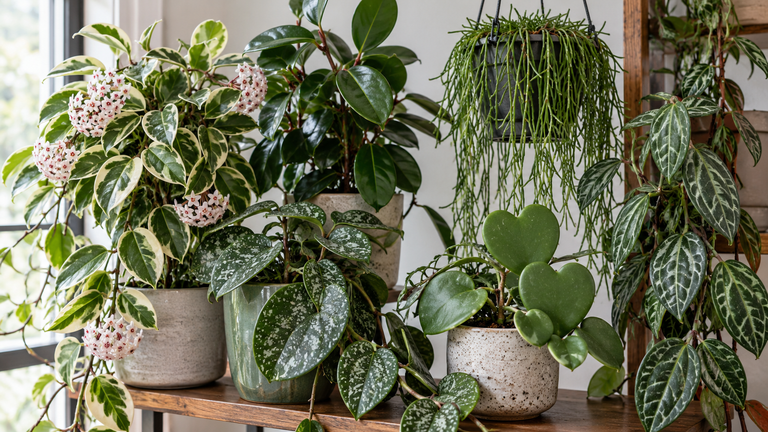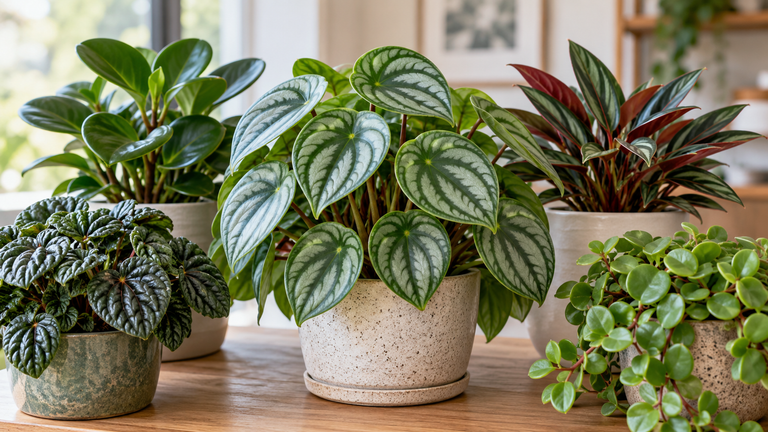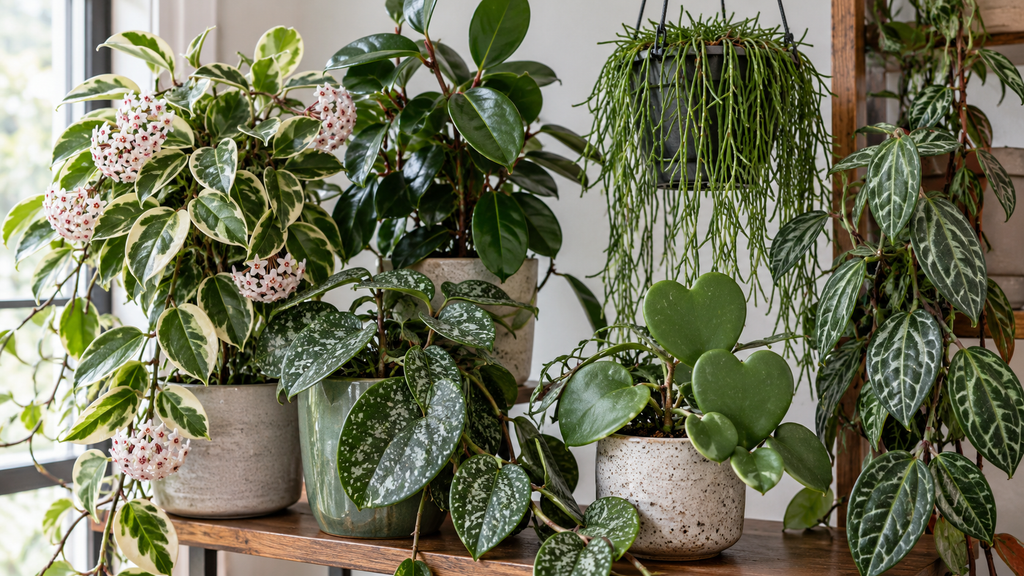
Hoya plant types range from familiar houseplants such as Hoya carnosa, Hoya australis, Hoya obovata, and Hoya kerrii to collector species valued for dramatic veins, unusual textures, silver markings, and distinctive flowers. Hoyas are commonly called wax plants because many have thick foliage and clusters of waxy, star-shaped blooms.
The genus is extremely diverse. Some Hoyas have round leaves, others have heart-shaped, narrow, curled, heavily veined, or miniature foliage. The easiest way to compare and identify them is by looking at leaf shape, thickness, texture, markings, growth habit, and flowers rather than relying only on nursery names.
This guide covers the most useful Hoya plant types, popular and rare varieties, identification clues, light requirements, Hoya australis, Hoya obovata, and how to choose the right Hoya for your home.
What Are Hoya Plants?
Hoyas are evergreen plants in the Apocynaceae family. Many naturally grow as climbers or epiphytes, meaning they use trees and other structures for support without taking nutrients from them like parasites.
That growth habit explains why many Hoyas prefer an airy root zone rather than dense soil that remains wet for long periods. It also explains why they adapt well to hanging pots, hoops, trellises, shelves, and vertical supports indoors.
Many commonly grown Hoyas have thick or leathery foliage that can store some moisture. However, leaf structure varies significantly between species. Hoya obovata has broad, substantial leaves, while Hoya linearis has narrow foliage that looks completely different.
Hoya flowers usually appear in clusters called umbels. Individual flowers often have five pointed petals surrounding a central corona. Depending on the species, flowers may be smooth, fuzzy, glossy, strongly scented, or almost porcelain-like.
Common names include:
- wax plant
- wax flower
- porcelain flower
- wax vine
- sweetheart Hoya
Because Hoyas vary so much, it is better to think of them as a diverse genus rather than one houseplant with dozens of color variations.
Hoya Species, Cultivars & Hybrids
Hoya names can be confusing because species, cultivars, hybrids, and trade names are often grouped together under the word “variety.”
A species is a formally recognized botanical taxon, such as Hoya carnosa or Hoya obovata. A cultivar is a cultivated selection chosen for a specific characteristic. Hoya carnosa ‘Compacta’, for example, is grown for its tightly curled foliage.
A hybrid results from crossing different parent plants, while a trade name may simply be a label used by nurseries or sellers.
For practical identification:
- Hoya carnosa = species
- Hoya carnosa ‘Compacta’ = cultivar
- “Silver Hoya” or “Rare Splash Hoya” may be marketing descriptions rather than complete botanical names
This matters when buying collector plants. Two listings can look like different species even though one may simply be a selected form or cultivar of the other.
Use the most complete botanical or cultivar name available and treat words such as “rare,” “splash,” and “silver” as descriptive until the plant’s identity is confirmed.
Different Hoya Plant Types
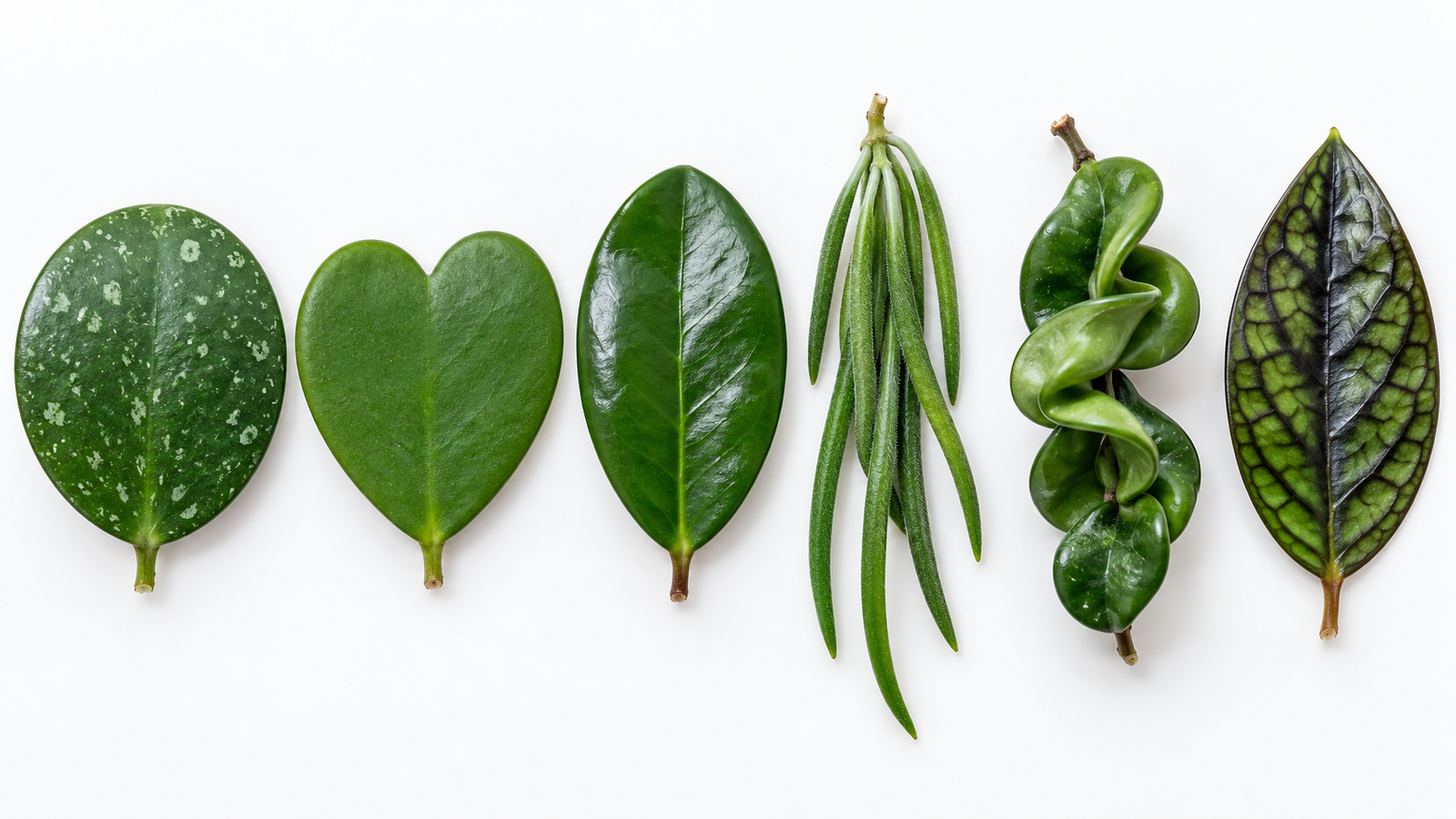
Grouping Hoyas by visible foliage makes the genus much easier to understand.
Round and Broad-Leaf Hoyas
These Hoyas produce substantial foliage with strong visual impact.
Examples include:
- Hoya obovata
- Hoya australis
- Hoya latifolia
Hoya obovata is one of the easiest round-leaf types to recognize because mature leaves are usually thick and noticeably broad.
Heart-Shaped Hoyas
The best-known heart-leaf species is Hoya kerrii. Its thick heart-shaped foliage has made it especially popular as a gift plant.
Narrow-Leaf Hoyas
These create a lighter, more flowing look.
Examples include:
- Hoya linearis
- Hoya wayetii
- Hoya shepherdii
- Hoya retusa
Narrow-leaf Hoyas are especially attractive in hanging baskets and on high shelves.
Curled and Textured Hoyas
Hoya carnosa ‘Compacta’ is the classic example. Its curled foliage forms dense rope-like stems.
Other collector Hoyas may have:
- wavy margins
- textured surfaces
- raised veins
- fuzzy foliage
- puckered leaves
Veined Hoyas
Strong venation is the main ornamental feature of several collector plants.
Examples include:
- Hoya callistophylla
- Hoya finlaysonii
- Hoya meredithii
- Hoya elliptica
- Hoya polyneura
Splash and Variegated Hoyas
“Splash” generally describes pale or silver markings scattered across leaves. It is often seen in cultivated Hoya pubicalyx and Hoya obovata.
Variegated Hoyas contain cream, yellow, white, or pink areas alongside green tissue. Always identify the underlying species or cultivar rather than treating “variegated Hoya” as a complete name.
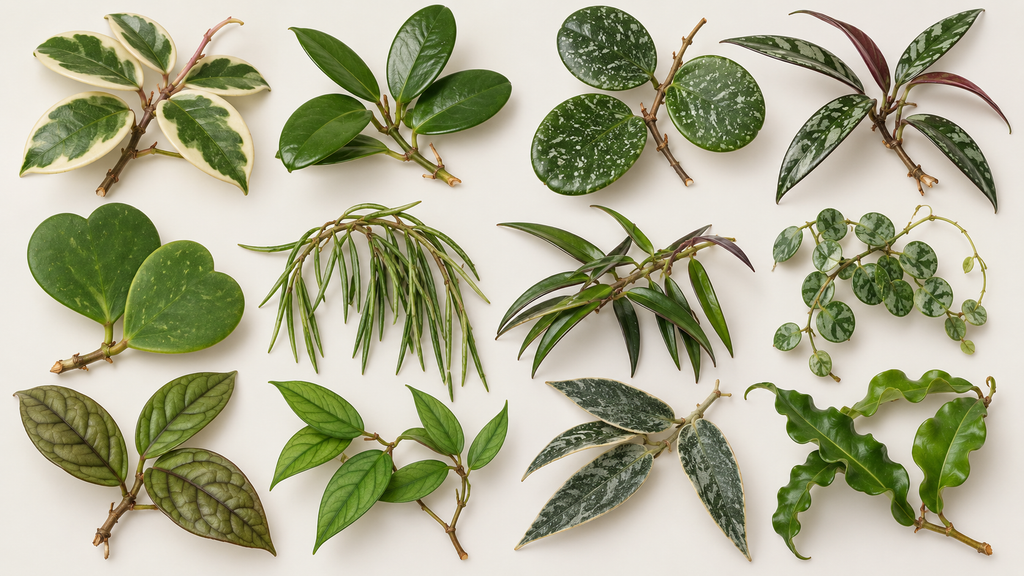
20 Hoya Plant Types to Know
You do not need to memorize hundreds of species. These 20 types represent the major foliage shapes and growth styles most useful to indoor growers.
1. Hoya carnosa
The classic wax plant with thick oval foliage and long climbing or trailing vines. It is one of the strongest choices for beginners.
2. Hoya australis
Known for glossy, rounded-to-oval leaves and vigorous climbing growth.
3. Hoya obovata
Recognizable for broad, thick, rounded leaves that create a bold foliage display.
4. Hoya pubicalyx
Usually has longer foliage and often shows silver flecking in cultivation.
5. Hoya kerrii
Best known for its distinctive heart-shaped leaves.
6. Hoya carnosa ‘Compacta’
A curled-leaf form commonly called Hindu rope Hoya.
7. Hoya linearis
Produces long cascading stems covered with fine, narrow foliage.
8. Hoya wayetii
A trailing Hoya with elongated leaves that may develop darker edges under strong light.
9. Hoya shepherdii
Has unusually long, narrow foliage that creates a fine-textured appearance.
10. Hoya lacunosa
Combines smaller leaves with attractive and often fragrant flowers.
11. Hoya serpens
Produces tiny rounded foliage and is popular with small-leaf collectors.
12. Hoya curtisii
Known for small patterned foliage and a dense trailing habit.
13. Hoya callistophylla
One of the most recognizable strongly veined collector Hoyas.
14. Hoya finlaysonii
Produces substantial leaves with dramatic visible veins.
15. Hoya meredithii
Another large-leaf species valued for its pronounced vein network.
16. Hoya polyneura
Recognizable for fishbone-like venation and elegant paired leaves.
17. Hoya latifolia
A large-leaf Hoya that works well when statement foliage is the goal.
18. Hoya caudata
Known for textured, rugged-looking foliage.
19. Hoya undulata
Has highly distinctive wavy leaf margins.
20. Hoya bella
A finer-growing Hoya valued for attractive foliage and abundant flowering.
For quick selection:
- classic beginner type → Hoya carnosa
- glossy foliage → Hoya australis
- round leaves → Hoya obovata
- heart leaves → Hoya kerrii
- cascading growth → Hoya linearis
- dramatic veins → Hoya callistophylla
- tiny leaves → Hoya serpens
- unusual texture → Hoya undulata
Most Popular Hoya Varieties
Several Hoyas stand out because they combine attractive foliage with relatively straightforward indoor growth.
Hoya carnosa
Hoya carnosa is the traditional wax plant and one of the safest choices for someone new to Hoyas. It has fleshy oval leaves, long vines, and many cultivated forms.
Choose it if you want a classic plant that can trail or climb and does not depend on unusual foliage for visual appeal.
Hoya pubicalyx
This species usually develops longer leaves and active climbing vines. Silver flecking is common in many cultivated plants.
It is a good choice if you want faster-looking vine development and a plant that works well on a trellis.
Hoya kerrii
The sweetheart Hoya is famous for heart-shaped leaves. However, a single rooted leaf is not the same as a full growing plant.
If you want a climbing Hoya, choose an established plant or cutting with a visible stem node.
Hoya carnosa ‘Compacta’
This cultivar has tightly curled foliage arranged along trailing stems. It is visually distinctive, but the leaf folds make pest inspection more difficult than with smooth-leaf Hoyas.
Hoya linearis
This is one of the best choices for a cascading display. Its narrow leaves create a softer, waterfall-like effect than broad-leaf Hoyas.
Rare Hoya Varieties
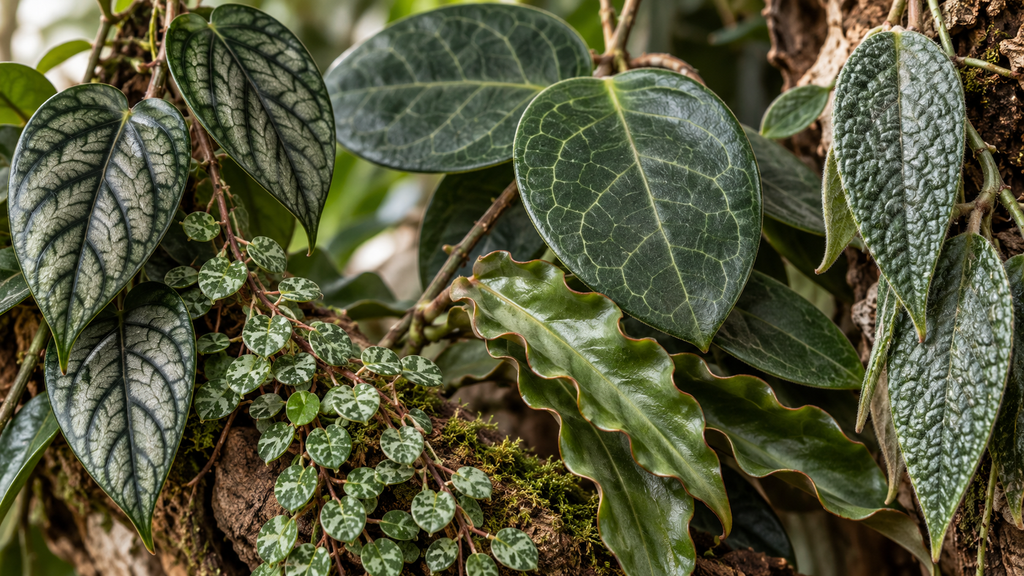
“Rare Hoya” is mainly a market term rather than a formal botanical classification. A plant may be difficult to obtain in one country but widely propagated in another.
Collector types often include:
Hoya callistophylla — prized for strong dark venation.
Hoya sigillatis — valued for narrow patterned foliage.
Hoya serpens — distinctive because of its tiny rounded leaves.
Hoya meredithii — produces large foliage with strong veins.
Hoya undulata — recognizable by dramatic wavy leaf margins.
Hoya caudata — known for textured and mottled-looking foliage.
A high price does not necessarily prove botanical rarity. Price may reflect:
- limited commercial production
- propagation speed
- import costs
- local demand
- unusual variegation
- scarcity of a particular clone
Before paying a premium, check whether the plant is rooted, correctly named, healthy, and suitable for your growing conditions.
Hoya Plant Types With Pictures
Pictures are one of the most useful tools for identifying Hoyas, but the image needs to show more than an attractive whole plant.
A useful identification image should show:
- mature leaf shape
- leaf size
- surface markings
- stem arrangement
- growth habit
- flowers when available
For this article, prioritize pictures of:
- Hoya carnosa
- Hoya pubicalyx
- Hoya australis
- Hoya obovata
- Hoya kerrii
- Hoya carnosa ‘Compacta’
- Hoya linearis
- Hoya callistophylla
- Hoya polyneura
- Hoya serpens
Use descriptive alt text such as:
- Hoya obovata with thick round leaves
- Hoya kerrii mature vine with heart-shaped foliage
- Hoya callistophylla dark-veined leaf
- Hoya linearis cascading narrow leaves
Original plant photography is particularly valuable because it allows readers to compare real mature foliage rather than idealized nursery images.
Hoya Plant Identification Guide
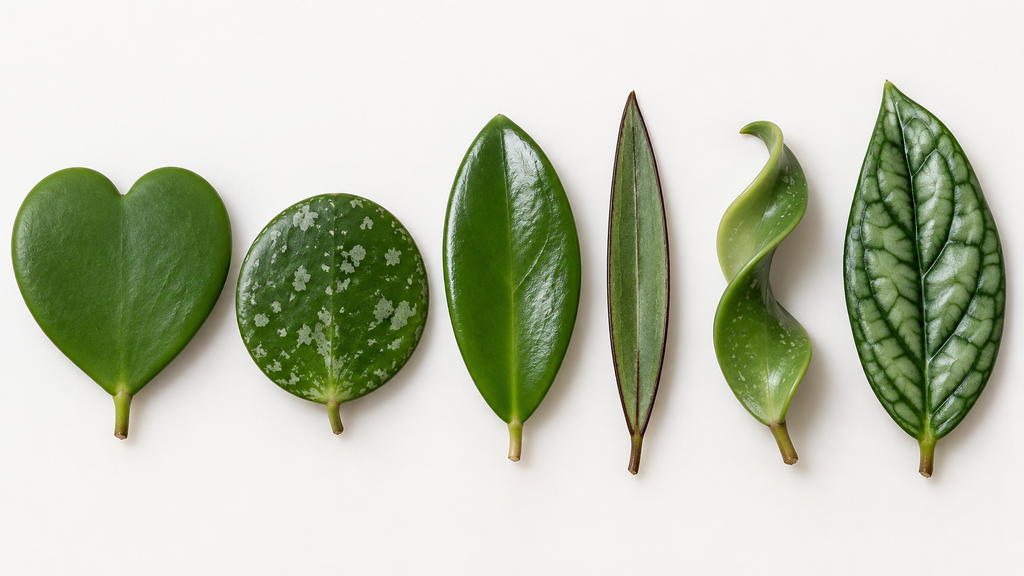
The fastest way to identify an unknown Hoya is to eliminate plants that clearly do not match its major traits.
Start with leaf shape.
Heart-shaped: compare Hoya kerrii.
Thick and round: compare Hoya obovata.
Glossy and oval: compare Hoya australis.
Tightly curled: compare Hoya carnosa ‘Compacta’.
Very narrow: compare Hoya linearis, Hoya wayetii, Hoya shepherdii, and Hoya retusa.
Tiny rounded leaves: compare Hoya serpens and other small-leaf types.
Strong dark veins: compare Hoya callistophylla, Hoya finlaysonii, Hoya meredithii, and Hoya polyneura.
Once you have a shortlist, check:
- mature leaf size
- leaf thickness
- surface texture
- splash or variegation
- internode spacing
- climbing or trailing habit
- flowers
Flowers are especially useful when similar species cannot be separated confidently by foliage.
Do not identify a Hoya from one matching characteristic alone. A silver-splashed leaf, for example, does not automatically make a plant Hoya pubicalyx because several Hoyas can show silver markings.
When evidence remains uncertain, keep the identification provisional rather than assigning a species simply because one online photo looks similar.
Hoya Light: Sun or Shade?
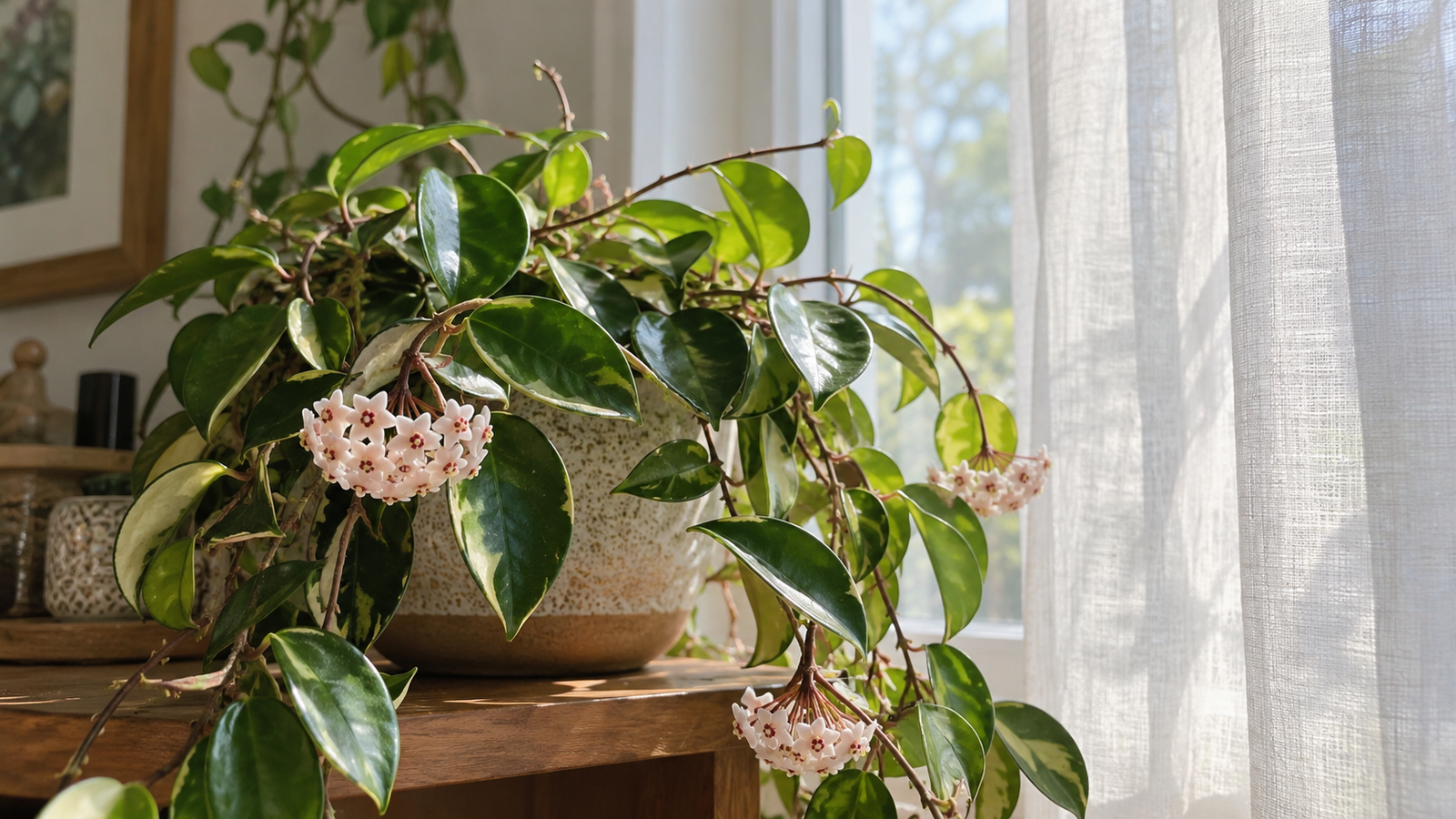
Most commonly cultivated Hoyas prefer bright indirect or filtered light rather than deep shade or intense hot sun.
Low light may allow a Hoya to survive, but it often leads to:
- slower growth
- wider gaps between leaves
- weaker vines
- reduced flowering
- slower drying of the potting mix
Some gentle direct sun, particularly morning sun, can be suitable for many Hoyas. The bigger risk is sudden exposure to strong midday or afternoon sunlight.
Watch for:
- bleached patches
- scorched tissue
- crispy damaged areas
Light also influences flowering. A mature Hoya that looks healthy but never blooms may simply need stronger usable light.
A practical window guide:
- east-facing → often a strong option
- bright south-facing → useful with filtering when needed
- west-facing → monitor afternoon heat
- north-facing → may support growth but can be weaker for flowering
The goal is strong light without excessive heat or scorch.
Hoya Australis
Hoya australis is a popular climbing Hoya with smooth, glossy, rounded-to-oval foliage. It has a cleaner and more classic appearance than heavily veined or splashed collector types.
It is a good choice if you want:
- glossy green foliage
- climbing growth
- a plant for a trellis
- an approachable Hoya
- flowers as the plant matures
Provide bright light, an airy growing medium, warmth, and careful watering.
Hoya australis vs Hoya obovata
Hoya australis generally has smoother and more oval foliage.
Hoya obovata has thicker, broader, and more distinctly rounded leaves.
Choose australis for a glossy climbing look and obovata for stronger foliage impact.
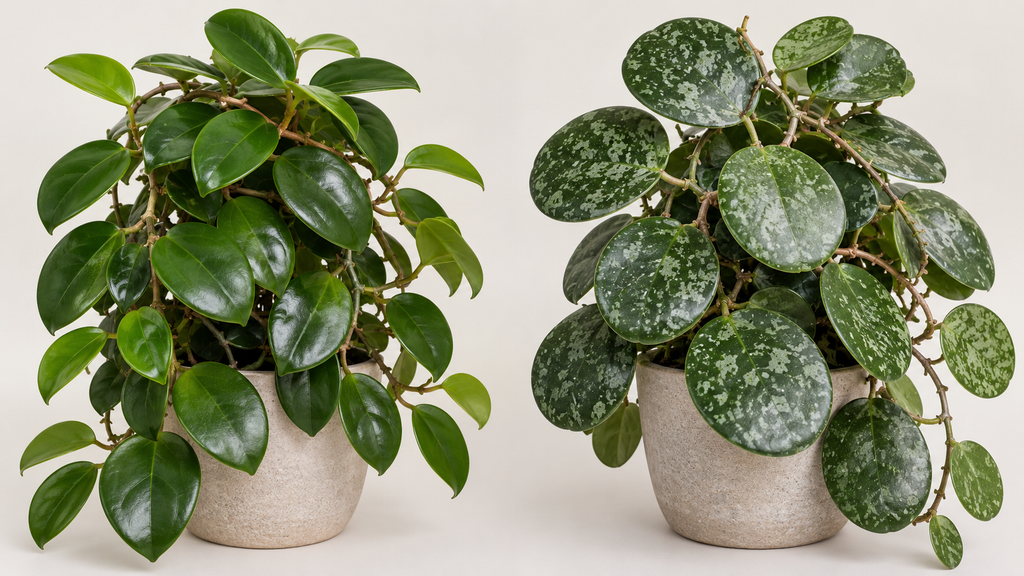
Hoya Obovata
Hoya obovata is one of the easiest broad-leaf Hoyas to recognize. Its mature foliage is thick, substantial, and usually noticeably round.
Some plants also show silver splash, although the rounded leaf shape is more useful for identification than the amount of silver.
Choose Hoya obovata if you want:
- bold round foliage
- thick leaves
- a climbing or trailing plant
- strong visual appeal even without flowers
It is generally manageable for growers who can provide bright light, good drainage, and sensible watering.
Best Hoya Plant Types for Your Home
The best Hoya depends on your space and visual preference rather than price or rarity.
Choose:
- Hoya carnosa for a classic first Hoya
- Hoya australis for glossy climbing foliage
- Hoya obovata for thick round leaves
- Hoya pubicalyx for vigorous vines
- Hoya kerrii for heart-shaped foliage
- Hoya linearis for a hanging display
- Hoya serpens for miniature leaves
- Hoya callistophylla for dramatic veins
- Hoya undulata for unusual leaf margins
For hanging baskets, prioritize natural trailers such as Hoya linearis, Hoya wayetii, and Hoya carnosa ‘Compacta’.
For trellises, Hoya australis, Hoya pubicalyx, Hoya carnosa, and Hoya obovata are more natural choices.
The best decision process is:
available conditions → eliminate unsuitable types → shortlist → choose
A beautiful Hoya is not a good choice if its mature growth habit conflicts with your available space.
Hoya Plant Types and Care Needs
Different Hoya plant types share broad care principles, but they should not all be treated identically.
Most commonly grown Hoyas benefit from:
- bright filtered light
- an airy growing medium
- containers with drainage
- careful watering
- warm conditions
- reasonable airflow
Avoid watering on a rigid weekly schedule. Drying speed changes with light, temperature, pot size, substrate, root mass, and season.
A plant near a bright summer window may use water quickly, while the same plant may stay moist much longer during a darker winter period.
Repot only when necessary, such as when the growing medium has broken down, drainage is poor, or roots have significantly filled the container. Moving directly into a much larger pot can make moisture management more difficult.
Detailed watering, soil, fertilizer, and propagation instructions belong in dedicated Hoya care guides rather than being repeated extensively on a Hoya-types page.
Hoya Care by Climate
Global readers should translate Hoya advice according to actual growing conditions rather than follow fixed watering or window rules.
Hot and Sunny Climates
Protect foliage from intense midday or afternoon sun and monitor pots because they may dry more quickly.
Cool or Seasonal Climates
Expect slower growth and water use during darker months. Do not automatically maintain summer watering frequency through winter.
Humid Climates
High humidity does not mean roots should remain constantly wet. Good airflow and drainage remain important.
Dry Indoor Conditions
Do not compensate for dry air by keeping the potting mix permanently saturated.
Instead of asking, “How often should I water my Hoya?” ask:
How quickly is this plant using water under my current light, temperature, humidity, pot size, and season?
That approach works far better internationally than one fixed schedule.
Why Is My Hoya Not Flowering?
A healthy Hoya that grows leaves but does not flower may need more light, greater maturity, healthier roots, or more stable conditions.
Check these factors first:
- light
- plant maturity
- root health
- watering consistency
- temperature stability
Do not automatically add more fertilizer.
Also avoid cutting off healthy old flower spurs. Many Hoyas can bloom again from existing peduncles.
If a plant produces plenty of healthy foliage but never blooms, improving light is often more useful than changing several care variables at once.
How to Choose a Healthy Hoya
Choose plant health before rarity.
Inspect:
- mature leaves
- stems
- nodes
- new growth
- leaf undersides
- stem junctions
Avoid plants with extensive soft black tissue, obvious rot, widespread pest damage, or badly collapsing growth.
When buying cuttings, make sure healthy nodes are present.
Ask for the full plant name whenever possible. A correctly labeled Hoya obovata is more useful than a plant marketed only as “Rare Silver Hoya.”
For expensive collector plants, also ask:
- Is it rooted?
- Is the photo of the actual plant?
- Is it established or recently imported?
- How many healthy nodes does it have?
A healthy common Hoya is usually a better purchase than a struggling rare one.
Which Hoya Should You Buy?
For a first Hoya, start with Hoya carnosa, Hoya australis, Hoya pubicalyx, or Hoya obovata.
Choose according to your priority:
- easiest classic type → Hoya carnosa
- glossy foliage → Hoya australis
- round foliage → Hoya obovata
- vigorous vines → Hoya pubicalyx
- heart-shaped leaves → Hoya kerrii
- cascading habit → Hoya linearis
- bold veins → Hoya callistophylla
Before buying, answer:
- How much bright light do I have?
- Do I want a climber or trailer?
- Do I care more about foliage or flowers?
- How much space will the mature plant have?
Those four questions are more useful than asking which Hoya is currently the rarest or most expensive.
Hoya Plant Types FAQs
What are the different types of Hoya plants?
Hoya plants include round-leaf, heart-shaped, narrow-leaf, curly, veined, splashed, variegated, and small-leaf types. Popular examples include Hoya carnosa, Hoya australis, Hoya obovata, and Hoya kerrii.
What are the most popular Hoya varieties?
Popular Hoyas include Hoya carnosa, Hoya pubicalyx, Hoya australis, Hoya obovata, Hoya kerrii, Hoya wayetii, and Hoya linearis.
What is the easiest Hoya for beginners?
Hoya carnosa is one of the easiest starting points. Hoya australis, Hoya pubicalyx, and Hoya obovata are also approachable choices.
How do I identify my Hoya?
Compare leaf shape, size, thickness, texture, venation, markings, growth habit, and flowers. Several matching traits provide a stronger identification than one feature alone.
Which Hoya has round leaves?
Hoya obovata is one of the best-known round-leaf Hoyas. Hoya australis also has broad foliage but usually appears smoother and more oval.
Which Hoya has heart-shaped leaves?
Hoya kerrii is famous for heart-shaped leaves. Choose a plant with a stem node if you want a full growing vine.
Which Hoya has curly leaves?
Hoya carnosa ‘Compacta’, commonly called Hindu rope Hoya, has tightly curled leaves along trailing stems.
Do Hoyas like sun or shade?
Most Hoyas prefer bright indirect or filtered light. Deep shade can reduce growth and flowering, while intense hot sunlight can scorch foliage.
Can Hoyas grow in low light?
Hoyas may survive in lower light, but growth and flowering are usually better in brighter conditions.
What are rare Hoya varieties?
Collector Hoyas include Hoya callistophylla, Hoya sigillatis, Hoya serpens, Hoya meredithii, Hoya undulata, and Hoya caudata. Rarity varies by region and availability.
Are rare Hoyas harder to grow?
Not necessarily. A plant can be rare because it is difficult to source rather than difficult to cultivate.
What is the difference between Hoya australis and Hoya obovata?
Hoya australis has smoother, glossy, oval-to-rounded foliage. Hoya obovata usually has thicker and more distinctly rounded leaves.
Why is my Hoya not flowering?
Insufficient light, immaturity, root stress, or unstable growing conditions can delay flowering. Healthy old peduncles should usually be preserved.
Which Hoya should I buy first?
Start with Hoya carnosa, Hoya australis, Hoya pubicalyx, or Hoya obovata, depending on your preferred leaf shape and available space.
Choosing the Right Hoya Plant Type
There is no single best Hoya plant type. The right choice depends on what you want the plant to look like and whether your conditions can support its mature growth.
For beginners, Hoya carnosa remains one of the safest places to start. Choose Hoya australis for glossy climbing foliage, Hoya obovata for thick round leaves, Hoya kerrii for heart-shaped foliage, and Hoya linearis for a cascading display.
Collectors may prefer species such as Hoya callistophylla, Hoya serpens, Hoya meredithii, or Hoya undulata because their leaf patterns, proportions, and textures differ from common wax plants.
Whatever you choose, identify the plant through leaf architecture, texture, venation, growth habit, and flowers, then adapt care to the actual species and your growing conditions.
The best Hoya is not necessarily the rarest plant. It is the one whose mature appearance you enjoy and whose requirements realistically match your home.

Myra is the founder and lead writer of Plantsaholic. She shares practical, research-backed advice on indoor plants, outdoor gardening, flowers, herbs, succulents, and everyday plant care. Her goal is to help gardeners of all experience levels grow healthier plants through simple, easy-to-follow gardening guides.