Shingling plants are tropical climbing plants that grow flat against surfaces with overlapping leaves. Popular types include Rhaphidophora hayi, Monstera dubia, and Rhaphidophora cryptantha. These plants require vertical support, bright indirect light, and moderate humidity to develop their characteristic flat growth pattern.
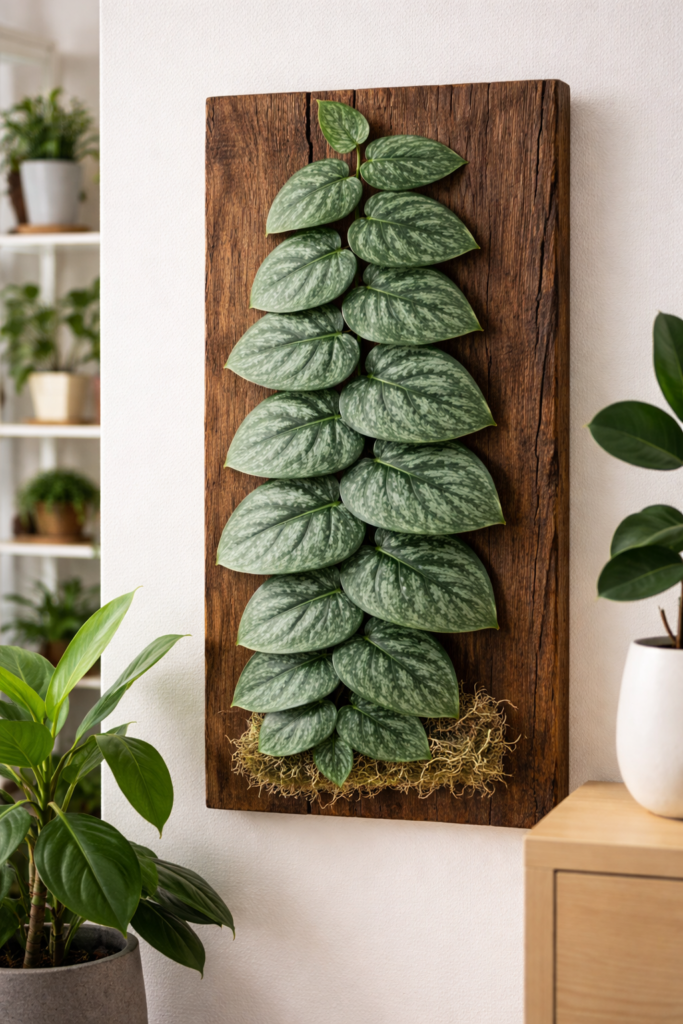
Shingling plants are one of the most visually unique houseplant categories. Instead of growing outward or trailing down, they attach themselves to surfaces and form a layered, flat structure that resembles roof shingles.
This makes them perfect for modern interiors, vertical gardens, and minimalist plant styling.
What Are Shingling Plants?
Shingling plants are climbing plants that grow tightly against vertical surfaces, with leaves overlapping each other in a flat formation. This growth pattern is natural in tropical forests, where plants climb tree trunks to access light while staying protected.
Unlike traditional vines, these plants depend on surface contact to maintain their structure. Their aerial roots attach directly to surfaces, allowing them to pull themselves closer and grow in a controlled, compact way.
Key characteristics of shingling plants:
- Leaves grow flat against surfaces
- Overlapping, layered structure
- Climbing growth habit
- Use aerial roots for attachment
- Require vertical support for proper growth
How Do Shingling Plants Grow?
Shingling plants grow through a process of surface attachment and vertical climbing. Their aerial roots act like anchors, attaching to bark, wood, or moss surfaces. As they climb, each new leaf forms directly on the surface, maintaining the flat pattern.
Without a vertical surface, the plant cannot express its natural form. Instead, it grows irregularly, with smaller leaves and a trailing structure that lacks the signature shingling effect.
Growth mechanism explained:
- Aerial roots attach to surfaces
- Leaves press flat against support
- Each new leaf overlaps the previous one
- Growth continues upward, not outward
- Leaf size increases with proper support
This is why mounting is not optional, it is essential.
Best Shingling Plants for Indoors
1. Rhaphidophora hayi
The most beginner-friendly shingling plant.
Why it stands out:
- Fast-growing
- Easy to mount
- Large, flat leaves
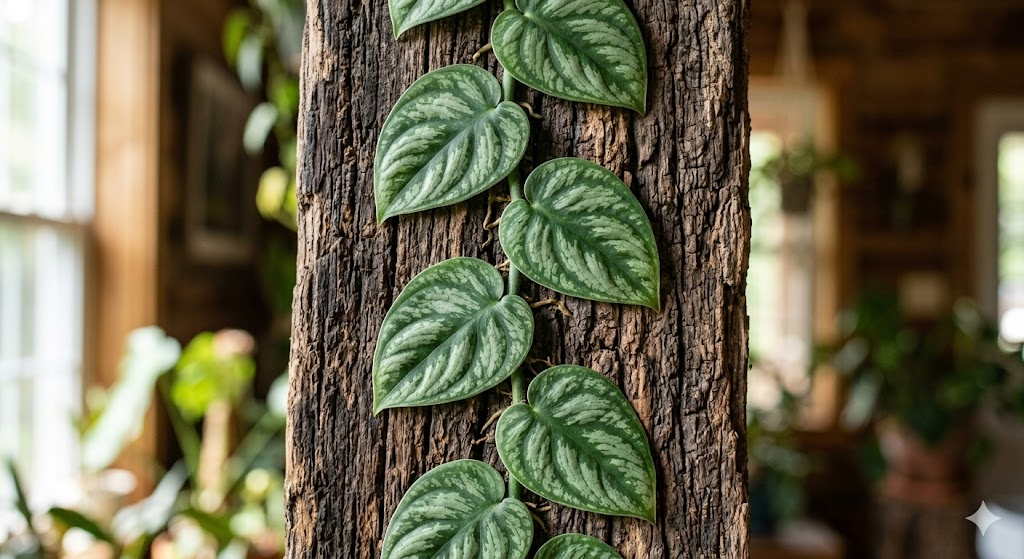
2. Monstera dubia
Highly decorative with patterned leaves.
Why it stands out:
- Unique juvenile leaf texture
- Strong attachment behavior
3. Rhaphidophora cryptantha
Smaller and more compact.
Best for:
Limited space setups
4. Marcgravia
Rare and visually striking.
Features:
- Rounded leaves
- Dense layering
Why Do Shingling Plants Need Support?
Shingling plants rely entirely on vertical surfaces to grow correctly. Without support, their aerial roots cannot attach, which prevents the plant from forming its characteristic flat structure.
Providing support mimics their natural habitat, where they climb tree trunks in humid forests. This allows the plant to develop larger leaves, stronger growth, and a cleaner appearance.
Best support options:
- Wooden boards
- Moss poles
- Tree bark slabs
- Cork panels
Proper support transforms the plant from messy growth to structured beauty.
How to Mount Shingling Plants (Step-by-Step)
Mounting is the most important part of growing shingling plants successfully. It allows the plant to attach naturally and develop its flat growth pattern.
Start by choosing a wooden or bark surface. Gently place the plant against the surface and secure it with clips or soft ties. Keep the mounting surface slightly moist to encourage root attachment.
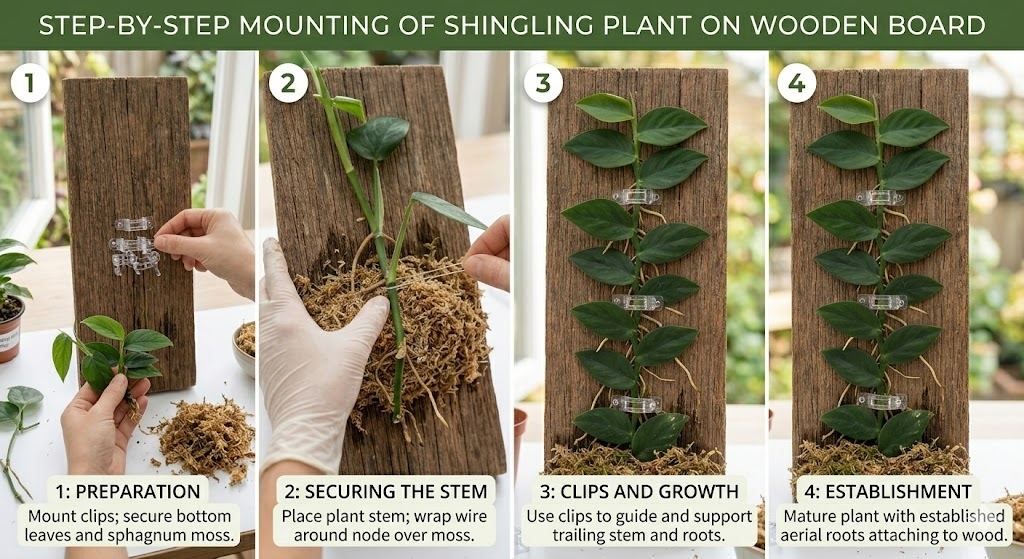
Mounting steps:
- Choose a flat mounting surface
- Position plant against the surface
- Secure with plant clips or ties
- Keep surface slightly moist
- Allow roots to attach naturally
Within weeks, the plant will begin attaching itself permanently.
Light Requirements for Shingling Plants
Shingling plants require bright indirect light to grow properly. Light plays a critical role in leaf size, attachment strength, and overall plant health.
Too little light results in slow growth and small leaves. Too much direct sunlight can damage the leaves and reduce humidity levels.
Lighting guidelines:
- Bright indirect light is ideal
- Avoid harsh direct sunlight
- Low light reduces growth quality
- Place near windows with filtered light
Watering and Humidity Needs
Shingling plants prefer consistent moisture but cannot tolerate waterlogged soil. Their tropical origin means they thrive in humid conditions where moisture is stable but not excessive.
Humidity is especially important because it helps aerial roots attach to surfaces and maintain healthy growth.
Watering and humidity tips:
- Keep soil slightly moist
- Avoid overwatering
- Maintain medium to high humidity
- Mist occasionally in dry environments
- Ensure proper drainage
How Shingling Plants Change as They Mature
Shingling plants go through a noticeable transformation as they mature, and understanding this evolution is essential for proper care. In their juvenile stage, plants like Monstera dubia and Rhaphidophora hayi produce small, tightly pressed leaves that grow flat against surfaces. This stage is where the classic “shingle effect” is most visible and aesthetically appealing.
As the plant matures, especially in optimal conditions, its growth pattern can begin to change. Leaves may become larger, spacing between nodes can increase, and in some species, the plant may eventually transition into a more typical climbing form with less flattened leaves. This is a natural biological progression influenced by light exposure, height, and environmental stability.
Growth stages explained:
- Juvenile stage: small, tightly overlapping leaves
- Active climbing phase: steady vertical expansion
- Mature stage: larger leaves, possible structural change
- Increased spacing between nodes over time
- Growth behavior influenced by light and support
Understanding this progression helps you maintain the desired flat growth for longer.
Best Mounting Surfaces for Shingling Plants (Tested Comparison)
The surface you choose directly impacts how well a shingling plant attaches and grows. While many guides suggest using “any support,” the reality is that different materials produce different results. The goal is to provide a surface that mimics natural tree bark, allowing aerial roots to attach easily and consistently.
Wooden boards and cork panels are the most effective surfaces because they offer a slightly rough texture that encourages root attachment. Moss poles can work, but they often produce less uniform flattening compared to flat boards. Smooth surfaces like plastic or glass should be avoided because roots cannot grip them effectively.
Best mounting surfaces ranked:
- Cork bark: best natural texture and root grip
- Wooden boards: stable and widely available
- Tree bark slabs: excellent for natural look
- Moss poles: good but less structured
- Plastic or smooth surfaces: poor attachment
The right surface determines whether your plant becomes structured or stays messy.
Why Your Shingling Plant Is Not Flattening (Exact Fixes)
If your shingling plant is not growing flat, the issue is almost always related to environmental setup rather than plant health. These plants require specific conditions to express their natural growth habit, and even small deviations can disrupt the shingling effect.
The most common cause is lack of proper surface contact. Without consistent pressure against a vertical surface, the plant cannot maintain its flat structure. Other factors include low humidity, insufficient light, or inconsistent watering. Each of these directly affects how well aerial roots attach and how leaves develop.
Diagnosis and fixes:
- No flattening → add proper mounting surface
- Small leaves → increase light exposure
- Loose growth → improve humidity levels
- Weak attachment → keep surface slightly moist
- Slow growth → adjust watering and nutrients
Fixing the setup usually restores proper growth quickly.
Mounted vs Trailing Growth: What Actually Happens
The difference between mounted and trailing growth in shingling plants is dramatic and defines the entire visual outcome. When mounted correctly, plants like Rhaphidophora cryptantha develop flat, overlapping leaves that create a structured, layered appearance. This is the natural growth pattern seen in tropical forests.
When left unmounted, the same plant behaves like a trailing vine. Leaves become smaller, spacing increases, and the flat shingling effect disappears. While the plant may still survive, it loses its defining visual characteristic, making it look like a standard climbing plant.
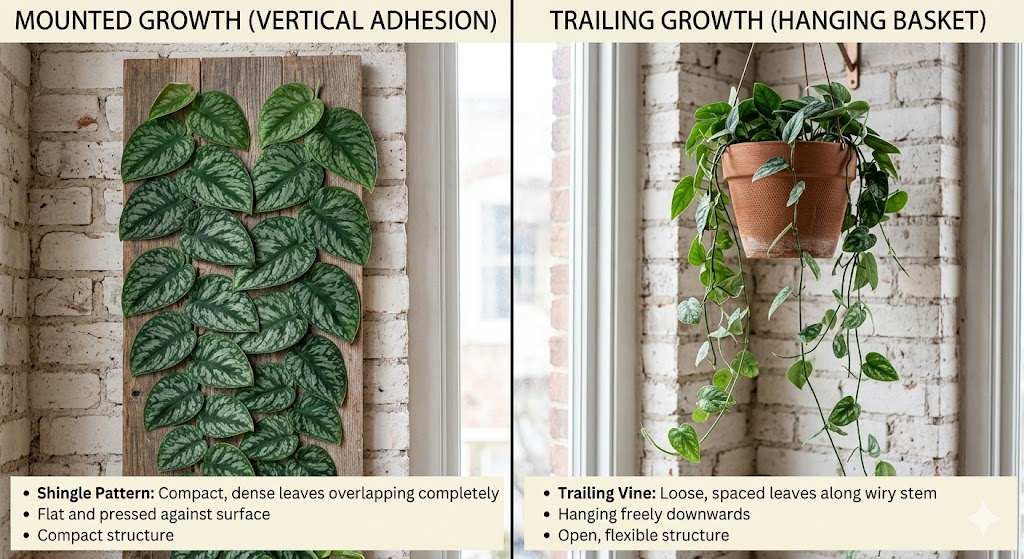
Mounted vs trailing comparison:
- Mounted: flat leaves, structured growth, larger foliage
- Trailing: loose vines, smaller leaves, irregular spacing
- Mounted plants attach naturally with aerial roots
- Trailing plants lack surface contact
- Visual impact is significantly reduced without mounting
Mounting transforms the plant from ordinary to extraordinary.
How to Recreate a Tropical Climbing Environment Indoors
Shingling plants naturally grow in tropical rainforests, where they climb tree trunks under high humidity and filtered light. To grow them successfully indoors, you need to recreate these conditions as closely as possible.
The key is to simulate a stable, humid environment with consistent light and moisture. This doesn’t require complex equipment, but it does require attention to detail. Positioning the plant near a bright window with indirect light, maintaining humidity, and providing a natural mounting surface are the core elements.
Environment simulation tips:
- Use bright indirect light (filtered sunlight)
- Maintain moderate to high humidity
- Keep temperature stable and warm
- Use natural mounting surfaces like wood or bark
- Group plants to increase humidity naturally
The closer your setup is to a rainforest environment, the better your plant performs.
Why Do Shingling Plants Grow Flat?
Shingling behavior is not random; it is a survival strategy developed by plants in dense tropical forests. In these environments, sunlight is limited because tall trees block direct light. To survive, plants evolve ways to maximize light exposure without competing directly with larger plants.
By growing flat against surfaces, shingling plants increase their surface area exposed to available light. This allows them to photosynthesize efficiently while using minimal energy for structural support. Instead of growing thick stems, they rely on existing surfaces like tree trunks.
Biological reasons for shingling:
- Maximizes light absorption in low-light environments
- Reduces energy needed for structural growth
- Provides protection from environmental stress
- Helps maintain moisture around leaves
- Supports efficient vertical climbing
This growth pattern is an optimized survival mechanism, not just a visual feature.
Common Problems and How to Fix Them
Shingling plants often fail due to incorrect setup rather than difficult care. Most issues are caused by lack of support, poor lighting, or low humidity.
Understanding these problems early allows you to correct them before the plant loses its structure.
Common issues:
- Leaves not flattening → no support
- Small leaves → low light
- Slow growth → low humidity
- Yellow leaves → overwatering
Can Shingling Plants Grow Without Mounting?
Yes, but they will not develop their signature look. Without mounting, the plant grows like a trailing vine, with smaller leaves and irregular spacing.
While this may still produce a healthy plant, it removes the defining feature that makes shingling plants unique.
Without mounting:
- Leaves stay small
- Growth becomes messy
- Structure is lost
Mounting unlocks the plant’s full potential.
Are Shingling Plants Beginner-Friendly?
Shingling plants are moderately easy to care for, but only if you understand their growth behavior. Most beginners struggle because they treat them like trailing plants instead of surface climbers.
Once mounted and placed in proper lighting, these plants become stable and predictable.
Beginner tips:
- Start with Rhaphidophora hayi
- Focus on proper mounting
- Maintain consistent humidity
- Avoid overwatering
Expert Insight: Surface Contact Controls Everything
The biggest mistake with shingling plants is ignoring how they grow.
They don’t need space
They need contact
When the plant has a surface:
- Leaves enlarge
- Growth stabilizes
- Structure improves
Final Thoughts
Shingling plants offer one of the most unique indoor plant experiences. Their flat, layered growth transforms vertical spaces into living green designs, making them ideal for modern and minimalist interiors.
If you want a plant that stands out from typical vines and foliage, shingling plants are one of the best choices.
Just remember:
Give them a surface, not space.
FAQ Section
What are shingling plants?
Plants that grow flat against surfaces with overlapping leaves.
Do shingling plants need support?
Yes, support is essential for proper growth.
Can they grow indoors?
Yes, they are popular indoor plants.
What is the easiest shingling plant?
Rhaphidophora hayi is best for beginners.
Do they need high humidity?
Moderate to high humidity improves growth.

Myra is the founder and lead writer of Plantsaholic. She shares practical, research-backed advice on indoor plants, outdoor gardening, flowers, herbs, succulents, and everyday plant care. Her goal is to help gardeners of all experience levels grow healthier plants through simple, easy-to-follow gardening guides.