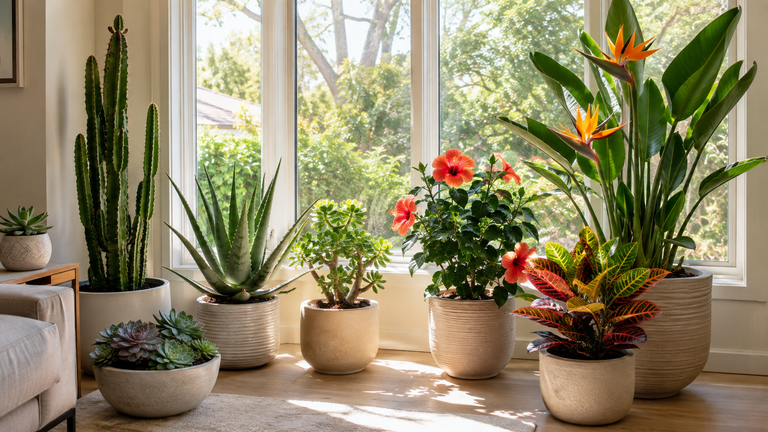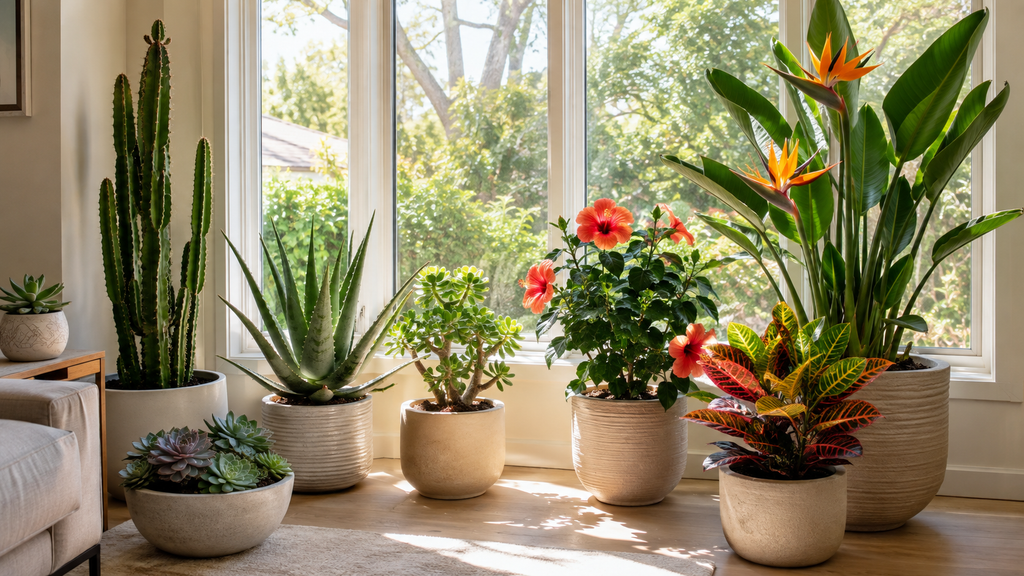
The best indoor plants for a south facing window include desert cacti, Echeveria, aloe vera, jade plant, Kalanchoe, hibiscus, pelargonium, croton, bird of paradise, indoor citrus, snake plant, and burro’s tail. The right choice depends on the light that actually reaches the leaves, the space available around the window, and what you want the plant to provide.
A useful south-window plant should do more than tolerate brightness. Strong light should support something valuable, such as compact succulent growth, better flowering, stronger foliage color, architectural growth, or productive citrus development. Use this guide to assess your window, eliminate unsuitable plants, choose the best fit, and check whether the final position is working.
Best Indoor Plants for South Facing Window
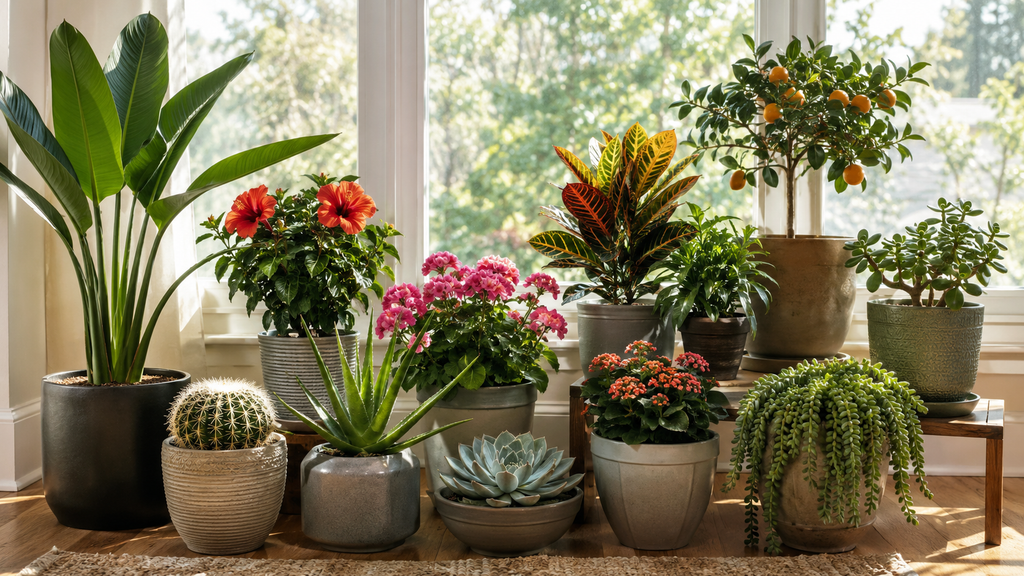
A south-facing window can provide one of the strongest indoor growing positions in the Northern Hemisphere, but every south-facing room is different. Trees, buildings, balconies, window size, glass treatments, and the plant’s distance from the window can all change the usable light.
Before choosing a plant, think about both the growing conditions and the function you want the plant to serve.
| Plant | Best For | Best Position | Main Success Signal |
|---|---|---|---|
| Desert cacti | Hot sunny sill | Strongest suitable light | Compact, firm growth |
| Echeveria | Small sunny sill | Close to bright window | Tight rosette growth |
| Aloe vera | Easy-care succulent | Bright sill or nearby | Firm new leaves |
| Jade plant | Long-term specimen | Very bright position | Dense new growth |
| Kalanchoe | Compact flowering plant | Bright sill | Buds and compact growth |
| Hibiscus | Showy flowers | Very bright position | Continued budding |
| Pelargonium | Sunny flowering display | Bright sill | Repeated flowering |
| Croton | Colorful foliage | Very bright nearby position | Healthy colored leaves |
| Bird of paradise | Large floor plant | Near large bright window | Strong new leaves |
| Indoor citrus | Flowers and possible fruit | Brightest practical position | New shoots and buds |
| Snake plant | Flexible placement | Bright room position | Steady upright growth |
| Burro’s tail | Trailing display | Bright protected position | Dense trailing stems |
Check Your South-Facing Window First
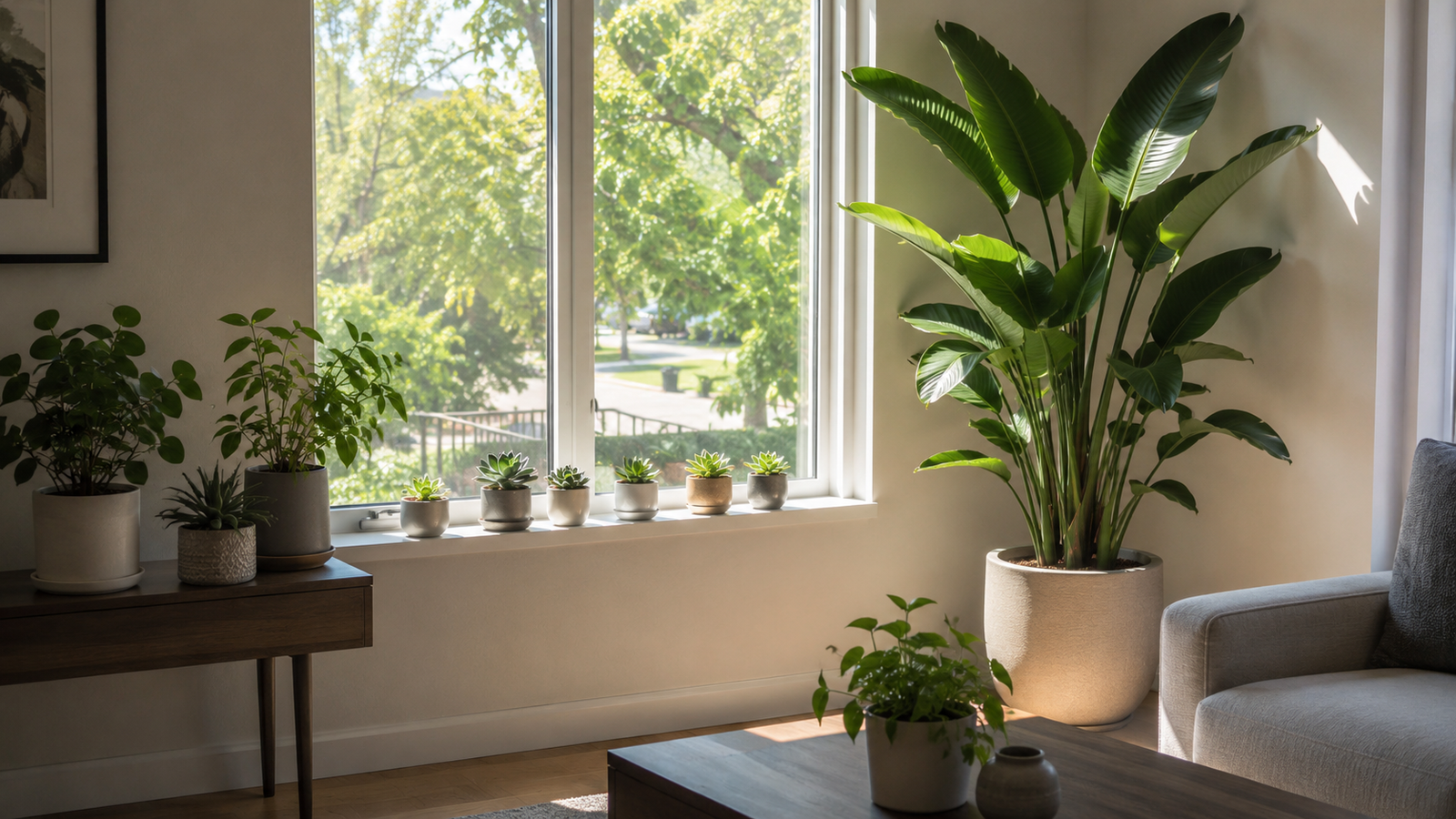
Do not choose a plant simply because the room faces south. Evaluate the exact place where the leaves will grow. A plant sitting directly on a narrow sill can experience very different conditions from a large floor plant placed several feet away.
Start by watching the proposed position during the day. Does direct sunlight actually reach it? How long does that light remain? Is the window blocked by a neighboring building, tree, balcony, or roof overhang?
Next, consider space and plant function.
Choose according to your goal:
- Compact sunny windowsill: cactus, Echeveria, Kalanchoe
- Easy-care structural plant: aloe or jade
- Flowers: hibiscus or pelargonium
- Colorful foliage: croton
- Large floor specimen: bird of paradise
- Trailing growth: burro’s tail
- Possible fruit: suitable container citrus
Your maintenance style matters too. A bright window does not make every plant equally easy to care for. Hibiscus and citrus generally need more regular monitoring than cactus, aloe, or jade.
Global note: the familiar rule that south-facing windows are the brightest mainly applies to the Northern Hemisphere. In much of the Southern Hemisphere, north-facing windows receive the stronger solar exposure. Always judge the light reaching the plant rather than relying only on compass direction.
12 Indoor Plants for South Facing Window
The following plants were selected because strong indoor light can provide a meaningful benefit. Each one also serves a different practical purpose, so you can choose according to space, appearance, flowering, and maintenance needs.
1. Desert Cacti
Desert cacti are among the best choices for a hot, bright windowsill. Many species naturally grow under intense light, and strong indoor exposure helps them maintain compact, firm growth.
They are especially useful when other plants struggle with the dry, bright conditions close to the glass.
Best for: compact sunny windowsills and low-maintenance setups.
Use a free-draining cactus mix and a container with drainage. Do not water simply because the surface looks dry; moisture can remain deeper in the pot.
Healthy cacti should remain firm and compact. If new growth becomes weak or distorted, reassess the light. If a newly moved cactus develops pale or scorched tissue, reduce the sudden increase in exposure.
2. Echeveria
Echeveria is a strong choice for a small south-facing sill because high light helps maintain the tight rosette shape that makes the plant attractive.
In inadequate light, Echeveria may stretch, open up, or lean toward the window. Good exposure encourages more compact growth.
Best for: small spaces and succulent collections.
Use a well-draining growing medium and let the root zone dry appropriately between waterings. Rotate the pot occasionally if growth becomes strongly directional.
The best sign of a good position is healthy new growth that remains relatively tight and symmetrical.
3. Aloe Vera
Aloe vera combines strong-light tolerance with relatively simple care. Its thick leaves store water, making it more forgiving than many tropical houseplants.
A bright position can support sturdy growth, particularly in homes where other locations are too dim.
Best for: beginners who want an easy structural plant.
Avoid keeping the growing medium constantly wet. Aloe is much more likely to suffer from prolonged moisture than from briefly drying between waterings.
Judge the position by new leaves. Firm, upright growth usually indicates the plant is responding well.
4. Jade Plant
Jade plant, Crassula ovata, is ideal when you want a long-lived succulent that becomes more substantial with age. Strong light helps maintain dense growth and reduces the stretched appearance that can occur in weaker conditions.
Best for: long-term indoor growing and tree-like succulent form.
Use a stable pot because mature jade plants can become top-heavy. Allow the growing medium to dry appropriately and avoid frequent light watering that keeps the root zone continually moist.
Healthy jade growth should remain sturdy and relatively compact.
5. Kalanchoe
Kalanchoe is particularly useful when you want both succulent growth and colorful flowers. Strong light helps maintain a compact plant and supports flowering when its other growing requirements are met.
Best for: small sunny windowsills where flowering is the priority.
Like other succulents, Kalanchoe should not sit in permanently wet compost. Let excess water drain freely.
A healthy plant should maintain dense growth rather than becoming stretched. Flower buds and repeated blooming are additional signs that the overall growing conditions are suitable.
6. Hibiscus
Hibiscus deserves a bright position because strong light can support one of its main attractions: large, colorful flowers.
Unlike a cactus or jade plant, hibiscus generally requires more regular moisture monitoring during active growth.
Best for: growers who want a flowering focal point.
Keep the plant in a bright, stable location and avoid unnecessary environmental changes. Hibiscus can respond to sudden moves by dropping buds or leaves.
A successful position should support healthy foliage and continued bud development rather than only leafy growth.
7. Pelargonium
Pelargoniums, commonly called geraniums, are practical flowering plants for sunny windows. They remain relatively compact and can bloom for extended periods when conditions suit them.
Best for: traditional flowering windowsills.
Provide strong light and allow the growing medium to approach dryness rather than keeping it permanently saturated. Remove faded blooms to maintain the plant’s appearance and encourage continued flowering.
Healthy plants should develop sturdy growth and repeated flowers rather than weak, elongated stems.
8. Croton
Croton, Codiaeum variegatum, is one of the best choices when foliage color matters more than flowers. Depending on the cultivar, leaves may contain combinations of green, yellow, orange, red, and burgundy.
Bright conditions can help maintain a stronger foliage display.
Best for: colorful foliage in a very bright room.
Croton prefers more consistent moisture than succulents and generally performs better when temperature and placement remain stable.
Avoid repeatedly moving it between very different conditions. Healthy new foliage with strong coloration is a good indicator that the position is suitable.
9. Bird of Paradise
Bird of paradise, Strelitzia, is an excellent option for a large, bright room because it develops bold paddle-shaped leaves and can grow into a substantial floor specimen.
It should be positioned near the window rather than treated like a small windowsill plant.
Best for: large living rooms and architectural foliage.
Give it plenty of bright light while keeping mature leaves from pressing directly against hot glass. Monitor moisture more closely during active growth than you would with succulents.
Large healthy new leaves indicate that the position is working.
10. Indoor Citrus
Suitable container citrus can make good use of a premium bright location because flowering and productive growth require substantial energy.
Meyer lemon, calamondin, and some kumquat varieties are commonly grown in containers indoors.
Best for: experienced growers who want fragrant flowers and possible fruit.
Citrus usually needs more active care than a succulent. Monitor moisture, feed appropriately during growth, and inspect foliage regularly for pests.
Fruit should be treated as a possible reward rather than a guarantee. Healthy shoots and flowering are better initial indicators of success.
11. Snake Plant
Snake plant, Dracaena trifasciata, is an adaptable option rather than a true south-window specialist. It can tolerate lower-light rooms but also performs well in brighter conditions.
Best for: flexible placement and upright growth.
Because snake plant does not require the strongest possible light, it can often sit slightly farther into the room while more light-dependent plants occupy the premium windowsill.
Avoid constant moisture around the roots. Healthy upright new leaves indicate that the placement is suitable.
12. Burro’s Tail
Burro’s tail, Sedum morganianum, provides trailing growth and works particularly well in hanging pots or elevated containers near a bright window.
It appreciates strong light but should not automatically be treated like a desert cactus in the harshest possible position.
Best for: bright hanging displays.
Use a free-draining substrate and choose a permanent location because its fleshy leaves detach easily when handled.
Healthy trailing stems with dense leaf growth indicate that the plant is receiving useful light.
Eliminate the Wrong Plant
Choosing correctly becomes easier when you eliminate plants that do not fit your site or routine.
| Your Situation | Better Direction |
| Narrow sunny sill | Cactus, Echeveria, Kalanchoe |
| Large floor area | Bird of paradise, croton, citrus |
| Want flowers | Hibiscus, Kalanchoe, pelargonium |
| Want low maintenance | Cactus, aloe, jade |
| Want trailing growth | Burro’s tail |
| Want possible fruit | Suitable citrus |
| No strong direct beam | More adaptable bright-light plants |
Do not choose a plant simply because it appears on a “best south-facing window plants” list.
Reject a recommendation when:
- its mature size conflicts with your available space;
- its moisture needs do not suit your routine;
- the actual plant position receives much less light than expected;
- another plant would benefit more from the premium location;
- you would need to move it constantly to prevent stress.
The best plant is the one whose light needs, function, mature form, and maintenance requirements match the actual site.
Is Your Plant Placement Working?
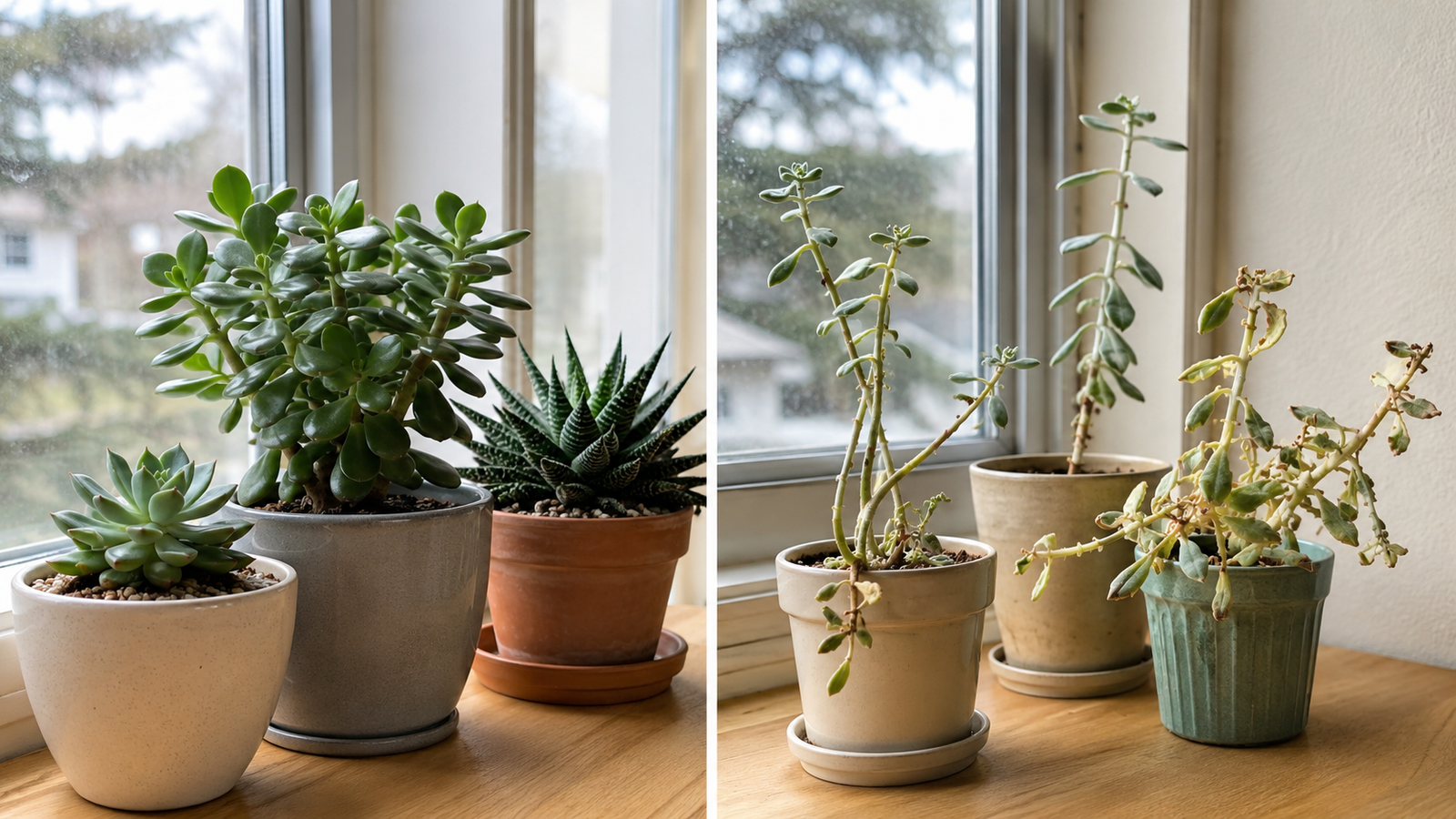
The final position should be judged by the plant’s response, not by how attractive the arrangement looks on the first day.
Old foliage may reflect conditions from the nursery, shop, or previous room. New symptoms and developing growth provide more useful information.
Immediate Signs
During the first several days, watch for:
- fresh bleaching;
- new crisp patches;
- repeated severe wilting during the brightest part of the day;
- foliage becoming extremely hot near the glass.
These symptoms can indicate excessive exposure or an abrupt change in conditions.
Longer-Term Signs
Over the following weeks, focus on new growth.
Positive signs include:
- compact succulent growth;
- healthy new leaves;
- less extreme leaning toward the window;
- continued flowering where appropriate;
- strong foliage color;
- vigorous new shoots.
| What You See | What to Check | Decision |
| Fresh bleached areas | Strong direct exposure | Reduce intensity |
| New stretched growth | Available light | Increase usable light |
| Healthy new growth | Overall position | Keep placement |
| Wilting with wet soil | Heat or roots | Diagnose before watering |
| Repeated new damage | Light and temperature | Change position |
A successful plant should do more than survive. Its new growth should show that the chosen position supports the reason you selected it.
Is Your South-Facing Window Bright Enough?
A south-facing window is not automatically a high-light site.
A building, large tree, balcony, roof overhang, tinted glass, small window, or deep room can significantly reduce the light reaching the leaves.
Your window may be weaker than expected when:
- direct sun rarely reaches the plant;
- most of the visible sky is blocked;
- the window is small compared with the room;
- the plant is positioned far from the glass;
- seasonal changes remove direct exposure.
If a supposedly high-light plant develops weak, stretched new growth, check the light before changing unrelated parts of its care.
For detailed measurements and light-meter guidance, link to the Plantsaholic article How Much Light Do Indoor Plants Need? rather than repeating those calculations here.
Bright Indirect Plants in South-Facing Rooms
A south-facing room can support both sun-loving and bright-indirect-light plants.
The strongest location may suit cactus, aloe, or flowering plants, while positions outside the direct beam can suit Monstera, philodendron, pothos, and other tropical foliage.
Do not force a bright-indirect-light plant onto the hottest sill simply because the room faces south.
Instead:
- reserve the strongest positions for plants that benefit from them;
- use nearby bright areas for adaptable plants;
- keep sensitive foliage outside unsuitable direct exposure.
For detailed guidance, internally link to What Is Bright Indirect Light for Plants?
How Strong Light Affects Pot Drying
Strong light can make a pot dry faster, but that does not mean every south-window plant automatically needs more water.
Drying depends on:
- plant species;
- temperature;
- pot size;
- growing medium;
- root activity;
- season.
If a pot begins drying much faster after relocation, check the new microclimate rather than immediately creating a rigid watering schedule.
Succulents such as cactus, Echeveria, aloe, jade, Kalanchoe, and burro’s tail should not remain constantly wet. Hibiscus, citrus, croton, and bird of paradise may require more frequent moisture checks during active growth.
Use the condition of the root zone rather than a fixed calendar.
How We Chose These Plants
Plants in this guide were not selected simply because they tolerate bright light or commonly appear in other houseplant lists.
Each recommendation needed to meet several conditions:
- strong light should support a useful plant outcome;
- the plant should be practical in an indoor container;
- it should serve a distinct purpose;
- its mature form should suit realistic indoor placement;
- important light recommendations should be supported by reliable horticultural guidance;
- readers should be able to recognize whether the placement is working.
A plant does not qualify automatically because it is popular, adaptable, or labeled “bright light.”
The main question is:
Why should this plant receive one of the brightest positions in the home instead of another plant?
If there is no strong answer, the plant is better treated as an adaptable alternative than a primary south-window recommendation.
FAQs About Indoor Plants for South Facing Window
What are the best indoor plants for a south-facing window?
Cacti, Echeveria, aloe, jade, Kalanchoe, hibiscus, pelargonium, croton, bird of paradise, and suitable citrus are strong choices. The best plant depends on your actual light, available space, and maintenance preferences.
Is a south-facing window direct sunlight or bright indirect light?
It can provide either. Leaves inside a visible sunbeam receive direct light, while plants outside the beam may receive bright indirect light.
Which plants can sit directly in a south-facing window?
Cacti and many sun-loving succulents are strong candidates. Aloe, Echeveria, jade, Kalanchoe, hibiscus, and some citrus can also use strong indoor sunlight.
Can a south-facing window be too bright?
Yes. Shade-adapted plants can develop pale, bleached, or scorched foliage when exposure is excessive.
How do I know if my south-facing window is bright enough?
Evaluate the light at the plant’s actual position. Buildings, trees, curtains, season, window size, and distance can all reduce usable light.
How far should plants be from a south-facing window?
There is no universal distance. Position each plant according to the light reaching its leaves and adjust according to new growth.
Can Monstera grow in a south-facing room?
Yes. Monstera can perform well in a south-facing room when it receives bright indirect light rather than prolonged harsh direct sunlight.
Do south-facing window plants need more water?
Not automatically. Strong light can increase drying, but watering should still depend on species and root-zone moisture.
What is the first sign that a plant is in the wrong position?
Fresh bleaching or scorch may indicate excessive exposure, while stretched new growth or strong leaning can indicate insufficient usable light.
Can a plant tolerate a south-facing window without benefiting from it?
Yes. Some adaptable plants tolerate strong light but do not require the premium position. Reserve the brightest locations for plants that gain a clear growth, flowering, or form benefit.
Is indoor window sunlight the same as outdoor full sun?
No. Outdoor sunlight is generally stronger, so indoor plants may still require gradual adjustment before being moved into strong outdoor sun.
Is a south-facing window always the brightest?
No. Outdoor obstructions, window size, season, and hemisphere can change the result. Judge the actual plant location instead of relying only on orientation.
Best Plant for Your South-Facing Window
There is no single plant that is best for every south-facing window.
For a small, intensely bright sill, cactus, Echeveria, aloe, jade, or Kalanchoe are practical choices. If flowers are your priority, consider hibiscus or pelargonium. For a larger room, bird of paradise, croton, or container citrus can make better use of the available space. Burro’s tail provides trailing growth, while snake plant works well as an adaptable bright-room option.
Use this simple decision process:
Assess the site → eliminate poor matches → select for benefit → position the plant → verify through new growth.
The right plant should not merely stay alive beside the window. Its new growth should show that the position is helping it perform the function you chose it for.
Myra is the founder and lead writer of Plantsaholic. She shares practical, research-backed advice on indoor plants, outdoor gardening, flowers, herbs, succulents, and everyday plant care. Her goal is to help gardeners of all experience levels grow healthier plants through simple, easy-to-follow gardening guides.