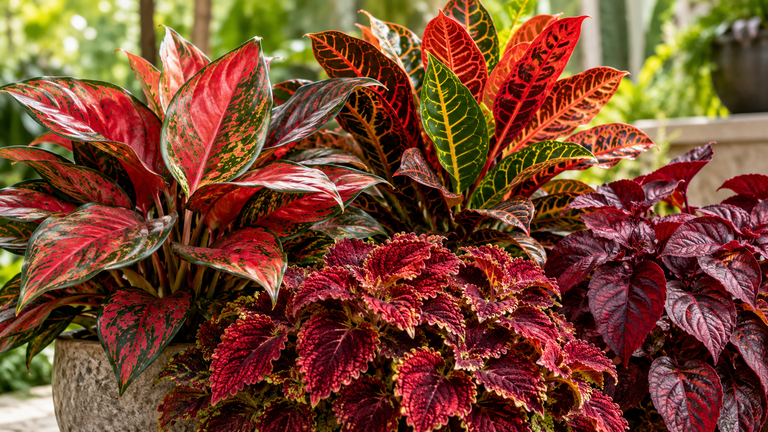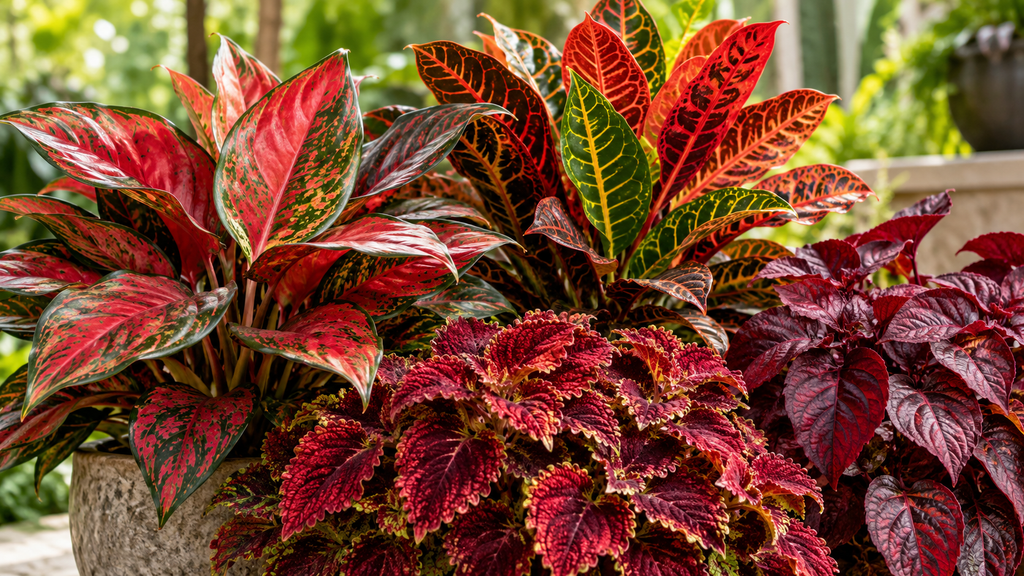
Plants with red leaves include red Aglaonema, croton, coleus, bloodleaf, Cordyline, caladium, Rex begonia, Heuchera, Japanese maple, smoke bush, ninebark, Loropetalum, copperleaf, and cranberry hibiscus. Some keep red or burgundy foliage for much of the year, while others show red only in new growth, veins, margins, or seasonal color.
The best plant depends on where you want to grow it. Red Aglaonema is well suited to indoor displays, coleus works especially well in containers, Heuchera provides compact outdoor color, Loropetalum adds burgundy shrub structure, and Japanese maple works as a red-leaved specimen tree.
The main things to compare are:
- Indoor or outdoor use
- Available light
- Climate
- Mature size
- Container suitability
- Evergreen or deciduous growth
- Persistent or seasonal red color
This guide helps you identify plants with red leaves and choose varieties that suit your actual growing conditions rather than selecting by color alone.
30+ Plants With Red Leaves
Red foliage appears in many forms. Some plants are almost completely red, while others mix burgundy, crimson, pink, green, or purple within the same leaf.
Here are more than 30 useful examples:
- Red Anjamani Aglaonema
- Red Gold Aglaonema
- Lucky Red Aglaonema
- Lady Valentine Aglaonema
- Croton
- Croton ‘Petra’
- Coleus
- Bloodleaf
- Cordyline or Ti plant
- Red caladium
- Rex begonia
- Red nerve plant
- Polka dot plant
- Copperleaf
- Cranberry hibiscus
- Brazilian Red Hots Alternanthera
- Joseph’s coat
- Parrot leaf
- Heuchera ‘Fire Chief’
- Heuchera ‘Forever Red’
- Japanese maple ‘Bloodgood’
- Japanese maple ‘Crimson Queen’
- Purple Japanese maple
- Smoke bush ‘Royal Purple’
- Purple smoke bush
- Summer Wine ninebark
- Diablo ninebark
- Coppertina ninebark
- Ruby Loropetalum
- Ever Red Loropetalum
- Purple Diamond Loropetalum
- Purple-leaf plum
- Photinia ‘Red Robin’
- Red or purple Japanese barberry cultivars
These plants are not interchangeable. Tropical foliage plants such as croton, copperleaf, bloodleaf, and Cordyline may remain outdoors all year in warm climates but need protection or indoor growing in colder areas.
Temperate plants such as Japanese maple, Heuchera, ninebark, and smoke bush are better suited to outdoor gardens where their seasonal growth cycle is expected.
Japanese barberry also requires caution because it is invasive or restricted in some regions. Always check local regulations before planting it.
Types of Plants With Red Leaves
The phrase “red leaves” can describe several different foliage patterns.
Predominantly Red Foliage
Bloodleaf, some coleus cultivars, red Aglaonema, Heuchera, and Alternanthera can produce foliage where red, crimson, or burgundy covers most of the leaf.
These are good choices when you want a strong block of color rather than subtle markings.
Red and Green Foliage
Aglaonema, croton, caladium, coleus, and Fittonia often combine red and green on the same leaf.
The red may appear as:
- Margins
- Veins
- Centers
- Spots
- Large patches
- Variegated patterns
Burgundy or Purple-Red Foliage
Smoke bush, ninebark, Loropetalum, Japanese maple, cranberry hibiscus, and dark Heuchera cultivars often look more burgundy, wine-red, or purple than bright scarlet.
Red New Growth
Some plants are red only while the leaves are young.
Photinia ‘Red Robin’ is a good example. New foliage emerges bright red and becomes green as it matures.
Seasonal Red Foliage
Deciduous plants such as Japanese maple may become especially red during autumn before losing their leaves.
This means you should always check whether a plant’s red color is persistent, temporary, or seasonal before buying it.
Best Indoor Plants With Red Leaves
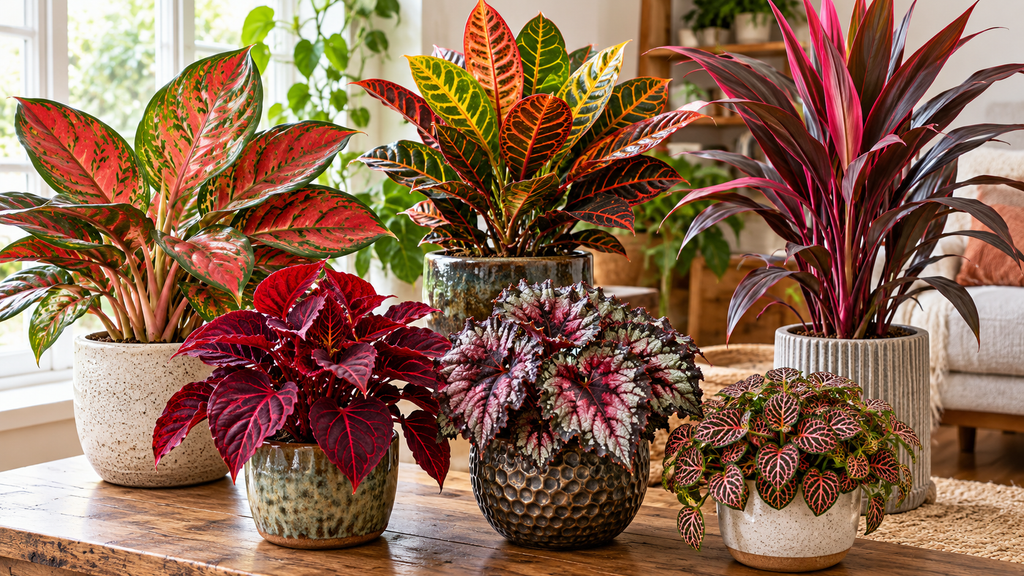
The best indoor plants with red leaves include red Aglaonema, croton, bloodleaf, Rex begonia, Cordyline, Fittonia, caladium, coleus, and polka dot plant.
Red Aglaonema
Red Aglaonema is one of the best choices for indoor red foliage because it combines broad decorative leaves with pink, red, and green.
Popular cultivars include:
- ‘Red Anjamani’
- ‘Red Gold’
- ‘Lucky Red’
- ‘Lady Valentine’
Different cultivars show different patterns. Some have red centers with green edges, while others are mainly green with bright red margins or veins.
Red Aglaonema is especially useful when you want colorful foliage without needing the very bright conditions preferred by some tropical plants.
Croton
Croton produces some of the most colorful indoor foliage available.
Its thick leaves can contain:
- Red
- Burgundy
- Orange
- Yellow
- Pink
- Green
Croton performs best in a bright position with indirect or filtered light. Very dim conditions may reduce the intensity of its foliage colors.
Choose croton when maximum color is more important than having a simple red-and-green plant.
Bloodleaf
Bloodleaf produces deep red-purple foliage and is one of the strongest choices when you want a plant that appears genuinely red rather than mostly green with red markings.
It can be used as:
- A houseplant
- A patio plant
- A warm-climate outdoor plant
- A seasonal container accent
Rex Begonia
Rex begonias are grown primarily for their foliage.
Their leaves can combine burgundy, red, silver, pink, green, and near-black colors in complex patterns.
They are especially useful when you want a smaller plant with unusual leaf texture and metallic-looking coloration.
Cordyline
Cordyline has long, upright leaves that may be burgundy, crimson, red, pink, or green.
It works well as a taller indoor or container plant and provides a more architectural shape than Aglaonema or bloodleaf.
Fittonia
Fittonia, or nerve plant, usually has green leaves crossed by a network of red or pink veins.
Its compact size makes it ideal for:
- Desktops
- Shelves
- Small pots
- Terrariums
Caladium
Caladiums have thin heart-shaped or arrow-shaped leaves with dramatic red, pink, white, and green patterns.
They provide excellent seasonal foliage but commonly enter dormancy, so they are not the best choice if you want permanent year-round leaves.
For most indoor growers, choose Aglaonema for versatility, croton for maximum color, Fittonia for small spaces, bloodleaf for deep red, and Cordyline for height.
Best Outdoor Plants With Red Leaves
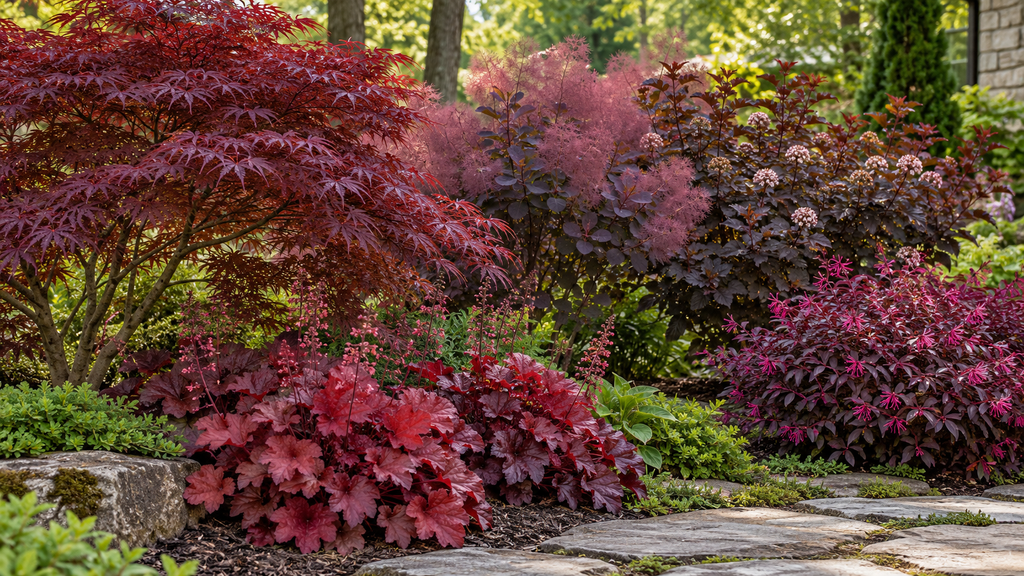
Outdoor red foliage plants include Japanese maple, Heuchera, smoke bush, ninebark, Loropetalum, cranberry hibiscus, Alternanthera, coleus, copperleaf, and Photinia.
Japanese Maple
Japanese maple is one of the most recognizable outdoor plants with red foliage.
Cultivars such as ‘Bloodgood’ and ‘Crimson Queen’ can produce purple-red or crimson leaves.
Japanese maples work especially well as:
- Specimen trees
- Courtyard features
- Small garden focal points
- Container trees when young and appropriately managed
They are deciduous, so the leaves eventually fall rather than remaining year-round.
Heuchera
Heuchera provides low-growing red, burgundy, purple, or wine-colored foliage.
Cultivars such as ‘Fire Chief’ and ‘Forever Red’ are especially useful when you want strong foliage color close to ground level.
Use Heuchera in:
- Border fronts
- Containers
- Path edges
- Mixed perennial beds
Smoke Bush
Smoke bush creates a larger mass of purple or burgundy foliage than Heuchera.
It is suitable when you need a substantial shrub rather than a compact accent.
Dark-leaved varieties generally develop their strongest foliage color in brighter outdoor conditions.
Ninebark
Ninebark cultivars such as ‘Summer Wine’, ‘Diablo’, and ‘Coppertina’ provide darker foliage on a hardy woody shrub.
Ninebark is useful for:
- Shrub borders
- Background planting
- Landscape contrast
- Larger garden spaces
Loropetalum
Loropetalum can provide burgundy or purple-red foliage on a woody shrub.
Depending on cultivar and climate, it works well in:
- Hedges
- Foundation planting
- Containers
- Mixed shrub borders
Cranberry Hibiscus
Cranberry hibiscus produces deeply colored maroon or crimson foliage.
Its lobed leaves create a different look from broad-leaved tropical plants and make it useful for warm-season beds and containers.
Plants With Red Leaves for Pots
Many red-leaf plants grow well in containers, but the right choice depends on plant size and where the pot will be placed.
Good options include:
- Red Aglaonema
- Croton
- Coleus
- Bloodleaf
- Cordyline
- Fittonia
- Rex begonia
- Caladium
- Alternanthera
- Heuchera
- Compact Loropetalum
For small indoor pots, Fittonia and compact begonias are easier to manage than large Cordylines.
For patio containers, coleus, bloodleaf, Cordyline, and Alternanthera create strong foliage combinations.
Heuchera is useful for temperate outdoor pots, while selected Japanese maples can also grow in larger containers when their long-term root space and climate needs are considered.
Whatever plant you choose, make sure the container has:
- Effective drainage
- Enough root space
- Suitable growing medium
- Protection from extreme heat or cold
- Room for future growth
A plant being suitable for pots does not mean it will remain healthy indefinitely in a small container.
Evergreen Plants With Red Leaves
Some red-leaf plants can retain foliage throughout the year, but evergreen behavior often depends on climate.
Loropetalum is one of the better outdoor woody choices for persistent burgundy foliage in suitable regions.
Croton, bloodleaf, Cordyline, and copperleaf are tropical plants that may remain evergreen where temperatures stay warm. In colder climates, they are more often grown indoors or used seasonally outdoors.
Some Heuchera cultivars can also retain foliage for long periods and may behave as evergreen or semi-evergreen depending on winter conditions.
Do not assume a plant labeled evergreen will behave the same everywhere.
For global gardening, it is better to ask:
- Is it evergreen in my climate?
- Can it survive my winter?
- Will it need indoor protection?
- Does it naturally become dormant?
- Is it deciduous even though the leaves are red?
Best Plants With Red Leaves by Climate
Climate is one of the most important factors when selecting a red-leaf plant.
Tropical and Frost-Free Climates
Good choices include:
- Copperleaf
- Croton
- Bloodleaf
- Cordyline
- Alternanthera
- Cranberry hibiscus
These plants perform well where warmth is consistent and frost is not a major concern.
Subtropical Climates
Depending on local winter temperatures, consider:
- Loropetalum
- Cordyline
- Bloodleaf
- Copperleaf
- Alternanthera
- Croton
Temperate Climates
Better outdoor choices include:
- Heuchera
- Japanese maple
- Ninebark
- Smoke bush
- Purple-leaf plum
- Photinia
Cold-Winter Climates
Use hardy temperate plants outdoors and grow tropical foliage plants as:
- Houseplants
- Summer annuals
- Patio plants
- Containers moved indoors before cold weather
If a specific plant is unsuitable, choose another plant that performs the same function.
For example, if bloodleaf cannot survive outdoors in your winter, a burgundy Heuchera can provide a similar low-growing color effect in a colder garden.
Plants With Burgundy Leaves
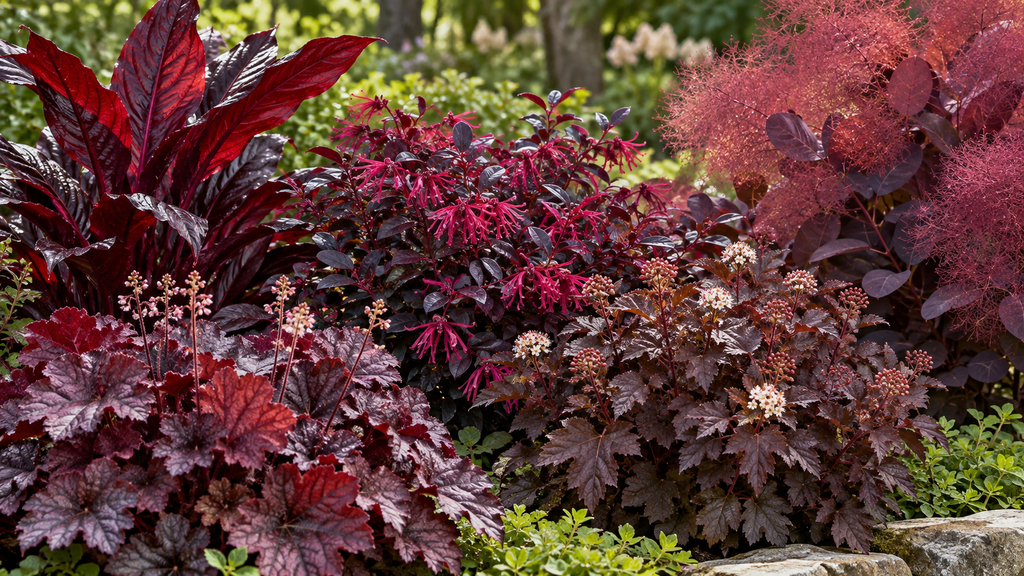
Burgundy foliage is darker than bright red and may look wine-red, maroon, purple-red, or almost black.
Good burgundy plants include:
- Bloodleaf
- Cordyline
- Heuchera
- Smoke bush
- Ninebark
- Loropetalum
- Japanese maple
- Cranberry hibiscus
- Dark coleus cultivars
- Rex begonia
For indoor growing, bloodleaf, Cordyline, Rex begonia, and dark coleus cultivars are useful choices.
For outdoor gardens, choose by mature size:
- Low perennial: Heuchera
- Seasonal plant: Coleus
- Medium to large shrub: Ninebark, Loropetalum, smoke bush
- Tree: Japanese maple
Burgundy plants often appear darker in low light, so consider how much natural light reaches the location before choosing solely from nursery photographs.
Plants With Red and Green Leaves
Plants with both red and green leaves are especially common among tropical foliage plants.
Common examples include:
- Red Aglaonema
- Croton
- Coleus
- Caladium
- Fittonia
- Rex begonia
- Cordyline
- Polka dot plant
You can often identify them by the pattern.
Broad red-and-green leaves: likely red Aglaonema.
Thick multicolored leaves: likely croton.
Soft serrated patterned leaves: likely coleus.
Heart-shaped red-green leaves: likely caladium.
Small green leaves with fine red veins: likely Fittonia.
Long upright red-green leaves: likely Cordyline.
Leaf shape, texture, plant size, and growth habit are usually more reliable identification clues than color alone.
How to Identify Plants With Red Leaves
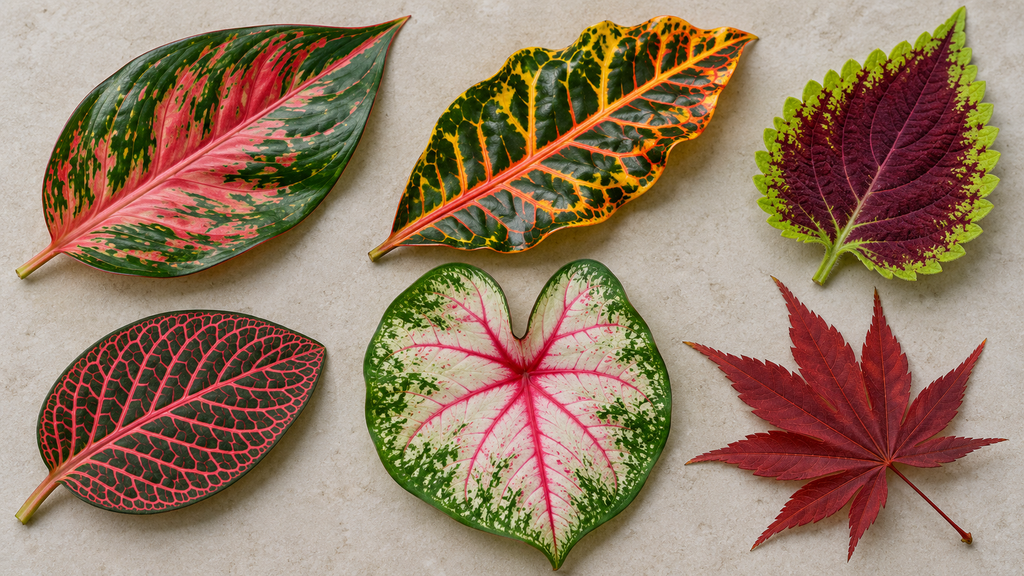
To identify an unknown plant with red leaves, start with the whole plant rather than examining only one leaf.
Use this order:
- Check whether the plant is woody or soft-stemmed.
- Look at the mature size.
- Identify the leaf shape.
- Check whether the leaf is thick, thin, smooth, or textured.
- Notice where the red appears.
- Examine the leaf margins and veins.
- Look at the growth habit.
- Consider whether it is growing indoors or outdoors.
Quick clues include:
- Broad red-green foliage → Aglaonema
- Thick multicolor foliage → Croton
- Soft serrated foliage → Coleus
- Deep red-purple foliage → Bloodleaf
- Long burgundy leaves → Cordyline
- Heart-shaped red-green leaves → Caladium
- Fine red veins → Fittonia
- Metallic patterned foliage → Rex begonia
- Low burgundy mound → Heuchera
- Lobed red leaves on a tree → Japanese maple
If identifying from a photograph, include the entire plant, one mature leaf, the stem, and the underside of the leaf.
Why Do Plants Have Red Leaves?
Red, burgundy, and purple foliage is often associated with plant pigments called anthocyanins.
However, visible leaf color results from more than one pigment. Chlorophyll, plant genetics, leaf age, light, temperature, and seasonal development can all influence what you see.
Some plants are bred specifically for persistent colored foliage.
Others develop red only during:
- New growth
- Autumn
- Certain light conditions
- Particular stages of leaf development
Photinia ‘Red Robin’, for example, produces red new leaves that later become green.
Japanese maples may show different shades between spring, summer, and autumn.
That is why red foliage should be viewed as a plant characteristic rather than a universal sign of one particular growing condition.
How to Keep Red Leaves Colorful
The best way to maintain attractive red foliage is to match care to the species.
Provide the Right Light
Some plants need relatively bright light to maintain strong color, but that does not mean every red plant needs full sun.
Croton generally performs best in bright indirect light indoors.
Fittonia prefers more filtered conditions.
Outdoor plants such as smoke bush often develop stronger dark foliage in brighter positions.
Water According to the Plant
Avoid watering solely according to a fixed weekly schedule.
Check:
- Soil moisture
- Pot size
- Drainage
- Temperature
- Season
- Plant type
Waterlogged roots can cause problems even if the foliage initially looks healthy.
Protect Tropical Plants From Cold
Croton, Cordyline, copperleaf, bloodleaf, and many other colorful tropical plants need protection from inappropriate cold conditions.
Expect Natural Color Changes
Some red plants naturally become darker, greener, or more burgundy as their leaves mature.
Do not immediately increase fertilizer or sunlight just because a red leaf changes color.
Why Are Red Leaves Turning Green?
A red-leaf plant turning green does not always mean something is wrong.
Possible reasons include:
- Normal leaf maturation
- Reduced light
- Seasonal change
- Cultivar behavior
- Plant stress
Photinia ‘Red Robin’ naturally produces red young leaves that mature green.
Croton may lose some color intensity when grown in insufficient light.
Before changing care, check:
- Is the plant supposed to stay red?
- Are only mature leaves becoming green?
- Has the plant recently moved?
- Has seasonal light changed?
- Is new growth healthy?
- Is the soil staying too wet?
- Is the plant naturally entering dormancy?
Diagnosis should be based on the plant and its normal growth pattern rather than color alone.
Quick Plants With Red Leaves Selector
Use this shortcut if you are unsure which plant to choose.
Indoors
For broad red-green foliage → Red Aglaonema
For maximum multicolor foliage → Croton
For a small plant → Fittonia
For deep red-purple foliage → Bloodleaf
For metallic patterns → Rex begonia
For tall tropical foliage → Cordyline
Outdoors
For a low perennial → Heuchera
For seasonal pots → Coleus or Alternanthera
For a burgundy shrub → Ninebark, Loropetalum, or smoke bush
For red hedge growth → Photinia ‘Red Robin’ where suitable
For a specimen tree → Japanese maple
For tropical outdoor foliage → Copperleaf, bloodleaf, or cranberry hibiscus
Before buying, confirm:
- Light
- Climate
- Mature size
- Pot or ground
- Evergreen or deciduous growth
- Persistent or seasonal color
- Local restrictions
Are Poinsettias Red-Leaf Plants?
Poinsettias look like they have large red leaves, but the colorful red structures are actually bracts, which are modified leaves associated with the small flowers.
Anthuriums create a similar misunderstanding. Their familiar red heart-shaped structure is a floral spathe rather than ordinary red foliage.
If you want genuinely colorful foliage, choose plants such as:
- Red Aglaonema
- Croton
- Bloodleaf
- Coleus
- Heuchera
- Cordyline
Choose poinsettia or Anthurium when the goal is colorful floral display rather than permanently red foliage.
FAQs About Plants With Red Leaves
What types of plants have red leaves?
Plants with red leaves include houseplants, tropical foliage plants, perennials, shrubs, and trees. Popular examples include red Aglaonema, croton, coleus, Heuchera, Loropetalum, bloodleaf, and Japanese maple.
What is the name of the plant with red leaves?
There is no single red-leaf plant. Common possibilities include red Aglaonema, croton, coleus, bloodleaf, Cordyline, caladium, Heuchera, and Japanese maple.
What are the best indoor plants with red leaves?
Red Aglaonema, croton, bloodleaf, Rex begonia, Cordyline, Fittonia, coleus, and caladium are good indoor choices. Choose according to available light and space.
What indoor plant has red and green leaves?
Red Aglaonema is one of the most recognizable choices. Croton, coleus, caladium, Fittonia, Rex begonia, and Cordyline can also combine red and green foliage.
What plant has burgundy leaves?
Bloodleaf, Heuchera, Loropetalum, ninebark, smoke bush, Cordyline, cranberry hibiscus, and Japanese maple can all produce burgundy foliage.
Are there evergreen plants with red leaves?
Yes, but evergreen behavior depends on climate. Loropetalum, croton, Cordyline, bloodleaf, and some Heuchera cultivars can retain colorful foliage in suitable conditions.
Which red-leaf plants are best for pots?
Coleus, red Aglaonema, croton, bloodleaf, Cordyline, Fittonia, caladium, Alternanthera, and Heuchera all work well in containers when drainage and pot size are appropriate.
Why is my red-leaf plant turning green?
Normal leaf maturity, reduced light, seasonal change, or cultivar behavior can all cause red foliage to become greener. Identify the plant before changing its care.
Do plants with red leaves need more sunlight?
Not always. Some maintain stronger color in bright light, while others prefer filtered light or partial shade. Light requirements depend on the species.
What is the easiest red-leaf plant for beginners?
Red Aglaonema is one of the easiest indoor choices. Coleus is another practical option for containers and seasonal outdoor color.
Best Plants With Red Leaves: Final Picks
The best plant with red leaves is the one that matches your light, climate, available space, and preferred growth habit.
For indoor growing, red Aglaonema provides one of the best combinations of colorful foliage and practical placement. Croton works well when stronger multicolor foliage is wanted and adequate light is available. Fittonia suits small spaces, while Cordyline provides a taller tropical look.
For outdoor gardens, Heuchera is useful at a compact perennial scale. Ninebark, Loropetalum, and smoke bush provide larger burgundy shrub structure. Japanese maple is the better choice when you want an ornamental tree with red or purple-red foliage.
Quick final picks:
- Best indoor all-rounder: Red Aglaonema
- Best multicolor foliage: Croton
- Best deep red-purple: Bloodleaf
- Best small indoor plant: Fittonia
- Best container plant: Coleus
- Best heart-shaped foliage: Caladium
- Best outdoor perennial: Heuchera
- Best tropical red shrub: Copperleaf
- Best burgundy shrub: Ninebark or smoke bush
- Best evergreen-type burgundy shrub: Loropetalum
- Best red-new-growth hedge: Photinia ‘Red Robin’
- Best red-leaf tree: Japanese maple
- Best tall tropical accent: Cordyline
For the most reliable result, choose in this order:
Climate → light → plant type → mature size → foliage behavior → color.
That approach gives you a plant that not only looks attractive when purchased but also has a realistic chance of continuing to perform well in your home, container, or garden.
Myra is the founder and lead writer of Plantsaholic. She shares practical, research-backed advice on indoor plants, outdoor gardening, flowers, herbs, succulents, and everyday plant care. Her goal is to help gardeners of all experience levels grow healthier plants through simple, easy-to-follow gardening guides.