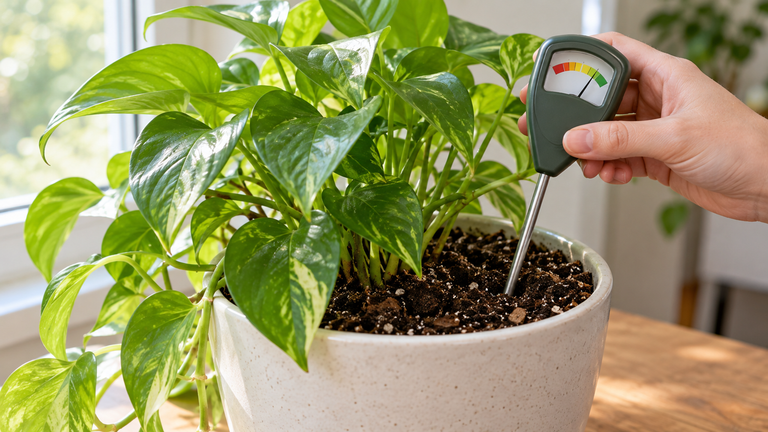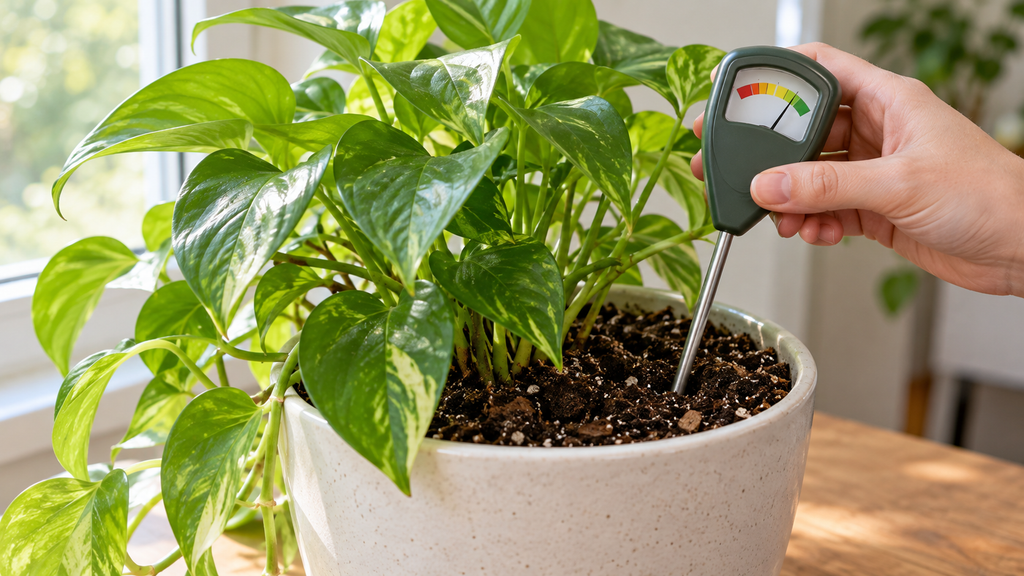
A moisture meter for plants helps you check how wet or dry the growing medium is below the surface, especially around the root zone. Insert a clean probe into a representative area of the pot, let the reading stabilize, and compare the result with the plant’s preferred moisture level before deciding whether to water.
The most important rule is simple: a moisture meter gives you evidence, not a watering command. Plant type, potting mix, container size, root depth, light, temperature, and recent watering all affect what a reading means.
How Does a Moisture Meter for Plants Work?
A plant moisture meter does not directly measure whether a plant is “thirsty.” It measures or estimates a property of the growing medium around the probe, then converts that information into a dry, moist, wet, or numerical reading.
Basic household probes are best treated as relative indicators. More advanced sensors may use capacitance, time-domain reflectometry, or soil-water tension measurements to estimate moisture more precisely. For ordinary houseplants, you rarely need research-grade accuracy. What matters more is whether your meter responds consistently as the same pot moves from freshly watered to progressively drier.
Common types include:
- Basic analog probe: useful for relative wet-to-dry checks.
- Digital consumer meter: may provide a more detailed display but still depends on sensor quality and growing medium.
- Capacitance sensor: can estimate moisture quantitatively when properly calibrated.
- TDR sensor: used in professional or research settings for higher-precision measurements.
- Tensiometer: measures how strongly water is held in soil rather than simply how much water is present.
The number on the display is only useful when you understand what that particular meter is designed to measure.
How to Use a Moisture Meter for Plants
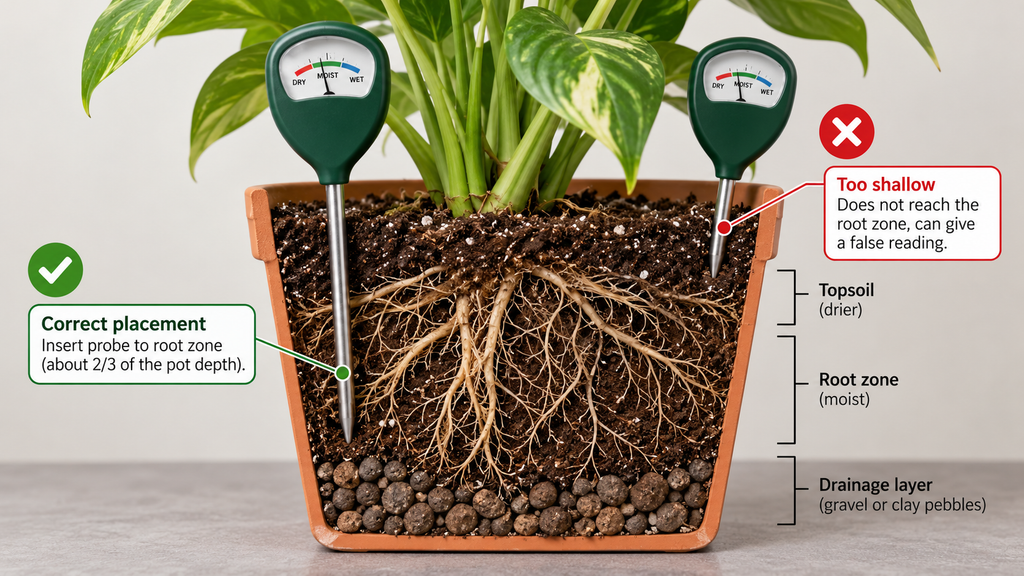
Start with a clean probe and read the instructions for your specific meter. Choose a representative part of the pot and insert the probe gently into the growing medium. Do not force it through dense roots, rocks, bark, or hard material.
Use this process:
- Clean the probe.
- Choose a representative area of the root zone.
- Insert the probe gently.
- Let the reading stabilize.
- Check another area in larger pots.
- Compare the result with the plant’s preferred dry-down level.
- Water only if the root zone has reached the appropriate level of dryness.
- Remove a handheld probe after testing.
- Wipe it clean before storing it.
How Deep Should the Probe Go?
Insert the probe far enough to measure the active root zone rather than only the rapidly drying surface. In a shallow pot, that may be only a few inches. In a tall container, you may need to check deeper because the top layer can dry while the lower half remains moist.
Do not automatically push the probe all the way to the bottom. The lowest part of the pot may stay wetter than the rest of the root zone and may not represent average conditions.
Should You Check More Than One Spot?
Yes, especially in wide or deep containers. Water is not always distributed evenly through potting mix. Root density, dry pockets, air gaps, and watering technique can make one section wetter than another.
If one reading says dry and another says wet, do not simply average them. Treat the difference as useful information and investigate why the pot is drying unevenly.
How Often Should You Check?
When you first begin using a meter, checking every few days can help you learn the drying pattern of a new plant. Once you understand that pattern, test closer to the expected watering window instead of probing every day.
Recheck more frequently after repotting, changing light levels, moving the plant, or during major seasonal changes.
How Do You Read a Moisture Meter?
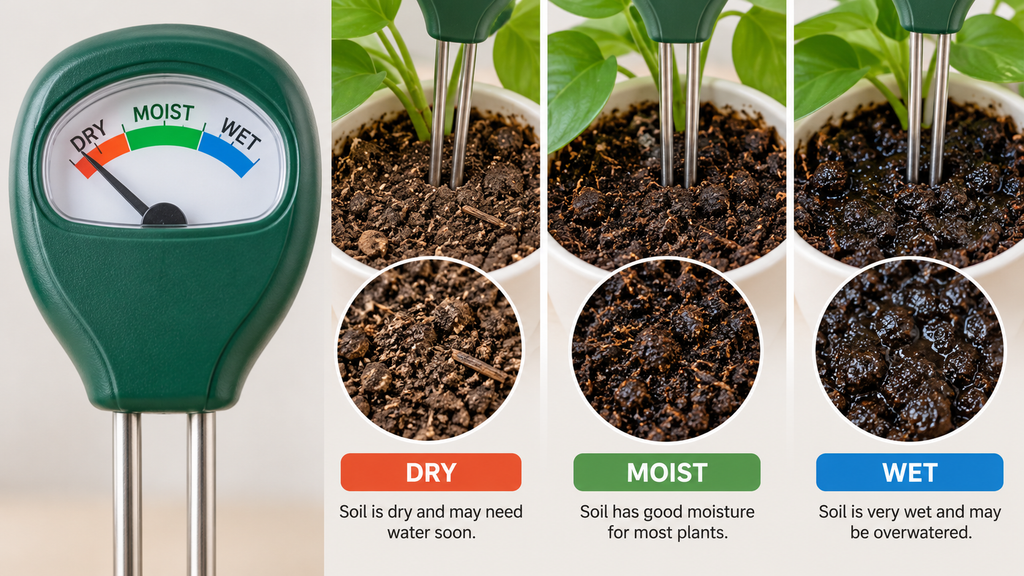
Most household moisture meters use labels such as dry, moist, and wet, often combined with numbers. These readings describe conditions around the probe. They do not automatically tell you what action to take.
A common 1–10 scale may look roughly like this:
- 1–3: relatively dry
- 4–7: relatively moist
- 8–10: relatively wet
These ranges are not a universal botanical standard. Always follow the scale supplied with your own meter.
A reading of 3 on one meter may not mean exactly the same thing as 3 on another. More importantly, the same reading can lead to different watering decisions for different plants.
A succulent may be comfortable in the dry range, while a fern may need water before the root zone reaches the same point.
Why Are Trends More Useful Than One Number?
A single reading is a snapshot. A sequence of readings shows how the pot actually dries.
For example:
- Very wet immediately after watering
- Moderately moist several days later
- Near the plant’s normal watering point later in the week
That pattern teaches you how long the container usually holds water. If the same pot suddenly stays wet much longer, something may have changed, such as light, temperature, root activity, potting mix, or drainage.
When Should You Water Your Plants?
There is no single moisture-meter number at which every plant should be watered.
The correct watering point depends on the plant, growing medium, root system, container, and environment. Instead of asking, “What number means water?” ask, “Has this plant reached the level of dryness it prefers before watering?”
A practical framework is:
- Dry-loving plants: allow substantial root-zone drying.
- Plants that prefer partial dry-down: water after part of the root zone has dried.
- Even-moisture plants: water before the root zone becomes completely dry.
- Moisture-loving plants: avoid prolonged complete drying.
Broad plant groups can also help:
- Cacti and many succulents usually tolerate substantial drying.
- Snake plants and ZZ plants usually prefer significant dry-down.
- Pothos, Monstera, and Philodendron types generally prefer partial drying.
- Ferns and other moisture-preferring plants usually tolerate less drying.
These are tendencies, not rigid watering rules. Pot size, light, humidity, temperature, season, and root density can all shift the timing.
Can You Trust a Moisture Meter Reading?
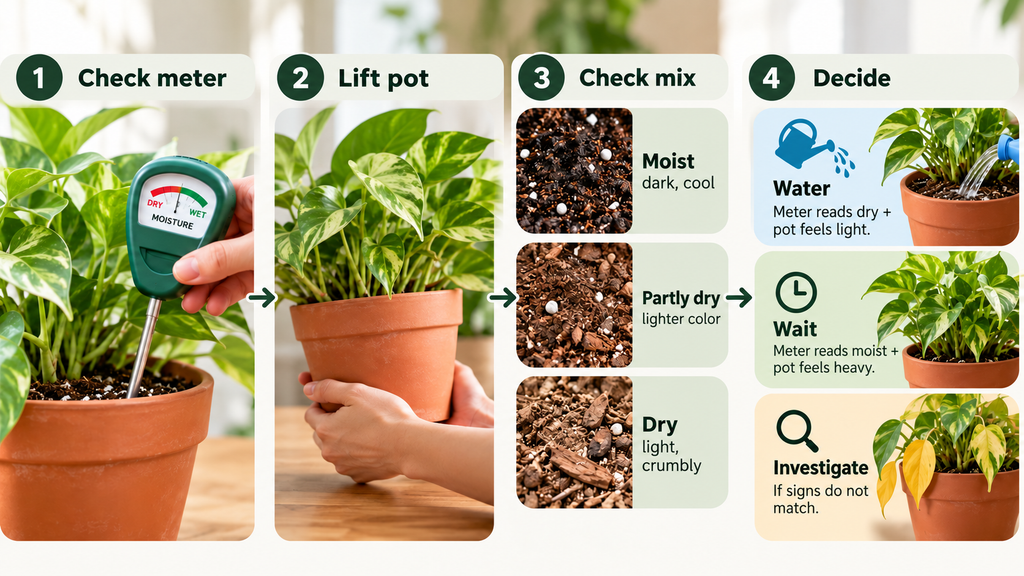
A reading is more trustworthy when it is repeatable, representative, and supported by another clue.
Instead of asking only whether the device is accurate, ask whether this particular reading makes sense in this particular pot.
Use the plantsaholic Measure → Verify → Match → Decide method.
Measure
Take a reading at a representative root-zone depth. In large pots, check more than one area.
Verify
Compare the result with another clue, such as:
- pot weight;
- physical feel of the growing medium;
- recent watering history;
- another meter reading;
- drainage behavior.
Match
Ask whether the meter is suitable for the potting mix. A probe can make consistent contact with a fine houseplant mix but behave less predictably in coarse bark or large air spaces.
Decide
Classify the result:
- Reading likely usable: several clues broadly agree.
- Reading needs verification: results conflict or the medium is difficult to measure.
- Do not rely on the meter alone: the device cannot give repeatable results in that setup.
For example, if a Monstera meter reads dry but the pot still feels unusually heavy, do not water immediately. Take another reading elsewhere in the root zone. If that area reads moist, the first probe may have entered a dry pocket.
The reading earns trust when independent evidence supports it.
Which Potting Mixes Work Best?
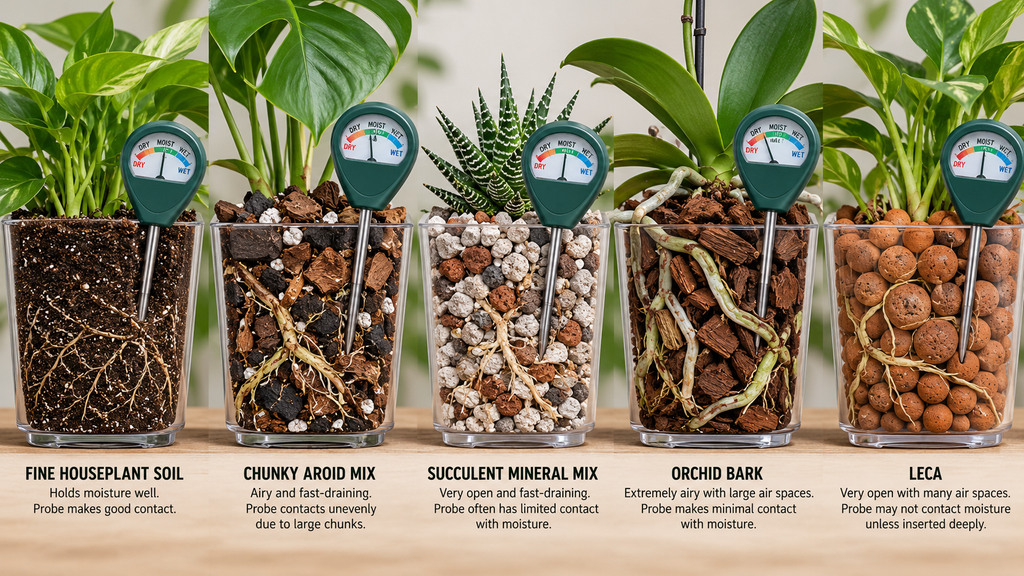
Moisture meters generally work more predictably when the probe can make consistent contact with the growing medium.
Use these guidelines:
- Standard houseplant mix: generally suitable, but check for uneven moisture.
- Peat or coir mix: usually suitable, though very dry media can become difficult to rewet evenly.
- Chunky aroid mix: use cautiously because bark, perlite, pumice, and air gaps can create inconsistent readings.
- Succulent or mineral mix: usefulness depends on the meter and particle size.
- Orchid bark: often difficult for conventional soil probes because of large air spaces.
- LECA or semi-hydro: standard soil meters are usually not the best tool because water is managed differently.
Why Can Peat or Coir Give Confusing Results?
Very dry peat-based media can become hydrophobic, meaning water may run through channels instead of rewetting the whole root ball.
That can create a pot with one wet area and another dry area immediately after watering. Different meter readings may therefore reflect a real distribution problem rather than a faulty meter.
Why Are Chunky Mixes Harder to Test?
A probe inserted into a coarse aroid mix may contact moist coir in one location, dry bark in another, and an air pocket somewhere else.
When the growing medium is very coarse, take several readings and cross-check with pot weight or another method.
Where Should You Check Soil Moisture?
Check the root zone, not just the surface.
The top layer of potting mix is exposed directly to air and often dries much faster than the material lower in the container. Watering every time the surface looks dry can therefore keep deeper roots constantly wet.
In a large container, test more than one area and, when useful, more than one depth. You are looking for the overall drying pattern rather than one perfect spot.
If one area is wet and another is dry, possible causes include:
- uneven watering;
- hydrophobic potting mix;
- different root densities;
- water channeling;
- air gaps.
Do not water just because one location is dry. Use the wider root-zone pattern to make the decision.
What Can Affect Moisture Meter Readings?
Several conditions can make a reading less representative:
- Poor probe contact
- Air gaps
- Chunky substrate
- Fertilizer salts
- Mineral buildup
- Uneven watering
- Incorrect probe depth
- Temperature changes
- Damaged or corroded probes
Can Fertilizer Affect a Moisture Meter?
Yes, some meters can be influenced by dissolved fertilizer salts because those salts change the electrical properties of the growing medium.
If the meter suddenly behaves differently after heavy fertilization, do not assume the soil moisture changed exactly as the display suggests. Cross-check the reading.
What About Mineral Buildup?
Residue can accumulate on probes over time, especially when hard water or fertilizer is used regularly.
Wipe the probe after use and follow the manufacturer’s cleaning instructions if buildup becomes visible.
When Should You Ignore the Reading?
Do not rely on one reading when the measurement conditions are clearly unreliable or when other evidence strongly disagrees.
Be cautious when:
- the medium is mostly coarse bark or large particles;
- nearby readings are dramatically different;
- the probe repeatedly lands in air pockets;
- heavy fertilizer or salt buildup is suspected;
- the pot weight strongly contradicts the meter;
- the probe is bent, corroded, or damaged;
- the meter shows nearly the same value in clearly wet and clearly dry medium.
If the meter says dry but the pot still feels heavy, verify before watering.
If the meter says wet but the plant is wilting, do not automatically add more water. Wet soil plus wilt can indicate root stress, poor aeration, damaged roots, or another problem.
When the meter and the rest of the plant disagree, investigate first and water second.
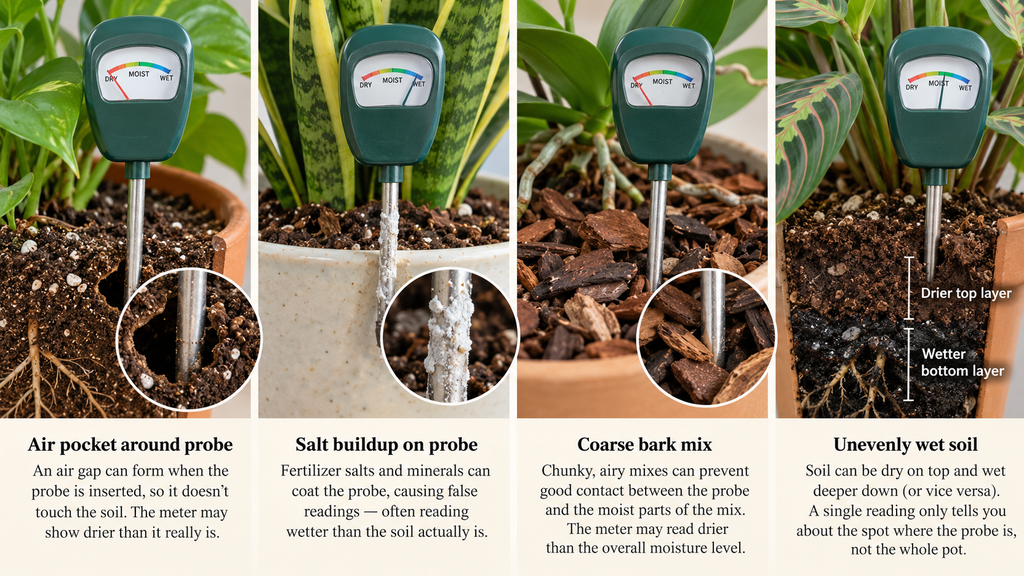
Why Is My Moisture Meter Not Working?
When a meter seems faulty, determine whether the problem is the device or the measurement conditions.
Use this sequence:
- Clean the probe.
- Test another location in the same pot.
- Compare with pot weight or physical inspection.
- Test the meter in clearly wet and clearly dry suitable potting mix.
- Consider whether the substrate is compatible with the meter.
- Check batteries, electronics, bending, corrosion, or damage.
- Replace the meter only if it still cannot distinguish wet from dry conditions.
Common patterns include:
- Always dry: poor contact, coarse mix, or damaged probe.
- Always wet: saturated medium, salts, or sensor problems.
- Reading jumps: air gaps or inconsistent contact.
- No movement: device or probe failure.
- Strange after fertilizing: possible salt influence.
- Works in one mix but not another: likely substrate compatibility issue.
Why Does It Say Dry After Watering?
The water may not have reached the area you measured. Dry peat-based mixes can sometimes rewet unevenly, allowing water to run through channels while some sections remain dry.
Check multiple locations before adding more water.
Why Does It Stay Wet for Days?
The pot may genuinely be drying slowly because of low light, cool conditions, a large container, moisture-retentive mix, limited root activity, or poor drainage.
Do not water again simply because the plant used to dry faster.
Can You Leave a Moisture Meter in Soil?
Usually, no.
A standard handheld moisture meter should generally be removed after taking the reading unless the manufacturer specifically says it is designed for continuous installation.
Leaving a portable probe in damp, fertilized growing medium can encourage residue buildup or corrosion. It also limits you to one measurement point.
After testing:
- remove the probe;
- wipe it clean;
- inspect it for buildup or damage;
- store it dry.
Purpose-built continuous sensors are a different category and should be used according to their installation instructions.
How Accurate Are Moisture Meters?
Accuracy depends on the sensor technology, calibration, potting mix, placement, salinity, temperature, and maintenance.
A basic consumer probe should not be expected to perform like research-grade equipment. Professional sensor technologies can measure water content more precisely, while inexpensive household probes are better used for relative wet-to-dry comparisons.
For ordinary houseplants, repeatability is often more useful than laboratory precision.
If the same meter consistently shows:
- high moisture after watering;
- a middle reading during drying;
- a lower reading near the normal watering point;
then it can still be useful even if the number is not an exact scientific measurement.
When choosing a household meter, prioritize:
- consistent response;
- suitable probe length;
- compatibility with your growing medium;
- clear instructions;
- durable construction.
Detailed product comparisons belong on a separate buying guide.
Moisture Meter vs Finger Test: Which Is Better?
Neither method is best in every situation.
A moisture meter is useful for reaching deeper parts of a pot. The finger test is quick and free but limited to shallow depths. Pot weight can provide an excellent whole-container clue once you learn what the pot feels like when wet and dry.
Use this simple selector:
- Moisture meter: best for deep pots and hidden moisture.
- Finger test: best for small or shallow pots.
- Pot weight: best when you know the container well.
- Wooden skewer: useful for checking deeper moisture in suitable media.
- Visual inspection: useful as a quick first check but not enough on its own.
The best method is the one that fits the pot and growing medium. Cross-check whenever the result is uncertain.
Is a Moisture Meter Worth Buying?
For many houseplant owners, yes.
A moisture meter is especially useful if you:
- frequently water too soon;
- use deep or heavy pots;
- manage many plants with different drying rates;
- struggle to judge moisture below the surface;
- are learning how quickly different pots dry.
It may be less useful if:
- your pots are very small and easy to inspect;
- your growing medium is too coarse for reliable probe contact;
- you already judge moisture confidently from pot weight;
- you mainly grow in LECA or another non-soil system.
A meter can help reduce overwatering by showing that the deeper root zone is still moist after the surface dries. It cannot compensate for poor drainage, an oversized pot, unhealthy roots, or unsuitable potting mix.
Buy one if it gives you better evidence before watering, not because you expect it to make every decision for you.
Should You Trust the Meter or the Plant?
Trust neither signal in isolation.
The meter tells you something about moisture around the probe. The plant tells you how it is responding. Pot weight, substrate condition, roots, light, temperature, and recent care provide the missing context.
Use the final plantsaholic system:
Measure: Take a representative root-zone reading.
Verify: Check another location or physical clue.
Match: Make sure the meter suits the growing medium.
Decide: Water, wait, or investigate.
This expands the plantsaholic 3-Check Rule:
Meter + Root Zone + Plant
A good moisture meter should not replace your understanding of the plant. It should help you make a better-informed watering decision.
FAQs About Moisture Meters for Plants
How do you use a moisture meter for plants correctly?
Insert the clean probe into the root zone, let the reading stabilize, and check another area in larger pots. Interpret the result according to that plant’s moisture needs.
At what moisture level should I water my plants?
There is no universal number. Water when the root zone reaches the level of dryness appropriate for the specific plant.
Should I water when the moisture meter reaches 3?
Not automatically. A reading of 3 may indicate dry conditions on some meters, but the plant and the meter’s own scale determine whether watering is appropriate.
How deep should a moisture meter go?
Insert the probe deeply enough to sample the active root zone rather than only the surface. Tall pots may need readings at more than one depth.
Do moisture meters actually work?
Yes, they can be useful for tracking relative root-zone moisture. Their reliability depends on the sensor, substrate, probe contact, and placement.
Are cheap moisture meters accurate enough?
They can be useful if they consistently distinguish wetter from drier conditions. For houseplants, repeatability often matters more than laboratory precision.
Why does my meter say dry after watering?
The probe may be in a dry pocket or the root ball may have been wetted unevenly. Check another location before watering again.
Can fertilizer affect a moisture meter?
Yes. Fertilizer salts can influence some electrical sensor technologies, so unusual readings should be cross-checked.
Can I leave a moisture meter in the pot?
Usually not if it is a handheld meter. Remove and clean it after use unless the manufacturer specifically designed it for continuous installation.
Can a moisture meter detect root rot?
No. It can show that the growing medium is staying wet, but diagnosing root rot requires checking the roots, drainage, substrate, and plant symptoms.
Is a moisture meter better than the finger test?
A meter is better for deeper areas, while the finger test is quick and useful near the surface. Pot weight is another valuable cross-check.
Is a moisture meter worth buying?
Yes, if you struggle with premature watering, deep pots, or judging moisture below the surface. It is less useful when other methods already work reliably.
When should I ignore a moisture-meter reading?
Do not rely on one reading when nearby measurements conflict, probe contact is poor, the substrate is extremely coarse, or the meter cannot clearly distinguish wet from dry conditions.

Myra is the founder and lead writer of Plantsaholic. She shares practical, research-backed advice on indoor plants, outdoor gardening, flowers, herbs, succulents, and everyday plant care. Her goal is to help gardeners of all experience levels grow healthier plants through simple, easy-to-follow gardening guides.