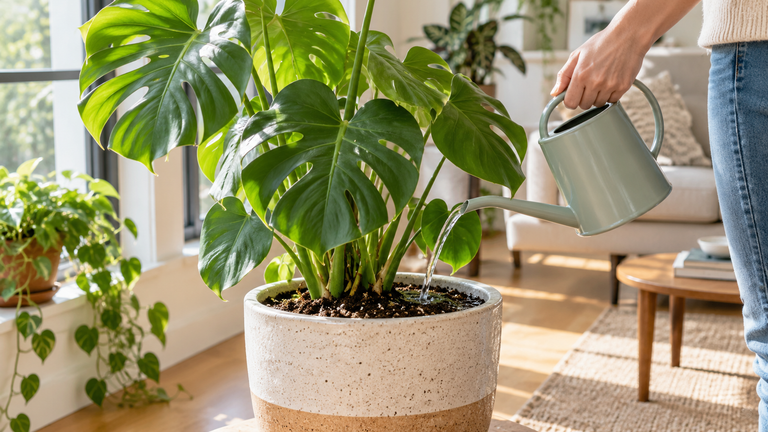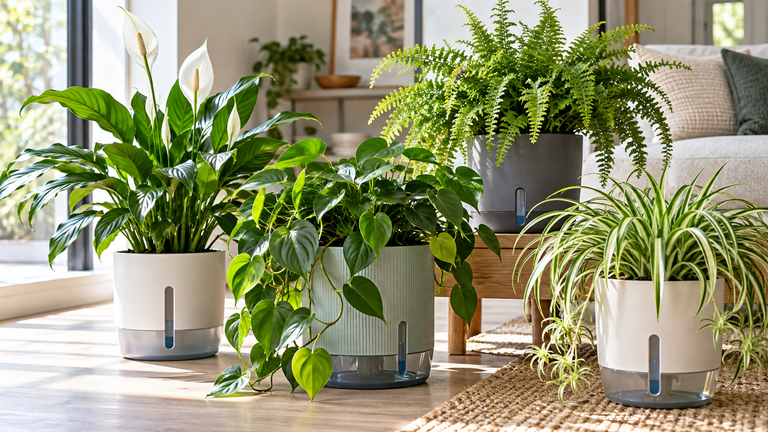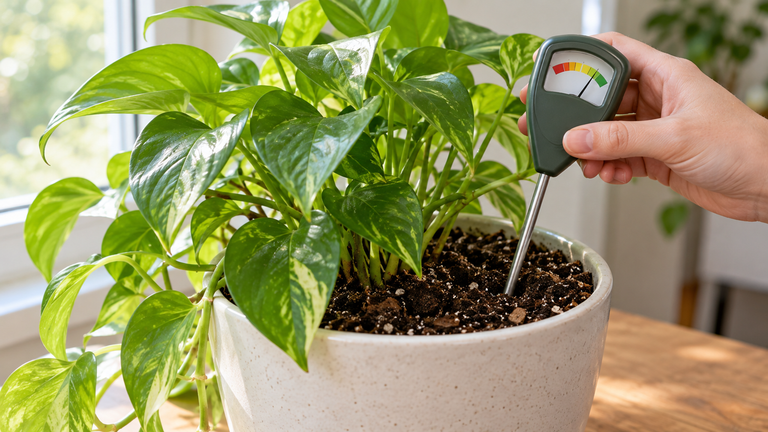
The best way to fertilize indoor plants is to feed healthy plants while they are actively growing, using a complete fertilizer at the correct label rate. Apply soluble fertilizer to normally moist potting mix, account for nutrients already present, and reduce or stop feeding when growth slows or the plant becomes stressed.
Indoor plants grow in a limited amount of potting mix, so their nutrient supply eventually declines. Fertilizer helps replace nutrients used for leaves, roots, stems, and flowers, but it should never be treated as a cure for every plant problem.
A plant struggling because of low light, root rot, overwatering, drought, or pests may not benefit from more fertilizer. In some cases, extra nutrients can make the problem worse.
The most useful rule is simple:
Plant condition before calendar.
Before fertilizing, look at how the plant is growing, how much light it receives, whether the roots are healthy, and what nutrients are already present in the pot.
Should You Fertilize Indoor Plants Now?
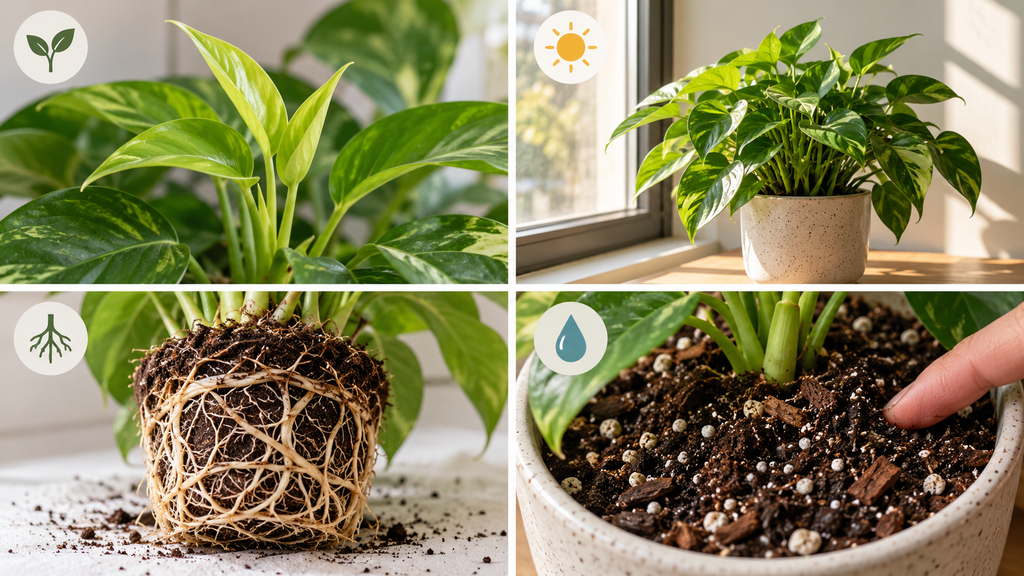
Fertilize indoor plants when they are healthy, actively growing, receiving enough light, and rooted in normally moist potting mix. Delay feeding if the plant is dormant, badly stressed, waterlogged, severely dry, root-damaged, or already receiving enough fertilizer.
Signs of active growth include:
- new leaves;
- fresh shoots;
- longer vines;
- new roots;
- flower buds;
- increased water use.
A plant that has stopped growing does not automatically need fertilizer. Slow growth can result from low light, temperature changes, root problems, or natural seasonal slowdown.
Before feeding, ask:
- Is the plant actively growing?
- Is it receiving adequate light?
- Are the roots healthy?
- Is the potting mix neither bone dry nor waterlogged?
- Was the plant recently repotted?
- Is fertilizer already present in the potting mix?
- When was the previous fertilizer application?
If the plant is healthy and growing steadily, fertilizer can support continued development. If one of the main growing conditions is poor, correct that problem first.
Why Do Indoor Plants Need Fertilizer?
Indoor plants need fertilizer because the potting mix inside a container cannot provide nutrients indefinitely. As roots absorb minerals and watering carries some soluble nutrients out of the pot, the available nutrient supply gradually decreases.
The three nutrients most commonly shown on fertilizer labels are nitrogen, phosphorus, and potassium.
Plants also require smaller amounts of nutrients such as:
- calcium;
- magnesium;
- sulfur;
- iron;
- manganese;
- zinc;
- copper;
- boron.
Fertilizer supports processes such as leaf development, root growth, chlorophyll production, flowering, water regulation, and enzyme activity.
However, plants do not get their energy directly from fertilizer. They produce sugars through photosynthesis using light, water, and carbon dioxide.
That is why fertilizer cannot replace:
- adequate light;
- correct watering;
- healthy roots;
- suitable temperatures;
- pest control;
- good potting mix.
For example, a pothos producing small leaves in a dark room may appear underfed, but additional fertilizer will not compensate for insufficient light.
Fertilize when nutrition is likely to be limiting an otherwise healthy plant.
What Nutrients Are Already in the Soil?
Before adding fertilizer, identify what nutrient sources are already present in the container. Using several feeding systems at the same time can result in more fertilizer than the plant can use.
Possible existing nutrient sources include:
- fertilized potting mix;
- slow-release granules;
- previous liquid fertilizer applications;
- fertilizer spikes or tablets;
- worm castings;
- compost;
- nursery-applied fertilizer.
A recently purchased plant may already contain controlled-release fertilizer even if you did not add it yourself.
Likewise, fresh commercial potting mix may include enough fertilizer to support growth for a period after repotting.
A common mistake is to repot a plant into fertilized soil, add slow-release granules, and then begin regular liquid feeding immediately.
Before adding another product, ask:
What nutrients are already being supplied?
This nutrient-load check is one of the easiest ways to prevent overfertilization.
Best Fertilizer for Indoor Plants
For many common indoor plants, a complete fertilizer containing nitrogen, phosphorus, potassium, and preferably micronutrients is a practical choice. The best fertilizer depends on the plant, its growth rate, and how much control you want over feeding.
Liquid and Water-Soluble Fertilizer
Liquid concentrates and soluble powders are diluted in water before use.
They provide:
- precise dose control;
- easy adjustment;
- relatively quick nutrient availability;
- flexibility for different plants.
They work well for growers who regularly inspect their plants.
The main risk is applying too much or fertilizing too often.
Slow-Release Fertilizer
Slow-release granules supply nutrients gradually.
They are useful for:
- large collections;
- busy plant owners;
- growers who prefer fewer applications.
The main concern is combining them with frequent liquid fertilizer without accounting for both nutrient sources.
Organic Fertilizer
Organic fertilizers may be made from plant, animal, fish, seaweed, composted, or other naturally derived materials.
They can work well, but organic fertilizer can still be overapplied.
Synthetic Fertilizer
Synthetic fertilizers provide nutrients in predictable concentrations and are easy to measure.
They are effective, but excessive use can cause soluble salts to accumulate quickly.
The best choice is the fertilizer you can measure correctly, apply consistently, and adjust to the plant’s actual growth.
What Does NPK Mean for Indoor Plants?
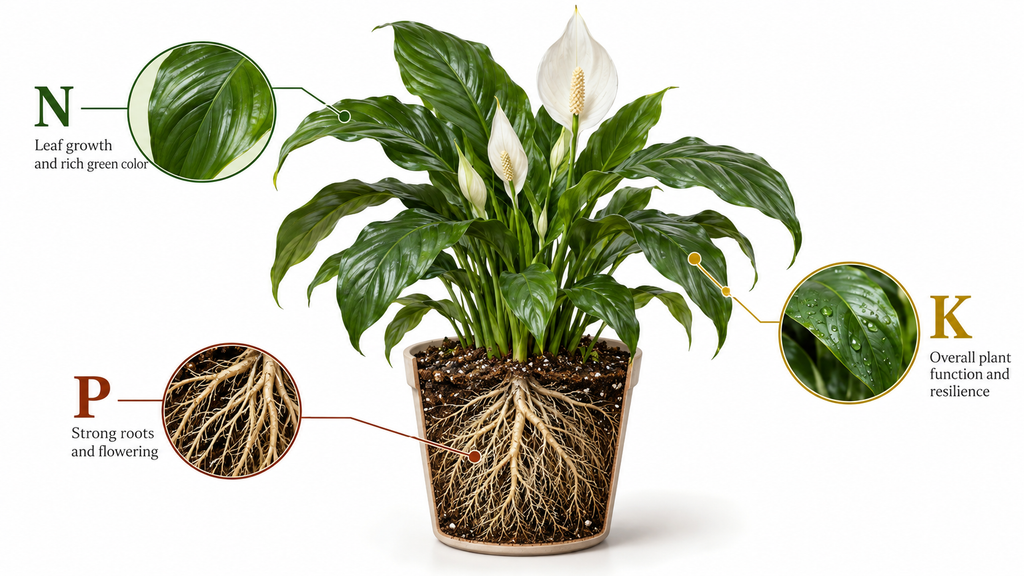
NPK stands for nitrogen, phosphorus, and potassium. The numbers on a fertilizer label show the relative concentration of these three primary nutrients.
Nitrogen
Nitrogen supports:
- leafy growth;
- chlorophyll;
- proteins;
- enzymes.
Too much nitrogen can contribute to weak or stretched growth, especially when light is limited.
Phosphorus
Phosphorus contributes to:
- energy transfer;
- root development;
- cellular activity;
- reproductive growth.
Although phosphorus is often associated with flowers, poor flowering does not automatically mean a plant needs more phosphorus. Light, maturity, temperature, and species requirements also matter.
Potassium
Potassium contributes to:
- water regulation;
- enzyme activity;
- general plant function;
- stress responses.
Do Higher NPK Numbers Mean Better Fertilizer?
No.
A 20-20-20 fertilizer is more concentrated than a 10-10-10 fertilizer, but that does not make it better.
The final amount reaching the roots depends on dilution and application frequency.
Choose fertilizer based on nutrient balance and correct use rather than the largest numbers on the label.
How Much Fertilizer Do Indoor Plants Need?
Use the amount recommended for indoor plants on the fertilizer label unless reliable plant-specific guidance indicates otherwise. Concentration and frequency must always be considered together.
If a fertilizer label recommends:
1 teaspoon per gallon every four weeks
that does not mean:
1 teaspoon per gallon every week
will make the plant grow faster.
It means the plant receives much more fertilizer over the same period.
Before increasing fertilizer, ask:
- Is the plant actively growing?
- Is light adequate?
- Are the roots healthy?
- Is another fertilizer already active?
- Has the previous feeding had time to work?
- Are mineral salts accumulating?
Some growers use weaker fertilizer more frequently, but this should be an intentional feeding method rather than simply increasing the number of applications.
Do not assume every fertilizer should automatically be used at half strength either. Products formulated specifically for houseplants may already provide an appropriate dilution.
Use the lowest appropriate amount that supports steady, healthy growth.
How to Fertilize Indoor Plants
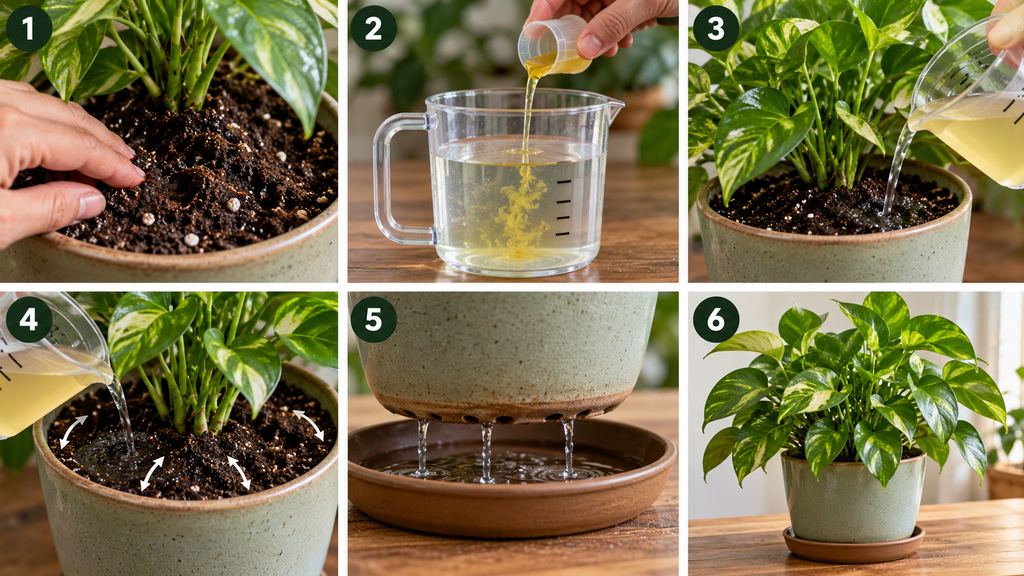
To fertilize indoor plants correctly, check plant health, confirm existing nutrient sources, read the fertilizer label, make sure the potting mix is appropriately moist, measure carefully, and apply the fertilizer evenly.
Use this four-point readiness check:
- Is the plant actively growing?
- Is it receiving adequate light?
- Are the roots reasonably healthy?
- Is the potting mix appropriately moist?
If one of these conditions is poor, delay feeding.
Step 1: Identify the Fertilizer Type
Determine whether the product is:
- liquid;
- water-soluble;
- slow-release;
- ready-to-use;
- a spike;
- a tablet.
Different fertilizer forms require different application methods.
Step 2: Read the Label
Check:
- dilution;
- application rate;
- feeding interval;
- compatible plant types;
- safety instructions.
Step 3: Check Soil Moisture
Avoid applying concentrated soluble fertilizer to severely dry roots.
If a plant is badly wilted from drought, restore appropriate moisture first.
If the soil is already waterlogged, fix the watering or drainage problem before adding fertilizer.
Step 4: Measure Accurately
Do not estimate concentrated fertilizer by eye.
Use a dedicated measuring tool and follow the product instructions.
Step 5: Apply Evenly
For liquid fertilizer, distribute the solution through the root zone.
For slow-release fertilizer, follow the instructions for surface application or incorporation into the potting mix.
Step 6: Allow Drainage
Good drainage helps excess water and soluble salts leave the container.
Do not allow ordinary houseplants to remain sitting in fertilizer-rich runoff.
Can You Sprinkle Fertilizer on Top?
Only if the product is designed for surface application.
Slow-release granules may sometimes be top-dressed, but soluble powders normally need to be dissolved first.
Should You Fertilize the Leaves?
Use root-zone feeding unless the fertilizer specifically provides instructions for foliar application.
A liquid fertilizer is not automatically suitable for spraying onto leaves.
Fertilizer Safety
Keep fertilizer:
- in its original container;
- away from children and pets;
- away from food-preparation areas.
Use dedicated measuring tools, wash your hands after handling concentrates, and follow the label’s storage and safety instructions.
When to Fertilize Indoor Plants
Fertilize primarily during active growth. The correct schedule depends on fertilizer type, light, temperature, plant growth, and current nutrient supply rather than a fixed month on the calendar.
Start or increase feeding when you see:
- new leaves;
- fresh shoots;
- root growth;
- flower buds;
- increased water use.
Should You Fertilize in Winter?
Only if the plant continues active growth.
Many naturally lit houseplants grow more slowly when winter light decreases and therefore need less fertilizer.
Plants under strong grow lights may continue growing and may still use nutrients.
After Repotting
Check whether the fresh potting mix already contains fertilizer.
If it does, additional feeding may not be necessary immediately.
How Often Should You Fertilize?
Follow the product label.
Some soluble fertilizers are applied every few weeks, while slow-release products may continue working for several months.
Factors that increase nutrient demand include:
- strong light;
- rapid growth;
- active flowering;
- grow lights;
- nutrient-poor growing media.
Factors that reduce nutrient demand include:
- low light;
- dormancy;
- slow growth;
- fresh fertilized soil;
- root stress.
Fertilizing Indoor Plants by Climate
Global fertilizer schedules should follow growth conditions rather than fixed calendar months. The same plant can have different nutrient needs depending on light, season, climate, and artificial lighting.
Use this simple translation:
Increasing light + active growth: normal feeding may begin or increase.
Strong grow lights + continuous growth: feeding may continue year-round.
Lower light + slower growth: reduce fertilizer.
Dormancy or complete growth pause: usually stop routine feeding.
A March-to-September schedule may work for many Northern Hemisphere homes but is not universally appropriate.
Readers in the Southern Hemisphere experience opposite seasons, while tropical or equatorial homes may have less dramatic seasonal change.
A pothos growing under a strong grow light may continue producing leaves while another pothos beside a dim winter window nearly stops.
Same species. Same date. Different fertilizer needs.
Use growth state, not month names, to guide feeding.
When Not to Fertilize Indoor Plants
Avoid routine fertilization when an indoor plant is dormant, severely stressed, root-damaged, badly waterlogged, extremely dry, or already receiving enough nutrients.
Reduce or pause feeding when:
- growth has stopped;
- roots are rotting;
- the plant is badly drought-stressed;
- potting mix remains waterlogged;
- the plant was recently repotted into fertilized soil;
- fertilizer burn is suspected;
- strong salt buildup is visible.
Low-Light Plants
Low-light plants generally grow more slowly and therefore use nutrients more slowly.
Extra fertilizer cannot replace inadequate light.
Cacti and Succulents
Many cacti and succulents need lighter feeding than fast-growing tropical foliage plants.
They are not always no-fertilizer plants, but excessive feeding is unnecessary.
Carnivorous Plants
Carnivorous plants are an important exception.
Many are adapted to nutrient-poor environments and should not receive ordinary houseplant fertilizer without species-specific guidance.
Does Your Indoor Plant Need Fertilizer?
Yellow leaves, slow growth, small leaves, or reduced flowering can involve nutrients, but they can also result from light, roots, water, temperature, or pests. Diagnose the plant before feeding.
Possible nutrient-related symptoms include:
- pale foliage;
- slow growth;
- reduced vigor;
- weak flowering.
But these same signs may also indicate:
- insufficient light;
- root damage;
- poor drainage;
- overwatering;
- pests;
- unsuitable temperatures.
Brown tips can indicate fertilizer salts, but they may also result from water quality or other environmental conditions.
White crust around the soil or pot can come from fertilizer, hard water, or both.
Do not diagnose nutrient deficiency from one leaf.
Ask:
What is limiting this plant right now?
If the answer is light or root health, fertilizer is not the first solution.
Signs of Overfertilizing Indoor Plants
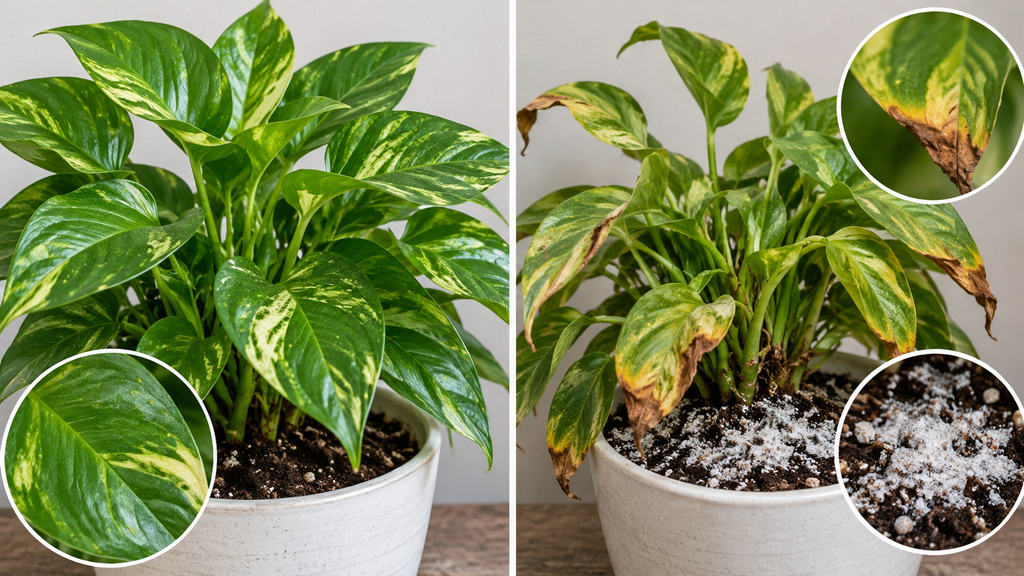
Common signs of overfertilization include brown leaf tips, scorched margins, wilting despite moist soil, damaged roots, distorted growth, and white mineral buildup around the pot.
Excess fertilizer increases dissolved salts around roots.
High salt levels can interfere with normal water uptake and injure root tissue.
Watch for:
- brown leaf tips;
- brown margins;
- wilting in moist soil;
- stalled growth;
- damaged roots;
- white crust;
- symptoms appearing after stronger feeding.
These symptoms are not unique to fertilizer damage, so always consider the plant’s recent feeding history.
How to Fix Fertilizer Burn
Stop fertilizing first. If the pot drains properly, flushing the growing medium with clean water can help remove excess soluble salts. Severe cases may require repotting and inspection of damaged roots.
Use this recovery process:
- Stop fertilizer applications.
- Flush a freely draining pot when appropriate.
- Allow excess water to escape.
- Check drainage and root condition.
- Repot severe cases into fresh suitable medium.
- Wait for healthy growth before feeding again.
Do not immediately add:
- another fertilizer;
- Epsom salts;
- plant vitamins;
- homemade nutrient mixtures.
Restart feeding only when the plant has stabilized and resumed healthy growth.
Recovery should be based on plant condition, not a fixed number of days.
How to Fertilize Indoor Plants Naturally
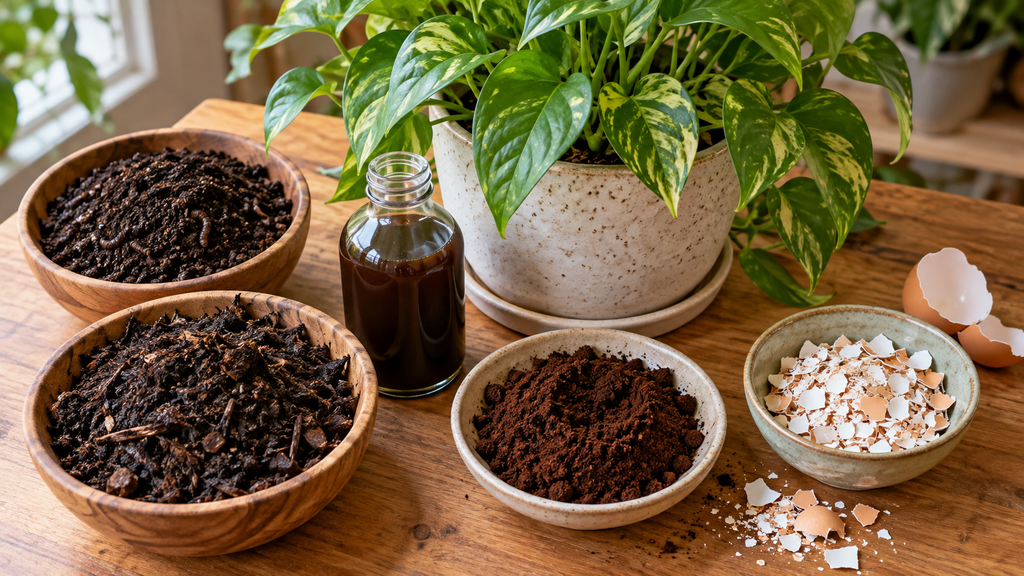
Natural fertilization can work, but reliable options are more useful than random kitchen scraps. Commercial organic fertilizer, worm castings, and mature compost provide more predictable nutrition than most homemade remedies.
Worm Castings
Worm castings can contribute nutrients and organic matter.
Use them:
- in small amounts;
- during repotting;
- as a light top-dressing.
Finished Compost
Mature compost can supply nutrients, but heavy compost used alone may hold too much water and reduce aeration.
Use it as part of a suitable potting mix rather than filling containers entirely with dense compost.
Coffee Grounds
Coffee grounds contain some nutrients but are not a complete fertilizer.
Large amounts placed directly on potting soil can affect moisture and aeration.
They are usually more useful in compost than as the main fertilizer source.
Eggshells
Eggshells contain calcium carbonate but break down slowly.
They do not provide balanced NPK nutrition and should not be treated as an immediate calcium fertilizer.
Homemade Fertilizer for Indoor Plants
Homemade fertilizers may contribute useful nutrients, but they are difficult to standardize. Their nutrient concentration, balance, and availability are often unknown.
Before relying on a homemade fertilizer, ask:
- What nutrients does it provide?
- At what concentration?
- How quickly are they released?
- Could it attract pests or mold?
- Is another fertilizer already being used?
One household ingredient rarely provides complete plant nutrition.
Homemade materials are generally better used as:
- compost ingredients;
- minor supplements;
- additions to a controlled organic system.
For predictable long-term feeding, a labeled fertilizer is easier to measure and manage.
Does Fertilizer Make Indoor Plants Grow Faster?
Fertilizer can improve growth when nutrients are limiting, but it cannot overcome inadequate light, unhealthy roots, poor watering, unsuitable temperature, or plant genetics.
Plant growth depends on:
light + water + roots + temperature + nutrients + genetics
If light is limiting growth, increasing fertilizer will not solve the problem.
If roots are damaged, stronger fertilizer may make the plant worse.
Fertilizer is most useful when:
- light is adequate;
- roots are healthy;
- watering is appropriate;
- temperature is suitable;
- nutrient reserves are becoming depleted.
The goal is steady, healthy growth rather than forcing the fastest possible growth.
How to Tell Fertilizer Is Working
Fertilizer is working when the plant maintains healthy, proportionate growth without signs of salt damage or forced weak growth.
Look for:
- healthy new leaves;
- normal leaf size;
- stable foliage color;
- steady stem or vine growth;
- healthy roots;
- appropriate flowering;
- no increasing salt buildup.
Do not judge fertilizer success by dramatic overnight changes.
Compare the plant to its own normal growth under similar conditions.
Simple records can help. Note:
- fertilizer date;
- product used;
- dilution;
- new leaves;
- brown tips;
- salt buildup.
Successful fertilization supports sustainable growth rather than extreme growth.
Indoor Plant Fertilizer FAQs
Can I fertilize indoor plants every time I water?
Only when using a fertilizer program specifically designed for frequent, diluted feeding. Avoid full-strength fertilizer at every watering.
Should I water before fertilizing?
If the soil is very dry, restore normal moisture first. Avoid applying concentrated fertilizer to severely drought-stressed roots.
Should I fertilize a newly bought houseplant?
Usually not immediately. Nursery plants may already contain fertilizer and often need time to adjust to their new environment.
Can I use liquid fertilizer with slow-release fertilizer?
Yes, but only after accounting for both nutrient sources. Combining them without adjusting the total dose can cause overfertilization.
Do low-light plants need less fertilizer?
Usually, yes. Lower light often means slower growth and therefore lower nutrient demand.
What time of day is best to fertilize?
The exact time matters less than correct dose, soil moisture, plant health, and application method.
Is evening fertilization okay?
Yes. Evening feeding is generally fine when the fertilizer is applied correctly to a healthy plant.
What does white crust on soil mean?
It usually indicates mineral salts from fertilizer, hard water, or both. Review your water source and feeding schedule.
Can organic fertilizer burn plants?
Yes. Organic fertilizer can still damage roots when applied too strongly or too frequently.
Can fertilizer revive a dying plant?
Only if nutrient deficiency is the actual problem. Fertilizer cannot fix root rot, severe drought, poor light, or pest damage.
Final Tips for Fertilizing Indoor Plants
Successful indoor-plant fertilizing is about matching nutrient supply to plant demand.
Remember:
Plant condition before calendar.
Before feeding, check:
- active growth;
- light;
- roots;
- soil moisture;
- existing fertilizer;
- product instructions.
Healthy plant growth depends on the full system:
light + water + air + roots + temperature + potting mix + nutrition
Fertilizer is important, but it is only one part of that system.
Feed the plant you actually have—not the plant you hope fertilizer will create.
Myra is the founder and lead writer of Plantsaholic. She shares practical, research-backed advice on indoor plants, outdoor gardening, flowers, herbs, succulents, and everyday plant care. Her goal is to help gardeners of all experience levels grow healthier plants through simple, easy-to-follow gardening guides.