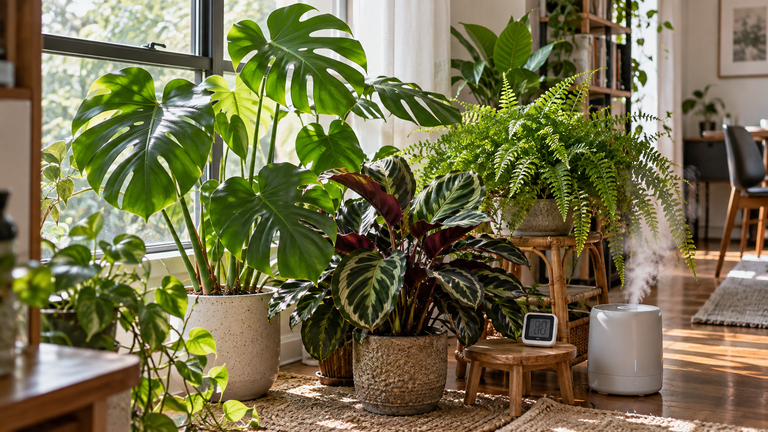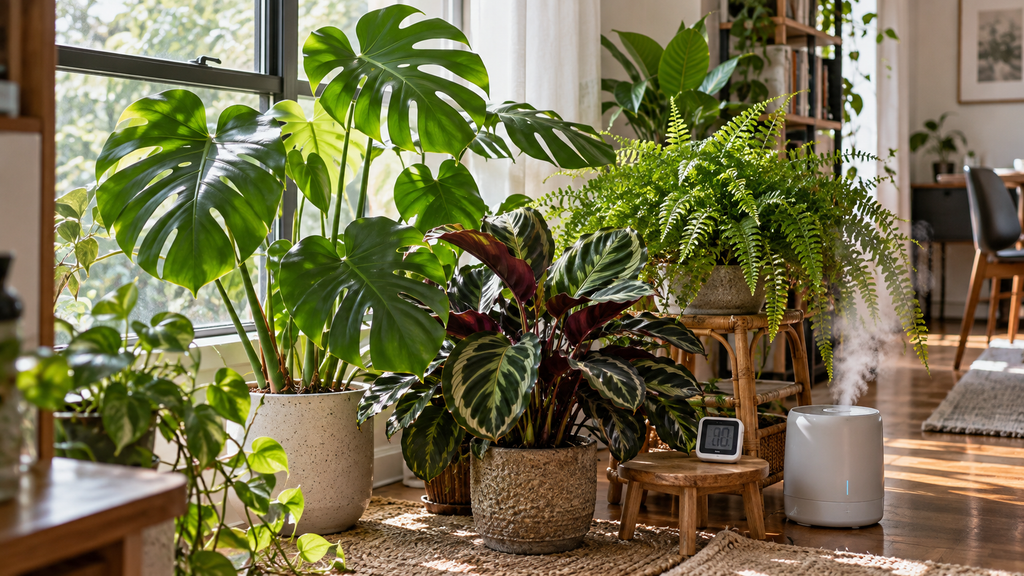
To increase humidity for plants, measure relative humidity first. Use grouping or passive evaporation for small local changes, a humidifier for sustained room-wide dryness, and a terrarium, cabinet, or humidity dome when one plant needs more humidity than is suitable for the entire room.
Humidity affects how quickly plants lose water through their leaves. When indoor air becomes very dry, especially near heating or air-conditioning systems, humidity-sensitive plants may develop dry edges, crispy tips, curling leaves, or faster-than-normal moisture loss.
Many common houseplants grow well around 40–60% relative humidity (RH), although exact needs vary by plant type, temperature, airflow, and growth stage. Tropical foliage plants often prefer more humidity than cacti, succulents, and other plants adapted to drier environments.
However, increasing humidity should not mean making the whole house excessively damp. If one plant needs much higher humidity than the rest of the room, creating a smaller humid microclimate is usually safer and more efficient.
The plantsaholic approach is simple:
Measure → identify the plant’s need → determine how much air must be humidified → choose the smallest effective method → verify the result.
What Humidity Do Plants Need?
Most common houseplants are comfortable at moderate humidity, often around 40–60% RH. Some tropical plants prefer higher humidity, while cacti and many succulents usually do not need additional moisture in the air.
Relative humidity describes how much water vapor is present in the air compared with how much the air could hold at the same temperature. Because temperature affects RH, the same room may show different humidity readings throughout the day.
Plant requirements also vary.
| Plant type or situation | Practical humidity approach |
|---|---|
| Cacti and many succulents | Usually no extra humidity needed |
| Common adaptable houseplants | Often comfortable at normal household RH |
| Tropical foliage plants | May benefit from moderate to higher RH |
| Humidity-sensitive tropicals | May need a localized humid microclimate |
| Unrooted cuttings | High localized humidity can reduce water loss |
| Terrarium plants | Often suited to enclosed humid environments |
Plants lose water through their leaves in a process called transpiration. When the surrounding air is very dry, water can leave the foliage more quickly.
Humidity and watering are related, but they are not the same thing.
Soil moisture controls water available to the roots. Humidity controls moisture in the surrounding air.
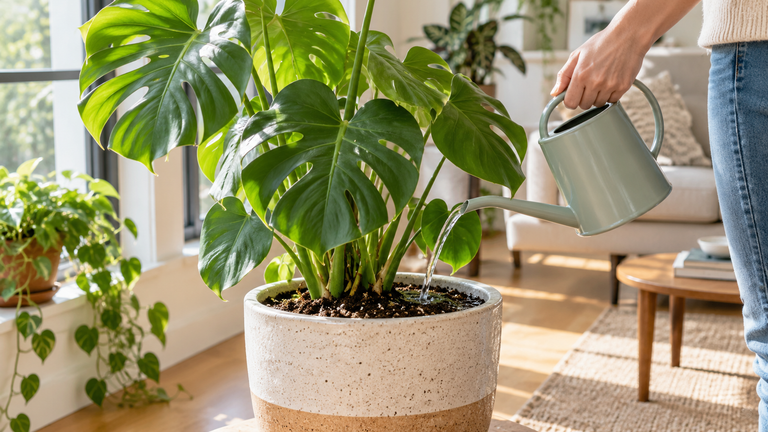
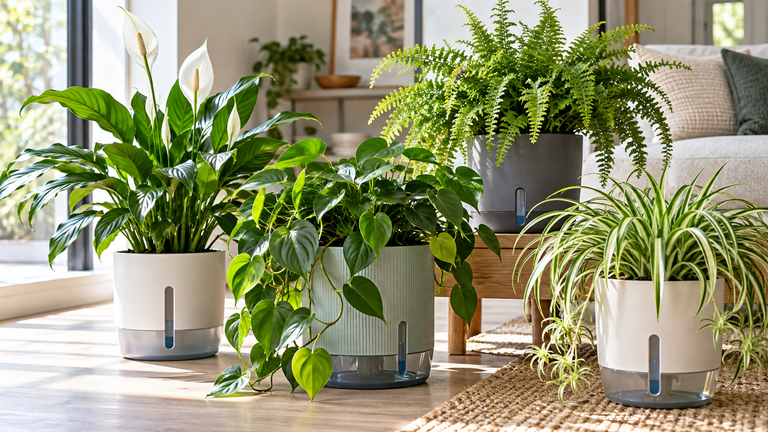
Increasing watering will not necessarily correct dry air, and increasing humidity will not fix a plant growing in dry potting mix.
How to Measure Plant Humidity
Use a digital hygrometer near the plant canopy and monitor the reading over normal daily conditions. Avoid placing the sensor directly beside a humidifier, heater, radiator, open window, or air-conditioning vent.
Sensor placement matters because different parts of the same room can have different microclimates.
A hygrometer sitting inside a humidifier’s mist may show a much higher reading than the plants a few feet away. A sensor beside a heating vent may show unusually dry conditions.
For the most useful measurement:
- Place the hygrometer close to leaf height.
- Keep it away from direct humidifier mist.
- Avoid direct heating and AC airflow.
- Compare morning, afternoon, and evening readings.
- Check conditions while heating or cooling systems are running.
- Monitor for more than one day before making major changes.
A single reading gives only a snapshot.
If the middle of the room stays around 45% RH but the plant shelf beside an HVAC vent repeatedly falls much lower, moving the plant may solve the problem without humidifying the entire room.
Do Your Plants Need More Humidity?
Measure RH before assuming brown tips or curling leaves are caused by dry air. Similar symptoms can come from watering problems, damaged roots, excess fertilizer salts, heat, pests, drafts, or unsuitable light.
Low humidity can contribute to crispy leaf edges and rapid moisture loss, particularly in humidity-sensitive foliage plants. However, those symptoms are not proof of a humidity problem.
Use this sequence:
Check the symptom → measure RH → check soil moisture → inspect roots → check temperature and drafts → review watering → inspect for pests.
Possible causes of dry or damaged foliage include:
- inconsistent watering;
- root damage or waterlogged soil;
- fertilizer or mineral buildup;
- hot air from heating vents;
- strong cold or AC drafts;
- excessive sunlight;
- pests;
- normal aging of older leaves.
If humidity is already suitable, adding more moisture may do nothing useful.
The goal is to diagnose the actual problem rather than automatically reaching for a humidifier.
How Much Space Needs Humidity?
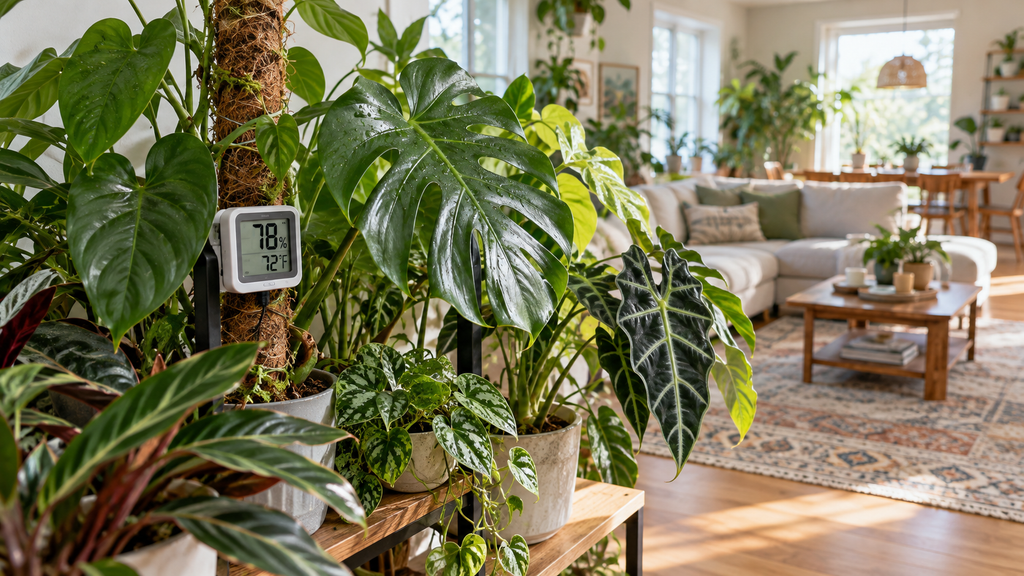
The larger the airspace, the more moisture you must continuously add to create a measurable humidity increase. A method that works inside a propagation dome may have almost no effect in a large room.
This is the basis of the plantsaholic Humidity Gap × Airspace rule.
Two things determine which method will work:
- How far current RH is from the desired range.
- How much air needs to be changed.
| Target area | Most suitable approach |
|---|---|
| One cutting | Humidity dome |
| One sensitive plant | Terrarium or enclosure |
| Small group of plants | Grouping and local methods |
| Plant corner | Local methods or active humidification |
| Whole room | Properly sized humidifier |
| Greenhouse or grow tent | Controlled environmental system |
Before choosing a method, ask:
- Is RH only slightly low or extremely low?
- Am I treating one plant or an entire room?
- Is heating, AC, or ventilation removing moisture?
- Could I create a smaller microclimate instead?
- Does the plant actually require higher RH?
A bowl of water can technically add moisture to the air, but the effect becomes diluted in a large room.
A humidity dome works much better for a cutting because it controls only a small volume of air.
The useful question is not simply “Does this method add humidity?”
It is:
“Does this method add enough humidity for the amount of air I need to control?”
How to Increase Humidity for Plants
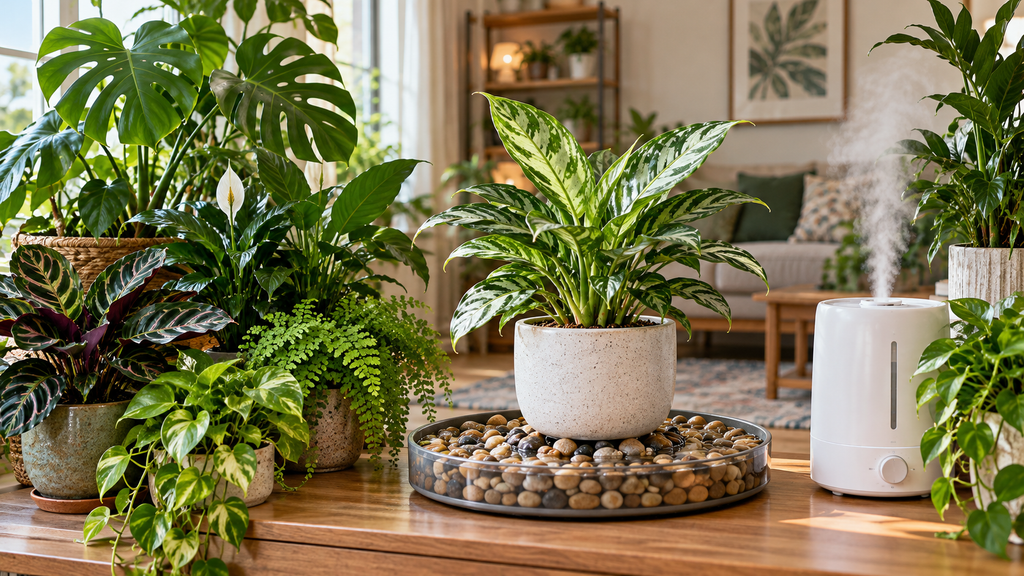
Use the least intensive method capable of reaching an appropriate humidity level. Passive methods can help with small local adjustments, while a humidifier is more reliable when an entire room is genuinely too dry.
The most practical options are:
| Method | Best for | Main limitation |
|---|---|---|
| Humidifier | Dry rooms | Requires cleaning and monitoring |
| Grouping plants | Small plant collections | Modest local effect |
| Pebble tray | Supplemental local humidity | Weak room-wide effect |
| Terrarium or cabinet | High-humidity plants | Requires ventilation |
| Humidity dome | Propagation | Temporary or specialized |
| Bowl of water | Minor passive evaporation | Limited effect |
| Better placement | Plants near dry vents | Does not actively add moisture |
Why is a humidifier effective?
A humidifier continuously transfers water into the surrounding air, making it far more effective for room-wide humidity than passive evaporation.
Use a hygrometer or humidistat instead of running the unit continuously at maximum output.
Good humidifier practice includes:
- choosing a unit suitable for the room size;
- avoiding direct mist on foliage;
- keeping nearby walls and furniture dry;
- cleaning the unit regularly;
- refreshing tank water as recommended;
- lowering output if condensation appears.
A humidifier should create humid air, not wet plants and damp furniture.
Does grouping plants help?
Yes, but mainly on a local scale.
Plants release water vapor through transpiration, while moisture also evaporates from potting media. Several compatible plants grouped together can therefore create a slightly more humid microclimate.
Grouping works best when plants are reasonably close without being packed so tightly that airflow becomes poor.
Increase Humidity Without a Humidifier
Without a humidifier, focus on improving the plant’s immediate microclimate. Group plants, use passive evaporation, reduce exposure to dry HVAC airflow, or place demanding plants inside a terrarium or cabinet.
Passive methods work best when the humidity gap is small.
A plant directly beside a radiator or AC vent may benefit more from relocation than from any water tray.
Bathrooms and kitchens may also have temporarily higher humidity, but light and temperature still matter. A dark bathroom is not automatically a better growing location simply because it is humid.
Do pebble trays increase humidity?
Pebble trays add moisture through evaporation, but their effect is usually local and relatively small.
Use a wide waterproof tray filled with clean pebbles or gravel. Add water below the top of the stones and place the plant pot above the waterline.
The pot should not sit permanently in water.
A pebble tray makes the most sense when:
- RH needs only a small adjustment;
- the plant is not extremely humidity-sensitive;
- several plants share the area;
- the room is not extremely dry.
If the hygrometer shows no meaningful improvement, the tray is not strong enough for the situation.
Does a bowl of water help?
Yes, but usually only slightly.
Water evaporating from an open bowl contributes moisture to the surrounding air, but the effect is quickly diluted in a large or well-ventilated room.
A broad, shallow container exposes more water to the air than a narrow, deep container.
Treat bowls of water as a supplemental method rather than a replacement for active humidification.
Which Humidity Methods Actually Work?
Humidifiers and enclosed microclimates provide sustained humidity control. Misting, water bowls, and small trays create weaker or temporary effects and should not be expected to solve severe room dryness.
Does misting increase humidity?
Only briefly.
Misting wets foliage and temporarily adds moisture to the nearby air, but once the droplets evaporate, RH usually returns to its previous level.
A plant may therefore be misted several times during the day while still spending most of its time in dry air.
If higher ambient humidity is genuinely required, use grouping, an enclosure, or a humidifier instead.
Does opening a window increase humidity?
Sometimes, but not reliably.
Opening a window can either raise or lower indoor RH depending on outdoor temperature and moisture.
Cold outdoor air may show high relative humidity but become much drier after it enters a heated room.
Instead of relying on a weather app, watch the indoor hygrometer after opening the window.
Treat windows as ventilation, not as a dependable humidity method.
Is 90% Humidity Too High?
For most established houseplants in normal living spaces, 90% RH is unnecessarily high. Very high humidity is better suited to propagation and specialized enclosed environments.
Some tropical plants naturally experience very humid conditions, but recreating those levels throughout an occupied room is rarely necessary.
If one plant needs much higher RH than the rest of the collection, create a terrarium, cabinet, or other controlled microclimate.
Propagation is an important exception.
Fresh cuttings continue losing water through their leaves before new roots are fully developed. A humidity dome can reduce that water loss while the cutting establishes.
Very high humidity should therefore be used for a specific purpose, not as a universal houseplant target.
When Not to Increase Humidity
Do not add more humidity when current RH is already suitable, plants are healthy, or the room is showing signs of excessive moisture.
Stop or reduce humidification when:
- windows regularly collect condensation;
- walls, furniture, or curtains become damp;
- mold appears;
- foliage remains wet for long periods;
- airflow is poor;
- the plant naturally prefers drier conditions;
- symptoms continue despite suitable RH.
A cactus and a humidity-sensitive tropical plant should not automatically receive identical treatment.
If one plant needs more humidity than the room can sensibly provide, create a smaller humid environment around that plant.
Change the plant’s microclimate instead of changing the whole building.
How to Make a Humidity Dome
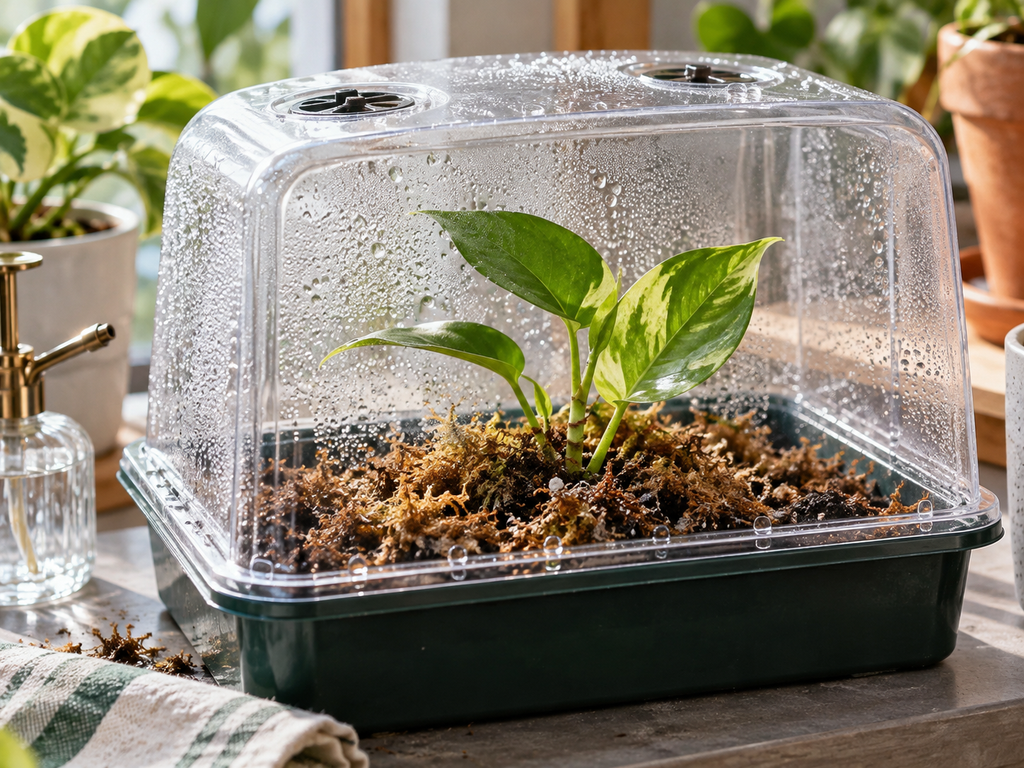
A simple humidity dome can be made from a clear plastic bag, transparent storage container, propagation lid, or similar cover placed around a cutting or small plant.
The enclosure traps moisture in a small airspace, making high RH much easier to maintain.
A basic setup:
- Place the cutting in suitable moist propagation medium.
- Add stakes if needed to keep plastic off the leaves.
- Cover the plant with a transparent bag or container.
- Leave some controlled air exchange.
- Keep the setup in bright indirect light.
- Monitor temperature, condensation, and medium moisture.
- Gradually increase ventilation after roots develop.
Avoid intense direct sunlight because transparent enclosures can heat up quickly.
Heavy condensation is not automatically a sign of success. If the enclosure remains constantly dripping and stagnant, provide more ventilation.
How Climate Affects Plant Humidity
Heating, air conditioning, ventilation, and seasonal weather can all change the humidity around indoor plants. Measure the actual plant zone instead of assuming outdoor conditions match indoor conditions.
What happens in winter?
Indoor RH can fall sharply when cold outdoor air is heated.
Move humidity-sensitive plants away from:
- heating vents;
- radiators;
- fireplaces;
- strong warm-air currents.
If an entire room remains very dry, a monitored humidifier is more effective than relying entirely on passive water trays.
Can air conditioning dry plants?
Yes.
Air-conditioning systems can remove moisture from indoor air, and plants sitting directly in cold airflow may experience particularly dry local conditions.
This means plants can struggle with low indoor humidity even in warm climates where outdoor air is humid.
Move sensitive plants away from direct AC airflow and measure RH before deciding whether additional humidification is necessary.
Humidity in Greenhouses and Grow Tents
Greenhouses and grow tents need more controlled humidity management because temperature, ventilation, plant density, and irrigation can cause RH to change rapidly.
In a greenhouse, humidity can be increased with misting, fogging, evaporative methods, or controlled ventilation. However, nighttime cooling can already push RH very high and create condensation.
Monitor:
humidity + temperature + airflow + condensation
Grow tents behave similarly but contain an even smaller volume of air.
Humidifier output, exhaust fan speed, plant transpiration, temperature, and intake airflow all influence RH.
Because these environments require more technical control, detailed greenhouse and grow-tent humidity management should be covered in dedicated guides rather than expanded further here.
Why Your Humidity Method Isn’t Working
A humidity method usually fails because it is too weak for the target airspace, moisture is escaping too quickly, measurements are inaccurate, or humidity is not the real cause of the plant problem.
| Problem | What to check | Next step |
|---|---|---|
| Pebble tray changes nothing | Room size and airflow | Use stronger method if needed |
| Humidifier cannot raise RH | Capacity and ventilation | Reduce target area or improve output |
| RH high only beside humidifier | Placement | Improve distribution |
| Brown tips continue | Watering, roots, salts, pests | Investigate another cause |
| Windows condense | Excess humidity | Reduce output |
| Dome stays dripping wet | Poor ventilation | Increase air exchange |
| RH drops with HVAC | Vent location | Move plants or adjust control |
Do not add several humidity techniques simply because the first one failed.
Find out why it failed.
If a room remains at 25% RH despite a small passive water tray, the most likely problem is not the tray setup. The method simply does not produce enough moisture for the airspace.
Which Humidity Method Is Best?
The best humidity method is the smallest, safest solution capable of producing the conditions your plant actually needs.
Use the plantsaholic Humidity Control Path:
Measure → Classify → Size → Eliminate → Select → Verify → Stop
Measure: Check RH around the plant.
Classify: Determine whether the plant needs normal, moderately high, or specialized humidity.
Size: Decide whether you need to change one plant’s environment or the whole room.
Eliminate: Remove methods that are too weak or inappropriate.
Select: Choose the least intensive method capable of solving the problem.
Verify: Measure RH again.
Stop: Once the environment is suitable, do not keep adding moisture.
| Situation | Best first choice |
|---|---|
| Plant healthy and RH suitable | Do nothing |
| Slightly dry plant group | Group plants |
| One plant needs more humidity | Local microclimate |
| Very dry room | Humidifier |
| Very humidity-sensitive plant | Terrarium or cabinet |
| Unrooted cutting | Humidity dome |
| Direct HVAC drying | Move the plant |
| Condensation appears | Reduce humidity |
The same method will not be best for every situation.
A dry winter room containing several tropical plants may need a humidifier.
One sensitive plant in an otherwise comfortable room may need only an enclosure.
Plant Humidity FAQs
What is the best way to increase humidity for plants?
A humidifier is most reliable for a dry room. For one plant or a small group, grouping or an enclosure may provide enough localized humidity.
How can I increase humidity without a humidifier?
Group plants, use passive evaporation, move them away from dry HVAC airflow, or create a smaller microclimate with a terrarium or cabinet.
Does a bowl of water increase humidity?
Yes, but usually only slightly. Its effect is limited because moisture quickly disperses through a large room.
Do pebble trays increase humidity?
They can create a small local increase but rarely raise room-wide humidity significantly. Keep the plant pot above the waterline.
Does misting increase humidity?
Only temporarily. Misting does not provide the sustained RH increase needed by genuinely humidity-sensitive plants.
How close should a humidifier be to plants?
Close enough to influence the plant area but far enough away that foliage, walls, or furniture do not stay wet.
How long should a humidifier run?
There is no fixed time. Use a hygrometer or humidistat and adjust output according to actual RH.
Can air conditioning dry plants?
Yes. Air conditioning can remove moisture and create particularly dry conditions around plants positioned directly beside vents.
Should I water more when humidity is low?
Not automatically. Check soil moisture first because dry air and dry potting mix are different problems.
What humidity is best for most houseplants?
Many common houseplants grow well around 40–60% RH, although individual plants and growing conditions vary.
How to Increase Humidity for Plants Safely
Measure first, choose the smallest effective solution, and stop adding moisture once conditions are suitable.
Moderate household humidity is enough for many indoor plants. When conditions are only slightly dry, better placement, grouping, or passive evaporation may be sufficient.
When an entire room remains very dry, a monitored humidifier provides more reliable control.
When only one plant needs substantially higher humidity, create a localized environment with a terrarium, cabinet, or humidity dome instead of pushing the whole room higher.
Before considering the problem solved, confirm that:
- RH has actually improved;
- the plant’s real requirements are being met;
- soil moisture is managed separately;
- airflow remains adequate;
- nearby surfaces remain dry;
- condensation is not becoming persistent.
The best humidity strategy is not the method that creates the highest RH.
It is the smallest, safest method that gives the plant the conditions it genuinely needs.

Myra is the founder and lead writer of Plantsaholic. She shares practical, research-backed advice on indoor plants, outdoor gardening, flowers, herbs, succulents, and everyday plant care. Her goal is to help gardeners of all experience levels grow healthier plants through simple, easy-to-follow gardening guides.