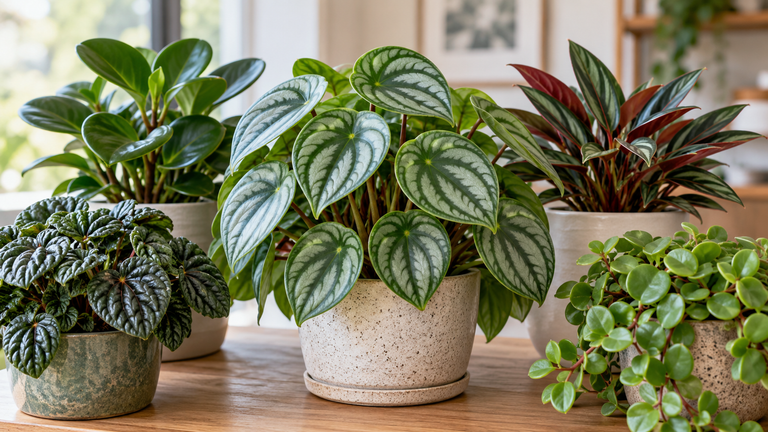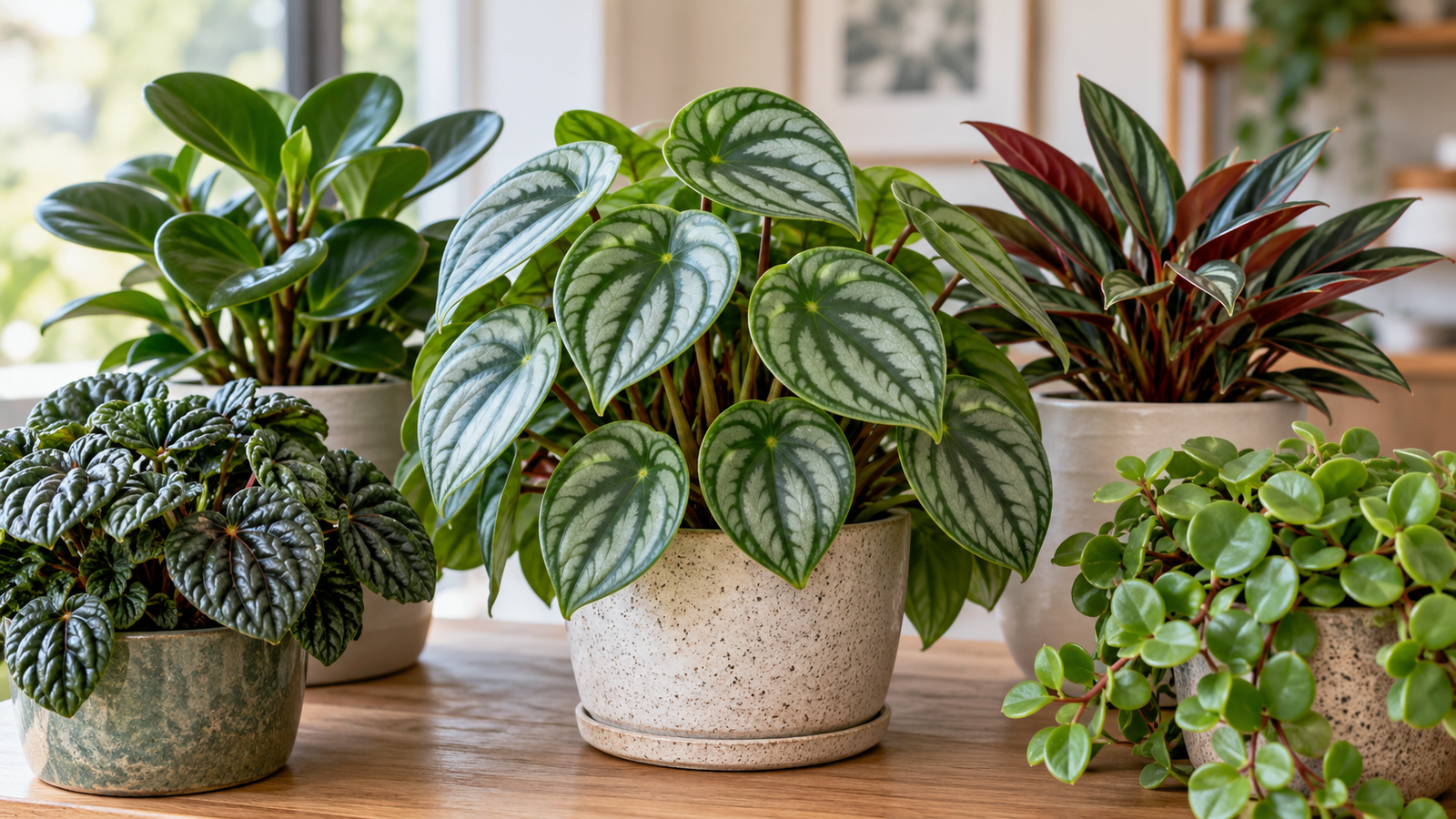
Peperomia varieties range from compact plants with deeply textured leaves to trailing vines and succulent-looking species. Popular indoor types include Watermelon Peperomia, Baby Rubber Plant, Emerald Ripple, String of Turtles, Peperomia Hope, and Raindrop Peperomia. Most prefer bright indirect light, good drainage, and some drying between waterings.
Peperomia belongs to the Piperaceae family and includes plants with very different growth habits, leaf shapes, colors, and moisture needs. Some stay small enough for a desk, some cascade from hanging baskets, and others have thick leaves adapted to storing more water.
This Plantsaholic guide compares 25 useful Peperomia varieties, explains their names and growth habits, and helps you choose the right type for your available light, space, and watering habits.
Peperomia at a Glance
| Feature | General Peperomia Trait |
| Family | Piperaceae |
| Main use | Indoor foliage plant |
| Growth habits | Compact, upright, rosette, creeping, trailing |
| Light | Bright indirect light is best for most |
| Watering | Allow some drying before watering again |
| Main risk | Overwatering and poor drainage |
| Common placement | Desk, shelf, hanging basket, plant stand |
| Main attraction | Diverse leaves, colors, patterns, and textures |
Peperomia care should not be reduced to one rigid schedule. A thick-leaved Baby Rubber Plant and a delicate String of Turtles may belong to the same genus, but their pot size, leaf structure, and drying behavior can be different.
Plantsaholic research note: Botanical names should be checked against current botanical references where possible because nursery labels may use cultivar names, trade names, or older scientific synonyms.
Most Popular Peperomia Varieties
Watermelon Peperomia is one of the most recognizable Peperomia varieties because of its rounded silver-and-green striped leaves. Baby Rubber Plant, Emerald Ripple, Rosso, String of Turtles, Peperomia Hope, and Raindrop Peperomia are also popular indoor choices.
Popularity, however, should not be your only selection factor. A Watermelon Peperomia may look impressive in a nursery but is not automatically the best plant for a darker room. A solid-green Baby Rubber Plant can be more forgiving where light is moderate, while String of Turtles makes more sense when trailing growth is the main goal.
Popular choices include:
- Watermelon Peperomia for bold patterned foliage
- Baby Rubber Plant for easier care
- Emerald Ripple for deeply textured leaves
- Rosso for red-backed foliage
- String of Turtles for patterned trailing stems
- Peperomia Hope for fuller cascading growth
- Raindrop Peperomia for larger glossy leaves
There is no reliable global sales ranking proving that one variety is universally the most popular. It is more accurate to describe Watermelon Peperomia as one of the most recognizable and widely grown types.
Understanding Peperomia Names
Peperomia names can be confusing because a nursery label may contain an accepted species name, cultivar, hybrid, older synonym, or simply a trade name. Knowing the difference helps prevent misidentification and keeps species-specific care advice accurate.
Useful naming categories include:
- Species: a recognized botanical species
- Cultivar: a selected cultivated form
- Hybrid: a plant produced from two parent taxa
- Synonym: an older botanical name now treated under another name
- Trade name: a horticultural label used by sellers
- Unplaced name: a name whose current botanical status is uncertain
A few examples from this guide show why that matters.
Watermelon Peperomia is currently treated as Peperomia argyraea. Parallel Peperomia is better identified as Peperomia tetragona, although the older name P. puteolata still appears in horticulture. Peperomia ‘Hope’ is a documented hybrid cultivar. Pixie Peperomia is commonly sold as Peperomia orba, although that botanical name should be treated cautiously.
Decision clarity: Use common names for easy recognition, but verify botanical names when exact species identity matters.
Peperomia Varieties Comparison Chart
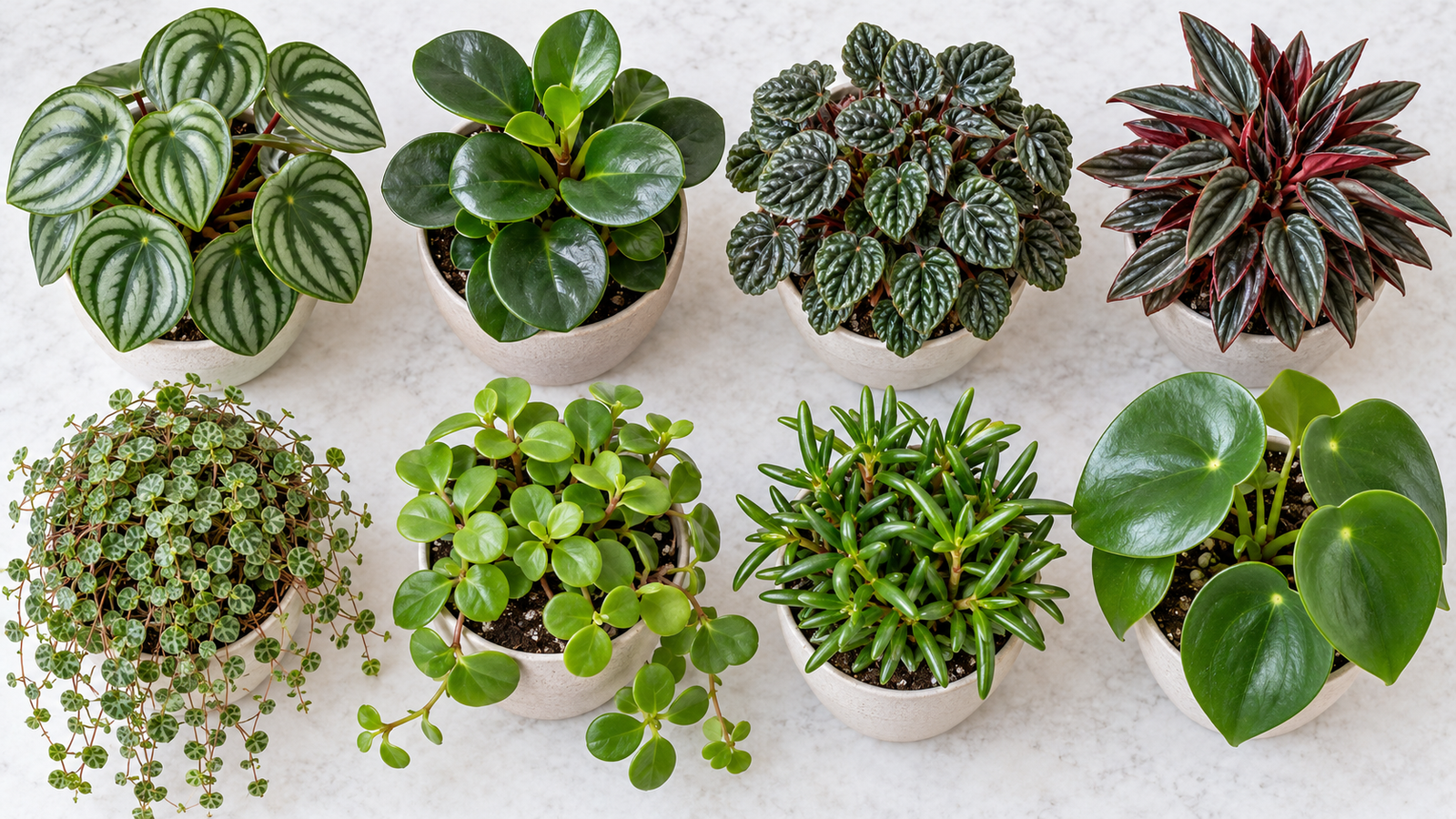
| Variety | Growth Habit | Main Feature | Best Use |
| Watermelon | Compact | Silver-green stripes | Feature plant |
| Baby Rubber Plant | Upright | Thick glossy leaves | Beginners |
| Emerald Ripple | Rosette | Deep leaf texture | Desk |
| Rosso | Rosette | Red undersides | Color contrast |
| Frost | Compact | Silver foliage | Decorative display |
| String of Turtles | Trailing | Patterned round leaves | Hanging basket |
| Hope | Trailing | Round fleshy leaves | Shelf/hanging pot |
| Trailing Jade | Trailing | Tiny green leaves | Hanging basket |
| Raindrop | Upright | Teardrop leaves | Statement plant |
| Cupid | Trailing | Heart-shaped leaves | Hanging planter |
| Piccolo Banda | Compact | Dark contrasting veins | Small spaces |
| Ginny | Upright | Pink-cream variegation | Bright room |
| Ruby Glow | Upright | Red-green foliage | Succulent display |
| Happy Bean | Upright | Bean-shaped leaves | Bright shelf |
| Parallel | Upright/arching | Long striped leaves | Shelf |
| Silver Leaf | Compact | Silver foliage | Foliage display |
| Red Log | Upright | Red undersides | Color contrast |
| Felted | Upright | Fuzzy leaves | Texture |
| P. nivalis | Succulent | Folded leaves | Dry-growing display |
| Prayer Pepper | Succulent | Taco-shaped leaves | Collector plant |
| Column Peperomia | Upright | Column-like form | Collector plant |
| Spotted Peperomia | Upright | Large patterned leaves | Tropical display |
| P. perciliata | Creeping | Small leaves | Shelf/terrarium |
| Four-Leaved | Creeping | Clustered leaves | Botanical collection |
| Pixie | Compact | Small oval leaves | Desk |
25 Types of Peperomia Plants
1. Watermelon Peperomia
Peperomia argyraea has broad rounded leaves marked with alternating silver and dark-green bands. Reddish petioles add extra color.
Best for: bold foliage and bright indoor displays.
Avoid when: the intended location is genuinely dim, because stronger filtered light helps maintain compact growth and clear patterning.
2. Baby Rubber Plant
Peperomia obtusifolia has thick, glossy oval foliage on sturdy stems and is one of the easiest Peperomia varieties for beginners.
Best for: offices, desks, and growers who sometimes forget watering.
Solid-green types generally tolerate moderate indoor light better than heavily variegated forms.
3. Emerald Ripple Peperomia
Peperomia caperata is recognized by deeply corrugated, heart-shaped foliage and a dense compact growth habit.
Best for: desks, shelves, and small pots.
Its compact crown makes good drainage particularly important because wet conditions around the base can be difficult to notice.
4. Rosso Peperomia
Rosso is a compact ripple-type Peperomia with narrow green leaves and striking burgundy-red undersides.
Best for: small spaces where you want strong color contrast.
It keeps a tidy rosette shape and is more suitable for compact displays than for hanging baskets.
5. Frost Peperomia
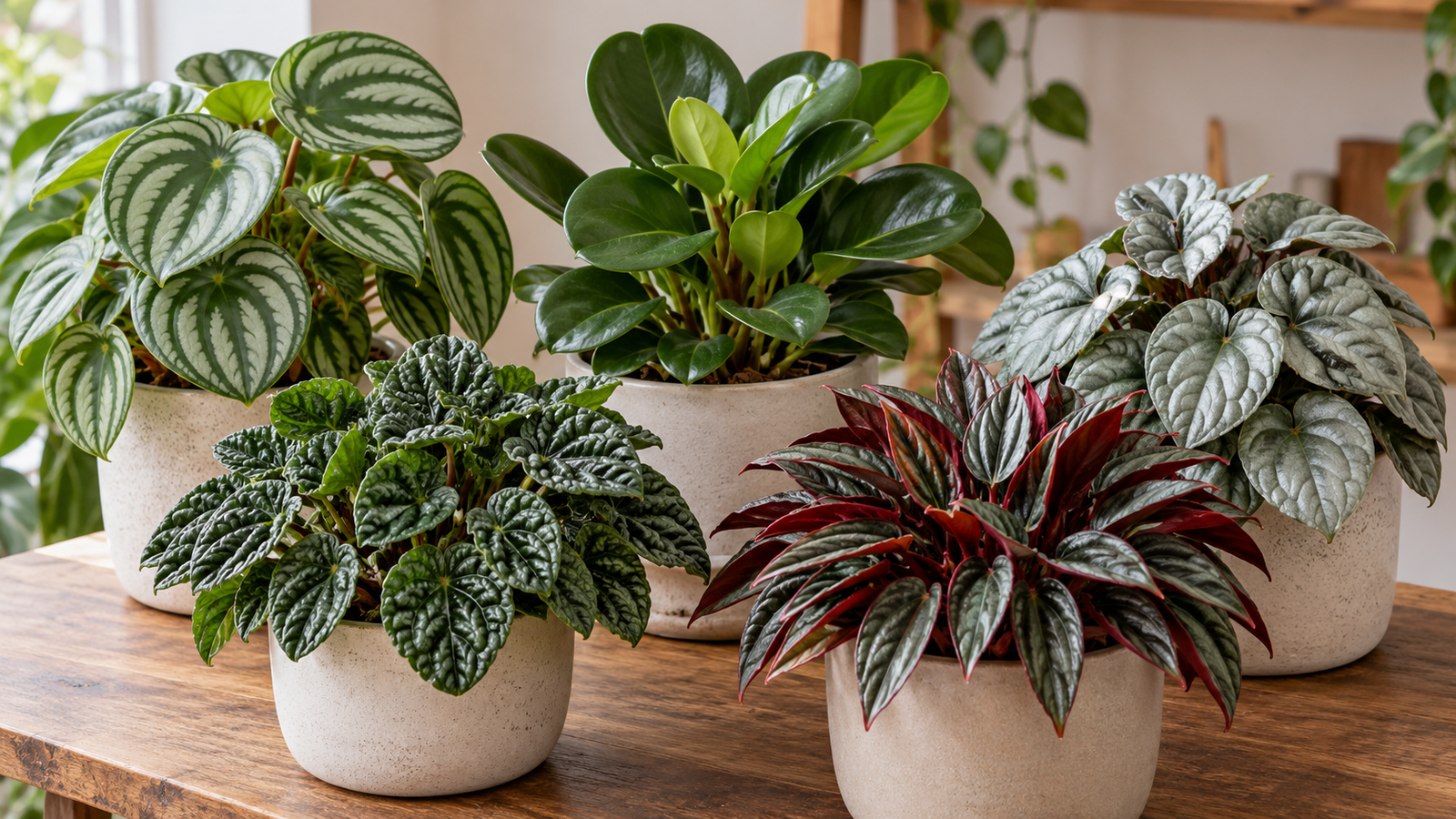
Frost is a silver-leaved ripple cultivar with pale metallic foliage and visible texture.
Best for: modern interiors and mixed foliage displays.
Its light-colored leaves create contrast beside darker green Peperomias without requiring much space.
6. String of Turtles
Peperomia prostrata has tiny rounded leaves with markings that resemble miniature turtle shells.
Best for: hanging baskets and elevated shelves.
Because it is often grown in small containers, check moisture directly rather than watering it according to the schedule of larger Peperomias nearby.
7. Peperomia Hope
Peperomia ‘Hope’ is a trailing hybrid with round fleshy leaves positioned along cascading stems.
Best for: shelves and hanging pots where you want fuller trailing growth.
Compared with very fine trailing species, Hope has a more substantial appearance and thicker foliage.
8. Trailing Jade Peperomia
Peperomia rotundifolia produces many small round green leaves on creeping or cascading stems.
Best for: simple green hanging displays.
Choose it when you want trailing foliage without the strong patterning of String of Turtles.
9. Raindrop Peperomia
Peperomia polybotrya develops glossy leaves shaped like large teardrops or raindrops.
Best for: tabletops and small statement displays.
Its foliage is broader than many miniature Peperomias, so give it enough horizontal room to develop naturally.
10. Cupid Peperomia
Cupid Peperomia is a trailing houseplant commonly sold for its soft heart-shaped foliage.
Best for: hanging planters and shelves.
Because Cupid is often used as a horticultural trade name, verify the botanical label before making species-specific assumptions.
11. Piccolo Banda Peperomia
Piccolo Banda has silver-green foliage marked by dark veins and stays relatively compact.
Best for: small shelves, desks, and decorative pots.
Choose it when you like patterned leaves but do not have room for a larger foliage plant.
12. Ginny Peperomia
Ginny is commonly grown as a colorful Peperomia clusiifolia cultivar with green foliage edged in cream, pink, or red.
Best for: brighter rooms and colorful plant groupings.
Variegated foliage normally benefits from stronger indirect light than plain green varieties.
13. Ruby Glow Peperomia
Peperomia graveolens has folded green leaves, red stems, and reddish leaf undersides.
Best for: succulent-style plant collections.
Its fleshy structure means it should sit toward the drier end of the Peperomia moisture spectrum.
14. Happy Bean Peperomia
Peperomia ferreyrae is recognized by narrow curved leaves that resemble green beans.
Best for: architectural foliage and bright shelves.
Its unusual leaf shape makes it useful when you want something noticeably different from broad-leaved Peperomias.
15. Parallel Peperomia
Parallel Peperomia is currently better treated as Peperomia tetragona, although P. puteolata remains common on older nursery labels.
Best for: striped foliage and shelf displays.
Its elongated leaves and arching stems create a different shape from compact ripple varieties.
16. Silver Leaf Peperomia
Peperomia griseoargentea has rounded foliage with a silver or gray-green appearance.
Best for: compact collections needing lighter foliage contrast.
It combines a small growth habit with prominent silver coloration.
17. Red Log Peperomia
Peperomia verticillata has green upper foliage with reddish lower leaf surfaces.
Best for: narrow upright displays.
Good indirect light helps maintain stronger structure and color.
18. Felted Peperomia
Peperomia incana is distinguished by fine hairs that give its foliage a soft, felted appearance.
Best for: collectors interested in unusual texture.
Avoid repeatedly wetting the fuzzy leaves where airflow is poor.
19. Peperomia nivalis
Peperomia nivalis is a compact succulent-form species with folded, moisture-storing foliage.
Best for: brighter, drier Peperomia displays.
It demonstrates why every Peperomia should not receive the same watering treatment.
20. Prayer Pepper Peperomia
Peperomia dolabriformis has thick folded leaves often compared to tacos, canoes, or purses.
Best for: collectors seeking unusual leaf shapes.
Its fleshy tissues favor good drainage and meaningful drying between waterings.
21. Column Peperomia
Peperomia columella develops tightly arranged succulent foliage that produces an upright column-like shape.
Best for: specialist collections.
It prefers a more porous root environment than typical moisture-loving tropical foliage plants.
22. Spotted Peperomia
Peperomia maculosa produces larger glossy leaves with striking pale venation.
Best for: tropical foliage displays.
Its larger leaf size gives it greater visual presence than miniature Peperomia varieties.
23. Peperomia perciliata
Peperomia perciliata is a small creeping or trailing type with delicate stems and foliage.
Best for: compact shelves and suitable terrarium-style displays.
Small pots should be monitored carefully because they can dry differently from larger containers.
24. Four-Leaved Peperomia
Peperomia tetraphylla has small fleshy leaves often arranged in clustered or whorled patterns.
Best for: botanical collections and creeping displays.
Do not automatically confuse it with Peperomia ‘Hope’, which is a separate hybrid cultivar.
25. Pixie Peperomia
Pixie Peperomia is commonly sold under the name Peperomia orba and has small oval green foliage.
Best for: desks and narrow shelves.
The name P. orba has uncertain current taxonomic placement, so it is safer to treat Pixie primarily as a horticultural label.
Peperomia Care Groups
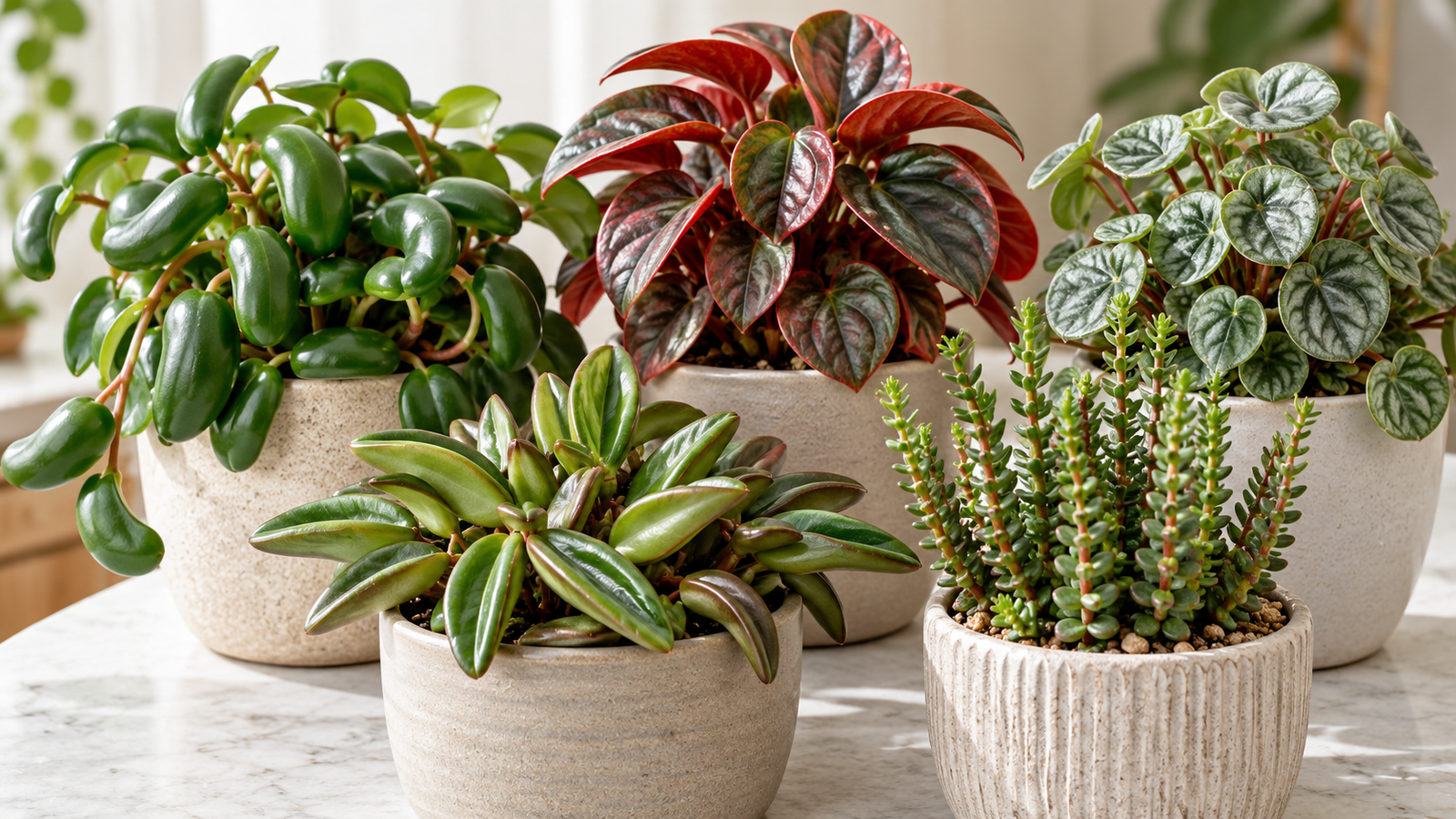
Peperomia varieties do not all use water at the same rate. Grouping them by practical growth behavior helps explain where care actually differs.
Thick-Leaved Types
Baby Rubber Plant, Raindrop Peperomia, and Red Log have relatively substantial foliage.
They generally tolerate some drying and are poor candidates for constantly saturated soil.
Ripple and Rosette Types
Emerald Ripple, Rosso, Frost, and Piccolo Banda form compact crowns.
Their main risk is a poorly aerated root zone that stays wet for too long.
Fine Trailing Types
String of Turtles, Trailing Jade, and P. perciliata are often kept in smaller hanging containers.
Their main challenge is keeping moisture consistent without letting small pots swing repeatedly between saturation and extreme dryness.
Succulent-Form Types
Happy Bean, Ruby Glow, P. nivalis, P. dolabriformis, and P. columella have more obvious moisture-storing structures.
These belong toward the drier end of Peperomia care.
Peperomia Varieties to Avoid Indoors
The best Peperomia is not simply the most attractive one. Eliminate plants that conflict with your conditions before choosing by appearance.
| Your Situation | Reconsider | Better Direction |
| Genuinely dim room | Highly variegated types | Solid-green type or grow light |
| You frequently overwater | Succulent-form types in heavy soil | Improve drainage first |
| Very high shelf | Delicate tiny trailers | Peperomia Hope |
| Hot direct afternoon sun | Pale/patterned foliage | Filter the sunlight |
| Very little space | Large upright foliage | Compact ripple variety |
| You want a hanging plant | Upright types | String of Turtles, Hope, Trailing Jade |
Use this order when selecting:
- Check available light.
- Choose upright or trailing growth.
- Consider your watering habits.
- Check how easy the pot will be to reach.
- Choose your preferred appearance from the suitable options.
Low-Light Peperomia Varieties
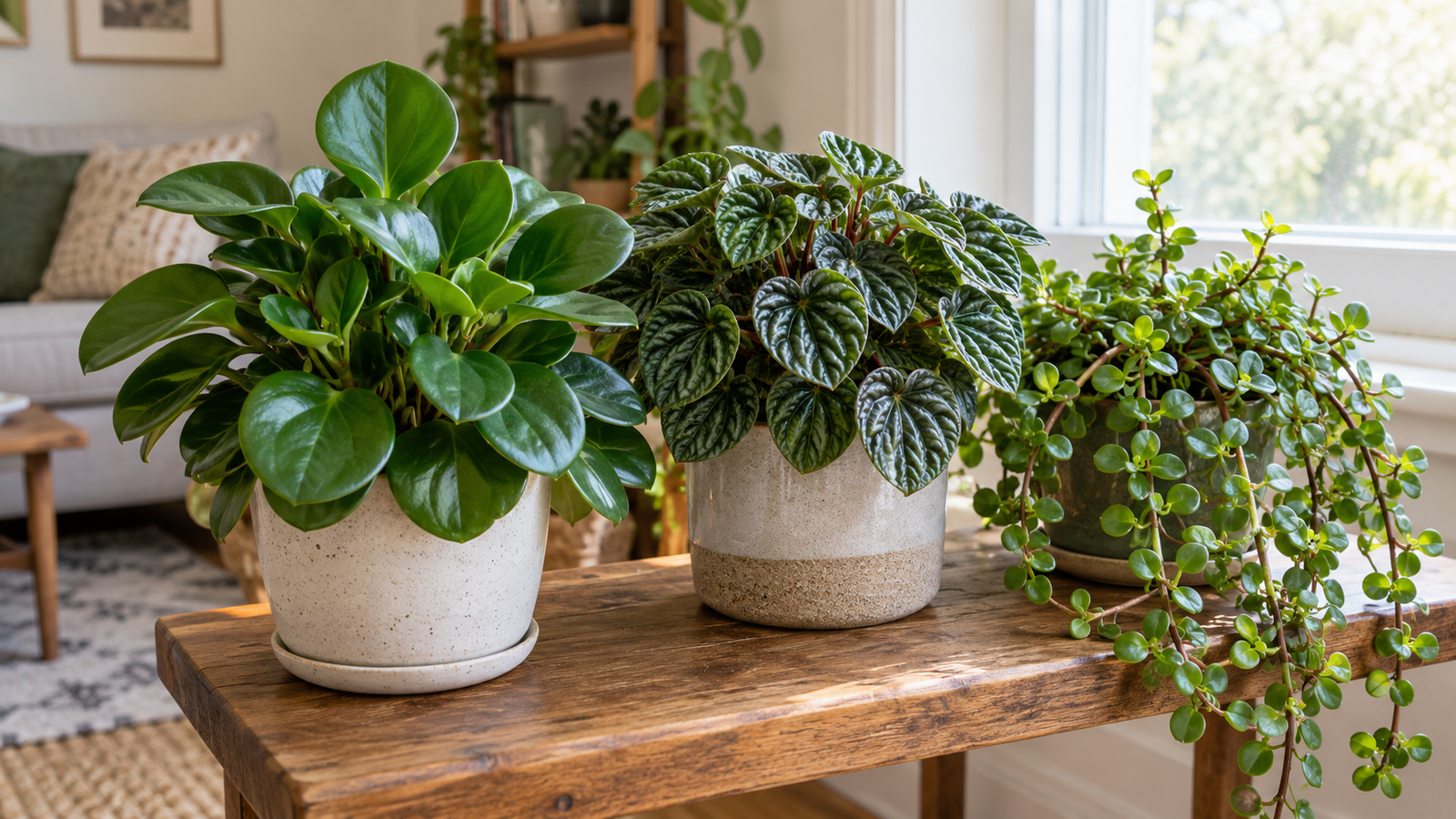
Solid-green Baby Rubber Plant, Emerald Ripple, and Trailing Jade are among the better Peperomia choices for moderately low indoor light.
However, low-light tolerant does not mean low-light loving. Most Peperomias produce stronger, denser growth in medium to bright indirect light.
Signs that a location may be too dark include:
- stretched stems
- long gaps between leaves
- leaning toward a window
- fading variegation
- weak new growth
- unusually slow soil drying
If a room receives very little useful daylight, adding a grow light is usually better than expecting a Peperomia to survive indefinitely in deep shade.
Trailing Peperomia Varieties
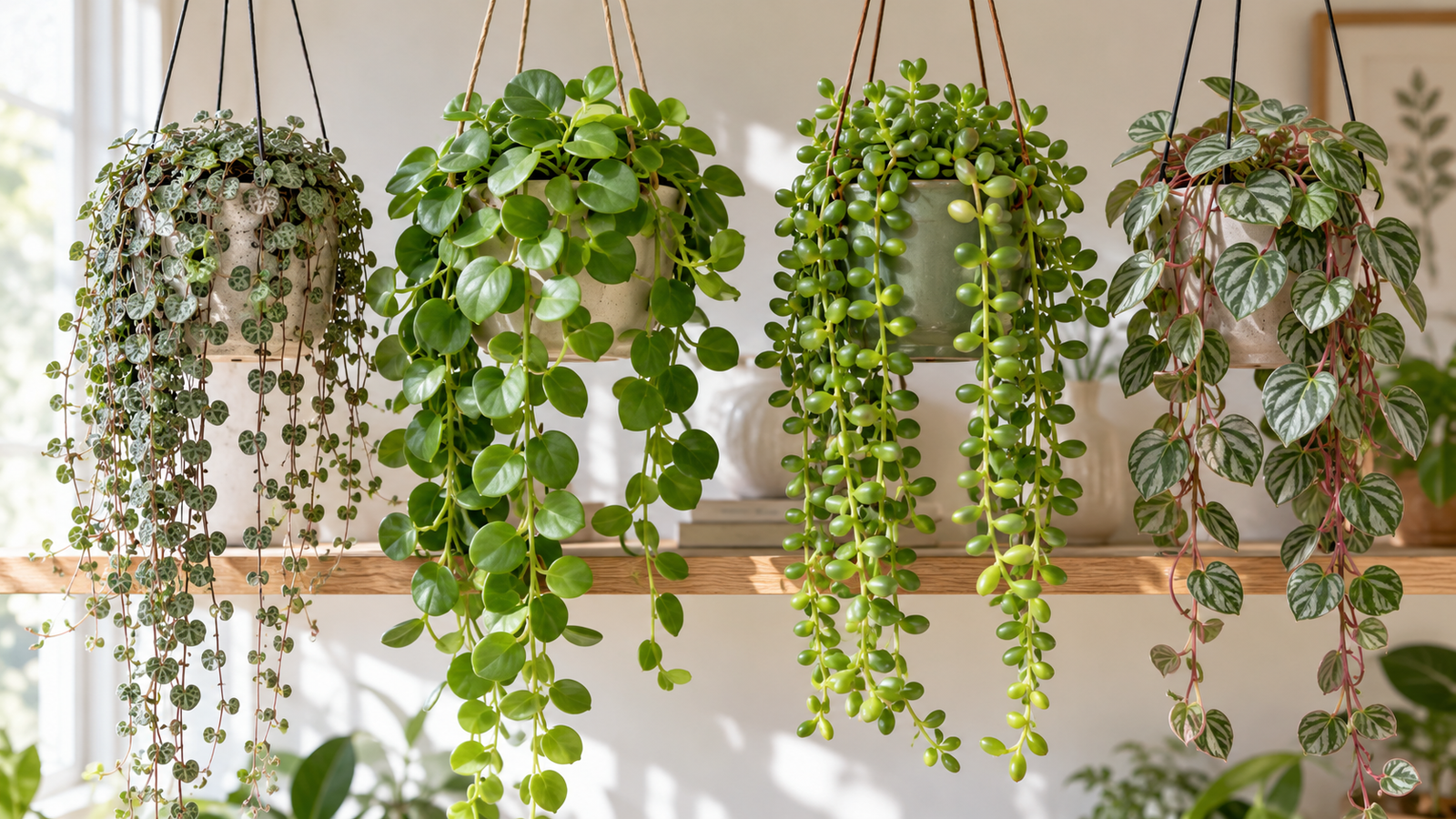
The best trailing Peperomia varieties include String of Turtles, Peperomia Hope, Trailing Jade, Cupid Peperomia, P. perciliata, and creeping P. tetraphylla.
Choose:
- String of Turtles for intricate pattern
- Peperomia Hope for fuller cascading growth
- Trailing Jade for simple green foliage
- Cupid Peperomia for heart-shaped leaves
- P. perciliata for smaller displays
Place hanging Peperomias where you can still reach the container easily. An attractive high shelf becomes a poor location if checking moisture and pests requires guesswork.
Peperomia Sun or Shade Needs
Most Peperomia varieties prefer bright indirect or filtered light, not intense full sun or deep shade.
Gentle morning sunlight is often tolerated, while strong midday or afternoon sun through glass can scorch foliage.
For a global audience, window direction should not be treated as universal. Southern exposure is generally stronger in the Northern Hemisphere, while northern exposure is generally stronger in the Southern Hemisphere.
Also consider:
- season
- latitude
- nearby buildings
- trees
- curtains
- distance from the window
Signs of too much sun include bleaching, crisp patches, and damage on the exposed side.
Signs of insufficient light include stretching, weak growth, reduced variegation, and stems leaning toward the brightest available source.
Decision clarity: Judge the light reaching the plant rather than relying only on the direction the window faces.
Best Peperomia for Your Space
After eliminating unsuitable options, use appearance and growth habit to make the final choice.
- Beginner-friendly: Baby Rubber Plant
- Bold stripes: Watermelon Peperomia
- Deep texture: Emerald Ripple
- Red-green color: Rosso
- Silver foliage: Frost
- Patterned trailer: String of Turtles
- Fuller trailer: Peperomia Hope
- Simple green trailer: Trailing Jade
- Unusual succulent form: Happy Bean
- Collector plant: Peperomia columella
Before buying, check for firm foliage, healthy new growth, clean stems, no visible pests, and no standing water around the pot.
A healthy common Peperomia is usually a better purchase than a rare specimen already showing root or pest problems.
Common Peperomia Problems
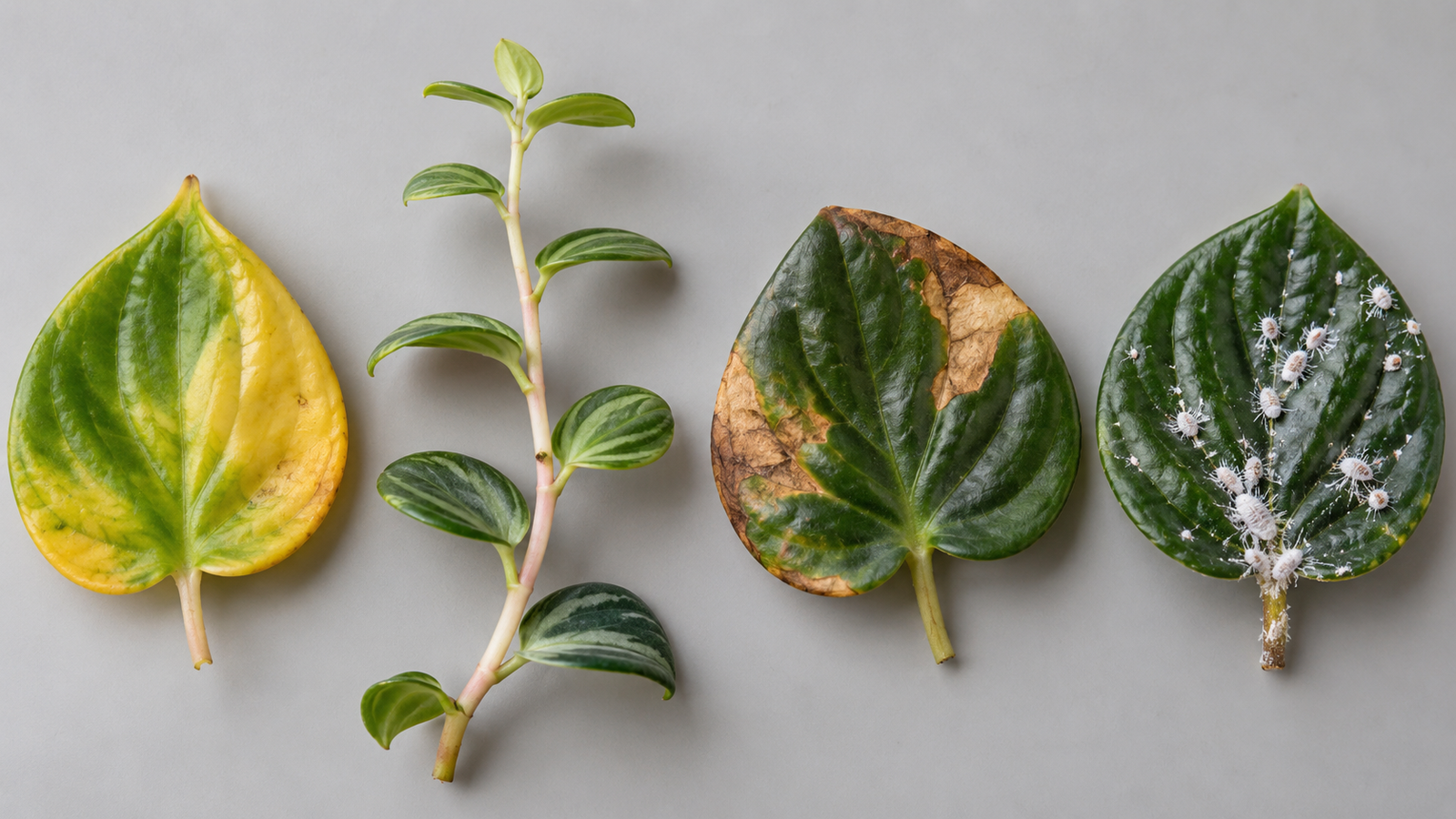
Do not treat every symptom with more water. Diagnose first.
| Symptom | Check First | Possible Cause |
| Several yellow leaves | Soil moisture | Soil staying too wet |
| Soft stem base | Roots and crown | Rot |
| Long gaps between leaves | Light | Insufficient light |
| Faded variegation | Light level | Too little light |
| Crisp pale patches | Sun exposure | Leaf scorch |
| Sudden leaf drop | Moisture and temperature | Environmental stress |
| Cotton-like clusters | Stems and leaf joints | Mealybugs |
| Fine webbing | Leaf undersides | Spider mites |
One symptom alone is rarely enough for a confident diagnosis. A yellow lower leaf can simply be aging, while brown edges may result from inconsistent watering, sun exposure, or other environmental stress.
Use the sequence:
symptom → inspect → confirm → act
rather than:
symptom → guess → water.
Peperomia Care by Variety
Most Peperomia varieties share the same broad foundation: filtered light, good drainage, warm indoor conditions, and protection from continuously wet soil.
The important differences are mainly in how quickly they should dry and how often the pot needs checking.
Thick-leaved upright types can generally tolerate more drying than delicate fine trailing forms.
Ripple Peperomias benefit from an airy root zone and should not remain wet around a dense crown.
Small trailing Peperomias may need more frequent checking because their containers often hold less soil.
Succulent-form species should be kept toward the drier end of the Peperomia range.
Remember that pot material, container size, temperature, season, airflow, light, and soil composition can affect moisture use as much as the plant name itself.
For detailed watering, soil, fertilizer, propagation, repotting, and pruning instructions, link this article to a dedicated Peperomia Care Guide instead of repeating those topics here.
Quick Pet-Safety Note
Many commonly grown Peperomia species are regarded as non-toxic to cats and dogs, including Baby Rubber Plant, Green Ripple Peperomia, and Trailing Jade.
However, non-toxic does not mean pets should be encouraged to eat houseplants. Fertilizer, pesticides, soil treatments, and large amounts of plant material can create separate problems.
Peperomia Varieties FAQs
What is the most popular Peperomia variety?
Watermelon Peperomia is one of the most recognizable varieties. Baby Rubber Plant, Emerald Ripple, String of Turtles, and Peperomia Hope are also widely grown.
How can I identify which Peperomia I have?
Compare growth habit, leaf shape, texture, color, venation, and stem arrangement. Use the nursery label as supporting evidence rather than relying on it alone.
Does Peperomia like sun or shade?
Most Peperomias prefer bright indirect or filtered light. Strong direct sun can scorch foliage, while deep shade may cause weak, stretched growth.
Which Peperomia varieties tolerate low light?
Solid-green Baby Rubber Plant, Emerald Ripple, and Trailing Jade are better choices for moderately low light. Most Peperomias still perform better with brighter indirect light.
Which Peperomia varieties are trailing?
String of Turtles, Peperomia Hope, Trailing Jade, Cupid Peperomia, and P. perciliata are popular trailing choices.
Which Peperomia is easiest for beginners?
Baby Rubber Plant is one of the easiest because its thick foliage tolerates some drying. Emerald Ripple and Peperomia Hope are also beginner-friendly.
How often should Peperomia be watered?
Water according to soil moisture rather than a fixed schedule. Allow part of the potting mix to dry before watering again.
Why are my Peperomia leaves turning yellow?
Several yellow leaves can indicate soil that is staying too wet. Check the root-zone moisture and drainage before watering again.
Is Peperomia a succulent?
Peperomia is a diverse genus, not one group of conventional succulents. However, many species have fleshy moisture-storing tissues, and some are distinctly succulent.
How many types of Peperomia are there?
Peperomia is a large genus containing many hundreds of species, while only a smaller group is regularly grown as indoor houseplants.
Is Peperomia the same as Chinese money plant?
No. Peperomia and Chinese money plant (Pilea peperomioides) belong to different genera and have different growth characteristics.
Why is my Peperomia leggy?
Leggy growth usually means the plant needs stronger usable light. Move it gradually into brighter indirect light before adding fertilizer.
Choosing the Right Peperomia Variety
Choose your Peperomia according to conditions first and appearance second.
For moderate light and beginner-friendly care, Baby Rubber Plant is a strong starting point. Choose Watermelon Peperomia for bold stripes, Emerald Ripple for compact texture, Rosso for red-green contrast, String of Turtles for patterned trailing growth, and Peperomia Hope for a fuller cascade.
If your setup is brighter and drier, Happy Bean or Ruby Glow may fit better. Collector species such as P. columella and P. nivalis make more sense when you can provide strong filtered light, excellent drainage, and careful moisture control.
The most important factors are:
- available light
- growth habit
- pot size and drainage
- moisture behavior
- how easy the plant will be to monitor
Plantsaholic decision rule: Choose by conditions first and appearance second.
When the Peperomia variety matches its growing location, proper care becomes much easier. Instead of forcing one care routine onto every plant, use its growth habit and leaf structure to guide light, watering, and placement decisions.
Myra is the founder and lead writer of Plantsaholic. She shares practical, research-backed advice on indoor plants, outdoor gardening, flowers, herbs, succulents, and everyday plant care. Her goal is to help gardeners of all experience levels grow healthier plants through simple, easy-to-follow gardening guides.