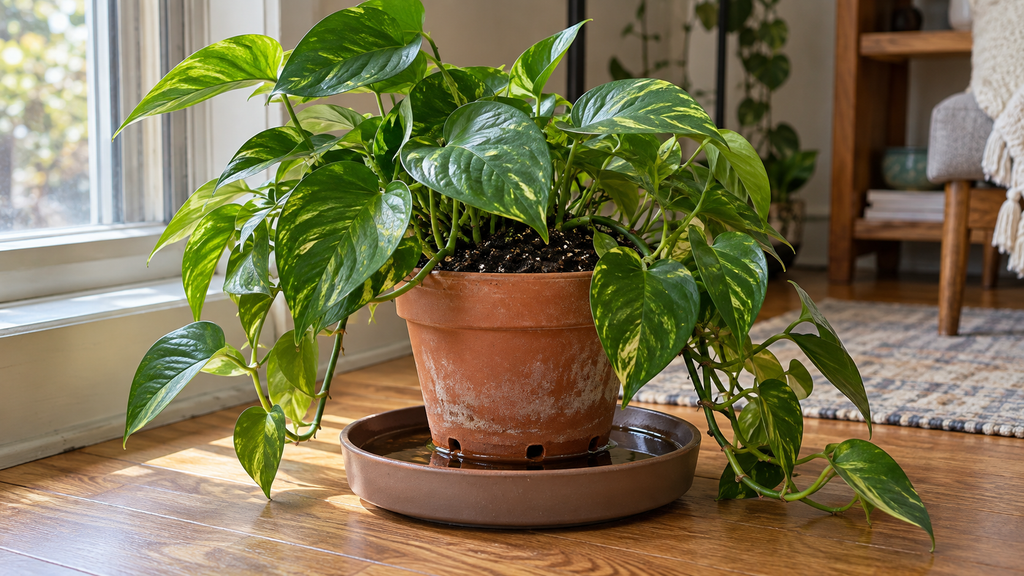
To bottom water plants, place a pot with drainage holes in a shallow container of water and let the potting mix absorb moisture from below. Check the plant after about 15–30 minutes, remove it once the root zone is adequately moist, and let excess water drain before returning it to its usual location.
Bottom watering can help when dry potting mix is difficult to wet evenly, when you want to avoid splashing sensitive foliage, or when seedlings need gentle watering. Instead of pouring water onto the soil surface, you allow moisture to enter through drainage holes and move upward through the growing medium.
However, bottom watering is not automatically better or safer than top watering. A plant can still be overwatered, the middle of the root ball can remain dry, and mineral salts can build up when bottom watering is used exclusively.
The most useful approach is to think about four things: Does the plant need water? Can water enter the pot? Can moisture move through the root zone? Can excess water drain afterward?
This guide explains how to bottom water plants correctly, how long to soak them, how often to do it, which plants need more caution, and how to troubleshoot the method when it does not work as expected.
How to Bottom Water Plants Step by Step
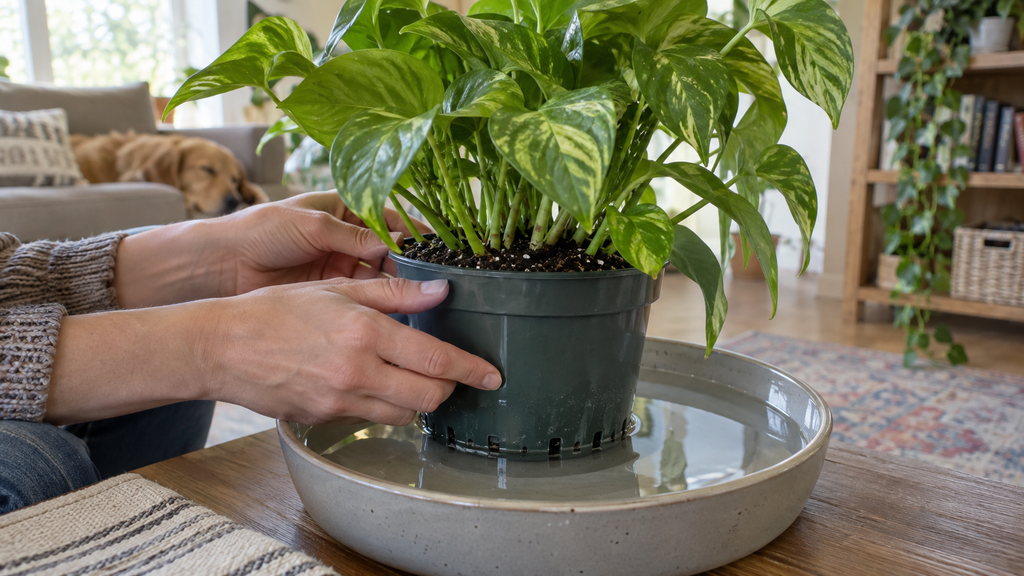
Bottom watering works best when the plant genuinely needs water and the pot has functional drainage holes. The aim is to hydrate the active root zone without leaving the container sitting unnecessarily in water.
1. Check Whether the Plant Needs Water
Check the potting mix before preparing a tray. A dry surface alone does not always mean the entire root zone is dry.
For smaller pots, lifting the container can help. A plant approaching its watering point usually feels noticeably lighter than it does after watering.
Consider the plant’s normal moisture preference rather than following a fixed weekly schedule.
2. Choose a Waterproof Container
Use a:
- plant saucer;
- shallow tray;
- basin;
- sink;
- bucket;
- or bathtub for larger plants.
The container should be wide enough for the plant pot to sit upright and allow water to reach its drainage openings.
3. Add Water
For many normal houseplant pots, about 2–3 inches of water is a practical starting point.
You do not need to submerge the whole pot. The important requirement is reliable contact between the water and the lower growing medium.
4. Place the Pot in the Water
Remove the plant from a decorative outer pot first.
Set the actual growing pot into the tray and check that:
- drainage openings are exposed;
- no liner blocks them;
- the pot remains upright;
- water can reach the growing medium.
5. Let the Pot Absorb Moisture
Start checking after approximately 15–30 minutes.
Small containers may hydrate faster, while large or very dry root balls may take longer.
Treat the timer as a checkpoint rather than proof that watering is complete.
6. Check the Root Zone
The pot should normally feel heavier.
Check whether moisture has moved beyond the bottom layer and reached the area where most roots are growing.
If only the lowest part of the pot is wet, the plant may need more time or the substrate may not be moving moisture effectively.
7. Remove and Drain
Lift the plant from the water and allow excess moisture to leave through the drainage holes.
Do not return a dripping nursery pot to a closed decorative container where runoff can collect around the roots.
The entire process can be remembered as:
Check → soak → verify → remove → drain.
Should You Bottom Water This Plant?
Bottom watering is useful only when the plant, container, and growing medium can support it. A plant may need water but still be a poor candidate for bottom watering if moisture cannot enter, move, or drain properly.
Use the Plantsaholic Need → Entry → Movement → Drainage check.
Need
Does the plant actually require water?
If the root zone is still adequately moist, do not add more water simply because several days have passed.
Entry
Can water physically enter the growing medium?
Check for:
- functional drainage holes;
- blocked openings;
- liners or inserts;
- poor contact between the pot and water.
If water cannot enter, soaking longer will not solve the problem.
Movement
Can moisture travel through enough of the root zone?
Very coarse, compacted, extremely dry, or heavily root-bound media may distribute water unevenly.
Drainage
Can excess water leave afterward?
A pot that traps water at its base can stay saturated even when the initial watering method was correct.
Bottom watering is a good choice when all four conditions are met:
the plant needs water, water can enter, moisture can move through the root zone, and excess water can drain.
How Does Bottom Watering Work?
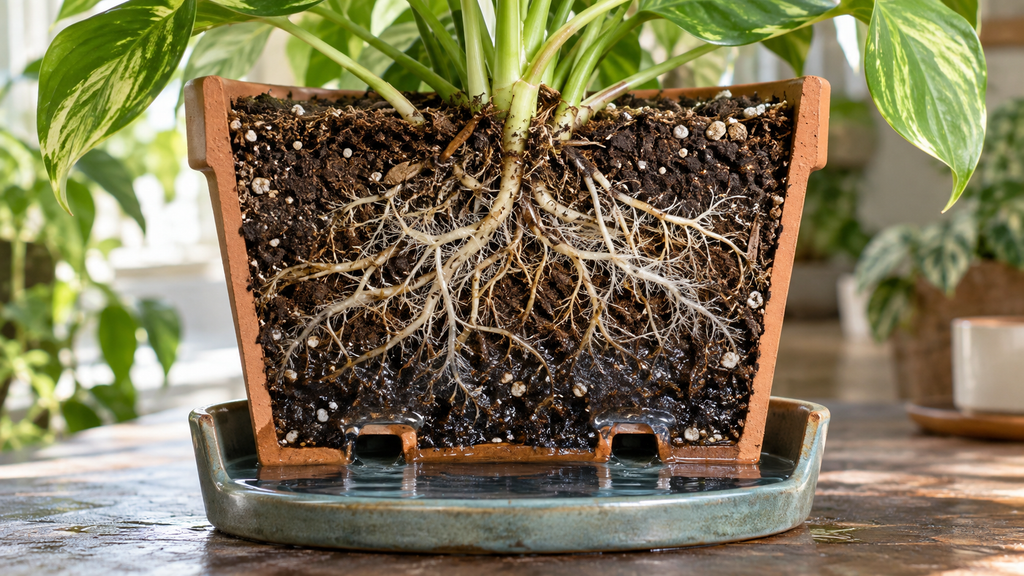
Bottom watering works because water moves through small spaces in the growing medium. This upward movement is commonly called capillary action or wicking.
For the method to succeed, four stages must happen:
- water enters through the pot’s drainage openings;
- the substrate moves moisture away from the base;
- enough of the root zone becomes hydrated;
- excess moisture drains after the pot is removed.
The structure of the potting mix matters.
A relatively fine houseplant mix may distribute water differently from a very chunky bark-based mix. Two pots of the same size can therefore absorb different amounts of water in the same period.
This is why a wet bottom does not necessarily mean the whole plant has been watered.
The useful question is:
Did enough moisture actually reach the active root zone?
If the answer is repeatedly no, investigate the potting mix, drainage openings, root density, or container rather than simply increasing the soak time.
How Long to Bottom Water Plants?
For many houseplants, 15–30 minutes is a useful first-check range.
Smaller pots may become moist sooner. Large containers, dry root balls, or slower-wicking potting media can require longer.
Do not use time as the only stopping signal.
Look for:
- a noticeably heavier pot;
- moisture through the active root zone;
- slower water uptake.
What If the Top of the Soil Is Still Dry?
A slightly dry surface does not necessarily mean the watering failed.
If the deeper root zone is moist, watering may already be complete.
However, if the bottom is wet while a large section in the middle remains completely dry, investigate:
- hydrophobic potting mix;
- coarse substrate;
- blocked drainage holes;
- very tall containers;
- severe root binding.
Do not keep the plant soaking just to make the visible soil surface look wet.
How Often to Bottom Water Plants?
Bottom water when the plant has reached the appropriate level of dryness for that species.
The watering method does not determine watering frequency.
How quickly a plant dries depends on:
- species;
- light;
- temperature;
- humidity;
- pot size;
- root density;
- container material;
- growing medium;
- season.
A plant growing in bright summer light may need water much sooner than the same plant during cooler, darker months.
A root-bound plant may also dry quickly because there is less potting mix available to hold moisture.
Avoid rules such as:
“Bottom water every seven days.”
Instead, check the actual root-zone moisture and water only when the plant is ready.
Can Bottom Watering Overwater Plants?
Yes. Bottom watering can still overwater plants.
The growing medium itself absorbs moisture. If the substrate stays saturated for too long, less air may remain around the roots.
Risk increases when:
- the soil is still wet before watering;
- the pot drains poorly;
- the substrate is dense;
- the container is oversized;
- the plant receives little light;
- water remains in the saucer or cachepot.
The main problem is usually not one thorough watering. It is repeated watering before the root zone has dried appropriately.
Can You Leave Plants Bottom Watering Overnight?
Ordinary houseplants usually do not need to sit in water overnight.
Once the root zone is adequately moist:
- remove the pot;
- allow it to drain;
- empty the tray;
- return the plant to its growing area.
Longer soaking is not automatically better.
Which Plants Benefit From Bottom Watering?
Many container plants can be bottom watered successfully when the pot and substrate are suitable.
Bottom watering is particularly useful when:
- the plant has foliage you prefer to keep dry;
- potting mix has become difficult to rewet;
- top-applied water runs down gaps around a dry root ball;
- seedlings need gentle watering;
- keeping the soil surface somewhat drier is useful.
African violets are a common example because bottom watering reduces direct water splashing onto their foliage.
Very dry peat- or coir-based potting mixes can also benefit because a slow soak gives the material more time to rehydrate.
The important question is not:
“Is this a bottom-watering plant?”
Instead ask:
“Does watering from below solve a specific problem for this plant right now?”
Which Plants Should Not Be Bottom Watered?
There is no useful universal blacklist of houseplants that must never be bottom watered.
The container and current soil condition usually matter more than the plant name.
Avoid or reconsider bottom watering when:
- the pot has no drainage holes;
- the substrate is already wet;
- the pot remains waterlogged after watering;
- the growing medium does not wick moisture effectively;
- the plant needs a strong dry-down and has not reached it;
- the container is unsafe to move.
What About Cacti and Succulents?
Succulents can be bottom watered if they are growing in an appropriate fast-draining substrate and are allowed to dry properly afterward.
The problem is not necessarily bottom watering itself.
The problem is keeping drought-adapted plants wet for too long or watering again too soon.
What About Root-Bound Plants?
A heavily root-bound plant may absorb water quickly but still dry very fast afterward.
If roots heavily circle the pot or emerge through drainage holes, repeated bottom watering may be treating the symptom rather than solving the underlying problem.
Repotting may be more useful.
Can You Only Bottom Water Plants?
Bottom watering can be your regular watering method, but using it exclusively may allow mineral and fertilizer salts to accumulate in the potting mix.
Top watering has one important advantage: water can move downward through the container and carry some accumulated salts out through the drainage holes.
Watch for:
- white crust on soil;
- mineral deposits on pots;
- deposits around drainage holes;
- browning leaf margins;
- visible fertilizer residue.
You do not need a rigid rule such as:
“Top water after every three bottom waterings.”
The need for flushing depends on:
- water quality;
- fertilizer frequency;
- fertilizer concentration;
- plant sensitivity;
- potting mix.
Occasional thorough top watering can therefore complement regular bottom watering when salt buildup becomes a concern.
Can You Fertilize While Bottom Watering?
Yes. Properly diluted water-soluble fertilizer can be added to bottom-watering water.
The plant can absorb dissolved nutrients as moisture enters the growing medium.
However, do not make every soak a fertilizer application.
Repeated fertilizing can increase soluble-salt buildup.
When fertilizing through bottom watering:
- follow the fertilizer label;
- use the correct dilution;
- alternate with plain water;
- watch for mineral crust;
- flush the potting medium when needed.
Avoid fertilizing when the plant is already stressed, visible salt buildup is present, or you recently fertilized and are unsure how much nutrient remains in the growing medium.
Bottom watering changes the delivery route.
It does not change the plant’s actual fertilizer requirement.
How to Bottom Water Plants Without Drainage Holes
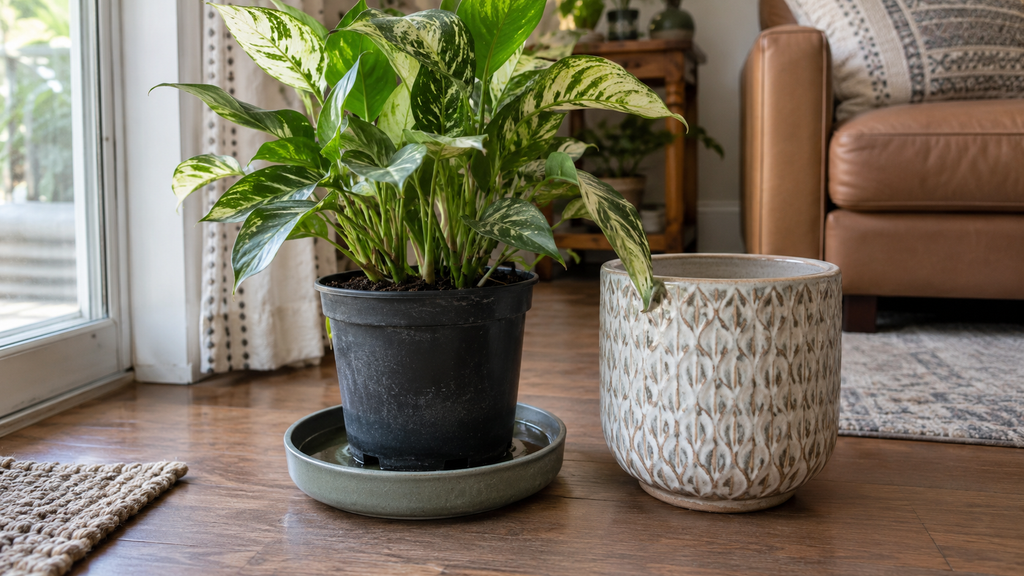
Conventional bottom watering does not work properly in a completely solid pot because water needs a route into the growing medium.
The easiest solution is a nursery pot inside a decorative cachepot.
Keep the plant in a growing pot with drainage holes.
When it needs watering:
- remove the nursery pot;
- place it in a tray of water;
- allow the root zone to hydrate;
- remove and drain it;
- return it to the decorative container.
Drainage holes are important because they allow water to enter during bottom watering and excess moisture to leave afterward.
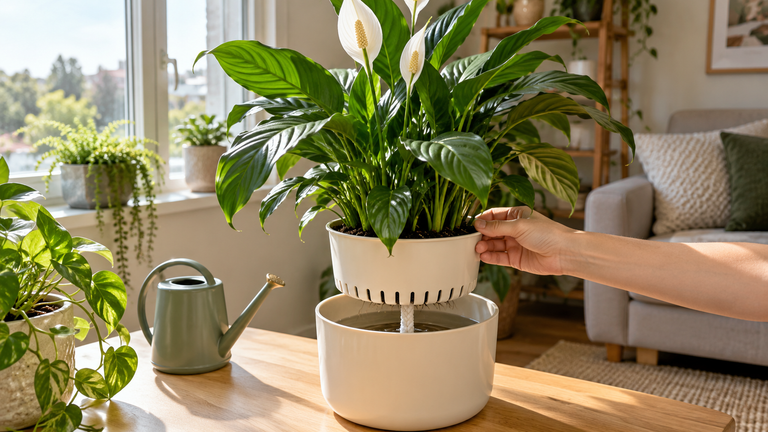
Self-watering planters are different because they are designed with a reservoir, wick, or other water pathway.
Do not assume that an ordinary decorative pot without drainage works the same way.
How to Bottom Water Plants Indoors
Bottom watering indoors is easiest when you use a dedicated waterproof area.
A sink, tray, basin, or bathtub can all work.
Use room-temperature or slightly tepid water and keep a separate drainage area available.
After soaking:
- let the plant drain;
- check its saucer;
- empty any water trapped in a cachepot;
- dry the outside of the pot before placing it on furniture.
Healthy plants can share a large watering tray for convenience, but plants with suspected root disease are better handled separately.
Most importantly, do not water every plant simply because the tray is already prepared.
Only soak plants that actually need water.
How to Bottom Water Plants in Ceramic Pots
Ceramic pots can be bottom watered if they have functional drainage openings.
Glazed Ceramic
A glazed ceramic pot with drainage holes can generally be treated like a normal container.
Most water enters through the drainage openings because the glazed walls are relatively nonporous.
Terracotta and Unglazed Ceramic
Terracotta is porous.
The pot itself may absorb moisture and darken while sitting in water.
Because moisture can also evaporate through the clay walls, plants in terracotta may dry faster than similar plants in plastic or glazed containers.
Ceramic Pots Without Drainage
Do not try to bottom water through a solid ceramic base.
Use a removable nursery pot inside the ceramic container instead.
The key factor is not whether the pot is ceramic.
It is whether water has a usable pathway into and out of the growing medium.
How to Bottom Water Seedlings
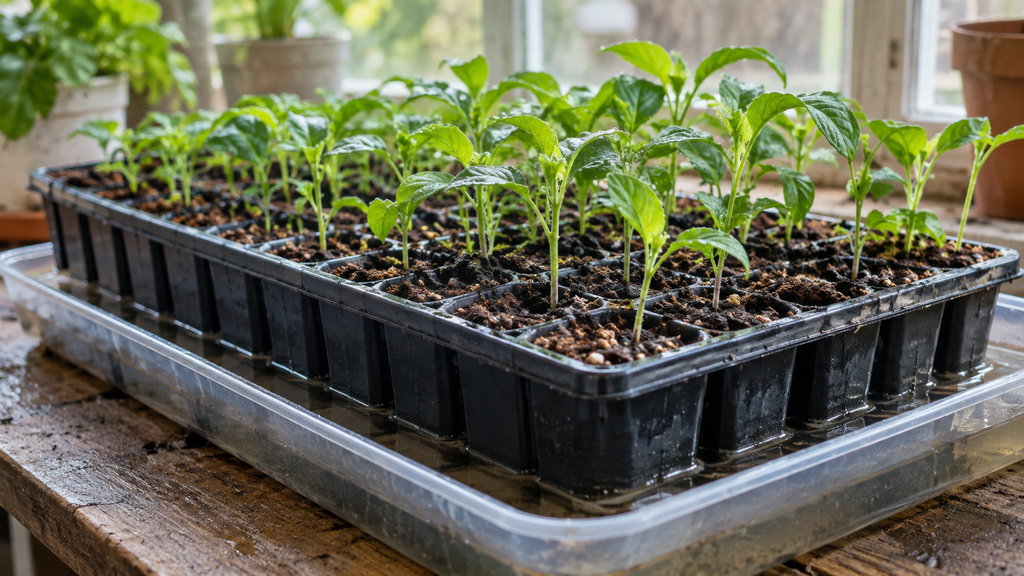
Bottom watering is useful for seedlings because it provides moisture without directing a stream of water onto young stems, seeds, or loose seed-starting mix.
Place seedling cells or pots into a shallow tray and allow the growing medium to absorb water from below.
Check frequently because small cells can hydrate quickly.
Once the medium is evenly moist:
- remove excess water;
- drain the tray;
- return the seedlings to their growing area.
Do not leave seedling trays permanently sitting in water unless the growing system was specifically designed for that purpose.
Seedlings need consistent moisture, but their young roots also need oxygen.
How to Bottom Water Big Plants
Large plants can be bottom watered, but handling often becomes the deciding factor.
A large pot can become extremely heavy once the growing medium absorbs water.
If the container can be moved safely, use a:
- bathtub;
- large basin;
- oversized tray;
- shower base.
Allow enough time for moisture to reach the root zone, then drain the pot thoroughly.
What If the Plant Is Too Heavy?
Use top watering instead.
Water gradually across the surface until the root ball is adequately hydrated.
If runoff collects in a saucer, remove it afterward.
There is no benefit in forcing bottom watering when moving the plant creates unnecessary difficulty or risk.
How to Bottom Water Plants in a Bathtub
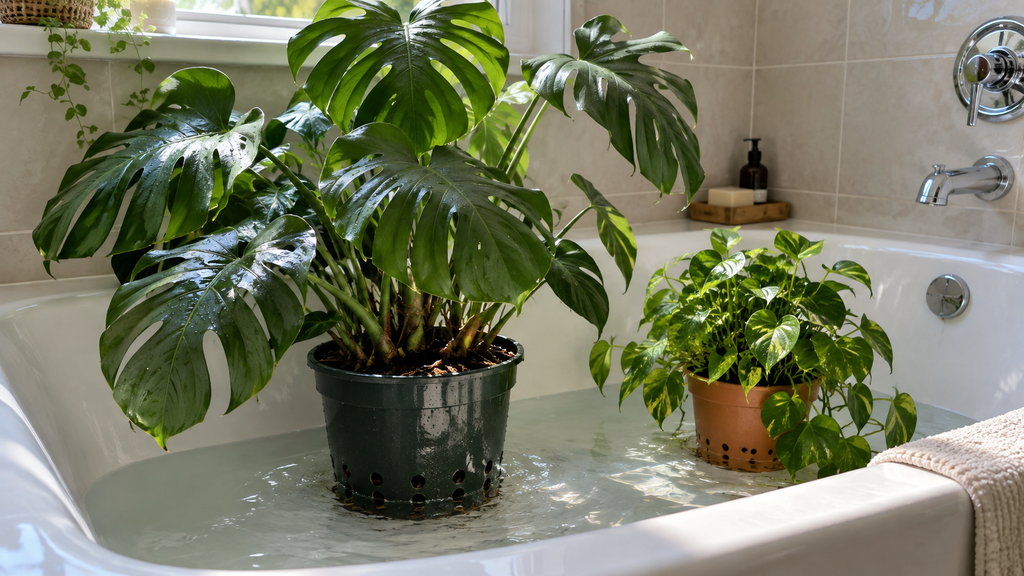
A bathtub can be convenient for several medium-sized plants or larger containers.
First rinse away soap, bath oils, or cleaning-product residue.
Then:
- place the pots upright;
- add enough water to reach the drainage area;
- let each plant absorb moisture;
- check each pot individually;
- drain the bathtub;
- allow the plants to release excess water before moving them.
Do not assume every plant needs the same soak time simply because they are in the same tub.
Once drainage is complete, return the plants to their normal light and growing conditions.
Why Is Bottom Watering Not Working?
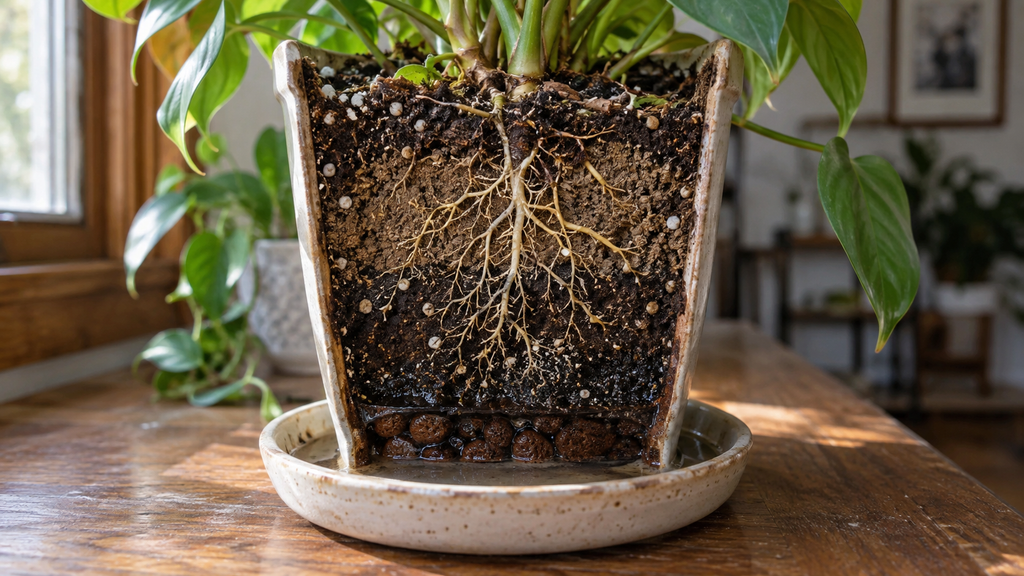
When bottom watering repeatedly fails, do not automatically increase the soaking time.
Identify where the water pathway is failing.
| What you notice | Likely issue | What to check |
|---|---|---|
| Water barely disappears | Entry problem | Drainage holes and water contact |
| Bottom wet, middle dry | Movement problem | Substrate structure |
| Pot stays wet too long | Drainage problem | Pot size, soil, drainage |
| Pot dries extremely fast | Capacity problem | Root binding or undersized pot |
| Water sits inside cachepot | Runoff problem | Empty decorative pot |
| Same dry pockets return | Distribution problem | Compaction or hydrophobic soil |
A fast-drying plant does not automatically mean bottom watering failed. It may be root-bound, growing in strong light, or planted in a low-water-holding mix.
Likewise, a pot that remains wet for many days may be oversized, poorly drained, or receiving insufficient light.
Use this sequence:
Observe → find the failing stage → correct the cause → reassess.
What Are the Disadvantages of Bottom Watering?
Bottom watering has several limitations.
It takes time. Plants need soaking and drainage periods.
Salt buildup can occur. Bottom watering does not flush minerals downward as effectively as thorough top watering.
Large plants are difficult to move. Wet soil substantially increases container weight.
Overwatering is still possible. Poor drainage and excessive frequency can keep roots wet too long.
Some potting mixes wick poorly. Very coarse, compacted, or degraded substrates may hydrate unevenly.
Drainage holes are required. Solid decorative containers cannot be conventionally bottom watered.
These disadvantages do not make bottom watering a poor method.
They simply mean it should be used where its benefits solve a specific watering problem.
When Should You Stop Bottom Watering?
Use another method when bottom watering repeatedly fails to hydrate the root zone efficiently or creates unnecessary problems.
Consider switching when:
- the middle of the root ball stays dry;
- the pot remains saturated for too long;
- the container cannot drain properly;
- mineral buildup needs flushing;
- the plant is too large to move safely;
- the substrate no longer distributes moisture effectively.
For example, a dry root ball that rejects top-applied water may benefit from temporary bottom watering.
A large indoor tree in a heavy ceramic container may be better watered from above.
The correct question is not:
“Is bottom watering better?”
It is:
“Which method gives this plant adequate moisture, drainage, and aeration with the least downside?”
Bottom Watering FAQs
Does the Top of the Soil Need to Get Wet?
No. The surface can remain slightly dry if the active root zone below is adequately moist.
How Long Should a Plant Drain?
Let the pot drain until steady dripping has mostly stopped before returning it to a saucer or decorative container.
Can You Leave Plants Bottom Watering Overnight?
No. Ordinary houseplants should be removed once the root zone is hydrated and allowed to drain.
What Water Temperature Should You Use?
Use room-temperature or slightly tepid water rather than very hot or cold water.
Can You Use Tap Water?
Yes, tap water is suitable for many houseplants. If heavy mineral deposits repeatedly appear, consider local water quality and fertilizer use.
Can Bottom Watering Help With Fungus Gnats?
It can help keep the soil surface drier, which may make conditions less favorable for fungus gnats, but it is not a complete treatment.
Does Bottom Watering Make Roots Grow Deeper?
Not necessarily. Root development depends on moisture, oxygen, substrate, nutrients, plant type, and container size.
Can Bottom Watering Rehydrate Hydrophobic Soil?
Yes. It can help very dry potting mix absorb moisture gradually, although recurring dry pockets may indicate a substrate problem.
What Does White Crust on the Soil Mean?
White crust often indicates mineral or fertilizer salt buildup. Thorough top watering can help flush excess salts from the growing medium.
How to Bottom Water Plants Successfully
Bottom watering works best when you treat it as a watering technique rather than a fixed schedule.
Use the Plantsaholic Need → Entry → Movement → Drainage check:
- Does the plant need water?
- Can water enter the pot?
- Can moisture reach the root zone?
- Can excess water leave afterward?
Then follow the practical sequence:
Check → bottom water → verify moisture → remove → drain → allow the appropriate dry-down.
Bottom watering is especially useful when dry potting mix is difficult to rehydrate, seedlings need gentle watering, or you want better control over where irrigation water goes.
But it should not be forced onto every plant.
If moisture repeatedly fails to reach the middle, the pot stays saturated too long, salt buildup develops, or the plant is too heavy to move safely, choose another watering method.
The best method is the one that provides the roots with adequate moisture, enough oxygen, and reliable drainage under the plant’s actual growing conditions.
Myra is the founder and lead writer of Plantsaholic. She shares practical, research-backed advice on indoor plants, outdoor gardening, flowers, herbs, succulents, and everyday plant care. Her goal is to help gardeners of all experience levels grow healthier plants through simple, easy-to-follow gardening guides.