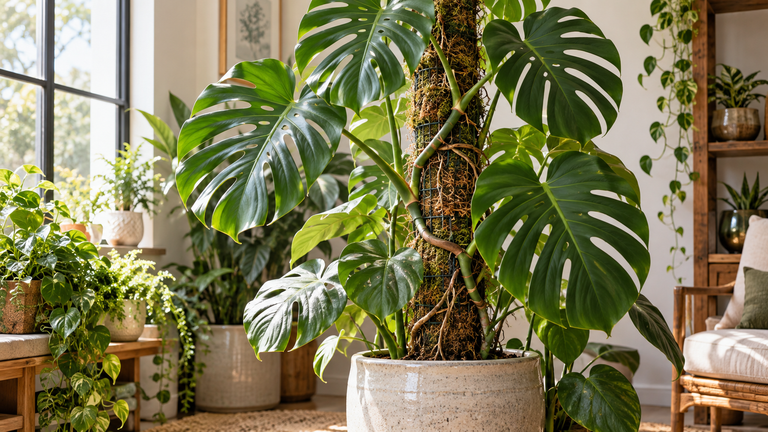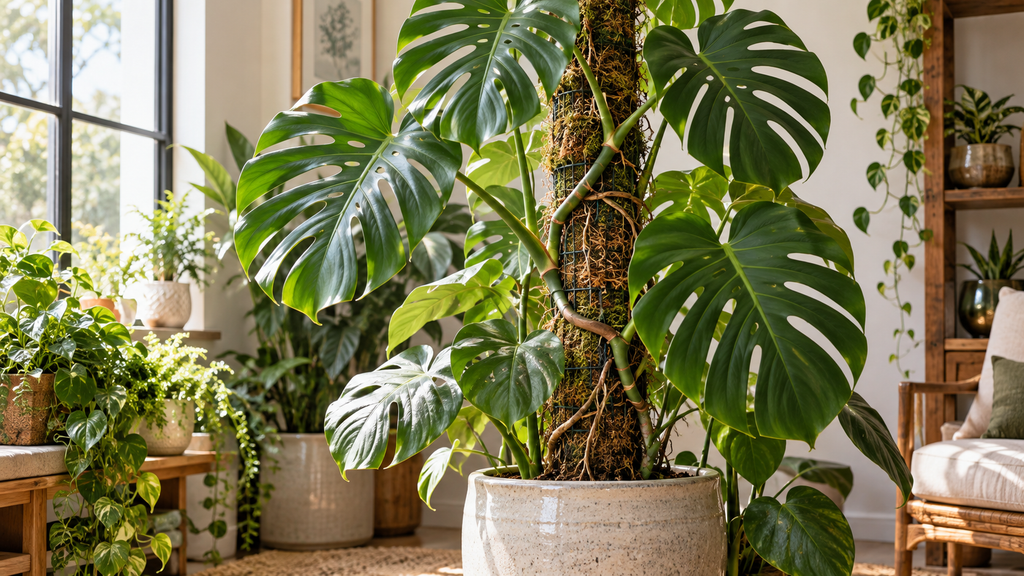
To use a moss pole, anchor it beside your climbing plant, position aerial-root nodes toward the moss, and fasten the main stem loosely with soft ties. Keep sphagnum moderately moist to encourage attachment, and guide new growth upward without bending stiff stems or tying leaf stalks.
Moss poles help Monstera, pothos, and climbing Philodendron grow vertically. This Plantsaholic guide covers installation, watering, DIY construction, and troubleshooting.
What Do You Need for a Moss Pole?
Gather a stable support, soft adjustable plant ties, water, and a healthy climbing plant. An empty mesh pole also needs long-fiber sphagnum moss. Locate the main stem before installation.
Beginner supply checklist:
- Support: Sphagnum-filled mesh, coir pole, or reinforced alternative.
- Filling: Long-fiber sphagnum if using an empty mesh structure.
- Fasteners: Soft hook-and-loop tape or flexible plant ties.
- Watering tools: Bowl and narrow-spout bottle.
- Optional stake: Reinforcement for tall or heavy plants.
For a quick setup, hydrate the moss, secure the pole beside the stem, turn rooting nodes toward it, and add loose ties. Check support stability.
How to Use a Moss Pole Correctly
Correct installation requires secure anchoring, close contact between aerial roots and moss, and gentle training. Support strength varies with plant size. Before securing the vine, gently touch the pole to check for wobbling; correcting the base now prevents later damage to attached roots.
Step 1: Choose and Prepare the Pole
A compact pole may suit young pothos; mature Monstera often needs reinforcement. If using sphagnum, soak the loose fibers until evenly damp, squeeze away excess water, and distribute them through the mesh without packing tightly.
Step 2: Identify the Climbing Side
Locate the plant’s main stem and the nodes producing aerial roots. Those nodes should face the support while leaves extend naturally outward.
Step 3: Install a Stable Base
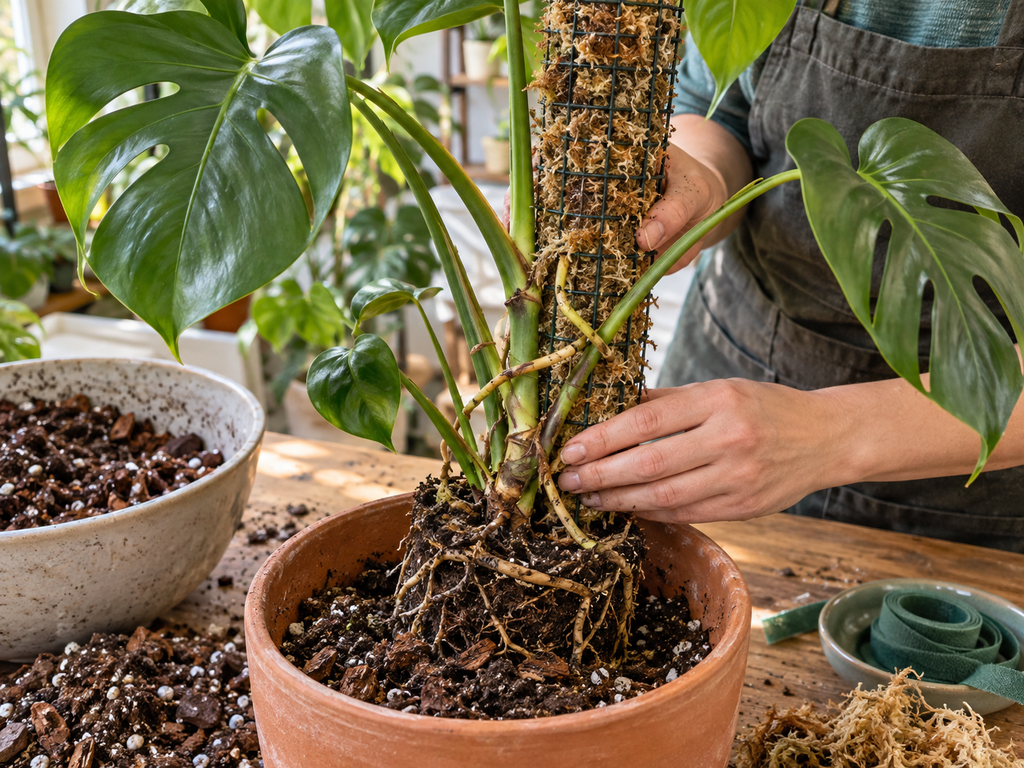
Anchor the pole according to its design. Avoid pushing a thick stake through a crowded root ball; installing the support during repotting may be safer. Choose a pot that fits the roots and remains stable when the moss is wet.
Step 4: Attach and Train the Stem
Bring flexible sections toward the pole without twisting mature growth. Fasten sturdy internodes with adjustable ties, leaving roots, nodes, and leaf stalks unobstructed.
Step 5: Check Conditions and Adjust
Provide species-appropriate light and watering. Inspect ties, moisture, and support stability regularly. Loosen ties as stems thicken.
Which Side Faces the Moss Pole?
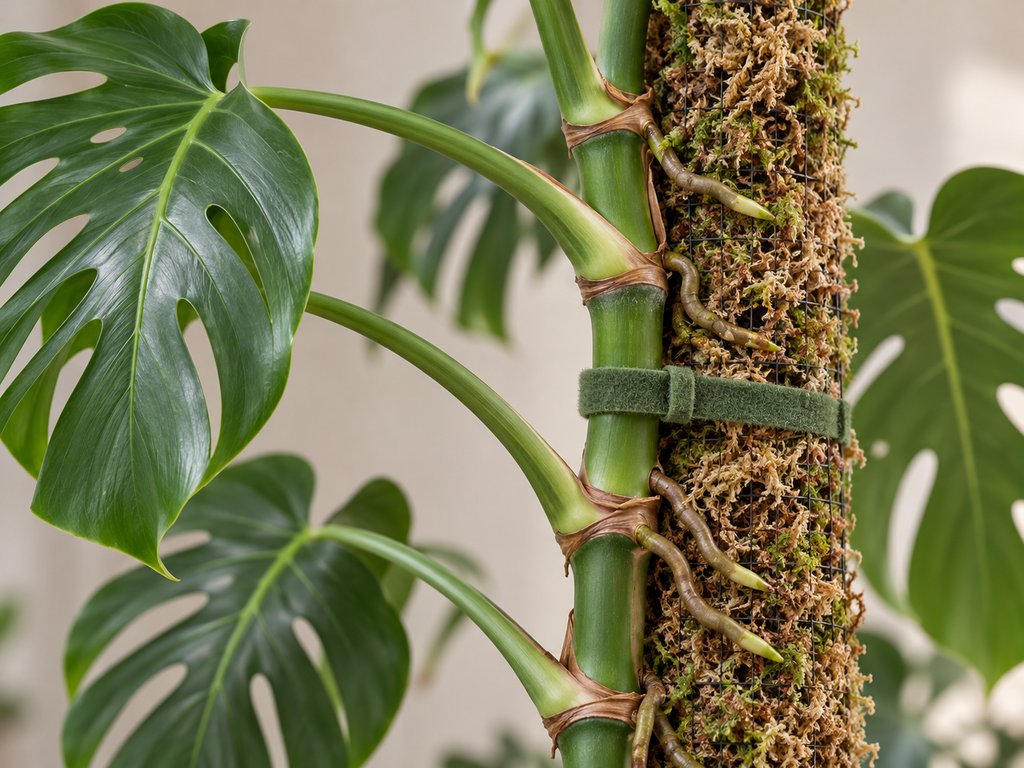
Generally, the aerial-root side of the climbing stem should face the pole. This is especially important for Monstera deliciosa, where roots often emerge from the side opposite most leaves.
A node is a stem point associated with a leaf and potential aerial root. The internode lies between nodes; the petiole connects a leaf to the main stem.
If roots face away, reposition the pole or redirect flexible new growth. Avoid sharply rotating thick older stems. For a multi-stem plant, inspect each vine independently instead of forcing all its nodes against one narrow surface. Several Monstera stems pointing in different directions may require wider or separate supports.
Correct: Rooting nodes face moss, leaves remain free, and the stem is loosely supported. Incorrect: Roots face away, petioles bear the weight, or rigid stems are forcibly bent.
How Do You Attach a Plant to a Moss Pole?
Use soft ties around the main stem, ideally between nodes, to hold aerial-root points close to the pole. Ties should be snug enough to guide the vine but loose enough to accommodate growth.
For multiple vines, distribute healthy stems around accessible moss instead of binding them tightly together. Some vines can remain trailing. Crowded or differently oriented mature stems may need another support.
Never secure a plant primarily by its leaves or petioles. You may guide young flexible aerial roots toward damp moss, but do not force thick roots through mesh. Remove unnecessary ties only once stems remain stable.
How Long Does Moss Pole Attachment Take?
Aerial roots may approach moss during several weeks of active growth, but secure attachment can take weeks or months. Timing depends on species, growing conditions, and root contact.
Look for three stages: a root touches the pole, new growth enters or grips fibers, and several roots establish contact. A single root resting against moss does not mean the plant can hold itself upright.
If attachment stalls, check whether nodes face the moss and whether the plant is actively growing. Keep fibers appropriately moist and avoid repeatedly disturbing the roots. Never tug at roots to test attachment.
What Does a Moss Pole Do?
A moss pole gives climbing plants a textured vertical surface and helps organize sprawling stems. Damp sphagnum also offers a rooting environment for some aerial roots, although it does not replace healthy underground roots.
Climbing support can contribute to larger, mature foliage in certain aroids, including pothos and Monstera, when other conditions are suitable. It cannot guarantee bigger leaves or fenestrations. Light, maturity, nutrition, and general plant health remain important.
Is a Moss Pole Necessary?
No. Pothos and heartleaf Philodendron can trail successfully, and many young climbing plants grow without vertical support. A pole becomes useful when vines sprawl, aerial roots seek a surface, or heavy stems lean.
Self-heading Philodendron types generally do not require climbing poles. For structural support alone, a wooden plank, coir pole, trellis, or stake may be adequate.
Choose sphagnum if you want aerial roots to enter moist fibers. Choose a plank or trellis if lower-maintenance upright support is your priority.
Which Plants Benefit From Moss Poles?
Climbing aroids with aerial roots benefit most. However, species within the same genus may grow differently, so identify the plant rather than assuming every Philodendron needs support.
| Plant | Suitability | Benefit |
|---|---|---|
| Monstera deliciosa | Excellent | Supports heavy stems |
| Monstera adansonii | Excellent | Trains flexible vines |
| Golden pothos | Excellent | Supports mature climbing |
| Heartleaf Philodendron | Excellent | Directs vines upward |
| Rhaphidophora tetrasperma | Excellent | Organizes climbing stems |
| Scindapsus pictus | Good | Offers root contact |
| Self-heading Philodendron | Usually unnecessary | Naturally different habit |
Pothos and heartleaf Philodendron are beginner-friendly; attachment may still require ties.
What Goes Inside a Moss Pole?
Long-fiber sphagnum is a common filling for open mesh poles because it holds moisture and leaves spaces that roots can enter. Coir-covered poles usually wrap coconut fibers around a rigid center and may function primarily as dry supports.
| Feature | Sphagnum-filled pole | Coir-covered pole |
|---|---|---|
| Root penetration | Often possible | Construction-dependent |
| Moisture management | Needs checking | Often simpler |
| Main purpose | Moist rooting surface | Structural support |
Avoid filling open mesh with ordinary potting soil: particles can escape, compact, or stay unevenly wet. Choose responsibly sourced sphagnum to reduce peatland impacts. If minimizing maintenance is your priority, try a plank or trellis before buying a moisture-retaining pole.
What Size Moss Pole Is Best?
Select enough height for the climbing stem you want to train, with room for some new growth. Strength and anchoring matter more than buying the tallest available pole; wet moss adds weight.
Consider stem thickness, foliage weight, rooting surface, support diameter, available pot space, and whether extensions are compatible. A compact support may suit young pothos, while a large Monstera often needs a reinforced pole or sturdy plank.
Extend a stable pole as the plant grows.
Should You Soak a Moss Pole?
Hydrate loose, dry sphagnum before filling a mesh pole. Place it in clean room-temperature water, gently separate compressed fibers, and squeeze out excess moisture. The fibers should feel evenly damp, not dripping.
Compressed moss may take longer to hydrate; check the interior.
Do not submerge a ready-made pole unless its instructions allow it; wooden components or fittings may be unsuitable for immersion. Once installed, apply water directly to the moss instead of soaking the entire pot unnecessarily.
How Do You Use a Moss Pole Indoors?
Place the plant in species-appropriate light with enough space for foliage to spread. Many tropical climbing aroids prefer bright indirect light. Keep the pole away from heating or air-conditioning drafts that rapidly dry exposed fibers.
A damp pole does not reliably regulate room humidity. Protect furniture from runoff and use a draining container with a saucer.
Check moss and potting mix separately: the pole may dry while soil remains wet.
How to Use a Moss Pole for Monstera
Monstera should climb with its aerial-root side against a sturdy support. On Monstera deliciosa, find roots emerging along the main stem and position the pole behind that rooting side while leaves extend outward.
How Do You Support a Large Monstera?
Use a reinforced pole or plank and a stable container. Consider the combined weight of wet sphagnum, thick stems, and future leaves.
How Do You Train Monstera adansonii?
Its thinner vines are generally easier to fasten with loose ties. Guide new nodes toward the moss and extend the pole when the growing tip reaches its top.
A pole can support the climbing habit associated with mature Monstera foliage, but leaf size and fenestration also depend on light, maturity, genetics, and general care.
How Do You Use Moss Poles for Philodendron?
Climbing Philodendrons can be trained by holding their main vines near the pole and allowing new aerial roots to reach it. Heartleaf Philodendron (Philodendron hederaceum) is a practical example.
Position its flexible stems against moss, secure them loosely, and avoid crowding several vines into one small area. Philodendron Brasil, a variegated cultivar of the same species, can be trained similarly.
Not all Philodendrons climb. Self-heading varieties usually do not need a traditional moss pole, although a heavy specimen may need ordinary structural support. Identify the species before purchasing accessories.
How Do You Use Moss Poles for Pothos?
Golden pothos (Epipremnum aureum) can grow as a trailing or climbing plant. For vertical growth, fasten selected vines against the pole with aerial-root nodes facing the surface; leave petioles free.
Climbing pothos may produce larger mature leaves under suitable conditions; existing leaves will not enlarge.
A sphagnum-filled support suits growers who want root penetration. Coir or a trellis can be enough when the objective is simply to arrange vines upright.
Should You Water a Moss Pole?
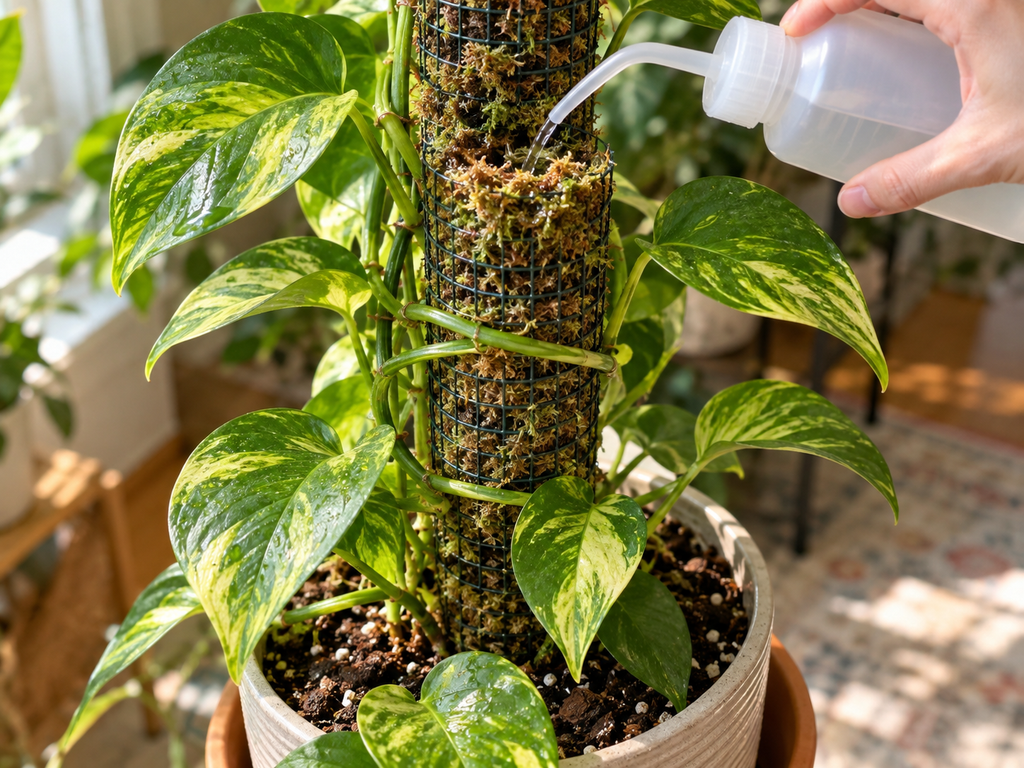
Keep sphagnum moderately moist when encouraging roots to enter it, but do not assume soil needs watering every time the pole dries. Exposed moss and potting mix often lose moisture at different rates.
How Should You Water a Moss Pole?
- Feel the outer moss and accessible inner fibers.
- Add water slowly near the top using a narrow-spout bottle.
- Check whether the middle and lower sections become damp.
- Stop before excessive runoff collects in the saucer.
Misting may wet only the surface. If the center remains dry, water more deeply. Frequency depends on room conditions and pole size.
How Can You Avoid Overwatering the Soil?
| Moss | Soil | Best action |
|---|---|---|
| Dry | Wet | Water pole selectively |
| Damp | Dry | Water potting mix as needed |
| Dry | Dry | Assess and water each |
| Saturated | Wet | Pause watering; check drainage |
If runoff repeatedly wets soil, apply water more gradually. Soil roots also need aeration. A clear or open-backed pole can make it easier to see whether moisture penetrates beyond the outermost layer.
How Long Can Moss Stay Dry?
Dried sphagnum can remain useful as structural filling, but roots established inside it may experience stress when repeatedly allowed to dry completely. No reliable number of safe dry days applies to every home or pole.
Check fibers at several heights: the upper surface may feel crisp while the center is still damp. A dry pole may also become harder to rehydrate evenly.
Apply water slowly and confirm it enters the fibers rather than running down the outside. Replace moss that has severely decomposed or no longer functions as intended.
How Do You Maintain a Moss Pole?
Maintenance means preserving useful moisture, structure, cleanliness, and root contact. Most commercial dried sphagnum is not living moss you need to keep growing; its fibrous texture is the main benefit.
Remove trapped dead leaves, check joints and ties, and avoid leaving the material continuously saturated. Persistent musty odors, decomposition, or mold warrant inspection and possibly replacement of affected filling.
Living moss cultivation has different care needs.
How Do You Make a Self-Watering Moss Pole?
A self-watering design uses a reservoir or wick to move moisture into the moss, reducing manual watering. However, it does not guarantee even hydration and must be tested before relying on it.
Use a stable fillable pole, small secured water reservoir, absorbent plant-watering wick, and cleanable fittings. Place one end of the wick in water and the other in contact with the moss.
Check moisture distribution: wicks may clog or overwater. Keep reservoirs clean; manual watering is often easier for beginners.
How Do You Make a Moss Pole?
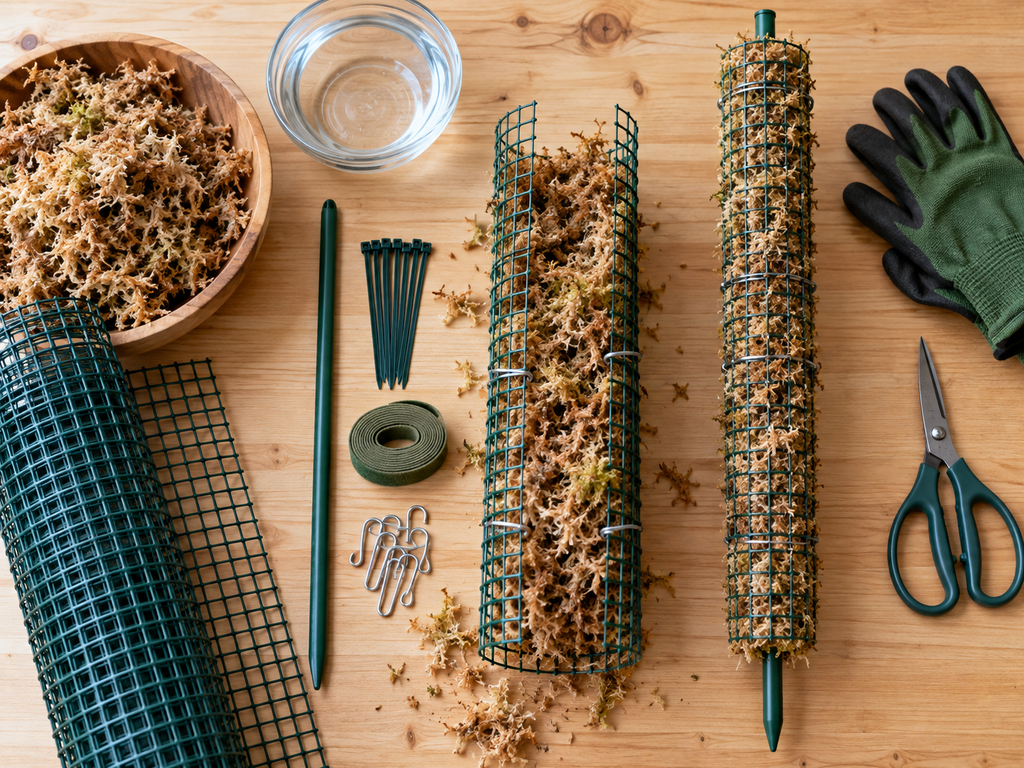
Make a DIY pole using rigid plant-safe mesh, long-fiber sphagnum, suitable fasteners, and a reinforcement stake. Build for stability and root access rather than appearance alone.
What Materials Do You Need?
- Rigid plastic mesh and corrosion-resistant fasteners.
- Long-fiber sphagnum moss.
- Strong stake or backing.
- Soft ties, gloves, cutting tools, and clean water.
Step 1: Measure and Shape the Mesh
Allow sufficient length for the climbing portion and anchoring arrangement. Roll or fold the mesh into a column, secure its edges, and remove or cover sharp points. Openings should retain moss while allowing roots to reach it.
Step 2: Hydrate and Fill the Pole
Soak sphagnum until evenly moist, squeeze away excess water, and distribute the fibers throughout the column. Avoid big empty spaces or dense compression that prevents root penetration.
Step 3: Reinforce and Install
Attach a rigid stake or backing and check for bending. The buried anchoring section does not necessarily need moss; a separate bare stake can hold the filled portion above soil.
Position the finished support beside the rooting side of the stem, anchor it safely, and fasten the vine loosely. Recheck stability after watering. When extending a DIY pole later, reinforce the connection rather than relying on soft plant ties to hold the two sections together. DIY may be economical for several poles, but compare all materials and your time when making only one.
What Are Common Moss Pole Problems?
Most failures involve incorrect positioning, excess or insufficient moisture, tight ties, or unstable supports. Match your correction to the symptom rather than adding water or more fasteners automatically.
| Problem | Likely cause | Useful fix |
|---|---|---|
| Roots will not attach | Nodes face away; moss stays dry | Redirect new growth; check moisture |
| Moss dries rapidly | Warm drafts or exposed fibers | Monitor more often; adjust location |
| Musty moss | Prolonged wetness or decay | Improve airflow; replace affected filling |
| Stem pressure marks | Ties too tight | Loosen or replace ties |
| Pole leans | Weak anchoring or flexible structure | Reinforce base or column |
| Small new leaves | Immaturity or unsuitable care | Reassess light and overall conditions |
Brown sphagnum alone does not prove decay; assess smell and texture. A musty odor accompanied by collapsing fibers merits closer inspection, whereas a clean, firm pole may simply show normal variation in moss color. If the plant falls away, determine whether the vine needs better ties or the pole needs stronger anchoring. A moss pole does not automatically cause root rot, but repeatedly flooding already wet potting mix can create unhealthy root conditions.
When Should You Replace a Moss Pole?
Extend a pole when the climbing tip reaches the top and more height is desirable. Replace it when severely damaged, unstable, or decomposed. Before adding an extension, check that the base safely supports extra wet moss and foliage.
If roots have entered old sphagnum, avoid pulling the pole away. To transfer a plant, support its stems, release unattached sections carefully, preserve moss around embedded roots where practical, and direct new growth toward the replacement.
When the plant approaches the ceiling, consider pruning or propagating suitable stem sections containing nodes rather than building an unsafe tower.
How Can You Track Moss Pole Progress?
Assess new aerial-root contact, healthy climbing growth, moisture behavior, and support stability instead of expecting attachment by a specific date.
During the first month, check anchoring, ties, and new stem direction. Over the following weeks, observe whether roots touch or enter the moss. Some plants attach within the first 30–90 days; others take longer.
Photograph the same stem area under similar lighting during inspections. Record new nodes and changes in watering. A healthy plant with a secure pole is progressing even if attachment remains gradual.
Moss Pole FAQs
Can You Add a Moss Pole Without Repotting?
Yes, if there is space without substantially damaging roots. Root-bound plants may be safer to support during repotting.
Should a Moss Pole Touch the Bottom of the Pot?
Not necessarily. Its anchoring must be secure, but the moss-filled portion need not extend to the bottom.
Can You Use a Dry Moss Pole?
Yes, as structural support. Damp sphagnum is more useful when encouraging roots to penetrate the filling.
Can You Fertilize Through a Moss Pole?
Established roots may absorb dilute nutrients, but ordinary potting-mix fertilization is often sufficient. Avoid salt buildup.
Do Moss Poles Attract Fungus Gnats?
Wet organic material may contribute, but moist potting soil is often the main breeding site. Manage excessive moisture.
Can You Use a Moss Pole Outdoors?
Yes, if the species tolerates local conditions. Account for wind, direct sun, rainfall, and temperature.
Can Moss Poles Damage Aerial Roots?
Yes, if roots are forcibly bent or torn away after attachment. Guide flexible growth gently.
Can a Moss Pole Fix a Leggy Plant?
It supports long stems but cannot shorten existing internodes. Improve light and consider appropriate pruning.
Can You Propagate a Plant Growing on a Moss Pole?
Yes. Many climbing aroids propagate from viable stem cuttings containing nodes. Preserve attached roots where possible.
Are Moss Poles Safe for Pets?
Secure the pole, but remember that Monstera, pothos, and Philodendron are toxic if chewed. Keep them away from pets.
What Is the Best Moss Pole Setup?
The best setup matches the plant’s climbing habit, provides stable support, and allows aerial roots to reach the intended surface. Choose sphagnum for moist root contact or a coir pole, plank, or trellis when simple upright support is sufficient.
At Plantsaholic, we recommend correct positioning, loose ties, separate moisture checks, and patience. Healthy growth matters more than an attachment deadline.

Myra is the founder and lead writer of Plantsaholic. She shares practical, research-backed advice on indoor plants, outdoor gardening, flowers, herbs, succulents, and everyday plant care. Her goal is to help gardeners of all experience levels grow healthier plants through simple, easy-to-follow gardening guides.