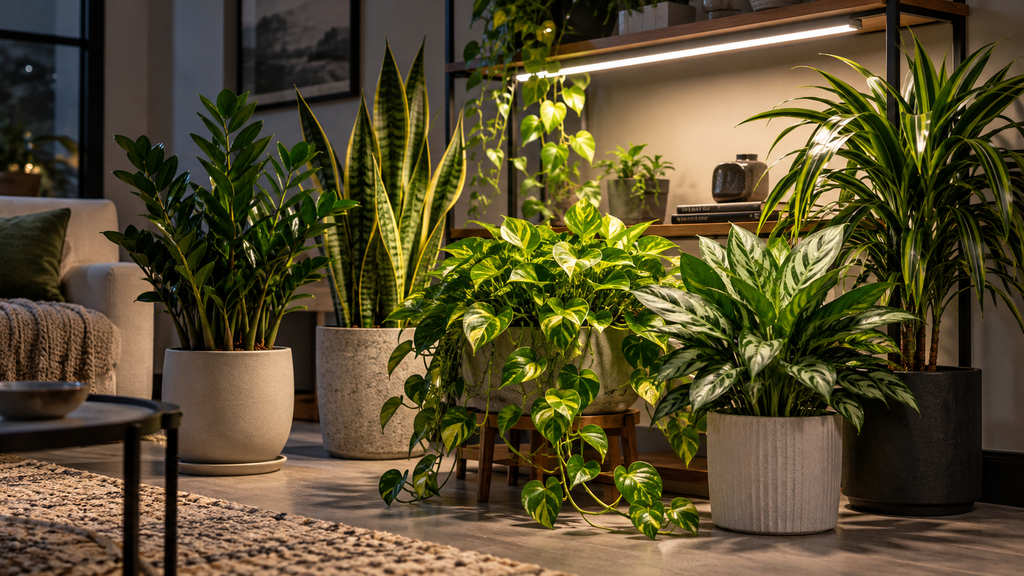
Indoor plants can grow successfully under artificial light when they receive enough usable light for enough hours each day. ZZ plants, snake plants, cast iron plants, Chinese evergreens, pothos, philodendrons, and several Dracaena varieties are among the best choices for homes, offices, and rooms with limited natural sunlight.
Artificial light does not automatically mean low light. A windowless room with a suitable grow light can provide better growing conditions than a dim room with a distant window. What matters is the amount of usable light reaching the leaves, how long the plant receives it, and whether the light covers enough of the plant.
| Need | Best Starting Choice |
|---|---|
| Best overall | ZZ plant |
| Very low artificial light | Cast iron plant |
| Tall and narrow | Snake plant |
| Trailing plant | Golden pothos |
| Decorative foliage | Chinese evergreen |
| Small desk | Compact ZZ or bird’s nest snake plant |
| Large floor plant | Dracaena or mature ZZ |
| Windowless room | Low-light plant + suitable grow light |
| Beginner-friendly | ZZ plant or snake plant |
Can Indoor Plants Grow With Artificial Light?
Yes. Indoor plants can grow entirely under artificial light because plants need usable light energy for photosynthesis, not sunlight specifically. A suitable artificial fixture can provide the wavelengths and intensity needed for healthy foliage growth.
Three factors matter most: light intensity, light quality, and duration. Distance also matters because the amount of light reaching the plant decreases as the foliage moves farther from the fixture.
Artificial lighting is particularly useful in:
- Windowless offices
- Interior rooms
- Basements
- Dark apartments
- Plant shelves
- Rooms far from windows
A common mistake is judging plant light by how bright a room looks to human eyes. Our eyes adapt well to indoor lighting, but a plant may still receive very little usable light.
The better question is not whether a room contains artificial lights. It is whether enough useful light reaches the plant for enough hours each day.
No ordinary houseplant can grow indefinitely in complete darkness. A plant described as low-light tolerant simply needs less light than a more demanding species.
How Much Artificial Light Do Indoor Plants Need?
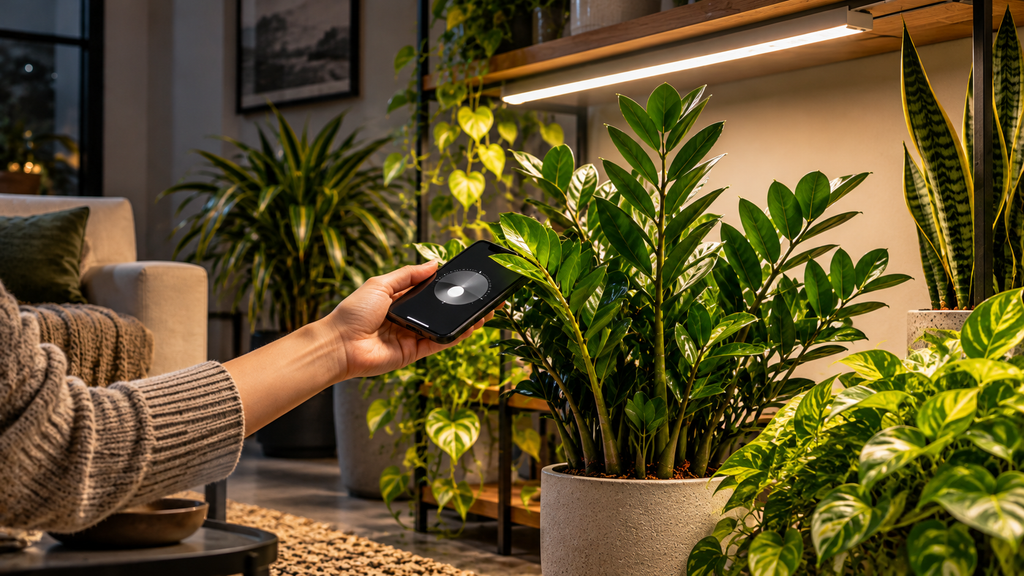
The amount of artificial light needed depends on the plant species, fixture strength, daily lighting period, and the result you want.
A plant that only needs to remain attractive can often tolerate less light than one expected to grow rapidly or flower.
The most useful place to evaluate light is at leaf level. Measuring near the bulb does not tell you how much light actually reaches the plant.
You may encounter four common measurements:
- Lux: visible brightness measured for human vision.
- Foot-candles: another measure of visible illumination.
- PPFD: plant-usable light reaching a surface such as a leaf.
- DLI: the total amount of usable light received during an entire day.
For most home growers, you do not need complicated equipment. A light meter, suitable smartphone app, or grow-light manufacturer’s PPFD chart can provide useful guidance.
A simple assessment is:
- Check light where the main leaves sit.
- Check several areas on a wide plant.
- Consider how many hours the light operates.
- Watch the quality of new growth.
- Adjust the fixture if growth becomes weak or stretched.
Measurements help you understand the environment, but healthy new growth remains one of the best practical indicators that the plant is receiving enough light.
Can Artificial Light Maintain, Grow, or Flower Plants?
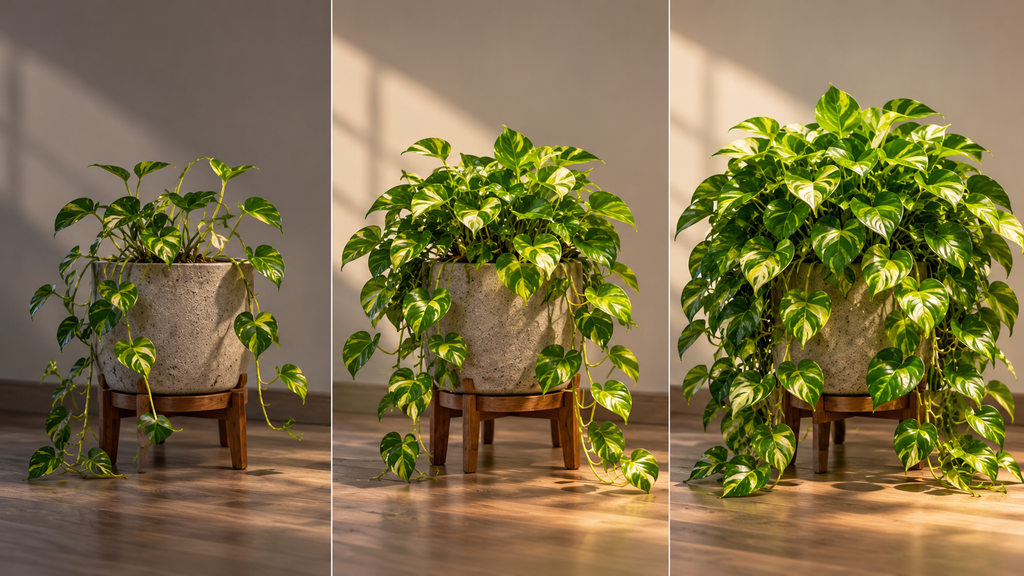
Artificial light can produce different outcomes depending on how much usable light the plant receives.
A helpful way to judge the setup is to separate three outcomes:
| Outcome | What It Means |
|---|---|
| Maintain | Existing foliage stays healthy but growth is slow |
| Grow | The plant regularly produces healthy new leaves |
| Flower | Enough light is available for more energy-demanding growth where the species allows it |
A ZZ plant may remain green for months under weak office lighting while producing few new shoots. The light may therefore be enough for maintenance but not strong active growth.
A pothos producing normal-sized leaves with short spaces between them is more likely to be receiving enough light for active growth.
A peace lily can maintain healthy foliage under lower light but may flower less frequently.
Before choosing a plant, decide what you want from the location. If you only need attractive greenery, slower growth may be acceptable. If you want dense foliage, strong variegation, or flowering, provide more usable light.
How to Choose Indoor Plants for Artificial Light
Choose the location first and the plant second.
A simple decision process is:
Assess → Eliminate → Select → Position → Verify
Assess
Identify the main light source:
- Ceiling lighting
- Fluorescent office lighting
- Natural plus artificial light
- Dedicated grow light
Eliminate
Remove plants that need more light than your setup can provide.
A high-light succulent, for example, is a poor choice for a dim office if supplemental lighting cannot be added.
Select
Choose from the remaining plants according to:
- Space
- Growth form
- Maintenance needs
- Mature size
- Watering habits
Position
Place the plant where its leaves receive useful light, not simply where it looks best.
Verify
Watch the next several weeks of new growth.
Healthy, compact new leaves indicate that the setup is probably working. Small, stretched, weak leaves suggest the plant may need more light.
Best Indoor Plants for Artificial Light
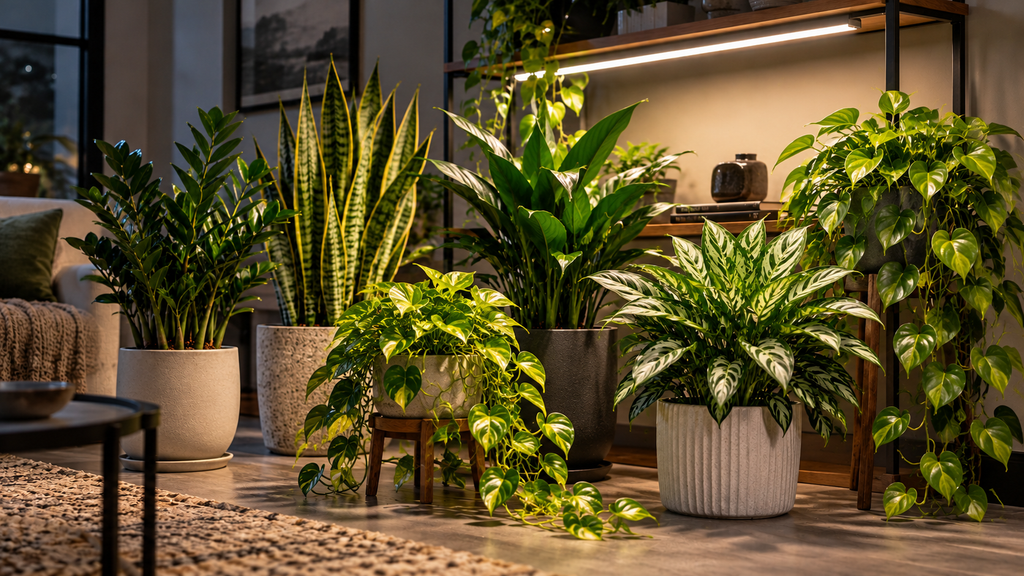
ZZ Plant
The ZZ plant (Zamioculcas zamiifolia) is one of the best artificial-light plants for beginners and offices.
Its thick rhizomes store water, making it tolerant of occasional missed watering. It can remain attractive under relatively weak light, although stronger artificial light usually encourages more active growth.
Best for: offices, desks, floor displays, and beginners.
Main risk: overwatering, especially where weak light keeps the soil wet longer.
Snake Plant
The snake plant (Dracaena trifasciata) is excellent for narrow spaces because of its upright growth.
It tolerates lower light better than many houseplants but grows more actively when usable light increases.
Best for: narrow floor spaces, bedrooms, offices, and desks.
Main risk: consistently wet soil.
Cast Iron Plant
The cast iron plant (Aspidistra elatior) is a strong choice for difficult lower-light interiors.
Its large dark-green leaves grow from underground rhizomes, and the plant is naturally slow-growing.
Best for: dim hallways, office corners, and low-maintenance floor displays.
Main limitation: slow growth.
Chinese Evergreen
Chinese evergreen (Aglaonema spp.) combines lower-light tolerance with decorative foliage.
Green cultivars are generally better suited to very subdued conditions, while heavily variegated forms benefit from stronger light.
Best for: offices, desks, and decorative floor displays.
Main risk: loss of strong coloration when light is too weak.
Golden Pothos
Golden pothos (Epipremnum aureum) is one of the easiest trailing plants for artificial-light environments.
It works well on shelves, cabinets, hanging baskets, and office partitions.
Best for: shelves and hanging displays.
Main warning sign: long gaps between leaves or smaller new foliage.
Heartleaf Philodendron
Heartleaf philodendron (Philodendron hederaceum) is another adaptable trailing or climbing plant.
Its dark-green foliage makes it useful for shelves and bookcases.
Best for: trailing or climbing displays.
Main warning sign: thin vines and stretched growth.
Lucky Bamboo
Lucky bamboo (Dracaena sanderiana) is not a true bamboo but is useful for small desks because of its narrow upright form.
It tolerates subdued indoor conditions but still needs usable light.
Best for: office desks and small spaces.
Corn Plant
The corn plant (Dracaena fragrans) provides height without requiring the intense light demanded by many indoor trees.
Its tall cane-like growth works well in living rooms, reception areas, and offices.
Best for: tall floor displays.
Main concern: ensuring enough light reaches the whole canopy.
Janet Craig Dracaena
Janet Craig Dracaena is commonly sold within the Dracaena fragrans group and is widely used in interior spaces.
Its dark foliage makes it relatively adaptable to subdued conditions.
Best for: offices, corridors, and reception spaces.
Main limitation: slow growth in very weak light.
Parlor Palm
The parlor palm (Chamaedorea elegans) is one of the more shade-tolerant palms.
Its soft, feathery foliage provides a different appearance from most artificial-light plants.
Best for: living rooms, offices, and medium floor displays.
Main limitation: naturally slow growth.
Peace Lily
Peace lilies (Spathiphyllum spp.) can maintain attractive foliage in relatively low light.
However, weaker light usually means less flowering.
Best for: broad tropical foliage.
Main limitation: flowering declines when usable light is insufficient.
Spider Plant
The spider plant (Chlorophytum comosum) works well in hanging baskets and elevated shelves.
It tolerates indoor conditions but produces fuller growth under moderate rather than extremely weak artificial light.
Best for: hanging containers.
Peperomia
Many Peperomia species and cultivars remain compact, making them suitable for desks and small shelves.
Requirements vary by species, so Peperomia should not be treated as one uniform plant type.
Best for: compact spaces.
Main risk: overwatering under weak light.
Bird’s Nest Snake Plant
Bird’s nest snake plants are compact snake plant forms that grow in tight rosettes.
They are useful where a full-size snake plant would become too large.
Best for: small desks and shelves.
Compact ZZ Plant
Compact ZZ forms provide the resilience of standard ZZ plants while fitting smaller spaces.
Best for: desks, shelves, and reception counters.
Main limitation: naturally slow growth.
Best Artificial-Light Plants by Size
Choose plants according to the space you actually need to fill.
| Space | Good Options |
|---|---|
| Small desk | Compact ZZ, bird’s nest snake plant, Peperomia |
| Shelf | Pothos, heartleaf philodendron |
| Narrow floor space | Snake plant, corn plant |
| Large floor area | Cast iron plant, mature ZZ, Dracaena |
| Hanging basket | Pothos, spider plant |
For compact plants, a small grow light can often illuminate the whole plant.
Tall and wide plants require more attention because an overhead fixture may light the upper foliage while leaving lower or outer leaves in shade.
Best Office Plants for Artificial Light
ZZ plant, snake plant, cast iron plant, Chinese evergreen, pothos, philodendron, and Dracaena are among the most practical office plants for artificial light.
Office plants often face additional challenges:
- Air conditioning
- Low humidity
- Weekend darkness
- Irregular watering
- Distant ceiling fixtures
Choose resilient plants when care will be inconsistent.
For desks, compact ZZ and bird’s nest snake plants are particularly practical. Pothos and philodendron work well on shelves, while snake plants and Dracaena suit floor spaces.
If a plant must rely entirely on office lighting, monitor new growth carefully rather than assuming that bright ceiling lights are sufficient.
Can Plants Grow in a Windowless Office?
Yes. Plants can grow in windowless offices if artificial lighting provides enough usable light.
A window is not required, but adequate light is.
A practical setup includes:
- A shade-tolerant plant
- A suitable grow light
- A timer
- Correct fixture placement
- Watering adjusted to actual growth
A windowless office with a useful grow light can provide better growing conditions than a dim room with poor natural light.
Is Office Lighting Enough for Indoor Plants?
Sometimes.
Existing office lights may be enough when:
- The plant has low light requirements.
- Fixtures run consistently through the workday.
- The foliage is reasonably close to the light.
- New growth remains normal.
Add a grow light when:
- New leaves become smaller.
- Stems stretch.
- Growth stalls.
- The plant strongly leans toward another light source.
- Ceiling fixtures are distant and weak.
Judge the environment by plant response rather than by how bright the room looks.
Best Artificial Light for Indoor Plants
A horticultural LED is usually the most practical option for indoor plants.
LED grow lights are:
- Energy efficient
- Relatively cool-running
- Long-lasting
- Available as bulbs, bars, and panels
- Suitable for both single plants and larger collections
Fluorescent lighting can also support many foliage plants, especially when fixtures are positioned relatively close to the canopy.
Ordinary household bulbs are less predictable because they may not provide enough useful intensity.
When choosing a grow light, evaluate:
- Output
- Coverage
- Spectrum
- Fixture distance
- Heat
- Daily operating time
Do not choose a fixture simply because the packaging says “full spectrum.”
How to Position Grow Lights for Indoor Plants
Grow-light distance affects both intensity and coverage.
Moving a fixture closer usually increases the amount of light reaching the foliage but reduces the size of the illuminated area. Moving it higher spreads the light more broadly but reduces intensity.
A broad 12–24 inch starting range is commonly used for foliage houseplants, but fixture output varies too much for one distance to work for every grow light.
Use these rules:
- Follow the manufacturer’s recommended distance first.
- Measure or assess light at foliage level.
- Raise the fixture as plants grow.
- Watch for stretched growth when light is weak.
- Watch for bleaching or stress when light is too strong.
The correct position is the one that gives the plant adequate light without causing excessive heat or light stress.
Does Your Grow Light Cover the Plant?
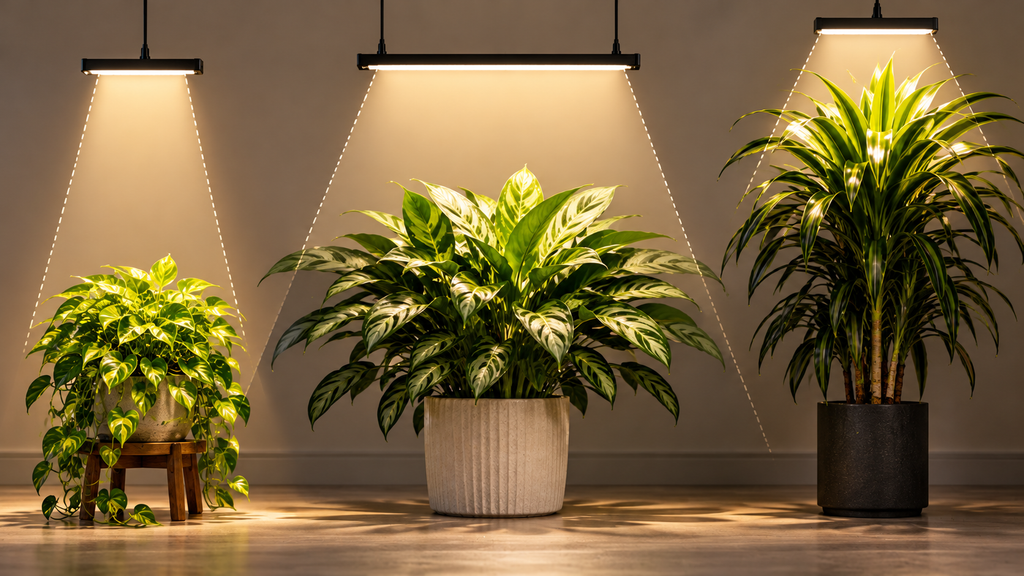
Light strength is only useful when it reaches enough of the plant.
A compact Peperomia may fit entirely under a small lamp, while a mature ZZ or tall Dracaena can extend beyond the fixture’s useful light footprint.
For wide plants, check the outer foliage.
For tall plants, compare upper and lower leaves.
For groups of plants, make sure taller specimens are not shading smaller ones.
A broader fixture, repositioning, or additional side lighting may be more useful than simply moving one small bulb closer.
Ask two questions:
Is the light strong enough?
Does it reach enough of the plant?
How Long Should Grow Lights Stay On?
About 12–14 hours per day is a useful starting point for many foliage houseplants, although the ideal schedule depends on the plant and fixture intensity.
There is no universal number because stronger lights can provide more usable energy in less time than weaker fixtures.
A timer helps maintain consistency.
Avoid leaving grow lights on 24 hours a day. Most plants benefit from a regular period of darkness.
How Does Artificial Light Affect Watering?
Plants under weaker artificial light often use water more slowly because their growth rate is reduced.
A plant moved from a bright window to a dim office may therefore take much longer to dry.
However, a strong grow light can increase growth and water use.
Watering depends on:
- Light intensity
- Plant species
- Pot size
- Soil
- Temperature
- Humidity
- Airflow
Avoid fixed watering schedules.
Instead, check how quickly the potting medium actually dries.
A useful rule is:
Less usable light usually means slower growth and slower water use.
Why Are Plants Struggling Under Artificial Light?
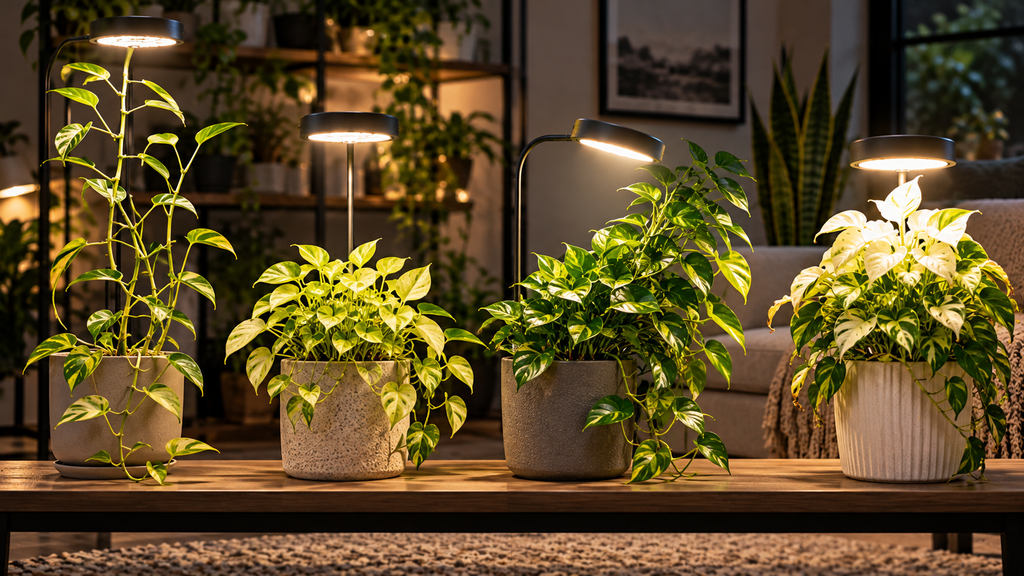
Use the plant’s symptoms to diagnose the problem.
| Symptom | Possible Cause | What to Check | Next Step |
|---|---|---|---|
| Long spaces between leaves | Too little light | Foliage-level light | Increase intensity |
| Smaller new leaves | Low daily light | Intensity + duration | Increase total light |
| Strong leaning | Uneven lighting | Both sides of plant | Rotate or reposition |
| Loss of variegation | Light may be too weak | New foliage | Increase gradually |
| Bleached upper leaves | Light too strong | Fixture distance | Raise or dim |
| Lower leaves decline | Poor coverage | Whole canopy | Broaden lighting |
| Soil stays wet | Slow growth | Light + moisture | Reduce watering |
| Green but no growth | Maintenance-level light | New-growth history | Add light if desired |
Do not change lighting, watering, fertilizer, soil, and position at the same time.
Make one likely correction and watch the next growth cycle.
When Is Artificial Light Not Enough?
Artificial light is not enough when too little usable light reaches the plant and the environment cannot be improved.
A live plant may be a poor choice when:
- The location remains almost completely dark.
- Lights operate only briefly.
- Supplemental lighting cannot be added.
- The plant sits outside the fixture’s useful coverage.
- The chosen species needs substantially more light.
Replacing one struggling plant with another slightly more shade-tolerant species does not solve a genuinely dark location.
Improve the lighting, change the plant’s location, or choose a non-living decorative alternative.
FAQs About Indoor Plants for Artificial Light
Can indoor plants grow entirely with artificial light?
Yes. Indoor plants can grow without sunlight when artificial light provides enough intensity, usable wavelengths, and daily duration.
Can plants grow in artificial light instead of sunlight?
Yes. Plants need usable light energy rather than sunlight specifically, so suitable artificial lighting can replace natural sunlight.
Which indoor plants grow best under artificial light?
ZZ plants, snake plants, cast iron plants, pothos, Chinese evergreens, philodendrons, peace lilies, and Dracaena are among the most adaptable choices.
Can normal LED room lights grow plants?
Sometimes. Ordinary LEDs can support low-light plants if enough light reaches the leaves, but distant ceiling fixtures may be too weak for active growth.
What is the best artificial light for indoor plants?
A horticultural LED is usually the most practical choice because it combines efficiency, useful output, flexible placement, and relatively low heat.
How many hours of artificial light do plants need?
Around 12–14 hours is a practical starting point for many foliage plants, although the ideal schedule depends on plant type and fixture intensity.
Should grow lights stay on 24 hours?
No. Most indoor plants need a regular period of darkness, so use a timer rather than leaving lights on continuously.
How close should a grow light be?
There is no universal distance. Start with the manufacturer’s recommendation and adjust according to fixture output and plant response.
Can plants survive in a windowless room?
Yes. A windowless room can support living plants when artificial lighting provides enough usable light.
Is office lighting enough for indoor plants?
It can be. Low-light foliage plants may grow under consistent office lighting, but weak or distant fixtures often require supplementation.
How do I know if artificial light is too weak?
Leggy growth, smaller leaves, leaning, weak new growth, reduced variegation, and poor flowering can indicate insufficient light.
Can a plant stay alive under artificial light but stop growing?
Yes. Weak light may maintain existing foliage while providing too little energy for active new growth.
Final Thoughts
Indoor plants can grow successfully under artificial light when plant choice and lighting conditions match.
ZZ plants, snake plants, cast iron plants, pothos, Chinese evergreens, and several Dracaena varieties are among the safest choices for lower-light homes and offices.
For reliable results, follow four steps:
Measure → Match → Position → Verify
Assess the light where the leaves will actually sit. Choose a species that fits the environment. Position the fixture so useful light reaches enough of the plant. Then verify the setup by watching healthy new growth.
A window is optional.
Usable light is not.
Myra is the founder and lead writer of Plantsaholic. She shares practical, research-backed advice on indoor plants, outdoor gardening, flowers, herbs, succulents, and everyday plant care. Her goal is to help gardeners of all experience levels grow healthier plants through simple, easy-to-follow gardening guides.