A moss pole for indoor plants supports climbing species such as Monstera, pothos, and philodendron by giving their stems and aerial roots a vertical surface. A damp sphagnum pole can also provide a rooting medium, while a coco-coir pole mainly provides structural support. Neither replaces proper light, watering, or root care.
This Plantsaholic guide compares supports and covers DIY construction, maintenance, troubleshooting, and Pakistan prices.
Moss Pole
| Question | Answer |
|---|---|
| Does Monstera need a pole? | Not to survive, but mature stems often benefit from support. |
| Sphagnum or coco coir? | Sphagnum for a rootable surface; coir for simpler support. |
| Should a pole be soaked? | Prehydrate dried sphagnum and drain excess water. |
| Can you build one yourself? | Yes, using mesh, sphagnum, a rigid stake, and ties. |
| When should you water it? | When the moss needs moisture, not on a fixed schedule. |
What Is a Moss Pole for Indoor Plants?
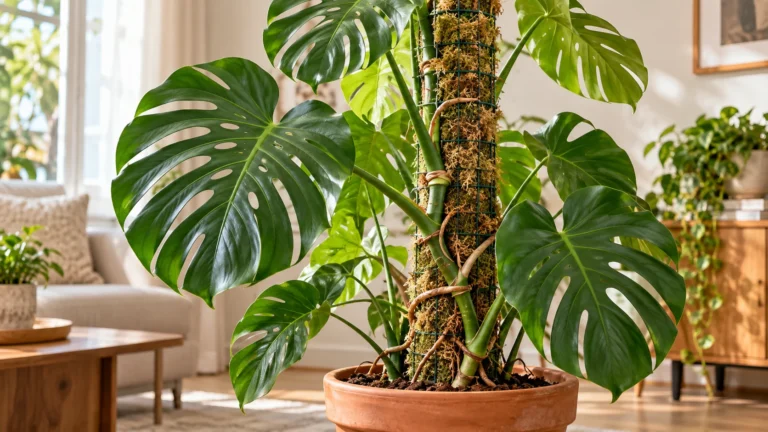
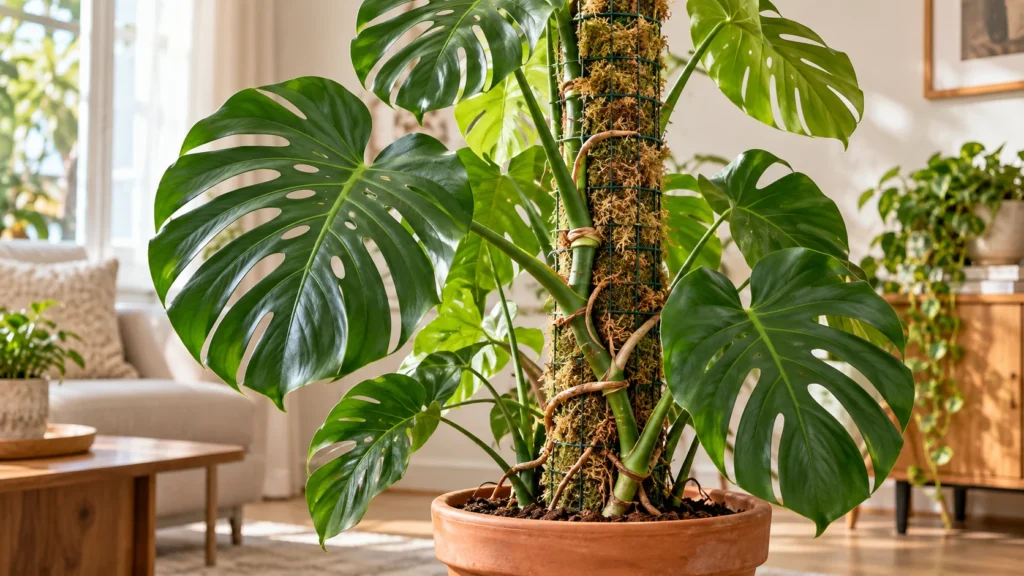
A moss pole is a vertical plant support installed inside a pot. Traditional versions contain long-fiber sphagnum wrapped around a core or held inside a mesh column. Ready-made “moss sticks” often use wrapped coconut coir.
How Is a Moss Pole Constructed?
Its parts are a rigid core, mesh, and a root-contact surface. Roots may enter loosely packed sphagnum, whereas tightly wrapped coir mainly offers external grip.
How Does It Support Natural Climbing?
Climbing aroids use trees for anchorage in nature, as explained in RHS guidance. A pole provides indoor anchorage without recreating a tropical climate. Before buying, check whether a product contains real moss, coconut fiber, or only an empty plastic shell.
What Does a Moss Pole Do?
A moss pole steadies stems and anchors aerial roots. Roots may penetrate damp sphagnum and absorb moisture.
Does It Encourage Larger Leaves?
Climbing aroids may develop more mature foliage. However, a pole alone cannot guarantee bigger leaves or fenestrations. Light, maturity, nutrients, and root health also influence growth.
Does Every Plant Need One?
No. Pothos can trail in a hanging basket. A Monstera that simply leans may need only a stake. Choose a moss-filled pole when root penetration is part of your goal; choose straightforward support when controlling the plant’s shape is enough.
Which Plants Need Moss Poles?
Moss poles suit climbing plants that produce aerial roots or naturally attach to vertical surfaces. They are optional for trailing vines and unnecessary for self-supporting plants.
| Plant | Appropriate support | Main benefit |
|---|---|---|
| Monstera deliciosa | Reinforced pole or plank | Holds heavy climbing stems |
| Monstera adansonii | Narrow moss pole | Trains flexible climbing vines |
| Golden pothos | Pole or trellis | Directs optional upward growth |
| Climbing philodendron | Sphagnum or coir | Supports stem and root contact |
| Rhaphidophora tetrasperma | Sturdy pole | Guides vigorous climbing growth |
Which Plants Do Not Need Them?
Snake plants, most compact succulents, many palms, and self-heading philodendrons usually do not benefit from a climbing pole. Pothos, Scindapsus, and some philodendrons can also grow attractively as trailing plants. Identify the species and its growth habit before purchasing anything.
Is Sphagnum Moss Good for Plants?
Loosely packed long-fiber sphagnum holds moisture and air spaces. Aerial roots may penetrate its fibers.
Sphagnum Moss vs. Peat Moss
Long-fiber sphagnum consists of recognizable strands. Sphagnum peat moss is finer, more decomposed, and commonly used in potting mixes. Fine peat and coco peat may compact or escape through mesh.
What Are the Risks?
Excessively wet, densely packed moss can reduce aeration and deteriorate. Wear gloves when handling moss or cut mesh, use clean horticultural material, and prefer responsibly sourced moss. Sphagnum retains water; it is not fertilizer, drainage material, or a cure for unhealthy roots.
Coco Pole vs. Moss Pole: Which Is Better?
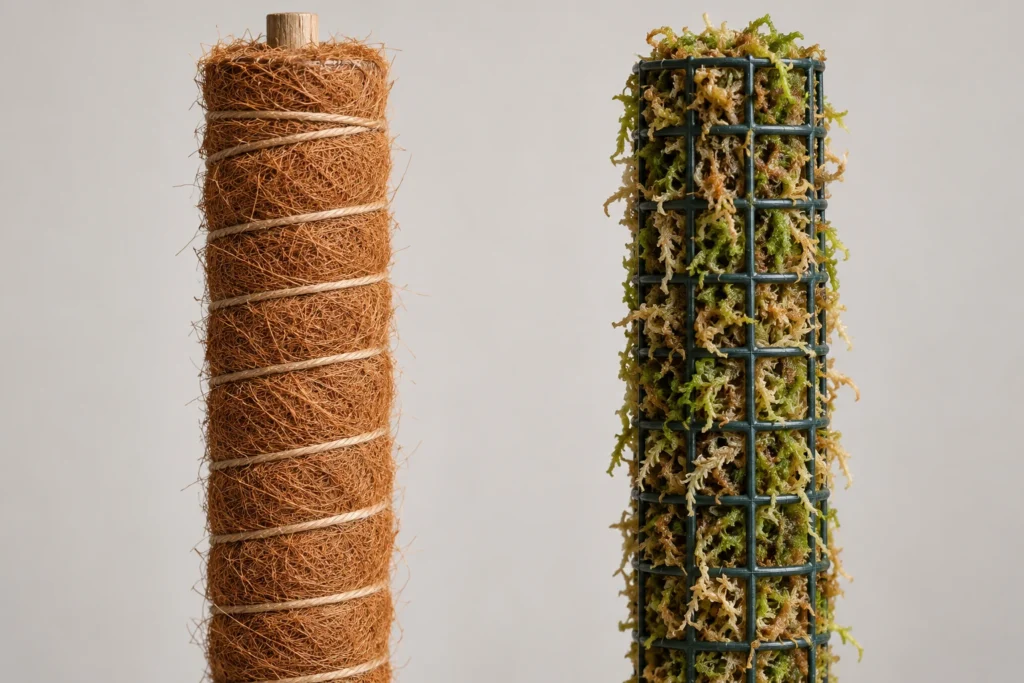
Sphagnum suits root penetration; coir suits basic support. Compare moisture needs and costs.
| Feature | Sphagnum pole | Coco-coir pole |
|---|---|---|
| Root penetration | Good with loose, accessible moss | Limited with tight wrapping |
| Moisture | Requires monitoring for rooting | Optional for basic support |
| Maintenance | Higher | Usually lower |
| Initial cost | Often higher | Often lower |
| Best purpose | Climbing plus rootable medium | Upright stem training |
Which Is Better for Monstera?
Both work when anchored firmly. Choose sphagnum if you want roots to grow into the column; choose coir if you want a tidy, relatively low-maintenance arrangement. In a room with strong air-conditioning, exposed sphagnum may dry quickly. Avoid buying solely on a “moss pole” label.
Best Moss Poles for Indoor Plants
Match design to plant size and rooting goals. D-shaped sphagnum provides root access; coir simplifies training; reinforced poles support larger Monsteras.
Which Type Should You Choose?
| Design | Best use | Check before buying |
|---|---|---|
| D-shaped sphagnum | Root penetration | Moss may be sold separately |
| Extendable coir | Beginner-friendly training | Connector strength |
| Modular sphagnum | Growing climbing aroids | Joint rigidity |
| Reinforced pole or plank | Heavy Monstera | Container stability |
How Do You Choose Height and Diameter?
Measure the main climbing stem from the potting mix to its tip, not the tallest leaf. For a smaller Monstera, 45–60 cm (18–24 inches) of exposed support and a 5–8 cm (2–3 inch) moss chamber are reasonable illustrative starting dimensions.
Broader poles weigh more when wet. Check the structural core, exposed height, anchoring depth, joint security, and pot balance. On a D-shaped design, confirm that the open front exposes damp moss to roots and the backing is attached firmly. Test stability after watering, not just while dry: heavy foliage extending to one side can tip a pot even when its pole remains straight. Favor strength over excessive height.
Can Monstera Grow Without a Moss Pole?
Yes. Monstera can survive for many years without a moss pole when its light, root space, water, and nutrition are suitable. A pole aids climbing, not survival.
What Happens Without Support?
Older stems may sprawl, lean, or extend aerial roots toward furniture and walls. These are not automatically disease signs. Protect nearby surfaces because aerial roots can adhere to them.
Will Leaves Still Become Larger?
They can. Leaf size and openings depend on maturity, light, genetics, and overall vigor. Support helps establish a climbing habit but does not independently cause fenestrations. If the plant looks healthy and has enough room, there is no need to add a pole immediately.
When Does Monstera Need a Moss Pole?
Add support when the main stem leans, aerial roots appear, or foliage spreads beyond the space available. Young stems train more easily than mature ones.
When Is Installation Safest?
Repotting lets you position support around visible roots. Place the pole first and fill around its anchored base. Do not force a thick stake blindly through a densely rooted container.
What Should You Check?
Face the aerial-root-bearing side of the main stem toward the support. Confirm that the pot will not tip and that there is room above the current growing tip. Avoid unnecessary repotting.
How Do You Extend a Moss Pole?
Extend before stems pass the pole top. Reinforce joints against added height and wet-moss weight.
How Do You Extend a DIY Pole?
- Form a matching mesh chamber with the same diameter.
- Align it above the original pole and connect the rigid cores securely.
- Fasten the mesh without leaving sharp edges.
- Add damp, loosely packed sphagnum, then test for wobbling.
What if the Pole Is Unstable?
Stop adding extensions. Reinforce the base, choose a stronger support, or consider appropriate pruning and propagation. Preserve aerial roots already embedded in the lower section. Check the anchoring beneath the connector.
How to Make a DIY Monstera Moss Pole?
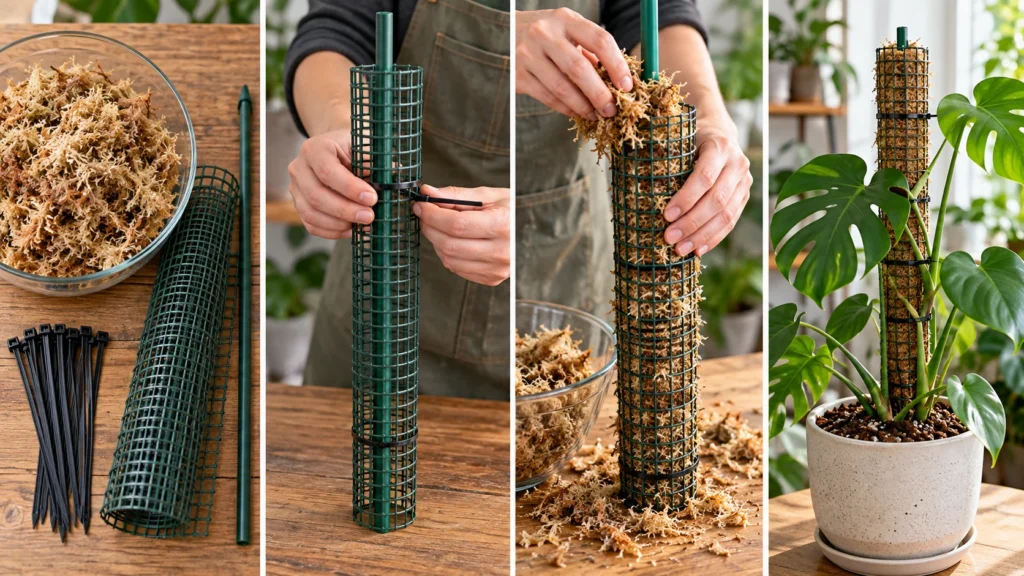
A DIY rootable pole needs long-fiber sphagnum, suitable garden mesh, a rigid support stake, cable ties, soft plant ties, clean water, gloves, and mesh cutters. Build an airy, stable column.
What Size Should You Make?
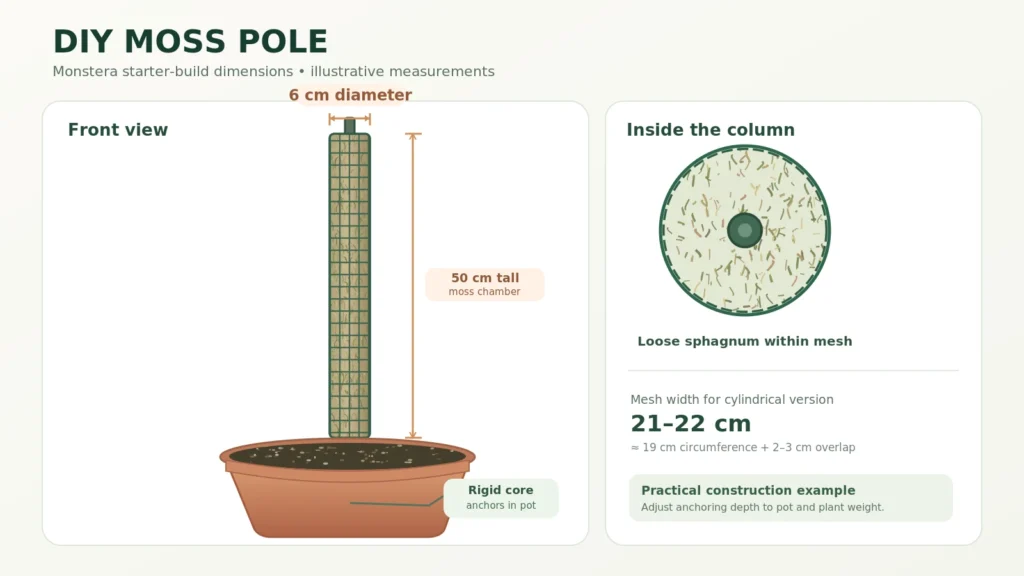
For an illustrative starter build, use a moss chamber 50 cm tall and 6 cm across. A cylindrical sheet needs approximately 19 cm of circumference (3.14 × 6 cm), plus 2–3 cm for a secured seam: about 21–22 cm of mesh width. Allow extra core length for anchoring. These dimensions are illustrative, not tested measurements.
Step 1: Hydrate the Sphagnum
Place dried moss in water until flexible, then gently squeeze away the excess. It should feel damp, not drip heavily.
Step 2: Shape and Reinforce the Mesh
Cut the mesh and roll it into a cylinder or create a D-shaped chamber. Fasten the edges, cover sharp ends, and attach the rigid core securely. If a connector bends easily before adding moss, reinforce it now rather than relying on plant ties later.
Step 3: Fill the Column
Add damp sphagnum in small amounts. Distribute fibers evenly without squeezing them into a dense block. Accessible air spaces help roots enter the moss.
Step 4: Install and Attach the Plant
Anchor the support beside the main climbing stem, preferably during repotting if roots are crowded. Position aerial-root nodes toward the moss and loosely tie the main stem, not its leaf petioles.
Step 5: Water and Inspect
Gradually moisten the column as needed, check soil runoff, and confirm stability after the moss has gained water weight. The finished pole must stand securely without sharp edges.
Plantsaholic build record: Document actual material quantities, cost, installation date, watering, root development, and photographs at consistent intervals. Publish only genuine observations.
What Is the Cheapest DIY Moss Pole?
For basic structural support, a suitable untreated wooden or bamboo stake is often cheapest. For rooting, a short DIY sphagnum column may cost less if you have supplies.
How Do You Calculate DIY Costs?
Include only the materials consumed, plus any purchased tools and delivery charges. Allocate bulk material costs per pole.
| Material | Cost basis |
|---|---|
| Sphagnum | Amount used, not necessarily whole bag |
| Mesh | Width and length cut |
| Rigid core | One suitable support |
| Fasteners and ties | Quantity required |
| Tools and delivery | Additional purchases or charges |
Is DIY Always Cheaper?
No. One DIY build may cost more than ready-made coir. Bulk supplies can be more economical for several builds. Avoid rusty mesh or chemically treated wood simply to save money. Compare finished cost and function, not one material’s sticker price.
How Do You Attach Monstera to a Moss Pole?
Identify the main stem and aerial-root nodes. Never tightly tie leaf stalks (petioles).
Which Side Should Face the Pole?
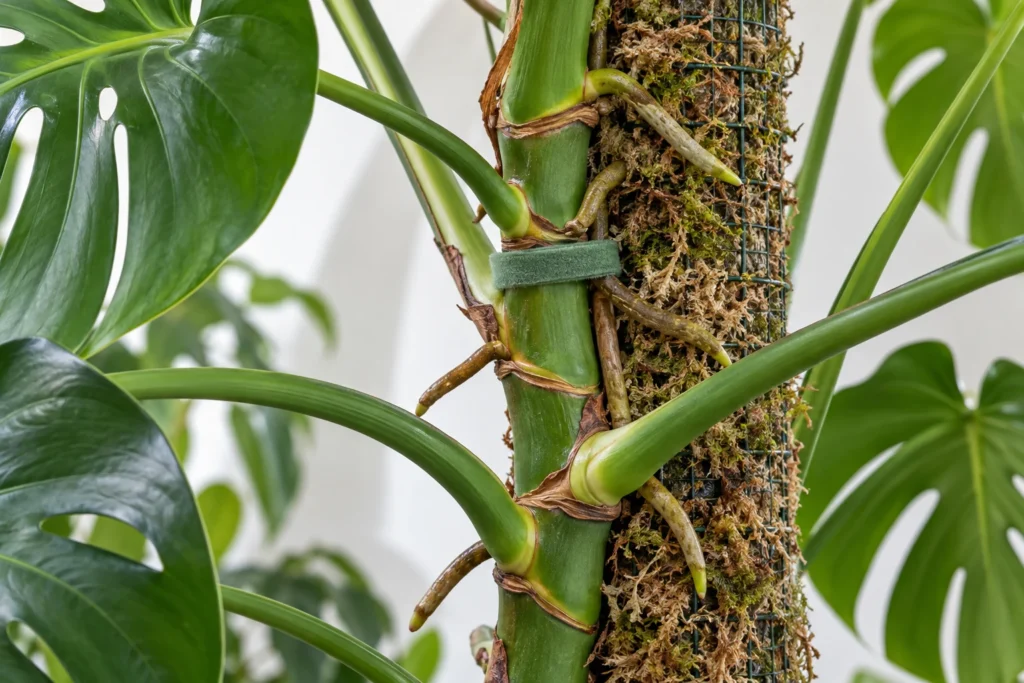
Place the aerial-root-bearing side against accessible sphagnum. Use soft, flexible ties around the main stem, with room for thickening. Check them periodically so they do not become restrictive.
Should You Cut Aerial Roots?
Preserve healthy roots, guide flexible ones, and trim only when necessary. Use clean tools and wear gloves because Monstera sap can irritate skin. Do not force older rigid roots into place or casually cut roots established inside sphagnum. Multiple plants in one pot may need wider or separate supports.
Should You Soak a Moss Pole?
Prehydrate dried sphagnum before assembling a rooting pole. Damp fibers are easier to arrange. Drain excess water to avoid immediately saturating the pot.
Does Coco Coir Need Soaking?
Not when it functions only as a structural stake. Moist coir still differs from a sphagnum-filled column.
What if Sphagnum Resists Rewetting?
Rewet fibers gradually. Check the interior rather than judging only the outer surface. Empty water from the saucer instead of letting the root ball stand submerged. The pole and potting mix may need different watering schedules.
How Do You Keep a Moss Pole Moist?
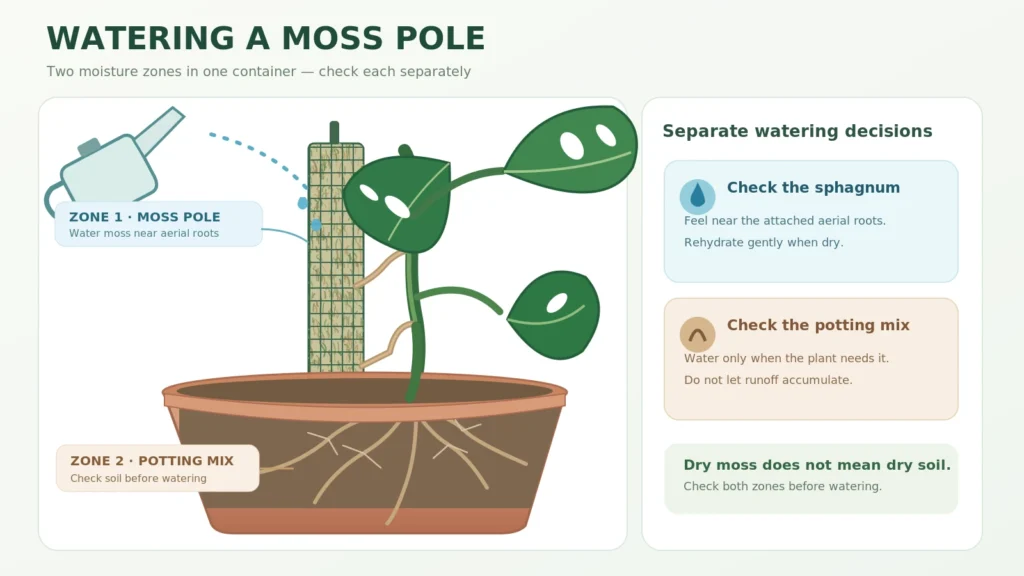
Check moss moisture around aerial roots. Exposed mesh dries faster than partially enclosed designs. Water the moss and potting mix according to their separate needs.
When Should You Water the Pole or Pot?
| Moss | Potting mix | Action |
|---|---|---|
| Dry | Still moist | Carefully rehydrate the pole only |
| Damp | Needs watering | Water the potting mix |
| Dry | Needs watering | Water both, separately |
| Wet | Wet | Wait and check again |
What Is the Easiest Method?
Apply water slowly with a narrow-spout bottle. Allow water to soak in and watch runoff. Misting can wet the surface without thoroughly hydrating a thick column.
Can Moss Poles Attract Mold or Pests?
Persistently wet organic material may grow fungi, while fungus gnat larvae commonly breed in damp potting media. Remove debris, improve airflow, and correct excessive watering. Sticky traps help monitor adult gnats; targeted controls should follow product instructions. Check whether insects originate in damp soil before blaming the moss pole. Surface fungal growth alone does not prove roots are rotting. Minor surface fungi rarely require dismantling rooted poles.
What Are the Best Moss Pole Alternatives?
Choose for shape and weight, not labels.
- Wooden plank: Broad, rigid support for larger climbing Monsteras; use suitable untreated wood.
- Bamboo stake: Affordable support for smaller vines; thin canes may not hold heavy foliage.
- Trellis: Spreads several stems across a wider area, often with soft ties.
- Coco-coir pole: Convenient, lower-maintenance vertical training.
- Hanging basket: Allows pothos or Scindapsus to trail without upright support.
Planks are easier to move than rooted moss columns. Consider ceiling height, repotting, and the weight of the future plant before deciding.
Why Won’t Aerial Roots Attach?
Roots may miss misaligned poles, dry material, or dense moss. Train flexible new roots, not rigid old ones.
What Should You Check?
| Observation | Possible reason | Practical response |
|---|---|---|
| Roots grow away | Incorrect orientation | Reposition support toward root nodes |
| Roots touch but do not enter | Dry or dense moss | Assess moisture and accessible fibers |
| Roots grip only outside | Tightly wrapped coir | Accept support function or choose sphagnum |
| No new roots | Limited plant growth | Check light, warmth, and root health |
| Stem keeps leaning | Weak anchoring | Reinforce the core |
Attachment timing varies. Do not repeatedly pull roots loose to test them. Protect nearby walls or furniture until new growth is trained safely.
What if Roots Grow Through a Moss Pole?
Embedded roots stabilize the plant and may absorb moisture. This makes removal harder.
Can You Repot Without Detaching Roots?
Yes. Where practical, move the plant and pole together, supporting the structure so its weight does not pull against the stem. Avoid cutting healthy roots simply to remove mesh. If the outer shell breaks, assess whether individual sections can be removed without disrupting the rooted column. During repotting, keep the stem and pole supported together, especially if the moss column is tall or heavy.
Can Rooted Sections Help Propagation?
A stem section containing a viable node and established roots may be useful for propagation. An aerial root alone does not make a complete cutting. Before making a cut, identify the node and attached roots; damaged roots can reduce the advantage of using an established section. Preserve established roots.
What Moss Pole Mistakes Should You Avoid?
Avoid weak supports, improper ties, excess water, and root damage.
- Weak core: Support becomes top-heavy after wetting or extension.
- Tied petioles: Leaf stalks cannot move naturally; attach the main stem instead.
- Waterlogged moss: Runoff leaves the potting mix wet too long.
- Wrong material: Fine peat or coco peat compacts inside open mesh.
- Forced installation: Thick stakes damage established roots.
- Pulled aerial roots: Useful roots detach or break.
- Unrealistic promises: Poles do not independently guarantee faster growth or bigger leaves.
Check ties, stability, moss condition, and pot moisture during routine care. Dry moss and wet soil can occur together, so never assume watering one automatically corrects the other.
What Is the Moss Stick Price in Pakistan?
Moss stick prices in Pakistan vary by material, pole length, seller, and whether sphagnum is included. Some listings offer coir stakes or empty shells.
Moss Stick Price Examples
These are previously recorded Daraz Pakistan listing examples from October 2026, not nationwide averages or guaranteed checkout totals.
| Advertised item | Listed price |
|---|---|
| Single three-foot coir stick | Rs. 229 |
| Three-pack of three-foot coir sticks | Rs. 659 |
| Sphagnum-marketed climbing support | Rs. 993 |
| Orchid/Monstera sphagnum-style support | Rs. 1,285 |
Confirm materials, dimensions, and delivery. The label may not guarantee included sphagnum.
Where Can You Buy Sphagnum Moss in Pakistan?
Try orchid specialists, aroid sellers, nurseries, and marketplaces. Search “long-fiber sphagnum moss Pakistan” and ask for clear photographs of the strands. If genuine sphagnum is unavailable, use a sturdy coir support when the main goal is simply upright growth.
How Do You Choose a Moss Pole?
Choose structural support or a moist rooting medium. Check weight, stability, extension, upkeep, and cost.
| Situation | Sensible choice |
|---|---|
| Small beginner Monstera | Stable coir or short sphagnum pole |
| Active aerial roots; rooting goal | Open sphagnum-filled pole |
| Large, heavy Monstera | Reinforced pole or wooden plank |
| Multiple climbing stems | Broad trellis or several supports |
| Limited budget | Suitable untreated stake |
| Trailing pothos | No vertical support needed |
Final Buying Checklist
Verify the true material, exposed height, diameter, rigid core, anchoring length, connector strength, and included accessories. Calculate delivered price per usable support. Disclose affiliate links and distinguish research from testing.
Moss Pole FAQs
Do Moss Poles Make Indoor Plants Grow Faster?
Not automatically. They support climbing and root contact, but growth still depends on light, temperature, nutrition, and healthy roots.
Can You Use a Moss Pole for Pothos?
Yes. Pothos can climb and may develop more mature foliage under suitable conditions. It can also remain healthy trailing.
Does a Moss Pole Need to Stay Wet All the Time?
No. Keep rootable sphagnum appropriately damp, not waterlogged. Coir used only for support usually needs no regular watering.
Can You Put a Moss Pole Into an Existing Pot?
Yes, if you can avoid established roots. Installing a substantial support during repotting is often safer.
Can You Use Coco Peat Instead of Sphagnum?
Not in most open mesh poles. Fine coco peat can compact or escape. Use long-fiber sphagnum for a rootable column.
Will a Moss Pole Increase Room Humidity?
It may create localized moisture near attached roots, but it will not reliably humidify an entire room.
Can Monstera Adansonii Grow on a Moss Pole?
Yes. Its climbing vines and aerial roots suit a narrow, stable pole, although a trailing arrangement also works.
Can You Reuse an Old Moss Pole?
Sometimes. Reuse a sound structure after checking its material, but avoid damaging healthy roots embedded in moss.
Can a Moss Pole Cause Root Rot?
Not directly. Excess runoff can saturate the potting mix and create conditions favoring root problems.
How Often Should Sphagnum Be Replaced?
There is no fixed schedule. Replace degraded or foul-smelling material while preserving established roots.
Is a Moss Pole Worth It?
A pole is worthwhile for climbing stability or root attachment. It remains optional for trailing plants.
When Should You Choose Sphagnum or Coir?
Choose sphagnum for root penetration when you can maintain the moss. Choose coir, a plank, or a stake for simpler structural support. Keep the core stable, secure stems loosely, protect attached roots, and reassess the arrangement as the plant grows.
Plantsaholic’s recommendation: Buy or build for the plant’s actual growth habit and the support function you need—not for promises of instant larger leaves.
Myra is the founder and lead writer of Plantsaholic. She shares practical, research-backed advice on indoor plants, outdoor gardening, flowers, herbs, succulents, and everyday plant care. Her goal is to help gardeners of all experience levels grow healthier plants through simple, easy-to-follow gardening guides.