15 Beautiful Pink Indoor Plants With Colorful Leaves
Pink indoor plants add lasting blush, rose, coral, burgundy, and magenta color through their foliage rather than short-lived flowers. Aglaonema ‘Lady Valentine’ is a strong beginner choice, Pink Princess Philodendron offers dramatic variegation, Fittonia fits terrariums, Tradescantia ‘Nanouk’ creates a trailing display, and Echeveria ‘Perle von Nürnberg’ suits a sunny windowsill. Choose according to available light, mature size, watering requirements, humidity, and pet safety.
Quick Picks
- Best for beginners: Aglaonema ‘Lady Valentine’
- Best compact plant: Peperomia ‘Ginny’
- Best dramatic variegation: Pink Princess Philodendron
- Best trailing plant: Tradescantia ‘Nanouk’
- Best terrarium plant: Pink Fittonia
- Best humid-room plant: Stromanthe ‘Triostar’
- Best sunny-window plant: Echeveria ‘Perle von Nürnberg’
- Best floor plant: Ficus elastica ‘Ruby’
- Best climbing plant: Syngonium ‘Neon Robusta’
- Best seasonal display: Pink Caladium
Best Pink Indoor Plants Compared
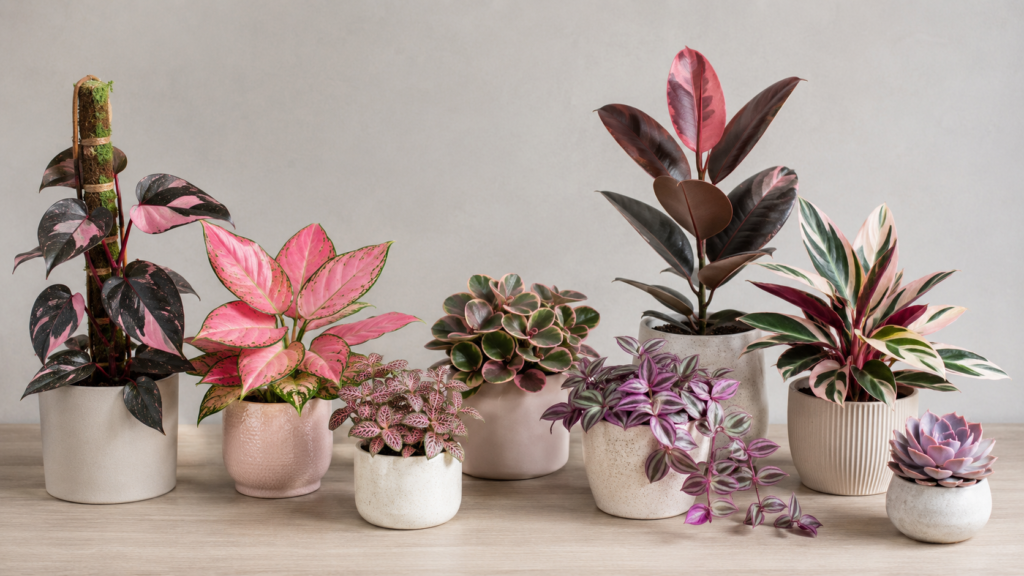
Pink indoor plants differ considerably in growth habit, care difficulty, light needs, and watering tolerance. Use the table to eliminate plants that do not match your home before choosing based only on color.
| Plant | Growth habit | Light | Care level | Best placement | Pet note |
|---|---|---|---|---|---|
| Pink Princess Philodendron | Climbing | Bright indirect | Intermediate | Trellis or plant stand | Toxic if chewed |
| Aglaonema ‘Lady Valentine’ | Upright | Medium to bright indirect | Easy | Bedroom or office | Toxic if chewed |
| Syngonium ‘Neon Robusta’ | Vining | Medium to bright indirect | Easy–intermediate | Shelf or support | Toxic if chewed |
| Pink Fittonia | Low and spreading | Medium indirect | Intermediate | Terrarium or desk | Commonly non-toxic |
| Pink Polka Dot Plant | Mounding | Bright filtered | Easy–intermediate | Desk or shelf | Commonly non-toxic |
| Stromanthe ‘Triostar’ | Upright | Bright indirect | Advanced | Humid bright room | Verify exact identity |
| Goeppertia ‘Rosy’ | Compact | Bright indirect | Advanced | Table or bathroom | Commonly non-toxic |
| Tradescantia ‘Nanouk’ | Trailing | Bright indirect | Easy | Shelf or basket | Irritation caution |
| Callisia ‘Pink Lady’ | Trailing | Bright filtered | Intermediate | Hanging planter | Irritation caution |
| Peperomia ‘Ginny’ | Compact | Medium to bright indirect | Easy | Desk or shelf | Commonly non-toxic |
| Ficus elastica ‘Ruby’ | Tree-like | Bright indirect | Intermediate | Floor display | Sap caution |
| Pink Ti Plant | Upright | Bright indirect | Intermediate | Floor display | Toxic to pets |
| Pink Rex Begonia | Compact | Bright indirect | Intermediate–advanced | Table or shelf | Ingestion caution |
| Pink Caladium | Seasonal upright | Bright filtered | Intermediate | Seasonal display | Toxic if chewed |
| Echeveria ‘Perle von Nürnberg’ | Rosette | Strong light | Intermediate | Sunny windowsill | Verify exact identity |
A plant described as non-toxic is not edible. Eating leaves can still cause digestive discomfort, and pet-safety decisions should be based on the verified botanical identity.
Pink Indoor Plant Color Ratings
Plantsaholic uses four editorial ratings to explain how reliably each plant retains pink foliage indoors:
- Reliable: Pink veins, margins, or markings usually remain visible under suitable care.
- Moderately light-dependent: The plant may become greener when light or overall care declines.
- Highly light-dependent: Strong color and compact growth rely heavily on sufficient light.
- Variable: Genetics, maturity, or season strongly affect the pink pattern.
These ratings are practical comparisons, not laboratory measurements. Two plants sold under the same cultivar name can still develop different colors because of genetics, age, health, light exposure, and propagation history.
Why Pink Indoor Plants Have Pink Leaves
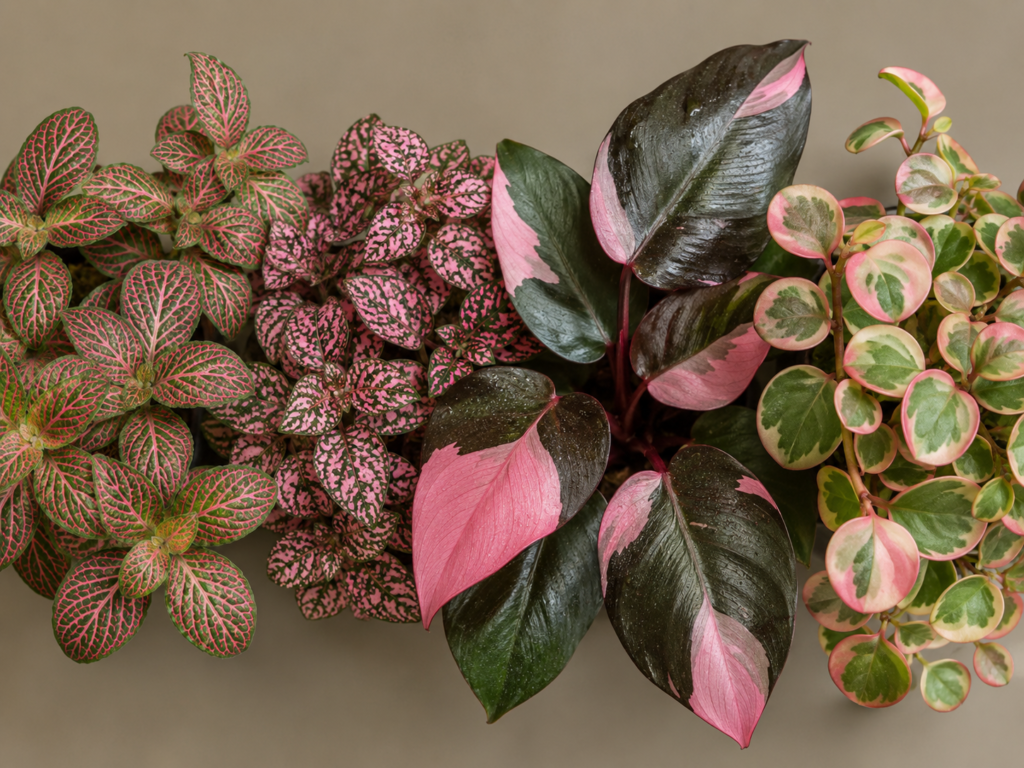
Pink foliage develops through natural pigments, genetic variegation, cultivar traits, and differences in chlorophyll distribution. The color may appear as fine veins, speckles, leaf margins, broad central areas, unpredictable sectors, or burgundy undersides.
Pale or pink tissue often contains less chlorophyll than green tissue. Because chlorophyll helps plants capture energy, heavily variegated plants can grow more slowly than balanced plants with enough green foliage.
Different plants express pink in different ways:
- Fittonia produces pink or red veins.
- Polka Dot Plant develops dense speckles.
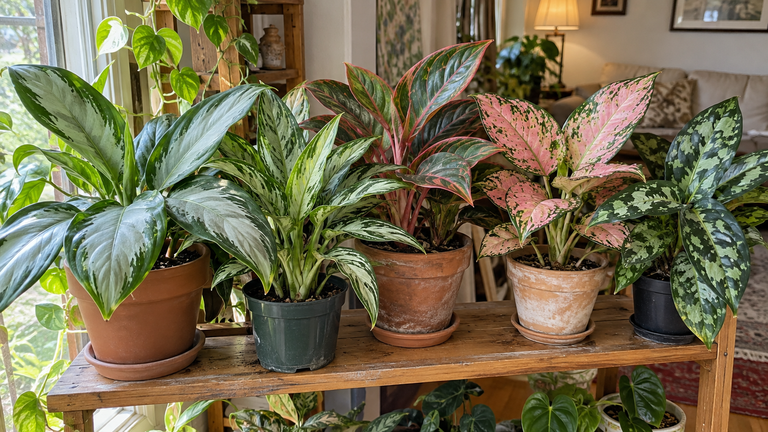
- Aglaonema forms broad pink-and-green patterns.
- Pink Princess Philodendron produces irregular sectors.
- Peperomia ‘Ginny’ develops colorful margins.
- Tradescantia ‘Nanouk’ forms cream, green, and pink stripes.
- Prayer-family plants may have pink upper surfaces and burgundy undersides.
- Some succulents develop stronger pink tones under bright light.
Light helps maintain color, but more light does not always produce more pink. Weak light can cause greener or stretched growth, while intense direct sun may burn pale tissue. Genetics sets the plant’s color potential; appropriate care helps preserve it.
How to Choose Pink Indoor Plants
The best pink indoor plant is not necessarily the most colorful plant in the nursery. It is the one whose requirements match the conditions you can maintain.
Check the Available Light
A shelf may appear bright while receiving little plant-usable light. Consider its distance from the window, curtain use, nearby buildings, trees, and seasonal changes.
- Softer indirect light: Aglaonema and Fittonia
- Medium to bright indirect light: Peperomia, Polka Dot Plant, and Syngonium
- Bright indirect light: Pink Princess, Tradescantia, Ficus ‘Ruby’, and Ti Plant
- Strong window light: Echeveria
- Bright light with humidity: Stromanthe, Goeppertia, and Rex Begonia
Match the Growth Habit to the Space
Fittonia, Peperomia, and Echeveria remain compact. Tradescantia and Callisia trail over shelves or baskets. Pink Princess and Syngonium eventually need room to climb or trail. Ficus ‘Ruby’ and Ti Plant become larger floor specimens.
Match Your Watering Habits
Fittonia, Stromanthe, Goeppertia, and actively growing Caladium prefer consistent moisture. Peperomia and Echeveria need clearer drying periods. Aglaonema, Philodendron, Ficus, and Syngonium fall between those extremes.
Consider Experience and Pet Safety
Beginners should start with Aglaonema, Peperomia, Polka Dot Plant, or Tradescantia. Stromanthe, Goeppertia, Rex Begonia, and Caladium require more controlled care.
Philodendron, Syngonium, Aglaonema, Caladium, and Ti Plant require caution around cats and dogs. Choose a verified non-toxic plant when pets regularly chew foliage or climb shelves.
Easy Pink Indoor Plants for Beginners
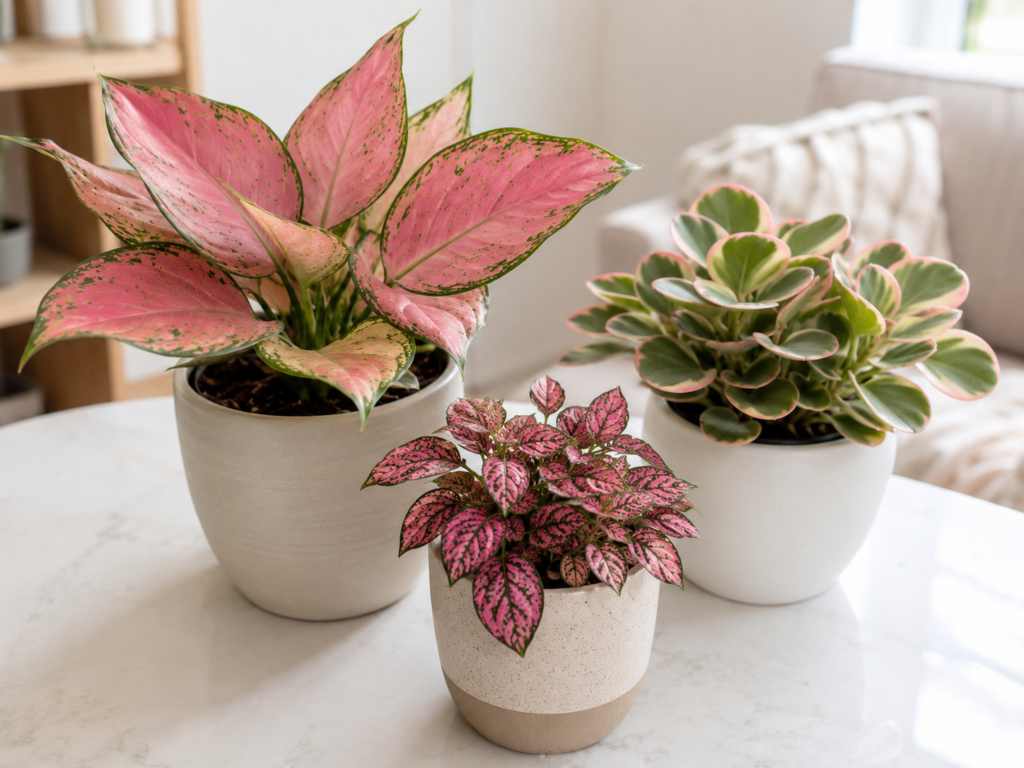
1. Aglaonema ‘Lady Valentine’
Aglaonema ‘Lady Valentine’ combines broad pink-and-green leaves with an upright, clumping habit. It tolerates ordinary indoor conditions better than many strongly colored foliage plants.
Place it in medium to bright indirect light. It can survive in softer light, but new leaves may become greener and growth may slow. Water when the upper part of the potting mix begins to dry, and never leave the pot standing in collected water.
Yellowing leaves with wet soil often indicate overwatering, while brown margins may result from dry air, drafts, or inconsistent moisture.
Color rating: Reliable to moderately light-dependent
Best for: Beginners, bedrooms, and offices
Main risk: Overwatering
Pet note: Toxic if chewed
2. Peperomia ‘Ginny’
Peperomia ‘Ginny’ has glossy green leaves edged in cream, coral, pink, or red. Its slow-growing, compact habit fits desks, shelves, bedside tables, and small apartments.
Give it medium to bright indirect light and allow part of the growing medium to dry before watering. Its thicker leaves retain moisture, making overwatering a greater risk than brief dryness.
Use a compact pot with drainage rather than moving it into an oversized container that remains wet for too long.
Color rating: Reliable
Best for: Compact spaces
Main risk: Root rot
Pet note: Peperomia species are commonly listed as non-toxic
3. Pink Polka Dot Plant
Pink Polka Dot Plant produces green leaves covered with rose, pink, or reddish speckles. It is affordable, fast-growing, and easy to propagate.
Place it in bright filtered light. Too little light causes faded color and leggy stems, while harsh sunlight can burn the leaves. Keep the soil lightly moist and pinch the stem tips regularly to create fuller growth.
Older plants can be refreshed by rooting healthy cuttings and replanting them in the original container.
Color rating: Moderately light-dependent
Best for: Fast, affordable color
Main risk: Leggy growth and repeated wilting
Pet note: Commonly listed as non-toxic
Pink Statement Plants
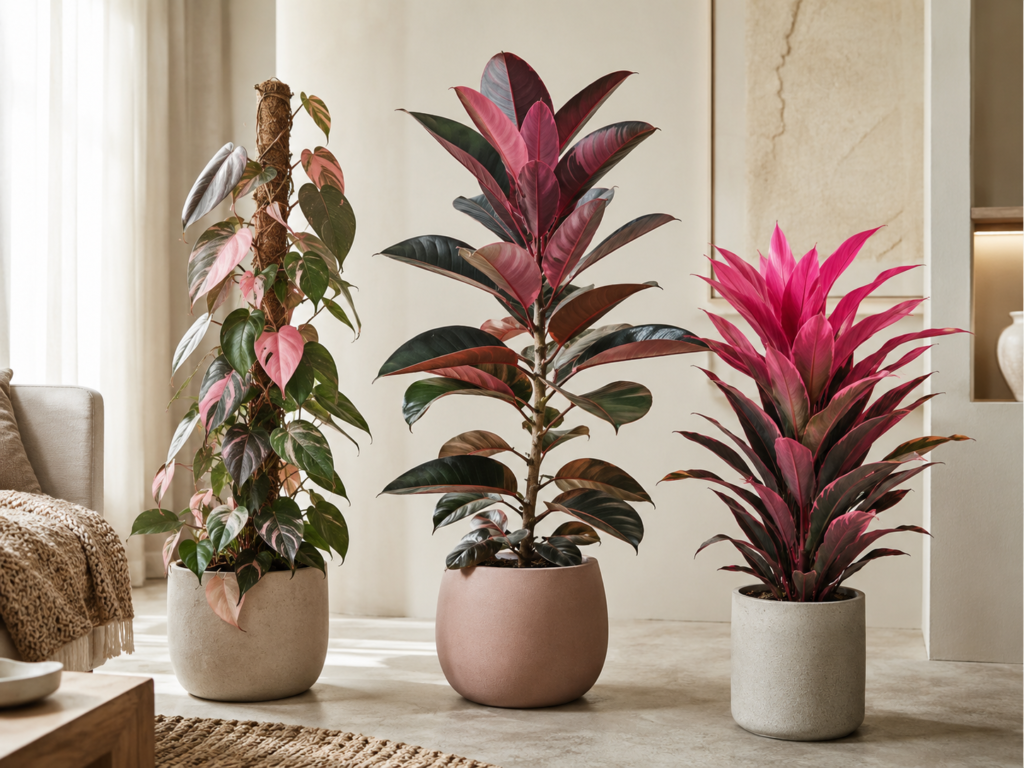
4. Pink Princess Philodendron
Pink Princess Philodendron develops dark green or burgundy leaves with unpredictable pink streaks, speckles, and sectors. Every leaf can carry a different pattern.
Provide bright indirect light, an airy growing medium, and a trellis or moss pole. Water when the upper mix partially dries. Harsh sunlight may scorch the pink tissue, while deep shade can create greener and more widely spaced growth.
A plant with balanced green and pink tissue is usually stronger than one producing almost fully pink leaves. Green tissue supports the energy the plant needs for continued growth.
Color rating: Variable
Best for: Collectors and trellis displays
Main risk: Expecting every leaf to be heavily pink
Pet note: Toxic if chewed
5. Ficus elastica ‘Ruby’
Ficus ‘Ruby’ produces large glossy leaves marked with cream, green, coral, and pink. A young plant can sit on a table, but a mature specimen becomes a strong floor feature.
Place it in bright indirect light and rotate it occasionally for balanced growth. Allow part of the potting mix to dry before watering. Ficus dislikes saturated roots, cold drafts, abrupt relocation, and sudden exposure to strong sun.
Choose its position carefully because repeatedly moving a rubber plant may trigger leaf drop.
Color rating: Highly light-dependent
Best for: Living-room and office floor displays
Main risk: Overwatering and environmental changes
Pet note: Sap and ingestion may irritate
6. Pink Ti Plant
Pink Ti Plant produces long upright leaves in shades of pink, burgundy, red, purple, and green. Its narrow, architectural growth introduces height without occupying the width of a bushy plant.
Provide bright indirect light, warmth, moderate humidity, and well-draining soil. Water thoroughly, then allow the surface to dry slightly. Brown tips may result from dry air, mineral buildup, cold drafts, or inconsistent moisture.
Ti Plant is a better choice for warm, stable rooms than for locations beside cold glass or air-conditioning vents.
Color rating: Highly light-dependent
Best for: Tropical vertical displays
Main risk: Brown tips and cold damage
Pet note: Toxic to cats and dogs
Small Pink Indoor Plants
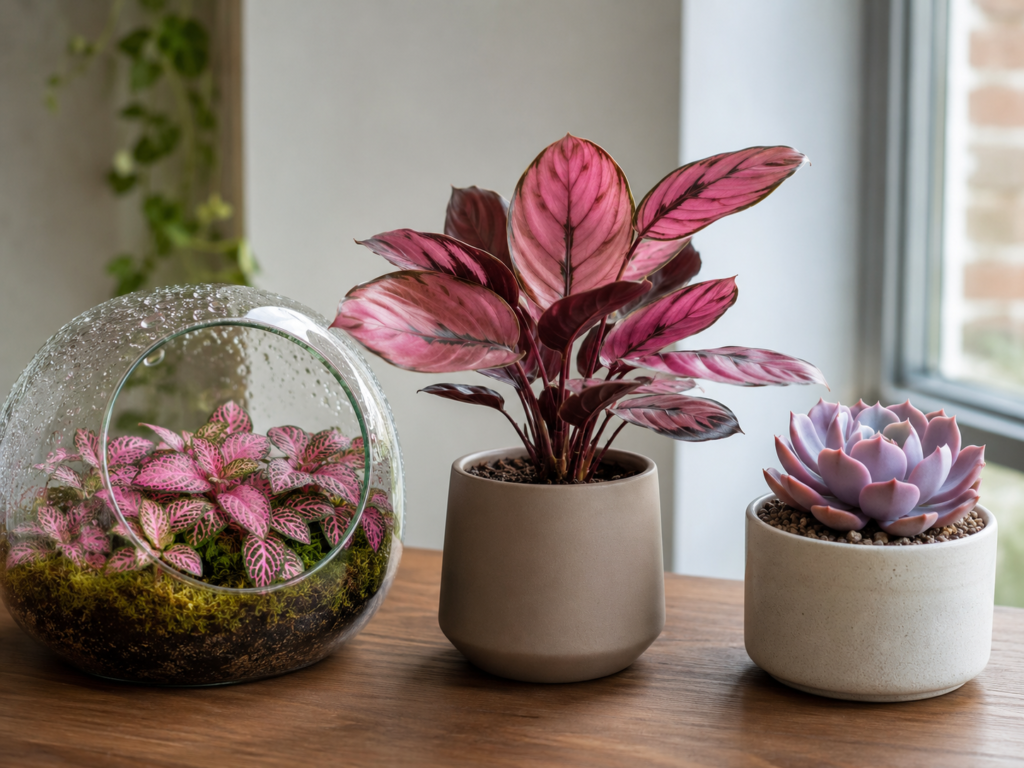
7. Pink Fittonia
Fittonia, or nerve plant, has green leaves crossed by fine pink or red veins. Its low, spreading habit suits terrariums, shallow pots, small shelves, and desktops.
Use medium to bright filtered light and keep the growing medium lightly moist without waterlogging it. Fittonia may collapse dramatically when dry, but repeated wilting weakens the plant.
Higher humidity helps prevent crisp edges, making Fittonia one of the best pink indoor plants for an enclosed terrarium.
Color rating: Reliable
Best for: Terrariums and humid desks
Main risk: Severe drying
Pet note: Commonly listed as non-toxic
8. Goeppertia ‘Rosy’
Goeppertia ‘Rosy’ produces rounded leaves with pink centers, dark green margins, and burgundy undersides. Its painted appearance is striking, but it needs more stable care than Aglaonema or Peperomia.
Provide bright indirect light, warmth, higher humidity, and moist but aerated soil. Dry air, mineral-heavy water, direct sun, or saturated soil can cause brown edges and declining foliage.
Use filtered, rain, or low-mineral water when tap water repeatedly damages the margins.
Color rating: Moderately light-dependent
Best for: Experienced owners and bright bathrooms
Main risk: Brown leaf edges
Pet note: Calathea-type plants are commonly listed as non-toxic
9. Echeveria ‘Perle von Nürnberg’
Echeveria ‘Perle von Nürnberg’ forms a compact rosette with gray, lilac, pink, and purple tones. Unlike tropical pink plants, it needs strong light and a dry watering cycle.
Place it near a sunny window, use a gritty succulent mix, and let the soil dry before watering. Weak light causes the stem to stretch and the leaves to separate, while frequent watering can rot the roots or crown.
Rotate the pot periodically to maintain a balanced rosette.
Color rating: Highly light-dependent
Best for: Sunny windowsills
Main risk: Overwatering and insufficient light
Pet note: Verify the exact species or cultivar
Trailing and Climbing Pink Plants
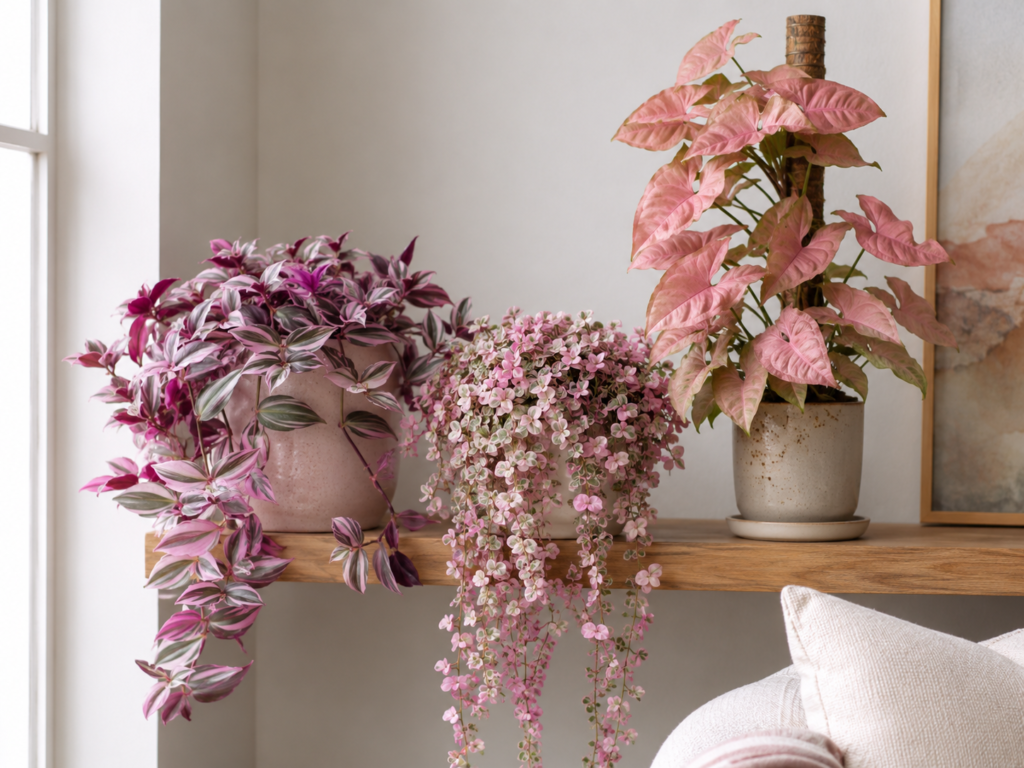
10. Tradescantia ‘Nanouk’
Tradescantia ‘Nanouk’ produces striped leaves in cream, green, pink, lavender, and purple. It grows quickly and creates an effective trailing display.
Give it bright indirect light and water when the upper soil dries. Weak light produces long gaps between leaves, while strong direct sun may scorch the foliage.
Pinch long stems and return healthy cuttings to the pot. Regular propagation helps prevent the plant from becoming thin and bare near its base.
Color rating: Highly light-dependent
Best for: Shelves and hanging baskets
Main risk: Sparse growth
Pet note: May irritate pets or skin
11. Callisia repens ‘Pink Lady’
Callisia ‘Pink Lady’ creates fine trailing stems covered in tiny cream, pink, green, and burgundy leaves. It works particularly well in small baskets and raised shelf planters.
Provide bright filtered light and an airy, draining growing medium. Low light creates greener, weaker stems, while intense sun can burn the delicate foliage.
Trim the plant regularly and replant healthy cuttings to maintain a dense display.
Color rating: Highly light-dependent
Best for: Fine-textured pastel arrangements
Main risk: Leggy growth
Pet note: Keep out of reach because irritation may occur
12. Syngonium ‘Neon Robusta’
Syngonium ‘Neon Robusta’ develops soft rose-pink arrow-shaped leaves. Young plants remain compact, but older stems become climbing or trailing vines.
Use medium to bright indirect light and water after the upper mix partially dries. Train mature growth on a pole or trellis, or prune regularly to retain a fuller tabletop form.
Its changing growth habit makes Syngonium useful for rooms where the plant can move from a desk to a shelf or support as it matures.
Color rating: Moderately light-dependent
Best for: Flexible climbing or trailing displays
Main risk: Untidy growth without support
Pet note: Toxic if chewed
Humidity-Loving Pink Plants
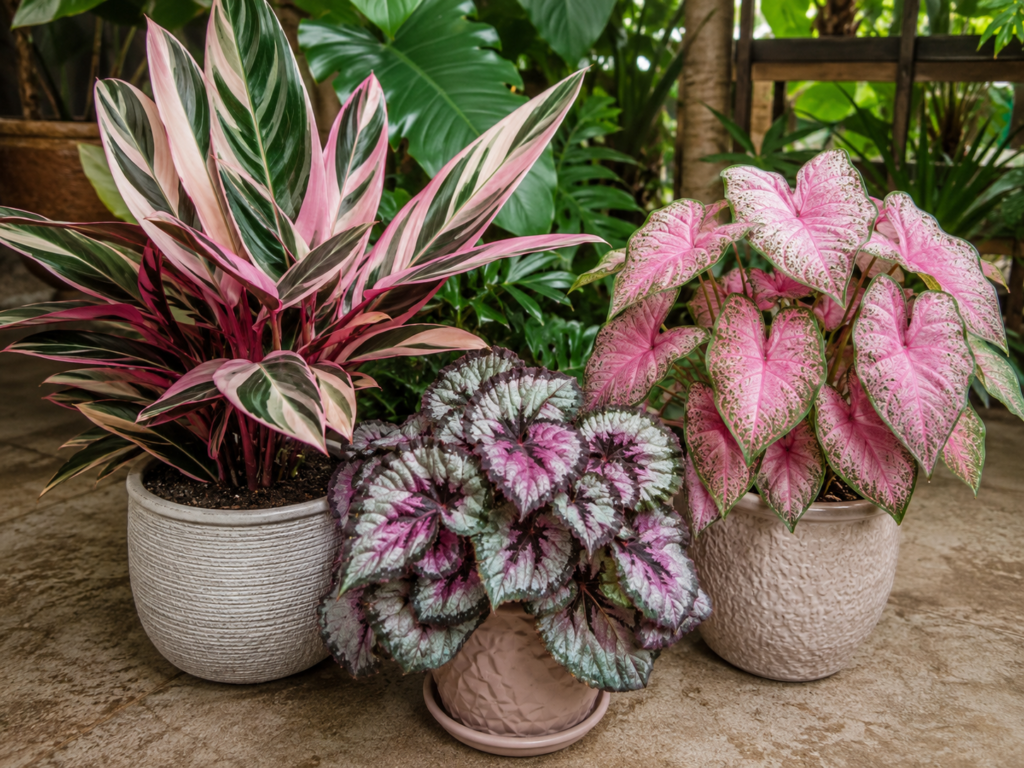
13. Stromanthe ‘Triostar’
Stromanthe ‘Triostar’ produces cream, green, pink, and burgundy leaves. It needs bright indirect light, warmth, humidity, and consistently moist but well-drained soil.
Dry air commonly causes brown edges and can encourage spider mites. A humidifier offers more reliable support than occasional misting.
Keep it away from cold windows, heaters, and air conditioners.
Color rating: Moderately light-dependent
Best for: Bright, humid rooms
Main risk: Brown margins and pests
14. Pink Rex Begonia
Pink Rex Begonias develop metallic foliage in combinations of pink, silver, burgundy, purple, and green. Their patterns may appear as spirals, broad zones, or irregular margins.
Use bright indirect light, moderate to high humidity, and good airflow. Water the growing medium directly instead of repeatedly wetting the leaves. Avoid both severe drying and constantly saturated roots.
Color rating: Moderately light-dependent
Best for: Collector shelves and tabletops
Main risk: Root or leaf disease
Pet note: Prevent ingestion
15. Pink Caladium
Pink Caladium produces large heart-shaped leaves with pink centers, veins, margins, or speckles. It creates a dramatic display but may not remain leafy throughout the year.
During active growth, provide warmth, bright filtered light, and consistent moisture. Reduce watering when the foliage yellows and the tuber enters dormancy.
Natural dormancy should not be confused with sudden plant failure.
Color rating: Variable
Best for: Seasonal focal displays
Main risk: Mistaking dormancy for death
Pet note: Toxic if chewed
Best Pink Plants by Room
| Room or placement | Best choices |
|---|---|
| Living-room floor | Ficus ‘Ruby’ or Ti Plant |
| Bedroom table | Aglaonema or Peperomia |
| Office desk | Fittonia, Peperomia, or Polka Dot Plant |
| Shelf or basket | Tradescantia or Callisia |
| Bright bathroom | Stromanthe or Goeppertia |
| Terrarium | Fittonia |
| Sunny windowsill | Echeveria |
| Trellis or moss pole | Pink Princess or Syngonium |
| Seasonal display | Pink Caladium |
A room recommendation is useful only when the actual light, temperature, and airflow match the plant’s needs. A windowless bathroom is not suitable simply because it is humid.
How to Keep Pink Plants Colorful
- Match each plant to its preferred light.
- Increase light gradually to prevent scorch.
- Rotate the pot for balanced growth.
- Clean dusty leaves.
- Water according to the species.
- Use drainage holes and an airy potting mix.
- Prune weak or reverted growth carefully.
- Avoid excessive fertilizer.
- Add a grow light when natural light is inadequate.
- Observe several new leaves before making another change.
More light does not guarantee more pink. Genetics controls the plant’s potential pattern, while healthy care helps it maintain that pattern.
Why Pink Plants Lose Color
| Symptom | Likely cause | Response |
|---|---|---|
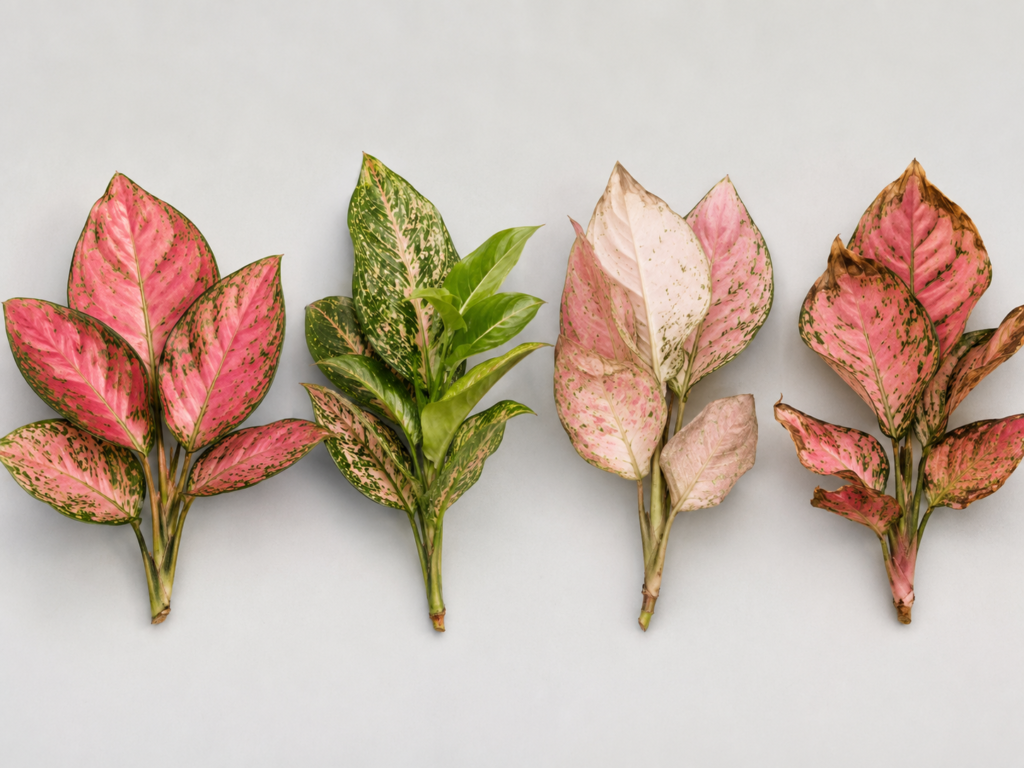
| New leaves become greener | Weak light or natural variation | Improve filtered light and observe |
| Pink areas appear bleached | Excessive direct sun | Move away from intense glass |
| Stems become stretched | Inadequate light | Improve light and prune |
| Pink margins turn crisp | Dry air, minerals, or irregular watering | Review humidity and moisture |
| Lower leaves yellow in wet soil | Overwatering | Allow drying and inspect roots |
| One stem becomes fully green | Reversion | Prune to variegated growth if appropriate |
| Caladium foliage declines | Dormancy | Reduce water and maintain the tuber |
Act quickly when soil smells sour, roots become brown and mushy, stems turn black, or yellowing spreads rapidly. Observe rather than panic when only one leaf changes color.
Styling Pink Indoor Plants
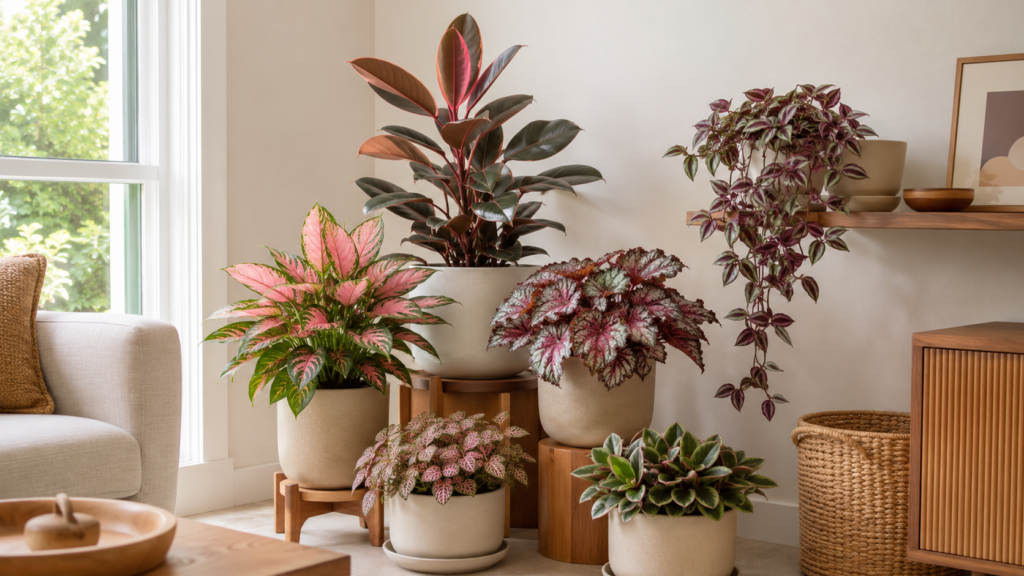
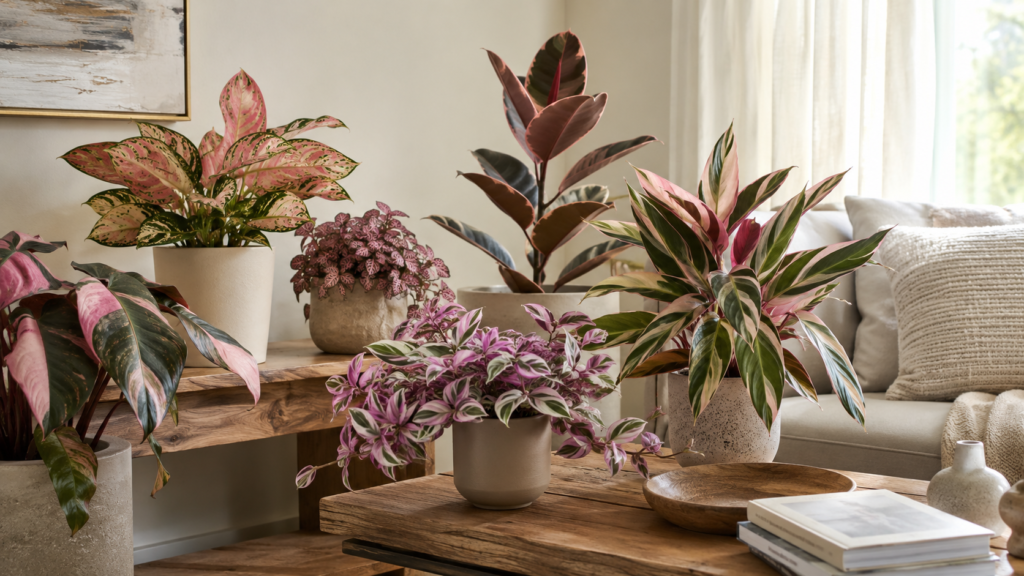
Pink foliage stands out against cream, white, beige, soft gray, charcoal, and natural wood. Highly patterned plants usually look best in simple containers such as matte white ceramic, terracotta, muted green, or dark charcoal.
Create depth by placing a Ficus or Ti Plant at the back, Aglaonema or Rex Begonia in the middle, and Fittonia or Peperomia at the front. Allow Tradescantia or Callisia to trail from a raised shelf.
Combine pink plants with deep green, silver, or burgundy foliage. Keep plants with incompatible care needs in separate containers; Fittonia, Echeveria, and Caladium should not share one pot.
Common Pink Plant Care Mistakes
Avoid:
- Buying based on highly edited photographs
- Assuming every pink plant tolerates low light
- Placing pale leaves in harsh afternoon sun
- Watering every plant on the same schedule
- Using misting as the only humidity solution
- Ignoring mature plant size
- Fertilizing a stressed plant
- Repotting into an oversized container
Before changing care, check the soil, drainage, roots, available light, drafts, temperature, and pests. Determine whether the problem affects one leaf or the entire plant.
FAQs
What are the best pink indoor plants?
Strong choices include Aglaonema ‘Lady Valentine’, Pink Princess Philodendron, Peperomia ‘Ginny’, Fittonia, Tradescantia ‘Nanouk’, and Ficus ‘Ruby’.
What is the easiest pink indoor plant?
Aglaonema ‘Lady Valentine’ is one of the easiest. Peperomia ‘Ginny’ is another compact, manageable choice.
Are pink indoor plants naturally pink?
Yes. Their color comes from natural pigments, veins, margins, or genetic variegation.
Can pink indoor plants grow in low light?
Aglaonema and Fittonia tolerate softer light, but most pink plants retain better color in medium to bright indirect light.
Do pink indoor plants need direct sunlight?
Most tropical pink plants prefer bright indirect light. Echeveria needs considerably stronger window light.
Why is my pink indoor plant turning green?
Low light, seasonal change, natural variation, or reversion may cause greener growth.
Can a green leaf become pink again?
A mature green leaf usually will not develop large new pink sections. Improved care is more likely to affect future leaves.
How often should pink indoor plants be watered?
It depends on the species. Fittonia prefers consistent moisture, while Peperomia and Echeveria require more drying.
Which pink indoor plants are safer around pets?
Fittonia, Polka Dot Plant, Peperomia, and several prayer-family plants are commonly listed as non-toxic. Always verify the exact species.
Are pink Caladiums permanent indoor plants?
No. Caladiums may enter dormancy and regrow from healthy tubers when warm growing conditions return.
Best Pink Indoor Plant for Your Home
Choose Aglaonema for easy upright color, Peperomia for compact growth, Fittonia for a terrarium, Tradescantia for trailing foliage, Pink Princess for dramatic variegation, Ficus ‘Ruby’ for a floor display, and Echeveria for a sunny window.
The best pink indoor plant is not the rarest or the plant with the largest pink section in the nursery. It is the one whose light, moisture, space, temperature, and safety requirements match the conditions you can maintain.
How We Chose These Pink Indoor Plants
Plantsaholic selected these plants for their distinctive pink foliage, indoor suitability, varied growth habits, different care levels, placement usefulness, and broad international availability.
The pink-retention ratings are editorial comparisons rather than laboratory measurements. No first-hand trial should be claimed unless Plantsaholic adds documented growing observations, original photographs, or a defined test.
Sources and Botanical References
Verify botanical identities, mature sizes, care requirements, toxicity, variegation, and dormancy through authoritative sources such as:
- Royal Horticultural Society
- Missouri Botanical Garden
- University extension plant databases
- ASPCA Animal Poison Control
- Recognized botanical gardens
- Peer-reviewed plant-science publications
Cultivar names can differ among growers and countries. Pet-safety guidance should always be based on the confirmed botanical identity rather than appearance or a common nursery name.
Myra is the founder and lead writer of Plantsaholic. She shares practical, research-backed advice on indoor plants, outdoor gardening, flowers, herbs, succulents, and everyday plant care. Her goal is to help gardeners of all experience levels grow healthier plants through simple, easy-to-follow gardening guides.