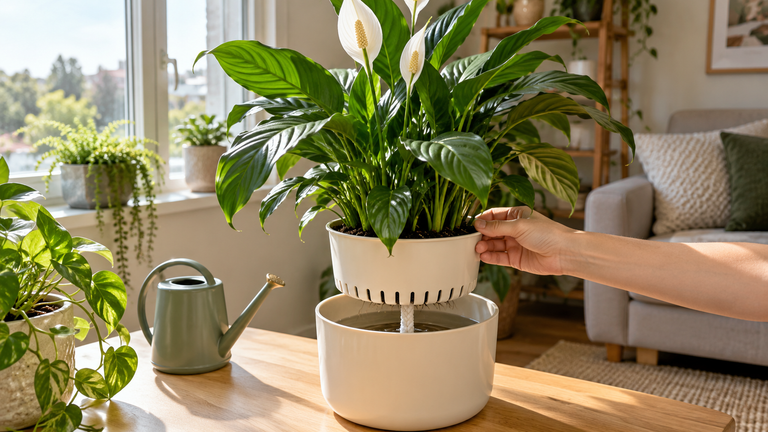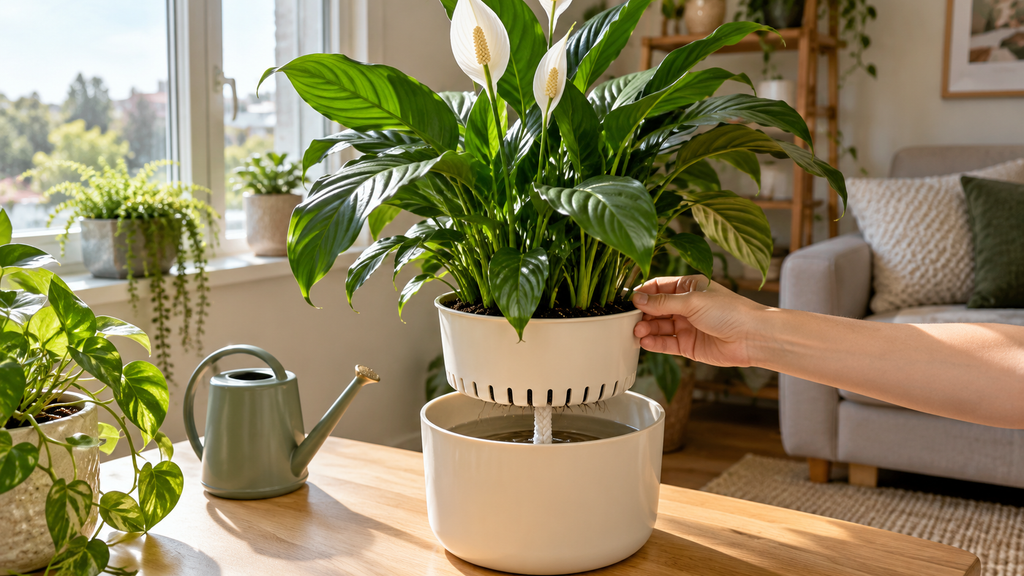
Self-watering pots store water below the planting chamber and draw it upward through a wick, soil column, or another porous connection. Capillary action moves moisture toward the roots, making watering more consistent between refills. These pots do not detect thirst: success still depends on the plant, growing medium, light, and water-level management.
| Quick question | Short answer |
|---|---|
| What makes the pot self-watering? | A reservoir connected to the growing medium. |
| Does it stop overwatering? | No; poor aeration can still damage roots. |
| Must the pot have a wick? | No; some systems use soil or porous inserts. |
| When should you refill? | According to reservoir use and root-zone moisture. |
How Do Self-Watering Pots Work?
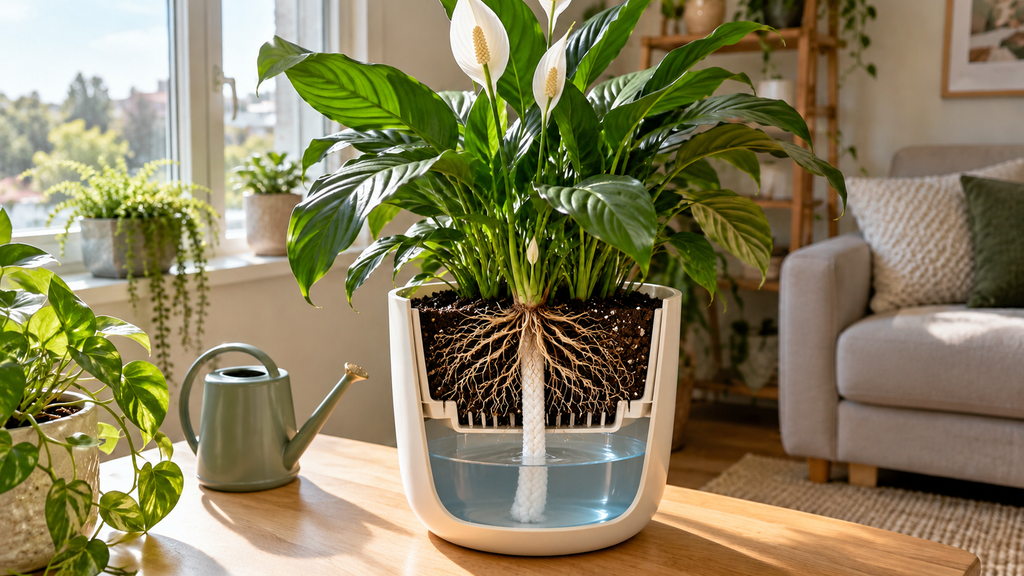
A self-watering pot supplies moisture from below rather than relying entirely on watering the soil surface. Water sits in a lower reservoir while a wick or connected growing medium transfers it toward the plant’s roots. This method is called sub-irrigation.
Reservoir → capillary connection → potting mix → roots → plant
As the medium loses moisture through root uptake and evaporation, more water can move along the connected pathway. A reservoir is not a guarantee of appropriate watering. If the pathway is broken, the soil can dry while water remains below. If the mix holds too much water, roots may lack oxygen even though the system operates as designed. That is why matching the pot to its plant matters.
What’s Inside a Self-Watering Pot?
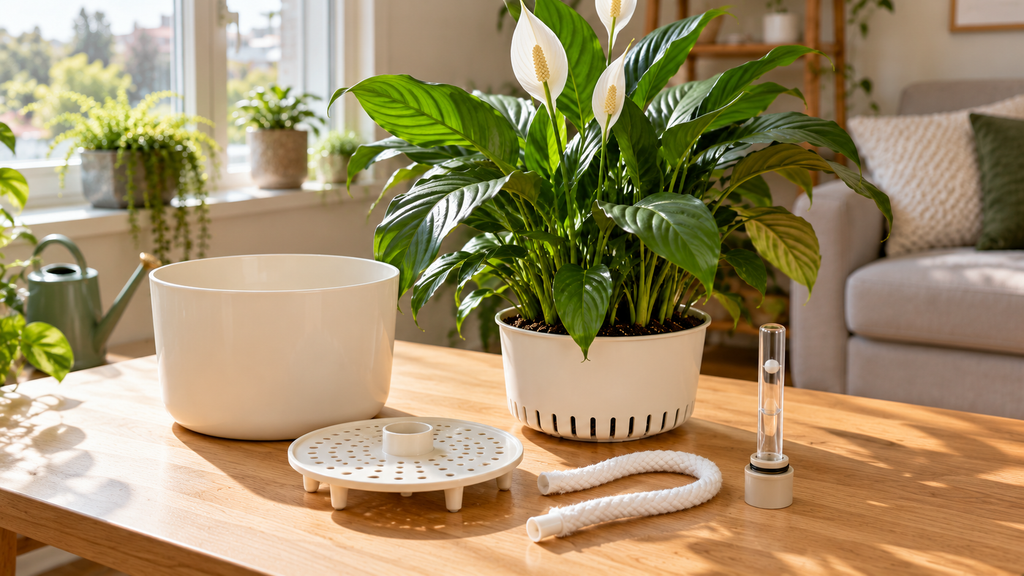
Most self-watering pots separate the growing medium from stored water. Their components differ, but each part should either transfer moisture, support roots, control the waterline, or make maintenance possible.
| Component | Purpose |
|---|---|
| Planting chamber | Holds roots and growing medium. |
| Reservoir | Stores water below the chamber. |
| Wick or soil column | Transfers moisture through capillary action. |
| Separator | Supports the potting mix above the reservoir. |
| Fill opening | Allows water to be added without flooding the soil. |
| Overflow or maximum mark | Helps control excess water. |
| Indicator | Shows approximate stored water, not soil moisture. |
Outdoor systems commonly benefit from a functioning overflow; sealed indoor models may rely on careful filling instead. Check whether the fill tube and water indicator can be accessed without disturbing the plant.
Can Roots Grow Into the Reservoir?
Yes. Some sub-irrigated containers allow roots to extend through openings into the reservoir. Others keep most roots above the water and supply moisture through a wick. Neither arrangement is automatically harmful if it matches the intended design.
What matters is oxygen availability and root health. Check the roots before making any change to a functioning planter. The University of Maryland Extension describes container systems designed for this type of growth.
How Does Capillary Action Work?
Capillary action lets water travel through tiny connected spaces in absorbent materials. Adhesion, cohesion, and surface tension help move moisture through a fabric cord or the pores of potting mix, sometimes upward against gravity.
A self-watering pot uses the same general principle, though soil structure and the distance water must travel affect its performance. The pathway must remain connected as the water level changes.
Fine particles usually retain more water, but an overly dense mix can restrict air around roots. Very coarse particles provide air space yet may not maintain a continuous moisture path.
Do Self Watering Pots Need a Wick
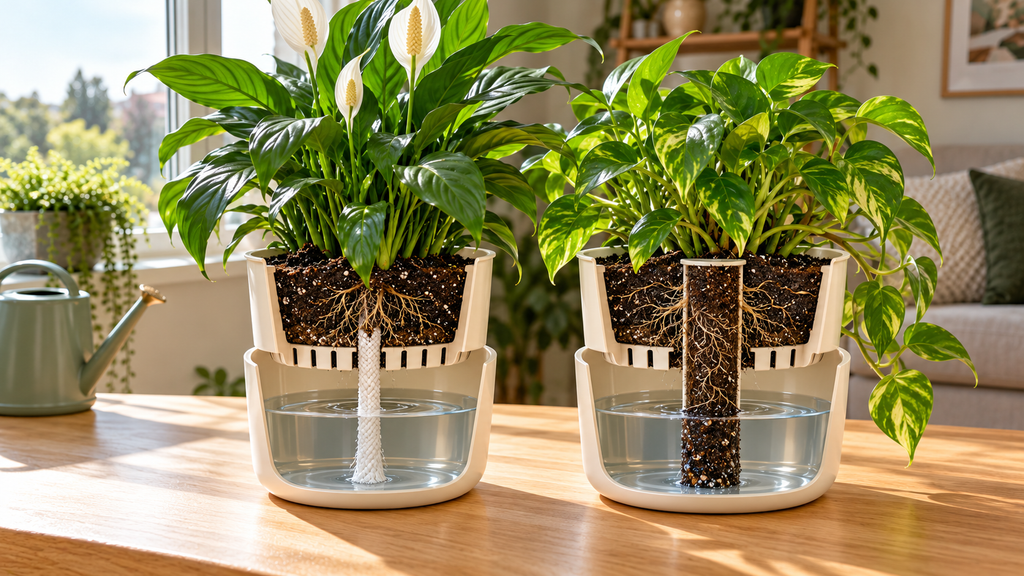
No. Fabric wicks are common, but a self-watering planter can also use a soil-filled chamber, porous insert, or growing medium extending into reservoir water.
| System | Water pathway | Common failure |
|---|---|---|
| Fabric wick | Cord connects reservoir and soil. | Wick shifts, dries, or deteriorates. |
| Soil column | Mix extends into stored water. | Column compacts or loses contact. |
| Porous insert | Absorbent component bridges the gap. | Deposits obstruct moisture movement. |
How Do Wickless Pots Work?
In a wickless design, soil or another porous material performs the wick’s job. A perforated platform alone does not pull water upward; there must be moisture-carrying contact through or around it.
Identify where reservoir water is supposed to enter the growing medium. A full tank with no working connection cannot irrigate the roots.
Is a Self-Watering Pot Right for You?
Self-watering is most useful when a plant prefers consistent moisture and manual watering has been difficult to maintain. It can also provide a useful buffer during busy periods, but convenience should not outweigh the plant’s needs.
Before switching, check four things: moisture preference, root health, potting mix, and available light. A peace lily in an airy mix and adequate light is generally a stronger candidate than a small ZZ plant in dense soil on a dark shelf.
Newly repotted plants need particular attention because their roots may not yet reach the best-moistened portion of the pot.
Which Plants Suit Self-Watering Pots?
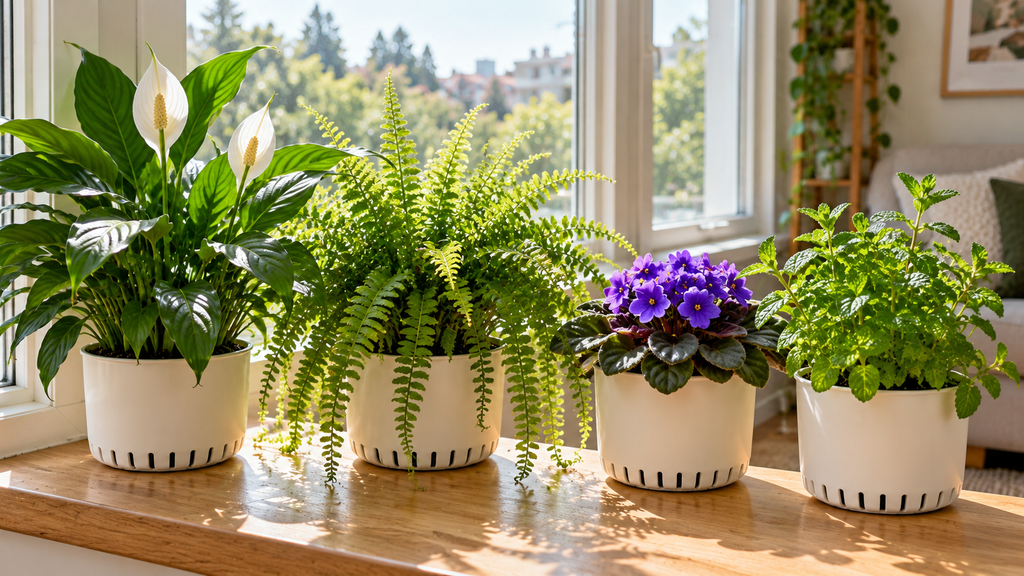
Plants that dislike repeated severe drying often benefit most, provided the growing medium remains aerated.
| Plant | General fit | Why |
|---|---|---|
| Peace lily | Good | Prefers fairly even moisture. |
| Boston fern | Good | Often suffers after substantial drying. |
| African violet | Good | Benefits from controlled root moisture. |
| Basil and mint | Good | Actively growing herbs use water regularly. |
| Container tomatoes | Often good | Fruit production can create high demand. |
| Snake plant and ZZ plant | Caution | Usually tolerate longer dry intervals. |
| Desert cacti and many succulents | Caution | Often need fast drying and airy roots. |
Which Plants Need More Caution?
Jade, echeveria, rosemary, lavender, and similar drought-adapted plants generally need more drying between waterings. A permanently full reservoir paired with dense soil can create the wrong root environment.
Beginners are usually better served by conventional draining pots for species that naturally withstand dry conditions.
How Does Indoor Climate Affect Watering?
A reservoir empties at different rates as growing conditions change. Bright light, warmth, active growth, and dry air often increase water demand. Cooler temperatures, weak light, and slower growth typically reduce it.
| Condition | Likely effect | Response |
|---|---|---|
| Bright, warm room | Faster water use | Check the reservoir more often. |
| Cool, dim room | Slower water use | Avoid automatic topping-up. |
| Outdoor rain | Potential overfilling | Check that overflow works. |
| Rapid new growth | Increasing demand | Reassess refill interval. |
Rather than assuming a fixed weekly schedule, compare reservoir decline and soil moisture over several ordinary watering cycles. A larger, actively growing plant may use the same reservoir much faster than a newly rooted cutting.
What’s the Best Soil for Self-Watering Pots?
The best mix draws water upward without collapsing into a dense, oxygen-poor mass. It needs connected pores for moisture transfer and enough larger air spaces for healthy roots.
Peat or coco coir can support moisture movement. Perlite, pumice, and appropriately sized bark particles help maintain structure. A mix that remains dry despite a wet wick may be too coarse or poorly connected. Assess the lower root zone instead of judging only the surface. If the mix smells stagnant or remains saturated for long periods, examine the roots before changing ingredients.
For more on ingredients and drainage, see best soil for indoor plants.
How Do You Set Up a Self-Watering Pot?
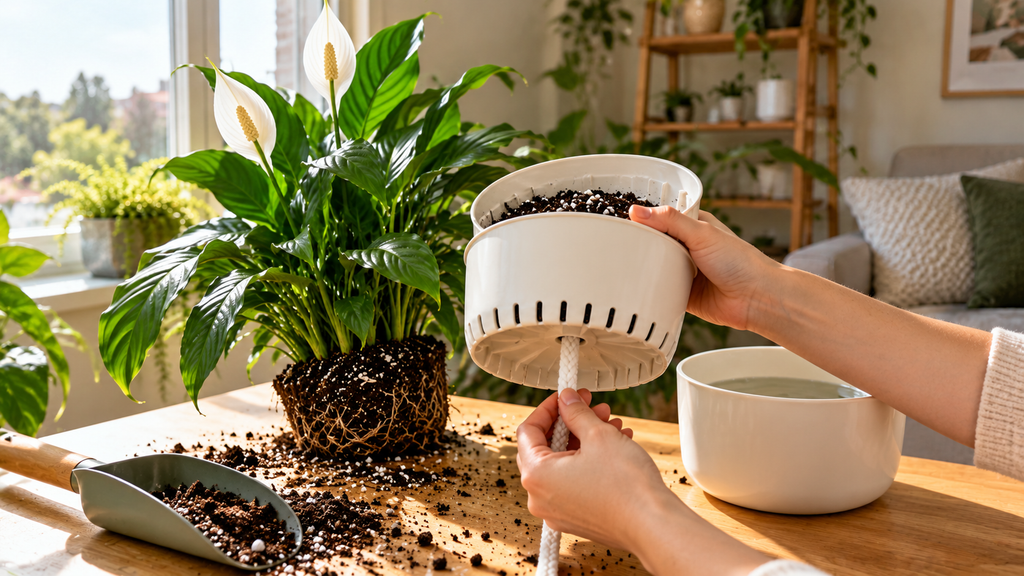
A newly planted system needs a continuous water pathway and sufficiently moist soil around the existing roots.
- Choose the plant and mix. Match the substrate’s moisture retention and aeration to the plant.
- Install the connection. Fit the wick, soil column, or insert exactly as instructed.
- Pre-moisten if needed. Very dry peat-based media and fabric wicks may need initial wetting.
- Pot at normal depth. Keep the crown where it belongs; do not bury stems to reach water.
- Water initially if instructed. Make sure the existing root ball receives moisture.
- Fill to the mark. Use the reservoir opening, then check moisture over the next few days.
How Do You Position a Fabric Wick?
The lower end must contact reservoir water and the upper end must touch the lower growing medium. A wick hanging outside the root zone, or one that has dried and lost contact, may stop supplying moisture.
A large thirsty plant may need more capacity than a small cord offers, while unnecessary extra wicking can keep sensitive plants too wet.
When Can You Stop Top Watering?
Rely mainly on the reservoir when the active root zone stays appropriately moist and water delivery is clearly established. There is no fixed number of days. If the reservoir remains full while soil dries, water the roots appropriately and repair the connection.
How Do You Fill the Reservoir?
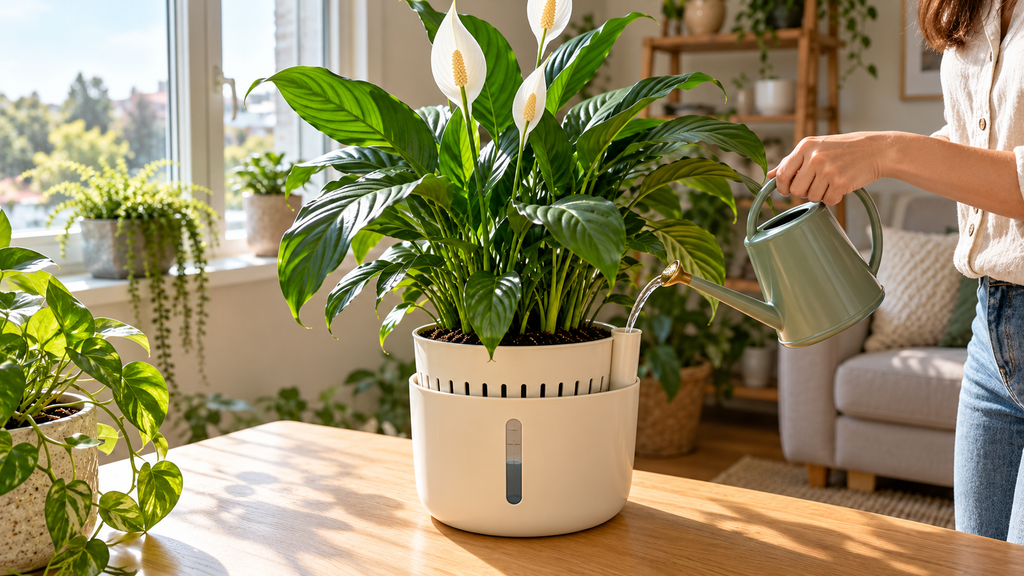
Use the designated fill tube or opening and stop at the manufacturer’s maximum mark. Do not pour water into the planting chamber simply to fill the reservoir unless the instructions specifically call for that approach.
A water indicator measures how much water is stored, not whether the plant needs it. Check root-zone moisture as well as the gauge.
What Happens if You Overfill It?
Excess water can rise into the planting chamber and reduce oxygen around roots. Many outdoor sub-irrigated planters include an overflow opening that releases water at a designed level, especially during rainfall.
Keep this opening clear of roots and debris. Follow the actual product design rather than drilling holes or removing plugs without guidance.
How Long Does the Reservoir Last?
Refill intervals depend on usable reservoir capacity and daily water loss. To estimate your interval, measure how much stored water disappears over several days under normal conditions.
Estimated refill interval = usable reservoir volume ÷ average daily reservoir loss
For example, suppose a reservoir holds 900 mL of usable water and its level falls by 270 mL over three days. Its average daily loss is 90 mL; at that rate, 900 ÷ 90 suggests about 10 days between refills.
This is an illustrative calculation, not a measured Plantsaholic experiment. Evaporation and leaks can contribute to reservoir loss, so the estimate does not equal plant uptake. Make the estimate again after repotting or moving the plant to a different window.
How Can You Test a Self-Watering Pot?
A working system should supply appropriate moisture to the active roots without leaving the mix consistently waterlogged.
How Do You Test the Water Pathway?
- Record the reservoir level after filling to its recommended mark.
- Keep the plant in its usual location under similar conditions.
- Carefully check moisture in the middle and lower root zone with a suitable probe or wooden skewer near the pot edge.
- Recheck the reservoir and soil over the following days.
- Investigate differences before changing the watering system.
| Observation | Possible meaning | Next action |
|---|---|---|
| Level falls; root zone suitably moist | Water delivery may be working. | Continue monitoring. |
| Reservoir full; lower mix dry | Connection failed or demand is low. | Check wick, mix, and roots. |
| Level falls; mix stays dry | Leak, evaporation, or uneven transfer. | Inspect container and pathway. |
| Mix soggy; leaves declining | Poor aeration or root stress. | Examine moisture and roots. |
If publishing an original test, record the plant, substrate, dates, conditions, and actual readings; do not present hypothetical numbers as findings. An inexpensive moisture probe provides only an approximate reading; verify suspicious results by checking the growing medium directly.
Can Self-Watering Pots Cause Root Rot?
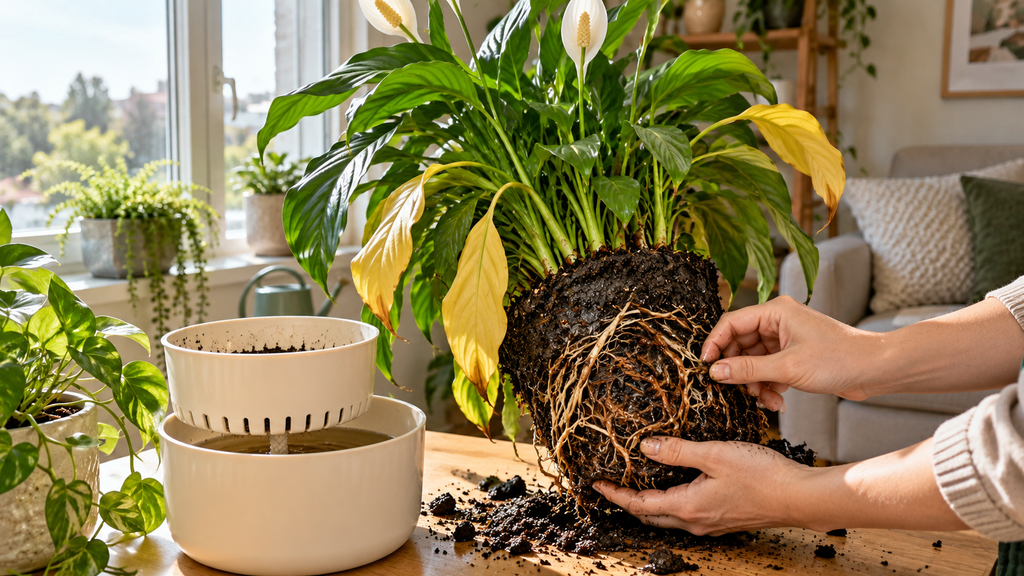
Yes. Excess moisture and limited oxygen in the root zone can encourage root damage. Yellow leaves, persistent wilting, sour odors, and wet mix can indicate a problem, but none confirms root rot on its own. Examine roots when a plant continues declining; damaged roots may be unable to absorb water even when soil is saturated.
Reduce risk with a suitable airy mix, functioning water-level controls, and realistic refill habits. Consult signs of root rot in plants before deciding on treatment.
Why Isn’t My Self-Watering Pot Working?
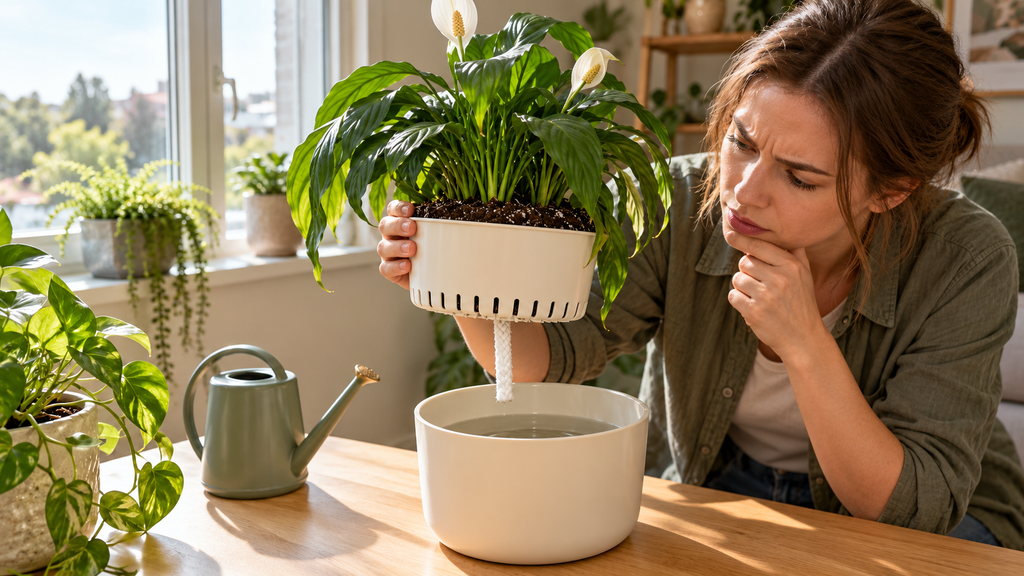
Trace the delivery chain: reservoir → transfer material → growing medium → roots → environment.
| Symptom | Possible cause | First response |
|---|---|---|
| Reservoir full, soil dry | Broken capillary contact | Reposition or rewet the connection. |
| Soil constantly soggy | Dense mix or low demand | Check aeration and water level. |
| Yellowing leaves | Root or moisture stress | Inspect roots before refilling. |
| White crust | Fertilizer or mineral salts | Review feeding and flushing. |
| Green film | Algae in accessible reservoir | Clean and reduce light exposure. |
| Fungus gnats | Persistently damp organic mix | Correct excess surface moisture. |
| Level drops unusually fast | Growth, heat, or a leak | Check conditions and container. |
Why Is the Reservoir Full but the Soil Dry?
A wick may have slipped, a soil column may no longer contact water, or the mix may have dried enough to resist rewetting. Examine the intended water path, then restore root-zone moisture as appropriate.
Why Does a Plant Wilt in Wet Soil?
Poorly aerated or damaged roots may struggle to absorb water. Do not assume wilting means thirst. Check deeper moisture and root condition first, then address the underlying cause rather than repeatedly refilling. For confirmed damage, see how to fix root rot in houseplants.
How Do You Fertilize Self-Watering Pots?
Use fertilizer according to the product label and planter instructions. Some systems permit a diluted nutrient solution in the reservoir; others recommend different feeding methods.
Because water often moves upward, dissolved salts can accumulate in the growing medium instead of washing out through drainage. White crust or damaged leaf tips may signal a problem, although other causes are possible.
Avoid adding full-strength fertilizer with every refill by default. When appropriate for the plant and design, occasional top watering with proper drainage can help flush salts.
How Do You Clean the Reservoir?
Inspect accessible reservoir parts during ordinary refills and clean them when sediment, algae, odor, or mineral deposits appear. Removable liners make maintenance easier, but roots extending into the reservoir should not be torn merely to disassemble it.
- Remove the inner pot only if it can be done safely.
- Empty standing water and debris.
- Rinse and gently scrub accessible surfaces.
- If necessary, wash removable non-plant parts with mild dish soap and rinse thoroughly.
- Check the fill opening, overflow, gauge, and water-transfer connection.
- Reassemble and refill to the intended level.
Never pour soap or disinfectant through a planted root ball.
When Should You Replace the Wick?
Replace a fabric wick when it frays, breaks down, becomes persistently blocked, or can no longer maintain contact with the reservoir and growing medium. Use material compatible with the pot.
How Do You Make a Self-Watering Pot?
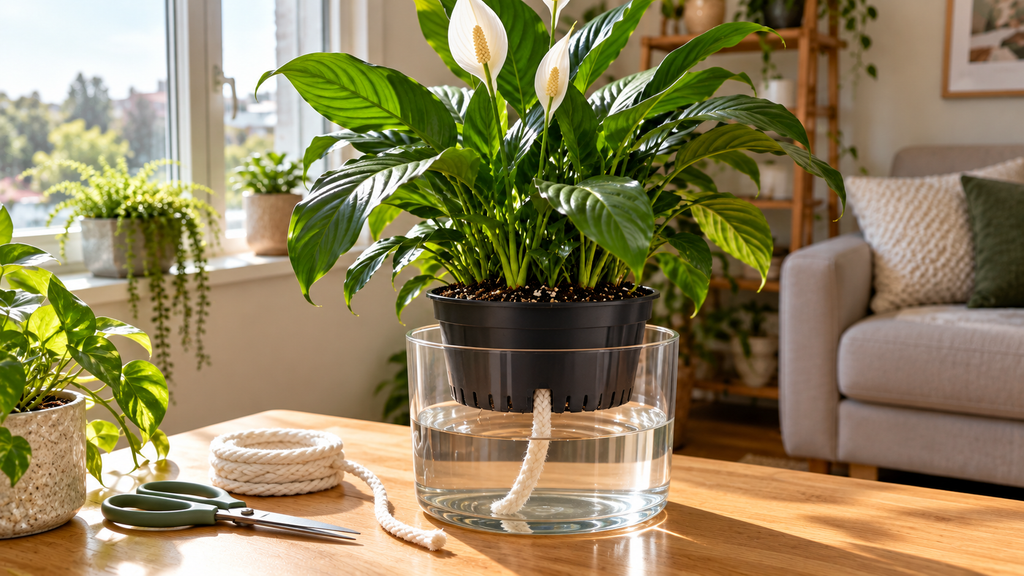
A simple DIY model needs a nursery pot, waterproof outer container, absorbent wick, and a controlled reservoir level. The main root ball should remain supported above standing water while the wick connects it to moisture below.
- Select an inner pot that sits securely within the outer container.
- Pass an appropriate wick through a drainage opening and into the lower potting mix.
- Leave the other end where it can reach reservoir water.
- Add suitable mix and plant at the normal depth.
- Pre-moisten the root zone and fill the reservoir below the pot base.
- Observe moisture transfer before relying on the system unattended.
Larger outdoor versions need a carefully designed separator and overflow; a basic indoor example is not a universal construction specification.
What Makes a Good Self-Watering Pot?
A useful planter combines reliable water transfer with controllable water levels and easy maintenance. Choose the design for your plant, not just the advertised number of days it can hold water.
Prioritize an accessible reservoir, stable inner pot, durable wick or wicking chamber, visible maximum level, and removable parts when possible. An overflow is particularly valuable outdoors. Make sure the potting mix can breathe and the reservoir can be cleaned without damaging roots.
Avoid designs that make the water pathway impossible to inspect.
Are Self-Watering Pots Better Than Regular Pots?
Neither is better for every plant. Self-watering pots offer passive moisture delivery and often fewer refills. Regular draining pots provide a simpler wet–dry cycle and may suit drought-adapted plants better.
| Consideration | Self-watering pot | Regular pot |
|---|---|---|
| Water supply | Reservoir and capillary pathway | Usually manual top watering |
| Moisture pattern | Potentially steadier | More distinct wet–dry cycles |
| Vacation buffer | Often helpful if tested | Usually more limited |
| Maintenance | Reservoir plus components | Simpler cleaning |
| Dry-loving plants | Greater caution | Often easier to manage |
A self-watering pot also differs from temporary bottom watering, where a conventional pot absorbs water briefly and then drains.
Are Self-Watering Pots Worth It?
Yes, when they solve a genuine watering problem without compromising root health. They can help with moisture-loving houseplants, actively growing herbs, container vegetables, and households where frequent hand watering is inconvenient.
They are less useful when a plant requires long dry intervals, light is inadequate, the mix stays saturated, or ordinary watering already works well. Bottom line: Choose a suitable plant and airy mix, establish the water pathway, then confirm moisture reaches the roots. The presence of water in the reservoir is only the starting point.
Self-Watering Pots FAQs
How Do Self-Watering Pots Actually Work?
They store water below the planting chamber and draw it into the growing medium through capillary action. A wick, soil column, or porous insert connects water to roots.
Do Self-Watering Pots Really Work?
Yes, for plants and mixes compatible with steady moisture. They still need suitable light, healthy roots, and occasional monitoring.
How Often Should You Refill a Self-Watering Pot?
Refill according to reservoir use and root-zone moisture, not a fixed calendar. Plant size, season, temperature, and light affect demand.
Should a Self-Watering Pot Always Have Water in It?
Not necessarily. Moisture-loving plants may use regular reservoir access; drought-tolerant species often need more drying time.
Can You Water a Self-Watering Pot From the Top?
Yes. Initial setup, rewetting very dry mix, or flushing salts may require top watering. Avoid leaving roots saturated.
How Much Water Should You Put in a Self-Watering Pot?
Fill only to the recommended maximum level. Do not flood the planting chamber or block the overflow.
Do Self-Watering Pots Need Drainage Holes?
They need a way to control excess water, though not always bottom drainage holes. Many models use a side overflow or controlled reservoir.
Can Self-Watering Pots Work Without a Wick?
Yes. Connected soil columns and porous inserts can move water upward without fabric. A continuous moisture pathway remains essential.
Which Plants Grow Best in Self-Watering Pots?
Peace lilies, many ferns, African violets, basil, and mint are often good candidates. Cacti and many succulents need more caution.
Can Self-Watering Pots Cause Root Rot?
Yes, if the growing medium stays excessively wet and poorly aerated. Match the mix and refill practices to the plant.
Why Is My Self-Watering Pot Full but the Soil Dry?
The wick or soil column may be disconnected or poorly matched to the mix. Check moisture below the surface and inspect the transfer path.
Do Plant Roots Sit in Water in Self-Watering Pots?
Designs differ. Wick-based pots usually keep most roots above water; some sub-irrigated containers allow roots into the reservoir.
Can You Put Fertilizer in a Self-Watering Reservoir?
Only when planter and fertilizer instructions permit it. Avoid excessive concentration and monitor salt buildup.
Are Self-Watering Pots Good for Vacations?
Yes, once the system is established and tested. Measure the usual refill interval before relying on the reservoir while away.
Myra is the founder and lead writer of Plantsaholic. She shares practical, research-backed advice on indoor plants, outdoor gardening, flowers, herbs, succulents, and everyday plant care. Her goal is to help gardeners of all experience levels grow healthier plants through simple, easy-to-follow gardening guides.