Prayer plant types are popular for their patterned foliage, tropical colors, and unusual day-to-night leaf movement. The classic prayer plant is Maranta leuconeura, but several closely related members of the Marantaceae family are also commonly sold under the prayer plant name.
Popular types include the Red Prayer Plant, Rabbit’s Foot, Lemon Lime, Fascinator, Silver Band, Orbifolia, Rattlesnake Plant, Ctenanthe, and Stromanthe.
Most prefer bright indirect light, consistent moisture, warm temperatures, good drainage, and moderate to high humidity. However, they do not all grow in the same way. True Marantas are generally low and spreading, while many Goeppertia, Ctenanthe, and Stromanthe plants grow more upright.
The most useful first step is therefore correct identification. Once you know whether you have a true Maranta or a related plant, it becomes much easier to understand its growth habit, choose the right location, and provide suitable care.
What Is a Prayer Plant?
A prayer plant is a tropical foliage plant known for decorative leaves that change position between day and night.
The name most accurately refers to Maranta leuconeura, a tropical perennial in the Marantaceae family.
Unlike many upright houseplants, Maranta usually grows low and spreads outward. This makes it especially useful for shelves, tables, plant stands, and hanging baskets.
Depending on the variety, the leaves may feature red or pink veins, lime-green markings, dark paired blotches, pale silver bands, or contrasting reddish-purple undersides.
The common name comes from the plant’s nighttime movement. During daylight, the leaves often remain flatter and more open. In the evening, many leaves rise into a more upright position that can resemble hands held together in prayer.
This rhythmic movement is commonly called nyctinasty.
Prayer plants come from tropical environments and behave like understory plants. Indoors, they generally prefer plenty of filtered light without harsh midday sun. They also like regular moisture but should not remain in permanently saturated soil.
What Are the Main Prayer Plant Types?
Prayer plant types are easiest to understand when divided into true Marantas and related Marantaceae plants.
| Group | True Maranta? | Typical Growth | Main Feature |
|---|---|---|---|
| Maranta | Yes | Low and spreading | Veins, blotches and leaf movement |
| Goeppertia/Calathea | No | Upright and clumping | Large patterned foliage |
| Ctenanthe | No | Upright to spreading | Striped or fishbone patterns |
| Stromanthe | No | Upright and clumping | Pink, cream and green variegation |
Maranta is the central group because Maranta leuconeura is the classic prayer plant.
Many plants that are still sold as Calathea are now classified under the genus Goeppertia. Ctenanthe and Stromanthe are also closely related members of the same plant family and may show similar leaf movement.
The practical difference becomes important when deciding where to place the plant.
A spreading Maranta can work beautifully in a hanging basket or on a high shelf. A larger Goeppertia or Stromanthe usually needs more upright growing space.
A simple rule is:
Marantas are prayer plants, but not every plant sold as a prayer plant is a Maranta.
How to Identify Prayer Plant Types
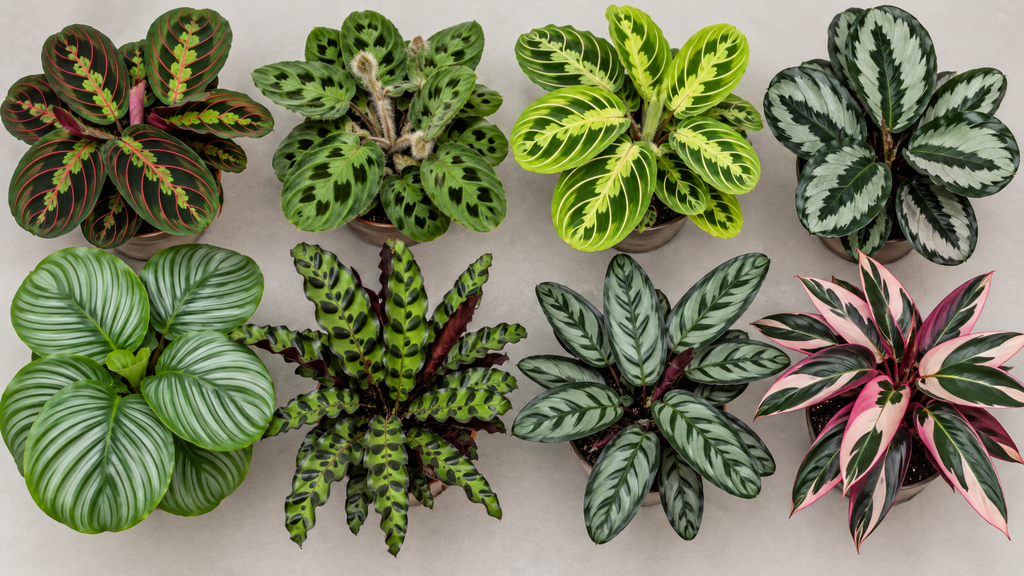
Prayer plant identification is easiest when you compare several characteristics together instead of using leaf color alone.
Start with the growth habit.
A low plant that spreads horizontally is more likely to be a Maranta. A taller plant that forms an upright clump may be a Goeppertia, Ctenanthe, or Stromanthe.
Then examine the foliage.
| Leaf Appearance | Likely Identification |
|---|---|
| Bright red fishbone veins | Red Prayer Plant |
| Dark paired blotches | Rabbit’s Foot Maranta |
| Lime or yellow-green veins | Lemon Lime Maranta |
| Broad pale or silver center | Silver Band Maranta |
| Large rounded silver-striped leaves | Orbifolia |
| Long wavy leaves with dark markings | Rattlesnake Plant |
| Fine pale or pinkish stripes | Pinstripe Goeppertia |
| Green, cream and pink variegation | Stromanthe |
| Fishbone-style striping | Ctenanthe |
Five features are particularly useful when identifying a plant:
- Growth habit
- Leaf shape
- Main foliage pattern
- Leaf underside
- Nursery label
Do not rely on a single photograph alone. Lighting, leaf age, plant health, growing conditions, and photo editing can all affect how the colors appear.
A better approach is to identify the genus first and the cultivar or horticultural form second.
Popular Maranta Prayer Plant Varieties
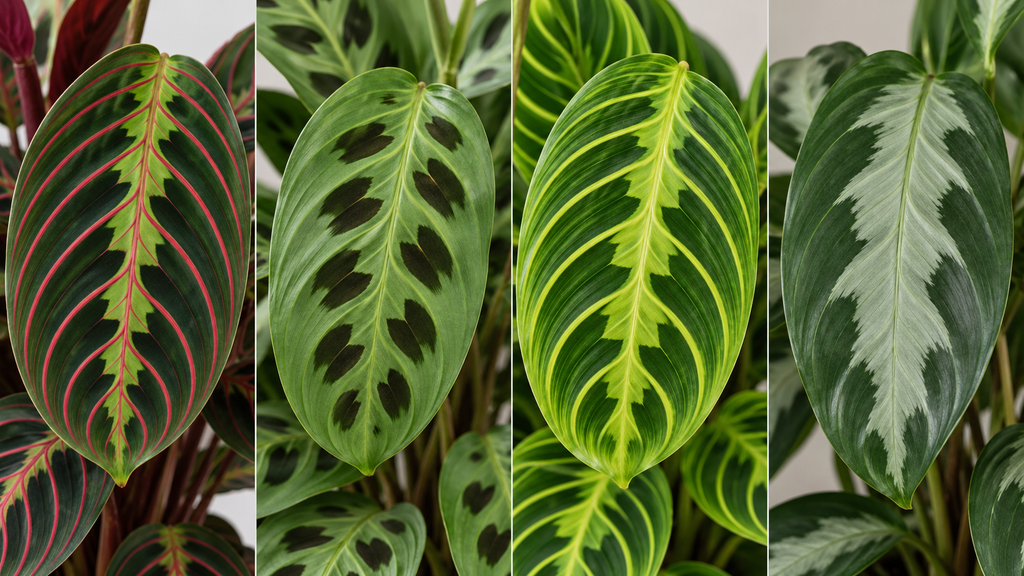
Several forms of Maranta leuconeura are widely grown indoors. Their general care requirements are similar, but their leaf patterns can look very different.
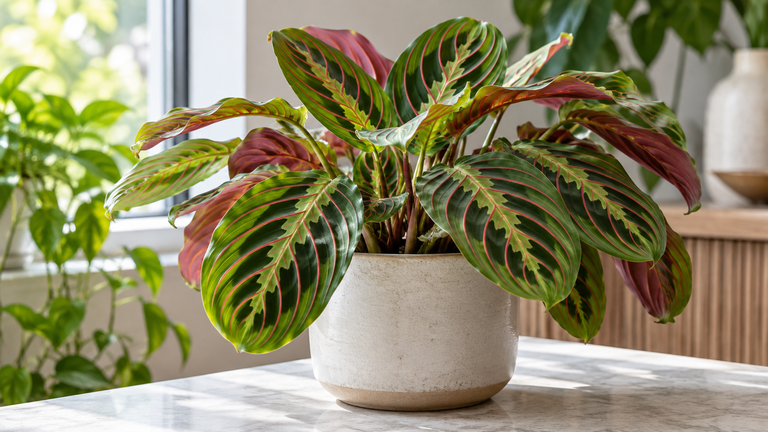
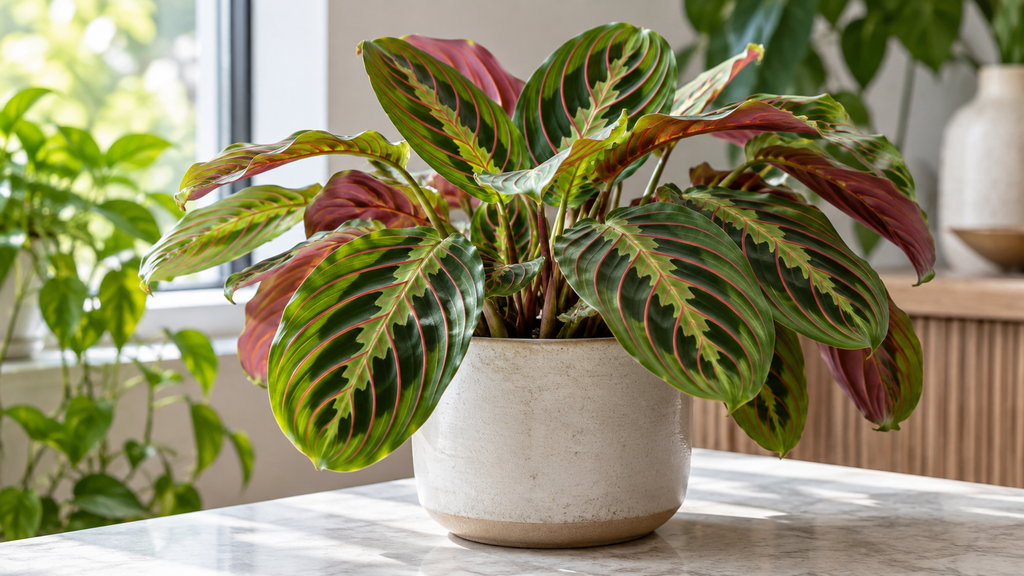
Red Prayer Plant
The Red Prayer Plant is the classic variety most people recognize.
Its foliage usually features dark green leaves, bright red or pink veins, lighter green central markings, and reddish or purple-toned undersides.
The red fishbone-style veining makes it one of the easiest Maranta types to identify.
Choose this type if you want the traditional prayer plant appearance with strong contrast between dark foliage and colorful veins.
Rabbit’s Foot Prayer Plant
Rabbit’s Foot is commonly associated with the horticultural name Maranta leuconeura var. kerchoveana.
Its main identifying feature is a row of paired dark blotches along both sides of the central vein.
Compared with the Red Prayer Plant, Rabbit’s Foot usually has a softer overall green appearance and less obvious red coloration.
It is a good choice if you prefer distinctive foliage without intense red veins.
Lemon Lime Prayer Plant
Lemon Lime has bright lime or yellow-green veins set against darker green foliage.
Its pattern is dramatic but looks fresher and greener than the traditional red-veined Maranta.
It is especially useful when you want strong foliage contrast without red coloring.
Fascinator and Tricolor
Fascinator and Tricolor-type Marantas often combine dark green areas, pale central markings, prominent red or pink veins, and contrasting leaf undersides.
Nursery names can overlap between these plants and other red-veined Marantas, so the label should not be your only identification clue.
Compare the actual foliage pattern, growth habit, and scientific name when available.
Silver Band Prayer Plant
Silver Band is recognized by the broad pale or silvery area running through the center of each leaf.
Its pattern looks noticeably different from the familiar red-veined forms.
This makes it particularly appealing if you already grow common Marantas and want a plant with a softer silver-green appearance.
Dark Maranta Forms
Darker Marantas may be sold under names such as Massangeana or Black Prayer Plant.
These plants typically have deeper green foliage combined with pale or silvery markings.
Trade names vary between sellers, so identification should be based on the plant’s actual leaf pattern, overall color, growth habit, and available botanical labeling.
Understanding Prayer Plant Names
Prayer plant names can be confusing because plant labels often mix common names, older botanical names, cultivar names, horticultural varieties, and trade names.
For example, Maranta leuconeura is the species name, while names such as Maranta leuconeura var. erythroneura and var. kerchoveana are still widely used horticulturally for familiar foliage forms.
A Rabbit’s Foot plant may therefore appear with several levels of naming:
Common name: Rabbit’s Foot Prayer Plant
Often sold as: Maranta leuconeura var. kerchoveana
Species: Maranta leuconeura
The same issue occurs with former Calatheas.
A Rattlesnake Plant may be labeled:
Common name: Rattlesnake Plant
Older nursery name: Calathea lancifolia
Accepted name: Goeppertia insignis
When buying a plant, record the full nursery label and separate the common name from the botanical name.
If the scientific name looks unfamiliar, check whether it is a current name or an older synonym. Older names are still useful because nurseries and sellers often continue using them.
The goal is not simply to memorize names. It is to make sure the label matches the actual plant.
Prayer Plant Relatives vs Maranta
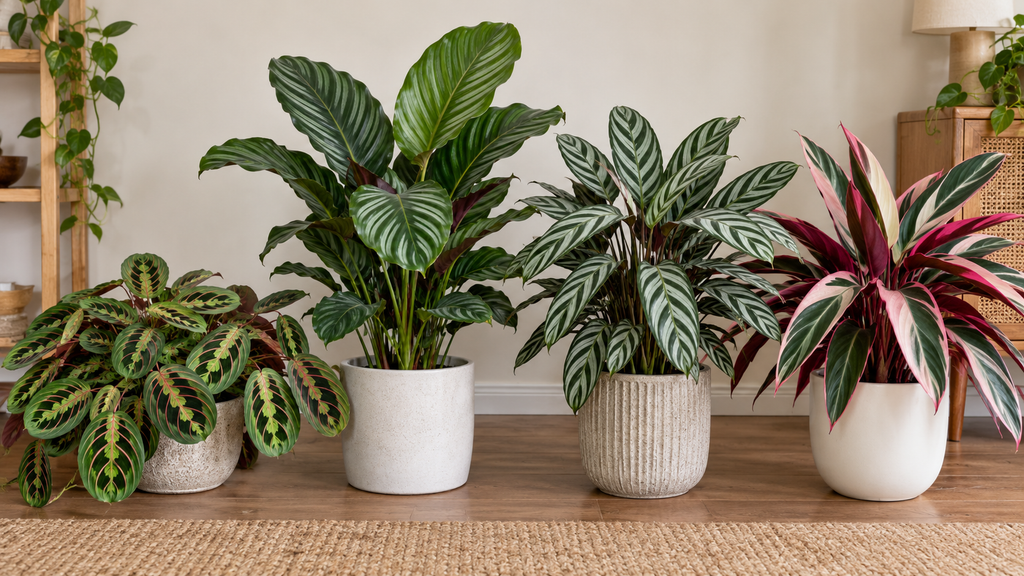
Several attractive houseplants are grouped with prayer plants even though they are not true Marantas.
Goeppertia and Calathea
Many plants historically sold as Calathea are now classified in the genus Goeppertia.
These plants usually grow more upright than Maranta and are often chosen for large statement foliage.
Orbifolia
Orbifolia has large rounded leaves marked with broad silver-green bands.
Its leaves are much larger and more upright than those of a typical spreading Maranta.
Choose it if you want a prayer plant relative with bold silver foliage and a more substantial appearance.
Peacock Plant
Peacock plants are known for decorative feather-like foliage patterns.
Their markings create a dramatic display even without flowers, making them popular for indoor foliage collections.
Rattlesnake Plant
The Rattlesnake Plant has long, narrow, wavy leaves with darker green markings.
Its elongated foliage gives it a very different appearance from the broader oval leaves found on many Marantas.
Pinstripe Plant
Pinstripe types usually have dark foliage marked by fine pale or pinkish stripes.
Their growth is typically more upright than Maranta.
Ctenanthe
Ctenanthe plants commonly display striped or fishbone-style patterns.
Depending on the type, they may grow upright or spread outward.
They are a good alternative if you like Maranta-style patterning but want a slightly different shape or growth habit.
Stromanthe
Stromanthe is especially popular for highly colorful foliage.
Triostar-type plants can combine green, cream, pale pink, burgundy, and deeper pink undersides.
Choose Stromanthe if pink and cream variegation matters more to you than the classic red-veined Maranta appearance.
In simple terms, choose Maranta for low spreading growth, Goeppertia for larger upright foliage, Ctenanthe for striped or fishbone patterns, and Stromanthe for pink-green variegation.
Are Rare Maranta Varieties Really Rare?
Not always.
The word “rare” is frequently used as a commercial description and does not always represent permanent botanical rarity.
A Maranta may be difficult to find in one region but readily available somewhere else. Availability can also change when commercial growers begin producing larger numbers of a cultivar.
A Maranta may genuinely be less common because of limited regional supply, unusual stable variegation, low propagation numbers, or high collector demand.
Variegated types may show white, cream, pale yellow, or mint-colored sections.
If you are considering an expensive variegated plant, look for the unusual pattern on several leaves and preferably on new growth as well.
Before paying a premium, check the exact cultivar name, whether you are buying a rooted plant or cutting, the health of the roots and foliage, repeated leaf characteristics, and regional availability.
A high price by itself does not prove rarity.
For a beginner, a healthy common Maranta is usually a better starting point than an expensive collector plant.
Which Prayer Plant Type Is Best for Your Home?
The best prayer plant is not automatically the rarest or most colorful one.
It is the plant that suits the conditions in your home.
| Your Situation | Better Choice |
|---|---|
| Small shelf | Compact Maranta |
| Hanging basket | Spreading Maranta |
| Large display area | Goeppertia or Stromanthe |
| Want red veins | Red Prayer Plant |
| Want bright green patterns | Lemon Lime |
| Want large silver leaves | Orbifolia |
| Want pink and cream leaves | Stromanthe |
| Very dry room | Improve humidity first |
| Strong direct sun | Filter the light first |
| Frequently forget watering | Consider a more drought-tolerant plant |
Before choosing a variety, think about where the plant will sit, how much indirect light reaches that location, whether direct sun touches the leaves, how quickly potting mix dries there, and how much mature space the plant will have.
Choosing according to growing conditions usually gives better results than buying only for leaf color.
How to Care for a Prayer Plant Indoors
Prayer plant care is mainly about balancing light, moisture, drainage, warmth, and humidity.
Light
Bright indirect or filtered light is best for most prayer plants.
Prolonged harsh sunlight can fade patterns, bleach foliage, scorch leaves, or create dry damaged patches.
Very low light is also undesirable because growth may slow and foliage color can become less distinct.
A bright position near a window with filtered light is generally better than either a dark corner or strong direct afternoon sun.
Watering
Avoid watering on a fixed weekly schedule.
Instead, check the potting mix regularly and water when the upper layer begins to dry slightly.
Water thoroughly and allow excess moisture to drain from the container.
Do not leave the pot standing in water.
Prayer plants appreciate regular moisture, but continuously saturated soil can damage roots and encourage root problems.
Water Quality
If brown tips continue even when watering and humidity seem reasonable, water quality may be worth considering.
Filtered, rain, or distilled water can be tested if necessary.
However, do not assume water quality is automatically the problem. Inconsistent watering, dry air, excess fertilizer, or root stress may produce similar symptoms.
Humidity
Prayer plants generally appreciate moderate to high humidity.
A room humidifier can help in very dry indoor environments. Grouping tropical plants together may also improve the immediate environment around the foliage.
A bright bathroom can work well if it receives enough natural light.
Do not place the plant directly beside heating vents or strong air-conditioning because these can dry the leaves quickly.
Temperature
Keep prayer plants warm and protect them from sudden temperature changes.
Cold drafts, cold window glass, strong air-conditioning, and heating vents can all stress the plant.
Stable indoor conditions are usually more important than trying to maintain one exact temperature.
Soil and Drainage
Use a potting mix that retains some moisture while still draining well.
The container should have drainage holes so excess water can escape.
The aim is evenly moist soil with enough air around the roots, not permanently wet soil.
Fertilizer
Feed lightly during active growth.
Avoid excessive fertilizer because salt buildup can damage roots and contribute to brown leaf tips or edges.
More fertilizer does not necessarily produce better foliage.
Repotting
Repot when the roots become crowded, drainage becomes poor, the potting medium deteriorates, or the plant clearly outgrows its container.
Healthy established Marantas can also be divided when they develop several strong growing sections.
Where Should You Place a Prayer Plant?
The best location combines bright filtered light, stable warmth, and protection from harsh direct sunlight.
An east-facing room can work well because morning light is usually gentler.
South- or west-facing rooms can also be suitable if the plant sits farther from the glass or direct light is filtered with a curtain.
A bright bathroom can be a useful location because of higher humidity, but a dark windowless bathroom is not suitable simply because it feels humid.
Living rooms, bedrooms, offices, and kitchens can all work if there is enough indirect light.
The simplest placement rule is:
Use the brightest suitable location where the foliage is protected from prolonged harsh direct sunlight and strong drafts.
Why Do Prayer Plants Move at Night?
Prayer plants naturally change leaf position between day and night through a movement commonly called nyctinasty.
During daylight, the leaves usually remain more open and horizontal.
In the evening, many gradually rise into a more upright position.
As the leaves move, the reddish or purple undersides may become more visible.
Not every leaf moves by exactly the same amount. Movement can vary with leaf age, position on the plant, light exposure, hydration, and natural variation.
The important point is that leaves rising at night do not automatically mean the plant is thirsty.
Nighttime movement is normal behavior.
What Does a Prayer Plant Look Like at Night?
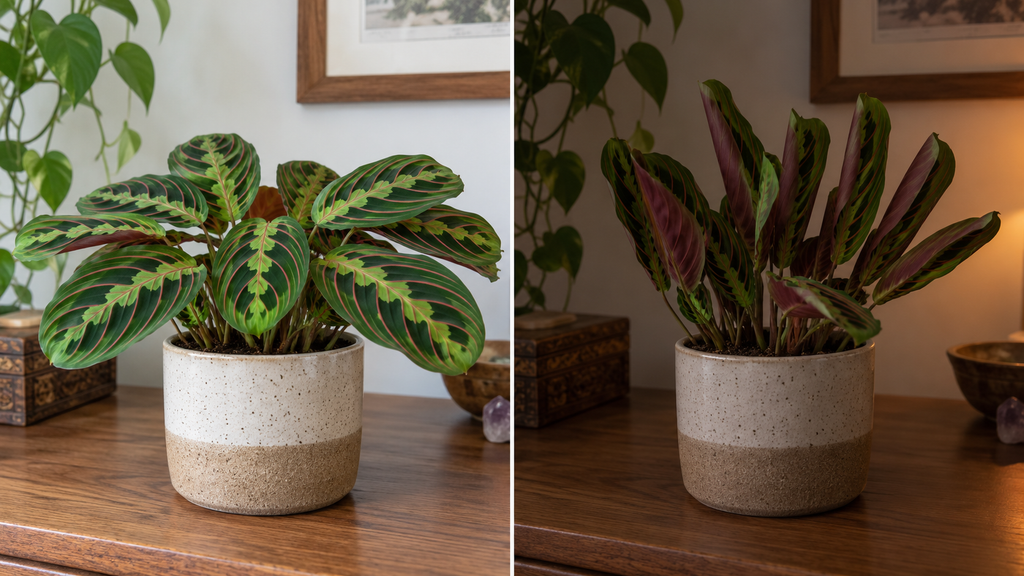
A healthy prayer plant often appears more upright and compact after dark.
During the morning, leaves begin opening. Through the day, they tend to sit flatter and spread outward. Around dusk, their angle starts changing, and during the night many stand noticeably more upright.
One useful way to understand this movement is to photograph the same plant from the same angle during daytime and again after dark.
If the leaves rise at night but remain firm and reopen the next day, the movement is generally normal.
Prayer Plant Movement vs Stress
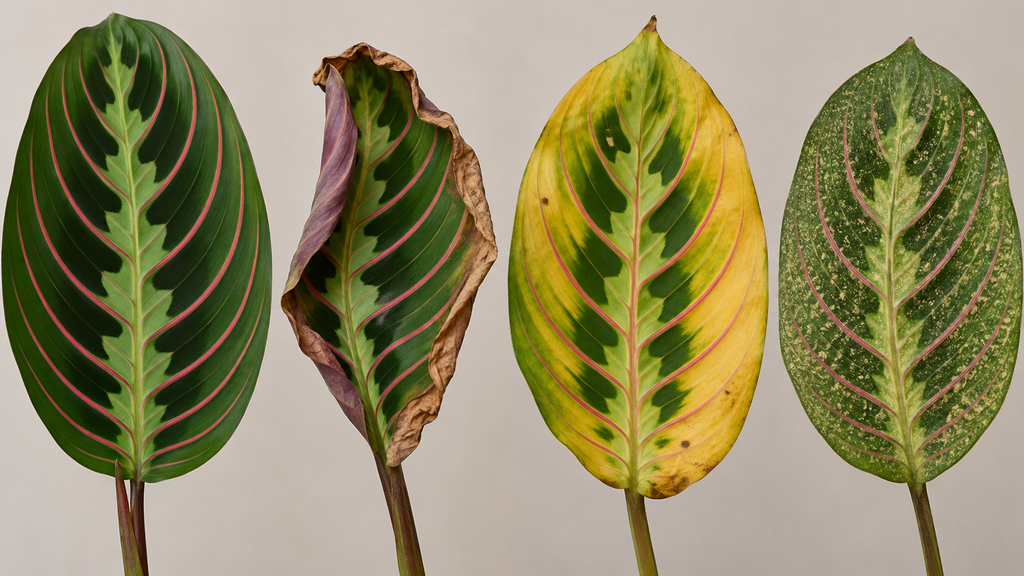
Normal prayer plant movement follows a repeated day-night pattern.
Stress usually remains visible for longer and is accompanied by additional symptoms.
| Observation | What It May Mean |
|---|---|
| Leaves rise at night and reopen during the day | Normal movement |
| Leaves remain firm while moving | Usually normal |
| Colored undersides become visible at night | Normal |
| Leaves remain limp during daylight | Check moisture and roots |
| Leaves curl tightly with crispy edges | Check water, humidity and light |
| Yellow leaves with wet soil | Check drainage and roots |
| Bleached foliage | Check direct sunlight |
| Fine webbing or stippling | Inspect for spider mites |
Before making major changes, observe the plant for a full day.
Check the soil, inspect the roots if necessary, look under the leaves for pests, and compare the plant’s appearance the following morning.
This can prevent unnecessary watering or relocation caused by mistaking normal leaf movement for stress.
5 Prayer Plant Checks Before Changing Care
If your prayer plant starts looking unhealthy, avoid changing several things at once.
Use this simple troubleshooting process.
1. Check the Soil
Determine whether the potting mix is dry, lightly moist, or saturated.
This immediately tells you whether watering could be involved.
2. Check the Roots
Look for poor drainage, mushy roots, unpleasant odor, or severe crowding.
Root problems often create symptoms above the soil that can be mistaken for simple watering issues.
3. Check the Light
Consider whether the plant recently received more direct sun or less light because of seasonal changes, curtains, or relocation.
4. Check the Air
Look for strong air-conditioning, heating vents, cold drafts, or unusually dry conditions.
5. Check for Pests
Inspect leaf undersides, stems, new growth, leaf joints, and nearby plants.
A useful troubleshooting sequence is:
Symptom → Check → Likely Cause → Targeted Fix
This is much more useful than changing water, fertilizer, humidity, and placement at the same time.
When Not to Choose a Prayer Plant
Prayer plants are not ideal for every growing situation.
Consider another houseplant if your only location receives intense direct sun, the room stays very dark, cold drafts are constant, or you regularly leave plants dry for long periods.
They are also a poor match if your pots cannot drain properly or if you specifically want a highly drought-tolerant plant.
Prayer plants work best when you can provide bright indirect light, warm indoor conditions, drainage, and regular moisture checks.
If those conditions are difficult to maintain, another houseplant may be easier.
Prayer Plant Types FAQs
Are there different kinds of prayer plants?
Yes. Maranta leuconeura is the classic prayer plant, while Goeppertia/Calathea, Ctenanthe, and Stromanthe are closely related Marantaceae plants that are often grouped under the same common name.
What are the most common prayer plant types?
Popular Marantas include Red Prayer Plant, Rabbit’s Foot, Lemon Lime, Fascinator or Tricolor, Silver Band, and darker Massangeana-type forms.
Is Maranta the same as Calathea?
No. Maranta and Calathea are related plants but belong to different genera. Many former Calatheas are now classified under Goeppertia.
Which prayer plant is best for beginners?
A healthy common Maranta such as Red Prayer Plant, Rabbit’s Foot, or Lemon Lime is usually a practical starting choice.
Can prayer plants grow in low light?
They may tolerate lower light, but bright indirect light generally supports stronger growth and better foliage color.
Can prayer plants grow in hanging baskets?
Yes. Maranta’s naturally spreading growth habit makes it well suited to hanging baskets and high shelves.
Why does a prayer plant fold at night?
The leaves naturally change position between day and night through rhythmic movement commonly called nyctinasty.
How long do prayer plants live?
Prayer plants are perennials and can live for many years indoors when their roots remain healthy and they receive suitable light, moisture, warmth, and drainage.
Why does my prayer plant have brown tips?
Possible causes include dry air, inconsistent watering, fertilizer salts, water quality, or root stress. Check the overall growing conditions before assuming one specific cause.
Are rare Maranta varieties actually rare?
Sometimes, but not always. Availability can vary by country and change quickly as commercial propagation increases.
Do prayer plants flower?
Yes. Maranta leuconeura can produce small flowers, although its patterned foliage is normally the main reason it is grown indoors.
Are prayer plants safe for cats and dogs?
Because the common name “prayer plant” can be used for different members of the Marantaceae family, confirm the exact botanical identity of your plant rather than relying only on the common name.
Which Prayer Plant Type Should You Choose?
Choose a Red Prayer Plant for classic red veins, Rabbit’s Foot for dark paired markings, Lemon Lime for bright green contrast, and Silver Band for a pale central leaf pattern.
Choose an Orbifolia-type Goeppertia if you want larger upright silver foliage.
Choose Ctenanthe for striped or fishbone-style patterns and Stromanthe when pink, cream, and green variegation is your priority.
For most beginners, a healthy common Maranta is the easiest place to start.
The best decision rule is simple:
Identify the plant first, match it to your home second, and choose the variety third.

Myra is the founder and lead writer of Plantsaholic. She shares practical, research-backed advice on indoor plants, outdoor gardening, flowers, herbs, succulents, and everyday plant care. Her goal is to help gardeners of all experience levels grow healthier plants through simple, easy-to-follow gardening guides.